
. It is one of the most prestigious in the world due to the variety of old and well-preserved aircraft.
The collection was founded in 1928 by aviator Richard Ormonde Shuttleworth. While flying a
at night on 2 August 1940, Shuttleworth fatally crashed. His mother, in 1944, formed the Richard Ormonde Shuttleworth Remembrance Trust "for the teaching of the science and practice of aviation and of afforestation and agriculture."
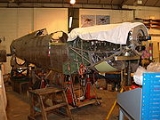
Restoration and maintenance work is carried out by a staff of nine full-time and many volunteer engineers. These volunteers are all members of the 3,000-strong Shuttleworth Veteran Aeroplane Society (SVAS). These dedicated enthusiasts are crucial to the preservation and restoration of the collection.
In addition to the aircraft, the collection houses a number of vintage and veteran cars. Events include model-flying days, and once a year, there is a special flying day for schools in the area.
The Shuttleworth Collection puts an emphasis on restoring as many aircraft as possible to flying condition, inline with the founder's original intention. There are typically about twelve air shows per year, including evening displays, which offer the opportunity to see aircraft which in many cases are the last of their type to survive, let alone existing in flyable condition.
Some of the most notable aircraft in the collection are the five Edwardian aeroplanes, of which one is the oldest
aeroplane still in flying condition. What makes these exceptional is that they still fly (weather permitting). The oldest, with British civil registration G-AANG, is the
' aircraft and is the world's oldest airworthy aeroplane, the next oldest being, at only three weeks newer by date of manufacture, the
's own restored original Bleriot XI (Bleriot factory serial number 56, with civil registration N60094) in the United States.
Aircraft in the collection, data from
| Type | Date | Identity | Notes |
| ANEC II |
1924 |
G-EBJO |
|
| Avro 504K |
1918 |
G-ADEV |
Painted as H5199 |
| Roe IV Triplane -Bibliography:* Jackson, A.J. Avro Aircraft Since 1908 London: Putnam, 1965.* Taylor, M.J.H. Jane's Encyclopedia of Aviation London: Studio Editions, 1989, p.91* World Aircraft Information Files London: Bright Star. File 889, Sheet 92... |
1964 |
G-ARSG |
Replica |
| Avro Tutor |
1933 |
G-AHSA |
Painted as RAF K3241 |
Avro Nineteen (Anson)The Avro Anson is a British twin-engine, multi-role aircraft that served with the Royal Air Force, Fleet Air Arm and numerous other air forces prior to, during, and after the Second World War. Named for British Admiral George Anson, it was originally designed for maritime reconnaissance, but was... |
1946 |
G-AHKX |
Owned by BAE Systems |
| Blackburn Type D |
1912 |
G-AANI |
Oldest airworthy British aeroplane |
Bleriot XIThe Blériot XI is the aircraft in which, on 25 July 1909, Louis Blériot made the first flight across the English Channel made in a heavier-than-air aircraft . This achievement is one of the most famous accomplishments of the early years of aviation, and not only won Blériot a lasting place in... |
1909 |
G-AANG |
Oldest airworthy aircraft |
| Bristol Boxkite -Military operators:* Australian Flying Corps** Central Flying School AFC at Point Cook, Victoria.* Union Defence Forces - South African Air Force Kingdom of Spain* Royal Flying Corps* Royal Naval Air Service** No. 3 Squadron RFC-References:... |
1964 |
G-ASPP |
Replica |
Bristol F.2b FighterThe Bristol F.2 Fighter was a British two-seat biplane fighter and reconnaissance aircraft of the First World War flown by the Royal Flying Corps. It is often simply called the Bristol Fighter or popularly the "Brisfit" or "Biff". Despite being a two-seater, the F.2B proved to be an agile aircraft... |
1918 |
G-AEPH |
Painted as RAF D8096 |
| Bristol M.1C |
1981 |
G-BWJM |
Replica painted as RFC C4918 |
CASA 1.131E Jungmann|-See also:-References:NotesBibliography* Bridgeman, Leonard. “The Bücker Bü 131B “Jungmann”.” Jane's Fighting Aircraft of World War II. London: Studio, 1946. ISBN 1-85170-493-0.... |
1967 |
G-RETA |
Painted as Luftwaffe Luftwaffe is a generic German term for an air force. It is also the official name for two of the four historic German air forces, the Wehrmacht air arm founded in 1935 and disbanded in 1946; and the current Bundeswehr air arm founded in 1956.... GD+EG |
| Comper Swift -See also:-References:*Boughton, Terence. 1963. The Story of The British Light Aeroplane. John Murray*Meaden, Jack & Fillmore, Malcolm. . The Comper Lightplanes. Air-Britain Archive . Air-Britain. ISSN 02624923... |
1932 |
G-ACTF |
|
| de Havilland DH.51 |
1924 |
G-EBIR |
Miss Kenya |
| de Havilland DH.53 Humming Bird |-See also:-External links:*... |
1923 |
G-EBHX |
|
| de Havilland DH.60 Cirrus Moth |
1925 |
G-EBLV |
Owned by BAE Systems |
| de Havilland DH.60X Hermes Moth |
1928 |
G-EBWD |
|
de Havilland DH.82A Tiger Moth IIThe de Havilland DH 82 Tiger Moth is a 1930s biplane designed by Geoffrey de Havilland and was operated by the Royal Air Force and others as a primary trainer. The Tiger Moth remained in service with the RAF until replaced by the de Havilland Chipmunk in 1952, when many of the surplus aircraft... |
1942 |
G-ANKT |
Painted as RAF K2585 |
de Havilland DH.88 CometThe de Havilland DH.88 Comet was a twin-engined British aircraft that won the 1934 MacRobertson Air Race, a challenge for which it was specifically designed... |
1934 |
G-ACSS |
Grosvenor House |
De Havilland Canada DHC-1 Chipmunk 22The de Havilland Canada DHC-1 Chipmunk is a tandem, two-seat, single-engined primary trainer aircraft which was the standard primary trainer for the Royal Canadian Air Force, Royal Air Force and several other air forces through much of the post-Second World War years... |
1952 |
G-BNZC |
Painted as RCAF 671 |
| Deperdussin Type A Monoplane |
1910 |
G-AANH |
|
| Desoutter I -Bibliography:* Kalevi Keskinen, Kari Stenman: Koulukoneet - Suomen ilmavoimien historia 22, Itä-Uudenmaan paino, Loviisa, 2003, ISBN 951-98751-5-8* Tervonen, Ismo: Veljekset Karhumäki Suomen ilmailun pioneereina 1924-1956, Apali Oy, ISBN 952-5026-25-6.... |
1930 |
G-AAPZ |
|
| English Electric Wren -External links:*... |
1923 |
G-EBNV |
|
Gloster GladiatorThe Gloster Gladiator was a British-built biplane fighter. It was used by the Royal Air Force and the Royal Navy and was exported to a number of other air forces during the late 1930s. It was the RAF's last biplane fighter aircraft and was rendered obsolete by newer monoplane designs even as it... |
1937 |
G-AMRK |
Painted as RAF K7985 |
| Granger Archaeopteryx -Bibliography:* Guttery, T.E. The Shuttleworth Collection. London: Wm. Carling & Co, 1969. SBN 901319-01-5* Jackson, A.J. British Civil Aircraft since 1919 . London, Putnam, 1974. ISBN 0 370 10010 7... |
1932 |
G-ABXL |
Under restoration off site |
| Hawker Cygnet -See also:-Bibliography:*Mason, Francis K. Hawker Aircraft since 1920. London:Putnam, 1991.ISBN 0 85177 839 9.-External links:*... |
1992 |
G-CAMM |
Replica |
| Hawker Hind -See also:-Bibliography:* Crawford, Alex. Hawker Hart Family. Redbourn, Hertfordshire, UK: Mushroom Model Publications Ltd., 2008. ISBN 83-89450-62-3.... |
1935 |
G-AENP |
Painted as RAF K5414 |
Hawker Sea Hurricane Mk.IbThe Hawker Hurricane is a British single-seat fighter aircraft that was designed and predominantly built by Hawker Aircraft Ltd for the Royal Air Force... |
1939 |
G-BKTH |
Painted as RN Z7015 |
| Hawker Tomtit -Bibliography:*Jackson, J.J. British Civil Aircraft 1919-72: Volume II. London: Putnam and Company, 1973. ISBN 0-85177-813-5* Mason, Francis K. Hawker Aircraft since 1920. London: Putnam & Company, 3rd revised edition 1991. ISBN 0-85177-839-9.... |
1931 |
G-AFTA |
Painted as RAF K1786 |
| Messerschmitt Me 163 The Messerschmitt Me 163 Komet, designed by Alexander Lippisch, was a German rocket-powered fighter aircraft. It is the only rocket-powered fighter aircraft ever to have been operational. Its design was revolutionary, and the Me 163 was capable of performance unrivaled at the time. Messerschmitt... |
|
191454 |
Fuselage mockup with original engine |
| Mignet HM.14 The Mignet HM.14 Flying Flea is a single-seat light aircraft first flown in 1933, designed for amateur construction. It was the first of a family of aircraft collectively known as Flying Fleas.... Flying Flea |
1939 |
G-AEBB |
|
| Miles Magister -See also:-References:NotesBibliography* Amos, Peter. Miles Aircraft = The early years. Tonbridge: Air-Britain, 2009. ISBN 978 0 85130 410 6... |
1939 |
G-AJRS |
Painted as RAF P6382 |
| Parnall Elf |-See also:-Bibliography:* Guttery, T.E. The Shuttleworth Collection. London: Wm. Carling & Co, 1969. SBN 901319-01-5* Ogilvy, David. Shuttleworth - The Historic Aeroplanes. Shrewsbury, England: Airlife Publishing Ltd., 1989 ISBN 1-85310-106-0... |
1932 |
G-AAIN |
|
Percival Prentice T1|-See also:-References:NotesBibliography* Ellison, Norman H. Percivals Aircraft . Chalford, Stroud, UK: Chalford Publishing Company, 1997. ISBN 0-7524-0774-0.... |
1949 |
G-AOKL |
|
Percival Provost T1|-See also:-References:NotesBibliography* Angelucci, Enzo. World Encyclopedia of Military Aircraft. London: Jane's Publishing, 1981. ISBN 0-7106-0148-4.... |
1955 |
G-KAPW |
Painted as RAF XF603 |
Polikarpov Po-2The Polikarpov Po-2 served as a general-purpose Soviet biplane, nicknamed Kukuruznik for maize; thus, 'maize duster' or 'crop duster'), NATO reporting name "Mule"... |
1924 |
G-BSSY |
Painted as Soviet Air Force 28 |
RAF SE.5AThe Royal Aircraft Factory S.E.5 was a British biplane fighter aircraft of the First World War. Although the first examples reached the Western Front before the Sopwith Camel and it had a much better overall performance, problems with its Hispano-Suiza engine, particularly the geared-output H-S... |
1918 |
G-EBIA |
Painted as RFC F904 |
| Slingsby Grasshopper TX.1 |-See also:-Bibliography:* Hardy, Michael. Gliders & Sailplanes of the World. London: Ian Allen, 1982. ISBN 0-7110-1152-4.... |
|
XA241 |
Display only |
Sopwith CamelThe Sopwith Camel was a British First World War single-seat biplane fighter introduced on the Western Front in 1917. Manufactured by Sopwith Aviation Company, it had a short-coupled fuselage, heavy, powerful rotary engine, and concentrated fire from twin synchronized machine guns. Though difficult... |
2001 |
G-BZSC |
Replica (under construction off site) |
Sopwith PupThe Sopwith Pup was a British single seater biplane fighter aircraft built by the Sopwith Aviation Company. It entered service with the Royal Flying Corps and the Royal Naval Air Service in the autumn of 1916. With pleasant flying characteristics and good maneuverability, the aircraft proved very... |
1920 |
G-EBKY |
Painted as RFC 9917 |
| Sopwith Triplane The Sopwith Triplane was a British single seat fighter aircraft designed and manufactured by the Sopwith Aviation Company during the First World War. Pilots nicknamed it the Tripehound or simply the Tripe. The Triplane became operational with the Royal Naval Air Service in early 1917 and was... |
1980 |
G-BOCK |
Replica painted as RNAS N6290 |
Southern Martlet-External links:** in Flight magazine 1930... |
1930 |
G-AAYX |
|
| Supermarine Spitfire LF.Mk.Vc The Supermarine Spitfire is a British single-seat fighter aircraft that was used by the Royal Air Force and many other Allied countries throughout the Second World War. The Spitfire continued to be used as a front line fighter and in secondary roles into the 1950s... |
1942 |
G-AWII |
Painted as RAF AR501 |
Westland Lysander Mk.IIIaThe Westland Lysander was a British army co-operation and liaison aircraft produced by Westland Aircraft used immediately before and during the Second World War... |
1942 |
G-AZWT |
Painted as RAF V9367 |