
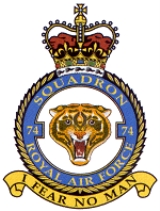
No. 74 Squadron RAF, also known as a "Tiger Squadron" from its tiger head motif, is a
squadronA squadron in air force, army aviation or naval aviation is mainly a unit comprising a number of military aircraft, usually of the same type, typically with 12 to 24 aircraft, sometimes divided into three or four flights, depending on aircraft type and air force...
of the
Royal Air ForceThe Royal Air Force is the aerial warfare service branch of the British Armed Forces. Formed on 1 April 1918, it is the oldest independent air force in the world...
. It operated fighter aircraft from 1917 to the 1990s.
First World War
The squadron was first formed at London Colney on 1 July 1917. No. 74 Squadron was a training unit flying Avro 504Ks.
Its first operational fighters were
S.E.5AThe Royal Aircraft Factory S.E.5 was a British biplane fighter aircraft of the First World War. Although the first examples reached the Western Front before the Sopwith Camel and it had a much better overall performance, problems with its Hispano-Suiza engine, particularly the geared-output H-S...
s in March 1918. The squadron served in France from April until February 1919, when it returned to Britain where it was disbanded on 3 July 1919.
During its wartime service, it was credited with 140 enemy planes destroyed and 85 driven down out of control, for 225 victories. Seventeen aces had served in the squadron, including
Victoria CrossThe Victoria Cross is the highest military decoration awarded for valour "in the face of the enemy" to members of the armed forces of various Commonwealth countries, and previous British Empire territories....
winner Major
Edward MannockMajor Edward Corringham "Mick" Mannock VC, DSO and Two Bars, MC & Bar was a British First World War flying ace. Mannock was probably born in Ireland, though of English and Scottish parentage....
,
Ira "Taffy" JonesJames Ira Thomas "Taffy" Jones DSO, MC, DFC & Bar, MM was a British flying ace during the First World War. Jones was born on 18 April 1896 at Woolstone Farm, near St. Clears, Carmarthenshire. In 1913, Jones enlisted in the Territorial Army, though he was soon transferred into the newly established...
,
Benjamin Roxburgh-SmithBenjamin Roxburgh-Smith DFC & Bar was a World War I fighter ace credited with 22 victories. After the war, he pioneered aviation in southern Africa. He also served in World War II.-Early life and service:...
,
future
Air CommodoreAir commodore is an air-officer rank which originated in and continues to be used by the Royal Air Force...
Keith CaldwellAir Commodore Keith Logan "Grid" Caldwell CBE, MC, DFC & Bar was a New Zealand fighter ace of the Royal Flying Corps in World War I who also rose to the rank of Air Commodore in the Royal New Zealand Air Force during World War II.-Early life:Born in Wellington, the son of David Robert Caldwell and...
,
Andrew KiddieCaptain Andrew Cameron Kiddie was a World War I flying ace credited with 15 aerial victories.As the last British Army veterans of World War I died in 2009 he must now be deceased.-Early service:...
,
Frederick Gordon,
Sydney Carlin,
Frederick Hunt,
Clive Glynn,
George HicksLieutenant George Rensbury Hicks was a World War I flying ace credited with eight aerial victories.-Reference:...
,
Wilfred Ernest YoungMajor Wilfred Ernest Young was an English World War I flying ace credited with 11 confirmed aerial victories.- World War I :Wilfred Ernest Young began his military service in the Dorsetshire Regiment of the British army. On 13 June 1916, Young was seconded from the Dorsetshires to the Royal Flying...
,
Henry Dolan,
Harris Clements,
George W. G. Gauld, and
Frederick Luff.
Interwar years
During the Abyssian crisis of 1935 the squadron was reformed in September to operate out of
MaltaMalta , officially known as the Republic of Malta , is a Southern European country consisting of an archipelago situated in the centre of the Mediterranean, south of Sicily, east of Tunisia and north of Libya, with Gibraltar to the west and Alexandria to the east.Malta covers just over in...
with Hawker Demon two-seater fighters. In July the following year, the Squadron, with its Demons, was shipped back to England. It re-equipped with
Gloster Gauntlet-See also:-References:NotesBibliography* Crawford, Alex. Bristol Bulldog, Gloster Gauntlet. Redbourn, UK: Mushroom Model Publications, 2005. ISBN 83-89450-04-6....
s in April 1937 at
HornchurchHornchurch is a large suburban town in England, and part of the London Borough of Havering. Hornchurch is in North-East London .It is located east-northeast of Charing Cross and is one of the locally important district centres identified in the London Plan. It comprises a number of shopping...
, and formed part of the newly created Fighter Command. The Gauntlets were exchanged for the
Supermarine SpitfireThe Supermarine Spitfire is a British single-seat fighter aircraft that was used by the Royal Air Force and many other Allied countries throughout the Second World War. The Spitfire continued to be used as a front line fighter and in secondary roles into the 1950s...
Mk.I in Feb 1939.
World War II
On 6 September 1939, after an early morning air raid alert, a flight of
No. 56 SquadronNumber 56 Squadron is one of the oldest and most successful squadrons of the Royal Air Force, with battle honours from many of the significant air campaigns of both World War I and World War II...
Hawker HurricaneThe Hawker Hurricane is a British single-seat fighter aircraft that was designed and predominantly built by Hawker Aircraft Ltd for the Royal Air Force...
s took off from North Weald. These were followed by two reserve Hurricanes.
The two reserves were identified as enemy aircraft and Spitfires from Hornchurch, among them 74 Squadron, were ordered to attack them. Both were shot down.
One pilot, P/O Montague Hulton-Harrop was killed; the other pilot, Frank Rose, survived. The pilot who fired the fatal shot was 74 Squadron's John Freeborn.
The exact story of what happened in this incident, which came to be known as the "
Battle of Barking CreekThe Battle of Barking Creek was a friendly fire incident that happened on 6 September 1939, resulting in the first death of a British fighter pilot in the Second World War.-Incident:...
" may never be known. Even the origin of the name is obscure, as it did not take place above Barking Creek, but near Ipswich, in Suffolk. This was the first RAF operational death of the war.
At the subsequent courts martial, the courts accepted that the entire incident was an unfortunate error.
The Squadron, as part of No 12 Group, first saw combat during the evacuation from Dunkirk. These battles extracted a heavy toll on both pilots and aircraft. Thereafter they served successfully through the
Battle of BritainThe Battle of Britain is the name given to the World War II air campaign waged by the German Air Force against the United Kingdom during the summer and autumn of 1940...
. Mark Is were replaced with Mark IIa Spitfires in September 1940 at
RAF ColtishallThe former Royal Air Force Station Coltishall, more commonly known as RAF Coltishall , was a Royal Air Force station, a military airbase, North-North-East of Norwich, in the English county of Norfolk, East Anglia, from 1938 to 2006....
. The squadron moved back south to RAF Biggin Hill in October for the end of the
Battle of BritainThe Battle of Britain is the name given to the World War II air campaign waged by the German Air Force against the United Kingdom during the summer and autumn of 1940...
. The Squadron went to the north of England in July 1941 to regroup, from there moving around to stations in Wales and Northern Ireland until it was sent, without aircraft, to the Middle East in April 1942. Shortly after moving to the Middle East in April 1942. In June they arrived in Egypt. The squadron was moved to Palestine to operate as a maintenance unit for USAAF B-24 Liberators. The squadron received Hurricane IIBs in December 1942 and served in Iran until May 1943, moving back to Egypt for shipping patrols and conversion to the Spitfire Mk.Vb and Mk. Vc in September 1943. In late October 1943 the squadron got Mk.IX Spitfires, which were swapped for Mk. XVIs in March. No 74 returned home just in time to take part in the D-Day landings in June 1944, using its aircraft as fighter-bombers supporting the Allied liberation of France, Belgium and the Netherlands.
Post war
Scarcely three days later the Squadron was sent back to England to equip with jets - initially the
Gloster MeteorThe Gloster Meteor was the first British jet fighter and the Allies' first operational jet. It first flew in 1943 and commenced operations on 27 July 1944 with 616 Squadron of the Royal Air Force...
F.4. Based at RAF Horsham St Faith, the squadron kept Meteors until 1957, latterly equipped with the improved Meteor F.8, when they were issued with a more modern fighter type, the
Hawker HunterThe Hawker Hunter is a subsonic British jet aircraft developed in the 1950s. The single-seat Hunter entered service as a manoeuvrable fighter aircraft, and later operated in fighter-bomber and reconnaissance roles in numerous conflicts. Two-seat variants remained in use for training and secondary...
.
In June 1959 the squadron moved to RAF Coltishall for re-equipment with the
English Electric LightningThe English Electric Lightning is a supersonic jet fighter aircraft of the Cold War era, noted for its great speed and unpainted natural metal exterior finish. It is the only all-British Mach 2 fighter aircraft. The aircraft was renowned for its capabilities as an interceptor; Royal Air Force ...
F.1 in mid 1960. In 1964 they moved to
RAF LeucharsRAF Leuchars is the most northerly air defence station in the United Kingdom. It is located in Leuchars, Fife, on the east coast of Scotland, near to the university town of St Andrews.-Operations:...
to get F.Mk.3 then F.Mk.6 Lightnings in 1966. The Squadron moved to RAF Tengah in Singapore, where it operated alongside
20 SquadronNo. 20 Squadron of the Royal Air Force was until March 2010, the OCU for the BAE Harrier GR9, and T12, operating from RAF Wittering...
which flew Hunters, and
81 SquadronNo 81 Squadron was a squadron of the Royal Air Force. It flew Fighter aircraft during the Second World War, and reconnaissance aircraft in the Far East after the war, but was disbanded in 1970.-First World War:No...
which flew Canberra PR-9s. The Squadron flew its
EE Lightning F6sThe English Electric Lightning is a supersonic jet fighter aircraft of the Cold War era, noted for its great speed and unpainted natural metal exterior finish. It is the only all-British Mach 2 fighter aircraft. The aircraft was renowned for its capabilities as an interceptor; Royal Air Force ...
to
RAF AkrotiriRoyal Air Force Station Akrotiri, more commonly known as RAF Akrotiri , is a large Royal Air Force station, on the Mediterranean island of Cyprus. It is located in the Western Sovereign Base Area, one of two areas which comprise Akrotiri and Dhekelia, a British Overseas Territory, administered as a...
,
CyprusCyprus , officially the Republic of Cyprus , is a Eurasian island country, member of the European Union, in the Eastern Mediterranean, east of Greece, south of Turkey, west of Syria and north of Egypt. It is the third largest island in the Mediterranean Sea.The earliest known human activity on the...
to hand them over to
56 SquadronNumber 56 Squadron is one of the oldest and most successful squadrons of the Royal Air Force, with battle honours from many of the significant air campaigns of both World War I and World War II...
and disbandment on 31 August 1971.
The squadron was reformed at
RAF WattishamRAF Wattisham was a Royal Air Force station located in East Anglia just outside the village of Wattisham, south of Stowmarket in Suffolk, England. During the Cold War it was a major front-line air force base...
in October 1984, with ex-US Navy/Marine
F-4JThe McDonnell Douglas F-4 Phantom II is a tandem two-seat, twin-engined, all-weather, long-range supersonic jet interceptor fighter/fighter-bomber originally developed for the United States Navy by McDonnell Aircraft. It first entered service in 1960 with the U.S. Navy. Proving highly adaptable,...
s (designated as the F-4J(UK) in RAF service) that were purchased by the RAF as a stop gap measure to replace those of
23 SqnNo. 23 Squadron was a squadron of the Royal Air Force. Until October 2009, it operated the Boeing Sentry AEW1 Airborne Warning And Control System aircraft from RAF Waddington, Lincolnshire.-First World War:...
that had been sent to the
FalklandsThe Falkland Islands are an archipelago in the South Atlantic Ocean, located about from the coast of mainland South America. The archipelago consists of East Falkland, West Falkland and 776 lesser islands. The capital, Stanley, is on East Falkland...
after the war. 74 Sqn gave up their
F-4J PhantomsThe McDonnell Douglas F-4 Phantom II is a tandem two-seat, twin-engined, all-weather, long-range supersonic jet interceptor fighter/fighter-bomber originally developed for the United States Navy by McDonnell Aircraft. It first entered service in 1960 with the U.S. Navy. Proving highly adaptable,...
and received surplus
Phantom FGR.2sThe McDonnell Douglas F-4 Phantom II is a tandem two-seat, twin-engined, all-weather, long-range supersonic jet interceptor fighter/fighter-bomber originally developed for the United States Navy by McDonnell Aircraft. It first entered service in 1960 with the U.S. Navy. Proving highly adaptable,...
in January 1991, disbanding in October 1992 when
RAF WattishamRAF Wattisham was a Royal Air Force station located in East Anglia just outside the village of Wattisham, south of Stowmarket in Suffolk, England. During the Cold War it was a major front-line air force base...
began its transition to the Army Air Corps. On 5 October 1992, 74 (R) Squadron stood up with the British Aerospace Hawk as part of No 4 Flying Training School at
RAF ValleyRAF Valley is a Royal Air Force station on the island of Anglesey, Wales, and which is also used as Anglesey Airport. It provides fast-jet training using the BAE Hawk and provides training for aircrew working with Search and Rescue. Unofficially the motto for RAF Valley is 'One Valley, Training...
in the weapon instruction role. At the 1993 Tiger Meet, 74 Sqn won the coveted 'Silver Tiger' trophy while competing against Mirages and F-16's, as Flt Lt Will Jonas said "Not bad for a training unit eh?!"
With the rationalisation of 4 FTS to just two squadrons, 74(R) Sqn was disbanded on 22 September 2000.
In 2008, No.74 would have celebrated its 90th anniversary, however No. 74 (F) Squadron still lives on through the 74 (F) Tiger Squadron Association, which brings together former tigers from all generations for a yearly reunion dinner. Pending raising the necessary funds, plans are in place to create a museum dedicated to the Squadron's history at their former base of Horsham St Faith, now Norwich Airport.
Famous pilots
Famous pilots associated with the squadron:
- Keith Caldwell
Air Commodore Keith Logan "Grid" Caldwell CBE, MC, DFC & Bar was a New Zealand fighter ace of the Royal Flying Corps in World War I who also rose to the rank of Air Commodore in the Royal New Zealand Air Force during World War II.-Early life:Born in Wellington, the son of David Robert Caldwell and...
- A.G. "Sailor" Malan
Adolph Gysbert Malan DSO & Bar DFC & Bar , better known as Sailor Malan, was a famed South African World War II RAF fighter pilot who led No. 74 Squadron RAF during the height of the Battle of Britain. Malan was known for sending German bomber pilots home with dead crews as a warning to other...
-32 victories
- Edward Mannock
Major Edward Corringham "Mick" Mannock VC, DSO and Two Bars, MC & Bar was a British First World War flying ace. Mannock was probably born in Ireland, though of English and Scottish parentage....
-61 victories of which 35 were made with 74 Sqn.
- H.M.Stephen
- John Colin Mungo Park
74 Squadron Aircraft
- July 1917 to Mar 1918 - Avro 504K
- Mar 1918 to Feb 1919 - SE5a
- Sept 1935 to Apr 1937 - Hawker Demon
- Mar 1937 - Gloster Gladiator
The Gloster Gladiator was a British-built biplane fighter. It was used by the Royal Air Force and the Royal Navy and was exported to a number of other air forces during the late 1930s. It was the RAF's last biplane fighter aircraft and was rendered obsolete by newer monoplane designs even as it...
I
- Mar 1937 to Feb 1939 - Gloster Gauntlet
-See also:-References:NotesBibliography* Crawford, Alex. Bristol Bulldog, Gloster Gauntlet. Redbourn, UK: Mushroom Model Publications, 2005. ISBN 83-89450-04-6....
II
- 1939 - Hawker Hurricane
The Hawker Hurricane is a British single-seat fighter aircraft that was designed and predominantly built by Hawker Aircraft Ltd for the Royal Air Force...
I
- 1938 to 1940 - Miles Magister
-See also:-References:NotesBibliography* Amos, Peter. Miles Aircraft = The early years. Tonbridge: Air-Britain, 2009. ISBN 978 0 85130 410 6...
14A
- Feb 1939 - Supermarine Spitfire
The Supermarine Spitfire is a British single-seat fighter aircraft that was used by the Royal Air Force and many other Allied countries throughout the Second World War. The Spitfire continued to be used as a front line fighter and in secondary roles into the 1950s...
1 & Ia
- June 1940 to Dec 1941 - Supermarine Spitfire
The Supermarine Spitfire is a British single-seat fighter aircraft that was used by the Royal Air Force and many other Allied countries throughout the Second World War. The Spitfire continued to be used as a front line fighter and in secondary roles into the 1950s...
IIa & IIb
- May 1941 to March 1942 - Vickers-Supermarine Spitfire
The Supermarine Spitfire is a British single-seat fighter aircraft that was used by the Royal Air Force and many other Allied countries throughout the Second World War. The Spitfire continued to be used as a front line fighter and in secondary roles into the 1950s...
Vb
- Dec 1942 to Sept 1943 - Hawker Hurricane
The Hawker Hurricane is a British single-seat fighter aircraft that was designed and predominantly built by Hawker Aircraft Ltd for the Royal Air Force...
I, IIb, IIc
- Sept 1943 to Apr 1944 - Vickers
Vickers was a famous name in British engineering that existed through many companies from 1828 until 1999.-Early history:Vickers was formed in Sheffield as a steel foundry by the miller Edward Vickers and his father-in-law George Naylor in 1828. Naylor was a partner in the foundry Naylor &...
-Supermarine SpitfireThe Supermarine Spitfire is a British single-seat fighter aircraft that was used by the Royal Air Force and many other Allied countries throughout the Second World War. The Spitfire continued to be used as a front line fighter and in secondary roles into the 1950s...
Vb
- Sept 1943 to Apr 1944 - Vickers
Vickers was a famous name in British engineering that existed through many companies from 1828 until 1999.-Early history:Vickers was formed in Sheffield as a steel foundry by the miller Edward Vickers and his father-in-law George Naylor in 1828. Naylor was a partner in the foundry Naylor &...
-Supermarine SpitfireThe Supermarine Spitfire is a British single-seat fighter aircraft that was used by the Royal Air Force and many other Allied countries throughout the Second World War. The Spitfire continued to be used as a front line fighter and in secondary roles into the 1950s...
Vc
- Oct 1943 to Apr 1944 - Vickers
Vickers was a famous name in British engineering that existed through many companies from 1828 until 1999.-Early history:Vickers was formed in Sheffield as a steel foundry by the miller Edward Vickers and his father-in-law George Naylor in 1828. Naylor was a partner in the foundry Naylor &...
-Supermarine SpitfireThe Supermarine Spitfire is a British single-seat fighter aircraft that was used by the Royal Air Force and many other Allied countries throughout the Second World War. The Spitfire continued to be used as a front line fighter and in secondary roles into the 1950s...
IX
- Apr 1944 to Mar 1945 - Vickers
Vickers was a famous name in British engineering that existed through many companies from 1828 until 1999.-Early history:Vickers was formed in Sheffield as a steel foundry by the miller Edward Vickers and his father-in-law George Naylor in 1828. Naylor was a partner in the foundry Naylor &...
-Supermarine SpitfireThe Supermarine Spitfire is a British single-seat fighter aircraft that was used by the Royal Air Force and many other Allied countries throughout the Second World War. The Spitfire continued to be used as a front line fighter and in secondary roles into the 1950s...
LFIXe
- Mar 1945 to May 1945 - Vickers
Vickers was a famous name in British engineering that existed through many companies from 1828 until 1999.-Early history:Vickers was formed in Sheffield as a steel foundry by the miller Edward Vickers and his father-in-law George Naylor in 1828. Naylor was a partner in the foundry Naylor &...
-Supermarine SpitfireThe Supermarine Spitfire is a British single-seat fighter aircraft that was used by the Royal Air Force and many other Allied countries throughout the Second World War. The Spitfire continued to be used as a front line fighter and in secondary roles into the 1950s...
LF16e
- May 1945 to Mar 1948 - Gloster Meteor
The Gloster Meteor was the first British jet fighter and the Allies' first operational jet. It first flew in 1943 and commenced operations on 27 July 1944 with 616 Squadron of the Royal Air Force...
F.3
- Dec 1947 to Oct 1950 - Gloster Meteor
The Gloster Meteor was the first British jet fighter and the Allies' first operational jet. It first flew in 1943 and commenced operations on 27 July 1944 with 616 Squadron of the Royal Air Force...
F.4
- 1950 to 1957 - Gloster Meteor
The Gloster Meteor was the first British jet fighter and the Allies' first operational jet. It first flew in 1943 and commenced operations on 27 July 1944 with 616 Squadron of the Royal Air Force...
T.7
- Oct 1950 - Feb 1957 - Gloster Meteor
The Gloster Meteor was the first British jet fighter and the Allies' first operational jet. It first flew in 1943 and commenced operations on 27 July 1944 with 616 Squadron of the Royal Air Force...
F.8
- Mar 1957 to Jan 1958 - Hawker Hunter
The Hawker Hunter is a subsonic British jet aircraft developed in the 1950s. The single-seat Hunter entered service as a manoeuvrable fighter aircraft, and later operated in fighter-bomber and reconnaissance roles in numerous conflicts. Two-seat variants remained in use for training and secondary...
F.4
- Nov 1957 to 1960 - Hawker Hunter
The Hawker Hunter is a subsonic British jet aircraft developed in the 1950s. The single-seat Hunter entered service as a manoeuvrable fighter aircraft, and later operated in fighter-bomber and reconnaissance roles in numerous conflicts. Two-seat variants remained in use for training and secondary...
F.6
- 1959 to 1960 - Hawker Hunter
The Hawker Hunter is a subsonic British jet aircraft developed in the 1950s. The single-seat Hunter entered service as a manoeuvrable fighter aircraft, and later operated in fighter-bomber and reconnaissance roles in numerous conflicts. Two-seat variants remained in use for training and secondary...
T.7
- June 1960 to April 1964 - English Electric Lightning
The English Electric Lightning is a supersonic jet fighter aircraft of the Cold War era, noted for its great speed and unpainted natural metal exterior finish. It is the only all-British Mach 2 fighter aircraft. The aircraft was renowned for its capabilities as an interceptor; Royal Air Force ...
F.1 & F.1a
- Apr 1964 to Sept 1967 - English Electric Lightning
The English Electric Lightning is a supersonic jet fighter aircraft of the Cold War era, noted for its great speed and unpainted natural metal exterior finish. It is the only all-British Mach 2 fighter aircraft. The aircraft was renowned for its capabilities as an interceptor; Royal Air Force ...
F.3
- 1961 to 1967 - English Electric Lightning
The English Electric Lightning is a supersonic jet fighter aircraft of the Cold War era, noted for its great speed and unpainted natural metal exterior finish. It is the only all-British Mach 2 fighter aircraft. The aircraft was renowned for its capabilities as an interceptor; Royal Air Force ...
T.4
- Jun 1967 to Aug 1971 - English Electric Lightning
The English Electric Lightning is a supersonic jet fighter aircraft of the Cold War era, noted for its great speed and unpainted natural metal exterior finish. It is the only all-British Mach 2 fighter aircraft. The aircraft was renowned for its capabilities as an interceptor; Royal Air Force ...
T.5
- Jun 1967 to Aug 1971 - English Electric Lightning
The English Electric Lightning is a supersonic jet fighter aircraft of the Cold War era, noted for its great speed and unpainted natural metal exterior finish. It is the only all-British Mach 2 fighter aircraft. The aircraft was renowned for its capabilities as an interceptor; Royal Air Force ...
F.6
- Aug 1984 to Jan 1991 - McDonnell Douglas Phantom F-4J(UK)
- Jan 1991 to Oct 1992 - McDonnell Douglas Phantom FGR.2
- Oct 1992 to Sept 2000 - British Aerospace Hawk T.1/T.1A
External links