

Wolseley Motor Company

Encyclopedia
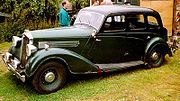
Automobile
An automobile, autocar, motor car or car is a wheeled motor vehicle used for transporting passengers, which also carries its own engine or motor...
manufacturer founded in 1901. After 1935 it was incorporated into larger companies but the Wolseley name remained as an upmarket marque until 1975.
History
The origins of the company as an automobile brand was in about 1895–96 when 30-year-old Herbert AustinHerbert Austin
Herbert 'Pa' Austin, 1st Baron Austin KBE was an English automobile designer and builder who founded the Austin Motor Company.-Background and early life:...
, then employed as a works manager at the Wolseley Sheep Shearing Company, became interested in engines and automobiles. During the winter of 1895–96 he made his own version of a design by Léon Bollée
Léon Bollée Automobiles
Léon Bollée Automobiles was a French company founded by Léon Bollée in Le Mans to build a first vehicle called "Voiturette".The Bollée family, all car makers, created three brands:* steam vehicles, Amédée Bollée , built between 1873 and 1885....
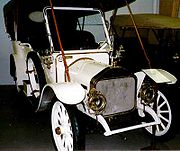
that he had seen in Paris. Later he found that another British group had bought the rights, therefore Austin had to come up with a design of his own. In 1897 the second Wolseley car, the Wolseley Autocar No. 1 was revealed. It was a three-wheeled design (one front, two rear) featuring independent rear suspension, mid-engine and back to back seating for two adults. It was not successful and although advertised for sale, none were sold. The third Wolseley car, the four-wheeled Wolseley "Voiturette" followed in 1899. A further four-wheeled car was made in 1900. The 1901 Wolseley Gasoline Carriage featured a steering wheel
Steering wheel
A steering wheel is a type of steering control in vehicles and vessels ....
instead of a tiller. The first Wolseley cars sold to the public were based on the "Voiturette", but production did not get under way until 1901, by which time the company had changed hands. In that year the automobile division was spun off (with financing from Vickers
Vickers
Vickers was a famous name in British engineering that existed through many companies from 1828 until 1999.-Early history:Vickers was formed in Sheffield as a steel foundry by the miller Edward Vickers and his father-in-law George Naylor in 1828. Naylor was a partner in the foundry Naylor &...
) as an independent concern in Adderley Park
Adderley Park
Adderley Park is an area in the east of Birmingham, England. Charles Adderley MP donated of land to create the park, which he managed privately from 1855 to 1864.It is served by Adderley Park railway station....
, Birmingham
Birmingham
Birmingham is a city and metropolitan borough in the West Midlands of England. It is the most populous British city outside the capital London, with a population of 1,036,900 , and lies at the heart of the West Midlands conurbation, the second most populous urban area in the United Kingdom with a...
. Austin managed the new Wolseley company for a short time before resigning to form his own concern, the Austin Motor Company
Austin Motor Company
The Austin Motor Company was a British manufacturer of automobiles. The company was founded in 1905 and merged in 1952 into the British Motor Corporation Ltd. The marque Austin was used until 1987...
, in 1905.
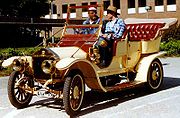
Wolseley purchased the Siddeley Autocar Company, with founder John Davenport Siddeley
John Davenport Siddeley, 1st Baron Kenilworth
John Davenport Siddeley, 1st Baron Kenilworth , was a captain of the automobile industry in the United Kingdom.-Career:...
in charge. Siddeley (later Baron Kenilworth
Baron Kenilworth
Baron Kenilworth, of Kenilworth in the County of Warwick, is a title in the Peerage of the United Kingdom. It was created in 1937 for the motor industry magnate Sir John Siddeley. His grandson, the third Baron, was an interior designer and the founder of John Siddeley International Ltd...
) took control of the merged concern, renaming the marque Wolseley-Siddeley until his resignation in 1910. He went on to manage the Deasy Motor Company, which became Siddeley-Deasy
Siddeley-Deasy
Siddeley-Deasy was a British automobile, engine and aircraft company based in Coventry in the early 20th century. It was central to the formation, by merger and buy-out, of the later Armstrong Sideleley Motor and Armstrong Whitworth Aircraft companies....
. This later merged with Armstrong-Whitworth to become Armstrong Siddeley
Armstrong Siddeley
Armstrong Siddeley was a British engineering group that operated during the first half of the 20th century. It was formed in 1919 and is best known for the production of luxury motor cars and aircraft engines.-Siddeley Autocars:...
. In 1912 they were commissioned by the Russian Count Peter P Schilovski, a lawyer and member of the Russian royal family, to build the Schilovski Gyrocar
Gyrocar
A gyrocar is a two-wheeled automobile. The difference between a bicycle or motorcycle and a gyrocar is that in a bike, dynamic balance is provided by the rider, and in some cases by the geometry and mass distribution of the bike itself...
.
Wolseley Motor Company
The company officially became the Wolseley Motor Company in 1914. It also began operations in Montreal and Toronto as Wolseley Motors Limited. This became British and American Motors after the First World War.In 1918, Wolseley began a joint venture in Tokyo, with Ishikawajiama Ship Building and Engineering. The first Japanese-built Wolseley car rolled off the line in 1922. After World War II
World War II
World War II, or the Second World War , was a global conflict lasting from 1939 to 1945, involving most of the world's nations—including all of the great powers—eventually forming two opposing military alliances: the Allies and the Axis...
the Japan venture is reorganized, renaming itself Isuzu Motors in 1949.
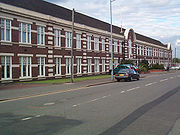
In 1919 Wolseley also took over the Ward End, Birmingham munitions factory from Vickers.
Wolseley grew quickly selling upmarket cars, and even opened a lavish showroom, Wolseley House, in Piccadilly
Piccadilly
Piccadilly is a major street in central London, running from Hyde Park Corner in the west to Piccadilly Circus in the east. It is completely within the city of Westminster. The street is part of the A4 road, London's second most important western artery. St...
(next to the Ritz Hotel, now housing a restaurant called The Wolseley). Finances were strained however, and the company faced receivership
Receivership
In law, receivership is the situation in which an institution or enterprise is being held by a receiver, a person "placed in the custodial responsibility for the property of others, including tangible and intangible assets and rights." The receivership remedy is an equitable remedy that emerged in...
in October, 1926 with debts of £2 million.
Nuffield
Wolseley was purchased personally by William Morris, 1st Viscount NuffieldWilliam Morris, 1st Viscount Nuffield
William Richard Morris, 1st Viscount Nuffield GBE, CH , known as Sir William Morris, Bt, between 1929 and 1934 and as The Lord Nuffield between 1934 and 1938, was a British motor manufacturer and philanthropist...
for £730,000 in February 1927 using his own money. Other bidders included General Motors and the Austin Motor Company
Austin Motor Company
The Austin Motor Company was a British manufacturer of automobiles. The company was founded in 1905 and merged in 1952 into the British Motor Corporation Ltd. The marque Austin was used until 1987...
. Morris renamed the company Wolseley Motors (1927) Ltd and consolidated its production at the sprawling Ward End
Ward End
Ward End is an area of Birmingham, England. It covers the area between Saltley, Hodge Hill and Stechford and includes Ward End Park, a public park that has been open for over 100 years.-Ward End territory:...
Works in Birmingham
Birmingham
Birmingham is a city and metropolitan borough in the West Midlands of England. It is the most populous British city outside the capital London, with a population of 1,036,900 , and lies at the heart of the West Midlands conurbation, the second most populous urban area in the United Kingdom with a...
. In 1935, Wolseley became a subsidiary of Morris' own Morris Motor Company
Morris Motor Company
The Morris Motor Company was a British car manufacturing company. After the incorporation of the company into larger corporations, the Morris name remained in use as a marque until 1984 when British Leyland's Austin Rover Group decided to concentrate on the more popular Austin marque...
and the Wolseley models soon became based on Morris designs. It became part of the Nuffield Organisation
Nuffield Organisation
The Nuffield Organisation was a vehicle manufacturing company in the United Kingdom. Named after its founder, William Morris, 1st Viscount Nuffield, it was formed in 1938 as the merger of Nuffield's Morris Motor Company , another of Nuffield's companies the MG Car Company and Riley.Morris Motors...
along with Morris and Riley/Autovia
Riley (automobile)
Riley was a British motorcar and bicycle manufacturer from 1890. The company became part of the Nuffield Organisation in 1938 and was later merged into British Leyland: late in 1969 British Leyland announced their discontinuance of Riley production, although 1969 was a difficult year for the UK...
in 1938.
After the war Morris and Wolseley production was consolidated at Cowley
Cowley, Oxford
Cowley in Oxford, England, is a residential and industrial area that forms a small conurbation within greater Oxford. Cowley's neighbours are central Oxford to the northwest, Rose Hill and Blackbird Leys to the south, New Headington to the north and the villages of Horspath and Garsington across...
, and badge engineering
Badge engineering
Badge engineering is an ironic term that describes the rebadging of one product as another...
took hold. The first post-war Wolseleys, the similar 4/50
Wolseley 4/50
The Wolseley 4/50 and similar 6/80 were Wolseley Motor Company's first post-war automobiles. They were rushed into production in 1948 and were based on the Morris Oxford MO and the Morris Six MS respectively...
and 6/80 models, were based on the Morris Oxford MO
Morris Oxford
After the Second World War the Oxford MO replaced the 10. It was introduced in 1948 and was produced until 1954. The design was shared with Nuffield Organisation stable-mate Wolseley 4/50....
.
BMC
Following the merger between Austin and Nuffield that created the British Motor CorporationBritish Motor Corporation
The British Motor Corporation, or commonly known as BMC was a vehicle manufacturer from United Kingdom, formed by the merger of the Austin Motor Company and the Nuffield Organisation in 1952...
(BMC), Wolseleys shared with MG and Riley common bodies and chassis, namely the 4/44
Wolseley 4/44
The Wolseley 4/44 was originally designed under the Nuffield Organisation but by the time it was released in 1953 Wolseley was part of BMC. Much of the design was shared with the MG Magnette ZA which came out later in the same year....
(later 15/50
Wolseley 15/50
The Wolseley 15/50 was an updated version of the Wolseley 4/44. The main change was the engine; the 4/44 used a Morris unit and after the MG TF stopped production it was the only car still fitted with it. To rationalise production the 15/50 was launched with the BMC B-series engined...
) and 6/90
Wolseley 6/90
The Wolseley 6/90 was a car from the British Wolseley Motor Company, produced from 1954-59, which replaced the 6/80 as the company's flagship model. It was badged as the Six-Ninety on the bonnet and 6/90 on the bootlid....
, which were closely related to the MG Magnette ZA/ZB
MG Magnette
The automobile manufacturer MG used the Magnette name on the K-type and N-type cars in the 1930s, but the Magnette models of the 1950s and 1960s are probably best-remembered...
and the Riley Pathfinder
Riley Pathfinder
First presented at the London Motor Show in October 1953, the Pathfinder replaced the RMF as Riley's top-line car.Designed as the "RMH" just before the 1952 merger of Riley-parent, the Nuffield Organisation, with Austin to form BMC, the Pathfinder is seen as the last proper Riley car...
/Two-point-Six
Riley Two-Point-Six
The Two-Point-Six replaced the Riley Pathfinder as Riley's top-line automobile. While its predecessor retained the Riley twin cam, cross flow motor, the Two-Point-Six was almost identical to the Wolseley Six-Ninety Series III...
respectively.
In 1957 the Wolseley 1500 was based on the planned successor to the Morris Minor
Morris Minor
The Morris Minor was a British economy car that debuted at the Earls Court Motor Show, London, on 20 September 1948. Designed under the leadership of Alec Issigonis, more than 1.3 million were manufactured between 1948 and 1971...
, sharing a bodyshell with the Riley One-Point-Five
Riley One-Point-Five
The Riley One-Point-Five and similar Wolseley 1500 were motor vehicles based on the Morris Minor floorpan, suspension and steering but fitted with the larger 1489 cc B-Series engine and MG Magnette gearbox...
. The next year, the Wolseley 15/60
Wolseley 15/60
The Wolseley 15/60 was the first of the mid-sized Pinin Farina-styled automobiles from the British Motor Corporation . Launched in December 1958, the design would eventually be shared with seven other marques. All of the cars were updated in 1961 with a larger engine and new model designations...
debuted the new mid-sized BMC saloon design penned by Pinin Farina. It was followed by similar vehicles from five marques within the year.
Austin Motor Company
The Austin Motor Company was a British manufacturer of automobiles. The company was founded in 1905 and merged in 1952 into the British Motor Corporation Ltd. The marque Austin was used until 1987...
and Morris
Morris Motor Company
The Morris Motor Company was a British car manufacturing company. After the incorporation of the company into larger corporations, the Morris name remained in use as a marque until 1984 when British Leyland's Austin Rover Group decided to concentrate on the more popular Austin marque...
Mini
Mini
The Mini is a small car that was made by the British Motor Corporation and its successors from 1959 until 2000. The original is considered a British icon of the 1960s, and its space-saving front-wheel-drive layout influenced a generation of car-makers...
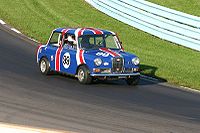
with a booted body style which was shared with Riley as the Elf. The 1500 was replaced with the Wolseley 1100 (BMC ADO16
BMC ADO16
ADO16 is the codename for the development of what became the Morris 1100, a small family car built by the British Motor Corporation and, later, British Leyland...
) in 1965, which became the Wolseley 1300 two years later. Finally, a version of the Austin 1800
Austin 1800
BMC ADO17 was the model code used by the British Motor Corporation for a range of cars produced from September 1964 to 1975 and sold initially under its Austin marque as the Austin 1800. The car was also sold as the Morris 1800 and Wolseley 18/85, and later as the Austin 2200, Morris 2200 and...
was launched in 1967 as the Wolseley 18/85.
British Leyland
After the merger of BMC and Leyland to form British Leyland in 1969 the Riley marque, long overlapping with Wolseley, was retired. Wolseley continued in diminished form with the Wolseley Six of 1972, a variant of the Austin 2200, a six-cylinder version of the Austin 1800. It was finally killed off just three years later in favour of the Wolseley variant of the wedge-shaped 18–22 series saloon, which was never even given an individual model name, being badged just "Wolseley", and sold only for seven months until that range was renamed as the PrincessLeyland Princess
The Princess is a family car that was produced in the United Kingdom by British Leyland from 1975 until 1981. The car inherited a front-wheel drive / transverse engine configuration from its predecessor, the BMC ADO17 range...
. This change thus spelled the end of the Wolseley marque after 80 years.
As of 2011 the Wolseley marque is owned by Nanjing Automobile Group
Nanjing Automobile Group
Nanjing Automobile is a state-owned enterprise with a history that dates from 1947, making it the oldest of the Chinese automobile manufacturers, although the comparatively younger First Automobile Works was the first to actually make cars.The group's products have included cars, trucks, and...
, bought as part of the assets of the MG Rover Group
MG Rover Group
MG Rover was the last domestically owned mass-production car manufacturer in the British motor industry. The company was formed when BMW sold the car-making and engine manufacturing assets of the original Rover Group to the Phoenix Consortium in 2000....
. The Wolseley Sheep Shearing Company continued trading, and continues today as Wolseley plc.
List of 1920s and 1930s Wolseley vehicles
- Four-cylinder
- 1920–1924 Wolseley 10
- 1920–1927 Wolseley 15
- 1934–1935 Wolseley Nine
- 1935–1936 Wolseley WaspWolseley WaspThe Wolseley Wasp was a light saloon car produced by the Wolseley Motor Company in 1935 and 1936. it was an updated version of the Wolseley Nine model with a larger engine and steel disc wheels....
- 1936–1937 Wolseley 10/40
- 1936–1939 Wolseley 12/48
- 1939-1939 Wolseley TenWolseley TenThe Wolseley Ten was a light saloon car produced by the Wolseley Motor Company in 1939 and 1945 to 1948 .The ten horsepower class of cars was an important part of the market in 1930s Britain and Wolseley entered the sector with their 10/40 of 1936 based on the contemporary Morris Ten. Both Morris...
- Six-cylinder
- 1920–1924 Wolseley 20
- 1930–1936 Wolseley HornetWolseley Hornet (1930)thumb|right|275px|1932 Wolseley Hornet EW SpecialThe Wolseley Hornet was a lightweight saloon car produced by the Wolseley Motor Company from 1930 to 1936...
OHC - 1927–1932 Wolseley Viper (car)
- 1928–1930 Wolseley 12/32
- 1930–1935 Wolseley 21/60
- 1933–1935 Wolseley Sixteen
- 1935–1936 Wolseley Fourteen
- 1935-1935 Wolseley Eighteen
- 1936–1938 Wolseley 14/56
- 1937–1938 Wolseley 18/80
- 1935–1937 Wolseley Super Six 16HP, 21HP, 25HP
- 1938–1941 Wolseley 14/60
- 1938–1941 Wolseley 16/65
- 1938–1941 Wolseley 18/85 (also produced in 1944, for the military)
- 1937–1940 Wolseley 16HP, 21HP, 25HP
- Eight-cylinder
- 1928–1931 Wolseley 21/60 Straight Eight Overhead Cam 2700cc (536 produced)
List of post-Second World War Wolseley vehicles
Wolseley long used a two-number system of model names. Until 1948, the numbers reflected the vehicle's engine size in units of taxable horsepower as defined by the Royal Automobile ClubRoyal Automobile Club
The Royal Automobile Club is a private club and is not to be confused with RAC plc, a motorists' organisation, which it formerly owned.It has two club houses, one in London at 89-91 Pall Mall, and the other in the countryside at Woodcote Park, Surrey, next to the City of London Freemen's School...
. Thus, the 14/60 was rated at 14 hp (RAC) for tax purposes but actually produced 60 hp (45 kW). Later, the first number equalled the number of cylinders. After 1956, this number was changed to reflect the engine's displacement for four-cylinder cars. Therefore, the seminal 15/60
Wolseley 15/60
The Wolseley 15/60 was the first of the mid-sized Pinin Farina-styled automobiles from the British Motor Corporation . Launched in December 1958, the design would eventually be shared with seven other marques. All of the cars were updated in 1961 with a larger engine and new model designations...
was a 1.5-litre engine capable of producing 60 hp (45 kW). Eventually, the entire naming system was abandoned.
- Four-cylinder
- 1939–1948 Wolseley TenWolseley TenThe Wolseley Ten was a light saloon car produced by the Wolseley Motor Company in 1939 and 1945 to 1948 .The ten horsepower class of cars was an important part of the market in 1930s Britain and Wolseley entered the sector with their 10/40 of 1936 based on the contemporary Morris Ten. Both Morris...
(Morris TenMorris TenThe Morris Ten was a medium sized car introduced in 1933 as the company's offering in the important 10 hp sector of the British market. It continued through a series of variants until 1948 when it was replaced by the MO Series Morris Oxford...
) - 1937–1948 Wolseley 12/48 (Post war version was the Series III)
- 1946–1948 Wolseley EightWolseley EightThe Wolseley Eight was a four door, light saloon car produced by the Wolseley Motor Company from 1946 to 1948. It was based on the Morris Eight Series E and also shared many body panels with the MG Y-type. At the time it was said to be Lord Nuffield's favourite car. The car was designed before...
(similar to Morris Eight Series EMorris EightThe Morris Eight was a small car inspired by the sales popularity of the similarly shaped Ford Model Y. The success of the car enabled Morris to regain its position as Britain's largest motor manufacturer.-Morris Eight Series I:...
) - 1947–1955 Wolseley Oxford TaxiWolseley Oxford TaxiThe Nuffield Oxford Taxi, often referred to as the Wolseley Oxford taxi was the first new taxicab designed to comply with the Metropolitan Police Conditions of Fitness for London taxicabs to be launched on the British market after the end of the Second World War....
(Morris Commercial design) - 1948–1953 Wolseley 4/50Wolseley 4/50The Wolseley 4/50 and similar 6/80 were Wolseley Motor Company's first post-war automobiles. They were rushed into production in 1948 and were based on the Morris Oxford MO and the Morris Six MS respectively...
(similar to Morris Oxford MOMorris OxfordAfter the Second World War the Oxford MO replaced the 10. It was introduced in 1948 and was produced until 1954. The design was shared with Nuffield Organisation stable-mate Wolseley 4/50....
) - 1952–1956 Wolseley 4/44Wolseley 4/44The Wolseley 4/44 was originally designed under the Nuffield Organisation but by the time it was released in 1953 Wolseley was part of BMC. Much of the design was shared with the MG Magnette ZA which came out later in the same year....
- 1956–1958 Wolseley 15/50Wolseley 15/50The Wolseley 15/50 was an updated version of the Wolseley 4/44. The main change was the engine; the 4/44 used a Morris unit and after the MG TF stopped production it was the only car still fitted with it. To rationalise production the 15/50 was launched with the BMC B-series engined...
(MG Magnette ZBMG MagnetteThe automobile manufacturer MG used the Magnette name on the K-type and N-type cars in the 1930s, but the Magnette models of the 1950s and 1960s are probably best-remembered...
) - 1957–1965 Wolseley 1500 (similar to Riley One-Point-FiveRiley One-Point-FiveThe Riley One-Point-Five and similar Wolseley 1500 were motor vehicles based on the Morris Minor floorpan, suspension and steering but fitted with the larger 1489 cc B-Series engine and MG Magnette gearbox...
, based on Morris MinorMorris MinorThe Morris Minor was a British economy car that debuted at the Earls Court Motor Show, London, on 20 September 1948. Designed under the leadership of Alec Issigonis, more than 1.3 million were manufactured between 1948 and 1971...
) - 1958–1961 Wolseley 15/60Wolseley 15/60The Wolseley 15/60 was the first of the mid-sized Pinin Farina-styled automobiles from the British Motor Corporation . Launched in December 1958, the design would eventually be shared with seven other marques. All of the cars were updated in 1961 with a larger engine and new model designations...
(Austin A55 (Mark 2) CambridgeAustin CambridgeThe Austin Cambridge is a motor car range sold by the Austin Motor Company in several generations from September 1954 through to 1969 as cars and 1971 as light commercials. It replaced the A40 Somerset but was entirely new with modern unibody construction...
) - 1961–1969 Wolseley HornetMiniThe Mini is a small car that was made by the British Motor Corporation and its successors from 1959 until 2000. The original is considered a British icon of the 1960s, and its space-saving front-wheel-drive layout influenced a generation of car-makers...
(similar to Riley Elf, based on MiniMiniThe Mini is a small car that was made by the British Motor Corporation and its successors from 1959 until 2000. The original is considered a British icon of the 1960s, and its space-saving front-wheel-drive layout influenced a generation of car-makers...
) - 1961–1971 Wolseley 16/60 (Austin A60 CambridgeAustin CambridgeThe Austin Cambridge is a motor car range sold by the Austin Motor Company in several generations from September 1954 through to 1969 as cars and 1971 as light commercials. It replaced the A40 Somerset but was entirely new with modern unibody construction...
) - 1965–1974 Wolseley 1100/1300 (BMC ADO16BMC ADO16ADO16 is the codename for the development of what became the Morris 1100, a small family car built by the British Motor Corporation and, later, British Leyland...
) - 1967–1971 Wolseley 18/85 (BMC ADO17Austin 1800BMC ADO17 was the model code used by the British Motor Corporation for a range of cars produced from September 1964 to 1975 and sold initially under its Austin marque as the Austin 1800. The car was also sold as the Morris 1800 and Wolseley 18/85, and later as the Austin 2200, Morris 2200 and...
)
- 1939–1948 Wolseley Ten
- Six-cylinder
- 1938–1948 Wolseley 14/60 (Post war version was the Series III)
- 1938–1948 Wolseley 18/85 (Post war version was the Series III)
- 1938–1948 Wolseley 25 (Post war version was the Series III)
- 1948–1954 Wolseley 6/80 (Morris SixMorris Six MSThe Morris Six MS was a six-cylinder midsize car from the Morris Motor Company made from 1948 to 1953. It was the company's first post war six cylinder car. At launch the car was priced at £671 on the UK market....
) - 1954–1959 Wolseley 6/90Wolseley 6/90The Wolseley 6/90 was a car from the British Wolseley Motor Company, produced from 1954-59, which replaced the 6/80 as the company's flagship model. It was badged as the Six-Ninety on the bonnet and 6/90 on the bootlid....
(Riley PathfinderRiley PathfinderFirst presented at the London Motor Show in October 1953, the Pathfinder replaced the RMF as Riley's top-line car.Designed as the "RMH" just before the 1952 merger of Riley-parent, the Nuffield Organisation, with Austin to form BMC, the Pathfinder is seen as the last proper Riley car...
/Riley Two-Point-SixRiley Two-Point-SixThe Two-Point-Six replaced the Riley Pathfinder as Riley's top-line automobile. While its predecessor retained the Riley twin cam, cross flow motor, the Two-Point-Six was almost identical to the Wolseley Six-Ninety Series III...
) - 1959–1961 Wolseley 6/99Wolseley 6/99The Wolseley 6/99 was the final large Wolseley car. Styled by Pinin Farina with additions by BMC staff sylists, the basic vehicle was also sold under two of BMC's other marques as the Austin A99 Westminster and Vanden Plas Princess 3-Litre. Production began in 1959 and the cars were updated and...
(Austin A99 WestminsterAustin WestminsterThe Westminster series were large saloon and estate cars sold by the British Austin Motor Company from 1954, replacing the A70 Hereford. The Westminster line was produced as the A90, A95, A99, A105, and A110 until 1968 when the new Austin 3-Litre took its place...
) - 1961–1968 Wolseley 6/110 (Austin A110 WestminsterAustin WestminsterThe Westminster series were large saloon and estate cars sold by the British Austin Motor Company from 1954, replacing the A70 Hereford. The Westminster line was produced as the A90, A95, A99, A105, and A110 until 1968 when the new Austin 3-Litre took its place...
) - 1962–1965 Wolseley 24/80Wolseley 24/80The Wolseley 24/80 is an automobile which was produced by British Motor Corporation from 1962 to 1965.The car was in most respect identical to the contemporary Austin Freeway, but employed different frontal treatment in order to maximise the perceived differences between the cars and therefore, it...
(AustraliaAustraliaAustralia , officially the Commonwealth of Australia, is a country in the Southern Hemisphere comprising the mainland of the Australian continent, the island of Tasmania, and numerous smaller islands in the Indian and Pacific Oceans. It is the world's sixth-largest country by total area...
n version of 15/60 and 16/60, but six-cylinder; similar to Austin FreewayAustin FreewayThe Austin Freeway is an automobile which was developed by the Australian division of the British Motor Corporation , based on the British Austin A60 Cambridge...
) - 1972–1975 Wolseley Six (BMC ADO17Austin 1800BMC ADO17 was the model code used by the British Motor Corporation for a range of cars produced from September 1964 to 1975 and sold initially under its Austin marque as the Austin 1800. The car was also sold as the Morris 1800 and Wolseley 18/85, and later as the Austin 2200, Morris 2200 and...
) - March–October 1975 Wolseley saloon (18–22 series)
- Also produced (dates to be confirmed):
- Wolseley 4/60 (DutchNetherlandsThe Netherlands is a constituent country of the Kingdom of the Netherlands, located mainly in North-West Europe and with several islands in the Caribbean. Mainland Netherlands borders the North Sea to the north and west, Belgium to the south, and Germany to the east, and shares maritime borders...
version of 16/60) - Wolseley 300 (DanishDenmarkDenmark is a Scandinavian country in Northern Europe. The countries of Denmark and Greenland, as well as the Faroe Islands, constitute the Kingdom of Denmark . It is the southernmost of the Nordic countries, southwest of Sweden and south of Norway, and bordered to the south by Germany. Denmark...
version of 6/99 and 6/110)
- Wolseley 4/60 (Dutch
Aero engines
Wolseley also produced a number of aircraft engineAircraft engine
An aircraft engine is the component of the propulsion system for an aircraft that generates mechanical power. Aircraft engines are almost always either lightweight piston engines or gas turbines...
designs, although there were no major design wins.
- Wolseley AriesWolseley Aries|-See also:-Bibliography:* Lumsden, Alec. British Piston Engines and their Aircraft. Marlborough, Wiltshire: Airlife Publishing, 2003. ISBN 1-85310-294-6.-External links:**...
- Wolseley AquariusWolseley Aquarius|-See also:-Bibliography:* Lumsden, Alec. British Piston Engines and their Aircraft. Marlborough, Wiltshire: Airlife Publishing, 2003. ISBN 1-85310-294-6.-External links:*...
- Wolseley Scorpio
- Wolseley Python
- Wolseley ViperWolseley Viper|-See also:-Bibliography:* Lumsden, Alec. British Piston Engines and their Aircraft. Marlborough, Wiltshire: Airlife Publishing, 2003. ISBN 1-85310-294-6....
-an improved Hispano Suiza 8 built during the First World War.
Wolseley Aero Engines Ltd was a subsidiary formed around 1931 to design aero engines. By 1942, the name of the company was Nuffield Mechanisations Ltd.
Nuffield
Nuffield Organisation
The Nuffield Organisation was a vehicle manufacturing company in the United Kingdom. Named after its founder, William Morris, 1st Viscount Nuffield, it was formed in 1938 as the merger of Nuffield's Morris Motor Company , another of Nuffield's companies the MG Car Company and Riley.Morris Motors...
was developing an advanced Wolseley radial aero engine of about 250 horsepower, but the project was abandoned in September 1936 when Lord Nuffield got the fixed price I.T.P. (Intention to Proceed) contract papers (which would have required an army of chartered accountant
Chartered Accountant
Chartered Accountants were the first accountants to form a professional body, initially established in Britain in 1854. The Edinburgh Society of Accountants , the Glasgow Institute of Accountants and Actuaries and the Aberdeen Society of Accountants were each granted a royal charter almost from...
s) and decided to deal only with the War Office and Admiralty, not the Air Ministry (see Airspeed).
External links
- Austin-Rover resource site with "family" history for many Wolseley models
- The Wolseley Register - Car club for Wolseley owners and enthusiasts
- Austin memories - History of Longbridge and models produced