

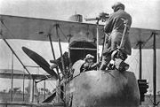
Royal Aircraft Factory F.E.2

Encyclopedia
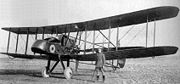
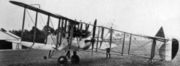
The Royal Aircraft Factory F.E.2 was a two-seat pusher
Pusher configuration
In a craft with a pusher configuration the propeller are mounted behind their respective engine. According to Bill Gunston, a "pusher propeller" is one mounted behind engine so that drive shaft is in compression...
biplane
Biplane
A biplane is a fixed-wing aircraft with two superimposed main wings. The Wright brothers' Wright Flyer used a biplane design, as did most aircraft in the early years of aviation. While a biplane wing structure has a structural advantage, it produces more drag than a similar monoplane wing...
that was operated as a day and night bomber
Bomber
A bomber is a military aircraft designed to attack ground and sea targets, by dropping bombs on them, or – in recent years – by launching cruise missiles at them.-Classifications of bombers:...
and as a fighter aircraft
Fighter aircraft
A fighter aircraft is a military aircraft designed primarily for air-to-air combat with other aircraft, as opposed to a bomber, which is designed primarily to attack ground targets...
by the Royal Flying Corps
Royal Flying Corps
The Royal Flying Corps was the over-land air arm of the British military during most of the First World War. During the early part of the war, the RFC's responsibilities were centred on support of the British Army, via artillery co-operation and photographic reconnaissance...
during the First World War
World War I
World War I , which was predominantly called the World War or the Great War from its occurrence until 1939, and the First World War or World War I thereafter, was a major war centred in Europe that began on 28 July 1914 and lasted until 11 November 1918...
. Along with the single-seat D.H.2
Airco DH.2
|-DH.2 aces:Distinguished pilots of the DH.2 included Victoria Cross winner Lanoe Hawker , who was the first commander of No 24 Squadron and ace Alan Wilkinson. The commander of No. 32 Squadron, Lionel Rees won the Victoria Cross flying the D.H.2 for single handedly attacking a formation of 10...
pusher biplane and the Nieuport 11
Nieuport 11
|-See also:-References:NotesBibliography* Angelucci, Enzio, ed. The Rand McNally Encyclopedia of Military Aircraft. New York: The Military Press, 1983. ISBN 0-517-41021-4....
, the F.E.2 was instrumental in ending the Fokker Scourge
Fokker Scourge
The Fokker Scourge was a term coined by the British press in the summer of 1915 to describe the then-current ascendancy of the Fokker Eindecker monoplane fighters of the German Fliegertruppen over the poorly-armed Allied reconnaissance types of the period....
that had seen the German Air Service
Luftstreitkräfte
The Deutsche Luftstreitkräfte , known before October 1916 as Die Fliegertruppen des deutschen Kaiserreiches , or simply Die Fliegertruppen, was the air arm of the Imperial German Army during World War I...
establish a measure of air superiority on the Western Front
Western Front (World War I)
Following the outbreak of World War I in 1914, the German Army opened the Western Front by first invading Luxembourg and Belgium, then gaining military control of important industrial regions in France. The tide of the advance was dramatically turned with the Battle of the Marne...
from the late summer of 1915 to the following spring.
Design and development
The F.E.2 (Farman Experimental 2) designation refers to three distinct designs, all pushersPusher configuration
In a craft with a pusher configuration the propeller are mounted behind their respective engine. According to Bill Gunston, a "pusher propeller" is one mounted behind engine so that drive shaft is in compression...
based on the general layout employed by the French
France
The French Republic , The French Republic , The French Republic , (commonly known as France , is a unitary semi-presidential republic in Western Europe with several overseas territories and islands located on other continents and in the Indian, Pacific, and Atlantic oceans. Metropolitan France...
aircraft designers, the Farman Brothers.
F.E.2 (1911 version)
The first F.E.2 was designed by Geoffrey de HavillandGeoffrey de Havilland
Captain Sir Geoffrey de Havilland, OM, CBE, AFC, RDI, FRAeS, was a British aviation pioneer and aircraft engineer...
at the Royal Aircraft Factory in 1911. Although it was claimed that it was a rebuild of the F.E.1
Royal Aircraft Factory F.E.1
The F.E.1 was designed and built in 1910 by the pioneer designer Geoffrey de Havilland. He used it to teach himself to fly during late 1910. After De Havilland was appointed assistant designer and test pilot at Army Balloon Factory at Farnborough in December 1910 the War Office bought the...
, a pusher biplane designed and built by de Havilland before he joined the Factory's staff, it was in fact an entirely new aircraft, with construction completed before the F.E.1 was wrecked in a crash in August 1911. The new aircraft resembled the final form of the F.E.1, with no front elevator
Elevator (aircraft)
Elevators are flight control surfaces, usually at the rear of an aircraft, which control the aircraft's orientation by changing the pitch of the aircraft, and so also the angle of attack of the wing. In simplified terms, they make the aircraft nose-up or nose-down...
, but seated a crew of two in a wood and canvas nacelle
Nacelle
The nacelle is a cover housing that holds engines, fuel, or equipment on an aircraft. In some cases—for instance in the typical "Farman" type "pusher" aircraft, or the World War II-era P-38 Lightning—an aircraft's cockpit may also be housed in a nacelle, which essentially fills the...
, and was powered by a 50 hp (37 kW) Gnome
Gnome et Rhône
Gnome et Rhône was a major French aircraft engine manufacturer. Between 1914 and 1918 they produced 25,000 of their 9-cylinder Delta and Le Rhône 110 hp rotary designs, while another 75,000 were produced by various licensees, powering the majority of aircraft in the first half of the war on...
rotary engine
Rotary engine
The rotary engine was an early type of internal-combustion engine, usually designed with an odd number of cylinders per row in a radial configuration, in which the crankshaft remained stationary and the entire cylinder block rotated around it...
.
It made its maiden flight on 18 August 1911, flown by de Havilland. It was fitted with floats in April 1912, first flying in this form on 12 April 1912, but was underpowered and its engine was therefore replaced by a 70 hp (52 kW) Gnome, this allowing it to take off carrying a passenger while fitted with floats. Later in the year the F.E.2, refitted with a landplane undercarriage, was modified to carry a Maxim machine gun on a flexible mount in the nose.
F.E.2 (1913 version)
The second F.E.2 was officially a rebuild of the first F.E.2, and may, indeed have included some components from the earlier aircraft. It was, however, larger and heavier than the 1911 aircraft, with wingspan increasing from 33 ft (10.06 m) to 42 ft (12.80 m) and a totally new more streamlined nacelle. Loaded weight rose from 1,200 lb (545 kg) to 1,865 lb (848 kg). The new F.E.2 used the outer wings of the B.E.2a, with wing warpingWing warping
Wing warping was an early system for lateral control of a fixed-wing aircraft. The technique, used and patented by the Wright brothers, consisted of a system of pulleys and cables to twist the trailing edges of the wings in opposite directions...
instead of aileron
Aileron
Ailerons are hinged flight control surfaces attached to the trailing edge of the wing of a fixed-wing aircraft. The ailerons are used to control the aircraft in roll, which results in a change in heading due to the tilting of the lift vector...
s for lateral control, and was powered by a 70 hp Renault engine. It was destroyed when it spun
Spin (flight)
In aviation, a spin is an aggravated stall resulting in autorotation about the spin axis wherein the aircraft follows a corkscrew downward path. Spins can be entered intentionally or unintentionally, from any flight attitude and from practically any airspeed—all that is required is sufficient yaw...
into the ground from 500 ft (150 m) on 23 February 1914, probably because of insufficient fin area. The pilot, R. Kemp, was killed.
1914 fighter
Work started on another totally new design in mid-1914, the F.E.2a, specifically intended as a "fighter", or machine gun carrier in the same class as the Vickers "Gunbus"Vickers F.B.5
The Vickers F.B.5 was a British two-seat pusher military biplane of the First World War...
. The first production order for 12 aircraft was placed "off the drawing board" (i.e. prior to first flight) shortly after the outbreak of the First World War. By this stage, the "pusher" design was becoming obsolete as far as aerodynamic performance was concerned, however, the RFC had not yet solved the problem of firing a machine gun
Machine gun
A machine gun is a fully automatic mounted or portable firearm, usually designed to fire rounds in quick succession from an ammunition belt or large-capacity magazine, typically at a rate of several hundred rounds per minute....
through the propeller of a tractor aircraft (the Germans were shortly to manage this using Anthony Fokker
Anthony Fokker
Anton Herman Gerard "Anthony" Fokker was a Dutch aviation pioneer and an aircraft manufacturer. He is most famous for the fighter aircraft he produced in Germany during the First World War such as the Eindecker monoplanes, the Fokker Triplane the and the Fokker D.VII, but after the collapse of...
's interrupter gear
Interrupter gear
An interrupter gear is a device used on military aircraft and warships in order to allow them to target opponents without damaging themselves....
) and consequently pushers, with a clear forward field of fire, remained the favoured configuration for fighters.
The F.E.2 was a two-seater with the observer sitting in the nose of the nacelle
Nacelle
The nacelle is a cover housing that holds engines, fuel, or equipment on an aircraft. In some cases—for instance in the typical "Farman" type "pusher" aircraft, or the World War II-era P-38 Lightning—an aircraft's cockpit may also be housed in a nacelle, which essentially fills the...
and the pilot sitting above and behind. The observer was armed with one .303 in Lewis machine gun firing forward on a specially designed, swivelling mount that gave it a very wide field of fire. Later, another Lewis was added, mounted to fire backwards over the top wing – however, the observer was required to stand on his seat in order to fire this weapon, which failed to cover a very large blind spot under the tail. The observer's perch was a precarious one, especially when firing the rear gun, and he was liable to be thrown out of his cockpit, however, his view was excellent in most important directions. The F.E.2 could also carry a small external bomb load.
The arrangement was described by Frederick Libby
Frederick Libby
Frederick Libby was the first American ace of World War I, and of all time, achieved while serving as an observer in the Royal Flying Corps.-Early life and service:Frederick Libby was born on 15 July 1891 in Sterling, Colorado...
, first American ace of World War I as follows:
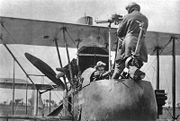
- "When you stood up to shoot, all of you from the knees up was exposed to the elements. There was no belt to hold you. Only your grip on the gun and the sides of the nacelle stood between you and eternity. Toward the front of the nacelle was a hollow steel rod with a swivel mount to which the gun was anchored. This gun covered a huge field of fire forward. Between the observer and the pilot a second gun was mounted, for firing over the F.E.2d's upper wing to protect the aircraft from rear attack ... Adjusting and shooting this gun required that you stand right up out of the nacelle with your feet on the nacelle coaming. You had nothing to worry about except being blown out of the aircraft by the blast of air or tossed out bodily if the pilot made a wrong move. There were no parachutes and no belts. No wonder they needed observers."
The first production batch was for 12 of the initial F.E.2a variant, with a large airbrake under the top centre section, and a Green E.6
Green E.6
|-See also:-Bibliography:* Gunston, Bill. World Encyclopaedia of Aero Engines. Cambridge, England. Patrick Stephens Limited, 1989. ISBN 1-85260-163-9...
engine. The first F.E.2a made its maiden flight on 26 January 1915. It was found to be underpowered, and was re-engined with a 120 hp (89 kW) Beardmore
Beardmore 120 hp
|-See also:-Bibliography:* Gunston, Bill. World Encyclopaedia of Aero Engines. Cambridge, England. Patrick Stephens Limited, 1989. ISBN 1-85260-163-9...
liquid-cooled inline engine
Inline engine (aviation)
In aviation, an inline engine means any reciprocating engine with banks rather than rows of cylinders, including straight engines, flat engines, V engines and H engines, but excluding radial engines and rotary engines....
, as were the other eleven aircraft. The F.E.2a was quickly followed by the main production model, the F.E.2b, again powered by a Beardmore, initially the 120 hp version while later F.E.2bs received the 160 hp (119 kW) Beardmore. The airbrake of the "a" having proved unsatisfactory, it was simply omitted. A total of 1,939 F.E.2b/cs were built. The Royal Aircraft Factory itself built only a few, most construction was by private British manufacturers with G & J Weir, Boulton & Paul Ltd
Boulton & Paul Ltd
Boulton & Paul was a British general manufacturer from Norwich that became involved in aircraft manufacture.Jeld Wen Inc, bought Boulton & Paul Boulton & Paul was a British general manufacturer from Norwich that became involved in aircraft manufacture.Jeld Wen Inc, bought Boulton & Paul Boulton &...
and Ransomes, Sims & Jefferies
Ransomes, Sims & Jefferies
Ransomes, Sims and Jeffries was a major British agricultural machinery maker producing a wide range of products including traction engines, ploughs, lawn mowers, combine harvesters and other tilling equipment. They also manufactured aeroplanes during the First World War...
, the main suppliers.
The F.E.2c was an experimental night fighter
Night fighter
A night fighter is a fighter aircraft adapted for use at night or in other times of bad visibility...
and bomber variant of the F.E.2b, the main change being the switching of the pilot and observer positions so that the pilot had the best view for night landings. Two were built in 1916, with the designation being re-used in 1918 for a similar night bomber version of the F.E.2b, which was used by 100 Squadron
No. 100 Squadron RAF
No. 100 Squadron of the Royal Air Force is based at RAF Leeming in North Yorkshire, UK, and operates the Hawker-Siddeley Hawk.-World War I:No. 100 was established on 23 February 1917 at Hingham in Norfolk as the Royal Flying Corps' first squadron formed specifically as a night bombing unit and...
. In the end, the observer-first layout was retained for the standard aircraft.
The Royal Aircraft Factory was always primarily a research establishment, and other experiments were carried out using F.E.2bs, including the testing of a generator-powered searchlight attached between two .303 inch (7.7 mm) Lewis guns, apparently for night fighting duties.
The final model was the F.E.2d (386 built) which was powered by a Rolls-Royce Eagle engine with 250 hp (186 kW). While the more powerful engine made little difference in maximum speed, especially at low altitude, it did improve altitude performance, with an extra 10 mph at 5,000 ft. The Rolls-Royce engine also improved payload, so that in addition to the two observer's guns, an additional one or two Lewis guns could be mounted to fire forward, operated by the pilot.
While the F.E.2d was replaced by the Bristol Fighter
Bristol F.2 Fighter
The Bristol F.2 Fighter was a British two-seat biplane fighter and reconnaissance aircraft of the First World War flown by the Royal Flying Corps. It is often simply called the Bristol Fighter or popularly the "Brisfit" or "Biff". Despite being a two-seater, the F.2B proved to be an agile aircraft...
, the older F.E.2b proved an unexpected success as a light tactical night bomber, and remained a standard type in this role for the rest of the war. Its climb rate and ceiling were too poor for it to make a satisfactory night fighter.
Operational history
No. 6 Squadron RAF
No. 6 Squadron of the Royal Air Force operates the Eurofighter Typhoon FGR4 at RAF Leuchars.It was previously equipped with the Jaguar GR.3 in the close air support and tactical reconnaissance roles, and was based at RAF Coltishall, Norfolk until April 2006, moving to RAF Coningsby until...
, which used the F.E.2 in conjunction with B.E.2s and a single Bristol Scout
Bristol Scout
The Bristol Scout was a simple, single seat, rotary-engined biplane originally intended as a civilian racing aircraft. Like other similar fast, light aircraft of the period - it was acquired by the RNAS and the RFC as a "scout", or fast reconnaissance type...
, with the first squadron completely equipped with the F.E.2 being 20 Squadron
No. 20 Squadron RAF
No. 20 Squadron of the Royal Air Force was until March 2010, the OCU for the BAE Harrier GR9, and T12, operating from RAF Wittering...
, deploying to France on 23 January 1916. At this stage it served as a fighter/reconnaissance aircraft - eventually about two/thirds of the F.E.2s were built as fighters (816) and one third as bombers (395). The F.E.2b and F.E.2d variants remained in day operations well into 1917 while the "b" continued as a standard night bomber until August 1918. At its peak, the F.E.2b equipped 16 RFC squadrons in France and six Home Defence squadrons in England.
On 18 June 1916, German ace
Flying ace
A flying ace or fighter ace is a military aviator credited with shooting down several enemy aircraft during aerial combat. The actual number of aerial victories required to officially qualify as an "ace" has varied, but is usually considered to be five or more...
Max Immelmann
Max Immelmann
Max Immelmann was the first German World War I flying ace. He was a great pioneer in fighter aviation and is often mistakenly credited with the first aerial victory using a synchronized gun...
was killed in combat with F.E.2bs of No. 25 Squadron RFC
No. XXV Squadron RAF
No. 25 Squadron was a squadron of the Royal Air Force. Until April 2008 the squadron operated the Panavia Tornado F3, from RAF Leeming.-The first years:...
. The squadron claimed the kill, but the German version of the encounter is either that Immelmann's Fokker Eindecker
Fokker Eindecker
The Fokker Eindecker was a German World War I monoplane single-seat fighter aircraft designed by Dutch engineer Anthony Fokker. Developed in April 1915, the Eindecker was the first purpose-built German fighter aircraft and the first aircraft to be fitted with synchronizer gear, enabling the pilot...
broke up after his synchronizer gear
Interrupter gear
An interrupter gear is a device used on military aircraft and warships in order to allow them to target opponents without damaging themselves....
failed and he shot off his own propeller, or that he was hit by friendly fire
Friendly fire
Friendly fire is inadvertent firing towards one's own or otherwise friendly forces while attempting to engage enemy forces, particularly where this results in injury or death. A death resulting from a negligent discharge is not considered friendly fire...
from German anti-aircraft
Anti-aircraft warfare
NATO defines air defence as "all measures designed to nullify or reduce the effectiveness of hostile air action." They include ground and air based weapon systems, associated sensor systems, command and control arrangements and passive measures. It may be to protect naval, ground and air forces...
guns.
In combat with single-seater fighters, the pilots of F.E.2b and F.E.2d fighters would form what is probably the first use of what later became known as a Lufbery circle (defensive circle). In the case of the F.E.2 - the intention was that the gunner of each aircraft could cover the blind spot under the tail of his neighbour, and several gunners could fire on any enemy attacking the group. On occasion formations of F.E.2s fought their way back from far over the lines, while under heavy attack from German fighters, using this tactic.
The undercarriage of the F.E.2b/d was particularly well designed - a small nosewheel prevented nose-overs when landing on soft ground, and the effective oleo type shock absorbers were also appreciated by crews landing in rough, makeshift fields. In order to gain a few extra miles an hour the nosewheels were however frequently removed in the field, and some aircraft were fitted with a normal "V" type undercarriages - again in an effort to reduce drag.
By autumn 1916, the arrival of more modern German fighters such as the Albatros D.I
Albatros D.I
|-See also:...
and Halberstadt D.II
Halberstadt D.II
The Halberstadt D.II was a biplane fighter aircraft of the Luftstreitkräfte that served through the period of Allied air superiority in early 1916, but had begun to be superseded in the Jagdstaffeln by the superior Albatros fighters by the autumn of that year.-Design and development:The D.II was...
meant that even the F.E.2d was outperformed and, by April 1917, it had been withdrawn from offensive patrols. Despite its obsolescence in 1917, the F.E.2 was still well liked by its crews for its strength and good flight characteristics and it remained a difficult opponent for even the best German aces. Rittmeister Baron von Richthofen
Manfred von Richthofen
Manfred Albrecht Freiherr von Richthofen , also widely known as the Red Baron, was a German fighter pilot with the Imperial German Army Air Service during World War I...
was badly wounded in the head during combat with F.E.2d aircraft in June 1917 - the Red Baron, like most German pilots of the period, classed the F.E.2 as a "Vickers" type, confusing it with the earlier Vickers F.B.5
Vickers F.B.5
The Vickers F.B.5 was a British two-seat pusher military biplane of the First World War...
.
Although outclassed as a day fighter, the F.E.2 proved very suitable for use at night, and was used both as a night fighter in home defence squadrons on anti-Zeppelin
Zeppelin
A Zeppelin is a type of rigid airship pioneered by the German Count Ferdinand von Zeppelin in the early 20th century. It was based on designs he had outlined in 1874 and detailed in 1893. His plans were reviewed by committee in 1894 and patented in the United States on 14 March 1899...
patrols and as a light tactical night bomber. It was first used as a night bomber in November 1916, with the first dedicated F.E.2b night bomber squadrons being formed in February 1917. F.E.2bs continued to be heavily used as night bombers in eight bomber squadrons until the end of the First World War, with up to 860 being converted to, or built as, bombers. Service as a night fighter was less successful, due to the type's poor climb and ceiling.
F.E.2bs were experimentally fitted with flotation bags for operation over water, and were also used to conduct anti-submarine patrols operating out of the Isle of Grain
Isle of Grain
The Isle of Grain, in the north of Kent, England, is the easternmost point of the Hoo Peninsula. No longer an island, the Isle is almost all marshland and the Grain Marshes are an important habitat for birdlife...
at the mouth of the Thames River.
A total of 35 aircraft derived from the F.E.2 were sold to China in 1919 by Vickers
Vickers
Vickers was a famous name in British engineering that existed through many companies from 1828 until 1999.-Early history:Vickers was formed in Sheffield as a steel foundry by the miller Edward Vickers and his father-in-law George Naylor in 1828. Naylor was a partner in the foundry Naylor &...
as Vickers Instructional Machines
Vickers VIM
-References:* Andrews, C.F. and Morgan, E.B. Vickers Aircraft since 1908. London:Putnam, 1988. ISBN 0-85177-815-1.* "." Flight, 6 January 1921, p.4-5.-External links:...
(VIM), to be used as advanced trainers, having a redesigned nacelle fitted with dual controls and powered by a Rolls-Royce Eagle VIII engine. Although acquired as trainers they were used in battles between Chinese warlords
Warlord era
The Chinese Warlord Era was the period in the history of the Republic of China, from 1916 to 1928, when the country was divided among military cliques, a division that continued until the fall of the Nationalist government in the mainland China regions of Sichuan, Shanxi, Qinghai, Ningxia,...
. The last combat operations were those in early 1927, when Zhili clique and Fengtian clique
Fengtian clique
The Fengtian Clique was one of several mutually hostile cliques or factions that split from the Beiyang Clique in the Republic of China's warlord era. It was named for Fengtian Province and led by Zhang Zuolin...
warlords joined their forces to defeat Guominjun
Guominjun
The Guominjun , a.k.a Nationalist Army, KMC, or Northwest Army , refers to the military faction founded by Feng Yuxiang, Hu Jingyi and Sun Yue during China's Warlord Era. It was formed when Feng betrayed the Zhili clique during the Second Zhili-Fengtian War with the Fengtian clique in 1924...
. VIMs in the hands of Fengtian clique
Fengtian clique
The Fengtian Clique was one of several mutually hostile cliques or factions that split from the Beiyang Clique in the Republic of China's warlord era. It was named for Fengtian Province and led by Zhang Zuolin...
warlords continued to fly in training missions until their capture by the Japanese in the Mukden Incident
Mukden Incident
The Mukden Incident, also known as the Manchurian Incident, was a staged event that was engineered by Japanese military personnel as a pretext for invading the northern part of China known as Manchuria in 1931....
, and the new owner soon disposed the obsolete aircraft.
Notable appearances in media
Derek Robinson's novel War Story is centred around a fictional Hornet SquadronHornet Squadron
Hornet Squadron is the name of a fictional Royal Flying Corps, and later Royal Air Force, fighter squadron featured in a number of novels by British author Derek Robinson....
flying the F.E.2b, and later the F.E.2d, giving a realistic, albeit darkly humorous account of flying the fighter in the months leading up to the Battle of the Somme
Battle of the Somme (1916)
The Battle of the Somme , also known as the Somme Offensive, took place during the First World War between 1 July and 14 November 1916 in the Somme department of France, on both banks of the river of the same name...
.
In Robert Radcliffe's novel, 'Across the Blood-Red Skies', the narrator is an F.E.2 pilot, and offers a well-researched insight into the skills required in order to fly the aeroplane.
Reproductions
Two reproductions of the F.E.2b, one to full airworthinessAirworthiness
Airworthiness is a term used to describe whether an aircraft has been certified as suitable for safe flight. Certification is initially conferred by a Certificate of Airworthiness from a National Airworthiness Authority, and is maintained by performing required maintenance actions by a licensed...
standards and fitted with a genuine Beardmore engine, have been manufactured by The Vintage Aviator Ltd of New Zealand.
Operators
- Australian Flying Corps
-
-
- Central Flying School AFC at Point Cook, VictoriaPoint Cook, VictoriaPoint Cook is a suburb in Melbourne, Victoria, Australia, 25 km south-west from Melbourne's central business district. Its Local Government Area is the City of Wyndham. At the 2006 Census, Point Cook had a population of 14,162, now it is estimated that the population of Point Cook is 32,167...
- One aircraft only.
- Central Flying School AFC at Point Cook, Victoria
-
- Royal Flying CorpsRoyal Flying CorpsThe Royal Flying Corps was the over-land air arm of the British military during most of the First World War. During the early part of the war, the RFC's responsibilities were centred on support of the British Army, via artillery co-operation and photographic reconnaissance...
/ Royal Air ForceRoyal Air ForceThe Royal Air Force is the aerial warfare service branch of the British Armed Forces. Formed on 1 April 1918, it is the oldest independent air force in the world...
-
- No. 6 Squadron RAFNo. 6 Squadron RAFNo. 6 Squadron of the Royal Air Force operates the Eurofighter Typhoon FGR4 at RAF Leuchars.It was previously equipped with the Jaguar GR.3 in the close air support and tactical reconnaissance roles, and was based at RAF Coltishall, Norfolk until April 2006, moving to RAF Coningsby until...
- No. 11 Squadron RAF
- No. 12 Squadron RAFNo. 12 Squadron RAFNo. 12 Squadron of the Royal Air Force currently operates the Tornado GR4 from RAF Lossiemouth.-History:No. 12 Squadron Royal Flying Corps was formed in February 1915 from a flight of No. 1 Squadron RFC at Netheravon. The squadron moved to France in September 1915 and operated a variety of aircraft...
- No. 16 Squadron RAFNo. 16 Squadron RAFNo. 16 Squadron is a flying squadron of the Royal Air Force. It formed in 1915 at Saint-Omer to carry out a mixture of offensive patrolling and reconnaissance and was disbanded in 1919 with the end of the First World War...
- No. 18 Squadron RAFNo. 18 Squadron RAFNo. 18 Squadron of the Royal Air Force operates the CH-47 Chinook HC.2 from RAF Odiham. No. 18 Squadron was the first and is currently the largest RAF operator of the Chinook.-First World War:...
- No. 20 Squadron RAFNo. 20 Squadron RAFNo. 20 Squadron of the Royal Air Force was until March 2010, the OCU for the BAE Harrier GR9, and T12, operating from RAF Wittering...
- No. 22 Squadron RAFNo. 22 Squadron RAFNo. 22 Squadron of the Royal Air Force operates the Sea King HAR.3 and HAR.3A at three stations in the southern United Kingdom. The squadron was originally formed in 1915 as an aerial reconnaissance unit of the Royal Flying Corps serving on the Western Front during First World War...
- No. 23 Squadron RAFNo. 23 Squadron RAFNo. 23 Squadron was a squadron of the Royal Air Force. Until October 2009, it operated the Boeing Sentry AEW1 Airborne Warning And Control System aircraft from RAF Waddington, Lincolnshire.-First World War:...
- No. 24 Squadron RAF
- No. 25 Squadron RAF
- No. 28 Squadron RAFNo. 28 Squadron RAFNo. 28 Squadron of the Royal Air Force operates the Merlin HC3/HC3A from RAF Benson.-World War I:No. 28 Squadron of the Royal Flying Corps was formed on 7 November 1915. Initially a training squadron it became a fighter squadron equipped with the Sopwith Camel.After the end of World War I No. 28...
- No. 31 Squadron RAFNo. 31 Squadron RAFNo. 31 Squadron of the Royal Air Force, known as the 'Goldstars', currently operates the Tornado GR4 from RAF Marham, Norfolk.-History:The squadron was formed at Farnborough on October 11, 1915. Its first deployment was to Risulpur, India with its BE2Cs and Farmans, and during this time it took...
- No. 33 Squadron RAFNo. 33 Squadron RAFNo. 33 Squadron of the Royal Air Force operates the Puma HC.1 from RAF Benson, Oxfordshire.-Current role:The squadron is part of the RAF Support Helicopter force, which reports into the Joint Helicopter Command....
- No. 36 Squadron RAFNo. 36 Squadron RAFNo. 36 Squadron of the Royal Flying Corps was formed at Cramlington on February 1, 1916 and was disbanded for the last time in 1975.-First World War:No...
- No. 38 Squadron RAFNo. 38 Squadron RAFNo. 38 Squadron of the Royal Air Force was a bomber squadron formed in 1916 and was disbanded for the last time in 1967.-World War I :...
- No. 39 Squadron RAFNo. 39 Squadron RAFNo. 39 Squadron of the Royal Air Force operates the MQ-9 Reaper since 2007, operating from Creech AFB, Nevada, USA.-World War I:39 Squadron was founded at Hounslow Heath Aerodrome in April 1916 with B.E.2s and Royal Aircraft Factory B.E.12s in an attempt to defend against German Zeppelin raids on...
- No. 51 Squadron RAFNo. 51 Squadron RAFNo. 51 Squadron of the Royal Air Force most recently operated the Nimrod R1 from RAF Waddington, Lincolnshire until June 2011. Crews from No. 51 Squadron are currently training alongside the US Air Force on the Boeing RC-135, which is planned to enter service with the RAF over the next seven years...
- No. 57 Squadron RAFNo. 57 Squadron RAF-History:57 Squadron of the Royal Flying Corps was formed on 8 June 1916 at Copmanthorpe, Yorkshire. In December 1916 the squadron was posted to France equipped with the FE2d. The squadron re-equipped with Airco DH4s in May 1917 and commenced long range bombing and reconnaissance operations near...
- No. 58 Squadron RAFNo. 58 Squadron RAFNo. 58 Squadron was a squadron of the Royal Air Force.- History :No. 58 Squadron was first formed at Cramlington, Northumberland, on 8 June 1916 as a squadron of the Royal Flying Corps....
- No. 6 Squadron RAF
-
- No. 78 Squadron RAFNo. 78 Squadron RAFNo. 78 Squadron of the Royal Air Force operates the Merlin HC3/3A transport helicopter from RAF Benson.Until December 2007 it was the operator of two Westland Sea King HAR3s from RAF Mount Pleasant, Falkland Islands.-History:No...
- No. 64 Squadron RAFNo. 64 Squadron RAFNo. 64 Squadron was a squadron of the Royal Air Force. It was first formed on 1 August 1916 as a squadron of the Royal Flying Corps. It was last disbanded on 31 January 1991 at RAF Leuchars.- 1916 to 1919 :...
- No. 83 Squadron RAFNo. 83 Squadron RAFNo. 83 Squadron RAF was a Royal Flying Corps and Royal Air Force squadron active from 1917 until 1969. It was operative during both World War I and World War II.-Establishment and early service:...
- No. 90 Squadron RAF
- No. 100 Squadron RAFNo. 100 Squadron RAFNo. 100 Squadron of the Royal Air Force is based at RAF Leeming in North Yorkshire, UK, and operates the Hawker-Siddeley Hawk.-World War I:No. 100 was established on 23 February 1917 at Hingham in Norfolk as the Royal Flying Corps' first squadron formed specifically as a night bombing unit and...
- No. 101 Squadron RAFNo. 101 Squadron RAFNo. 101 Squadron of the Royal Air Force operates the Vickers VC10 C1K, K3 and K4 from RAF Brize Norton, Oxfordshire. Since 10 Squadron disbanded in 2005, the squadron is the only operator of the VC10.-Formation and early years:...
- No. 102 Squadron RAFNo. 102 Squadron RAFNo. 102 Squadron was a Royal Air Force night bomber squadron in World War I and a heavy bomber squadron in World War II. After the war it flew briefly as a transport squadron before being reformed a light bomber unit with the Second Tactical Air Force within RAF Germany. Its last existence was as a...
- No. 116 Squadron RAFNo. 116 Squadron RAFNo. 116 Squadron, Royal Flying Corps, was formed on 1 December 1917 at Andover and was intended to become a night bomber unit but the end of the war resulted in the Squadron's disbandment on 20 November 1918....
- No. 118 Squadron RAFNo. 118 Squadron RAFFormed at Catterick, North Yorkshire, on 1 January 1918 as a heavy night bomber unit, No. 118 Squadron never saw service in World War I and was disbanded again on 7 September 1918....
- No. 131 Squadron RAFNo. 131 Squadron RAFNo. 131 Squadron RAF was a Royal Air Force Squadron formed to be a night bomber unit in World War I and reformed as a fighter unit in World War II.-Formation and World War I:No...
- No. 133 Squadron RAFNo. 133 Squadron RAF133 Squadron RAF was one of the famous Eagle squadrons formed from American volunteers serving with the RAF during World War II.-History:133 Squadron was first formed in 1918 at RAF Ternhill. It was a training unit for the Handley Page O/400, flying the Royal Aircraft Factory F.E.2, that was...
- No. 148 Squadron RAFNo. 148 Squadron RAFNo. 148 Squadron of the Royal Air Force has been part of the RAF since World War I.-History:As No. 148 Squadron it was reformed as a special duties squadron and part of the Balkan Air Force in World War II. It dropped men and materiel behind enemy lines in the occupied countries such as...
- No. 149 Squadron RAFNo. 149 Squadron RAFNo. 149 Squadron RAF was a Royal Air Force Squadron between 1918 and 1956. Formed 1918 in the Royal Flying Corps as a night-bomber unit, it remained in that role for the rest of its existence which spanned three periods between 1918 and 1956.-World War I:...
- No. 166 Squadron RAFNo. 166 Squadron RAFNo. 166 Squadron RAF was a Royal Air Force squadron that formed just after the end of World War I. It was the first and one of only three to be equipped with the Handley Page V/1500 heavy bomber.-History:...
- No. 191 Squadron RAFNo. 191 Squadron RAFNo. 191 Squadron was a Royal Air Force squadron. During World War I it was a non-operational night training unit, while during World War II it was engaged in maritime reconnaissance.-Formation in World War I:...
- No. 192 Squadron RAFNo. 192 Squadron RAFNo. 192 Squadron was a Royal Air Force squadron, operational during the First World War as a night training squadron, and during the Second World War as a radar countermeasure unit. After the war the squadron served again in the Electronic Intelligence role, until disbanded.-Formation in World War...
- No. 199 Squadron RAFNo. 199 Squadron RAFNo. 199 Squadron was a Royal Air Force aircraft squadron that operated during the second world war and later in the 1950s as a radar countermeasures squadron.-History:...
- No. 200 Squadron RAFNo. 200 Squadron RAFNo. 200 Squadron of the Royal Air Force operated during the Second World War.It was formed in May 1941 from a section of No. 206 Squadron RAF, at Bircham Newton in Norfolk, operating Lockheed Hudson bombers...
- No. 246 Squadron RAFNo. 246 Squadron RAF-In the World War I:The squadron was formed at the former Royal Naval Air Station Seaton Carew, England on 18 August 1918 to provide coastal patrols. It was the only RAF squadron to operate the Blackburn Kangaroo...
- No. 78 Squadron RAF
- American Expeditionary ForceAmerican Expeditionary ForceThe American Expeditionary Forces or AEF were the United States Armed Forces sent to Europe in World War I. During the United States campaigns in World War I the AEF fought in France alongside British and French allied forces in the last year of the war, against Imperial German forces...
Royal Aircraft Factory F.E.2 aces
During its widespread service, four dozen aces used the FE.2 as their mount. Notable aces flying the FE.2 included:F.E.2b pilot aces
- Carleton Main ClementCarleton Main ClementCaptain Carleton Main Clement MC was a Canadian First World War flying ace officially credited with 14 victories despite being handicapped by flying an obsolete plane.-Early life and service:...
- Chester Stairs Duffus
- James GreenJames Green (aviator)Sergeant James Hubert Ronald Green was a World War I flying ace credited with six aerial victories.-Reference:...
- Harold HartneyHarold HartneyHarold Evans Hartney was a Canadian-born World War I flying ace with the United States Army Air Service, credited with seven confirmed and one unconfirmed aerial victories.-Early life and service:...
- Victor HustonVictor HustonMajor Victor Henry Huston was a World War I flying ace credited with six aerial victories. He was the only ace in his squadron.-Early life and service:...
- Reginald Malcolm
- Stephen PriceStephen Price (aviator)Major Stephen William Price was a World War I flying ace credited with seven aerial victories....
- John QuestedJohn Quested (aviator)Major John Bowley Quested was an English World War I flying ace credited with eight aerial victories, the most notable of which was over Gustav Leffers.-World War I service:Quested was commissioned in November 1914...
- Lancelot RichardsonLancelot RichardsonCaptain Lancelot Lytton Richardson was an Australian flying ace during World War I. He was credited with seven confirmed aerial victories.-Early life and service:...
- David StewartDavid Stewart (aviator)Captain David Arthur Stewart was a World War I flying ace credited with 16 aerial victories. Remarkably, they were all scored while he was flying bombers instead of fighters.-World War I flying service:...
- Noel WebbNoel Webb (aviator)Captain Noel William Ward Webb was an early World War I flying ace credited with 14 aerial victories. He was the first pilot to use the Sopwith Camel to claim an enemy plane...
- Charles WoollvenCharles WoollvenCaptain Charles Henry Chapman Woollven was a World War I flying ace credited with five aerial victories.Woollven was seconded from the Devon Regiment to the Royal Flying Corps. On 19 June 1916, he joined 25 Squadron as a pilot assigned to a Royal Aircraft Factory FE.2. He scored his first victory...
F.E.2d pilot aces
- Donald CunnellDonald CunnellDonald Charles Cunnell was a British World War I flying ace who was killed in action over Belgium. He is known for having shot down and wounded the Red Baron, Manfred von Richthofen.-Early life:...
- Harry G. E. Luchford
- Reginald MakepeaceReginald MakepeaceCaptain Reginald Milburn Makepeace was a World War I flying ace credited with 17 aerial victories.-Early life:Makepeace's father was a printer and compositor named John P. Makepeace. His mother was Mary A. Makepeace née Milburn. Reginald Makepeace emigrated to Canada in 1908...
- George ReidGeorge Reid (aviator)Air Vice Marshal Sir George Ranald MacFarlane Reid KCB, DSO, MC & Bar was a senior officer of the Royal Air Force. He began his career in aviation in World War I with the Royal Flying Corps after transferring from the Black Watch...
- Guy ReidGuy ReidCaptain Guy Patrick Spence Reid was a World War I flying ace credited with five aerial victories.Reid transferred from infantry duty to the Royal Flying Corps; he was posted to 20 Squadron in early 1916...
- Cecil Roy RichardsCecil Roy RichardsLieutenant Cecil Roy Richards was an Australian flying ace of World War I. He was credited with twelve aerial victories.Cecil Roy Richards' father was named Alf. The younger Richards enlisted on 16 March 1915. He served on ground duty in both Gallipolli and France before transferring to the Royal...
- Frederick Thayre
- Richard M. TrevethanRichard M. TrevethanCaptain Richard Michael Trevethan was a World War I flying ace credited with twelve aerial victories.-Early life:...
Ace's honours were not reserved solely for FE.2 pilots. Though slightly in the minority in the listings, a score of observers that manned the guns also became aces. The more notable among them are listed below:
F.E.2b observer aces
- Giles BlennerhassetGiles BlennerhassetSecond Lieutenant Giles Noble Blennerhasset was a World War I flying ace credited with eight aerial victories.Blennerhasset served originally in the Irish Rifles before transferring to the Royal Flying Corps on 24 March 1916. On the last day of the year, he was posted to 18 Squadron as an...
- 8 - Leslie CourtLeslie CourtSergeant Leslie Simpson Court was a World World aerial observer who was credited with eight aerial victories while serving as an observer/gunner in the Royal Aircraft Factory FE.2bs of 25 Squadron....
- John Cowell
- Leonard Herbert EmsdenLeonard Herbert EmsdenSergeant Leonard Herbert Emsden DCM was an observer and gunner aboard Royal Aircraft Factory FE.2b two-seater airplanes. He began scoring aerial victories during March 1917, continued winning through Bloody April, and capped his career as a flying ace with three victories on 1 May 1917...
- 8 - Frederick LibbyFrederick LibbyFrederick Libby was the first American ace of World War I, and of all time, achieved while serving as an observer in the Royal Flying Corps.-Early life and service:Frederick Libby was born on 15 July 1891 in Sterling, Colorado...
- James Robert SmithJames Robert Smith (aviator)Second lieutenant James Robert Smith was a World War I flying ace credited with five aerial victories.-Early life:...
F.E.2d observer aces
- William CambrayWilliam CambrayLieutenant William Charles Cambray was a World War I flying ace credited with six aerial victories won while flying as an observer/gunner in two-seater aircraft.-Early life and ground service:...
- Francis CubbonFrancis CubbonCaptain Francis Richard Cubbon MC & Bar was an aerial observer and flying ace in World War I. In conjunction with his pilots, he was credited with 21 aerial victories.-Early life and service:...
- Campbell HoyCampbell HoyGroup Captain Campbell Alexander Hoy began his military career as a flying ace during World War I, with eleven aerial victories. He served through the end of World War II.-Early life:...
- Laurence Henry Scott
- Thomas LewisThomas Lewis (aviator)Lieutenant Thomas Archibald Mitford Stuart Lewis was a World War I flying ace credited with six aerial victories.-Reference:...
- James TennantJames Tennant (aviator)Lieutenant James Tennant was a Scots World War I flying ace credited with seven aerial victories....
Specifications (F.E.2b)
See also
External links
- Vintage Aviator Co. (NZ) restoration