

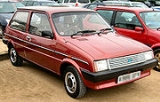
Rover Metro

Encyclopedia
The Metro is a supermini car
Supermini car
A supermini is a British term that describes automobiles larger than a city car but smaller than a small family car. This car class is also known as the B-segment across Europe, and as subcompact in North America....
that was produced by the Austin Rover Group
Austin Rover Group
The Austin Rover Group was a British motor manufacturer. It was formed in 1981 as the mass-market car manufacturing subsidiary of British Leyland...
division of British Leyland and its successors. It was launched in 1980 as the Austin miniMetro. It was intended to complement the Mini
Mini
The Mini is a small car that was made by the British Motor Corporation and its successors from 1959 until 2000. The original is considered a British icon of the 1960s, and its space-saving front-wheel-drive layout influenced a generation of car-makers...
, and was developed under the codename LC8.
During its 18-year lifespan, the Metro wore many names: Austin Metro, MG Metro and Rover Metro. It was re-badged as the Rover 100 series in 1994. There were also van versions known as the Morris Metro and later, Metrovan.
At the time of its launch, the Metro was sold as an Austin
Austin Motor Company
The Austin Motor Company was a British manufacturer of automobiles. The company was founded in 1905 and merged in 1952 into the British Motor Corporation Ltd. The marque Austin was used until 1987...
. From 1982, MG
MG (car)
The MG Car Company is a former British sports car manufacturer founded in the 1920s by Cecil Kimber. Best known for its two-seat open sports cars, MG also produced saloons and coupés....
versions became available. From 1990 until its withdrawal in 1997, the Metro was sold only as a Rover
Rover (car)
The Rover Company is a former British car manufacturing company founded as Starley & Sutton Co. of Coventry in 1878. After developing the template for the modern bicycle with its Rover Safety Bicycle of 1885, the company moved into the automotive industry...
.
Although the new Rover 200 (introduced in 1995 and smaller than previous 200 models) had originally been designed as a replacement for the Metro, it was not marketed as such after its launch. A direct replacement in the supermini
Supermini car
A supermini is a British term that describes automobiles larger than a city car but smaller than a small family car. This car class is also known as the B-segment across Europe, and as subcompact in North America....
class did not arrive until 2003 with the CityRover. The Rover 100 finally ceased production in 1997, ironically being out-lived (by two years) by the original Mini it was meant to replace.
Austin/MG Metro
On 8 October 1980, BL introduced the Austin mini Metro. It was intended as a big brother, rather than as a replacement, for the MiniMini
The Mini is a small car that was made by the British Motor Corporation and its successors from 1959 until 2000. The original is considered a British icon of the 1960s, and its space-saving front-wheel-drive layout influenced a generation of car-makers...
, the earlier Mini replacement project, ADO88, having been replaced in late 1977 by a new project, LC8, for the development of a larger car which could compete more effectively with the successful supermini
Supermini
A superminicomputer, or supermini, is “a minicomputer with high performance compared to ordinary minicomputers.” The term was an invention used from the mid-1970s mainly to distinguish the emerging 32-bit minis from the classical 16-bit minicomputers...
s, such as the Ford Fiesta
Ford Fiesta
The Ford Fiesta is a front wheel drive supermini/subcompact manufactured and marketed by Ford Motor Company and built in Europe, Brazil, Argentina, Mexico, Venezuela, China, India, Thailand and South Africa...
and Vauxhall Chevette
Vauxhall Chevette
The Chevette was a supermini model of car manufactured by Vauxhall in the UK from 1975 to 1984. It was Vauxhall's version of the family of small "T-Cars" from Vauxhall's parent General Motors ; the family included the Opel Kadett in Germany, the Isuzu Gemini in Japan, the Holden Gemini in...
. Some of the Mini's underpinnings were carried over into the Metro, namely the 998 cc and 1275 cc A-Series engines
BMC A-Series engine
Austin Motor Company's small straight-4 automobile engine, the A-Series, is one of the most common in the world. Launched in 1951 with the Austin A30, production lasted until 2000 in the Mini. It used a cast-iron block and cylinder head, and a steel crankshaft with 3 main bearings...
, much of the front-wheel drivetrain
Powertrain
In a motor vehicle, the term powertrain or powerplant refers to the group of components that generate power and deliver it to the road surface, water, or air. This includes the engine, transmission, drive shafts, differentials, and the final drive...
and four-speed manual gearbox
Transmission (mechanics)
A machine consists of a power source and a power transmission system, which provides controlled application of the power. Merriam-Webster defines transmission as: an assembly of parts including the speed-changing gears and the propeller shaft by which the power is transmitted from an engine to a...
, and suspension subframes. The Metro used the Hydragas suspension system found on the Allegro
Austin Allegro
The Austin Allegro is a small family car manufactured by British Leyland under the Austin name from 1973 until 1983. The same vehicle was built in Italy by Innocenti between 1974 and 1975 and sold as the Innocenti Regent...
but without front to rear interconnection. The hatchback
Hatchback
A Hatchback is a car body style incorporating a shared passenger and cargo volume, with rearmost accessibility via a rear third or fifth door, typically a top-hinged liftgate—and features such as fold-down rear seats to enable flexibility within the shared passenger/cargo volume. As a two-box...
body shell was one of the most spacious of its time and this was a significant factor in its popularity. Initially, the Metro was sold as a three-door hatchback.
The name was chosen through a ballot of BL employees. They were offered a choice of three names, Match, Maestro or Metro. Once the result was announced, the manufacturer of trains and buses, Metro Cammell, objected to the use of the Metro name by BL. The issue was resolved by BL promising to advertise the car only as the miniMetro.
A two-door saloon model was included in the Metro's development, which would have been similar in concept to the Vauxhall Chevette
Vauxhall Chevette
The Chevette was a supermini model of car manufactured by Vauxhall in the UK from 1975 to 1984. It was Vauxhall's version of the family of small "T-Cars" from Vauxhall's parent General Motors ; the family included the Opel Kadett in Germany, the Isuzu Gemini in Japan, the Holden Gemini in...
saloon as well as the Volkswagen Polo
Volkswagen Polo
The Volkswagen Polo is a supermini car manufactured by Volkswagen. It is sold in Europe and other markets worldwide in hatchback, saloon, coupé and estate variants....
based Derby
Volkswagen Derby
The Volkswagen Derby is a saloon or booted or three-box version of the Volkswagen Polo supermini, produced by the German automobile maker Volkswagen, between 1977 and 1981....
. However, by the time production of the Metro began, it was decided not to include a saloon version; this niche being filled by the Mini remaining in production.
At the time of its launch, the Metro was hailed as British Leyland's saviour, as the company was facing a serious financial crisis and there were fears that it could go out of business. British Leyland's troubles were largely attributed to out-of-date technology and design of most of its model range. The Mini, for example, had been in production for 21 years by the time of the Metro's launch. The Austin Allegro
Austin Allegro
The Austin Allegro is a small family car manufactured by British Leyland under the Austin name from 1973 until 1983. The same vehicle was built in Italy by Innocenti between 1974 and 1975 and sold as the Innocenti Regent...
was seven years old and the Morris Ital
Morris Ital
The Morris Ital was a medium-sized saloon car built by British Leyland from 1980 until 1984.-Design and launch:The Ital was first launched on 1 July 1980. It took its name from Giorgetto Giugiaro's ItalDesign studio, who had been employed by BL to manage the re-engineering of Morris Marina, a car...
was also launched in 1980 but was effectively a reworked version of the nine-year-old Morris Marina
Morris Marina
The Morris Marina is a car which was manufactured by the Morris division of British Leyland in the UK throughout the 1970s, which was a period of great turbulence and difficulty for the British car industry. It was known in some markets as the Austin Marina, Leyland Marina, and Morris 1.7...
, and BL's latest all-new car was the 1976 Rover SD1
Rover SD1
Rover SD1 is both the code name and eventual production name given to a series of large executive cars made by British Leyland or BL through its Specialist, Rover Triumph and Austin Rover divisions from 1976 until 1986....
.
One of the consequences was that there was enormous public interest in the car from well before its launch. The company chose to stage the launch presentations for dealers and major company car buyers on board a cruise ship, the MS Vistafjord. The news broke in the national newspapers a full year ahead of the public launch with The Sun
The Sun (newspaper)
The Sun is a daily national tabloid newspaper published in the United Kingdom and owned by News Corporation. Sister editions are published in Glasgow and Dublin...
, among others, carrying the story. It was finally revealed to the public on the press day of the British Motor Show with the British Prime Minister, Margaret Thatcher
Margaret Thatcher
Margaret Hilda Thatcher, Baroness Thatcher, was Prime Minister of the United Kingdom from 1979 to 1990...
in attendance.
The Metro quickly proved popular with buyers, and during the early part of its production life it was the best selling mini-car in the UK, before being eclipsed by the updated Ford Fiesta
Ford Fiesta
The Ford Fiesta is a front wheel drive supermini/subcompact manufactured and marketed by Ford Motor Company and built in Europe, Brazil, Argentina, Mexico, Venezuela, China, India, Thailand and South Africa...
. Its clever interior design made it spacious considering its dimensions, and Hydragas compensation gave surprisingly good ride and handling. Its updated A+ series 1.0 and 1.3L OHV engines hardly represented the cutting edge in performance, but they were strong on economy.
A major TV
Television
Television is a telecommunication medium for transmitting and receiving moving images that can be monochrome or colored, with accompanying sound...
advertising
Advertising
Advertising is a form of communication used to persuade an audience to take some action with respect to products, ideas, or services. Most commonly, the desired result is to drive consumer behavior with respect to a commercial offering, although political and ideological advertising is also common...
campaign was created by the London agency, Leo Burnett which came up with the headline "a British car to beat the world". The advert also featured the similar-sized Fiat 127
Fiat 127
The Fiat 127 is a supermini produced by the Italian automaker Fiat between 1971 and 1983. It was introduced in 1971 as the replacement for the Fiat 850...
, Renault 5
Renault 5
The Renault 5 was first unveiled on 10 December 1971, being launched at the beginning of 1972.The Renault 5 was styled by Michel Boué, who died before the car's release, the R5 featured a steeply sloping rear hatchback and front dashboard...
, Volkswagen Polo
Volkswagen Polo
The Volkswagen Polo is a supermini car manufactured by Volkswagen. It is sold in Europe and other markets worldwide in hatchback, saloon, coupé and estate variants....
and Datsun Cherry as "foreign invaders
Invasion
An invasion is a military offensive consisting of all, or large parts of the armed forces of one geopolitical entity aggressively entering territory controlled by another such entity, generally with the objective of either conquering, liberating or re-establishing control or authority over a...
" and the voiceover spoke of the Metro's ability to "send the foreigners back where they belong". Patriotism was very much the theme of the early advertising campaign for the Metro at a time when, following the Falklands War
Falklands War
The Falklands War , also called the Falklands Conflict or Falklands Crisis, was fought in 1982 between Argentina and the United Kingdom over the disputed Falkland Islands and South Georgia and the South Sandwich Islands...
, patriotism was a common marketing tool for British companies. Following the launch of the Austin Maestro
Austin Maestro
The Austin Maestro is a compact-sized 5-door hatchback car that was produced from 1983 to 1994, initially by the Austin Rover subsidiary of British Leyland , and from 1988 onwards by its successor, Rover Group. The car was produced at the former Morris plant in Cowley, Oxford. It was initially...
in 1983, less of British Leyland's advertising was focused on the Metro, which by 1983 had achieved strong sales.

Vanden Plas
Vanden Plas is the name of a company of coachbuilders who produced bodies for specialist and up-market automobile manufacturers. Latterly the name became a top-end luxury model designation for cars from various subsidiaries of British Leyland and the Rover Group.-Belgium:It originated in Belgium in...
and MG
MG (car)
The MG Car Company is a former British sports car manufacturer founded in the 1920s by Cecil Kimber. Best known for its two-seat open sports cars, MG also produced saloons and coupés....
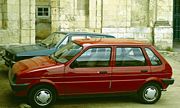
versions. The Vanden Plas featured higher levels of luxury and equipment, while the slightly more powerful MG Metro 1.3 sold as a sports model (0-60 mph in 10.1 seconds, top speed 105 mph). The Vanden Plas variant received the same MG engine from 1984 onwards (with the exception of the VP Automatic, which retained the 63 bhp 1275 cc unit). The luxury fittings marking out the Metro Vanden Plas took the form of a radio-cassette player, electric front windows, an improved instrument panel with tachometer
Tachometer
A tachometer is an instrument measuring the rotation speed of a shaft or disk, as in a motor or other machine. The device usually displays the revolutions per minute on a calibrated analogue dial, but digital displays are increasingly common...
, and a variety of optional extras such as trip computer
Trip computer
A trip computer is an onboard computer device fitted to cars which can generally record distance travelled, average speed, average fuel consumption, and display real time fuel consumption information...
, leather trim, remote boot
Trunk (automobile)
The trunk or boot of an automobile or car is the vehicle's main storage, luggage, or cargo compartment. Trunk is used in North American English and Jamaican English; boot is used elsewhere in the English speaking world. Trunk is also primarily used in many non-English speaking regions, such as...
release, and front fog lamps.
The changes between the MG engine and the standard 1275 included a modified cylinder head
Cylinder head
In an internal combustion engine, the cylinder head sits above the cylinders on top of the cylinder block. It closes in the top of the cylinder, forming the combustion chamber. This joint is sealed by a head gasket...
, with larger valves and imporved porting, altered cam
Camshaft
A camshaft is a shaft to which a cam is fastened or of which a cam forms an integral part.-History:An early cam was built into Hellenistic water-driven automata from the 3rd century BC. The camshaft was later described in Iraq by Al-Jazari in 1206. He employed it as part of his automata,...
profile and larger carburettor leading to a 20% increase in BHP. Soon afterwards, the MG Metro Turbo
Turbocharger
A turbocharger, or turbo , from the Greek "τύρβη" is a centrifugal compressor powered by a turbine that is driven by an engine's exhaust gases. Its benefit lies with the compressor increasing the mass of air entering the engine , thereby resulting in greater performance...
variant was released with a quoted bhp of 93, 0-60 mph in 8.9 seconds, and top speed of 115 mph (185 km/h). This model had a great many modifications over the normally aspirated
Naturally-aspirated engine
A naturally aspirated engine is one common type of reciprocating piston internal combustion engine that depends solely on atmospheric pressure to counter the partial vacuum in the induction tract to draw in combustion air...
MG model. Aside from the turbocharger and exhaust system itself, and what was (at the time) a relatively sophisticated boost delivery and control system, the MG Turbo variant incorporated stiffer suspension
Suspension (vehicle)
Suspension is the term given to the system of springs, shock absorbers and linkages that connects a vehicle to its wheels. Suspension systems serve a dual purpose — contributing to the car's roadholding/handling and braking for good active safety and driving pleasure, and keeping vehicle occupants...
(purportedly with engineering input from Lotus
Lotus Cars
Lotus Cars is a British manufacturer of sports and racing cars based at the former site of RAF Hethel, a World War II airfield in Norfolk. The company designs and builds race and production automobiles of light weight and fine handling characteristics...
), including a rear anti-rollbar plus uprated crankshaft.
Both MG variants were given a "sporty" interior with red seat belts, red carpets and a sports-style steering wheel. The later MG variants were emblazoned with the MG logo both inside and out, which only served to fuel claims of badge engineering
Badge engineering
Badge engineering is an ironic term that describes the rebadging of one product as another...
from some of the more steadfast MG enthusiasts. Others believed that this sentiment was unfounded, particularly in the case of the turbo variant, due to the undeniably increased performance and handling when compared to the non-MG models. Indeed, at the time of its release, the MG Metro was the first in a succession of modern cars which heralded a spirited return of the MG marque after several years' absence of new MGs.
A mild facelift during 1985 saw some minor styling modifications to the Metro's front end, wider suspension subframes, along with a new dashboard design and the long-awaited 5-door version.
A rear spoiler
Spoiler (automotive)
A spoiler is an automotive aerodynamic device whose intended design function is to 'spoil' unfavorable air movement across a body of a vehicle in motion. Spoilers on the front of a vehicle are often called air dams, because in addition to directing air flow they also reduce the amount of air...
reduced drag coefficient
Drag coefficient
In fluid dynamics, the drag coefficient is a dimensionless quantity that is used to quantify the drag or resistance of an object in a fluid environment such as air or water. It is used in the drag equation, where a lower drag coefficient indicates the object will have less aerodynamic or...
to increase the Metro's already good fuel economy, and the hydraulic clutch (often berated as the cause of the Metro's particularly harsh gearchange) was replaced by a cable-operated mechanism. The lack of a 5-speed transmission would become a major handicap as time went on; the BMC sump-mounted gearbox was never developed to accommodate an extra gear ratio
Gear ratio
The gear ratio of a gear train is the ratio of the angular velocity of the input gear to the angular velocity of the output gear, also known as the speed ratio of the gear train. The gear ratio can be computed directly from the numbers of teeth of the various gears that engage to form the gear...
, which was a severe handicap against the opposition - by the mid 1980s the Ford Fiesta
Ford Fiesta
The Ford Fiesta is a front wheel drive supermini/subcompact manufactured and marketed by Ford Motor Company and built in Europe, Brazil, Argentina, Mexico, Venezuela, China, India, Thailand and South Africa...
, Peugeot 205
Peugeot 205
The Peugeot 205 is a supermini produced by the French car manufacturer Peugeot between 1983 and 1998. It was declared 'Car of the Decade' by CAR magazine in 1990. The 205 won 1984 What Car? car of the year.-History:...
, Fiat Uno
Fiat Uno
The Fiat Uno is a supermini car produced by the Italian manufacturer Fiat. The Uno was launched in 1983 and built in its homeland until 1995, with production still taking place in other countries.-First series :...
and General Motors
General Motors
General Motors Company , commonly known as GM, formerly incorporated as General Motors Corporation, is an American multinational automotive corporation headquartered in Detroit, Michigan and the world's second-largest automaker in 2010...
' Corsa/Nova
Opel Corsa
The front-wheel drive Opel Corsa was first launched in September 1982 to replace the Opel Kadett C City, and to fill the gap vacated as the Kadett grew in size and price. Built in Zaragoza, Spain, the first Corsas were three-door hatchback and two-door saloon models, with four-door and five-door...
were all available with a 5-speed option. The Hydragas suspension also gave the car a harsh, bouncy ride despite pleas from the system's inventor, Dr. Alex Moulton
Alex Moulton
Dr. Alexander Eric Moulton CBE is an English engineer and inventor, specialising in suspension design.Moulton is the great-grandson of the rubber pioneer Stephen Moulton, the founder of the family business George Spencer Moulton & Co...
, that it should be interconnected front-to-rear as opposed to side-to-side at the rear only as was found on the production version.
The Austin Metro was a huge seller in Britain, with some 1,000,000 being sold over a 10-year production run. The MK3 Ford Escort was the only single model to outsell it in Britain throughout the 1980s, and by December 1989 only the MK3 Ford Escort was a more common model on British roads.
However, it gained a reputation for unreliability and lacklustre build quality early in its career which dented its appeal in foreign markets, where the likes of the Volkswagen Polo
Volkswagen Polo
The Volkswagen Polo is a supermini car manufactured by Volkswagen. It is sold in Europe and other markets worldwide in hatchback, saloon, coupé and estate variants....
, Fiat Uno
Fiat Uno
The Fiat Uno is a supermini car produced by the Italian manufacturer Fiat. The Uno was launched in 1983 and built in its homeland until 1995, with production still taking place in other countries.-First series :...
and Peugeot 205
Peugeot 205
The Peugeot 205 is a supermini produced by the French car manufacturer Peugeot between 1983 and 1998. It was declared 'Car of the Decade' by CAR magazine in 1990. The 205 won 1984 What Car? car of the year.-History:...
were firmly established favourites.
October 2010 marks the 30th anniversary of the launch of the Metro, which is now a very rare sight on Britain's roads.
Engines
- 1980–90: 998 cc A-Series I4Straight-4The inline-four engine or straight-four engine is an internal combustion engine with all four cylinders mounted in a straight line, or plane along the crankcase. The single bank of cylinders may be oriented in either a vertical or an inclined plane with all the pistons driving a common crankshaft....
, 48 hp (35 kW) at 5500 rpm and 54 ft·lbf (73 Nm) at 3250 rpm - 1980–90: 1275 cc A-Series I4Straight-4The inline-four engine or straight-four engine is an internal combustion engine with all four cylinders mounted in a straight line, or plane along the crankcase. The single bank of cylinders may be oriented in either a vertical or an inclined plane with all the pistons driving a common crankshaft....
, 60 hp (44 kW) at 5250 rpm and 72 ft·lbf (98 Nm) at 3200 rpm - 1982–89: 1275 cc A-Series I4Straight-4The inline-four engine or straight-four engine is an internal combustion engine with all four cylinders mounted in a straight line, or plane along the crankcase. The single bank of cylinders may be oriented in either a vertical or an inclined plane with all the pistons driving a common crankshaft....
, 72 hp (54 kW) at 6000 rpm and 75 ft·lbf (99 Nm) at 4000 rpm (MG Metro) - 1983–89: 1275 cc A-Series turbo I4Straight-4The inline-four engine or straight-four engine is an internal combustion engine with all four cylinders mounted in a straight line, or plane along the crankcase. The single bank of cylinders may be oriented in either a vertical or an inclined plane with all the pistons driving a common crankshaft....
, 93 hp (69 kW) at 6200 rpm and 85 ft·lbf (115 Nm) at 2650 rpm (MG Metro Turbo) - 1989–90: 1275 cc A-Series I4Straight-4The inline-four engine or straight-four engine is an internal combustion engine with all four cylinders mounted in a straight line, or plane along the crankcase. The single bank of cylinders may be oriented in either a vertical or an inclined plane with all the pistons driving a common crankshaft....
, 72 hp (54 kW) at 6000 rpm and 75 ft·lbf (99 Nm) at 4000 rpm (Metro GTa)
Rover Metro
At the end of 1987, the Austin marque was shelved. The Austin badge was removed from the cars, which continued to be manufactured with no marque badge, just a model name badge. Rover management never allowed Rover badges on the Montego or the Maestro in their home market, although they were sometimes referred to as "Rovers" in the press and elsewhere. They wore badges that were the same shape as the Rover longship badge, but which did not say "Rover". The Metro did too until May 1990, when it was officially relaunched as the Rover Metro, heavily revised and fitted with a new range of engines.
The ageing 998 cc and 1275 cc A-Series engines - which had been in use since the late 1950s - gave way to the K-Series 8 valve engines and a 16 valve engine in the GTi (early variants were 95 bhp Spi & later Mpi version 103 bhp) and the early GTa. All models used bought in end-on Peugeot gearboxes. In 1993, a 1.4 PSA
PSA Peugeot Citroën
PSA Peugeot Citroën is a French manufacturer of automobiles and motorcycles sold under the Peugeot and Citroën marques. Headquartered in the 16th arrondissement of Paris, PSA is the second largest automaker based in Europe and the number eight in the world.-History:In December 1974 Peugeot S.A....
TUD
TUD
TUD can refer to:*The Darmstadt University of Technology *The Dresden University of Technology...
diesel from the Citroën AX
Citroën AX
The Citroën AX is a supermini built by the French manufacturer Citroën from 1986 to 1998. The AX was launched at the 1986 Paris Motor Show to replace the Citroën Visa and Citroën LNA.-Overview:...
/ Peugeot 106
Peugeot 106
The Peugeot 106 is a supermini produced by French automaker Peugeot from 1991 to 2004.-Phase I:The Peugeot 106 was introduced on 12 September 1991, as the French marque's entry level car slotting in beneath the 205 - although it is now largely considered the 'true' replacement to the 205. It was a...
was launched. The Hydragas suspension was finally modified to accept front to rear interconnection in the way that Alex Moulton so desperately wanted to bring the car back up to standard in terms of handling and ride quality.
A new bodyshell was designed, but cancelled by Chairman Graham Day, because British Aerospace (the then new owners) refused to fund it. A mockup could be seen at the Canley, Coventry design centre in the 1990s during open days. The basic bodyshell was retained, but was improved with the addition of new plastic front and rear bumpers, new front wings, new rear lights and bootlid, new front headlamps and bonnet. The interior was altered with a new rounded instrument binnacle and instruments, new steering wheel, new seats (from the successful Rover 200 series), new door casings and other detail improvements. General build quality, fit and finish was improved enormously from the old Metro.
Now badged as a Rover, the Metro's build quality, driving manners and reliability were so much improved that it was brought to the top of the supermini class, winning What Car?
What Car?
What Car? is a long-running UK monthly automobile magazine and website, currently edited by Steve Fowler and published by Haymarket Motoring. First published in 1973, it is intended primarily as a magazine for consumers rather than dedicated automobile enthusiasts...
"Car of The Year" in 1991. Throughout the early 1990s it competed quite effectively with more recent designs such as the Opel/Vauxhall Corsa
Opel Corsa
The front-wheel drive Opel Corsa was first launched in September 1982 to replace the Opel Kadett C City, and to fill the gap vacated as the Kadett grew in size and price. Built in Zaragoza, Spain, the first Corsas were three-door hatchback and two-door saloon models, with four-door and five-door...
, Peugeot 106
Peugeot 106
The Peugeot 106 is a supermini produced by French automaker Peugeot from 1991 to 2004.-Phase I:The Peugeot 106 was introduced on 12 September 1991, as the French marque's entry level car slotting in beneath the 205 - although it is now largely considered the 'true' replacement to the 205. It was a...
and Ford Fiesta
Ford Fiesta
The Ford Fiesta is a front wheel drive supermini/subcompact manufactured and marketed by Ford Motor Company and built in Europe, Brazil, Argentina, Mexico, Venezuela, China, India, Thailand and South Africa...
. Sales were conceivably helped by the then fading perception of Rover as a 'premium' marque, and the fact that other premium manufacturers had not yet entered the supermini segment. This though was undermined by the all too obviously re-used 1970s designed bodyshell.
In many export markets, including Italy
Italy
Italy , officially the Italian Republic languages]] under the European Charter for Regional or Minority Languages. In each of these, Italy's official name is as follows:;;;;;;;;), is a unitary parliamentary republic in South-Central Europe. To the north it borders France, Switzerland, Austria and...
, the Rover Metro was badged as the Rover 100 series.
Latterly this car has attracted an enthusiastic following including use as a low-cost entry to motor racing. The basic just-over-100 bhp engine for the GTI can be boosted to over 130 hp at the flywheel. For ultimate performance the 1.8 K-series engine, with standard cams or VVC (Variable Valve Control) system can be fitted (these engines are found in the MGF and Lotus Elise sports cars, as well as various Rovers and MGs). The Metro currently holds the unusual title of eastern Europe's quickest front wheel drive drag car (Zastec tuning in Poland).
Rover 100
In the autumn of 1994, Rover scrapped the Metro nameplate, replacing it with a new name, Rover 100, which had been adopted on continental Europe on the Rover Metro's launch in 1990, due to the weakness of the Austin marque in Europe.
The mechanics of the car remained much the same with 1.1 and 1.4 petrol engines and Hydragas suspension, but there was now the option of a Peugeot
Peugeot
Peugeot is a major French car brand, part of PSA Peugeot Citroën, the second largest carmaker based in Europe.The family business that precedes the current Peugeot company was founded in 1810, and manufactured coffee mills and bicycles. On 20 November 1858, Emile Peugeot applied for the lion...
-sourced 1.5 diesel. The exterior was altered to disguise the car's age, meet the increased cooling requirements of the Peugeot motor and offer a reduced-format Rover family grille. This was achieved through fitment of new front and rear bumpers, sill covers, rear boot handle and lamps headlamps, bonnet and grille.
A variety of bolder paint colours and the use of chrome trim helped give a more upmarket appearance. The interior trim was revised to give a greater impression of quality and luxury, but as there were no changes to the basic architecture it was considered by many as being short on space and outdated in comparison to its most modern rivals (most of which had been replaced with all-new models since the launch of the Rover Metro) It was criticised by the press for its lack of equipment, with front electric windows only available on the range topping 114 GSi. Rear electric windows were never an option on the 100. Neither were Anti-Lock Brakes, Power Steering or a rev counter (except the GTa and later manual 114 GSi models) One saving grace for the 100 was the option of full leather trim, a rarity in a small car and coupled with the standard wood veneer dashboard inserts, a tinted glass sunroof and the optional wood veneer door cappings, the 114 GSi made for traditional luxury motoring; an image Rover was trying to retain. The only safety efforts came in the form of an optional drivers airbag, an alarm, a passive engine imobiliser, a removable radio keypad, central locking and side intrusion beams. Overall, the 100 series was considered a rather typical facelift of a car which had been a class leader on launch but had now been overtaken by events.
Rover 114 GTa
A 'hot' version of the 100 called the 114 GTa was available from launch. The main differences over the 114 SLi 3 door was sports seats, red seatbelts, a rev counter, sports suspension, a slightly higher top speed, faster acceleration, GSi alloy wheels and GTa badging. It was only available as a 3-door.
End of the line...
In 1997, the Rover 100 gave a poor performance in EuroNCAP
EuroNCAP
The European New Car Assessment Programme is a European car safety performance assessment programme based in Brussels and founded in 1997 by the Transport Research Laboratory for the UK Department for Transport and backed by several European governments.-History and activities:Euro NCAP is a...
crash tests (despite the improved safety features, including side impact bars in the doors and an optional driver's airbag, the 1970s design was showing its age) - it was at the time the only car tested to receive a one-star Adult Occupant Rating. Other superminis tested at the same time received 2 or 3 stars out of five. The passenger compartment was subjected to severe structural damage in the frontal-offset test and results showed a high risk of injury to all body regions for the driver. Meanwhile, the side impact test also showed high injury risks.
The Rover 100's dismal safety showing was not its only problem by 1997. It was fast falling behind the best cars in its sector when it came to design, build quality, refinement and specification, although it remained strong in terms of fuel economy and affordability. Unlike the Ford Fiesta, Volkswagen Polo
Volkswagen Polo
The Volkswagen Polo is a supermini car manufactured by Volkswagen. It is sold in Europe and other markets worldwide in hatchback, saloon, coupé and estate variants....
and Vauxhall Corsa, the Rover 100 could still provide sub-£7,000 motoring.
Facing a complete collapse of sales, Rover withdrew the 100 from production - marking the end of nearly 18 years of production.
There was no direct replacement for the Metro/100, although the 1995 Rover 200 had been developed inside Rover Cars to serve as a replacement for the 100 as well as the previous 200 model, which was slightly larger. The 100 and 200 were sold concurrently until 1998, when the 100 was withdrawn. When the Rover 200 was facelifted in late 1999 and rebadged as the Rover 25, Rover marketed this as a supermini reflecting the continued, steady, growth of all car classes. The plan was for the both the 100 and the 25 to be on the market until the launch of the true replacement for the Metro in the shape of the MINI
Mini
The Mini is a small car that was made by the British Motor Corporation and its successors from 1959 until 2000. The original is considered a British icon of the 1960s, and its space-saving front-wheel-drive layout influenced a generation of car-makers...
. However, BMW's sale of Rover put an end to those plans. BMW kept the MINI design and MG Rover's notional successor to the Metro was the Rover 25 and its MG ZR
MG ZR
The MG ZR is a high-performance MG-branded "hot hatch" version of the Rover 25 supermini-class car, produced by MG Rover at their Longbridge plant in Birmingham from 2001 to 2005...
badge-engineered relative.
The gap left by the Metro as a true Rover supermini was not filled even in late 2003, when the CityRover was launched – it was a 1.4 engined supermini built in India
India
India , officially the Republic of India , is a country in South Asia. It is the seventh-largest country by geographical area, the second-most populous country with over 1.2 billion people, and the most populous democracy in the world...
alongside the Tata Indica
Tata Indica
The Tata Indica is a hatchback automobile range manufactured by Tata Motors of India. It is the first passenger car from Tata Motors and is also considered India's first indigenously developed passenger car. , more than 910,000 Indicas were produced. The annual sales of Indica has been as high as ...
. This model was nowhere near as popular as the Metro or even the Rover 100, and was not included in the revived product range by Nanjing Automobile following MG Rover's bankruptcy in 2005.
Metro 6R4 rally car
Created for the short lived Group B
Group B
Group B was a set of regulations introduced in 1982 for competition vehicles in sportscar racing and rallying regulated by the FIA. The Group B regulations fostered some of the quickest, most powerful and sophisticated rally cars ever built. However, a series of major accidents, some fatal, were...
race category, the 4WD
Four-wheel drive
Four-wheel drive, 4WD, or 4×4 is a four-wheeled vehicle with a drivetrain that allows all four wheels to receive torque from the engine simultaneously...
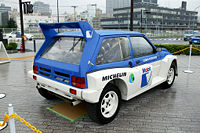
mid engined MG 6R4 (6-cylinder, rally car, four-wheel-drive) Metro of 1984 was a world away from the best selling supermini to which it bore only a superficial cosmetic resemblance. The competition car effectively only shared the name of the production Metro as it featured a mid-mounted engine with four wheel drive transmission enclosed within a seam-welded tubular chassis. The development of this vehicle had been entrusted to Williams Grand Prix Engineering.
The resulting car was shown to the world in May 1985. It was powered by a David Wood designed bespoke 3-litre V6 powerplant which used some of the engine architecture of the Cosworth DFV
Cosworth DFV
The DFV is an internal combustion engine that was originally produced by Cosworth for Formula One motor racing. Named Four Valve because of the four valves per cylinder, and Double as it was a V8 development of the earlier, four-cylinder FVA , making it a Double Four Valve engine...
. It featured twin overhead camshafts and four valves per cylinder. The engine was a break from the norm, as it wasn't turbocharged as the majority of its competitors were. The engine was mounted back to front in the car, with the forward end of the engine facing the hatchback and the gearbox attached conventionally behind it and, therefore, in the middle of the vehicle. The four-wheel-drive was permanently engaged, and drove separate propshafts to the front and rear differentials. The rear differential was mounted on the side of the engine sump with one driveshaft running through the sump to the nearside rear wheel. Much of the outer bodywork was made of GRP
Glass-reinforced plastic
Fiberglass , is a fiber reinforced polymer made of a plastic matrix reinforced by fine fibers of glass. It is also known as GFK ....
, with the only exception being the roof panels (which were aluminium) and the steel doors. These were, however, concealed by plastic airboxes. Indeed, models now on show generally have stickers demonstrating where it is safe to push from when moving the vehicle, so as not to damage the bodywork.
The 6R4 appeared in two guises. There was a so-called Clubman model which was the road going version which developed in the region of 250 bhp, of which around 200 were made and sold to the public for £40,000 (the homologation version). A further 20 were taken and built to International specifications which had a recorded output of over 410 bhp
Rover (car)
The Rover Company is a former British car manufacturing company founded as Starley & Sutton Co. of Coventry in 1878. After developing the template for the modern bicycle with its Rover Safety Bicycle of 1885, the company moved into the automotive industry...
announced that it would complete the necessary number of cars required for homologation by November of that year. This was undertaken at the group's large manufacturing facility at Longbridge
Longbridge
Longbridge is an area of Birmingham, England. For local government purposes it is a ward within the district of Northfield.Since 1905, the area has been dominated by the Longbridge plant, which produced Austin, Nash Metropolitan, Morris, British Leyland, and most recently MG Rover cars...
. The car was to participate in the Lombard RAC rally
Rally GB
Wales Rally GB is the largest and most high profile motor rally in the United Kingdom. It is a round of the FIA World Rally Championship and was formerly a round of the MSA British Rally Championship and is based in and around the city of Cardiff in Wales...
in November 1985, and an example, driven by works driver Tony Pond
Tony Pond
Tony Pond was a well-known British rally driver.-Career:His first outings in a rally car were on the then regular Saturday night road rallies in the home counties around London, driving a Mini Cooper S...
, finished a highly respectable third, behind two Lancia Delta S4
Lancia Delta S4
The Lancia Delta S4 is a Group B rally car that competed in the World Rally Championship in 1985 and 1986, until Group B cars were banned from competition by the FIA. The car replaced and was an evolution of the Lancia 037 Monte Carlo. The S4 took full advantage of the Group B regulations, and...
s.
This good start was unfortunately not repeated, and although a 6R4 was entered in rallies at Monte Carlo
Monte Carlo
Monte Carlo is an administrative area of the Principality of Monaco....
, Sweden
Sweden
Sweden , officially the Kingdom of Sweden , is a Nordic country on the Scandinavian Peninsula in Northern Europe. Sweden borders with Norway and Finland and is connected to Denmark by a bridge-tunnel across the Öresund....
, Portugal
Portugal
Portugal , officially the Portuguese Republic is a country situated in southwestern Europe on the Iberian Peninsula. Portugal is the westernmost country of Europe, and is bordered by the Atlantic Ocean to the West and South and by Spain to the North and East. The Atlantic archipelagos of the...
and Corsica
Corsica
Corsica is an island in the Mediterranean Sea. It is located west of Italy, southeast of the French mainland, and north of the island of Sardinia....
during the 1986 season, none of the Metros managed to complete a course. The majority of these problems were related to the V6 powerplant which suffered teething issues. Halfway during the 1986 season, Group B was banned (following a series of fatal crashes in which both competitors and spectators lost their lives). From that point on, the 6R4 was always going to be limited in front line competition, although they were run with limited success for the remainder of the year. A number passed into private hands and have proved formidable rally and rallycross cars. Despite the expiry of the 6R4's homologation the MSA still allow the cars to run in competition although engine sizes have been limited to 2800cc (single plenum engines) and 2500cc (multi-plenum engines).
Austin Rover withdrew from the rallying scene at the end of the season, but in 1987 all the parts and engines were sold to Tom Walkinshaw Racing
Tom Walkinshaw Racing
Tom Walkinshaw Racing , was an auto racing team and engineering firm founded in 1976 by touring car racer Tom Walkinshaw.-History:TWR started by modifying BMW 3.0 CSLs, but soon was contracted to head Mazda's works program in the British Touring Car Championship. The TWR developed RX-7, with Win...
, whereupon the V6 engine reappeared under the bonnet of the Jaguar XJ220
Jaguar XJ220
The Jaguar XJ220 is a mid-engined supercar produced by Jaguar in collaboration with Tom Walkinshaw Racing as Jaguar Sport between 1992 and 1994. It held the record for the highest top speed of a production car , until the arrival of the McLaren F1 in 1994...
, this time with turbochargers added.
Popularity
The Metro remained one of Britain's most popular cars throughout its production life, even during its final year when it was among the oldest designs on sale in the country. During its early years the Austin Metro was Britain's most popular supermini, often outselling the Ford Fiesta. By the time of the Rover Metro's demise in late 1994, 1,370,000 examples of the two incarnations had been sold in the space of 14 years; averaging at nearly 100,000 sales per year.This popularity endured in spite of the Metro failing to match the durability of key rivals, notably the Nissan Micra and Volkswagen Polo
Volkswagen Polo
The Volkswagen Polo is a supermini car manufactured by Volkswagen. It is sold in Europe and other markets worldwide in hatchback, saloon, coupé and estate variants....
. This is illustrated well by the findings of Auto Express
Auto Express
Auto Express is a weekly motoring magazine sold in the United Kingdom published by Dennis Publishing. The Editor-in-Chief is Steve Fowler.Launched in September 1988, its 1000th issue was published on 20 February 2008. It's only weekly competitor in Britain is the long established Autocar...
s 2006 survey which named the Metro as Britain's seventh most scrapped car. Just 21,468 were still in working order at the time of the survey, approximately 1.5% of all those registered. Nearly five years on, that figure has inevitably declined further, with the number remaining as of 2011 now likely to be in four figures.
Many Metros (particularly the pre-1990 Austin models) have been scrapped as a result of the bodyshell's vulnerability to rust
Rust
Rust is a general term for a series of iron oxides. In colloquial usage, the term is applied to red oxides, formed by the reaction of iron and oxygen in the presence of water or air moisture...
. Also, pre-1989 Metros cannot run on unleaded fuel without expensive conversion of the cylinder head
Cylinder head
In an internal combustion engine, the cylinder head sits above the cylinders on top of the cylinder block. It closes in the top of the cylinder, forming the combustion chamber. This joint is sealed by a head gasket...
reducing these older cars' viability as daily drivers, and often resulting in their being scrapped. An equally large number of Metros were scrapped or disappeared as a result of theft. Early Metros were notoriously easy to steal. Later Rover badged models however had better anti-theft equipment (including an engine immobiliser) which addressed this weakness.
Including the post-1994 Rover 100 Series models, a total of just under 1,500,000 Metros were sold in Britain in less than 20 years, making it the seventh most popular ever sold there.
Lady Diana Spencer (later Diana, Princess of Wales
Diana, Princess of Wales
Diana, Princess of Wales was the first wife of Charles, Prince of Wales, whom she married on 29 July 1981, and an international charity and fundraising figure, as well as a preeminent celebrity of the late 20th century...
) owned a red W-registered Metro before her engagement to Prince Charles. This car is in the Museum of British Road Transport
Coventry Transport Museum
The Coventry Transport Museum is a motor museum, located in Coventry City Centre, England. It houses a collection of British-made road transport. It is located in Coventry because the city was previously the centre of the British car industry...
, Coventry.