
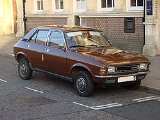
The Austin Allegro is a small family car manufactured by British Leyland under the
AustinThe Austin Motor Company was a British manufacturer of automobiles. The company was founded in 1905 and merged in 1952 into the British Motor Corporation Ltd. The marque Austin was used until 1987...
name from 1973 until 1983. The same vehicle was built in Italy by
InnocentiInnocenti was an Italian machinery works originally established by Ferdinando Innocenti in 1920.After World War II, the company was famous for many years for Lambretta scooters models such as LI125, LI150, TV175, TV200, SX125, SX150, SX200, GP125, GP150 and GP200.From 1961 to 1976 Innocenti built...
between 1974 and 1975 and sold as the Innocenti Regent. In total, 642,350 Austin Allegros were produced during its ten-year production life, most of which were sold on the home market.
Design
The Allegro was designed as the replacement for the popular Austin 1100/1300, designed by Sir Alec Issigonis. As with the
Morris MarinaThe Morris Marina is a car which was manufactured by the Morris division of British Leyland in the UK throughout the 1970s, which was a period of great turbulence and difficulty for the British car industry. It was known in some markets as the Austin Marina, Leyland Marina, and Morris 1.7...
, the car can be seen with hindsight as symptomatic of the enormous difficulties facing British Leyland during that period. The key factor that British Leyland can now be seen to have missed is that a much more useful and popular form of car, the
hatchbackA Hatchback is a car body style incorporating a shared passenger and cargo volume, with rearmost accessibility via a rear third or fifth door, typically a top-hinged liftgate—and features such as fold-down rear seats to enable flexibility within the shared passenger/cargo volume. As a two-box...
, was emerging in Europe, with designs such as the
Autobianchi A112The Autobianchi A112 is a supermini produced by the Italian automaker Autobianchi. It was developed using the mechanicals which subsequently underpinned the Fiat 127. It was introduced in 1969, as a replacement for the Bianchina and Primula, and was built until 1986, when it made way for the more...
,
Renault 16The Renault 16 is a hatchback produced by French automaker Renault between 1965 and 1980 in Le Havre, France. The reviewer in the May 1965 edition of the English "Motoring Illustrated" said: "The Renault Sixteen can thus be described as a large family car but one that is neither a four door saloon...
, and
Volkswagen GolfThe Volkswagen Golf is a small family car manufactured by Volkswagen since 1974 and marketed worldwide across six generations, in various body configurations and under various nameplates – as the Volkswagen Rabbit in the United States and Canada , and as the Volkswagen Caribe in Mexico .The...
. This configuration would go on to dominate the market for small family cars in the space of a few years. British Leyland stuck to the more traditional and less versatile booted design when they launched the Allegro. This was because of internal company politics; it had been decided that the
Austin MaxiThe Austin Maxi was a medium sized 5-door hatchback car from British Leyland for the 1970s. It was the first British five speed five-door hatchback.-History:...
should have a hatchback as its unique selling point, and that no other car in the company's line-up was allowed one. This decision hamstrung both the Allegro and the
Leyland PrincessThe Princess is a family car that was produced in the United Kingdom by British Leyland from 1975 until 1981. The car inherited a front-wheel drive / transverse engine configuration from its predecessor, the BMC ADO17 range...
, both designs naturally suited to a hatchback yet not given one.
The Allegro used
front-wheel driveFront-wheel drive is a form of engine/transmission layout used in motor vehicles, where the engine drives the front wheels only. Most modern front-wheel drive vehicles feature a transverse engine, rather than the conventional longitudinal engine arrangement generally found in rear-wheel drive and...
, using the familiar A-Series engine with a sump-mounted transmission. The higher-specification models used the SOHC E-Series engine (from the Maxi), in 1500 cc and 1750 cc displacements. The two-box saloon bodyshell was suspended using the new Hydragas system (derived from the previous
HydrolasticHydrolastic is a type of space-efficient automotive suspension system used in many cars produced by British Motor Corporation and its successor companies....
system used on the 1100/1300).
Stylistically, it went against the sharp-edged styling cues that were becoming fashionable (largely led by Italian designer
Giorgetto GiugiaroGiorgetto Giugiaro is an Italian automobile designer responsible equally for a stable of supercars and several of the most popular everyday vehicles driven today...
), and featured rounded panel work. The original styling proposal, by
Harris MannHarris Mann is a British car designer. Mann took over from Roy Haynes as chief stylist at British Leyland in 1970.-Biography:...
, had the same sleek, wedge-like shape of the
PrincessThe Princess is a family car that was produced in the United Kingdom by British Leyland from 1975 until 1981. The car inherited a front-wheel drive / transverse engine configuration from its predecessor, the BMC ADO17 range...
, but because British Leyland management, keen to control costs, wanted to install the existing E-Series engine and bulky heating system from the Marina, it became impossible to incorporate the low bonnet line as envisaged: the bodyshell began to look more and more bloated and tubby. This was acceptable to BL, however, which according to Jeff Daniels' book—
British Leyland, The Truth About The Cars, published in 1980—wanted to follow the
CitroënCitroën is a major French automobile manufacturer, part of the PSA Peugeot Citroën group.Founded in 1919 by French industrialist André-Gustave Citroën , Citroën was the first mass-production car company outside the USA and pioneered the modern concept of creating a sales and services network that...
approach of combining advanced technology with styling that eschewed mainstream trends to create long-lasting "timeless" models. Its unfashionable shape was thus not a problem. The final car bore little resemblance to Mann's original concept that had originally been conceived as an 1100/1300 re-skin. This, as well as British Leyland's faith in it as a model that would help turn the company around, led to it earning the early nickname of the "flying pig". The car was offered in the usual range of British Leyland colours; notably beige, brown, and green.
With the Allegro, the makers avoided the full extent of
badge engineeringBadge engineering is an ironic term that describes the rebadging of one product as another...
that defined the marketing of
its predecessorADO16 is the codename for the development of what became the Morris 1100, a small family car built by the British Motor Corporation and, later, British Leyland...
, but they nevertheless introduced in September 1974 an upmarket Allegro branded as the Vanden Plas 1500/automatic: this featured a prominent grille at the front and an interior enhanced by a range of modifications designed to attract traditionally inclined customers, including special seats upholstered in real leather with reclining backrests, 'deep' carpets, extra sound insulation, a new instrument panel in walnut, nylon headlining and, for the luggage a fully trimmed boot / trunk. In 1974, a time when the UK starting price for the Austin Allegro was given as £1159,
BLMCBritish Leyland was a vehicle manufacturing company formed in the United Kingdom in 1968 as British Leyland Motor Corporation Ltd . It was partly nationalised in 1975 with the government creating a new holding company called British Leyland Ltd which became BL Ltd in 1978...
were quoting, at launch, a list price of £1951 for its Vanden Plas sibling. The Allegro name was not used on this version.
Early Allegro models featured a "quartic" steering wheel, which was rectangular, with rounded sides. This was touted as allowing extra room between the driver's legs and the base of the steering wheel. The quartic wheel did not take off, and was first dropped in 1974 when the SS was replaced by the HL, the VP 1500 was never introduced with one, despite it being featured in the owners manual. Despite this feature only having appeared on certain models for a limited time, the Allegro has always been associated with the criticism that it "had a square steering wheel".
In April 1975 a 3-door
estate carA station wagon is a body style variant of a sedan/saloon with its roof extended rearward over a shared passenger/cargo volume with access at the back via a third or fifth door , instead of a trunk lid...
version was added to the range: Allegros were now coming off the production line with the same conventional steering wheel as the
Morris MarinaThe Morris Marina is a car which was manufactured by the Morris division of British Leyland in the UK throughout the 1970s, which was a period of great turbulence and difficulty for the British car industry. It was known in some markets as the Austin Marina, Leyland Marina, and Morris 1.7...
, although the company waited till early June 1975 to announce, rather quietly, the demise of the Allegro's quartic steering wheel, presumably to give time for older cars to emerge from the sales and distribution network. Similar to the 2-door saloon the Allegro estates featured a rear wash wipe and coachline like the saloon models: the spare wheel was housed under the rear load floor area. They were only in production for approx 100 days before the arrival of the Series 2 model, making Series I Allegro estate rarer than most other models in the range.
There was a similar situation in
New ZealandNew Zealand is an island country in the south-western Pacific Ocean comprising two main landmasses and numerous smaller islands. The country is situated some east of Australia across the Tasman Sea, and roughly south of the Pacific island nations of New Caledonia, Fiji, and Tonga...
where the New Zealand Motor Corporation, which at the time had CKD kit assembly plants in Newmarket and
PanmurePanmure may refer to:Places*Panmure, New Zealand, a suburb of Auckland*Panmure , a former New Zealand Parliamentary electorate*Panmure, Victoria, Australia*Panmure Island, Prince Edward Island, Canada...
,
AucklandThe Auckland metropolitan area , in the North Island of New Zealand, is the largest and most populous urban area in the country with residents, percent of the country's population. Auckland also has the largest Polynesian population of any city in the world...
, and
PetonePetone is a major suburb of the city of Lower Hutt in New Zealand. It is located at the southern end of the narrow triangular plain of the Hutt River, on the northern shore of Wellington Harbour...
,
WellingtonWellington is the capital city and third most populous urban area of New Zealand, although it is likely to have surpassed Christchurch due to the exodus following the Canterbury Earthquake. It is at the southwestern tip of the North Island, between Cook Strait and the Rimutaka Range...
, began Allegro assembly in 1975 - with the circular steering wheel. Only a few hundred 'Mark Ones' - among the first locally built car models to have a factory-fitted heated rear window - were built before the 'Mark Two' was launched. Most Allegros sold in New Zealand had the 1300cc A-series OHV engine and four-speed manual gearbox. Later, the 1.5-litre OHC engine with four-speed automatic 'box was offered but this was eventually dropped. NZMC, moving away from UK sourced cars to models from its Honda franchise (it began
CivicThe Honda Civic is a line of subcompact and subsequently compact cars made and manufactured by Honda. The Civic, along with the Accord and Prelude, comprised Honda's vehicles sold in North America until the 1990s, when the model lineup was expanded...
assembly in 1976 with the
AccordThe Honda Accord is a series of compact, mid-size and full-size automobiles manufactured by Honda since 1976, and sold in a majority of automotive markets throughout the world....
following in 1978), later rationalised Allegro output to offering just two paint colours - metallic brown or solid dark blue - with a cream vinyl roof and brown interior trim. One batch of 48 'Mark Three' CKD kits was shipped from England after NZMC had decided to drop the Allegro in 1980 and these were assembled and sold - also in brown or cream; these rare cars have four round headlights rather than two square units and different tail lights plus a restyled dashboard.
Dimensions
- Overall length: 3852 mm (152 in)
- Overall width: 1613 mm (63 in)
- Height: 1398 mm (55 in)
- Wheelbase: 2442 mm (96 in)
- Track: 1346 mm (53 inches)
- Weight: 869 kg (1915 lb)
- Tyre size: 145 x 13 (155 x 13 on 1750 and Sport)
Range
| Types |
Years |
Body Style |
Engine |
Transmission |
| Allegro 1100 DL |
1973–1975 |
2-door Saloon 4-door Saloon |
1098 cc 48 bhp |
4-speed Manual |
| Allegro 1300 DL |
1973–1975 |
2-door Saloon 1973–74 4-door Saloon |
1275 cc 54 bhp |
4-speed Manual 4-speed Automatic |
| Allegro 1300 SDL |
1973–1975
1975 |
2-door Saloon 4-door Saloon 3-door Estate |
1275 cc 54 bhp |
4-speed Manual 4-speed Automatic |
| Allegro 1500 SDL |
1973–1975 1975 |
2-door Saloon 1973–74 4-door Saloon 3-door Estate |
1485 cc 68 bhp |
5-speed Manual 4-speed Automatic |
| Allegro 1500 Special |
1973–1975 |
4-door Saloon |
1485 cc 68 bhp |
5-speed Manual 4-speed Automatic |
| Allegro 1750 Sport |
1973–1974 |
2-door Saloon 4-door Saloon |
1748 cc 80 bhp |
5-speed Manual 4-speed Automatic |
| Allegro 1750 SS |
1973–1974 |
4-door Saloon |
1748 cc 80 bhp |
5-speed Manual 4-speed Automatic |
| Allegro 1750 HL |
1974–1975 |
4-door Saloon |
1748 cc 90 bhp |
5-speed Manual |
| Allegro 1750 Sport TC |
1974–1975 |
4-door Saloon |
1748 cc 90 bhp |
5-speed Manual |
Allegro 2 (1975–1979)
Launched in time for the London Motor Show in October 1975, the Allegro 2 had the same bodyshells but featured a new grille, reversing lights on most models and some interior changes to increase rear seat room. The Estate gained a new coachline running over the wing top lip and window edges. Changes were also made to the suspension, braking, engine mounts and drive shafts.
At the end of 1976 British Leyland confirmed that they were holding exploratory talks with trades union representatives concerning the possible transfer of Allegro production from
LongbridgeLongbridge is an area of Birmingham, England. For local government purposes it is a ward within the district of Northfield.Since 1905, the area has been dominated by the Longbridge plant, which produced Austin, Nash Metropolitan, Morris, British Leyland, and most recently MG Rover cars...
to the company's plant at
SeneffeSeneffe is a Walloon municipality located in the Belgian province of Hainaut. On January 1, 2006 Seneffe had a total population of 10,743. The total area is 62.77 km² which gives a population density of 171 inhabitants per km²....
in Belgium. The Belgian plant was already assembling the cars for continental European markets using
CKDA knock-down kit is a kit containing the parts needed to assemble a product...
kits shipped from the UK. The stated objective of the transfer was to free up capacity at Longbridge for the manufacture of the forthcoming ADO88
MiniThe Mini is a small car that was made by the British Motor Corporation and its successors from 1959 until 2000. The original is considered a British icon of the 1960s, and its space-saving front-wheel-drive layout influenced a generation of car-makers...
replacement. In the event the ADO88 project was abandoned and the eventual Mini replacement, the less ambitiously engineered Mini Metro, did not reach the market place for another four years. Whether for reasons of politics or of customer demand or of cost at a time of rapid currency realignment, Allegros for the UK market continued to be manufactured in the UK; the Belgian plant was closed in the early 1980s, by which time Allegro demand in continental Europe had faltered and BLMC's Austin-Morris division clearly had more production capacity than product demand.
Some models of Allegro 2 made for non-UK markets were equipped with four round headlights, rather than the usual two rectangular items.
Range
| Types |
Years |
Body Style |
Engine |
Transmission |
| Allegro S2 1100 DL |
1975–1979 |
2-door Saloon 4-door Saloon |
1098 cc 48 bhp |
4-speed Manual |
| Allegro S2 1300 DL |
1975–1977 for fleet customers only |
2-door Saloon 4-door Saloon |
1275 cc 54 bhp |
4-speed Manual |
| Allegro S2 1300 Super |
1975–1979 |
2-door Saloon 4-door Saloon 3-door Estate |
1275 cc 54 bhp |
4-speed Manual 4-speed Automatic |
| Allegro S2 1500 Super |
1975–1979 |
4-door Saloon 3-door Estate |
1485 cc 68 bhp |
5-speed Manual 4-speed Automatic |
| Allegro S2 1500 Special |
1975–1979 |
4-door Saloon |
1485 cc 68 bhp |
5-speed Manual 4-speed Automatic |
| Allegro S2 1500 Special LE |
1978 Limited Edition |
4-door Saloon |
1485 cc 68 bhp |
5-speed Manual |
| Allegro S2 1750 HL |
1975–1979 |
4-door Saloon |
1748 cc 91 bhp |
5-speed Manual |
| Allegro S2 1750 Equipe |
1979 Limited Edition |
2-door Saloon |
1748 cc 91 bhp |
5-speed Manual |
Allegro 3 (1979–1983)
The Allegro 3, introduced at the end of 1979, used the "A-Plus" version of the 1.0 litre A-Series engine (developed for the
MetroThe Metro is a supermini car that was produced by the Austin Rover Group division of British Leyland and its successors. It was launched in 1980 as the Austin miniMetro. It was intended to complement the Mini, and was developed under the codename LC8....
), and featured some cosmetic alterations in an attempt to keep the momentum going, but by then the Allegro was outdated, competing against the relatively high-tech Ford Escort Mark III and
Vauxhall AstraAstra is a model name which has been used by Vauxhall, the British subsidiary of General Motors , on their small family car ranges since 1979. Astras are technically essentially identical with similar vehicles offered by GM's German subsidiary Opel in most other European countries...
, and after 1980 it failed to feature in the top 10 best selling new cars in Britain, barely a decade since its predecessor had been Britain's most popular new car.
The Vanden Plas models were rebranded as the 1.5 and the 1.7. The 1.5 having a twin carburettor 1500cc engine and a manual gear box while the 1.7 had a single carburettor 1750cc engine and an automatic gear box.
Some models of Allegro 3 (the early HL and later HLS models) were equipped with four round headlights, rather than the more usual two rectangular ones.
The Allegro was finally discontinued with the launch of the
Austin MaestroThe Austin Maestro is a compact-sized 5-door hatchback car that was produced from 1983 to 1994, initially by the Austin Rover subsidiary of British Leyland , and from 1988 onwards by its successor, Rover Group. The car was produced at the former Morris plant in Cowley, Oxford. It was initially...
on 1 March 1983.
Range
| Types |
Years |
Body Style |
Engine |
Transmission |
| Allegro S3 1.1 |
1979–1981 |
2-door Saloon 4-door Saloon |
1098 cc 48 bhp |
4-speed Manual |
| Allegro S3 1.0 L |
1981–1982 |
2-door Saloon 4-door Saloon |
998 cc 45 bhp |
4-speed Manual |
| Allegro S3 1.3 |
1979–1981 |
2-door Saloon 4-door Saloon |
1275 cc 63 bhp |
4-speed Manual 3-speed Automatic |
| Allegro S3 1.3 L |
1979–1982 |
2-door Saloon 4-door Saloon 3-door Estate |
1275 cc 63 bhp |
4-speed Manual 3-speed Automatic |
| Allegro S3 1.3 HL |
1979–1982 |
4-door Saloon |
1275 cc 63 bhp |
4-speed Manual |
| Allegro S3 1.3 HLS |
1981–1982 |
4-door Saloon |
1275 cc 63 bhp |
4-speed Manual 3-speed Automatic |
| Allegro S3 1.5 |
1979–1981 |
4-door Saloon |
1485 cc 77 bhp |
5-speed Manual |
| Allegro S3 1.5 L |
1979–1981 |
4-door Saloon 3-door Estate |
1485 cc 77 bhp |
5-speed Manual |
| Allegro S3 1.5 HL |
1979–1982 |
4-door Saloon 3-door Estate |
1485 cc 7 bhp |
5-speed Manual |
| Allegro S3 1.5 HLS |
1981–1982 |
4-door Saloon |
1485 cc 77 bhp |
5-speed Manual |
| Allegro S3 1.7 L |
1979–1981 |
4-door Saloon 3-door Estate |
1748 cc 91 bhp |
3-speed Automatic |
| Allegro S3 1.7 HL |
1979–1982 |
4-door Saloon 3-door Estate |
1748 cc 91 bhp |
5-speed Manual |
| Allegro S3 1.7 HLS |
1981–1982 |
4-door Saloon |
1748 cc 91 bhp |
5-speed Manual |
Reputation
The car was somewhat underdeveloped at the time of its launch, and a number of design flaws plagued the early models. Most of these were fixed in the Allegro 2 edition of the car, launched in 1975.
In spite of all of this bad press, the Allegro was still a very popular car. As late as 1979, six years after its launch, it was the fifth best selling new car in Britain, and sales were still reasonably strong when it was replaced by the
MaestroThe Austin Maestro is a compact-sized 5-door hatchback car that was produced from 1983 to 1994, initially by the Austin Rover subsidiary of British Leyland , and from 1988 onwards by its successor, Rover Group. The car was produced at the former Morris plant in Cowley, Oxford. It was initially...
in March 1983. In certain overseas markets it is not uncommon to see Allegros still in daily use.
Sales in its final years were disappointing, and by 1981 it had fallen out of the top 10, as more buyers were choosing two newer BL products: the similar-sized and more viable
Triumph AcclaimThe Triumph Acclaim was a front-wheel drive medium-sized family car made by British Leyland from 1981 to 1984. It was based on the Honda Ballade and used a Honda-designed engine, but met United Kingdom component-content requirements...
, and the smaller Austin Metro.
In a July 2008 poll conducted by
The SunThe Sun is a daily national tabloid newspaper published in the United Kingdom and owned by News Corporation. Sister editions are published in Glasgow and Dublin...
, the Austin Allegro was named, "the worst British car ever made".
In his book,
Crap Cars, writer Richard Porter says "the only bit of the Allegro they got even vaguely right was the rust-proofing". The Allegro placed second worst in his list, beaten only by the VW Beetle. Despite this, the Allegro picked up a reputation for rust problems during its life. This was probably due to association with many other cars of the period (both from BL and other manufacturers) which had poor rust proofing. An early edition of
What Car?What Car? is a long-running UK monthly automobile magazine and website, currently edited by Steve Fowler and published by Haymarket Motoring. First published in 1973, it is intended primarily as a magazine for consumers rather than dedicated automobile enthusiasts...
ran a feature on the then new Allegro, including an interview with staff at a BL dealership, who were asked if any problems occurred with the car in service. They replied that the car suffered from rust problems to its rear
subframeA subframe is a structural component of a vehicle, such as an automobile or an aircraft, that uses a discrete, separate structure within a larger body-on-frame or unit body to carry certain components, such as the engine, drivetrain, or suspension. The subframe is bolted and/or welded to the vehicle...
. However, the staff thought they were being asked about the
1100/1300ADO16 is the codename for the development of what became the Morris 1100, a small family car built by the British Motor Corporation and, later, British Leyland...
car, which had been out of production for five years. Nonetheless, the magazine went on to report on the Allegro's non-existent rust problems, creating a serious image problem.
A commonly given example of the Allegro's poor design is that it is more
aerodynamicAerodynamics is a branch of dynamics concerned with studying the motion of air, particularly when it interacts with a moving object. Aerodynamics is a subfield of fluid dynamics and gas dynamics, with much theory shared between them. Aerodynamics is often used synonymously with gas dynamics, with...
when travelling backwards than it is when going forwards. While this is true, the Allegro is far from unique in this respect. Most similar vehicles of the era (especially those designed before
wind tunnelA wind tunnel is a research tool used in aerodynamic research to study the effects of air moving past solid objects.-Theory of operation:Wind tunnels were first proposed as a means of studying vehicles in free flight...
testing became extensive), with a sloping rear end containing the rear window and boot lid and a flat front holding a radiator grille and headlamps, have the same property.
The poor reputation of the car, and the inefficient production and management techniques in British Leyland at the time at which it was produced, have meant that the Austin Allegro has become associated with waste, inefficiency and poor quality. In
Clarkson's Car YearsClarkson's Car Years was a television series presented by Jeremy Clarkson and first shown during June and July 2000 on BBC Two. Over the series, Clarkson discusses six different topics relating to motoring, looking at the defining moments of each...
Jeremy Clarkson compares the Austin Allegro to the Morris Marina. He concludes the Allegro is a better (less worse) car than the Marina, because the Allegro is a horrible car in a more original way than the Marina. In 2007, Sir
Digby JonesDigby Marritt Jones, Baron Jones of Birmingham, Kt is a British businessman and politician, who has served as Director General of the CBI and Minister of State for Trade and Investment...
, in criticising the inefficiencies of the
Learning and Skills CouncilThe Learning and Skills Council was a non-departmental public body jointly sponsored by the Department for Business, Innovation and Skills and the Department for Children, Schools and Families in England...
, said, "It is what I call the British Leyland model – you put a lot of money in at the top, and an Austin Allegro comes out at the bottom".
In February 2006 it was reported that more than 1,000 Allegros sold in Britain were still registered with the DVLA, a better survival rate than the more popular
Morris MarinaThe Morris Marina is a car which was manufactured by the Morris division of British Leyland in the UK throughout the 1970s, which was a period of great turbulence and difficulty for the British car industry. It was known in some markets as the Austin Marina, Leyland Marina, and Morris 1.7...
, most of which were dismantled for parts that were interchangeable with other British Leyland cars such as the
MGBThe MGB is a sports car launched by MG Cars in May 1962 to replace the MGA. Introduced as a four-cylinder roadster, a coupé with 2+2 seating was added in 1965...
and
Morris MinorThe Morris Minor was a British economy car that debuted at the Earls Court Motor Show, London, on 20 September 1948. Designed under the leadership of Alec Issigonis, more than 1.3 million were manufactured between 1948 and 1971...
.
Engines
- 1973–75: 1098 cc A-Series Straight-4
The inline-four engine or straight-four engine is an internal combustion engine with all four cylinders mounted in a straight line, or plane along the crankcase. The single bank of cylinders may be oriented in either a vertical or an inclined plane with all the pistons driving a common crankshaft....
, 49 bhp (37 kW) at 5250 rpm and 60 ft·lbf (81 Nm) at 2450 rpm
- 1975–80: 1098 cc A-Series Straight-4
The inline-four engine or straight-four engine is an internal combustion engine with all four cylinders mounted in a straight line, or plane along the crankcase. The single bank of cylinders may be oriented in either a vertical or an inclined plane with all the pistons driving a common crankshaft....
, 45 bhp (34 kW) at 5250 rpm and 55 ft·lbf (75 Nm) at 2900 rpm
- 1973–80: 1275 cc A-Series Straight-4
The inline-four engine or straight-four engine is an internal combustion engine with all four cylinders mounted in a straight line, or plane along the crankcase. The single bank of cylinders may be oriented in either a vertical or an inclined plane with all the pistons driving a common crankshaft....
, 59 bhp (44 kW) at 5300 rpm and 69 ft·lbf (94 Nm) at 3000 rpm
- 1980–82: 998 A+ cc A-Plus Straight-4
The inline-four engine or straight-four engine is an internal combustion engine with all four cylinders mounted in a straight line, or plane along the crankcase. The single bank of cylinders may be oriented in either a vertical or an inclined plane with all the pistons driving a common crankshaft....
, 44 bhp (33 kW) at 5250 rpm and 52 ft·lbf (71 Nm) at 3000 rpm
- 1980–82: 1275 cc A-Plus Straight-4
The inline-four engine or straight-four engine is an internal combustion engine with all four cylinders mounted in a straight line, or plane along the crankcase. The single bank of cylinders may be oriented in either a vertical or an inclined plane with all the pistons driving a common crankshaft....
, 62 bhp (46 kW) at 5600 rpm and 72 ft·lbf (98 Nm) at 3200 rpm
- 1973–82: 1485 cc E-Series
The BMC E-series engine was a straight-4 and straight-6 overhead camshaft automobile petrol engine from the British Motor Corporation . It displaced 1.5 L or 1.8 L in four-cylinder form, and 2.2 L or 2.6 L as a six-cylinder...
Straight-4The inline-four engine or straight-four engine is an internal combustion engine with all four cylinders mounted in a straight line, or plane along the crankcase. The single bank of cylinders may be oriented in either a vertical or an inclined plane with all the pistons driving a common crankshaft....
, 69 bhp (51 kW) at 5600 rpm and 83 ft·lbf (113 Nm) at 3200 rpm
- 1973–82: 1748 cc E-Series
The BMC E-series engine was a straight-4 and straight-6 overhead camshaft automobile petrol engine from the British Motor Corporation . It displaced 1.5 L or 1.8 L in four-cylinder form, and 2.2 L or 2.6 L as a six-cylinder...
Straight-4The inline-four engine or straight-four engine is an internal combustion engine with all four cylinders mounted in a straight line, or plane along the crankcase. The single bank of cylinders may be oriented in either a vertical or an inclined plane with all the pistons driving a common crankshaft....
, 76 bhp (56 kW) at 5000 rpm and 104 ft·lbf (143 Nm) at 3100 rpm
- 1974–?: 1748 cc E-Series
The BMC E-series engine was a straight-4 and straight-6 overhead camshaft automobile petrol engine from the British Motor Corporation . It displaced 1.5 L or 1.8 L in four-cylinder form, and 2.2 L or 2.6 L as a six-cylinder...
twin-carburetted Straight-4The inline-four engine or straight-four engine is an internal combustion engine with all four cylinders mounted in a straight line, or plane along the crankcase. The single bank of cylinders may be oriented in either a vertical or an inclined plane with all the pistons driving a common crankshaft....
, 90 bhp (67 kW) at 5000 rpm and 104 ft·lbf (143 Nm) at 3100 rpm
External links