


Clameur de haro

Encyclopedia
Injunction
An injunction is an equitable remedy in the form of a court order that requires a party to do or refrain from doing certain acts. A party that fails to comply with an injunction faces criminal or civil penalties and may have to pay damages or accept sanctions...
of restraint employed by a person that believes they are being wronged by another at that moment. It survives as a fully enforceable law to this day in the legal systems of Jersey
Law of Jersey
The Law of Jersey has been influenced by several different legal traditions, in particular Norman customary law, English common law and modern French civil law. The Bailiwick of Jersey is a separate jurisdiction from that of the United Kingdom, and is also distinct from that of the other Channel...
and Guernsey
Guernsey
Guernsey, officially the Bailiwick of Guernsey is a British Crown dependency in the English Channel off the coast of Normandy.The Bailiwick, as a governing entity, embraces not only all 10 parishes on the Island of Guernsey, but also the islands of Herm, Jethou, Burhou, and Lihou and their islet...
, and is used, albeit infrequently, for matters affecting land.
History
Based in Norman lawNorman law
Norman law refers to the customary law of Normandy which developed between the 10th and 13th centuries following the establishment of the Vikings there and which survives today still through the legal systems of Jersey and Guernsey in the Channel Islands....
, it is often thought to be a plea for justice to Rollo of Normandy
Rollo of Normandy
Rollo , baptised Robert and so sometimes numbered Robert I to distinguish him from his descendants, was a Norse nobleman of Norwegian or Danish descent and founder and first ruler of the Viking principality in what soon became known as Normandy...
, the 10th century founder of the Duchy of Normandy
Duchy of Normandy
The Duchy of Normandy stems from various Danish, Norwegian, Hiberno-Norse, Orkney Viking and Anglo-Danish invasions of France in the 9th century...
, interpreted as a contraction of "Ha-Rollo". The view that it is a plea to Rollo is now believed to be incorrect. 'Harrow' meaning 'give chase' was commonly used in medieval England and France as a cry to others to drop what they were doing and assist in the apprehension of a miscreant. It survives in English hunting parlance as 'Halloo' and possibly in the word 'harrier' as a name for a runner.
Procedure
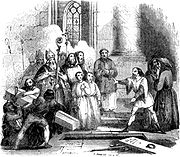
The procedure is performed on one's knees before witnesses, in the presence of the wrong-doer and in the location of the offence. The "Criant" with his hand in the air must call out —Following this, the Criant must recite the Lord's Prayer
Lord's Prayer
The Lord's Prayer is a central prayer in Christianity. In the New Testament of the Christian Bible, it appears in two forms: in the Gospel of Matthew as part of the discourse on ostentation in the Sermon on the Mount, and in the Gospel of Luke, which records Jesus being approached by "one of his...
in French
French language
French is a Romance language spoken as a first language in France, the Romandy region in Switzerland, Wallonia and Brussels in Belgium, Monaco, the regions of Quebec and Acadia in Canada, and by various communities elsewhere. Second-language speakers of French are distributed throughout many parts...
.
On hearing this, the alleged wrong-doer must cease their challenged activities until the matter is adjudicated in court. Failure to stop will lead to the imposition of a fine, whether they were in the right or not. If the Criant is found to have called Haro without a valid reason, they in turn must pay a penalty.
The Clameur in Guernsey
Guernsey
Guernsey, officially the Bailiwick of Guernsey is a British Crown dependency in the English Channel off the coast of Normandy.The Bailiwick, as a governing entity, embraces not only all 10 parishes on the Island of Guernsey, but also the islands of Herm, Jethou, Burhou, and Lihou and their islet...
requires that a Grace be said after the Lord's Prayer: