

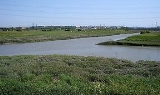
River Darent

Encyclopedia
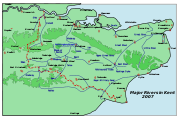
River Thames
The River Thames flows through southern England. It is the longest river entirely in England and the second longest in the United Kingdom. While it is best known because its lower reaches flow through central London, the river flows alongside several other towns and cities, including Oxford,...
in England
England
England is a country that is part of the United Kingdom. It shares land borders with Scotland to the north and Wales to the west; the Irish Sea is to the north west, the Celtic Sea to the south west, with the North Sea to the east and the English Channel to the south separating it from continental...
. Its name is believed to be from a Celtic
Celtic languages
The Celtic languages are descended from Proto-Celtic, or "Common Celtic"; a branch of the greater Indo-European language family...
word meaning 'river where oak
Oak
An oak is a tree or shrub in the genus Quercus , of which about 600 species exist. "Oak" may also appear in the names of species in related genera, notably Lithocarpus...
-trees grow' (compare "Derwent
River Derwent, Cumbria
The Derwent is a river in the Lake District of the county of Cumbria in the north of England. The name Derwent is derived from a Celtic word for "oak trees"....
"). The tidal part of the river is known as the Dartford Creek.
Fed by springs in the greensand
Greensand
Greensand or Green sand is either a sand or sandstone, which has a greenish color. This term is specifically applied to shallow marine sediment, that contains noticeable quantities of rounded greenish grains. These grains are called glauconies and consist of a mixture of mixed-layer clay...
hills south of Westerham
Westerham
Westerham is a town and civil parish in the Sevenoaks District of Kent, in South East England with 5,000 people. The parish is south of the North Downs, ten miles west of Sevenoaks. It covers 5800 acres . It is recorded as early as the 9th century, and was mentioned in the Domesday Book in a...
in Kent
Kent
Kent is a county in southeast England, and is one of the home counties. It borders East Sussex, Surrey and Greater London and has a defined boundary with Essex in the middle of the Thames Estuary. The ceremonial county boundaries of Kent include the shire county of Kent and the unitary borough of...
and below Limpsfield Chart
Limpsfield Chart
Limpsfield Chart is a village near to Oxted in Surrey, just south of the A25.The High Chart to the east of Limpsfield is a large area of woodland owned by the National Trust and has a large network of footpaths. Within this area is the small settlement of Limpsfield Chart...
in Surrey
Surrey
Surrey is a county in the South East of England and is one of the Home Counties. The county borders Greater London, Kent, East Sussex, West Sussex, Hampshire and Berkshire. The historic county town is Guildford. Surrey County Council sits at Kingston upon Thames, although this has been part of...
it flows for 21 miles (33.8 km) eastwards and then northwards past the villages of Otford
Otford
Otford is a village and civil parish in the Sevenoaks District of Kent known for its classically British countryside. The village is located on the River Darent, flowing north down its valley from its source on the North Downs...
and Shoreham
Shoreham, Kent
Shoreham is a village and civil parish in the valley of the River Darent six miles north of Sevenoaks in Kent: it is in the District of Sevenoaks. The parish includes the settlements of Badgers Mount and Well Hill....
, past the castle and ruined Roman villa at Lullingstone
Lullingstone
Lullingstone is a village in the county of Kent, England. It is best known for its castle, Roman villa and its public golf course.- Pre-Roman :It is believed that an Iron Age hill fort is sited on the hill above the castle, although this is unconfirmed....
, past Eynsford
Eynsford
Eynsford is a village and civil parish in the Sevenoaks District of Kent, England. It is located on the River Darent, south of Dartford in Kent.-The village:...
, Farningham
Farningham
Farningham is a village and civil parish in the Sevenoaks District of Kent in England. It is located on the River Darent, south of Dartford, and has a population of 1,289...
, Horton Kirby
Horton Kirby
Horton Kirby is a village in the civil parish of Horton Kirby and South Darenth in the Sevenoaks District of Kent, England.The village is located on the right bank of the River Darent, south of Dartford. Its church is dedicated to St Mary. The nearest railway station is at Farningham Road...
, South Darenth
South Darenth
South Darenth is a village in the civil parish of Horton Kirby and South Darenth in the Sevenoaks District of Kent, England.The village is located on the right bank of the Darent, south of Dartford. The nearest railway station is at Farningham Road, with train services west-bound to Bromley and...
, Sutton-at-Hone
Sutton-at-Hone
Sutton-at-Hone is a village south of Dartford in Kent, England. It is part of the Dartford local government district and the civil parish of Sutton-at-Hone and Hawley. It is represented by Dartford Borough Councilors Pat Coleman and Tony Martin....
, Darenth
Darenth
Darenth is a village and civil parish in the Dartford District of Kent, England. The parish is located to the south-east of Dartford town; the village is three miles from there.The ancient parish church is dedicated to St. Margaret of Antioch....
, and through the large town of Dartford
Dartford
Dartford is the principal town in the borough of Dartford. It is situated in the northwest corner of Kent, England, east south-east of central London....
. North of Dartford the Darent receives the waters of the River Cray
River Cray
The River Cray is a tributary of the River Darent in southern England. It rises in Priory Gardens in Orpington in the London Borough of Bromley, where rainwater permeates the chalk bedrock and forms a pond at the boundary between the chalk and impermeable clay...
from the west as it passes through Dartford Marshes and Crayford Marshes, where it forms a boundary between Greater London
Greater London
Greater London is the top-level administrative division of England covering London. It was created in 1965 and spans the City of London, including Middle Temple and Inner Temple, and the 32 London boroughs. This territory is coterminate with the London Government Office Region and the London...
and Kent
Kent
Kent is a county in southeast England, and is one of the home counties. It borders East Sussex, Surrey and Greater London and has a defined boundary with Essex in the middle of the Thames Estuary. The ceremonial county boundaries of Kent include the shire county of Kent and the unitary borough of...
(and specifically, the London Borough of Bexley
London Borough of Bexley
The London Borough of Bexley lies in south east Greater London, and is a borough referred to as part of Outer London. It has common borders with the London Borough of Bromley to the south, the London Borough of Greenwich to the west, across the River Thames to the north it borders the London...
and the borough of Dartford
Dartford (borough)
Dartford is the name given to a local government district and borough in north west Kent, England, which takes its name from its administrative capital. It borders Thurrock, to the north across the River Thames; to the west lies the London Borough of Bexley; to the south Sevenoaks district; and the...
). The Darent joins the Thames near Crayford Ness.
As its name suggests, Dartford ('Tarentefort' in the Domesday Book
Domesday Book
Domesday Book , now held at The National Archives, Kew, Richmond upon Thames in South West London, is the record of the great survey of much of England and parts of Wales completed in 1086...
) was once a fording place over the Darent where it crossed the road from London to the Kent coast. There are records of a ford operating in Roman times. A ferry, operated by a hermit
Hermit
A hermit is a person who lives, to some degree, in seclusion from society.In Christianity, the term was originally applied to a Christian who lives the eremitic life out of a religious conviction, namely the Desert Theology of the Old Testament .In the...
, was established there by 1235. The post of hermit continued until 1518, long after the first bridge was built (a footbridge, constructed during the reign of Henry IV
Henry IV of England
Henry IV was King of England and Lord of Ireland . He was the ninth King of England of the House of Plantagenet and also asserted his grandfather's claim to the title King of France. He was born at Bolingbroke Castle in Lincolnshire, hence his other name, Henry Bolingbroke...
(1399–1413) and surviving until the mid-18th century). The landscapes of the river's valley were painted in a visionary manner by the early Victorian artist Samuel Palmer
Samuel Palmer
Samuel Palmer was a British landscape painter, etcher and printmaker. He was also a prolific writer. Palmer was a key figure in Romanticism in Britain and produced visionary pastoral paintings.-Early life:...
.
The river is largely small and peaceful, a surprise given the breadth of the valley it has cut out. Apparently the 'proto-Darent' was formerly much larger than the present day but the River Medway
River Medway
The River Medway, which is almost entirely in Kent, England, flows for from just inside the West Sussex border to the point where it enters the Thames Estuary....
, through erosion of the soft chalk and clays of the North Downs
North Downs
The North Downs are a ridge of chalk hills in south east England that stretch from Farnham in Surrey to the White Cliffs of Dover in Kent. The North Downs lie within two Areas of Outstanding Natural Beauty , the Surrey Hills and the Kent Downs...
/Western Weald
Weald
The Weald is the name given to an area in South East England situated between the parallel chalk escarpments of the North and the South Downs. It should be regarded as three separate parts: the sandstone "High Weald" in the centre; the clay "Low Weald" periphery; and the Greensand Ridge which...
, has captured much of the headwaters that once supplied the Darent.
The river was used for trade and in 1835 approximately 50,000 to 60,000 tons per annum were being carried on the river. The size of the river limited single cargoes to 50 long tons (50.8 t) even on spring tides and as a result a ship canal was proposed. The proposal was unable to overcome its critics and as a result in 1839 an alternative based on dredging the river and a few short cuts was taken up. An Act of Parliament
Act of Parliament
An Act of Parliament is a statute enacted as primary legislation by a national or sub-national parliament. In the Republic of Ireland the term Act of the Oireachtas is used, and in the United States the term Act of Congress is used.In Commonwealth countries, the term is used both in a narrow...
was passed in 1840 allowing construction to start and tolls to be levied once the work was complete. The project was completed in 1844 and included shortening the upper part of the navigation through the use of a cut and dredging.
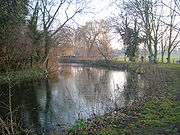
Borehole
A borehole is the generalized term for any narrow shaft bored in the ground, either vertically or horizontally. A borehole may be constructed for many different purposes, including the extraction of water or other liquid or gases , as part of a geotechnical investigation, environmental site...
s along its length, by the Environment Agency
Environment Agency
The Environment Agency is a British non-departmental public body of the Department for Environment, Food and Rural Affairs and an Assembly Government Sponsored Body of the Welsh Assembly Government that serves England and Wales.-Purpose:...
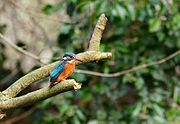
. A sculpture was unveiled in 2004 to celebrate the renewed life of the river, depicting the wildlife which has been saved.
Watermills
The River Darent powered a number of watermillWatermill
A watermill is a structure that uses a water wheel or turbine to drive a mechanical process such as flour, lumber or textile production, or metal shaping .- History :...
s. From source to mouth they are:
Westerham (Elm View) Mill
V-1 flying bomb
The V-1 flying bomb, also known as the Buzz Bomb or Doodlebug, was an early pulse-jet-powered predecessor of the cruise missile....
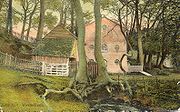
landed nearby and blew the roof of the mill off. The derelict building stood in April 1954, but had been demolished by July 1960.
Darenth (Tower Wood) Mill
This corn mill had an external cast iron overshot waterwheel carried on a wooden axle. The mill was working up to the outbreak of the First World War and demolished in the 1930s. It had two pairs of millstone
Millstone
Millstones or mill stones are used in windmills and watermills, including tide mills, for grinding wheat or other grains.The type of stone most suitable for making millstones is a siliceous rock called burrstone , an open-textured, porous but tough, fine-grained sandstone, or a silicified,...
s.
Squerryes (Spring Shaw) Mill, Westerham
Squerryes, or Spring Shaw Mill was a corn mill with a cast iron overshot waterwheel some 9 feet (2.74 m) or 10 feet (3.05 m) diameter and 3 foot (0.9144 m) wide. The mill was marked as disused on the 1895 6" Ordnance Survey
Ordnance Survey
Ordnance Survey , an executive agency and non-ministerial government department of the Government of the United Kingdom, is the national mapping agency for Great Britain, producing maps of Great Britain , and one of the world's largest producers of maps.The name reflects its creation together with...
map. It was a small building of 17 in 6 in (5.33 m) square and had been demolished by 1955. Little is known of the machinery except that the upright shaft was wooden and of 11.5 inches (292.1 mm) diameter. The wooden great spur wheel was of compass arm construction.
Valence Pump, Brasted
This water powered pump was driven by a cast iron high breast shot waterwheel of 16 feet (4.88 m) by 3 in 5 in (1.04 m). A 6 feet (1.83 m) diameter cast iron spur geared pitwheel drove two ram pumps. The pump dated from 1858 and was still in existence in 1980.
Brasted Mill
Cast iron
Cast iron is derived from pig iron, and while it usually refers to gray iron, it also identifies a large group of ferrous alloys which solidify with a eutectic. The color of a fractured surface can be used to identify an alloy. White cast iron is named after its white surface when fractured, due...
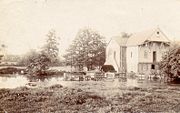
breast shot waterwheel was 13 feet (3.96 m) by 6 in 6 in (1.98 m). In September 1812, James Weight, miller of Brasted, was claiming relief for himself, his wife and five children. A man by the name of Staples who went by the name of Chapman had leased the mill in Brasted
Brasted
Brasted is a village and civil parish in the Sevenoaks District of Kent, England. The parish is located to the west of Sevenoaks town. The parish includes the settlements of Brasted Chart and Toys Hill, and had a population of 1321 persons . The single slightly winding street of the village has a...
in 1812; he claimed relief in January 1815. The mill ceased work in the 1920s and the machinery was removed c1934.
Sundridge Mill
This was a paper mill. In December 1822 Nicholas Tapsfield, papermaker
Papermaking
Papermaking is the process of making paper, a substance which is used universally today for writing and packaging.In papermaking a dilute suspension of fibres in water is drained through a screen, so that a mat of randomly interwoven fibres is laid down. Water is removed from this mat of fibres by...
of Sundridge
Sundridge
Sundridge may mean:* Sundridge, Ontario, a village in Ontario, Canada* Sundridge, Kent, a village in Kent, England* Sundridge, London, suburb in the London Borough of Bromley southeast London....
was claiming relief for himself and his wife Mary. He had been apprenticed at a paper mill at East Malling
East Malling Stream
The East Malling Stream, known locally as "The Stream", rises at Well Street, East Malling, Kent, and flows in a generally easterly direction to join the River Medway at Mill Hall, Aylesford. It powered six watermills...
. In December 1831, Thomas Green, papermaker of Sundridge was claiming relief for himself, his wife and five children. He had been apprenticed in 1804 to William Dacie at a paper mill in Bermondsey
Bermondsey
Bermondsey is an area in London on the south bank of the river Thames, and is part of the London Borough of Southwark. To the west lies Southwark, to the east Rotherhithe, and to the south, Walworth and Peckham.-Toponomy:...
, then to a Mr Hall in St. Mary Cray when Dacie retired. In March 1832, Henry Sparks, papermaker of Sundridge was claiming relief for himself, wife Susanna and five children. He had been apprenticed to Messrs. Smith & Knight at Godalming
Godalming
Godalming is a town and civil parish in the Waverley district of the county of Surrey, England, south of Guildford. It is built on the banks of the River Wey and is a prosperous part of the London commuter belt. Godalming shares a three-way twinning arrangement with the towns of Joigny in France...
in 1796, serving only four years. In May 1839, Henry Thomas, papermaker of Sundridge was claiming relief for himself. He had been a papermaker all his working life. The internal overshot waterwheel was 12 in 6 in (3.81 m) by 6 in 3 in (1.91 m), carried on an oak
Oak
An oak is a tree or shrub in the genus Quercus , of which about 600 species exist. "Oak" may also appear in the names of species in related genera, notably Lithocarpus...
axle. Sundridge Mill produced paper for the Bank of England
Bank of England
The Bank of England is the central bank of the United Kingdom and the model on which most modern central banks have been based. Established in 1694, it is the second oldest central bank in the world...
until its closure in 1901, business being transferred to Eynsford Paper Mill. The mill buildings were converted to a laundry, and the waterwheel was removed c1914 to be replaced by steam power. The mill was demolished in October 1969.
Chipstead Mill, Chevening
Chipstead Mill was a four storey building which had been enlarged in the late C19th. It worked until after the Second World War, but the machinery had been removed by 1950. The waterwheel was overshot and drove two pairs of French Burr millstones. A steam engine provided auxiliary power until it was replaced by a 75 hp suction gas engine
Gas engine
A gas engine means an engine running on a gas, such as coal gas, producer gas biogas, landfill gas, or natural gas. In the UK, the term is unambiguous...
. Roller milling plant had been installed in the 1890s but milling ceased in the 1920s. The mill building was standing in the 1980s.
Longford Mill, Dunton Green
This was a corn mill rebuilt by Weeks of Maidstone in 1859, it had an internal cast iron overshot waterwheel 7 feet (2.13 m) by 12 feet (3.66 m), which had probably replaced a breast shot waterwheel of larger diameter. The waterwheel drove three pairs of millstone
Millstone
Millstones or mill stones are used in windmills and watermills, including tide mills, for grinding wheat or other grains.The type of stone most suitable for making millstones is a siliceous rock called burrstone , an open-textured, porous but tough, fine-grained sandstone, or a silicified,...
s. Electricity replaced water power between the wars, and the mill last worked in 1947. The stones of the mill were said to have been caused to run backwards at one time through the mill being bewitched. The mill drove three pairs of millstones, the machinery being mostly of cast iron. The mill building survived until 1987 when the site was redeveloped.
Otford Mill
There was a watermill in Otford in 1541. The last mill on this site was a corn mill with two waterwheels. It was latterly used as a saw mill and burnt down on 7 January 1924. A picture of the mill can be seen here. The breastshot waterwheel remained in 1930. One waterwheel was of wood construction, driving three pairs of French Burr millstones and one pair of Peak millstones. The machinery was all wooden. The second waterwheel was of cast iron, driving two pairs of French Burr stones vis cast iron machinery.
Upper Mill, Shoreham
This was a corn mill. Originally powered by an internal breast shot waterwheel of some 14 feet (4.27 m) by 6 feet (1.83 m) driving one pair of French Burr millstones and one pair of Peak millstones. The great spur wheel was a cast iron wheel with wooden cogs. The waterwheel had been replaced by a turbine
Water turbine
A water turbine is a rotary engine that takes energy from moving water.Water turbines were developed in the 19th century and were widely used for industrial power prior to electrical grids. Now they are mostly used for electric power generation. They harness a clean and renewable energy...
which drove the millstones via a great spur wheel that was only 3 in 3 in (990.6 mm) diameter. The mill was house converted in 1971.
Lower (Shoreham Paper) Mill, Shoreham
This was the site of a fulling mill belonging to Palsters Manor. It was bought by the Passele family in the 14th century. The manor passed to Francis Sandbach in 1578 and was willed to John Polhill. He bought the fulling mill in 1602. The last mill on the site was a paper mill; it was demolished in 1936. The low breast shot waterwheel was 16 feet (4.88 m) by 8 feet (2.44 m). It drove machinery via a layshaft driven from the spur geared pitwheel. The mill was demolished in the 1930s. The paper mill had been run for over 200 years by the Wilmot family.
Wood Mill, Eynsford
Although it is said that this mill, which stood just downstream of Eynsford
Eynsford
Eynsford is a village and civil parish in the Sevenoaks District of Kent, England. It is located on the River Darent, south of Dartford in Kent.-The village:...
Bridge, was a corn mill with an undershot waterwheel other evidence shows this to have been a water powered saw mill which had been erected c1853. It may have stood on the site of an earlier mill.
Old Mill, Eynsford
This was a corn mill. It stands immediately downstream of the bridge by Eynsford ford
Ford (crossing)
A ford is a shallow place with good footing where a river or stream may be crossed by wading or in a vehicle. A ford is mostly a natural phenomenon, in contrast to a low water crossing, which is an artificial bridge that allows crossing a river or stream when water is low.The names of many towns...
. The low breast shot waterwheel was 8 feet (2.44 m) diameter in 1887, being replaced by one of at least 10 feet (3.05 m) diameter. It was 10 feet (3.05 m) wide. The millstones were only 3 feet (914.4 mm) diameter, suggesting that only a limited amount of flour was available. The mill was working until 1911, no auxiliary power being used. The building was house converted in the 1920s and survives today.
Eynsford Paper Mill
This paper mill was founded in 1648 by Hugenot refugees. The paper mill replaced an earlier corn mill. In 1882, it is recorded as having a waterwheel 18 in 3 in (5.56 m) by 8 feet (2.44 m). The mill suffered two fires in the 20th century but was rebuilt. It was working until 1952 but has now been demolished.
Farningham Mill
A mill has been on this site since Domesday. In the 15th century the mill was in the possession of the Roper family, Sir Anthony Roper being charged with "pulling down and allowing the watermill to decay and become uninhabited" in 1636. He was ordered to rebuild the mill within two years. The present building built by the Colyers dates to c.1780. The mill was a corn mill; the converted building survives. A curious feature is that the door on the north side of the east face is painted on, to look symmetrical with the real door. The mill was latterly worked by a turbine
Water turbine
A water turbine is a rotary engine that takes energy from moving water.Water turbines were developed in the 19th century and were widely used for industrial power prior to electrical grids. Now they are mostly used for electric power generation. They harness a clean and renewable energy...
which drove a saw mill in its final years of operation. The mill last worked for trade in 1900.
Franks Generating Station, Horton Kirby
This installation was of late C19th date. A turbine drove a generating plant to provide elecricity to Franks Hall
Franks Hall
Franks Hall in Horton Kirby, Kent, is a large Elizabethan country house, completed in 1591. The Grade I listed building is now used both as a business premises and a licensed wedding venue for civil ceremonies.-History:...
. After it ceased to be used, the turbine is said to have been installed in Westminster Mill.
Westminster Mill, Horton Kirby

Horton Kirby
Horton Kirby is a village in the civil parish of Horton Kirby and South Darenth in the Sevenoaks District of Kent, England.The village is located on the right bank of the River Darent, south of Dartford. Its church is dedicated to St Mary. The nearest railway station is at Farningham Road...
who died in 1724 and Thomas Welch was a miller in Horton who died in 1734. George Cannon took the mill in the early 1830s. In 1843 he was bankrupt as a common brewer, an occupation he carried on along with the mill. Ill health forced his retirement in 1852, and the mill was bought by his brother Stephen. His son, also Stephen, was running Old Mill from 1850, then being 14 years old. Stephen Cannon (father) died in 1872 and Stephen Cannon (son) sold Westminster Mill and Old Mill in order to concentrate the milling business at a mill in Bexley
River Cray
The River Cray is a tributary of the River Darent in southern England. It rises in Priory Gardens in Orpington in the London Borough of Bromley, where rainwater permeates the chalk bedrock and forms a pond at the boundary between the chalk and impermeable clay...
. Latterly the waterwheel was replaced by a turbine and the mill generated electricity. The mill burnt down when struck by lightning in 1908 and was rebuilt as a factory which made shoe laces. The factory closed down in 1991 and the mill has been demolished and the site redeveloped as housing.
Horton Kirby Paper Mill
This mill is under the viaduct
Viaduct
A viaduct is a bridge composed of several small spans. The term viaduct is derived from the Latin via for road and ducere to lead something. However, the Ancient Romans did not use that term per se; it is a modern derivation from an analogy with aqueduct. Like the Roman aqueducts, many early...
of the Chatham Main Line
Chatham Main Line
The Chatham Main Line is a British railway line that runs from either London Victoria to Dover Priory / Ramsgate or London St Pancras to Faversham, with both services travelling via Medway...
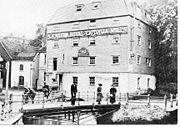
railway. In 1700 there were two corn mills and a forge here. The mill was rebuilt by Henry Hall in 1820 as a paper mill. Paper from this mill was used to print The Sphere
The Sphere (newspaper)
The Sphere was a British newspaper, published weekly from 27 January 1900 until the closure of the paper on 27 June 1964; the first issue came out at the height of the Boer War and was no doubt a product of that conflict and the public appetite for images...
and The Tatler; photographs of the paper making process at the mill were used in the first edition of The Children's Encyclopedia
The Children's Encyclopedia
The Children's Encyclopædia was an encyclopædia originated by Arthur Mee, and published by the Educational Book Company, a subsidiary of Amalgamated Press of London. It was published from 1908 to 1964. Walter M. Jackson's company Grolier acquired the rights to publish it in the U.S...
. Henry Hall was the proprietor in 1840. An illustration of the machine house c.1880 can be seen here. The mill has a chimney 230 feet (70.1 m) high, which is a listed building. The mill was last used as a factory and closed in 2003, with plans being put forward for conversion to housing use in 2005. The chimney dates to 1880.
Frog Lane Mill, Sutton at Hone
This corn mill was of C19th date. The cast iron breast shot waterwheel was 10 feet (3.05 m) by 6 feet (1.83 m) carried on a 5 inches (127 mm) square axle. An unusual feature of this mill was that the pitwheel was the same diamter as the waterwheel. The mill had ceased working by 1914. The upper storeys of the mill were demolished in February 1936, leaving the brick base, waterwheel and some machinery. These had been cleared away by June 1965.
South Darenth Mill
South Darenth Mill was a brick building that replaced an earlier mill that burnt down in 1879. This mill was run by the Cannon family. The mill had a cast iron waterwheel which drove three pairs of millstones. A steam engine provided auxiliary power. In 1894, roller milling plant was installed but milling ceased in 1905. The building was severely damaged in the Great Storm of 1987Great Storm of 1987
The Great Storm of 1987 occurred on the night of 15/16 October 1987, when an unusually strong weather system caused winds to hit much of southern England and northern France...
.
Darenth Paper Mill
Darenth Paper Mill was working until 1931 when it was taken over by Messrs Portals Ltd, of LaverstokeLaverstoke
Laverstoke is a village in the north of Hampshire, England. It forms a parish with the nearby village of Freefolk.Businesses include Laverstoke Park Farm-Literature:...
, Hampshire
Hampshire
Hampshire is a county on the southern coast of England in the United Kingdom. The county town of Hampshire is Winchester, a historic cathedral city that was once the capital of England. Hampshire is notable for housing the original birthplaces of the Royal Navy, British Army, and Royal Air Force...
. In 1910, it was in the occupation of Messrs T H Saunders & Co Ltd, also at Hawley Mills and Beech and Rye Mills, High Wycombe
High Wycombe
High Wycombe , commonly known as Wycombe and formally called Chepping Wycombe or Chipping Wycombe until 1946,is a large town in Buckinghamshire, England. It is west-north-west of Charing Cross in London; this figure is engraved on the Corn Market building in the centre of the town...
, Buckinghamshire
Buckinghamshire
Buckinghamshire is a ceremonial and non-metropolitan home county in South East England. The county town is Aylesbury, the largest town in the ceremonial county is Milton Keynes and largest town in the non-metropolitan county is High Wycombe....
. The breast shot waterwheel was of cast iron with wooden floats. It was12 feet (3.66 m) by 10 feet (3.05 m).
Sutton (Old, Sutton at Hone, Darenth Corn, Little Darenth) Mill
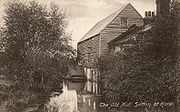
Stephen Cannon later bought the mill and it passed to his daughter Harriet on his death on 27 February 1856. The mill remained in the Cannon family until 1872, and the mill house until 1888. Latterly the mill had a steam engine and a tall chimney. During the First World War, a bomb hit the mill, but did not explode, although the mill was put out of action. The mill was demolished in September 1928. Photographs of the mill during demolition reveal the cast iron low breast shot waterwheel drove three pairs of millstones via a cast iron layshaft. The original wooden upright shaft and crown wheel were retained.
Hawley Mills, Sutton at Hone
A site mentioned in Domesday, the mills here were held by the manor of Bignoures and belonged to the Knights of St. John in the Middle Ages
Middle Ages
The Middle Ages is a periodization of European history from the 5th century to the 15th century. The Middle Ages follows the fall of the Western Roman Empire in 476 and precedes the Early Modern Era. It is the middle period of a three-period division of Western history: Classic, Medieval and Modern...
, being let at a peppercorn rent to the Prioress of Dartford Nunnery. A wheat mill and a malt mill were released to one George Tasser in 1534. William Vaughan
William Vaughan (philanthropist)
William Vaughan was an English landowner, farmer and philanthropist who lived in the mid-16th century in the Dartford and Erith area of north-west Kent...
received them from the Crown in 1546 and the mills reverted to the Crown when he died in 1580. The two mills were granted to John Spilman
John Spilman
Sir John Spilman was a Lindau, German-born entrepreneur who founded the first commercially successful paper-mill in England, establishing a factory on the River Darenth in Dartford, Kent in 1588...
(later Sir John Spilman) by the Crown in 1581.
In 1588, Spilman converted the corn mill into a paper mill, and obtained a monopoly for his paper by manipulating the favour and patronage of successive monarchs. Thomas Churchyard
Thomas Churchyard
Thomas Churchyard , English author, was born at Shrewsbury, the son of a farmer.-Life:Churchyard received a good education, and, having speedily dissipated at court the money with which his father provided him, he entered the household of Henry Howard, Earl of Surrey...
wrote a long poem in 1588, the first description of the papermaking process. Spielman employed 600 men, mainly Germans. The mills remained in the Spilman family until 1679, then a Mr Blackman was the owner in 1686 but he was bankrupt by 1739. Messrs. Pike and Edsall purchased the mill and converted it into a gunpowder mill
Gunpowder
Gunpowder, also known since in the late 19th century as black powder, was the first chemical explosive and the only one known until the mid 1800s. It is a mixture of sulfur, charcoal, and potassium nitrate - with the sulfur and charcoal acting as fuels, while the saltpeter works as an oxidizer...
.There were explosions here in 1745, 1790, 1795, 1796, 1799 and 1833. These killed at least forty people. Edsall went bankrupt in 1778 and the mills were purchased by Messrs Pigou
Pigou
Pigou is an English surname of Hugenot derivation.The Pigou family originated from Amiens in France. The name was related to pique or pike, and the Pigou arms consist of three pike heads. Two sons of Lawrence Pigou of Amiens – Jacques and John - fled from persecution in France and settled with...
and Andrews
Miles Peter Andrews
Miles Peter Andrews was an 18th century English playwright, gunpowder manufacturer and politician who sat in the House of Commons from 1796 to 1814.-Biography:...
. The mill was a papermill by 1840, when William Wiggins was the owner.
The malt mill was not required by Spilman, and he leased it to Godfrey Box of Liège. He erected an iron rolling and slitting mill (for the manufacture of nails; the first in England) between 1590 and 1595, which by 1758 had two waterwheels, one working the upper roller, the other working the lower rollers and a guillotine. A company of "white paper makers" was established here in 1694 and during the 18th century the mill was owned by a Mr Quelch.
Dartford Powder Mills
ApproximatelyThe Powder Mills were in operation from c1730, possibly on the site of Spilman's paper mill of 1588. It was in operation until the C20th.
Lower Paper Mill, Dartford
Lower Mill was built in the mid C17th, and closed in 1790. Later it was used as a zinc rolling mill and a printing works for silk and calico.
Victoria Mills, Dartford
Wire
A wire is a single, usually cylindrical, flexible strand or rod of metal. Wires are used to bear mechanical loads and to carry electricity and telecommunications signals. Wire is commonly formed by drawing the metal through a hole in a die or draw plate. Standard sizes are determined by various...
, mentioned by William Lambarde
William Lambarde
William Lambarde was an antiquarian and writer on legal subjects.-Life:Lambarde was born in London. His father was a draper , an alderman and a sheriff of London. In 1556, he was admitted to Lincoln's Inn...
in 1570 as a glazing mill
Compacted oxide layer glaze
Compacted oxide layer glaze describes the often shiny, wear-protective layer of oxide formed when two metals are slid against each other at high temperature in an oxygen-containing atmosphere...
. This was used for polishing armoured plate. In the early 19th century there were three mills here; an oil mill, a mustard mill
Mustard plant
Mustards are several plant species in the genera Brassica and Sinapis whose small mustard seeds are used as a spice and, by grinding and mixing them with water, vinegar or other liquids, are turned into the condiment known as mustard or prepared mustard...
and a corn mill in the late 18th century it was owned by a Mr Fomereau and worked by the Loder family. The corn mill was a four storey wood structure built in 1790. In the early 19th century, miller James Hard was appointed miller to King George IV
George IV of the United Kingdom
George IV was the King of the United Kingdom of Great Britain and Ireland and also of Hanover from the death of his father, George III, on 29 January 1820 until his own death ten years later...
. It had a wrought iron
Wrought iron
thumb|The [[Eiffel tower]] is constructed from [[puddle iron]], a form of wrought ironWrought iron is an iron alloy with a very low carbon...
breast shot waterwheel of 20' diameter driving four pairs of millstones.
Colyers (Orchard's, Bridge, Acacia Hall) Mill, Dartford
In 1217 King John
John of England
John , also known as John Lackland , was King of England from 6 April 1199 until his death...
granted a mill worth 100/- a year, situated in Dartford
Dartford
Dartford is the principal town in the borough of Dartford. It is situated in the northwest corner of Kent, England, east south-east of central London....
to Michael de Wallensi and in 1221 William, Prior of Rochester, granted to Alan Martel, Prior of the Knights Templars, half an acre of land by the mill. The mill belonged to the Bishop of Rochester in 1253 and in 1299 was known as Orchard's mill, being then privately owned. Henry Colyer was the miller in 1840. The mill was later run by R & H Strickland Ltd, although milling ceased in 1893 and the building was stripped of its machinery, including a large cast iron waterwheel and a steam engine, in 1898. It then served as a social club for Messrs Burroughs Wellcome & Co. The mill burnt down on 24 January 1962.
Silk Printing Works, Dartford
There was a silk printing works in Dartford which is said to have been powered by a waterwheel. It was said that the waterwheel had been "recently removed" in 1986 as part of a clearance programme for the section of river that the works stood on.
Phoenix Mill, Dartford
This was the furthermost mill on the Darent. About 1650 one John Brown erected a "brassell" mill for splitting iron into rods and nails. Nicholas Tooke owned the mill in 1656 followed by Charles Mauum from 1687 to 1719 and then Messrs. Cooke and Coolson in 1779. The brassell mill gave way to a saw mill, then in 1790 a seven storey cotton mill
Cotton mill
A cotton mill is a factory that houses spinning and weaving machinery. Typically built between 1775 and 1930, mills spun cotton which was an important product during the Industrial Revolution....
was built. This burnt down in 1795 and a smaller building, the Phoenix Mill was erected in 1797. George Willding was the miller and Messrs Saunders and Harrison were mustard makers here in 1840. T H Saunders rebuilt it in 1855. William Masters was a workman here until his death in 1873, and has a memorial in Horton Kirby church. It was a paper mill and closed in 1889.
Tributaries.
Various tributaries feed into the River Darent. They also powered a number of watermills.Mill Farm Mill, Brasted
Mill Farm Mill may have been built in 1705, which is the date of the Mill House. It was worked by the Smith family, ceasing work c1858. The 14 feet (4.27 m) by 3 foot (0.9144 m) cast iron waterwheel and machinery were removed before the First World War. The building was standing in 1954, converted to a garage.
Whitley (Dibden) Mill, Chevening
This mill stood deep in woodland west of Sevenoaks
Sevenoaks
Sevenoaks is a commuter town situated on the London fringe of west Kent, England, some 20 miles south-east of Charing Cross, on one of the principal commuter rail lines from the capital...
. It was held by Ralph Bosville of Bradbourne Manor in the 16th century. The mill was in existence until at least the mid-19th century but had ceased working by 1900. The overshot waterwheel of composite construction was carried on a wooden axle 9 in 6 in (2.9 m) long and 18 inches (457.2 mm) square at the waterwheel, 12 inches (304.8 mm) diameter in the mill. The mill was in ruins by the 1920s
Ightham Mill
A tributary rising near St. Cleres is reputed to have driven a watermill, possibly the one at IghthamIghtham
Ightham is a village in Kent, England, located approximately four miles east of Sevenoaks and six miles north of Tonbridge. The parish includes the hamlet of Ivy Hatch....
recorded in 1322 as the property of William Inge.
Kemsing Mill
This mill was on the tributary that drove the mill at Ightham. Kemsing is reputed to be the site of a Roman
Roman Britain
Roman Britain was the part of the island of Great Britain controlled by the Roman Empire from AD 43 until ca. AD 410.The Romans referred to the imperial province as Britannia, which eventually comprised all of the island of Great Britain south of the fluid frontier with Caledonia...
watermill at Springhead, which was excavated in 1949.
Greatness Mill, Sevenoaks
An old mill site, in 1381 a mill at Gretnarsche was in the possession of John ColepeperJohn Culpeper
John Culpeper lived from 1366 to 1414. He was styled "Sir John Culpeper of Oxon Hoath, Knight", a knight in the court of King Henry V of England. The family's name is believed to derive from the herb.-External links:*...
. The mills were later in the ownership of the Fane/Vane
Vane
Vane may refer to:* Cooper vane* Vane anemometer* Weather vaneA vane is also each of the parts besides the shaft in a pennaceous feather...
family, being known as "Gretness-mylls" in the 1550s, being two water corn mills. John Thorpe (miller?) was living at Greatness Mill at the time of his death in 1835. The building is of weatherboard on a steel frame on a brick base, replacing an earlier mill that burnt down after the First World War. The overshot waterwheel was 20 feet (6.1 m) by 4 in 6 in (1.37 m). It drove two pairs of French Burr millstones and one pair of Peak millstones. Roller milling plant had been fitted by 1906. In 1927, the mill was still worked by water power, aided by a 15 hp gas engine
Gas engine
A gas engine means an engine running on a gas, such as coal gas, producer gas biogas, landfill gas, or natural gas. In the UK, the term is unambiguous...
.
Greatness Silk Mill, Sevenoaks
This mill was built in 1761 by Peter Nouaille, who came into the possession of the manorial watermill on marrying Elizabeth de la Mare of Greatness. It stood downstream of the corn mill. Nouaille went bankrupt in 1778 but recovered, employing 100 people when he retired in 1800. The mill had a breastshot waterwheel. It closed down after Nouaille's death c1828. The mills were immortalised in the poem Ode on the Silk Mills at Greatness by Joseph Harrison.
Childs Bridge Mill, Kemsing
A long lost mill site, thought to have been a corn mill. The mill pond was some 400 yards (365.8 m) by 50 yards (45.7 m) in extent.
Longlodge Mill, Otford
Possibly the site of one of Otford's eight Domesday mills. The mill was abandoned at an early date as it was not remembered in field names.
Bradbourne Mill, Sevenoaks
This was a corn mill. On 24 October 1545 Bradbourne Mill was granted by Henry VIIIHenry VIII of England
Henry VIII was King of England from 21 April 1509 until his death. He was Lord, and later King, of Ireland, as well as continuing the nominal claim by the English monarchs to the Kingdom of France...
to William Darkenolde for 21 years at £6.13s.4d per annum. The King finding the timber for the repair of the mill. In 1557, Ralph Bosville bought the mill. In 1592, Henry Bosville died, leaving his manor of Bradbourne, and a "water grist mill" in the tenure of Richard Phillipes and a "Sythe Mill" in the occupation of Chapman amongst his property.
Hall's Engineering Works, Dartford
Millwright
Millwright
A millwright is a craftsman or tradesman engaged with the construction and maintenance of machinery.Early millwrights were specialist carpenters who erected machines used in agriculture, food processing and processing lumber and paper...
John Hall built a cast iron waterwheel to replace a windmill that powered some of the machinery at his workshops in Hythe Street, Dartford.
Fords
Ford (crossing)
A ford is a shallow place with good footing where a river or stream may be crossed by wading or in a vehicle. A ford is mostly a natural phenomenon, in contrast to a low water crossing, which is an artificial bridge that allows crossing a river or stream when water is low.The names of many towns...
on the River Darent.
Shoreham
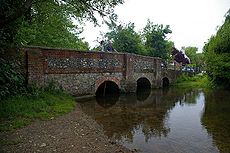
TQ 5205 6165 51.333127°N 0.182954°WThere was a ford by the bridge in the village.
Eynsford
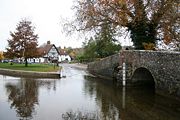
Eynsford is famous for its ford by the old packhorse bridge
Packhorse bridge
A packhorse bridge is a bridge intended to carry packhorses across a river or stream. Typically a packhorse bridge consists of one or more narrow masonry arches, and has low parapets so as not to interfere with the horse's panniers.Packhorse bridges were often built on the trade routes that...
.
Dartford
There was a ford in Dartford in Roman times, Dartford being a contraction of Darent-ford. The ford was still in existence in 1840.See also
- Tributaries of the River ThamesTributaries of the River ThamesThis article lists the tributaries of the River Thames, in England. It also includes significant backwaters and waterways which also have confluences with the main stream of the River Thames.Most of the tributaries are natural, but a few were man-made...
- List of rivers in England
- Darent Valley PathDarent Valley PathThe waymarked path Darent Valley Path is long, following the River Darent from the banks of the River Thames at Dartford through the Kent Downs Area of Outstanding Natural Beauty to the Greensand Hills above Sevenoaks.It is close to Shoreham Village and Otford Village.The route is well served by...