

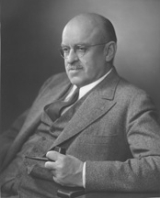
Ralph Flanders

Encyclopedia
Ralph Edward Flanders was an American mechanical engineer, industrialist and Republican
U.S. Senator
from the state
of Vermont
. He grew up on subsistence farms in Vermont and Rhode Island, became an apprentice first as a machinist, then as a draftsman, before training as a mechanical engineer. He spent five years in New York City as an editor for a machine tool magazine. After moving to Vermont, he managed and then became president of a successful machine tool company. Flanders used his experience as an industrialist to advise state and national commissions in Vermont, New England and Washington, D.C. on public economic policy. He was president of the Boston
Federal Reserve Bank
for two years before being elected U.S. Senator from Vermont.
Flanders was noted for introducing a 1954 motion in the Senate to censure Senator Joseph McCarthy
. McCarthy had made sensational claims that there were large numbers of Communists and Soviet spies and sympathizers inside the federal government and elsewhere. He used his Senate committee as a nationally televised forum for attacks on individuals whom he accused. Flanders felt that McCarthy’s attacks distracted the nation from a much greater threat of Communist successes elsewhere in the world and that they had the effect of creating division and confusion within the United States, to the advantage of its enemies. Ultimately, McCarthy's tactics and his inability to substantiate his claims led to his being discredited and censured by the United States Senate.
Flanders was born oldest of nine children in Barnet
, a town in Caledonia County
in northeastern Vermont, and spent much of his childhood in Rhode Island
. In his autobiography
, Senator from Vermont, Flanders described life on his family’s subsistence farms in Vermont and Rhode Island, before he left to work in the machine tool
industry for most of his career. In his first years as a machinist and draftsman, he spent his vacations traveling by bicycle over country roads between Rhode Island and Vermont and New Hampshire. Later, he lived for a time in New York City
where he edited a machine tool magazine, but after five years decided to move back to Vermont. In 1911, he married Helen Edith Hartness
, daughter of inventor and industrialist James Hartness
. They made their home in Springfield, Vermont
, where Flanders became president of the Jones & Lamson Machine Company. Flanders and his wife had three children: Elizabeth (born 1912), Anna (also known as Nancy—born 1918), and James (born 1923).
and Central Falls, Rhode Island
. But even so, he achieved a solid grounding in mathematics, literature, Latin and Classical Greek there. Unable to afford college tuition, his father bought a two-year apprenticeship for him in 1896 at the Brown & Sharpe Manufacturing Company
, a leading machine tool builder. There and through the International Correspondence School he learned machinist and drafting skills. Following his apprenticeship, he worked for various machine tool companies in New England. Despite his lack of a formal university education, he was a self-taught scholar, who read extensively in the literatures of science, engineering and the liberal arts.
, gear cutting machinery
, hobs
, the manufacture of cans
, and of motor cars, including Machinery’s reference series on the subject.
In 1909, while working long hours on his definitive book on gear cutting machinery, his energy gave out and he suffered a “nervous breakdown.” He had to take time off to recover. In 1910, he accepted a job offer to work in a machine tool company in Vermont. He continued to write on technical and other matters throughout his life and would develop a broader philosophy of the role of industry in society. In 1938, he received a Worcester Reed Warner Medal in recognition for his technical writing.
develop a box-folding machine. After that, he worked as a draftsman for General Electric
until 1905, when he moved to New York City to work for Machine.
In 1910, he moved to Springfield, Vermont to work as a mechanical engineer for the Fellows Gear Shaper Company. He was already friendly with James Hartness
, the president of the Jones & Lamson Machine Company (J&L), another company in town. In 1911, Flanders married Hartness' daughter, Helen. Shortly afterwards, Hartness hired Flanders as a manager of the department at J&L that built the Fay automatic lathe
. Flanders redesigned that lathe to achieve higher productivity and accuracy. He became a director in 1912 and president of the company in 1933 after Hartness retired.
As president of J&L, Flanders implemented a continuous production line to manufacture the Hartness Turret Lathe instead of building each machine individually, attempting to bring some of the efficiencies of mass production to machine tool building.
By 1923, he had acquired and assigned more than twenty patents to J&L.
Flanders and his brother, Ernest, were instrumental in developing screw thread grinding machines. These incorporated advances in thread technology (furthered by the Hartness optical comparator
) and Flanders’s engineering calculations for gear-cutting machinery. In 1946, the two brothers received the Edward Longstreth Medal of the Franklin Institute
as recognition for this accomplishment. They had improved the accurate manufacture of die-cut screws in soft metal and solved the problem of thread-grinding on hardened work.
(ASME) from 1934 to 1936. He was vice president of the American Engineering Council in 1937. Throughout the 1930s, Flanders served as chairman of the Screw-Thread Committee of the American Standards Association. In 1942 he was awarded the Edward Longstreth Medal. In 1944 the ASME awarded him the Hoover Medal
for his “public service in the field of social, civic and humanitarian effort[s].” The British Institution of Mechanical Engineers made him an honorary member.
During the Great Depression
Flanders began to write about social policy. His major concern was human development in a technological era. He addressed employing spiritual guidance with a “program of human values” to achieve a good life. Nevertheless, his underlying goal was to achieve “full employment.” So, he kept himself grounded in economic principles, as understood and debated during that era.
In 1933, Franklin D. Roosevelt’s
Secretary of Commerce, Daniel Roper
, appointed Flanders to the Business Advisory Council, which was created to provide input to the administration on matters affecting business. The Council then made Flanders chairman of the Committee on Unemployment. This committee recommended addressing the problem both geographically and by industry. Flanders reported, however, that when the committee made its recommendations President Roosevelt was preoccupied with augmenting the Supreme Court and ultimately chose the undistributed profits tax instead—a choice that Flanders felt discouraged capital investment.
In 1933, the National Industrial Recovery Act
created the National Recovery Administration
(NRA). The NRA allowed industries to create "codes of fair competition," intended to reduce destructive competition and to help workers by setting minimum wages and maximum weekly hours. Flanders was appointed to the industrial advisory board of the NRA. In a speech before a 1934 conference of the code authority members, attended by President Roosevelt
, Flanders opposed a proposal by the Roosevelt administration to require that businesses cut worker hours by 10 percent and raise wages by 10 percent in order to spread employment more widely. Ultimately, economic policy moved away from the codes system.
In 1937, Vermont Governor George Aiken
appointed Flanders to two commissions: first, the Special Milk Investigative Committee to study ways to modernize dairying in Vermont; and second, the Flood Control Commission, which chose Flanders as its chairman. This commission was to negotiate with other New England states a means of sharing costs in a system of flood-control dams.
In 1940, the New England Council elected Flanders president. The governors of the New England states had established this council to study industry and commerce in their states. Flanders’s role increased his awareness of the labor and business assets in New England. He also tried to alert his peers to the prospect of U.S. involvement in the expanding Second World War
.
In 1942, Flanders became involved in the Committee for Economic Development (CED), an offshoot of the Business Advisory Council, whose purpose was to help re-align the nation to a peacetime economy after the war. Flanders reported helping to shape the CED’s recommendations to Congress on roles for the World Bank
and International Monetary Fund
.
Boston and Maine Railroad, National Life Insurance Company, Massachusetts Institute of Technology
, and Norwich University
.
In 1944, he was elected to a two-year term as president of the Federal Reserve Bank in Boston, Massachusetts. During this period, the bank helped establish the Boston Port Authority to revitalize the capacity for cargo from New England.
In 1946, Georges Doriot
, Flanders, Karl Compton
and others organized American Research & Development
(AR&D). This was the first venture capital
company to invest—according to a set of investment rules and goals—in a pool of fledgling companies. Flanders served as a director of AR&D.
U. S. Senate. His Republican
primary opponent was George Aiken
, the popular two-term Governor of Vermont. Although Flanders admired and liked Aiken, he felt that Aiken's "liberal" ideas would not help the nation’s economic recovery. In 1990, one of Vermont’s major newspapers, The Rutland Herald
described the 1940 Republican primary campaign as dirty and mean. Aiken’s side accused Flanders of selling arms to the Nazis, and Flanders’s side suggested that "Aiken was unduly influenced by his administrative assistant, a pretty 24-year-old with a fondness for power." In retrospect, Flanders felt that he had allowed his campaign advisers to make too many of the decisions. For example, a campaign brochure showed the candidate wearing a three-piece suit and holding a piglet in his arms. Although he had grown up on a subsistence farm and had an active interest in Vermont agriculture—especially in the type of hog shown in the picture—this had the effect of making him appear to be a phony. The Rutland Herald observed that, “In Vermont in 1940, pigs were common to many households. But so was common sense. There were many people, most in fact, who did not want as their representative someone who would wear his best clothes if he intended to be handling pigs.” Aiken won by 7,000 votes, having spent $3,219.50 to Flanders’s $18,698.45. This campaign taught Flanders that “I had to be myself.”
On November 1, 1946, Vermont Governor Mortimer R. Proctor
appointed Flanders to the U.S. Senate as a Republican to complete the term of Republican Senator Warren Austin
. Austin had just been appointed by U.S. President Harry S. Truman
as Ambassador
to the United Nations
. Flanders's appointment gave him seniority over the freshman Senators who would be elected four days later on November 5. Flanders ran for the office then, as well, and was elected to a full term. He was overwhelmingly reelected in 1952. He declined to seek a third term in 1958.
—this committee acted in an investigatory and advisory capacity to both Houses of the Congress—the Finance Committee
and the Committee on Armed Services
. These assignments reflected his interests as a senator.
religious beginning, which evolved with his experience into a belief in “moral law.” He felt that “recognition of moral law is as much a necessary requirement of social achievement as physical law is of material advancement.” In Flanders’s view, moral law required honesty, compassion, responsibility, cooperation, humility, and wisdom—values that all cultures hold in common. For him it was an absolute standard. He spoke of a “Presence” or “daimon” that “renewed his courage” and “indicated direction” in everything he did.
Flanders referred to the Marshall Plan
as an important application of moral law to public policy. He said that the plan’s true purpose was to fend off Communism through the economic restoration of Europe—not to provide relief to Europe (something beyond the powers of the U.S.), nor to enhance gratitude towards the U.S., its prestige or power.
(of 1946) before the Banking and Currency Committee of the Senate in 1945, Flanders defined the “right to a job,” as implying a responsibility shared among individuals, organized labor, businesses, and governments, as follows:
Flanders felt that, to quell inflation, wage increases should be tied to productivity increases, rather than the cost of living. He recommended splitting gains in productivity three ways: to the worker for higher wages, to the company for higher profits and to the consumer for lower prices. He felt that with this approach everyone would benefit at the company level and in the national economy. Such an approach would require mutual respect and understanding between labor and management.
Flanders’s relations with organized labor were amicable. He welcomed the United Electrical Workers Union into Jones & Lamson Machine Company. J&L became the first company in Springfield, Vermont to be unionized.
on several occasions. He felt that Roosevelt and his advisors did not heed Secretary of the Navy, Frank Knox’s
warning that it was “easily possible that hostilities would be initiated by a surprise attack upon the fleet or the Naval Base at Pearl Harbor.” He further faulted the president for failing to recognize the growing threat of Communism
in China. In Flanders’s opinion, he sold out on Mongolia, Nationalist China and Central Europe to Communist powers at the 1943 Tehran Conference
. Flanders recognized the president’s political genius and leadership skills, but deplored his advocacy of raising taxes. He characterized the Roosevelt philosophy as one where re-employment “must come from Government—not private—action.” Flanders felt that large social programs were an ineffective approach to solve national problems.
interested Flanders greatly. He was concerned about the world-wide encroachment of Communism even without force of arms. He felt that President Truman
was generally a good president, but was hampered by the Roosevelt legacy of appeasing the Soviets. He also felt that Truman's commitment to bringing the Nationalist and Communist Chinese factions together into an alliance was mistaken. He endorsed the Marshall Plan
as a way to avoid Communist influence in Western Europe. However, he was critical of John Foster Dulles
, Secretary of State, for mishandling opportunities to create friendly alignment with Egypt
and India, countries which instead sided with the Soviet Union
.
Flanders felt that spending 62% of federal income on defense was irrational, when the Soviet government claimed it wished to avoid nuclear conflict. He advocated that the development of “A[tomic]- and H[ydrogen]-bombs be paralleled with equally intense negotiations towards disarmament.” For him, “gaining the co-operation of the Soviet government on an effective armament control,” was most important.
"misdirection of our efforts at fighting communism” and his role in “the loss of respect for us in the world at large.” He felt that rather than looking inward for communists within U.S. borders, the nation should look outward at the “alarming world-wide advance of Communist power” that would leave the United States and Canada as “the last remnants of the free world.” On March 9, 1954 he addressed Senator McCarthy on the Senate floor, expressing these concerns. (McCarthy had been advised of the speech, but was absent at the time.) Apart from a brief note of encouragement after this speech, Flanders was grateful that President Eisenhower stayed out of the McCarthy controversy. Members of President Eisenhower’s cabinet passed along the message that Flanders should “lay off.”
The Times-Argus newspaper of Randolph, Vermont
reported:
Other reactions were not so favorable. People who wrote the Rutland Herald “hinted at retribution for McCarthy’s foes” and called McCarthy “a demigod above the law of the U.S.A. … If you disagree, you are RED.” William Loeb, owner of the Burlington Daily News, wrote, “It would take somebody as stupid as Senator Flanders to finally swallow the Democratic bait on the subject of Senator McCarthy.”
In a speech that Flanders did not mention in his autobiography, the Times-Argus article reported that on June 1, 1954 Flanders
On June 11, 1954, Flanders introduced a resolution charging McCarthy “with unbecoming conduct and calling for his removal from his committee membership.” Upon the advice of Senators Cooper and Fulbright
and legal assistance from the Committee for a More Effective Congress he modified his resolution to “bring it in line with previous actions of censure.” The text of the resolution of censure condemns the senator for “obstructing the constitutional processes of the Senate” when he “failed to cooperate with the Subcommittee on Privileges and Elections of the Senate Committee on Rules and Administration and acting “contrary to senatorial ethics” when he described the Select Committee to Study Censure Charges and its chairman in slanderous terms. Time reported that a “group of 23 top businessmen, labor leaders and educators… wired every U.S. Senator (except McCarthy himself) urging a favorable vote ‘to curb the flagrant abuse of power by Senator McCarthy.’" The Senate censured McCarthy on December 2, 1954 by a vote of 65 to 22. The Senate Republicans were split 22 to 22. For a further treatment of this episode, refer to Joseph McCarthy—Censure and the Watkins Committee.
A 1990 article in the Rutland Herald characterized the reaction in Vermont to Flanders’s role in the McCarthy censure as “sour.” It concludes that Flanders’s convictions did not necessarily reflect the priorities of his constituency, which regarded the issue as “not our problem.”
, Senator from Vermont. He wrote about many issues: the problems of unemployment, inflation, ways for achieving a cooperative relationship between management and labor, and his belief that “moral law is natural law” and should be an integral part of everyone’s education. His papers are located at the Special Collections Research Center at Syracuse University
Library and at the http://cdi.uvm.edu/collections/getCollection.xql?title=Congressional%20Papers/Special Collections of the University of Vermont
’s Bailey-Howe Library].
During his lifetime, Flanders received more than sixteen honorary degrees from institutions that included Dartmouth College
, Harvard University
(LL.D.), Middlebury College
(D. Sc.) and the University of Vermont
(D. Eng.).
His wife, Helen Hartness Flanders
, was a folk song collector and author of several books on New England ballads.
Flanders died in 1970 and he is buried in the Summer Hill Cemetery in Springfield, Vermont, alongside his wife, Helen, and members of the Hartness family.
Flanders’s Senate legacy has continued to inspire Vermont politicians. In his May 24, 2001 speech announcing his departure from the Republican Party, Vermont Senator James Jeffords cited Flanders three times and spoke of him as one of five Vermont politicians who, “spoke their minds, often to the dismay of their party leaders, and did their best to guide the party in the direction of those fundamental principles they believed in.” In speeches to Georgetown University Law Center and Johnson State College, Senator Patrick Leahy
cited Flanders as one of three Vermont politicians who showed, “the importance of standing firm in your beliefs,” “that conflict need not be hostile or adversarial” and who, “rose up against abuses, against infringements upon Americans' rights when doing that was not popular.”
Republican Party (United States)
The Republican Party is one of the two major contemporary political parties in the United States, along with the Democratic Party. Founded by anti-slavery expansion activists in 1854, it is often called the GOP . The party's platform generally reflects American conservatism in the U.S...
U.S. Senator
United States Senate
The United States Senate is the upper house of the bicameral legislature of the United States, and together with the United States House of Representatives comprises the United States Congress. The composition and powers of the Senate are established in Article One of the U.S. Constitution. Each...
from the state
U.S. state
A U.S. state is any one of the 50 federated states of the United States of America that share sovereignty with the federal government. Because of this shared sovereignty, an American is a citizen both of the federal entity and of his or her state of domicile. Four states use the official title of...
of Vermont
Vermont
Vermont is a state in the New England region of the northeastern United States of America. The state ranks 43rd in land area, , and 45th in total area. Its population according to the 2010 census, 630,337, is the second smallest in the country, larger only than Wyoming. It is the only New England...
. He grew up on subsistence farms in Vermont and Rhode Island, became an apprentice first as a machinist, then as a draftsman, before training as a mechanical engineer. He spent five years in New York City as an editor for a machine tool magazine. After moving to Vermont, he managed and then became president of a successful machine tool company. Flanders used his experience as an industrialist to advise state and national commissions in Vermont, New England and Washington, D.C. on public economic policy. He was president of the Boston
Boston
Boston is the capital of and largest city in Massachusetts, and is one of the oldest cities in the United States. The largest city in New England, Boston is regarded as the unofficial "Capital of New England" for its economic and cultural impact on the entire New England region. The city proper had...
Federal Reserve Bank
Federal Reserve Bank
The twelve Federal Reserve Banks form a major part of the Federal Reserve System, the central banking system of the United States. The twelve federal reserve banks together divide the nation into twelve Federal Reserve Districts, the twelve banking districts created by the Federal Reserve Act of...
for two years before being elected U.S. Senator from Vermont.
Flanders was noted for introducing a 1954 motion in the Senate to censure Senator Joseph McCarthy
Joseph McCarthy
Joseph Raymond "Joe" McCarthy was an American politician who served as a Republican U.S. Senator from the state of Wisconsin from 1947 until his death in 1957...
. McCarthy had made sensational claims that there were large numbers of Communists and Soviet spies and sympathizers inside the federal government and elsewhere. He used his Senate committee as a nationally televised forum for attacks on individuals whom he accused. Flanders felt that McCarthy’s attacks distracted the nation from a much greater threat of Communist successes elsewhere in the world and that they had the effect of creating division and confusion within the United States, to the advantage of its enemies. Ultimately, McCarthy's tactics and his inability to substantiate his claims led to his being discredited and censured by the United States Senate.
Biographical
Flanders was born oldest of nine children in Barnet
Barnet, Vermont
Barnet is a town in Caledonia County, Vermont, United States. The population was 1,690 at the 2000 census. Barnet contains the locations of Barnet Center, East Barnet, McIndoe Falls, Mosquitoville, Passumpsic and West Barnet.-Geography:...
, a town in Caledonia County
Caledonia County, Vermont
Caledonia County is a county located in the U.S. state of Vermont. As of 2010, the population was 31,227. Its shire town is St. Johnsbury.The county was given the Latin name for Scotland, in honor of the many settlers who claimed ancestry there....
in northeastern Vermont, and spent much of his childhood in Rhode Island
Rhode Island
The state of Rhode Island and Providence Plantations, more commonly referred to as Rhode Island , is a state in the New England region of the United States. It is the smallest U.S. state by area...
. In his autobiography
Autobiography
An autobiography is a book about the life of a person, written by that person.-Origin of the term:...
, Senator from Vermont, Flanders described life on his family’s subsistence farms in Vermont and Rhode Island, before he left to work in the machine tool
Machine tool
A machine tool is a machine, typically powered other than by human muscle , used to make manufactured parts in various ways that include cutting or certain other kinds of deformation...
industry for most of his career. In his first years as a machinist and draftsman, he spent his vacations traveling by bicycle over country roads between Rhode Island and Vermont and New Hampshire. Later, he lived for a time in New York City
New York City
New York is the most populous city in the United States and the center of the New York Metropolitan Area, one of the most populous metropolitan areas in the world. New York exerts a significant impact upon global commerce, finance, media, art, fashion, research, technology, education, and...
where he edited a machine tool magazine, but after five years decided to move back to Vermont. In 1911, he married Helen Edith Hartness
Helen Hartness Flanders
Helen Hartness Flanders , a native of the U.S. state of Vermont, was an internationally recognized ballad collector and an authority on the folk music found in New England and the British Isles...
, daughter of inventor and industrialist James Hartness
James Hartness
James Hartness was an American inventor; a mechanical engineer; an entrepreneur who mentored other inventors to develop their machine tool products and create a thriving industrial center in southeastern Vermont; an amateur astronomer who fostered the construction of telescopes by amateurs in his...
. They made their home in Springfield, Vermont
Springfield, Vermont
Springfield is a town in Windsor County, Vermont, United States. The population was 9,373 at the 2010 census.-History:One of the New Hampshire grants, the township was chartered on August 20, 1761 by Governor Benning Wentworth and awarded to Gideon Lyman and 61 others...
, where Flanders became president of the Jones & Lamson Machine Company. Flanders and his wife had three children: Elizabeth (born 1912), Anna (also known as Nancy—born 1918), and James (born 1923).
Professional career
Flanders’s career began with an apprenticeship, progressed into engineering, journalism, management, policy consulting, banking, finance, and finally politics when he was elected U.S. Senator from Vermont.Education and apprenticeship
Flanders had no formal education beyond the high schools that he attended in PawtucketPawtucket, Rhode Island
Pawtucket is a city in Providence County, Rhode Island, United States. The population was 71,148 at the 2010 census. It is the fourth largest city in the state.-History:...
and Central Falls, Rhode Island
Central Falls, Rhode Island
Central Falls is a city in Providence County, Rhode Island, United States. The population was 19,376 at the 2010 census. With an area of only , it is the smallest and most densely populated city in the smallest state, and the thirty-second most densely populated incorporated place in the United...
. But even so, he achieved a solid grounding in mathematics, literature, Latin and Classical Greek there. Unable to afford college tuition, his father bought a two-year apprenticeship for him in 1896 at the Brown & Sharpe Manufacturing Company
Brown & Sharpe
Brown & Sharpe is a division of Hexagon Metrology, Inc., a multinational corporation focused mainly on metrological tools and technology. During the 19th and 20th centuries, Brown & Sharpe was one of the most well-known and influential firms in the machine tool industry...
, a leading machine tool builder. There and through the International Correspondence School he learned machinist and drafting skills. Following his apprenticeship, he worked for various machine tool companies in New England. Despite his lack of a formal university education, he was a self-taught scholar, who read extensively in the literatures of science, engineering and the liberal arts.
Technical journalism
Flanders began writing early in his career. His published articles on machine tool technology led to a job as an editor of Machine magazine in New York City. This job, which he held between 1905 and 1910, required him to cover developments in the machine tool industry. He traveled widely to visit the companies that he wrote about, which provided him many valuable contacts with leaders in the industry. As editor, he wrote articles on gear tooth systemsGear
A gear is a rotating machine part having cut teeth, or cogs, which mesh with another toothed part in order to transmit torque. Two or more gears working in tandem are called a transmission and can produce a mechanical advantage through a gear ratio and thus may be considered a simple machine....
, gear cutting machinery
Gear cutting
Gear cutting is the process of creating a gear. The most common processes include hobbing, broaching, and machining; other processes include shaping, forging, extruding, casting, and powder metallurgy. Gears are commonly made from metal, plastic, and wood.-Broaching:For very large gears or splines,...
, hobs
Hobbing machine
Hobbing is a machining process for making gears, splines, and sprockets on a hobbing machine, which is a special type of milling machine. The teeth or splines are progressively cut into the workpiece by a series of cuts made by a cutting tool called a hob...
, the manufacture of cans
Tin can
A tin can, tin , steel can, or a can, is a sealed container for the distribution or storage of goods, composed of thin metal. Many cans require opening by cutting the "end" open; others have removable covers. Cans hold diverse contents: foods, beverages, oil, chemicals, etc."Tin" cans are made...
, and of motor cars, including Machinery’s reference series on the subject.
In 1909, while working long hours on his definitive book on gear cutting machinery, his energy gave out and he suffered a “nervous breakdown.” He had to take time off to recover. In 1910, he accepted a job offer to work in a machine tool company in Vermont. He continued to write on technical and other matters throughout his life and would develop a broader philosophy of the role of industry in society. In 1938, he received a Worcester Reed Warner Medal in recognition for his technical writing.
Engineering
Flanders's first major experience in machine design came when he helped an entrepreneur in Nashua, New HampshireNashua, New Hampshire
-Climate:-Demographics:As of the census of 2010, there were 86,494 people, 35,044 households, and 21,876 families residing in the city. The population density was 2,719.9 people per square mile . There were 37,168 housing units at an average density of 1,202.8 per square mile...
develop a box-folding machine. After that, he worked as a draftsman for General Electric
General Electric
General Electric Company , or GE, is an American multinational conglomerate corporation incorporated in Schenectady, New York and headquartered in Fairfield, Connecticut, United States...
until 1905, when he moved to New York City to work for Machine.
In 1910, he moved to Springfield, Vermont to work as a mechanical engineer for the Fellows Gear Shaper Company. He was already friendly with James Hartness
James Hartness
James Hartness was an American inventor; a mechanical engineer; an entrepreneur who mentored other inventors to develop their machine tool products and create a thriving industrial center in southeastern Vermont; an amateur astronomer who fostered the construction of telescopes by amateurs in his...
, the president of the Jones & Lamson Machine Company (J&L), another company in town. In 1911, Flanders married Hartness' daughter, Helen. Shortly afterwards, Hartness hired Flanders as a manager of the department at J&L that built the Fay automatic lathe
Fay automatic lathe
The Fay automatic lathe was an automatic lathe tailored to cutting workpieces that were mounted on centers . It could also do chucking work...
. Flanders redesigned that lathe to achieve higher productivity and accuracy. He became a director in 1912 and president of the company in 1933 after Hartness retired.
As president of J&L, Flanders implemented a continuous production line to manufacture the Hartness Turret Lathe instead of building each machine individually, attempting to bring some of the efficiencies of mass production to machine tool building.
By 1923, he had acquired and assigned more than twenty patents to J&L.
Flanders and his brother, Ernest, were instrumental in developing screw thread grinding machines. These incorporated advances in thread technology (furthered by the Hartness optical comparator
Optical comparator
An optical comparator is a device that applies the principles of optics to the inspection of manufactured parts...
) and Flanders’s engineering calculations for gear-cutting machinery. In 1946, the two brothers received the Edward Longstreth Medal of the Franklin Institute
Franklin Institute
The Franklin Institute is a museum in Philadelphia, Pennsylvania, and one of the oldest centers of science education and development in the United States, dating to 1824. The Institute also houses the Benjamin Franklin National Memorial.-History:On February 5, 1824, Samuel Vaughn Merrick and...
as recognition for this accomplishment. They had improved the accurate manufacture of die-cut screws in soft metal and solved the problem of thread-grinding on hardened work.
Professional societies
Flanders became president of the National Machine-Tool Builders Association in 1923. He served as president of the American Society of Mechanical EngineersAmerican Society of Mechanical Engineers
The American Society of Mechanical Engineers is a professional body, specifically an engineering society, focused on mechanical engineering....
(ASME) from 1934 to 1936. He was vice president of the American Engineering Council in 1937. Throughout the 1930s, Flanders served as chairman of the Screw-Thread Committee of the American Standards Association. In 1942 he was awarded the Edward Longstreth Medal. In 1944 the ASME awarded him the Hoover Medal
Hoover Medal
The Hoover Medal is an American engineering prize.It has been given since 1930 for "outstanding extra-career services by engineers to humanity"...
for his “public service in the field of social, civic and humanitarian effort[s].” The British Institution of Mechanical Engineers made him an honorary member.
Public life
In 1917, Flanders served in the Machine-Tool Section of the War Industries Board. After World War I, he oversaw the completion of international standards for screw threads through the 1930s, first as a member, then as chairman of the Screw-Thread Committee of the American Standards Association.During the Great Depression
Great Depression
The Great Depression was a severe worldwide economic depression in the decade preceding World War II. The timing of the Great Depression varied across nations, but in most countries it started in about 1929 and lasted until the late 1930s or early 1940s...
Flanders began to write about social policy. His major concern was human development in a technological era. He addressed employing spiritual guidance with a “program of human values” to achieve a good life. Nevertheless, his underlying goal was to achieve “full employment.” So, he kept himself grounded in economic principles, as understood and debated during that era.
In 1933, Franklin D. Roosevelt’s
Franklin D. Roosevelt
Franklin Delano Roosevelt , also known by his initials, FDR, was the 32nd President of the United States and a central figure in world events during the mid-20th century, leading the United States during a time of worldwide economic crisis and world war...
Secretary of Commerce, Daniel Roper
Daniel Calhoun Roper
Daniel Calhoun Roper was a U.S. administrator, particularly under President Franklin Delano Roosevelt, born in Marlboro County, South Carolina...
, appointed Flanders to the Business Advisory Council, which was created to provide input to the administration on matters affecting business. The Council then made Flanders chairman of the Committee on Unemployment. This committee recommended addressing the problem both geographically and by industry. Flanders reported, however, that when the committee made its recommendations President Roosevelt was preoccupied with augmenting the Supreme Court and ultimately chose the undistributed profits tax instead—a choice that Flanders felt discouraged capital investment.
In 1933, the National Industrial Recovery Act
National Industrial Recovery Act
The National Industrial Recovery Act , officially known as the Act of June 16, 1933 The National Industrial Recovery Act (NIRA), officially known as the Act of June 16, 1933 The National Industrial Recovery Act (NIRA), officially known as the Act of June 16, 1933 (Ch. 90, 48 Stat. 195, formerly...
created the National Recovery Administration
National Recovery Administration
The National Recovery Administration was the primary New Deal agency established by U.S. president Franklin D. Roosevelt in 1933. The goal was to eliminate "cut-throat competition" by bringing industry, labor and government together to create codes of "fair practices" and set prices...
(NRA). The NRA allowed industries to create "codes of fair competition," intended to reduce destructive competition and to help workers by setting minimum wages and maximum weekly hours. Flanders was appointed to the industrial advisory board of the NRA. In a speech before a 1934 conference of the code authority members, attended by President Roosevelt
Franklin D. Roosevelt
Franklin Delano Roosevelt , also known by his initials, FDR, was the 32nd President of the United States and a central figure in world events during the mid-20th century, leading the United States during a time of worldwide economic crisis and world war...
, Flanders opposed a proposal by the Roosevelt administration to require that businesses cut worker hours by 10 percent and raise wages by 10 percent in order to spread employment more widely. Ultimately, economic policy moved away from the codes system.
In 1937, Vermont Governor George Aiken
George Aiken
George David Aiken was an American politician from Vermont. A Republican, he served as the 64th Governor of Vermont from 1937 to 1941 and as a U.S. Senator from 1941 to 1975...
appointed Flanders to two commissions: first, the Special Milk Investigative Committee to study ways to modernize dairying in Vermont; and second, the Flood Control Commission, which chose Flanders as its chairman. This commission was to negotiate with other New England states a means of sharing costs in a system of flood-control dams.
In 1940, the New England Council elected Flanders president. The governors of the New England states had established this council to study industry and commerce in their states. Flanders’s role increased his awareness of the labor and business assets in New England. He also tried to alert his peers to the prospect of U.S. involvement in the expanding Second World War
World War II
World War II, or the Second World War , was a global conflict lasting from 1939 to 1945, involving most of the world's nations—including all of the great powers—eventually forming two opposing military alliances: the Allies and the Axis...
.
In 1942, Flanders became involved in the Committee for Economic Development (CED), an offshoot of the Business Advisory Council, whose purpose was to help re-align the nation to a peacetime economy after the war. Flanders reported helping to shape the CED’s recommendations to Congress on roles for the World Bank
World Bank
The World Bank is an international financial institution that provides loans to developing countries for capital programmes.The World Bank's official goal is the reduction of poverty...
and International Monetary Fund
International Monetary Fund
The International Monetary Fund is an organization of 187 countries, working to foster global monetary cooperation, secure financial stability, facilitate international trade, promote high employment and sustainable economic growth, and reduce poverty around the world...
.
Banking and investment
Starting in the 1930s, Flanders held directorships on the boards of the Shawmut Bank (1938–41), Federal Reserve Bank (1941–44)Boston and Maine Railroad, National Life Insurance Company, Massachusetts Institute of Technology
Massachusetts Institute of Technology
The Massachusetts Institute of Technology is a private research university located in Cambridge, Massachusetts. MIT has five schools and one college, containing a total of 32 academic departments, with a strong emphasis on scientific and technological education and research.Founded in 1861 in...
, and Norwich University
Norwich University
Norwich University is a private university located in Northfield, Vermont . The university was founded in 1819 at Norwich, Vermont, as the American Literary, Scientific and Military Academy. It is the oldest of six Senior Military Colleges, and is recognized by the United States Department of...
.
In 1944, he was elected to a two-year term as president of the Federal Reserve Bank in Boston, Massachusetts. During this period, the bank helped establish the Boston Port Authority to revitalize the capacity for cargo from New England.
In 1946, Georges Doriot
Georges Doriot
Georges F. Doriot was one of the first American venture capitalists. In 1946, he founded American Research and Development Corporation, the first publicly owned venture capital firm...
, Flanders, Karl Compton
Karl Taylor Compton
Karl Taylor Compton was a prominent American physicist and president of the Massachusetts Institute of Technology from 1930 to 1948.- The early years :...
and others organized American Research & Development
American Research and Development Corporation
American Research and Development Corporation was a venture capital and private equity firm founded in 1946 by Georges Doriot, the "father of venture capitalism" , with Ralph Flanders and Karl Compton .ARDC is credited with the first major venture capital success story when its 1957 investment of...
(AR&D). This was the first venture capital
Venture capital
Venture capital is financial capital provided to early-stage, high-potential, high risk, growth startup companies. The venture capital fund makes money by owning equity in the companies it invests in, which usually have a novel technology or business model in high technology industries, such as...
company to invest—according to a set of investment rules and goals—in a pool of fledgling companies. Flanders served as a director of AR&D.
U.S. Senate career
In 1940, Ralph Flanders ran an unsuccessful campaign for theU. S. Senate. His Republican
Republican Party (United States)
The Republican Party is one of the two major contemporary political parties in the United States, along with the Democratic Party. Founded by anti-slavery expansion activists in 1854, it is often called the GOP . The party's platform generally reflects American conservatism in the U.S...
primary opponent was George Aiken
George Aiken
George David Aiken was an American politician from Vermont. A Republican, he served as the 64th Governor of Vermont from 1937 to 1941 and as a U.S. Senator from 1941 to 1975...
, the popular two-term Governor of Vermont. Although Flanders admired and liked Aiken, he felt that Aiken's "liberal" ideas would not help the nation’s economic recovery. In 1990, one of Vermont’s major newspapers, The Rutland Herald
Rutland Herald
The Rutland Herald is the second largest daily newspaper in the U.S. state of Vermont . It is published in Rutland. With a daily circulation of about 12,000, it is the main source of news geared towards the southern part of the state, along with the Brattleboro Reformer and the Bennington Banner...
described the 1940 Republican primary campaign as dirty and mean. Aiken’s side accused Flanders of selling arms to the Nazis, and Flanders’s side suggested that "Aiken was unduly influenced by his administrative assistant, a pretty 24-year-old with a fondness for power." In retrospect, Flanders felt that he had allowed his campaign advisers to make too many of the decisions. For example, a campaign brochure showed the candidate wearing a three-piece suit and holding a piglet in his arms. Although he had grown up on a subsistence farm and had an active interest in Vermont agriculture—especially in the type of hog shown in the picture—this had the effect of making him appear to be a phony. The Rutland Herald observed that, “In Vermont in 1940, pigs were common to many households. But so was common sense. There were many people, most in fact, who did not want as their representative someone who would wear his best clothes if he intended to be handling pigs.” Aiken won by 7,000 votes, having spent $3,219.50 to Flanders’s $18,698.45. This campaign taught Flanders that “I had to be myself.”
On November 1, 1946, Vermont Governor Mortimer R. Proctor
Mortimer R. Proctor
Mortimer Robinson Proctor , known as Mortimer R. Proctor, was an American politician from Vermont. He served as the 66th Governor of Vermont from 1945 to 1947, and as the 60th Lieutenant Governor of Vermont from 1941 to 1945...
appointed Flanders to the U.S. Senate as a Republican to complete the term of Republican Senator Warren Austin
Warren Austin
Warren Robinson Austin was an American politician and statesman; among other roles, he served as Senator from Vermont....
. Austin had just been appointed by U.S. President Harry S. Truman
Harry S. Truman
Harry S. Truman was the 33rd President of the United States . As President Franklin D. Roosevelt's third vice president and the 34th Vice President of the United States , he succeeded to the presidency on April 12, 1945, when President Roosevelt died less than three months after beginning his...
as Ambassador
Ambassadors from the United States
This is a list of ambassadors of the United States to individual nations of the world, to international organizations, to past nations, and ambassadors-at-large.Ambassadors are nominated by the President and confirmed by the Senate...
to the United Nations
United Nations
The United Nations is an international organization whose stated aims are facilitating cooperation in international law, international security, economic development, social progress, human rights, and achievement of world peace...
. Flanders's appointment gave him seniority over the freshman Senators who would be elected four days later on November 5. Flanders ran for the office then, as well, and was elected to a full term. He was overwhelmingly reelected in 1952. He declined to seek a third term in 1958.
Senate record and committee assignments
Flanders's voting record in the Senate was more conservative than his senior colleague, George Aiken, and reflected Flanders's business orientation. In his second term, a Republican majority allowed Flanders to obtain seats on the Joint Economic CommitteeUnited States Congress Joint Economic Committee
The Joint Economic Committee is one of four standing joint committees of the U.S. Congress. The committee was established as a part of the Employment Act of 1946, which deemed the committee responsible for reporting the current economic condition of the United States and for making suggestions...
—this committee acted in an investigatory and advisory capacity to both Houses of the Congress—the Finance Committee
United States Senate Committee on Finance
The U.S. Senate Committee on Finance is a standing committee of the United States Senate. The Committee concerns itself with matters relating to taxation and other revenue measures generally, and those relating to the insular possessions; bonded debt of the United States; customs, collection...
and the Committee on Armed Services
United States Senate Committee on Armed Services
The Committee on Armed Services is a committee of the United States Senate empowered with legislative oversight of the nation's military, including the Department of Defense, military research and development, nuclear energy , benefits for members of the military, the Selective Service System and...
. These assignments reflected his interests as a senator.
Political philosophy
Flanders, although himself a conservative, espoused a constructive competition between conservatism and liberalism. He felt that liberalism represented the welfare of individual people, as opposed to organizations—governments, businesses, etc.—preserving freedom of thought and action. For him, conservatism was concerned with preserving institutions that serve the interests of people, collectively. Conservatives, according to Flanders, could find themselves offering "reasoned objections to foolish proposals" by emotionally motivated liberals. He observed that, “Even in the established democracies,… the voters are easily seduced into leaving politics to skillful politicians who are themselves without a sense of general, social responsibility.”On moral law in policy formulation
Flanders had a strict CongregationalistCongregational church
Congregational churches are Protestant Christian churches practicing Congregationalist church governance, in which each congregation independently and autonomously runs its own affairs....
religious beginning, which evolved with his experience into a belief in “moral law.” He felt that “recognition of moral law is as much a necessary requirement of social achievement as physical law is of material advancement.” In Flanders’s view, moral law required honesty, compassion, responsibility, cooperation, humility, and wisdom—values that all cultures hold in common. For him it was an absolute standard. He spoke of a “Presence” or “daimon” that “renewed his courage” and “indicated direction” in everything he did.
Flanders referred to the Marshall Plan
Marshall Plan
The Marshall Plan was the large-scale American program to aid Europe where the United States gave monetary support to help rebuild European economies after the end of World War II in order to combat the spread of Soviet communism. The plan was in operation for four years beginning in April 1948...
as an important application of moral law to public policy. He said that the plan’s true purpose was to fend off Communism through the economic restoration of Europe—not to provide relief to Europe (something beyond the powers of the U.S.), nor to enhance gratitude towards the U.S., its prestige or power.
On labor and business
In testifying on the Employment ActEmployment Act
The Employment Act of 1946 ch. 33, section 2, 60 Stat. 23, codified as , is a United States federal law. Its main purpose was to lay the responsibility of economic stability of inflation and unemployment onto the federal government...
(of 1946) before the Banking and Currency Committee of the Senate in 1945, Flanders defined the “right to a job,” as implying a responsibility shared among individuals, organized labor, businesses, and governments, as follows:
- Each individual should be “productive, self-reliant and energetically in search of employment, when out of a job.”
- Organized Labor should avoid wage demands that upset costs of production in a manner that decreases the total volume of employment.
- Business should operate efficiently to allow for expansion of production and employment.
- State and local governments can help preserve human rights and property rights that foster investment, while the Federal Government should “encourage business to expand and investors to undertake new ventures.”
Flanders felt that, to quell inflation, wage increases should be tied to productivity increases, rather than the cost of living. He recommended splitting gains in productivity three ways: to the worker for higher wages, to the company for higher profits and to the consumer for lower prices. He felt that with this approach everyone would benefit at the company level and in the national economy. Such an approach would require mutual respect and understanding between labor and management.
Flanders’s relations with organized labor were amicable. He welcomed the United Electrical Workers Union into Jones & Lamson Machine Company. J&L became the first company in Springfield, Vermont to be unionized.
On Franklin D. Roosevelt
Flanders met with President RooseveltFranklin D. Roosevelt
Franklin Delano Roosevelt , also known by his initials, FDR, was the 32nd President of the United States and a central figure in world events during the mid-20th century, leading the United States during a time of worldwide economic crisis and world war...
on several occasions. He felt that Roosevelt and his advisors did not heed Secretary of the Navy, Frank Knox’s
Frank Knox
-External links:...
warning that it was “easily possible that hostilities would be initiated by a surprise attack upon the fleet or the Naval Base at Pearl Harbor.” He further faulted the president for failing to recognize the growing threat of Communism
Communism
Communism is a social, political and economic ideology that aims at the establishment of a classless, moneyless, revolutionary and stateless socialist society structured upon common ownership of the means of production...
in China. In Flanders’s opinion, he sold out on Mongolia, Nationalist China and Central Europe to Communist powers at the 1943 Tehran Conference
Tehran Conference
The Tehran Conference was the meeting of Joseph Stalin, Franklin D. Roosevelt and Winston Churchill between November 28 and December 1, 1943, most of which was held at the Soviet Embassy in Tehran, Iran. It was the first World War II conference amongst the Big Three in which Stalin was present...
. Flanders recognized the president’s political genius and leadership skills, but deplored his advocacy of raising taxes. He characterized the Roosevelt philosophy as one where re-employment “must come from Government—not private—action.” Flanders felt that large social programs were an ineffective approach to solve national problems.
Cold War policies
National policy relating to the Cold WarCold War
The Cold War was the continuing state from roughly 1946 to 1991 of political conflict, military tension, proxy wars, and economic competition between the Communist World—primarily the Soviet Union and its satellite states and allies—and the powers of the Western world, primarily the United States...
interested Flanders greatly. He was concerned about the world-wide encroachment of Communism even without force of arms. He felt that President Truman
Harry S. Truman
Harry S. Truman was the 33rd President of the United States . As President Franklin D. Roosevelt's third vice president and the 34th Vice President of the United States , he succeeded to the presidency on April 12, 1945, when President Roosevelt died less than three months after beginning his...
was generally a good president, but was hampered by the Roosevelt legacy of appeasing the Soviets. He also felt that Truman's commitment to bringing the Nationalist and Communist Chinese factions together into an alliance was mistaken. He endorsed the Marshall Plan
Marshall Plan
The Marshall Plan was the large-scale American program to aid Europe where the United States gave monetary support to help rebuild European economies after the end of World War II in order to combat the spread of Soviet communism. The plan was in operation for four years beginning in April 1948...
as a way to avoid Communist influence in Western Europe. However, he was critical of John Foster Dulles
John Foster Dulles
John Foster Dulles served as U.S. Secretary of State under President Dwight D. Eisenhower from 1953 to 1959. He was a significant figure in the early Cold War era, advocating an aggressive stance against communism throughout the world...
, Secretary of State, for mishandling opportunities to create friendly alignment with Egypt
Egypt
Egypt , officially the Arab Republic of Egypt, Arabic: , is a country mainly in North Africa, with the Sinai Peninsula forming a land bridge in Southwest Asia. Egypt is thus a transcontinental country, and a major power in Africa, the Mediterranean Basin, the Middle East and the Muslim world...
and India, countries which instead sided with the Soviet Union
Soviet Union
The Soviet Union , officially the Union of Soviet Socialist Republics , was a constitutionally socialist state that existed in Eurasia between 1922 and 1991....
.
Flanders felt that spending 62% of federal income on defense was irrational, when the Soviet government claimed it wished to avoid nuclear conflict. He advocated that the development of “A[tomic]- and H[ydrogen]-bombs be paralleled with equally intense negotiations towards disarmament.” For him, “gaining the co-operation of the Soviet government on an effective armament control,” was most important.
The censure of Joseph McCarthy
Flanders was an early and strong critic of fellow Republican Senator Joseph McCarthy’sJoseph McCarthy
Joseph Raymond "Joe" McCarthy was an American politician who served as a Republican U.S. Senator from the state of Wisconsin from 1947 until his death in 1957...
"misdirection of our efforts at fighting communism” and his role in “the loss of respect for us in the world at large.” He felt that rather than looking inward for communists within U.S. borders, the nation should look outward at the “alarming world-wide advance of Communist power” that would leave the United States and Canada as “the last remnants of the free world.” On March 9, 1954 he addressed Senator McCarthy on the Senate floor, expressing these concerns. (McCarthy had been advised of the speech, but was absent at the time.) Apart from a brief note of encouragement after this speech, Flanders was grateful that President Eisenhower stayed out of the McCarthy controversy. Members of President Eisenhower’s cabinet passed along the message that Flanders should “lay off.”
The Times-Argus newspaper of Randolph, Vermont
Randolph, Vermont
Randolph is a town in Orange County, Vermont, United States. The population was 4,853 at the 2000 census, making Randolph the largest town in Orange County. The town is a commercial center for many of the smaller, rural farming communities that surround it....
reported:
.
The speech was a sensation, and the next day Vonda Bergman reported to the Herald that Flanders was unable to appear on the Senate floor because of the flood of telephone calls and telegrams, said to run 6-1 in his support. One message called his speech "a fine example of Vermont courage, humor and decency," while another told him, "Your remarks brought a breath of fresh clean air from the Green Mountains."
Two Senate colleagues, John Sherman Cooper, R-Kentucky, and Herbert Lehman, D-New York, were among those who heaped praise on the Vermont senator. The editor of a national publication said: "It was one of the few recent indications that the Republican Party on Capitol Hill is not wholly devoid of courageous moral leadership." And an editorial in the Rutland Herald stated, "the effect of the speech was to hearten that vast majority of Americans who hate communism but who also revere the Constitution."
Other reactions were not so favorable. People who wrote the Rutland Herald “hinted at retribution for McCarthy’s foes” and called McCarthy “a demigod above the law of the U.S.A. … If you disagree, you are RED.” William Loeb, owner of the Burlington Daily News, wrote, “It would take somebody as stupid as Senator Flanders to finally swallow the Democratic bait on the subject of Senator McCarthy.”
In a speech that Flanders did not mention in his autobiography, the Times-Argus article reported that on June 1, 1954 Flanders
…addressed the Senate on "the colossal innocence of the junior Senator from Wisconsin." Comparing McCarthy to "Dennis the MenaceDennis the Menace (U.S.)Dennis the Menace is a daily syndicated newspaper comic strip originally created, written and illustrated by Hank Ketcham. It debuted on March 12, 1951 in 16 newspapers and was originally distributed by Post-Hall Syndicate...
" of cartoon fame, the Vermonter delivered a scathing address in which he lambasted the Wisconsin man for dividing the nation. "In every country in which communism has taken over, " he reminded the Senate, "the beginning has been a successful campaign of division and confusion." He marveled at the way the Soviet Union was winning military successes in Asia without risking its own resources or men, and said this nation was witnessing "another example of economy of effort...in the conquest of this country for communism. He added, "One of the characteristic elements of communist and fascist tyranny is at hand as citizens are set to spy upon each other." "Were the junior Senator from Wisconsin in the pay of the communists, he could not have done a better job for them." "This is a colossal innocence, indeed."
On June 11, 1954, Flanders introduced a resolution charging McCarthy “with unbecoming conduct and calling for his removal from his committee membership.” Upon the advice of Senators Cooper and Fulbright
J. William Fulbright
James William Fulbright was a United States Senator representing Arkansas from 1945 to 1975.Fulbright was a Southern Democrat and a staunch multilateralist who supported the creation of the United Nations and the longest serving chairman in the history of the Senate Foreign Relations Committee...
and legal assistance from the Committee for a More Effective Congress he modified his resolution to “bring it in line with previous actions of censure.” The text of the resolution of censure condemns the senator for “obstructing the constitutional processes of the Senate” when he “failed to cooperate with the Subcommittee on Privileges and Elections of the Senate Committee on Rules and Administration and acting “contrary to senatorial ethics” when he described the Select Committee to Study Censure Charges and its chairman in slanderous terms. Time reported that a “group of 23 top businessmen, labor leaders and educators… wired every U.S. Senator (except McCarthy himself) urging a favorable vote ‘to curb the flagrant abuse of power by Senator McCarthy.’" The Senate censured McCarthy on December 2, 1954 by a vote of 65 to 22. The Senate Republicans were split 22 to 22. For a further treatment of this episode, refer to Joseph McCarthy—Censure and the Watkins Committee.
A 1990 article in the Rutland Herald characterized the reaction in Vermont to Flanders’s role in the McCarthy censure as “sour.” It concludes that Flanders’s convictions did not necessarily reflect the priorities of his constituency, which regarded the issue as “not our problem.”
Legacy
Flanders was the author or coauthor of eight books, including his autobiographyAutobiography
An autobiography is a book about the life of a person, written by that person.-Origin of the term:...
, Senator from Vermont. He wrote about many issues: the problems of unemployment, inflation, ways for achieving a cooperative relationship between management and labor, and his belief that “moral law is natural law” and should be an integral part of everyone’s education. His papers are located at the Special Collections Research Center at Syracuse University
Syracuse University
Syracuse University is a private research university located in Syracuse, New York, United States. Its roots can be traced back to Genesee Wesleyan Seminary, founded by the Methodist Episcopal Church in 1832, which also later founded Genesee College...
Library and at the http://cdi.uvm.edu/collections/getCollection.xql?title=Congressional%20Papers/Special Collections of the University of Vermont
University of Vermont
The University of Vermont comprises seven undergraduate schools, an honors college, a graduate college, and a college of medicine. The Honors College does not offer its own degrees; students in the Honors College concurrently enroll in one of the university's seven undergraduate colleges or...
’s Bailey-Howe Library].
During his lifetime, Flanders received more than sixteen honorary degrees from institutions that included Dartmouth College
Dartmouth College
Dartmouth College is a private, Ivy League university in Hanover, New Hampshire, United States. The institution comprises a liberal arts college, Dartmouth Medical School, Thayer School of Engineering, and the Tuck School of Business, as well as 19 graduate programs in the arts and sciences...
, Harvard University
Harvard University
Harvard University is a private Ivy League university located in Cambridge, Massachusetts, United States, established in 1636 by the Massachusetts legislature. Harvard is the oldest institution of higher learning in the United States and the first corporation chartered in the country...
(LL.D.), Middlebury College
Middlebury College
Middlebury College is a private liberal arts college located in Middlebury, Vermont, USA. Founded in 1800, it is one of the oldest liberal arts colleges in the United States. Drawing 2,400 undergraduates from all 50 United States and over 70 countries, Middlebury offers 44 majors in the arts,...
(D. Sc.) and the University of Vermont
University of Vermont
The University of Vermont comprises seven undergraduate schools, an honors college, a graduate college, and a college of medicine. The Honors College does not offer its own degrees; students in the Honors College concurrently enroll in one of the university's seven undergraduate colleges or...
(D. Eng.).
His wife, Helen Hartness Flanders
Helen Hartness Flanders
Helen Hartness Flanders , a native of the U.S. state of Vermont, was an internationally recognized ballad collector and an authority on the folk music found in New England and the British Isles...
, was a folk song collector and author of several books on New England ballads.
Flanders died in 1970 and he is buried in the Summer Hill Cemetery in Springfield, Vermont, alongside his wife, Helen, and members of the Hartness family.
Flanders’s Senate legacy has continued to inspire Vermont politicians. In his May 24, 2001 speech announcing his departure from the Republican Party, Vermont Senator James Jeffords cited Flanders three times and spoke of him as one of five Vermont politicians who, “spoke their minds, often to the dismay of their party leaders, and did their best to guide the party in the direction of those fundamental principles they believed in.” In speeches to Georgetown University Law Center and Johnson State College, Senator Patrick Leahy
Patrick Leahy
Patrick Joseph Leahy is the senior United States Senator from Vermont and member of the Democratic Party. He is the first and only elected Democratic United States Senator in Vermont's history. He is the chairman of the Senate Judiciary Committee. Leahy is the second most senior U.S. Senator,...
cited Flanders as one of three Vermont politicians who showed, “the importance of standing firm in your beliefs,” “that conflict need not be hostile or adversarial” and who, “rose up against abuses, against infringements upon Americans' rights when doing that was not popular.”
External links
- United States Congress Biography
- Times-Argus Article on the Flanders's Censure of McCarthy.
- Vermont Public Radio commentary commemorating the 50th anniversary of Flanders's senate speech on McCarthy.