


RAF Wattisham

Encyclopedia
RAF Wattisham was a Royal Air Force
station located in East Anglia
just outside the village of Wattisham
, south of Stowmarket
in Suffolk
, England
. During the Cold War
it was a major front-line air force base. It closed in 1993 and is now operated by the British Army
as Wattisham Airfield
.
bombers. Part of No. 2 Group
, No. 107 Squadron RAF
and No. 110 Squadron RAF
were stationed there on the outbreak of war. On 4 September 1939, just 29 hours after the declaration of war, bombers from Wattisham took off on the first attack of the war, against enemy shipping in Wilhelmshaven
harbour.
In 1942, the Blenheims left to be replaced with Bristol Beaufighter
s, but some time after October 1942 the base was handed over to the United States Army Air Forces
.
Work ceased on the runways leaving only the E-W with a concrete surface and short stretches of the other two. The main SW-NE runway was finished off with steel matting while the remaining NW-SE runway continued to be grass-surfaced for most of its length.
The 4th Strategic Air Depot installation was officially named Hitcham, which was actually the name of a village two miles to the north-west of the site, to differentiate it from the fighter station using the same airstrip. The base was, by 1944, responsible for the maintenance of all American fighters in the UK. In May 1944, USAAF fighters in the form of P-38 Lightning
and later P-51 Mustang
s arrived.
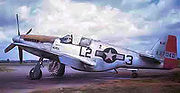 Along with the depot maintenance mission, Wattisham also hosted an Eighth Air Force fighter group, the 479th Fighter Group
, arriving from Santa Maria AAF, California
, on 15 May 1944. The group was part of the 65th Fighter Wing of the VIII Fighter Command
. Aircraft of the group had no cowling color markings as did other Eighth Air Force fighter groups and were marked only with colored tail rudders. The initial inventory of P-38s, many of which were hand-me-downs from other groups painted in olive drab camouflage, used geometric symbols on the tail to identify squadrons, white for camouflaged aircraft and black for unpainted (natural metal finish) Lightnings.
The group consisted of the following squadrons:
The 479th FG escorted heavy bombers during operations against targets on the continent, strafed targets of opportunity, and flew fighter-bomber, area and counter-air patrol
missions. Engaged primarily in B-17/B-24 escort activities and fighter sweeps until the Normandy invasion
in June 1944.
The group patrolled the beachhead during the invasion, strafed and dive-bombed troops, bridges, locomotives, railway cars, barges, vehicles, airfields, gun emplacements, flak towers, ammunition dumps, power stations and radar sites while on escort or fighter-bomber missions as the Allies drove across France
during the summer and fall of 1944. The unit flew area patrols to support the breakthrough at Saint-Lô
in July and the airborne attack on Holland in September.
The 479th Fighter Group received a Distinguished Unit Citation for the destruction of numerous aircraft on airfields in France
on 18 August and 5 September and during aerial battle near Münster
on 26 September. The unit continued escort and fighter-bomber activities from October to mid-December 1944. It converted to P-51s between 10 September and 1 October, using both types on missions until conversion was completed.
The group participated in the Battle of the Bulge
(December 1944-January 1945) by escorting bombers to and from targets in the battle area and by strafing transportation targets while on escort duty. From February to April 1945 it continued to fly escort missions, but also provided area patrols to support the airborne attack across the Rhine
in March.
The unit returned to Camp Kilmer
, New Jersey
, in November 1945, and was inactivated on December 1945. Among the notable pilots of the 479th were its second group commander, Col. Hubert Zemke
, and an ace
, Major Robin Olds
.
Legacy
The United States Air Force
479th Tactical Fighter Wing at George AFB, California
, (1952–1971) was bestowed the lineage, honors and history of the World War II USAAF 479th Fighter Group. The 479th TFW deployed personnel and aircraft to Key West NAS, Florida
, in response to the 1962 Cuban Missile Crisis
and deployed squadrons frequently to Southeast Asia
during the Vietnam War
. Later, the 479th Tactical Training Wing at Holloman AFB, New Mexico
, (1977–1991) provided pilot training.
The 479th Fighter Group at Moody AFB, Georgia, (2000–present) currently stands on active duty today.
, the UK's
first jet fighter. 152 Squadron was using Meteor night fighters NF11., and these were added to in 1954 by Hawker Hunter
s, from 257 and 263 Squadrons, the UK's next generation fighter, which helped secure Wattisham's future as a major fighter base]. 257 Sqd.had an American C.O., Major Howard E Tanner in 1955, the Station Commander was Group Captain Edwards, another Bader figure with artificial legs, the Wing Commander was one of the four Sowerey brothers, all of which held senior RAF posts. There was also a Station Flight which received and serviced visiting aircraft and had aircraft for other purposes. These included a Vampire, a Rapide and the COs Hunter. In 1955, with pilots returning from the Korean War
with battle and aerobatic expertise, following another renovation, the Royal Air Force
's display team, the Black Arrows
, was added to Wattisham's roster, flying the Hunters. Air displays were a regular feature from 1955. Shortly afterwards, the base moved briefly to Wymeswold in Leicestershire whilst the runways were resurfaced.
In the late 1950s, the Cold War
began to develop and so the RAF began to develop Britain's air defence. So, in 1960, the station was equipped with the very latest in British fighter aircraft: the English Electric Lightning
. The combination of the capabilities of this plane and Wattisham's location near the East Anglia
n coast was very suitable for countering the threats faced from the east. The airfield quickly became one of, if not the front-line airbase in the UK
. So throughout the Cold War Wattisham operated its 'QRA' or Quick Reaction Alert Sheds where live armed jets were on standby at all times and it was also a major 'Blacktop' diversion runway.
In 1974 McDonnell Douglas Phantom
s arrived to replace the Lightnings. They continued the role of playing a major part in defending Britain's airspace which largely involved intercepting the Soviet Tupolev Tu-95 Bear
aircraft. The Phantoms served through to 1992 and the end of the Cold War.
(41 Squadron was also based at Wattisham. It operated Gloster Javelin
all-weather fighters in the 1960s.)
in March 1993. The Army Air Corps soon moved in and it rapidly became a major Army airfield. The Royal Air Force returned to operate Sea King
Search and Rescue
helicopters on the site of the former QRA hangars.
Royal Air Force
The Royal Air Force is the aerial warfare service branch of the British Armed Forces. Formed on 1 April 1918, it is the oldest independent air force in the world...
station located in East Anglia
East Anglia
East Anglia is a traditional name for a region of eastern England, named after an ancient Anglo-Saxon kingdom, the Kingdom of the East Angles. The Angles took their name from their homeland Angeln, in northern Germany. East Anglia initially consisted of Norfolk and Suffolk, but upon the marriage of...
just outside the village of Wattisham
Wattisham
Wattisham is a civil parish near to the town of Stowmarket in Suffolk, England.-Wattisham Airfield:The village houses an airbase. Formerly known as RAF Wattisham, it was one of the front-line airbases in the Cold War. The RAF moved out in March 1993 and it is now the largest Army Air Corps airfield...
, south of Stowmarket
Stowmarket
-See also:* Stowmarket Town F.C.* Stowmarket High School-External links:* * * * *...
in Suffolk
Suffolk
Suffolk is a non-metropolitan county of historic origin in East Anglia, England. It has borders with Norfolk to the north, Cambridgeshire to the west and Essex to the south. The North Sea lies to the east...
, England
England
England is a country that is part of the United Kingdom. It shares land borders with Scotland to the north and Wales to the west; the Irish Sea is to the north west, the Celtic Sea to the south west, with the North Sea to the east and the English Channel to the south separating it from continental...
. During the Cold War
Cold War
The Cold War was the continuing state from roughly 1946 to 1991 of political conflict, military tension, proxy wars, and economic competition between the Communist World—primarily the Soviet Union and its satellite states and allies—and the powers of the Western world, primarily the United States...
it was a major front-line air force base. It closed in 1993 and is now operated by the British Army
British Army
The British Army is the land warfare branch of Her Majesty's Armed Forces in the United Kingdom. It came into being with the unification of the Kingdom of England and Scotland into the Kingdom of Great Britain in 1707. The new British Army incorporated Regiments that had already existed in England...
as Wattisham Airfield
Wattisham Airfield
Wattisham Airfield is the biggest centralised operational Army Airfield in the UK, located next to the small village of Wattisham in Suffolk, England. It is home to 3 Regiment Army Air Corps and 4 Regiment Army Air Corps. They are part of 16 Air Assault Brigade, whose headquarters is at Colchester...
.
RAF use
Wattisham opened on 5 April 1939 as a medium bomber station, the squadrons there being equipped with Bristol BlenheimBristol Blenheim
The Bristol Blenheim was a British light bomber aircraft designed and built by the Bristol Aeroplane Company that was used extensively in the early days of the Second World War. It was adapted as an interim long-range and night fighter, pending the availability of the Beaufighter...
bombers. Part of No. 2 Group
No. 2 Group RAF
Number 2 Group is a Group of the Royal Air Force which was first activated in 1918, served from 1918–20, from 1936 through the Second World War to 1947, from 1948 to 1958, from 1993 to 1996, was reactivated in 2000, and is today part of Air Command....
, No. 107 Squadron RAF
No. 107 Squadron RAF
No. 107 Squadron RAF was a bomber unit in the RAF in both World War I and World War II and during the Cold war was operational on Thor Intermediate Range Ballistic Missiles.-Formation and World War I:...
and No. 110 Squadron RAF
No. 110 Squadron RAF
-Formation and World War I:No. 110 Squadron RFC was formed on 1 November 1917, at Rendcomb, Gloucestershire and was equipped with B.E.2c aircraft. The squadron moved to Kenley the following year and re-equipped with the DH.9A - the first squadron to employ this aircraft. Its original complement of...
were stationed there on the outbreak of war. On 4 September 1939, just 29 hours after the declaration of war, bombers from Wattisham took off on the first attack of the war, against enemy shipping in Wilhelmshaven
Wilhelmshaven
Wilhelmshaven is a coastal town in Lower Saxony, Germany. It is situated on the western side of the Jade Bight, a bay of the North Sea.-History:...
harbour.
In 1942, the Blenheims left to be replaced with Bristol Beaufighter
Bristol Beaufighter
The Bristol Type 156 Beaufighter, often referred to as simply the Beau, was a British long-range heavy fighter modification of the Bristol Aeroplane Company's earlier Beaufort torpedo bomber design...
s, but some time after October 1942 the base was handed over to the United States Army Air Forces
United States Army Air Forces
The United States Army Air Forces was the military aviation arm of the United States of America during and immediately after World War II, and the direct predecessor of the United States Air Force....
.
USAAF use
Wattisham was assigned USAAF designation Station 377, and work began on building concrete runways with the intention of adapting the airfield for heavy bomber use. However, plans were apparently changed when it was evident that there would be sufficient heavy bomber airfields available for the USAAF, and it was decided that Wattisham would remain an air depot and also house a fighter unit.Work ceased on the runways leaving only the E-W with a concrete surface and short stretches of the other two. The main SW-NE runway was finished off with steel matting while the remaining NW-SE runway continued to be grass-surfaced for most of its length.
4th Strategic Air Depot
The 4th Strategic Air Depot (originally the 3rd Advanced Air Depot and then 3rd Technical Air Depot) serviced many types of aircraft but, by late 1943, was concentrating on fighter types. An additional technical area with four T2 hangars, some eighteen hardstands and a taxiway loop joining the airfield perimeter track, were constructed on the south side of the airfield. An engineering complex in temporary buildings was built around this area, chiefly in the village of Nedging Tye.The 4th Strategic Air Depot installation was officially named Hitcham, which was actually the name of a village two miles to the north-west of the site, to differentiate it from the fighter station using the same airstrip. The base was, by 1944, responsible for the maintenance of all American fighters in the UK. In May 1944, USAAF fighters in the form of P-38 Lightning
P-38 Lightning
The Lockheed P-38 Lightning was a World War II American fighter aircraft built by Lockheed. Developed to a United States Army Air Corps requirement, the P-38 had distinctive twin booms and a single, central nacelle containing the cockpit and armament...
and later P-51 Mustang
P-51 Mustang
The North American Aviation P-51 Mustang was an American long-range, single-seat fighter and fighter-bomber used during World War II, the Korean War and in several other conflicts...
s arrived.
479th Fighter Group
479th Flying Training Group
The 479th Flying Training Group is a United States Air Force unit, stationed at Naval Air Station Pensacola . A component of Air Education and Training Command , the 479 FTG was activated on 2 October 2009.-Overview:...
, arriving from Santa Maria AAF, California
California
California is a state located on the West Coast of the United States. It is by far the most populous U.S. state, and the third-largest by land area...
, on 15 May 1944. The group was part of the 65th Fighter Wing of the VIII Fighter Command
VIII Fighter Command
The VIII Fighter Command is an inactive United States Air Force organization. Its last assignment was with the United States Air Forces in Europe, being stationed at RAF Honington, England. It was inactivated on 20 March 1946....
. Aircraft of the group had no cowling color markings as did other Eighth Air Force fighter groups and were marked only with colored tail rudders. The initial inventory of P-38s, many of which were hand-me-downs from other groups painted in olive drab camouflage, used geometric symbols on the tail to identify squadrons, white for camouflaged aircraft and black for unpainted (natural metal finish) Lightnings.
The group consisted of the following squadrons:
- 434th Fighter Squadron (L2)
- 435th Fighter Squadron (J2)
- 436th Fighter Squadron (9B)
The 479th FG escorted heavy bombers during operations against targets on the continent, strafed targets of opportunity, and flew fighter-bomber, area and counter-air patrol
Counter-air patrol
Counter-air patrol is a type of flying mission for fighter aircraft against other fighters, common in World War II and sometimes combined with fighter sweeps against targets of opportunity...
missions. Engaged primarily in B-17/B-24 escort activities and fighter sweeps until the Normandy invasion
D-Day
D-Day is a term often used in military parlance to denote the day on which a combat attack or operation is to be initiated. "D-Day" often represents a variable, designating the day upon which some significant event will occur or has occurred; see Military designation of days and hours for similar...
in June 1944.
The group patrolled the beachhead during the invasion, strafed and dive-bombed troops, bridges, locomotives, railway cars, barges, vehicles, airfields, gun emplacements, flak towers, ammunition dumps, power stations and radar sites while on escort or fighter-bomber missions as the Allies drove across France
Operation Overlord
Operation Overlord was the code name for the Battle of Normandy, the operation that launched the invasion of German-occupied western Europe during World War II by Allied forces. The operation commenced on 6 June 1944 with the Normandy landings...
during the summer and fall of 1944. The unit flew area patrols to support the breakthrough at Saint-Lô
Saint-Lô
Saint-Lô is a commune in north-western France, the capital of the Manche department in Normandy.-History:Originally called Briovère , the town is built on and around ramparts. Originally it was a Gaul fortified settlement...
in July and the airborne attack on Holland in September.
The 479th Fighter Group received a Distinguished Unit Citation for the destruction of numerous aircraft on airfields in France
France
The French Republic , The French Republic , The French Republic , (commonly known as France , is a unitary semi-presidential republic in Western Europe with several overseas territories and islands located on other continents and in the Indian, Pacific, and Atlantic oceans. Metropolitan France...
on 18 August and 5 September and during aerial battle near Münster
Münster
Münster is an independent city in North Rhine-Westphalia, Germany. It is located in the northern part of the state and is considered to be the cultural centre of the Westphalia region. It is also capital of the local government region Münsterland...
on 26 September. The unit continued escort and fighter-bomber activities from October to mid-December 1944. It converted to P-51s between 10 September and 1 October, using both types on missions until conversion was completed.
The group participated in the Battle of the Bulge
Battle of the Bulge
The Battle of the Bulge was a major German offensive , launched toward the end of World War II through the densely forested Ardennes mountain region of Wallonia in Belgium, hence its French name , and France and...
(December 1944-January 1945) by escorting bombers to and from targets in the battle area and by strafing transportation targets while on escort duty. From February to April 1945 it continued to fly escort missions, but also provided area patrols to support the airborne attack across the Rhine
Operation Varsity
Operation Varsity was a successful joint American–British airborne operation that took place toward the end of World War II...
in March.
The unit returned to Camp Kilmer
Camp Kilmer
Camp Kilmer, New Jersey is a former United States Army camp that was activated in June 1942 as a staging area and part of an installation of the New York Port of Embarkation. The camp was organized as part of the Army Service Forces Transportation Corps. Troops were quartered at Camp Kilmer in...
, New Jersey
New Jersey
New Jersey is a state in the Northeastern and Middle Atlantic regions of the United States. , its population was 8,791,894. It is bordered on the north and east by the state of New York, on the southeast and south by the Atlantic Ocean, on the west by Pennsylvania and on the southwest by Delaware...
, in November 1945, and was inactivated on December 1945. Among the notable pilots of the 479th were its second group commander, Col. Hubert Zemke
Hubert Zemke
Colonel Hubert A. "Hub" Zemke was a career officer in the United States Air Force, a fighter pilot in World War II, and a leading USAAF ace...
, and an ace
Flying ace
A flying ace or fighter ace is a military aviator credited with shooting down several enemy aircraft during aerial combat. The actual number of aerial victories required to officially qualify as an "ace" has varied, but is usually considered to be five or more...
, Major Robin Olds
Robin Olds
Robin Olds was an American fighter pilot and general officer in the U.S. Air Force. He was a "triple ace", with a combined total of 16 victories in World War II and the Vietnam War. He retired in 1973 as a brigadier general....
.
Legacy
The United States Air Force
United States Air Force
The United States Air Force is the aerial warfare service branch of the United States Armed Forces and one of the American uniformed services. Initially part of the United States Army, the USAF was formed as a separate branch of the military on September 18, 1947 under the National Security Act of...
479th Tactical Fighter Wing at George AFB, California
California
California is a state located on the West Coast of the United States. It is by far the most populous U.S. state, and the third-largest by land area...
, (1952–1971) was bestowed the lineage, honors and history of the World War II USAAF 479th Fighter Group. The 479th TFW deployed personnel and aircraft to Key West NAS, Florida
Florida
Florida is a state in the southeastern United States, located on the nation's Atlantic and Gulf coasts. It is bordered to the west by the Gulf of Mexico, to the north by Alabama and Georgia and to the east by the Atlantic Ocean. With a population of 18,801,310 as measured by the 2010 census, it...
, in response to the 1962 Cuban Missile Crisis
Cuban Missile Crisis
The Cuban Missile Crisis was a confrontation among the Soviet Union, Cuba and the United States in October 1962, during the Cold War...
and deployed squadrons frequently to Southeast Asia
Southeast Asia
Southeast Asia, South-East Asia, South East Asia or Southeastern Asia is a subregion of Asia, consisting of the countries that are geographically south of China, east of India, west of New Guinea and north of Australia. The region lies on the intersection of geological plates, with heavy seismic...
during the Vietnam War
Vietnam War
The Vietnam War was a Cold War-era military conflict that occurred in Vietnam, Laos, and Cambodia from 1 November 1955 to the fall of Saigon on 30 April 1975. This war followed the First Indochina War and was fought between North Vietnam, supported by its communist allies, and the government of...
. Later, the 479th Tactical Training Wing at Holloman AFB, New Mexico
New Mexico
New Mexico is a state located in the southwest and western regions of the United States. New Mexico is also usually considered one of the Mountain States. With a population density of 16 per square mile, New Mexico is the sixth-most sparsely inhabited U.S...
, (1977–1991) provided pilot training.
The 479th Fighter Group at Moody AFB, Georgia, (2000–present) currently stands on active duty today.
Cold War
In 1946, the base was returned to the RAF. In 1949, new runways were laid, and the following year Wattisham became home to the Gloster MeteorGloster Meteor
The Gloster Meteor was the first British jet fighter and the Allies' first operational jet. It first flew in 1943 and commenced operations on 27 July 1944 with 616 Squadron of the Royal Air Force...
, the UK's
United Kingdom
The United Kingdom of Great Britain and Northern IrelandIn the United Kingdom and Dependencies, other languages have been officially recognised as legitimate autochthonous languages under the European Charter for Regional or Minority Languages...
first jet fighter. 152 Squadron was using Meteor night fighters NF11., and these were added to in 1954 by Hawker Hunter
Hawker Hunter
The Hawker Hunter is a subsonic British jet aircraft developed in the 1950s. The single-seat Hunter entered service as a manoeuvrable fighter aircraft, and later operated in fighter-bomber and reconnaissance roles in numerous conflicts. Two-seat variants remained in use for training and secondary...
s, from 257 and 263 Squadrons, the UK's next generation fighter, which helped secure Wattisham's future as a major fighter base]. 257 Sqd.had an American C.O., Major Howard E Tanner in 1955, the Station Commander was Group Captain Edwards, another Bader figure with artificial legs, the Wing Commander was one of the four Sowerey brothers, all of which held senior RAF posts. There was also a Station Flight which received and serviced visiting aircraft and had aircraft for other purposes. These included a Vampire, a Rapide and the COs Hunter. In 1955, with pilots returning from the Korean War
Korean War
The Korean War was a conventional war between South Korea, supported by the United Nations, and North Korea, supported by the People's Republic of China , with military material aid from the Soviet Union...
with battle and aerobatic expertise, following another renovation, the Royal Air Force
Royal Air Force
The Royal Air Force is the aerial warfare service branch of the British Armed Forces. Formed on 1 April 1918, it is the oldest independent air force in the world...
's display team, the Black Arrows
Black Arrows
The Black Arrows, one of the predecessors of the current Royal Air Force Aerobatic Team, the Red Arrows, were an aerobatic demonstration team formed in the 1950s from 111 Squadron...
, was added to Wattisham's roster, flying the Hunters. Air displays were a regular feature from 1955. Shortly afterwards, the base moved briefly to Wymeswold in Leicestershire whilst the runways were resurfaced.
In the late 1950s, the Cold War
Cold War
The Cold War was the continuing state from roughly 1946 to 1991 of political conflict, military tension, proxy wars, and economic competition between the Communist World—primarily the Soviet Union and its satellite states and allies—and the powers of the Western world, primarily the United States...
began to develop and so the RAF began to develop Britain's air defence. So, in 1960, the station was equipped with the very latest in British fighter aircraft: the English Electric Lightning
English Electric Lightning
The English Electric Lightning is a supersonic jet fighter aircraft of the Cold War era, noted for its great speed and unpainted natural metal exterior finish. It is the only all-British Mach 2 fighter aircraft. The aircraft was renowned for its capabilities as an interceptor; Royal Air Force ...
. The combination of the capabilities of this plane and Wattisham's location near the East Anglia
East Anglia
East Anglia is a traditional name for a region of eastern England, named after an ancient Anglo-Saxon kingdom, the Kingdom of the East Angles. The Angles took their name from their homeland Angeln, in northern Germany. East Anglia initially consisted of Norfolk and Suffolk, but upon the marriage of...
n coast was very suitable for countering the threats faced from the east. The airfield quickly became one of, if not the front-line airbase in the UK
United Kingdom
The United Kingdom of Great Britain and Northern IrelandIn the United Kingdom and Dependencies, other languages have been officially recognised as legitimate autochthonous languages under the European Charter for Regional or Minority Languages...
. So throughout the Cold War Wattisham operated its 'QRA' or Quick Reaction Alert Sheds where live armed jets were on standby at all times and it was also a major 'Blacktop' diversion runway.
In 1974 McDonnell Douglas Phantom
F-4 Phantom II
The McDonnell Douglas F-4 Phantom II is a tandem two-seat, twin-engined, all-weather, long-range supersonic jet interceptor fighter/fighter-bomber originally developed for the United States Navy by McDonnell Aircraft. It first entered service in 1960 with the U.S. Navy. Proving highly adaptable,...
s arrived to replace the Lightnings. They continued the role of playing a major part in defending Britain's airspace which largely involved intercepting the Soviet Tupolev Tu-95 Bear
Tupolev Tu-95
The Tupolev Tu-95 is a large, four-engine turboprop-powered strategic bomber and missile platform. First flown in 1952, the Tu-95 entered service with the former Soviet Union in 1956 and is expected to serve the Russian Air Force until at least 2040...
aircraft. The Phantoms served through to 1992 and the end of the Cold War.
Squadrons at Wattisham between 1957 and 1992
| Squadron | Equipment | Dates operational at Wattisham |
|---|---|---|
| 23 No. 23 Squadron RAF No. 23 Squadron was a squadron of the Royal Air Force. Until October 2009, it operated the Boeing Sentry AEW1 Airborne Warning And Control System aircraft from RAF Waddington, Lincolnshire.-First World War:... |
EE Lightning F3 English Electric Lightning The English Electric Lightning is a supersonic jet fighter aircraft of the Cold War era, noted for its great speed and unpainted natural metal exterior finish. It is the only all-British Mach 2 fighter aircraft. The aircraft was renowned for its capabilities as an interceptor; Royal Air Force ... Phantom FGR.2 F-4 Phantom II The McDonnell Douglas F-4 Phantom II is a tandem two-seat, twin-engined, all-weather, long-range supersonic jet interceptor fighter/fighter-bomber originally developed for the United States Navy by McDonnell Aircraft. It first entered service in 1960 with the U.S. Navy. Proving highly adaptable,... |
1974 to 1982 |
| 29 No. 29 Squadron RAF No. 29 Squadron of the Royal Air Force was first raised in 1915, and is one of the world's oldest fighter squadrons. The second British squadron to receive the Eurofighter Typhoon, it is currently the Operational Conversion Unit for the RAF's newest fighter.-Service in World War I:This unit was... |
EE Lightning F3 English Electric Lightning The English Electric Lightning is a supersonic jet fighter aircraft of the Cold War era, noted for its great speed and unpainted natural metal exterior finish. It is the only all-British Mach 2 fighter aircraft. The aircraft was renowned for its capabilities as an interceptor; Royal Air Force ... |
1967 to 1974 |
| 56 No. 56 Squadron RAF Number 56 Squadron is one of the oldest and most successful squadrons of the Royal Air Force, with battle honours from many of the significant air campaigns of both World War I and World War II... |
Hawker Hunter Hawker Hunter The Hawker Hunter is a subsonic British jet aircraft developed in the 1950s. The single-seat Hunter entered service as a manoeuvrable fighter aircraft, and later operated in fighter-bomber and reconnaissance roles in numerous conflicts. Two-seat variants remained in use for training and secondary... EE Lightning F1A English Electric Lightning The English Electric Lightning is a supersonic jet fighter aircraft of the Cold War era, noted for its great speed and unpainted natural metal exterior finish. It is the only all-British Mach 2 fighter aircraft. The aircraft was renowned for its capabilities as an interceptor; Royal Air Force ... EE Lightning F6 English Electric Lightning The English Electric Lightning is a supersonic jet fighter aircraft of the Cold War era, noted for its great speed and unpainted natural metal exterior finish. It is the only all-British Mach 2 fighter aircraft. The aircraft was renowned for its capabilities as an interceptor; Royal Air Force ... Phantom FGR.2 F-4 Phantom II The McDonnell Douglas F-4 Phantom II is a tandem two-seat, twin-engined, all-weather, long-range supersonic jet interceptor fighter/fighter-bomber originally developed for the United States Navy by McDonnell Aircraft. It first entered service in 1960 with the U.S. Navy. Proving highly adaptable,... |
1957 to 1967 and 1975 to 1992 |
| 74 No. 74 Squadron RAF No. 74 Squadron RAF, also known as a "Tiger Squadron" from its tiger head motif, is a squadron of the Royal Air Force. It operated fighter aircraft from 1917 to the 1990s.-First World War:... |
Phantom F-4J(UK) F-4 Phantom II The McDonnell Douglas F-4 Phantom II is a tandem two-seat, twin-engined, all-weather, long-range supersonic jet interceptor fighter/fighter-bomber originally developed for the United States Navy by McDonnell Aircraft. It first entered service in 1960 with the U.S. Navy. Proving highly adaptable,... Phantom FGR.2 F-4 Phantom II The McDonnell Douglas F-4 Phantom II is a tandem two-seat, twin-engined, all-weather, long-range supersonic jet interceptor fighter/fighter-bomber originally developed for the United States Navy by McDonnell Aircraft. It first entered service in 1960 with the U.S. Navy. Proving highly adaptable,... |
1984 to 1992 |
| 111 No. 111 Squadron RAF No. 111 Squadron of the Royal Air Force operated the Panavia Tornado F3 from RAF Leuchars, Scotland until March 2011, when the squadron was disbanded, ending the Tornado F3's RAF service.-In World War I:... |
Hawker Hunter Hawker Hunter The Hawker Hunter is a subsonic British jet aircraft developed in the 1950s. The single-seat Hunter entered service as a manoeuvrable fighter aircraft, and later operated in fighter-bomber and reconnaissance roles in numerous conflicts. Two-seat variants remained in use for training and secondary... EE Lightning F1A English Electric Lightning The English Electric Lightning is a supersonic jet fighter aircraft of the Cold War era, noted for its great speed and unpainted natural metal exterior finish. It is the only all-British Mach 2 fighter aircraft. The aircraft was renowned for its capabilities as an interceptor; Royal Air Force ... |
1957 to 1974 |
(41 Squadron was also based at Wattisham. It operated Gloster Javelin
Gloster Javelin
The Gloster Javelin was an "all-weather" interceptor aircraft that served with Britain's Royal Air Force in the late 1950s and most of the 1960s...
all-weather fighters in the 1960s.)
Closure
Wattisham's future hung in the balance as a major air force base and it was decided that with the Cold War threat gone it was no longer needed by the RAF. Wattisham stood down as a fighter base on 31 October 1992 and was handed over to the British ArmyBritish Army
The British Army is the land warfare branch of Her Majesty's Armed Forces in the United Kingdom. It came into being with the unification of the Kingdom of England and Scotland into the Kingdom of Great Britain in 1707. The new British Army incorporated Regiments that had already existed in England...
in March 1993. The Army Air Corps soon moved in and it rapidly became a major Army airfield. The Royal Air Force returned to operate Sea King
Sea King helicopter
Sea King helicopter may refer to:* SH-3 Sea King* CH-124 Sea King* Westland Sea King...
Search and Rescue
Search and rescue
Search and rescue is the search for and provision of aid to people who are in distress or imminent danger.The general field of search and rescue includes many specialty sub-fields, mostly based upon terrain considerations...
helicopters on the site of the former QRA hangars.