
All Topics  
Hawker Hunter


   Email Print
   Bookmark   Link


Hawker Hunter


The Hawker Hunter was a jet fighter aircraft
Fighter aircraft

A fighter aircraft is a military aircraft designed primarily for air-to-air combat with other aircraft, as opposed to a bomber, which is designed primarily to attack ground targets by dropping bombs....
 of the 1950s and 1960s. The Hunter served for many years with the Royal Air Force
Royal Air Force

The Royal Air Force is the United Kingdom's air force, the oldest independent air force in the world. Formed on 1 April 1918, the RAF has taken a significant role in British military history ever since, playing a large part in World War II and in more recent conflicts....
 and was widely exported, serving with 19 air forces. A total of 1,972 Hunters were produced by Hawker Siddeley and under licence.

origins of the Hunter trace back to the Hawker Sea Hawk
Hawker Sea Hawk

The Hawker Sea Hawk was a United Kingdom single-seat jet fighter of the Fleet Air Arm , the air branch of the Royal Navy , built by Hawker Aircraft and its sister company, Armstrong Whitworth Aircraft....
 straight-wing carrier-based fighter.


Discussion
Ask a question about 'Hawker Hunter'
Start a new discussion about 'Hawker Hunter'
Answer questions from other users
Full Discussion Forum


Encyclopedia


The Hawker Hunter was a jet fighter aircraft
Fighter aircraft

A fighter aircraft is a military aircraft designed primarily for air-to-air combat with other aircraft, as opposed to a bomber, which is designed primarily to attack ground targets by dropping bombs....
 of the 1950s and 1960s. The Hunter served for many years with the Royal Air Force
Royal Air Force

The Royal Air Force is the United Kingdom's air force, the oldest independent air force in the world. Formed on 1 April 1918, the RAF has taken a significant role in British military history ever since, playing a large part in World War II and in more recent conflicts....
 and was widely exported, serving with 19 air forces. A total of 1,972 Hunters were produced by Hawker Siddeley and under licence.

Development

Farnborough
The origins of the Hunter trace back to the Hawker Sea Hawk
Hawker Sea Hawk

The Hawker Sea Hawk was a United Kingdom single-seat jet fighter of the Fleet Air Arm , the air branch of the Royal Navy , built by Hawker Aircraft and its sister company, Armstrong Whitworth Aircraft....
 straight-wing carrier-based fighter. Seeking better performance and fulfillment of the Air Ministry
Air Ministry

The Air Ministry was formerly a department of the British Government with the responsibility of managing the affairs of the Royal Air Force....
 Specification E.38/46
List of Air Ministry Specifications

This is a partial list of the United Kingdom Air Ministry specifications for aircraft. A specification started from an Operational Requirement, abbreviated "OR", describing what the aircraft would be used for - this in turn led to a specification e.g....
, Hawker Aircraft's
Hawker Aircraft

Hawker Aircraft Limited was a United Kingdom list of aircraft manufacturers responsible for some of the most famous products in British aviation history....
 chief designer Sydney Camm created the Hawker P.1052
Hawker P.1052

The Hawker P.1052 was a United Kingdom experimental aircraft built by Hawker Aircraft for trials with swept wings....
, which was essentially a Sea Hawk with a 35-degree swept wing
Swept wing

A swept-wing is a wing planform common on jet aircraft capable of near-sonic or supersonic speeds. The wings are swept back instead of being set at right angles to the fuselage which was common on propeller.driven aircraft and early jets....
. First flying in 1948, the P.1052 demonstrated good performance but did not warrant further development into a production aircraft. As a private venture, Hawker converted the second P.1052 prototype into the Hawker P.1081
Hawker P.1081

The Hawker P.1081, also known as the "Australian Fighter" was a United Kingdom jet aircraft from the mid-twentieth century.Hawker Aircraft, a British manufacturer, submitted a proposal to meet a specification put out by the Australian government....
 with swept tailplanes and revised fuselage, with a single jet exhaust at the rear. First flying on 19 June 1950, the P.1081 was promising enough to draw interest from the Royal Australian Air Force
Royal Australian Air Force

The Royal Australian Air Force is the Air Force branch of the Australian Defence Force. The RAAF began in March 1912 as the Australian Flying Corps and became a fully independent Air Force in March 1921....
 but development went no further and the sole prototype was lost in a crash in 1951.

Meanwhile, in 1946, the Air Ministry
Air Ministry

The Air Ministry was formerly a department of the British Government with the responsibility of managing the affairs of the Royal Air Force....
 issued Specification F.43/46 for a daytime jet-powered interceptor. Camm took the basic P.1052 design and adapted it for the upcoming Rolls-Royce Avon
Rolls-Royce Avon

The Avon was Rolls-Royce Limited's first axial flow jet engine. Introduced in 1950, it went on to become one of their most successful post-World War II engine designs....
 turbojet
Turbojet

Turbojets are the oldest kind of general purpose jet engines. Two engineers, Frank Whittle in the United Kingdom and Hans von Ohain in Germany, developed the concept independently into practical engines during the late 1930s, although credit for the first turbojet is given to Whittle who submitted the first proposal and held a UK patent that...
. The Avon's major advantage over the Rolls-Royce Nene
Rolls-Royce Nene

The Rolls-Royce River Nene was a 1940s British centrifugal compressor turbojet engine....
, used in the Sea Hawk, was the axial compressor
Axial compressor

Axial compressors are rotating, aerofoil based Gas compressor in which the working fluid principally flows parallel to the axis of rotation. This is in contrast with other rotating compresors such as centrifugal, axi-centrifugal and mixed-flow compressors where the air may enter axially but will have a significant radial component on exit....
, which resulted in a much smaller engine diameter and better thrust. In March 1948, the Air Ministry issued Specification F.3/48, to cover development of the project. Initially fitted with a single air intake in the nose and a T-tail, the project rapidly evolved to the more familiar shape. The intakes were moved to the wing roots, to make room for weapons and radar in the nose. A more conventional tail arrangement was devised, as a result of stability concerns.

The P.1067 first flew from MoD Boscombe Down
MoD Boscombe Down

MoD Boscombe Down is an aircraft testing site located south of Amesbury, Wiltshire, England. It is run and managed by QinetiQ, the company created as part of the break up of the Defence Evaluation and Research Agency in 2001 by the United Kingdom Ministry of Defence ....
 on 20 July 1951, powered by a 6,500 lbf (28.91 kN) Avon 103 engine from an English Electric Canberra
English Electric Canberra

The English Electric Canberra is a first-generation jet-powered light bomber manufactured in large numbers through the 1950s. It proved to be highly adaptable, serving in such varied roles for tactical bomber, photographic, electronics, and meteorological reconnaissance....
 bomber. The second prototype was fitted with production avionics, armament and a 7,550 lbf (33.58 kN) Avon 107 turbojet. It first flew on 5 May 1952. As a back-up, Hawker was asked to adapt the new fighter to another British axial turbojet. The third prototype with an 8,000 lbf (35.59 kN) Armstrong Siddeley Sapphire 101 flew on 30 November 1952. The two Avon-engined aircraft were duck-egg green in color, while the Sapphire prototype was speed silver.

The Ministry of Supply
Ministry of Supply

The Ministry of Supply was a department of the UK Government formed in 1939 to co-ordinate the supply of equipment to all three British armed forces, headed by the Minister of Supply....
 ordered the Hunter into production in March 1950, a year before the first flight. The first production Hunter F.1 with a 7,600 lbf (33.80 kN) Avon 113 turbojet flew on 16 March 1953. The first 20 aircraft were, in effect, a pre-production series and featured a number of "one-off" modifications such as blown flap
Blown flap

Blown flaps are a powered aerodynamic high-lift device invented by the British on the wings of certain aircraft to improve low-speed Lift during takeoff and landing....
s and area rule
Area rule

The Whitcomb area rule, also called the transonic area rule, is a design technique used to reduce an aircraft's drag at transonic and supersonic speeds, particularly between Mach number 0.8 and 1.2....
d fuselage. On 7 September 1953, a Hunter F.3 flown by Neville Duke
Neville Duke

Squadron Leader Neville Frederick Duke Distinguished Service Order, Order of the British Empire, Distinguished Flying Cross , Air Force Cross , FRAeS was a British World War II Fighter aircraft....
 broke the world air speed record
Air speed record

An air speed record is the highest airspeed attained by an aircraft of a particular class.The rules for all official aviation records are defined by F?d?ration A?ronautique Internationale , and they also ratify any claims....
, achieving 727.63 mph
MPH

mph is a three-letter acronym that refers to miles per hour, a measurement of speedMPH may also refer to:* Master of Public Health, a Master's degree in public health...
 over Littlehampton
Littlehampton

Littlehampton is a seaside resort town and civil parish in the Arun District of West Sussex, England, located on the east bank at the mouth of the River Arun....
. However, the record stood for less than three weeks before being broken by an RAF Supermarine Swift
Supermarine Swift

The Supermarine Swift was a United Kingdom single-seat jet fighter of the Royal Air Force, built by Supermarine during the 1950s. After a protracted development period, the Swift entered service as an Interceptor aircraft, but, due to a spate of accidents, its service life was short....
 on 25 September 1953.

Design


The Hunter was a conventional all-metal monoplane. The pilot sat on a Martin-Baker
Martin-Baker

Martin-Baker Aircraft Co. Ltd. is a United Kingdom manufacturer of aircraft ejection seats and was a pioneer in their design and manufacture. The company's headquarters are in Denham, Buckinghamshire, Buckinghamshire, England....
 2H or 3H ejector seat
Ejector seat

In aircraft, an ejection seat is a system designed to rescue the pilot or other crew of an aircraft in an emergency. In most designs, the seat is propelled out of the aircraft by an explosive charge or rocket motor, carrying the pilot with it....
. The two-seat trainer version used the Mk.4H ejection seats. The fuselage was of monocoque
Monocoque

Monocoque, from Greek language for single and French for shell , is a construction technique that supports structural load by using an object's external skin as opposed to using an internal frame or truss that is then covered with a non-load-bearing skin....
 construction, with a removable rear section for engine maintenance. The engine was fed through triangular air intakes in the wing roots and had a single jetpipe in the rear of the fuselage. The mid-mounted wings had a leading edge sweep of 35 degrees and slight anhedral
Dihedral

Dihedral is the upward angle from horizontal of the wings or tail pane of a fixed-wing aircraft or the wing of a bird. Dihedral is also used in some types of kites such as box kites....
. The tailplanes and fin were also swept. The controls were completely conventional. A single airbrake was fitted under the ventral rear fuselage. The aircraft had conventional retractable tricycle landing gear. A noteworthy feature of the single seat fighter version was the armament of four 30 mm ADEN cannon
ADEN cannon

The Royal Small Arms Factory ADEN is a 30 mm cannon used on many military aircraft, particularly those of the United Kingdom Royal Air Force and Fleet Air Arm....
. The cannon and ammunition boxes were contained in a single pack that could be removed from the aircraft for rapid re-arming and maintenance. Interestingly, the barrels of the cannon remained in the aircraft when the pack was removed. In the two seat version, either a single ADEN cannon was carried or, in some export versions, two ADEN cannon, with a removable ammunition tank. A simple Ekco ranging radar was fitted in the nose. Later Marks (Mks) of Hunter had SNEB Pods fitted. These were 68 mm rockets in 18-round Matra pods, giving a strike capability against road convoys and trains.

Operational history


The Hunter F.1 entered service with the Royal Air Force in July 1954. It quickly became apparent that the new fighter had insufficient fuel capacity. In addition, incorrectly-designed air intakes produced disruptions in air flow to the engine, with resultant compressor stall
Compressor stall

A compressor stall is a situation of abnormal airflow resulting from a Stall of the airfoil within the compressor. Stall is found in dynamic Gas compressor, particularly axial compressors, as used in jet engines and turbocharger reciprocating engines....
s. The engine problems were compounded by ingestion of gas when the cannon were fired, which resulted in flameout
Flameout

A flameout refers to the failure of a jet engine caused by the extinction of the flame in the combustion chamber. It can be caused by a number of factors, including fuel exhaustion; compressor stall; insufficient oxygen supply; foreign object damage ; severe inclement weather; mechanical failure; and other factors....
s. The potential solutions of cutting fuel to the engine when the cannon fired and restricting the use of cannon to low speeds and altitudes were obviously unsatisfactory. The F 2 produced at the same time which used the Armstrong-Siddeley Sapphire
Armstrong-Siddeley Sapphire

The Armstrong Siddeley Sapphire was a turbojet engine produced by Armstrong Siddeley in the 1950s. It was the ultimate development of work that had started as the Metropolitan-Vickers F.2 in 1940, evolving into an advanced Axial compressor design with an annular combustion chamber that developed over 11,000 lbf ....
 engine did not suffer from flameouts.

Furthermore, ejected cannon ammunition links had a tendency to strike and damage the underside of the fuselage. The original split flap airbrakes caused adverse changes in pitch trim and were quickly replaced by a single ventral airbrake. Unfortunately, this meant the airbrake could not be used for landings. Finally, the canopy suffered from fogging and icing during rapid descents.

Its short range was crippling for the new British fighter, with a maximum flight endurance of about an hour. On 8 February 1956, a flight of eight Hunters was redirected to another airfield due to inclement weather. Six aircraft ran out of fuel and crashed, with one pilot killed. One of the aircraft that landed ran out of fuel while taxiing. On the positive side, the aircraft possessed good handling characteristics and even the early F.1 version would exceed sonic speed in a 30°-40° dive at full throttle from 40,000 feet and above with comparatively minor trim changes.

The first Hunter prototype was fitted with an afterburning
AfterBurner

The AfterBurner is a lighting solution for the Game Boy Advance system that was created by Triton-Labs.Originally, portablemonopoly.net was a website created to petition Nintendo to put some kind of light in their Game Boy Advance system....
 Avon RA.7R with 9,600 lbf (42.70 kN) of thrust and other aerodynamic refinements (most noticeably a pointed nose). Dubbed Hunter F.3, on 7 September 1953 it set a speed record of 628.1 knots (722.2 mph, 1,163.2 km/h) over a 1.62 nautical mile (1.86 mile, 3 kilometre) course.

To address the problem of range, a production Hunter F.1 was fitted with a new wing which featured fuel bladders in the leading edge and "wet" hardpoints. This increased the internal fuel capacity from 337 to 414 imperial gallons (404 to 497 US gal, 1533 to 1833 L). In addition, a single 100 imperial gallon (120 US gal, 454 L) external fuel tank could be carried under each wing. The resulting Hunter F.4 first flew on 20 October 1954, entering service in March 1955. A distinctive Hunter feature added on the F.4 was the pair of blisters under the nose, which collected spent ammunition links to prevent airframe damage. Crews dubbed them "Sabrinas
Sabrina (actress)

Sabrina was a 1950s England glamour photography who progressed to a minor movie career. Her main claim to fame was her hourglass figure of prodigious breasts coupled with a tiny 17" waist....
" after the contemporary movie star. The Sapphire-powered version of the F.4 was designated the Hunter F.5. Although the Sapphire did not suffer from the flameout problems of the Avon and had better fuel economy, the RAF elected to persevere with the Avon in order to simplify supply and maintenance, since the same engine was also used by the Canberra
English Electric Canberra

The English Electric Canberra is a first-generation jet-powered light bomber manufactured in large numbers through the 1950s. It proved to be highly adaptable, serving in such varied roles for tactical bomber, photographic, electronics, and meteorological reconnaissance....
 bomber.

To deal with surging and flameout problems, Rolls-Royce fitted the Avon with a new automatic fuel system and redesigned compressor. The resulting Avon 203, producing 10,000 lbf (44.48 kN) of thrust, was fitted to Hawker P.1099, which became the definitive Hunter F.6. The other crucial revision on the F.6 was the new "Mod 228" wing, which had a larger area, a distinctive "dogtooth" leading edge notch to alleviate the pitch-up
Pitch-up

In aerodynamics, pitch-up is a severe form of Stall in an aircraft.The phenomenon of pitch-up is directly related to inherent properties of all swept wings....
 problem, and four "wet" hardpoints, finally giving the aircraft a good ferry range.

The Hunter F.6 was retired from its fighter role in the RAF in 1963, being replaced by the English Electric Lightning
English Electric Lightning

The English Electric Lightning is a supersonic jet fighter aircraft of the Cold War era, remembered for its great speed and unpainted natural metal exterior finish....
. However, many F.6s were given a new lease of life in the close air support
Close air support

In military tactics, close air support is defined as air action by fixed or rotary winged aircraft against hostile targets that are in close proximity to friendly forces, and which requires detailed integration of each air mission with fire and movement of these forces....
 role, after being converted into the Hunter FGA.9 variant. This had a further strengthened wing and greater external fuel and weapons capability. The FGA.9 saw front-line use from 1960 to 1971, alongside the closely related Hunter FR.10 tactical reconnaissance variant. The F.6 and FGA.9 continued in service with the RAF at the Tactical Weapons Unit at RAF Brawdy
RAF Brawdy

RAF Brawdy was a Royal Air Force station in South West Wales near to St David's.The Pembrokeshire base was officially opened on 2 February 1944 as a satellite station for the nearby RAF St....
 in South Wales
South Wales

South Wales is an area of Wales bordered by England and the Bristol Channel to the east and south, and Mid Wales and West Wales to the north and west....
 and later at RAF Chivenor in Devon
Devon

Devon is a large Counties of England in South West England. The county is also referred to as Devonshire, but that is an entirely unofficial name, rarely used inside of the county but often indicating a shire....
. A variant of the F.6, the F.6A, was also flown here and were essentially F.6 aircraft with 230 gallon under-wing tanks and brake parachutes fitted. The component squadrons of the TWU were No.63
No. 63 Squadron RAF

No. 63 Squadron...
 and No. 234
No. 234 Squadron RAF

History...
 with No. 79 Squadron
No. 79 Squadron RAF

No. 79 Squadron is a squadron of the Royal Air Force....
 acting as the standards organisation and for the training of foreign and Commonwealth students from the Singapore Air Force. The types remained in service until shortly after the Hawk T.1
BAE Hawk

The BAE Systems Hawk is a United Kingdom single engine, advanced jet trainer aircraft. It first flew in 1974 as the Hawker Siddeley Hawk....
 entered service in the mid-1970s.

Two-seat trainer versions of the Hunter, the T.7 and T.8 remained in use for training and secondary roles by the RAF and Royal Navy
Royal Navy

The Royal Navy of the United Kingdom is the oldest of the British Armed Forces . From the mid-18th century until well into the 20th century, it was the most powerful navy in the world, playing a key part in establishing the British Empire as the dominant world power from 1815 until the early 1940s....
 until the early 1990s.

In December 2006, the Hunter re-entered RAF service with two ex-Swiss examples leased from a private operator to act as targets for a surface to air missile program. They were allocated RAF serials ZZ190 and ZZ191. This was followed by a two-seat aircraft in April 2007, which reverted to its original RAF serial XF995.

Others


Switzerland and Singapore Perhaps the most enthusiastic Hunter users were Switzerland and Singapore, who used it from 1958 to 1994, both improving it in service and often choosing to retain it in lieu of newer aircraft.

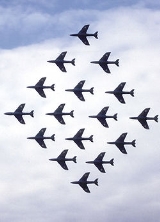
The Swiss AF for some years ran a display team using Hawker Hunter Mk.58s, which performed internationally. Some Hunters in private hands are ex-Swiss AF. (The aerobatic demonstration team of Swiss Air Force
Swiss Air Force

The Swiss Air Force is the air component of the Swiss Armed Forces. It was established on July 31, 1914 but did not become a separate service until 1936, and an independent service separate from the Army until 1 January 1996....
 is the Patrouille Suisse
Patrouille Suisse

The Patrouille Suisse is an Aerobatics of the Swiss Air Force. The team flies six Northrop F-5 Freedom Fighter fighter/bomber jets....
, which now flies six Northrop F-5E Tiger II jets).

Sweden In the early 1950s, the Swedish Air Force
Swedish Air Force

The Swedish Air Force is the air force branch of the Swedish Armed Forces....
 saw the need for an interceptor that could reach enemy bombers at a higher altitude than the J 29 Tunnan that formed the backbone of the fighter force. A contract for 120 Hawker Hunters was therefore signed in 1954 and the first one were delivered in August 1955. The model was designated J 34 and was assigned to the F 8 and F 18 wings that defended Stockholm
Stockholm

is the capital and largest city of Sweden. It is the site of the national Swedish Government of Sweden, the Parliament of Sweden, and the official residence of the Swedish Monarchy of Sweden....
. The J 34 was armed with four 30 mm cannons and two Sidewinder
AIM-9 Sidewinder

The AIM-9 Sidewinder is a Infrared homing, short-range, air-to-air missile carried by fighter aircraft and recently, certain Attack helicopter. It is named after the Crotalus cerastes, which detects its prey via body heat and also because of the peculiar snake-like path of flight the early versions had when launched....
s. The Swedish Air Force
Swedish Air Force

The Swedish Air Force is the air force branch of the Swedish Armed Forces....
's aerobatic team Acro Hunters used five J 34s during the late 1950s. The J 34s were gradually replaced by supersonic J 35 Draken and re-assigned to less prominent air wings, F 9 in Gothenburg and F 10 in Ängelholm, during the 1960s. The last ones were retired in 1969.

A project to improve the performance of the J 34 by installing a Swedish-designed afterburner proved successful in 1958. However, the cost turned out to be prohibitive, so the project was shelved.

Combat history


Middle East
During the Suez Crisis
Suez Crisis

The Suez Crisis, also referred to as the Tripartite Aggression, was a military attack on Egypt by United Kingdom, France, and Israel beginning on 29 October 1956....
 of 1956, Hunters of No. 1
No. 1 Squadron RAF

No. 1 Squadron is a squadron of the Royal Air Force. It currently operates the RAF Harrier II from RAF Cottesmore.The squadron motto is In omnibus princeps , appropriate for the RAF's oldest squadron and one that has been involved in almost every major British military operation since World War I....
 and No. 34
No. 34 Squadron RAF

No. 34 Squadron RAF was a squadron of the Royal Air Force. During the First World War it operated as a reconnaissance and bomber squadron, and in the 1930s operated light bombers....
 Squadrons based at RAF Akrotiri
RAF Akrotiri

Royal Air Force Station Akrotiri, more commonly known as RAF Akrotiri , is a large Royal Air Force Royal Air Force station and military airbase, on the Mediterranean Sea island of Cyprus....
 in Cyprus
Cyprus

Cyprus , officially the Republic of Cyprus , is an island country situated in the eastern Mediterranean Sea, east of Greece, west of Lebanon, Syria, and Israel, south of Turkey and north of Egypt....
 flew escort for English Electric Canberra
English Electric Canberra

The English Electric Canberra is a first-generation jet-powered light bomber manufactured in large numbers through the 1950s. It proved to be highly adaptable, serving in such varied roles for tactical bomber, photographic, electronics, and meteorological reconnaissance....
 bombers on bombing missions into Egypt for just one day before being put on local air defence due to their lack of range.

In 1967 during the Six-Day War
Six-Day War

In the Six-Day War of June 5-10, 1967, Israel defeated the armies of the neighboring states of Egypt, Jordan, and Syria. In Arabic, the war is called ....
, Hunters of the Iraqi air force gave a good account of themselves. While flying a Hunter from Iraqi Airbase H3, Flt. Lt. Saiful Azam of PAF
PAF

PAF can refer to:...
 shot down two Israeli jets including a Mach 2.2 Mirage IIIC. Some missions were also flown by the Jordanian AF, but most of the Jordanian Hunters were destroyed on the ground on the first day of the war. A total of 16 were lost in air-to-air battles. Iraqi Hunters flew from Egypt and Syria also but many were lost in combat.

Aden

In Aden
Aden

Aden is a city in Yemen, 170 kilometers east of Bab-el-Mandeb.Aden's ancient, natural harbour lies in the crater of an extinct volcano which now forms a peninsula, joined to the mainland by a low isthmus....
 in May 1964 Hunter FGA.9s and FR.10s of No. 43 Squadron RAF
No. 43 Squadron RAF

No. 43 Squadron of the Royal Air Force operates the Panavia Tornado RAF Tornado F3 from RAF Leuchars, Scotland....
 and No. 8 Squadron RAF were used extensively and effectively during the Radfan campaign against insurgents attempting to overthrow the Federation of South Arabia
Federation of South Arabia

The Federation of South Arabia was an organization of states under British Empire protection in what would become South Yemen. It was formed on 4 April 1962 from the 15 protected states of the Federation of Arab Emirates of the South....
, predominantly using 3 inch high explosive rockets and 30mm Aden cannon. Both squadrons continued operations with their Hunters until the UK withdrew from Aden in November 1967.

Brunei Revolt and Borneo Confrontation

During the Brunei Revolt
Brunei Revolt

The Brunei Revolt broke out on December 8, 1962 and was led by Yassin Affandi and his armed rebels. The rebels began co-ordinated attacks on the oil town of Seria, targeting the Royal Dutch Shell oil installations and attacks on police stations and government facilities around the protectorate....
 in 1962, the Royal Air Force deployed Hunters over Brunei to provide support for British ground forces. In one event, several Bruneian and Expatriate
Expatriate

An expatriate is a person temporarily or permanently Residency in a country and culture other than that of the person's upbringing or legal residence....
 hostages were under threat of execution, however several Hunters overflew the rebel compound which prevented any executions from taking place. In the following Borneo Confrontation, Hunters were deployed along with other RAF aircraft in Borneo
Borneo

Borneo is the List of islands by area and is located at the centre of Maritime Southeast Asia. Administratively, this island is divided between Indonesia, Malaysia and Brunei....
 and Malaya
Federation of Malaya

The Federation of Malaya , is the name given to a federation of 11 states that existed from 31 January 1948 until 16 September 1963. Comprising the nine Malay states and the United Kingdom Straits Settlements of Penang and Malacca, it was eventually superseded by Malaysia....
.

Chile

Hunters played a role in the military coup that overthrew the socialist president of Chile
Chile

Chile, officially the Republic of Chile , is a country in South America occupying a long and narrow coastal strip wedged between the Andes mountains and the Pacific Ocean....
, Salvador Allende
Salvador Allende

Salvador Isabelino Allende Gossens was President of Chile of Chile from November 1970 until his death during the 1973 Chilean coup d'?tat.Allende's involvement in Chilean political life spanned a period of nearly forty years....
, on 11 September 1973 Chilean coup d'état. Hunters of Squadron No 7 of the Chilean Air Force
Chilean Air Force

The Chilean Air Force is the air force of Chile, a branch of the Military of Chile....
s bombarded the presidential palace, Allende's house in Santiago
Santiago, Chile

Santiago , is the Capital and largest city of Chile, and the center of its largest conurbation . It is located in the country's central valley, at an elevation of 520 m Above mean sea level....
, and radio stations loyal to the government.

Somalia
The regime of Siad Barre
Siad Barre

Mohamed Siad Barre was the President of Somalia from 1969 to 1991. Prior to his presidency, he was very educated army commander under then corrupted democratic government of Somalia , which had been in place since independence in June 1960....
 used Hunters for indiscriminate bombings during the civil war in Somalia
Somalia

Somalia , officially the Republic of Somalia and formerly known as the Somali Democratic Republic, is a country located in the Horn of Africa....
 in the late 1980s.

Rhodesia
The Rhodesia
Rhodesia

Rhodesia was the name adopted when the formerly British colonies of Southern Rhodesia declared itself independent on 11 November 1965. The name was also used with the establishment of Zimbabwe Rhodesia in 1979....
ns (now Zimbabwe
Zimbabwe

Zimbabwe , is a landlocked country located in the southern part of the continent of Africa, between the Zambezi and Limpopo River rivers. It is bordered by South Africa to the south, Botswana to the southwest, Zambia to the northwest and Mozambique to the east....
) used their Hunter FGA.9s extensively against ZANU/ZAPU insurgents in the late 1960s and throughout the 1970s, including cross-border strikes.

Zimbabwe
Zimbabwe
Zimbabwe

Zimbabwe , is a landlocked country located in the southern part of the continent of Africa, between the Zambezi and Limpopo River rivers. It is bordered by South Africa to the south, Botswana to the southwest, Zambia to the northwest and Mozambique to the east....
 used its Hunters (inherited from the Rhodesian Air Force) to support Laurent Kabila during the Second Congo War
Second Congo War

The Second Congo War, also known as Africa's World War and the Great War of Africa, began in August 1998 in the Democratic Republic of the Congo , and officially ended in July 2003 when the Transitional Government of the Democratic Republic of the Congo took power ....
 and they were supposedly also involved in the fighting in Mozambique
Mozambique

Mozambique, officially the Republic of Mozambique , is a country in southeastern Africa bordered by the Indian Ocean to the east, Tanzania to the north, Malawi and Zambia to the northwest, Zimbabwe to the west and Swaziland and South Africa to the southwest....
.

Lebanon

The Lebanese Air Force
Lebanese Air Force

The Lebanese Air Force is the aerial warfare branch of the Lebanese Armed Forces. The seal of the air force is constituted of a Roundel with two wings and a Lebanon Cedar tree, surrounded by two Bay Laurel leaves on a blue background....
 operated Hawker Hunters from 1958. A Lebanese Hawker Hunter shot down an Israeli jet over Kfirmishki in early sixties, its pilot was captured by the LAF
Lebanese Armed Forces

The Lebanese Armed Forces is the military of the Republic of Lebanon. The motto of the Lebanese Army is "Honor, Sacrifice, Loyalty" . The Lebanese Army Emblem represents the Lebanon Cedar tree surrounded by two Bay Laurel leaves and positioned above the symbols of the three branches of the army, the ground forces represented by the two swor...
 . One Lebanese Hawker Hunter was shot down on the first day of the Six-Day War
Six-Day War

In the Six-Day War of June 5-10, 1967, Israel defeated the armies of the neighboring states of Egypt, Jordan, and Syria. In Arabic, the war is called ....
 by the Israeli Air Force
Israeli Air Force

The Israeli Air Force is the air force of the Israel Defense Forces. The current Commander in Chief is Aluf Ido Nehoshtan. The Israeli Air Force has approximately 700 aircraft....
. They were used infrequently during the Lebanese Civil War
Lebanese Civil War

conflict=Lebanese Civil War |date=1984 - 1990|place=Lebanon|result=Taif Agreement|combatant1=|combatant2=|commander1=|commander2=|strength1=|strength2=...
, flying their last sorties in a period from 1 September to 15 September 1983.

On 20 August 2007, reports indicated that the Lebanese Armed Forces may restart using them after the conflict with Fatah al Islam
2007 Lebanon conflict

The 2007 Lebanon conflict began when fighting broke out between Fatah al-Islam, an Islamism List of designated terrorist organizations, and the Lebanese Armed Forces on May 20, 2007 in Nahr al-Bared, an UNRWA Palestinian List of Palestinian refugee camps near Tripoli, Lebanon....
 militants in the Nahr el-Bared camp north of Tripoli.

Further statements have since been made indicating that Lebanon is currently in the process of returning eight FGA.70 and T.66C Hunters to airworthy condition for operational combat sorties against guerillas. However, the programme has been held up in recent times by lack of certain spares for the aircraft, most notably cartridges for the Martin-Baker ejection seats.

On the 12 November 2008, the Lebanese Air Force succeeded in returning the Hawker Hunter to service after 50 years of service. The Hawker Hunter fighters of the Lebanese Air Force participated in the aerial show over Lebanese skies on the 22 November as part of the 65th anniversary of independence.

Indo-Pakistan Wars

1965 According to official statistics of the Indian Air Force, a total of 18 Indian Air Force Hunters were destroyed in the air and on the ground by Pakistan Air Force during the 1965 war. 1971 The Hunters participated extensively in the war of 1971. The audacious attack of the Pakistani 51st Infantry Brigade backed up by the 1st Armoured Brigade on the Indian outpost of Longewala
Longewala

Longewala is a place in western India where the famous Battle of Longewala occurred during the Indo-Pakistani War of 1971. It is located approximately 30 km from Ramgarh, Rajasthan in the West India States and territories of India of Rajasthan ....
 became famous as the Battle of Longewala
Battle of Longewala

The Battle of Longewala was one of the first major engagement in the Western Sector during the Indo-Pakistani War of 1971, fought between assaulting Pakistan Army forces and Indian army defenders at the Indian Army of Longewala, in the Thar Desert of the Rajasthan States and territories of India in India....
, in which the Hunters played a crucial role in blunting the attack. The Hunters destroyed several Pakistani tanks (notably T-59 of Chinese origin). Similarly it was also used for strategic bombing of Attock Oil refinery, which resulted in severe oil supply shortage in Pakistan.

Variants

.

Operators


  • **********
Belgium
Belgium

* A small German-speaking Community of Belgium exists in eastern Wallonia. Belgium's linguistic diversity and related political and cultural conflicts are reflected in the history of Belgium and a complex Communities and regions of Belgium....
 and Netherlands
Netherlands

The Netherlands is a country that is part of the Kingdom of the Netherlands. It is a parliamentary democratic constitutional monarchy. The Netherlands is located in North-West Europe, and bordered by the North Sea to the north and west, Belgium to the south, and Germany to the east....
 produced the Hunter under licence, through Avions Fairey
Avions Fairey

Avions Fairey was the Belgian-based subsidiary of the British Fairey Aviation that built Fairey aircraft designs for the Belgian government....
 and Fokker
Fokker

Fokker was a Dutch aircraft manufacturer named after its founder, Anthony Fokker. The company operated under several different names, starting out in 1912 in Germany, moving to the Netherlands in 1919....
 respectively

Civil operators

Hawker Hunter Hillsboro Air Show Crash2
Embraer
  • Operates an ex-Chilean Air Force Hunter T72 as a flight test chase plane


Hawker Hunter Aviation.
  • Operates a fleet of 10 ex-Swiss F.58As and a pair of two seaters (a T7 and T8), as well as a single Blackburn Buccaneer
    Blackburn Buccaneer

    The Blackburn Buccaneer was a United Kingdom low level strike aircraft serving with the Royal Navy and the Royal Air Force. Designed and initially produced by Blackburn Aircraft it was later known as the Hawker Siddeley Buccaneer when Blackburn became a part of the Hawker Siddeley group....
     and a Sukhoi
    Sukhoi

    Sukhoi is a major Russian aircraft manufacturer famous for its fighter aircraft. Founded by Pavel Sukhoi in 1939 as the Sukhoi Design Bureau , it is currently known as Sukhoi Corporation....
     Su-22.


Dutch Hawker Hunter Foundation.
  • Operates a Hunter T.8C two-seat in classic RNLAF paint and a single seat Hunter F.6A It should fly from England to the Netherlands in October 2008 but it had some technical problems. Now it still is in the United Kingdom because the weather is bad over the North Sea. The Hawker Hunter T.8C and the upcoming F.6A are based at Leeuwarden Air Base
    Leeuwarden Air Base

    Leeuwarden Air Base is a The Netherlands military airport . The airbase is one of the two F-16 bases of the RNLAF. The airbase lies North-West of the capital of Friesland, Leeuwarden....
     in the Netherlands


Hunter Flying Ltd.
  • Based at Exeter International Airport
    Exeter International Airport

    Exeter International Airport is an airport close to the city of Exeter in the county of Devon, England.The airport handled 1,024,730 passengers in 2007, the first time over 1 million passengers have used the airport in a single year, which represented a 4.3% increase on the 2006 passenger total of 982,804....
     in England
    England

    native_name =|conventional_long_name = England|common_name = England|image_flag = Flag of England.svg|image_coat = England COA.svg|symbol_type = Royal Coat of Arms...
    , Hunter Flying Ltd maintain over fifteen privately owned examples of the Hunter.


Delta Jets
  • Delta Jets who operate from Kemble Airfield
    Kemble Airfield

    Kemble Airport , is a general aviation airport, near the village of Kemble, Gloucestershire in Gloucestershire, England. Located southwest of Cirencester, it was built as an Royal Air Force base ....
     near Cirencester
    Cirencester

    Cirencester is a market town in Gloucestershire, England, 93 miles west northwest of London. Cirencester lies on the River Churn, a tributary of the River Thames, and is the largest town in Cotswold ....
    , England
    England

    native_name =|conventional_long_name = England|common_name = England|image_flag = Flag of England.svg|image_coat = England COA.svg|symbol_type = Royal Coat of Arms...
    , have three operational Hunters.


Robert Guilford
  • On 16 July 2006 in Hillsboro
    Hillsboro, Oregon

    Hillsboro is the fifth-largest city in the U.S. state of Oregon and is the county seat of Washington County, Oregon. Lying in the Tualatin Valley on the west side of the Portland metropolitan area, the city is home to many hi tech companies such as Intel that comprise what has become known as the Silicon Forest....
    , Oregon
    Oregon

    Oregon is a U.S. state in the Pacific Northwest region of the United States. The area was inhabited by many indigenous tribes before the arrival of traders, explorers and settlers....
    , USA
    United States

    The United States of America is a Federal government constitutional republic comprising U.S. state and a federal district. The country is situated mostly in central North America, where its Contiguous United States and Washington, D.C., the Capital districts and territories, lie between the Pacific Ocean and Atlantic Oceans, Borders of the U...
    , a Mk 58 Hawker Hunter owned by lawyer Robert Guilford crashed into a residential area when it failed to gain full power upon takeoff, killing the pilot and causing damage to properties.The Hunter had been part of a static display on the ground and not an active participant in the Oregon Air Show.


Thunder City Seven Hunters are based at Thunder City at Cape Town
Cape Town

Cape Town is the second most populous city in South Africa, forming part of the metropolitan municipality of the City of Cape Town. It is the provincial Capital of the Western Cape, as well as the legislature capital of South Africa, where the Parliament of South Africa and many government offices are located....
 International Airport in South Africa
South Africa

The Republic of South Africa, also known by Official names of South Africa, is a country located at the southern tip of the continent of Africa....
:
  • Hunter F.6A, XE653 (ZU-AUJ), ex-RAF 111 Squadron Black Arrows
  • Hunter GA.11, XF368 (used for spares), ex-Fleet Air Arm
  • Hunter T.8B, XF967 (Buccaneer instruments) (ZU-CTN), ex-RAF
  • Hunter T.8C XL598 (ZU-ATH), ex-Fleet Air Arm
  • Hunter T.7, XL613 (ZU-LEE), ex-RAF
  • Hunter F.58, J-4059 (ZU-AVC), ex-Swiss Air Force
  • Hunter T.68, J-4202 (ZU-HUN), ex-Swiss Air Force


The latter two aircraft belong to Johannesburg lawyer Ron Wheeldon.

Northern Lights Combat Air Support This company, based in Quebec City
Quebec City

Qu?bec or Quebec, also Quebec City or Qu?bec City , is the Capital of the Canada Provinces and territories of Canada of Quebec and is located within the Capitale-Nationale region....
, Canada
Canada

Canada is a country occupying most of northern North America, extending from the Atlantic Ocean in the east to the Pacific Ocean in the west and northward into the Arctic Ocean....
, owns and operates 12 Hunters (mainly ex-Swiss F.58 variants) for a range of military co-operation duties such as FAC training, radar calibration, radar target facilities and missile simulation.

Survivors


There are a large number of surviving Hunters in private and museum collections.

Specifications (Hunter F.6)


See also


Bibliography

  • Deacon, Ray. Hawker Hunter - 50 Golden Years. Feltham,, UK: Vogelsang Publications, 2001. ISBN 0-9540666-0-X.
  • Griffin, David. Hawker Hunter 1951 to 2007. Tacoma, WA: Lulu Enterprises, www.Lulu.com, 2007. ISBN 1-4303-0593-4.
  • Hannah, Donald. Hawker FlyPast Reference Library. Stamford, Lincolnshire, UK: Key Publishing Ltd., 1982. ISBN 0-946219-01-X.
  • Jackson, Robert. Modern Combat Aircraft 15, Hawker Hunter. Shepperton, Surrey, UK: Cromwell Books, 1982, ISBN 0-7110-1216-4.
  • James, Derek N. Hawker: Aircraft Album No. 5. New York: Arco Publishing Company, 1973 (First published in the UK by Ian Allan in 1972). ISBN 0-668-02699-5.
  • Mason, Francis K. Hawker Aircraft since 1920. London: Putnam, 1991. ISBN 0-85177-839-9
  • Winchester, Jim, ed. "Hawker Hunter." Military Aircraft of the Cold War (The Aviation Factfile). London: Grange Books plc, 2006. ISBN 1-84013-929-3.


External links

  • , a (now famous) former RAF Hunter F.4
  • Yahoo Group featuring hundreds of Hunter photos