


RAF Upavon

Encyclopedia
The former Royal Air Force Station Upavon, more commonly known as RAF Upavon, was a grass airfield, military flight training
school, and administrative headquarters
of the Royal Air Force
.
The station motto
was In Principio Et Semper, and translated from Latin
means "In the Beginning and Always". The station crest had a pterodactyl rising from rocks, which symbolised the station's connection with the early days of flying, and was also a reference to the location of the station near to the ancient monument Stonehenge
.
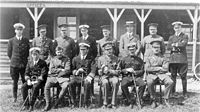 Construction began on 19 June 1912, on some training gallops, on an elevated site about 1.5 mi (2.4 km) east of Upavon
village, near the edge of the Salisbury Plain
, in the English county
of Wiltshire
. The RAF site is unusual, in that it is bisected by a public highway, the A342
- with the airfield and hangar
s on the south side of the road, and all the administrative (and some technical) buildings and accommodation on the north side.
Upavon airfield was originally created for pilots of the Military and Naval
Wings of the newly formed Royal Flying Corps
(RFC), and became home to the Army Central Flying School
(CFS). Captain Godfrey M Paine, RN
, became the first Commandant
, with Major Hugh Trenchard
being his assistant. Trenchard later became the Chief of Air Staff, and subsequently became known as the "Father of the Royal Air Force".

made in England was achieved at Upavon by Lieutenant Cholmondley. At some time during the same year, Winston Churchill
, the then First Lord of the Admiralty
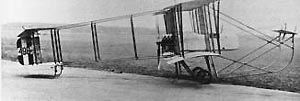
, was a passenger in a flight by a Farman MF.7 biplane
while visiting Upavon.
Two Officers of the CFS at Upavon developed the "Bomb Sight
" between 1914–1915, and this was used in a very successful manner at the Western Front
. For a short period of time during 1917, Upavon was used as an "Air Fighting School".
became the Royal Air Force
, and Upavon became Royal Air Force Station Upavon, commonly abbreviated to RAF Upavon. Accordingly, the former Army Central Flying School became Royal Air Force Central Flying School (RAF CFS). The RAF CFS became the centre of training of all RAF flying instructors.
It is therefore appropriate to rightly refer to Upavon as the "birthplace" of the Royal Air Force.
moved to Upavon to join No.3 (Fighter) Squadron RAF
, who had been at Upavon since 1924. For the next 8 years, the two Fighter Squadrons developed both Night Flying and Aviation Fighting techniques. At the same time, they wooed the public all over the country with impressive Air Displays. In May 1934, both Squadrons left Upavon for RAF Kenley
, London, and were replaced at Upavon, for a short time, by 4 Squadrons from the Fleet Air Arm
(No.800, No.801, No.820 and No.821).
, known to his colleagues as 'Dan', Captain Leslie Hamilton, and Princess Loewenstein-Wertheim took off from Upavon airfield in a Dutch Fokker F.VII
A named the St. Raphael in a bid to become the first aviators to cross the Atlantic from east to west.
The St. Raphael was last sighted some 800 mi (1,287.5 km) west of Galway heading for Newfoundland. Sadly, the St Raphael was never seen again, and the fate of Lieutenant Colonel Minchin, Captain Leslie Hamilton and Princess Loewenstein-Wertheim remains a mystery.
with more than one engine
, a newly required twin-engine syllabus was created.
visited the CFS at Upavon.
Twenty four years later, military aviation
was to mark its 50th Anniversary
. On 16 June 1962, Upavon held a static, and flying display, and this was attended by His Royal Highness Prince Philip
.
, Gloucestershire
. During this time, Upavon simply became a Flying Training School.
No.38 Group. Subsequently, HQ RAF Transport Command
arrived at Upavon. For most of the 1950s, No.38 Group disbanded, but during 1960, it reformed again. Unfortunately, it became clear that Upavon was simply too small to accommodate two HQs, so a short while after, No.38 Group relocated to RAF Odiham
, Hampshire
. The newly created Headquarters building for Transport Command was developed throuought the 1960s, and in 1969 a substantial new wing was added. In the intervening years, on 1 August 1967, Transport Command was renamed Air Support Command
.
, now RAF Air Support Command
, was merged with RAF Strike Command
. On the same date, No.46 Group was reformed at Upavon, which meant that Upavon was to maintain a long-standing link with RAF transport services.
Amalgamations continued, and on 10 November 1975, No.38 and No.46 Groups were merged into one, with No.38 Group keeping the title. At this time, No.38 Group returned to Upavon, and was to become the largest Group in the RAF.
Nearly eight years later, reorganisation was again at the forefront of Upavon. On 17 November 1983, No.38 Group merged with No.1 Group
, and Upavon became home to Headquarters No.1 Group RAF.
were not wholly appropriate for heavy fixed-wing aircraft
, nor any kind of jet aircraft
, and so the administrative control of aviation for the whole of the RAF developed in strength at Upavon. HQ No.1 Group
was a major component of RAF 'life' at Upavon, controlling operations of the large fleet of transport aircraft.
However, aviation, particularly training at Upavon continued, with the grass runways and tarmac taxiway
s being used for training purposes by various RAF rotary-wing
helicopters, and RAF C-130 Hercules
. It was also home to gliding
, mainly winch launched. The RAF Air Cadets
, known as the Air Training Corps
, used static winch-launched gliders
of No. 622 Volunteer Gliding Squadron
(VGS), along with the Army Gliding Association (AGA) Wyvern Gliding Club (which used self-propelled, winch-launched, and aero-towed gliders). These activities still continue at this present time.
.
is a fine example of classic British military architecture at its finest. It was built in 1915, and prior to the RAFs departure from Upavon, was the oldest RAF Officers' Mess in use.
Of notable interest, one of the smaller administrative buildings was used to house the Trenchard Museum
, which contained exhibits and artifacts dedicated to Lord Trenchard
, who was the founder of the Royal Air Force. However, the ravages of time were not kind to this particular old building, so a new home needed to be found for the precious artifacts. This museum is now located at RAF Halton
.
From late 1993, it became a British Army
garrison
called Trenchard Lines. When the Army initially moved into Upavon, it became home to Headquarters Doctrine & Training. On 30 January 1995, it then became Headquarters Adjutant General (Personnel & Training Command)
. In 2008, the base became HQ Land Forces.
Flight training
Flight training is a course of study used when learning to pilot an aircraft. The overall purpose of primary and intermediate flight training is the acquisition and honing of basic airmanship skills....
school, and administrative headquarters
Headquarters
Headquarters denotes the location where most, if not all, of the important functions of an organization are coordinated. In the United States, the corporate headquarters represents the entity at the center or the top of a corporation taking full responsibility managing all business activities...
of the Royal Air Force
Royal Air Force
The Royal Air Force is the aerial warfare service branch of the British Armed Forces. Formed on 1 April 1918, it is the oldest independent air force in the world...
.
The station motto
Motto
A motto is a phrase meant to formally summarize the general motivation or intention of a social group or organization. A motto may be in any language, but Latin is the most used. The local language is usual in the mottoes of governments...
was In Principio Et Semper, and translated from Latin
Latin
Latin is an Italic language originally spoken in Latium and Ancient Rome. It, along with most European languages, is a descendant of the ancient Proto-Indo-European language. Although it is considered a dead language, a number of scholars and members of the Christian clergy speak it fluently, and...
means "In the Beginning and Always". The station crest had a pterodactyl rising from rocks, which symbolised the station's connection with the early days of flying, and was also a reference to the location of the station near to the ancient monument Stonehenge
Stonehenge
Stonehenge is a prehistoric monument located in the English county of Wiltshire, about west of Amesbury and north of Salisbury. One of the most famous sites in the world, Stonehenge is composed of a circular setting of large standing stones set within earthworks...
.
Origins and Construction
Upavon
Upavon is a rural village in the English County of Wiltshire, England. As its name suggests, it is on the upper portions of the River Avon which runs from the north to the south through the village. It is situated about south of Pewsey, about southeast of the market town of Devizes, and about ...
village, near the edge of the Salisbury Plain
Salisbury Plain
Salisbury Plain is a chalk plateau in central southern England covering . It is part of the Southern England Chalk Formation and largely lies within the county of Wiltshire, with a little in Hampshire. The plain is famous for its rich archaeology, including Stonehenge, one of England's best known...
, in the English county
Counties of England
Counties of England are areas used for the purposes of administrative, geographical and political demarcation. For administrative purposes, England outside Greater London and the Isles of Scilly is divided into 83 counties. The counties may consist of a single district or be divided into several...
of Wiltshire
Wiltshire
Wiltshire is a ceremonial county in South West England. It is landlocked and borders the counties of Dorset, Somerset, Hampshire, Gloucestershire, Oxfordshire and Berkshire. It contains the unitary authority of Swindon and covers...
. The RAF site is unusual, in that it is bisected by a public highway, the A342
A342 road
The A342 is an A road that runs from Pewsham near Chippenham, Wiltshire to Andover, Hampshire.The road begins at the A4 junction just outside of the small village Pewsham, to the east of Chippenham. It heads south past the village of Derry Hill towards Devizes, briefly meeting with the A3102 near...
- with the airfield and hangar
Hangar
A hangar is a closed structure to hold aircraft or spacecraft in protective storage. Most hangars are built of metal, but other materials such as wood and concrete are also sometimes used...
s on the south side of the road, and all the administrative (and some technical) buildings and accommodation on the north side.
Upavon airfield was originally created for pilots of the Military and Naval
Navy
A navy is the branch of a nation's armed forces principally designated for naval and amphibious warfare; namely, lake- or ocean-borne combat operations and related functions...
Wings of the newly formed Royal Flying Corps
Royal Flying Corps
The Royal Flying Corps was the over-land air arm of the British military during most of the First World War. During the early part of the war, the RFC's responsibilities were centred on support of the British Army, via artillery co-operation and photographic reconnaissance...
(RFC), and became home to the Army Central Flying School
Central Flying School
The Central Flying School is the Royal Air Force's primary institution for the training of military flying instructors. Established in 1912 it is the longest existing flying training school.-History:...
(CFS). Captain Godfrey M Paine, RN
Godfrey Paine
Rear Admiral Sir Godfrey Marshall Paine KCB MVO was a senior commander in the Royal Naval Air Service and the Royal Air Force in the early part of the 20th century...
, became the first Commandant
Commandant
Commandant is a senior title often given to the officer in charge of a large training establishment or academy. This usage is common in anglophone nations...
, with Major Hugh Trenchard
Hugh Trenchard, 1st Viscount Trenchard
Marshal of the Royal Air Force Hugh Montague Trenchard, 1st Viscount Trenchard GCB OM GCVO DSO was a British officer who was instrumental in establishing the Royal Air Force...
being his assistant. Trenchard later became the Chief of Air Staff, and subsequently became known as the "Father of the Royal Air Force".
Early flying developments
During 1913 the first ever night landingLanding
thumb|A [[Mute Swan]] alighting. Note the ruffled feathers on top of the wings indicate that the swan is flying at the [[Stall |stall]]ing speed...
made in England was achieved at Upavon by Lieutenant Cholmondley. At some time during the same year, Winston Churchill
Winston Churchill
Sir Winston Leonard Spencer-Churchill, was a predominantly Conservative British politician and statesman known for his leadership of the United Kingdom during the Second World War. He is widely regarded as one of the greatest wartime leaders of the century and served as Prime Minister twice...
, the then First Lord of the Admiralty
Lord Commissioner of the Admiralty
The Lords Commissioners of the Admiralty were the members of the Board of Admiralty, which exercised command over the Royal Navy.Officially known as the Commissioners for Exercising the Office of Lord High Admiral of the United Kingdom of Great Britain and Northern Ireland &c. The Lords...
, was a passenger in a flight by a Farman MF.7 biplane
Farman MF.7
|-See also:-External links:* Contemporary technical description of the MF.7 with photographs and drawings....
while visiting Upavon.
Two Officers of the CFS at Upavon developed the "Bomb Sight
Bombsight
A bombsight is a device used by bomber aircraft to accurately drop bombs. In order to do this, the bombsight has to estimate the path the bomb will take after release from the aircraft. The two primary forces during its fall are gravity and air drag, which makes the path of the bomb through the air...
" between 1914–1915, and this was used in a very successful manner at the Western Front
Western Front (World War I)
Following the outbreak of World War I in 1914, the German Army opened the Western Front by first invading Luxembourg and Belgium, then gaining military control of important industrial regions in France. The tide of the advance was dramatically turned with the Battle of the Marne...
. For a short period of time during 1917, Upavon was used as an "Air Fighting School".
"Birth" of the Royal Air Force
On the 1 April 1918 the Royal Flying CorpsRoyal Flying Corps
The Royal Flying Corps was the over-land air arm of the British military during most of the First World War. During the early part of the war, the RFC's responsibilities were centred on support of the British Army, via artillery co-operation and photographic reconnaissance...
became the Royal Air Force
Royal Air Force
The Royal Air Force is the aerial warfare service branch of the British Armed Forces. Formed on 1 April 1918, it is the oldest independent air force in the world...
, and Upavon became Royal Air Force Station Upavon, commonly abbreviated to RAF Upavon. Accordingly, the former Army Central Flying School became Royal Air Force Central Flying School (RAF CFS). The RAF CFS became the centre of training of all RAF flying instructors.
It is therefore appropriate to rightly refer to Upavon as the "birthplace" of the Royal Air Force.
Aviation "Fighting", and air displays
During 1926 the Central Flying School moved from Upavon. At the same time, No.17 (Fighter) Squadron RAFNo. XVII Squadron RAF
No. 17 Squadron is an active squadron of the Royal Air Force and the Operational Evaluation Unit for the Typhoon T.1 and F.2.-History:...
moved to Upavon to join No.3 (Fighter) Squadron RAF
No. 3 Squadron RAF
No 3 Squadron of the Royal Air Force operates the Typhoon F2, FGR4 and T3 from RAF Coningsby, Lincolnshire.No 3 Squadron, which celebrated its 95th anniversary over the weekend of 11-13 May 2007, is unique in the RAF for having two official crests....
, who had been at Upavon since 1924. For the next 8 years, the two Fighter Squadrons developed both Night Flying and Aviation Fighting techniques. At the same time, they wooed the public all over the country with impressive Air Displays. In May 1934, both Squadrons left Upavon for RAF Kenley
RAF Kenley
The former Royal Air Force Station Kenley, more commonly known as RAF Kenley was a station of the Royal Flying Corps in World War I and the RAF in World War II. It is located near Kenley, London, England.-History:...
, London, and were replaced at Upavon, for a short time, by 4 Squadrons from the Fleet Air Arm
Fleet Air Arm
The Fleet Air Arm is the branch of the British Royal Navy responsible for the operation of naval aircraft. The Fleet Air Arm currently operates the AgustaWestland Merlin, Westland Sea King and Westland Lynx helicopters...
(No.800, No.801, No.820 and No.821).
The St. Raphael
On 31 August 1927 Lieutenant Colonel Frederick F. MinchinFrederick F. Minchin
Frederick Frank Reilly Minchin CBE DSO MC was born in Madras on 16 June 1890 and was educated at Eastbourne College. He passed out of Sandhurst in 1909 and after 2 years resigned his commission to train as a civilian pilot at the recently formed Eastbourne Aviation Company. In 1913 he obtained his...
, known to his colleagues as 'Dan', Captain Leslie Hamilton, and Princess Loewenstein-Wertheim took off from Upavon airfield in a Dutch Fokker F.VII
Fokker F.VII
The Fokker F.VII, also known as the Fokker Trimotor, was an airliner produced in the 1920s by the Dutch aircraft manufacturer Fokker, Fokker's American subsidiary Atlantic Aircraft Corporation, and other companies under licence....
A named the St. Raphael in a bid to become the first aviators to cross the Atlantic from east to west.
The St. Raphael was last sighted some 800 mi (1,287.5 km) west of Galway heading for Newfoundland. Sadly, the St Raphael was never seen again, and the fate of Lieutenant Colonel Minchin, Captain Leslie Hamilton and Princess Loewenstein-Wertheim remains a mystery.
Return of the Central Flying School
During August 1935, the Central Flying School was to return to Upavon. The CFS stayed until April 1942. During this crucial period, the CFSs primary role was to train and supply flight instructors to the now increasing number of military flying schools. Additionally, with the arrival of aeroplanesAircraft
An aircraft is a vehicle that is able to fly by gaining support from the air, or, in general, the atmosphere of a planet. An aircraft counters the force of gravity by using either static lift or by using the dynamic lift of an airfoil, or in a few cases the downward thrust from jet engines.Although...
with more than one engine
Internal combustion engine
The internal combustion engine is an engine in which the combustion of a fuel occurs with an oxidizer in a combustion chamber. In an internal combustion engine, the expansion of the high-temperature and high -pressure gases produced by combustion apply direct force to some component of the engine...
, a newly required twin-engine syllabus was created.
Royal footsteps
At some time during May 1938, the Monarch of the United Kingdom, His Majesty King George VIGeorge VI of the United Kingdom
George VI was King of the United Kingdom and the Dominions of the British Commonwealth from 11 December 1936 until his death...
visited the CFS at Upavon.
Twenty four years later, military aviation
Aerial warfare
Aerial warfare is the use of military aircraft and other flying machines in warfare, including military airlift of cargo to further the national interests as was demonstrated in the Berlin Airlift...
was to mark its 50th Anniversary
Anniversary
An anniversary is a day that commemorates or celebrates a past event that occurred on the same day of the year as the initial event. For example, the first event is the initial occurrence or, if planned, the inaugural of the event. One year later would be the first anniversary of that event...
. On 16 June 1962, Upavon held a static, and flying display, and this was attended by His Royal Highness Prince Philip
Prince Philip, Duke of Edinburgh
Prince Philip, Duke of Edinburgh is the husband of Elizabeth II. He is the United Kingdom's longest-serving consort and the oldest serving spouse of a reigning British monarch....
.
World War II
During the Second World War, the CFS was moved from Upavon to take up residence at RAF Little RissingtonRAF Little Rissington
RAF Little Rissington is an RAF aerodrome and former RAF station in Gloucestershire, England. It was once home to the Central Flying School, the Vintage Pair and the Red Arrows.Built during the 1930s, the station was opened in 1938 and closed in 1994...
, Gloucestershire
Gloucestershire
Gloucestershire is a county in South West England. The county comprises part of the Cotswold Hills, part of the flat fertile valley of the River Severn, and the entire Forest of Dean....
. During this time, Upavon simply became a Flying Training School.
Post-War
Following the end of World War II, Upavon became home to HeadquartersHeadquarters
Headquarters denotes the location where most, if not all, of the important functions of an organization are coordinated. In the United States, the corporate headquarters represents the entity at the center or the top of a corporation taking full responsibility managing all business activities...
No.38 Group. Subsequently, HQ RAF Transport Command
RAF Transport Command
RAF Transport Command was a Royal Air Force command that controlled all transport aircraft of the RAF. It was established on 25 March 1943 by the renaming of the RAF Ferry Command, and was subsequently renamed RAF Air Support Command in 1967.-History:...
arrived at Upavon. For most of the 1950s, No.38 Group disbanded, but during 1960, it reformed again. Unfortunately, it became clear that Upavon was simply too small to accommodate two HQs, so a short while after, No.38 Group relocated to RAF Odiham
RAF Odiham
RAF Odiham is a Royal Air Force station situated a little to the south of the historic small village of Odiham in Hampshire, England. It is the home of the Royal Air Force's heavy lift helicopter, the Chinook HC2, HC2A and HC3...
, Hampshire
Hampshire
Hampshire is a county on the southern coast of England in the United Kingdom. The county town of Hampshire is Winchester, a historic cathedral city that was once the capital of England. Hampshire is notable for housing the original birthplaces of the Royal Navy, British Army, and Royal Air Force...
. The newly created Headquarters building for Transport Command was developed throuought the 1960s, and in 1969 a substantial new wing was added. In the intervening years, on 1 August 1967, Transport Command was renamed Air Support Command
RAF Air Support Command
Air Support Command of the Royal Air Force was formed on 1 August 1967 by the redesignation of Transport Command. Its change of name reflected the change of emphasis of the Command from merely transporting materials and men around the world to providing general support to RAF operations around the...
.
1970s and 80s, Command reorganisation, rename, amalgamisation
The 1970s saw many changes to the overall structure of the Royal Air Force. On 1 September 1972, the former RAF Transport CommandRAF Transport Command
RAF Transport Command was a Royal Air Force command that controlled all transport aircraft of the RAF. It was established on 25 March 1943 by the renaming of the RAF Ferry Command, and was subsequently renamed RAF Air Support Command in 1967.-History:...
, now RAF Air Support Command
RAF Air Support Command
Air Support Command of the Royal Air Force was formed on 1 August 1967 by the redesignation of Transport Command. Its change of name reflected the change of emphasis of the Command from merely transporting materials and men around the world to providing general support to RAF operations around the...
, was merged with RAF Strike Command
RAF Strike Command
The Royal Air Force's Strike Command was the military formation which controlled the majority of the United Kingdom's bomber and fighter aircraft from 1968 until 2007: it was merged with Personnel and Training Command to form the single Air Command. It latterly consisted of two formations - No. 1...
. On the same date, No.46 Group was reformed at Upavon, which meant that Upavon was to maintain a long-standing link with RAF transport services.
Amalgamations continued, and on 10 November 1975, No.38 and No.46 Groups were merged into one, with No.38 Group keeping the title. At this time, No.38 Group returned to Upavon, and was to become the largest Group in the RAF.
Nearly eight years later, reorganisation was again at the forefront of Upavon. On 17 November 1983, No.38 Group merged with No.1 Group
No. 1 Group RAF
Number 1 Group of the Royal Air Force is one of the two operations groups in Air Command.The group is today referred to as the Air Combat Group, as it controls the RAF's combat fast-jet aircraft and has airfields in the UK plus RAF Unit Goose Bay in Canada, which is used extensively as an...
, and Upavon became home to Headquarters No.1 Group RAF.
Flying towards the millennium and beyond
In its latter RAF years the grass runwaysRunway
According to ICAO a runway is a "defined rectangular area on a land aerodrome prepared for the landing and take-off of aircraft." Runways may be a man-made surface or a natural surface .- Orientation and dimensions :Runways are named by a number between 01 and 36, which is generally one tenth...
were not wholly appropriate for heavy fixed-wing aircraft
Fixed-wing aircraft
A fixed-wing aircraft is an aircraft capable of flight using wings that generate lift due to the vehicle's forward airspeed. Fixed-wing aircraft are distinct from rotary-wing aircraft in which wings rotate about a fixed mast and ornithopters in which lift is generated by flapping wings.A powered...
, nor any kind of jet aircraft
Jet aircraft
A jet aircraft is an aircraft propelled by jet engines. Jet aircraft generally fly much faster than propeller-powered aircraft and at higher altitudes – as high as . At these altitudes, jet engines achieve maximum efficiency over long distances. The engines in propeller-powered aircraft...
, and so the administrative control of aviation for the whole of the RAF developed in strength at Upavon. HQ No.1 Group
No. 1 Group RAF
Number 1 Group of the Royal Air Force is one of the two operations groups in Air Command.The group is today referred to as the Air Combat Group, as it controls the RAF's combat fast-jet aircraft and has airfields in the UK plus RAF Unit Goose Bay in Canada, which is used extensively as an...
was a major component of RAF 'life' at Upavon, controlling operations of the large fleet of transport aircraft.
However, aviation, particularly training at Upavon continued, with the grass runways and tarmac taxiway
Taxiway
A taxiway is a path on an airport connecting runways with ramps, hangars, terminals and other facilities. They mostly have hard surface such as asphalt or concrete, although smaller airports sometimes use gravel or grass....
s being used for training purposes by various RAF rotary-wing
Rotorcraft
A rotorcraft or rotary wing aircraft is a heavier-than-air flying machine that uses lift generated by wings, called rotor blades, that revolve around a mast. Several rotor blades mounted to a single mast are referred to as a rotor. The International Civil Aviation Organization defines a rotorcraft...
helicopters, and RAF C-130 Hercules
C-130 Hercules
The Lockheed C-130 Hercules is a four-engine turboprop military transport aircraft designed and built originally by Lockheed, now Lockheed Martin. Capable of using unprepared runways for takeoffs and landings, the C-130 was originally designed as a troop, medical evacuation, and cargo transport...
. It was also home to gliding
Gliding
Gliding is a recreational activity and competitive air sport in which pilots fly unpowered aircraft known as gliders or sailplanes using naturally occurring currents of rising air in the atmosphere to remain airborne. The word soaring is also used for the sport.Gliding as a sport began in the 1920s...
, mainly winch launched. The RAF Air Cadets
Air Cadets
Air Cadets may refer to:* Members of the British Air Training Corps or Combined Cadet Force* Members of the Australian Air Force Cadets* Members of the Royal Canadian Air Cadets* Members of the New Zealand Air Training Corps, New Zealand Cadet Forces...
, known as the Air Training Corps
Air Training Corps
The Air Training Corps , commonly known as the Air Cadets, is a cadet organisation based in the United Kingdom. It is a voluntary youth group which is part of the Air Cadet Organisation and the Royal Air Force . It is supported by the Ministry of Defence, with a regular RAF Officer, currently Air...
, used static winch-launched gliders
Military glider
Military gliders have been used by the military of various countries for carrying troops and heavy equipment to a combat zone, mainly during the Second World War. These engineless aircraft were towed into the air and most of the way to their target by military transport planes, e.g...
of No. 622 Volunteer Gliding Squadron
Volunteer Gliding Squadron
Volunteer Gliding Squadrons are Royal Air Force Flying Training Units , operating military Viking TX.1 and Vigilant T.1 gliders to train Air Cadets from the Combined Cadet Force and the Air Training Corps....
(VGS), along with the Army Gliding Association (AGA) Wyvern Gliding Club (which used self-propelled, winch-launched, and aero-towed gliders). These activities still continue at this present time.
Departure of the Royal Air Force
As a result of major reorganisation of the entire structure of the Royal Air Force in the early 1990s, RAF Upavon became surplus to requirements, and the RAF was to permanently withdraw from Upavon. On 3 August 1993, the RAF officially handed over RAF Upavon to the British ArmyBritish Army
The British Army is the land warfare branch of Her Majesty's Armed Forces in the United Kingdom. It came into being with the unification of the Kingdom of England and Scotland into the Kingdom of Great Britain in 1707. The new British Army incorporated Regiments that had already existed in England...
.
Upavon architecture
Many of the buildings at Upavon still stand from when Upavon was originally constructed. The Officers' MessMess
A mess is the place where military personnel socialise, eat, and live. In some societies this military usage has extended to other disciplined services eateries such as civilian fire fighting and police forces. The root of mess is the Old French mes, "portion of food" A mess (also called a...
is a fine example of classic British military architecture at its finest. It was built in 1915, and prior to the RAFs departure from Upavon, was the oldest RAF Officers' Mess in use.
Of notable interest, one of the smaller administrative buildings was used to house the Trenchard Museum
Trenchard Museum
The Trenchard Museum is based at RAF Halton, Halton, Buckinghamshire, England. The overall aim of the museum is to preserve and display items that relate to the early history of Royal Air Force and in particular the training of apprentices which took place at RAF Halton...
, which contained exhibits and artifacts dedicated to Lord Trenchard
Hugh Trenchard, 1st Viscount Trenchard
Marshal of the Royal Air Force Hugh Montague Trenchard, 1st Viscount Trenchard GCB OM GCVO DSO was a British officer who was instrumental in establishing the Royal Air Force...
, who was the founder of the Royal Air Force. However, the ravages of time were not kind to this particular old building, so a new home needed to be found for the precious artifacts. This museum is now located at RAF Halton
RAF Halton
RAF Halton is one of the largest Royal Air Force stations in the United Kingdom, located near the village of Halton near Wendover, Buckinghamshire.HRH The Duchess of Cornwall is the Honorary Air Commodore of RAF Halton.-History:...
.
Upavon aircraft
- Farman MF.7 biplaneFarman MF.7|-See also:-External links:* Contemporary technical description of the MF.7 with photographs and drawings....
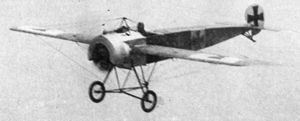
- Fokker E.IIIFokker EindeckerThe Fokker Eindecker was a German World War I monoplane single-seat fighter aircraft designed by Dutch engineer Anthony Fokker. Developed in April 1915, the Eindecker was the first purpose-built German fighter aircraft and the first aircraft to be fitted with synchronizer gear, enabling the pilot...
- Grob 103 Viking T Mk1 - No. 622 Volunteer Gliding Squadron
Upavon squadrons
- No. 3 Squadron RAFNo. 3 Squadron RAFNo 3 Squadron of the Royal Air Force operates the Typhoon F2, FGR4 and T3 from RAF Coningsby, Lincolnshire.No 3 Squadron, which celebrated its 95th anniversary over the weekend of 11-13 May 2007, is unique in the RAF for having two official crests....
- No. 17 Squadron RAF
- No. 800 Squadron FAA
- No. 801 Squadron FAA801 Naval Air Squadron801 Naval Air Squadron was a Fleet Air Arm squadron of the Royal Navy formed in 1933 which fought in World War II, the Korean War and the Falklands War.- Fleet Air Arm of the Royal Air Force:...
- No. 820 Squadron FAA
- No. 821 Squadron FAA
- No. 622 VGS
Upavon today
Today, the RAF no longer occupies the site. The only RAF-related unit at Upavon today is No. 622 Volunteer Gliding Squadron, training cadets on the Viking T1 glider. The airfield is still used for training purposes by visiting RAF aircraft, and for gliding by No. 622 VGS and the Wyvern (Army) Gliding Club.From late 1993, it became a British Army
British Army
The British Army is the land warfare branch of Her Majesty's Armed Forces in the United Kingdom. It came into being with the unification of the Kingdom of England and Scotland into the Kingdom of Great Britain in 1707. The new British Army incorporated Regiments that had already existed in England...
garrison
Garrison
Garrison is the collective term for a body of troops stationed in a particular location, originally to guard it, but now often simply using it as a home base....
called Trenchard Lines. When the Army initially moved into Upavon, it became home to Headquarters Doctrine & Training. On 30 January 1995, it then became Headquarters Adjutant General (Personnel & Training Command)
Adjutant general
An Adjutant General is a military chief administrative officer.-Imperial Russia:In Imperial Russia, the General-Adjutant was a Court officer, who was usually an army general. He served as a personal aide to the Tsar and hence was a member of the H. I. M. Retinue...
. In 2008, the base became HQ Land Forces.
See also
- Royal Air Force station
- List of RAF stations
- List of Royal Air Force aircraft squadrons
- List of aircraft of the RAF