


Czechoslovak government-in-exile

Encyclopedia
The Czechoslovak government-in-exile
(sometimes styled officially as: provisional government of Czechoslovakia) was an informal title conferred upon the Czechoslovak National Liberation Committee, initially by British diplomatic recognition
. The name came to be used by other World War II Allies as they subsequently recognized it. The Committee was originally created by the former Czechoslovak President, Edvard Beneš
in Paris, France in October 1939. Unsuccessful negotiations with France
for diplomatic status, as well as the impending Nazi occupation of France, forced the Committee to withdraw to London
in 1940. From there, it moved to Aston Abbots, Buckinghamshire
in 1941, where it sought relative safety from the London Blitz.
It was the legitimate government for Czechoslovakia throughout the Second World War. A specifically anti-Fascist government, it sought to reverse the Munich Agreement
and the subsequent German occupation of Czechoslovakia, and to return the Republic to its 1937 boundaries. As such it was ultimately considered, by those countries that recognized it, the legal continuation of the First Republic of Czechoslovakia
.
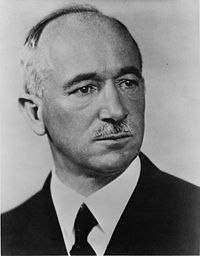 Seeing the end of the Republic as a fait accompli
, Edvard Beneš
resigned as president of the First Czechoslovak Republic
one week after the Munich Agreement
ceded the Sudetenland
to Nazi Germany
. He initially fled to the University of Chicago
, where he took refuge in the same community that had once buoyed his predecessor and friend, Tomáš Masaryk
. While there, he was urged to quickly return to Europe to organize some kind of government-in-exile. He therefore returned to Europe to live in Paris along with several other key players in his former administration. After World War II
formally broke out, the group became known as the Czech National Liberation Committee, and immediately began to seek international recognition as the exiled government of Czechoslovakia. By the end of 1939, though, France and Britain had extended it the right to conclude international treaties — France on 13 November and Britain on 20 December 1939 — but did not yet see those treaties as having been concluded in the name of the Czechoslovak Republic.
It was in fact France herself that proved the greatest obstacle to accepting the Committee as a full government-in-exile. The government of Édouard Daladier
was ambivalent towards the ambitions of the Committee and of Czechoslovakia in general. Though he had publicly seen the appeasement of Hitler as the road to war, Daladier ultimately capitulated to the wishes of Neville Chamberlain
. After the war came, he and his government dithered over whether the Soviet or Nazi threat was the greater. Likewise, though he extended recognition to the Committee as a non-governmental agency, his government was non-committal to Beneš himself, and saw many possibilities for a post-war Czechoslovakia. One of its principal reservations about giving governmental status to Beneš, was the fact of the murky situation in the then-independent Slovakia. The French government of the winter of 1939 felt that Beneš was not necessarily speaking for all Czechoslovaks, based on the relatively fluid situation in Slovakia. France's diplomacy towards Beneš was therefore agile. It avoided any direct expression of support for the Beneš Committee's desire to return to the First Republic. However, as Beneš was the key to getting military support from the well-trained Czechoslovak army, France was in fact the first nation to conclude a treaty with the Committee. The 2 October 1939 agreement between France and Beneš allowed for the reconstitution of the Czechoslovak army on French territory. Ultimately, units of the First Division of the Czechoslovak Army fought alongside their hosts in the final stages of the Battle of France
.
It was the failure of the Allied military forces in this battle which most directly helped the ambitions of the Beneš Committee. With the fall of France, the views of the newly appointed prime minister Winston Churchill
took predominance over the concerns of the waning Third Republic. He was very much clearer than his predecessor with respect to Czechoslovak affairs, and quickly recognized Beneš as the president of a government-in-exile after the fall of France. Nevertheless, the Committee still felt somewhat insecure about this recognition, because it specifically mentioned Beneš as president, but did not explicitly link Beneš to the previously-existing government. Thus, they pressed the British in April 1941 for even greater clarity. On the 18th of that month, they sent a letter to the British requesting that their agreements "be concluded, as before September, 1938, in the name of the Czechoslovak Republic". British Foreign Minister
Anthony Eden
gave such assent on 18 July 1941. The United States and the Soviet Union were effectively forced to do the same later in the year, as Slovakia declared war on the two countries. With an Axis
government both firmly and formally in place in Bratislava
, the only friendly government left to recognize by the later half of 1941 was that of Beneš. The remaining legal question was whether the Beneš government was actually a continuation of the First Republic, or a successor without solid constitutional underpinnings.
This doubt was erased by the spring of 1942. Following almost six months of planning behind enemy lines, Czechoslovak Allied operatives in Bohemia fatally wounded Reinhard Heydrich
, the dictator at the head of the Protectorate of Bohemia and Moravia
. The success of this mission, Operation Anthropoid
, caused Britain and Free France (itself a government-in-exile) to formally repudiate the Munich Agreement, thus conferring de jure
legitimacy on the Beneš government as the continuation of the First Republic.
The government's continued health now depended on Allied military victory.
Beneš determined to strengthen Czechoslovak security against future German aggression through alliances with Poland and the Soviet Union. The Soviet Union, however, objected to a tripartite Czechoslovak-Polish-Soviet commitment. In December 1943, Beneš's government concluded a treaty with the Soviets. Beneš's interest in maintaining friendly relations with the Soviet Union was motivated also by his desire to avoid Soviet encouragement of a postwar communist coup in Czechoslovakia. Beneš worked to bring Czechoslovak communist exiles in the United Kingdom into cooperation with his government, offering far-reaching concessions, including nationalization of heavy industry and the creation of local people's committees at the war's end. In March 1945, he gave key cabinet positions to Czechoslovak communist exiles in Moscow
.
, most of the Czech resistance groups
demanded, based on German Nazi terror during occupation, the "final solution of the German question" which would have to be "solved" by deportation of the ethnic Germans to Germany and Austria.
These demands were adopted by the Government-in-Exile, which sought the support of the Allies for this proposal, beginning in 1943.
The Government-in-Exile promulgated a series of law
s that are now referred to as the "Beneš decrees
". One part of these decrees dealt with the status of ethnic Germans and Hungarians in postwar Czechoslovakia, including the confiscation of their property, anticipating their future deportation
(see expulsion of Germans from Czechoslovakia
, and Hungarians in Slovakia
). However, the final agreement authorizing the forced population transfer of the Germans was not reached until 2 August 1945 at the end of the Potsdam Conference.
Government in exile
A government in exile is a political group that claims to be a country's legitimate government, but for various reasons is unable to exercise its legal power, and instead resides in a foreign country. Governments in exile usually operate under the assumption that they will one day return to their...
(sometimes styled officially as: provisional government of Czechoslovakia) was an informal title conferred upon the Czechoslovak National Liberation Committee, initially by British diplomatic recognition
Diplomatic recognition
Diplomatic recognition in international law is a unilateral political act with domestic and international legal consequences, whereby a state acknowledges an act or status of another state or government in control of a state...
. The name came to be used by other World War II Allies as they subsequently recognized it. The Committee was originally created by the former Czechoslovak President, Edvard Beneš
Edvard Beneš
Edvard Beneš was a leader of the Czechoslovak independence movement, Minister of Foreign Affairs and the second President of Czechoslovakia. He was known to be a skilled diplomat.- Youth :...
in Paris, France in October 1939. Unsuccessful negotiations with France
France
The French Republic , The French Republic , The French Republic , (commonly known as France , is a unitary semi-presidential republic in Western Europe with several overseas territories and islands located on other continents and in the Indian, Pacific, and Atlantic oceans. Metropolitan France...
for diplomatic status, as well as the impending Nazi occupation of France, forced the Committee to withdraw to London
London
London is the capital city of :England and the :United Kingdom, the largest metropolitan area in the United Kingdom, and the largest urban zone in the European Union by most measures. Located on the River Thames, London has been a major settlement for two millennia, its history going back to its...
in 1940. From there, it moved to Aston Abbots, Buckinghamshire
Buckinghamshire
Buckinghamshire is a ceremonial and non-metropolitan home county in South East England. The county town is Aylesbury, the largest town in the ceremonial county is Milton Keynes and largest town in the non-metropolitan county is High Wycombe....
in 1941, where it sought relative safety from the London Blitz.
It was the legitimate government for Czechoslovakia throughout the Second World War. A specifically anti-Fascist government, it sought to reverse the Munich Agreement
Munich Agreement
The Munich Pact was an agreement permitting the Nazi German annexation of Czechoslovakia's Sudetenland. The Sudetenland were areas along Czech borders, mainly inhabited by ethnic Germans. The agreement was negotiated at a conference held in Munich, Germany, among the major powers of Europe without...
and the subsequent German occupation of Czechoslovakia, and to return the Republic to its 1937 boundaries. As such it was ultimately considered, by those countries that recognized it, the legal continuation of the First Republic of Czechoslovakia
First Republic of Czechoslovakia
-Independence:The Czechoslovak declaration of independence was published by the Czechoslovak National Council, signed by Masaryk, Štefánik and Beneš on October 18, 1918 in Paris, and proclaimed on October 28 in Prague...
.
From committee to government
Fait Accompli
Fait accompli is a French phrase which means literally "an accomplished deed". It is commonly used to describe an action which is completed before those affected by it are in a position to query or reverse it...
, Edvard Beneš
Edvard Beneš
Edvard Beneš was a leader of the Czechoslovak independence movement, Minister of Foreign Affairs and the second President of Czechoslovakia. He was known to be a skilled diplomat.- Youth :...
resigned as president of the First Czechoslovak Republic
First Republic of Czechoslovakia
-Independence:The Czechoslovak declaration of independence was published by the Czechoslovak National Council, signed by Masaryk, Štefánik and Beneš on October 18, 1918 in Paris, and proclaimed on October 28 in Prague...
one week after the Munich Agreement
Munich Agreement
The Munich Pact was an agreement permitting the Nazi German annexation of Czechoslovakia's Sudetenland. The Sudetenland were areas along Czech borders, mainly inhabited by ethnic Germans. The agreement was negotiated at a conference held in Munich, Germany, among the major powers of Europe without...
ceded the Sudetenland
Sudetenland
Sudetenland is the German name used in English in the first half of the 20th century for the northern, southwest and western regions of Czechoslovakia inhabited mostly by ethnic Germans, specifically the border areas of Bohemia, Moravia, and those parts of Silesia being within Czechoslovakia.The...
to Nazi Germany
Nazi Germany
Nazi Germany , also known as the Third Reich , but officially called German Reich from 1933 to 1943 and Greater German Reich from 26 June 1943 onward, is the name commonly used to refer to the state of Germany from 1933 to 1945, when it was a totalitarian dictatorship ruled by...
. He initially fled to the University of Chicago
University of Chicago
The University of Chicago is a private research university in Chicago, Illinois, USA. It was founded by the American Baptist Education Society with a donation from oil magnate and philanthropist John D. Rockefeller and incorporated in 1890...
, where he took refuge in the same community that had once buoyed his predecessor and friend, Tomáš Masaryk
Tomáš Masaryk
Tomáš Garrigue Masaryk , sometimes called Thomas Masaryk in English, was an Austro-Hungarian and Czechoslovak politician, sociologist and philosopher, who as an eager advocate of Czechoslovak independence during World War I became the founder and first President of Czechoslovakia, also was...
. While there, he was urged to quickly return to Europe to organize some kind of government-in-exile. He therefore returned to Europe to live in Paris along with several other key players in his former administration. After World War II
World War II
World War II, or the Second World War , was a global conflict lasting from 1939 to 1945, involving most of the world's nations—including all of the great powers—eventually forming two opposing military alliances: the Allies and the Axis...
formally broke out, the group became known as the Czech National Liberation Committee, and immediately began to seek international recognition as the exiled government of Czechoslovakia. By the end of 1939, though, France and Britain had extended it the right to conclude international treaties — France on 13 November and Britain on 20 December 1939 — but did not yet see those treaties as having been concluded in the name of the Czechoslovak Republic.
It was in fact France herself that proved the greatest obstacle to accepting the Committee as a full government-in-exile. The government of Édouard Daladier
Édouard Daladier
Édouard Daladier was a French Radical politician and the Prime Minister of France at the start of the Second World War.-Career:Daladier was born in Carpentras, Vaucluse. Later, he would become known to many as "the bull of Vaucluse" because of his thick neck and large shoulders and determined...
was ambivalent towards the ambitions of the Committee and of Czechoslovakia in general. Though he had publicly seen the appeasement of Hitler as the road to war, Daladier ultimately capitulated to the wishes of Neville Chamberlain
Neville Chamberlain
Arthur Neville Chamberlain FRS was a British Conservative politician who served as Prime Minister of the United Kingdom from May 1937 to May 1940. Chamberlain is best known for his appeasement foreign policy, and in particular for his signing of the Munich Agreement in 1938, conceding the...
. After the war came, he and his government dithered over whether the Soviet or Nazi threat was the greater. Likewise, though he extended recognition to the Committee as a non-governmental agency, his government was non-committal to Beneš himself, and saw many possibilities for a post-war Czechoslovakia. One of its principal reservations about giving governmental status to Beneš, was the fact of the murky situation in the then-independent Slovakia. The French government of the winter of 1939 felt that Beneš was not necessarily speaking for all Czechoslovaks, based on the relatively fluid situation in Slovakia. France's diplomacy towards Beneš was therefore agile. It avoided any direct expression of support for the Beneš Committee's desire to return to the First Republic. However, as Beneš was the key to getting military support from the well-trained Czechoslovak army, France was in fact the first nation to conclude a treaty with the Committee. The 2 October 1939 agreement between France and Beneš allowed for the reconstitution of the Czechoslovak army on French territory. Ultimately, units of the First Division of the Czechoslovak Army fought alongside their hosts in the final stages of the Battle of France
Battle of France
In the Second World War, the Battle of France was the German invasion of France and the Low Countries, beginning on 10 May 1940, which ended the Phoney War. The battle consisted of two main operations. In the first, Fall Gelb , German armoured units pushed through the Ardennes, to cut off and...
.
It was the failure of the Allied military forces in this battle which most directly helped the ambitions of the Beneš Committee. With the fall of France, the views of the newly appointed prime minister Winston Churchill
Winston Churchill
Sir Winston Leonard Spencer-Churchill, was a predominantly Conservative British politician and statesman known for his leadership of the United Kingdom during the Second World War. He is widely regarded as one of the greatest wartime leaders of the century and served as Prime Minister twice...
took predominance over the concerns of the waning Third Republic. He was very much clearer than his predecessor with respect to Czechoslovak affairs, and quickly recognized Beneš as the president of a government-in-exile after the fall of France. Nevertheless, the Committee still felt somewhat insecure about this recognition, because it specifically mentioned Beneš as president, but did not explicitly link Beneš to the previously-existing government. Thus, they pressed the British in April 1941 for even greater clarity. On the 18th of that month, they sent a letter to the British requesting that their agreements "be concluded, as before September, 1938, in the name of the Czechoslovak Republic". British Foreign Minister
Foreign minister
A Minister of Foreign Affairs, or foreign minister, is a cabinet minister who helps form the foreign policy of a sovereign state. The foreign minister is often regarded as the most senior ministerial position below that of the head of government . It is often granted to the deputy prime minister in...
Anthony Eden
Anthony Eden
Robert Anthony Eden, 1st Earl of Avon, KG, MC, PC was a British Conservative politician, who was Prime Minister from 1955 to 1957...
gave such assent on 18 July 1941. The United States and the Soviet Union were effectively forced to do the same later in the year, as Slovakia declared war on the two countries. With an Axis
Axis Powers
The Axis powers , also known as the Axis alliance, Axis nations, Axis countries, or just the Axis, was an alignment of great powers during the mid-20th century that fought World War II against the Allies. It began in 1936 with treaties of friendship between Germany and Italy and between Germany and...
government both firmly and formally in place in Bratislava
Bratislava
Bratislava is the capital of Slovakia and, with a population of about 431,000, also the country's largest city. Bratislava is in southwestern Slovakia on both banks of the Danube River. Bordering Austria and Hungary, it is the only national capital that borders two independent countries.Bratislava...
, the only friendly government left to recognize by the later half of 1941 was that of Beneš. The remaining legal question was whether the Beneš government was actually a continuation of the First Republic, or a successor without solid constitutional underpinnings.
This doubt was erased by the spring of 1942. Following almost six months of planning behind enemy lines, Czechoslovak Allied operatives in Bohemia fatally wounded Reinhard Heydrich
Reinhard Heydrich
Reinhard Tristan Eugen Heydrich , also known as The Hangman, was a high-ranking German Nazi official.He was SS-Obergruppenführer and General der Polizei, chief of the Reich Main Security Office and Stellvertretender Reichsprotektor of Bohemia and Moravia...
, the dictator at the head of the Protectorate of Bohemia and Moravia
Protectorate of Bohemia and Moravia
The Protectorate of Bohemia and Moravia was the majority ethnic-Czech protectorate which Nazi Germany established in the central parts of Bohemia, Moravia and Czech Silesia in what is today the Czech Republic...
. The success of this mission, Operation Anthropoid
Operation Anthropoid
Operation Anthropoid was the code name for the targeted killing of top German SS leader Reinhard Heydrich. He was the chief of the Reich Main Security Office , the acting Protector of Bohemia and Moravia, and a chief planner of the Final Solution, the Nazi German programme for the genocide of the...
, caused Britain and Free France (itself a government-in-exile) to formally repudiate the Munich Agreement, thus conferring de jure
De jure
De jure is an expression that means "concerning law", as contrasted with de facto, which means "concerning fact".De jure = 'Legally', De facto = 'In fact'....
legitimacy on the Beneš government as the continuation of the First Republic.
The government's continued health now depended on Allied military victory.
Planning for the future
Beneš hoped for a restoration of the Czechoslovak state in its pre-Munich form after the anticipated Allied victory, a false hope.Beneš determined to strengthen Czechoslovak security against future German aggression through alliances with Poland and the Soviet Union. The Soviet Union, however, objected to a tripartite Czechoslovak-Polish-Soviet commitment. In December 1943, Beneš's government concluded a treaty with the Soviets. Beneš's interest in maintaining friendly relations with the Soviet Union was motivated also by his desire to avoid Soviet encouragement of a postwar communist coup in Czechoslovakia. Beneš worked to bring Czechoslovak communist exiles in the United Kingdom into cooperation with his government, offering far-reaching concessions, including nationalization of heavy industry and the creation of local people's committees at the war's end. In March 1945, he gave key cabinet positions to Czechoslovak communist exiles in Moscow
Moscow
Moscow is the capital, the most populous city, and the most populous federal subject of Russia. The city is a major political, economic, cultural, scientific, religious, financial, educational, and transportation centre of Russia and the continent...
.
The "German problem"
During the latter years of the war, Beneš worked toward resolving the German minority problem and received consent from the Allies for a solution based on a postwar transfer of the Sudeten German population. Especially after the Nazi reprisals for the assassination of Reinhard HeydrichReinhard Heydrich
Reinhard Tristan Eugen Heydrich , also known as The Hangman, was a high-ranking German Nazi official.He was SS-Obergruppenführer and General der Polizei, chief of the Reich Main Security Office and Stellvertretender Reichsprotektor of Bohemia and Moravia...
, most of the Czech resistance groups
Czech resistance to Nazi occupation
Czech resistance to German Nazi occupation during World War II is a scarcely documented subject, by and large a result of little formal resistance and an effective German policy that deterred acts of resistance or annihilated organizations of resistance...
demanded, based on German Nazi terror during occupation, the "final solution of the German question" which would have to be "solved" by deportation of the ethnic Germans to Germany and Austria.
These demands were adopted by the Government-in-Exile, which sought the support of the Allies for this proposal, beginning in 1943.
The Government-in-Exile promulgated a series of law
Law
Law is a system of rules and guidelines which are enforced through social institutions to govern behavior, wherever possible. It shapes politics, economics and society in numerous ways and serves as a social mediator of relations between people. Contract law regulates everything from buying a bus...
s that are now referred to as the "Beneš decrees
Beneš decrees
Decrees of the President of the Republic , more commonly known as the Beneš decrees, were a series of laws that were drafted by the Czechoslovak Government-in-Exile in the absence of the Czechoslovak parliament during the German occupation of Czechoslovakia in World War II and issued by President...
". One part of these decrees dealt with the status of ethnic Germans and Hungarians in postwar Czechoslovakia, including the confiscation of their property, anticipating their future deportation
Deportation
Deportation means the expulsion of a person or group of people from a place or country. Today it often refers to the expulsion of foreign nationals whereas the expulsion of nationals is called banishment, exile, or penal transportation...
(see expulsion of Germans from Czechoslovakia
Expulsion of Germans from Czechoslovakia
The expulsion of Germans from Czechoslovakia after World War II was part of a series of evacuations and expulsions of Germans from Central and Eastern Europe during and after World War II....
, and Hungarians in Slovakia
Hungarians in Slovakia
Hungarians in Slovakia are the largest ethnic minority of the country, numbering 520,528 people or 9.7% of population . They are concentrated mostly in the southern part of the country, near the border with Hungary...
). However, the final agreement authorizing the forced population transfer of the Germans was not reached until 2 August 1945 at the end of the Potsdam Conference.
Further reading
- Neil Rees "The Secret History of The Czech Connection - The Czechoslovak Government in Exile in London and Buckinghamshire" compiled by Neil Rees, England, 2005. ISBN 0-9550883-0-5.