

Postage stamps and postal history of Canada

Encyclopedia
The postal history
of Canada
falls into four major periods: French
control (1604–1763), British
control (1763–1841), colonial government
control (1841–1867), and the Dominion of Canada, since 1867.
, Newfoundland
on 3 August 1527 that the first known letter was sent from North America. While in St. John's, John Rut
had written a letter to King Henry VIII
on his findings and his planned voyage. The letter in part reads as follows;
The conclusion of the letter reads:
is of courier
s in 1705, namely the "first courier" Pedro da Silva
, carrying the Governor's dispatches by boat, along with (for a fee) private letters. A regular postal system was proposed in 1721, but would have been too expensive at the time, and was not created until 1734, when a road existed between Montreal
and Quebec
. Post houses were established at intervals of nine miles (14 km) or so, along with ferries across the rivers. Fees were 10 sols between the two major cities, and 5 sols to Trois-Rivières, Quebec
.
.
The peace treaty of 1763 inaugurated the development of a civilian post. The Postmasters General
of the American colonies, Benjamin Franklin
and William Foxcroft surveyed a route between New York and Quebec, and contracted Quebec-Montreal mail to a Hugh Finlay, who provided a weekly service at 8d per letter. Mail to New York took two weeks and cost about a shilling. The service was quite successful, the Quebec-Montreal route increasing to twice/week, and eventually branching out to include Skenesborough.
The American Revolutionary War
disrupted mail to New York, and also showed the weakness in not having an all-British route to Halifax, Nova Scotia
, and in 1787 a complicated route was set up through Riviere du Loup
, Fredericton, Digby
, and Annapolis
. Upper Canada
had its own semi-monthly route through Kingston
, Niagara
, Detroit
, and as far as Michilimackinac
on Lake Huron
.
Finlay was succeeded in 1800 by George Heriot
, then in 1816 Daniel Sutherland
took over as Postmaster General. By this time dozens of post offices were being opened. 1816 was also when the postal services of Prince Edward Island
and Nova Scotia
were separated, and not rejoined until 1868.
Postmarks had been in use since 1764, Finlay having been introduced to them by Franklin. The earliest markings were town names in a straight line.
As is typical of the period, the postal service introduced ever-more-complicated systems of rates for mail, depending on destination and distance. In 1840 Rowland Hill
proposed a uniform rate for Great Britain
that could be prepaid by postage stamp
s, and on May 25, 1849, the Legislative Assembly of Canada resolved to adopt the use of stamps in the Province of Canada
.
.
and Vancouver Island
jointly issued stamps valid in both colonies in 1860. In 1865, each colony issued its own series. After the two colonies were merged
in 1866, the united colony issued stamps from 1867 to 1869.
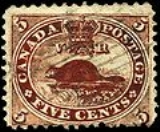
began issuing stamps in 1851. The first were in the values of 3d, 6d, and 12d. Designed by Sir Sandford Fleming
, the Threepenny Beaver depicted a beaver
in an oval frame, and is considered the first Canadian postage stamp. It was the first stamp to picture an animal and not a monarch. It was the first official postage stamp anywhere to picture an animal, though an unofficial postmaster's provisional from St. Louis, Missouri
showed two bears in 1845. The 6d was a portrait of Prince Albert from a drawing by William Drummond Esq. The 12d (1 shilling) was reproduced from a full-length painting of Queen Victoria done by Alfred Edward Chalon. All three stamps were produced by the firm of Rawdon, Wright, Hatch and Edson of New York.
In April 1851, the rate for inland letters to Canada, Nova Scotia, New Brunswick, Cape Breton and Prince Edward Island was 3d per ½ oz. Letters to the USA was 6d per ½ oz, excluding California and Orgeon, which was 9d per ½ oz. The first issues were made on laid paper
, which did not stick as well to envelopes; thus in 1852 the printers switched to wove paper
. All of these early stamps were imperforate issues. These earliest issues on laid paper
are quite rare; a grand total of only 1,450 copies of the 12d were ever issued. Copies today, depending on their condition, may sell for US$50,000 or more.
Between 1852 and 1857, the postal service came out with new values: ½d, 7½d, and 10d, while removing the 12d. The first two depicting Victoria, and the 10d featuring a portrait of Jacques Cartier
. The 7½d was unusual in that it was also denominated "6 Pence Sterling". In 1858 the first perforated perforated
stamps were issued in ½d, 3d, and 6d values, depicting Queen Victoria, a beaver and HRH Prince Albert.
In 1859 the province standardized on a single decimal monetary system, which also meant new stamps would be needed. Between 1859 and 1864, the American Bank Note Company, New York produced seven new stamps in: 1¢, 5¢, (two)10¢, 12½¢, 17¢ and 2¢ values. In general, the existing designs were used. These were the last stamps produced for the Province of Canada.
first issued stamps in 1851; they were imperforate and denominated in pence. They consisted of a 3d red, 6d olive yellow, 1/- bright red violet and a 1/- dull violet issues, all on bluish paper. All four stamps were diamond shaped and bore the New Brunswick coat of arms. In 1860, six new stamps, denominated in cents, were issued. The 1¢ depicted a steam locomotive, the 2¢, 5¢, and 10¢ values showed a young Queen Victoria, while the 12½¢ depicted a steamship and the 17¢ showed the Prince of Wales in Highland regalia.
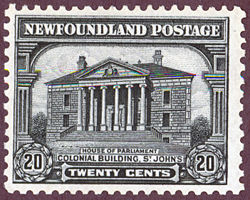
of Newfoundland had a 90-year history of issuing postage stamps. The first issues were in 1857. The last issue was in 1947, 2 years prior to Newfoundland joining the confederation
. Newfoundland stamps remain valid for postal mail delivered anywhere in Canada.
's first issue was from 1851 to 1857, in pence. The second issue, in cents, was from 1861 to 1863.
issued stamps in pence from 1862–1865, and a second series from 1868 to 1870. The third series, in cents, was issued in 1872.
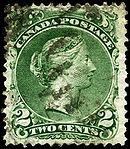 The Dominion came into existence July 1, 1867, assembled from colonies each of which had their own stamps, so the new government issued a new series of stamps on April 1, 1868, superseding all previous issues. These featured a profile of Queen Victoria, based on an engraving by Charles Henry Jeens and became known to philatelists as the "Large Queens". They ranged in value from ½¢ to 15¢. While mostly printed on wove paper, a few of the 1¢, 2¢, and 3¢ values were also printed on laid paper; only two examples of the Canada 2c Large Queen on laid paper
are known, making it Canada's rarest stamp.
Except for the 15c value which was in use as late as 1897, the Large Queens had a relatively short life, being replaced in 1870 by the "Small Queens", smaller stamps of the same basic design, adopted to be able to produce more stamps more quickly. The Small Queens came in a number of printings between 1870 and 1897. In 1893 20¢ and 50¢ stamps came out with a 3/4 portrait of Victoria.
 When Prince Edward Island
became a Canadian province in 1873, it sold off all of its remaining pre-Canadian stamps at discounted prices, flooding the market with over 1.5 million cheap stamps. Since these stamps had next to no value, forgers
had no compelling reason to make copies. Today, since forged versions of Prince Edward Island stamps are harder to find than the original, the forgeries are more valuable. Library and Archives Canada
holds a forged, lithographed version of a stamp from 1870 that features an engraving of Queen Victoria.
In 1897 the American Bank Note Company
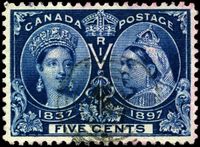
secured the contract to print stamps for Canada, which lasted until 1923. The company's first job was to print a series for the Diamond Jubilee
celebrating the 60th year of Queen Victoria and the 30th year of confederation, the first commemorative stamps of Canada. The design was a side-by-side of the Chalon vignette of the young Victoria and the likeness photographed by Alexander Bassano
in 1887. The series included 16 denominations ranging from ½¢ to five dollars, a princely sum in those days, and more aimed at collectors than mailers. Only 9,937 of the $4 value were ever sold, and unsurprisingly they are rare and expensive today.
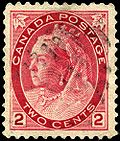 1897 also saw the Maple Leaf Issue, regular stamps with the central design based on a Jubilee portrait for Victoria, with maple
leaves in each corner. It was in use for only a few months before being replaced by a modified design that replaced the lower leaves with numerals of value, motivated by the French-speaking population who found it difficult to read the textual denomination on the original design. (The Universal Postal Union
would require the use of Arabic numerals in 1907.)
In 1898, a first step towards Imperial Penny Postage happened when a number of Dominions agreed on a uniform rate of 1d (2¢ in Canada). Canada issued an interesting stamp depicting a map of the entire world, with British possessions marked in red, inscribed "XMAS 1898" (the rate took effect on Christmas Day), and "WE HOLD A VASTER EMPIRE THAN HAS BEEN" underneath, a line extracted from "A Song of Empire" composed by Sir Lewis Morris
in 1887.
The stamp was notable as the first multi-colour stamp of Canada, and also for the tremendous variability of the red highlighting, resulting in amusing geographical incongruities.
, the basic maple leaf was retained but updated with a portrait of Edward wearing the ermine
Robes of State. Canada's first experiments with coil stamp
s occurred during this period.
 King George V
was depicted in 1911 as Admiral of the Fleet
in a widely-admired design that continued in use until 1928.
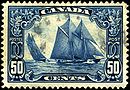 1928 saw the "Scroll Issue", so-called because "CANADA" appeared in a scroll across the top. This was the first issue to be bilingual. The pictorials are among the finest stamps ever produced, especially the 50¢ value Bluenose stamp
portraying the legendary schooner
Bluenose
.
The "Arch Issue" of 1930 was similarly elegant. The last issue for George V, in 1935, was called the "Dated Die Issue" because the year appeared in very small print in the design.
The dated die concept was used in 1937 as well, in the stamps issued for newly-crowned King George VI
. A group of three stamps in May 1939 marked a royal visit.
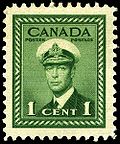 Soon after the Commonwealth was plunged into war; the War issue of 1942 highlighted Canada's contributions. While the low values showed the King wearing the uniforms of the different services, the higher values showed Canada's role in growing food and the production of munitions, including a Ram tank
, a corvette
, and a destroyer
.
In 1946 the "Peace issue" showed scenes and economic activities around the country. From the late 1940s on, the issuance of commemoratives became a regular event, with two in 1947, but gradually increasing. The last regular stamps of George VI came out in 1951.
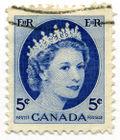 The first definitive issue for Elizabeth II's reign was based on a portrait by Yusuf Karsh, and was issued on a plain background in five values on 1953-05-01.
The Karsh series was replaced in the following year by a new design based on the portrait by Dorothy Wilding
that was also used in the United Kingdom. The 5¢ value was issued on April 1 with the introduction of the new domestic first class letter rate. Five more values in this series were introduced on June 10. It was with this series that the post office bean experimenting with fluorescence on stamps, resulting in a number of challenging varieties over the life of this and the next two series.
The Wilding series was replaced by the "Cameo" series, a horizontal design by Ernst Roch. The series began with the 5¢ value on 1962-10-03. The 1¢ and 4¢ values were released on 1963-02-04, and the 2¢ and 3¢ values followed on May 2.
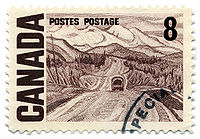 From the 1960s on, Canadian stamp policies have favoured issuing a relatively large number of single commemoratives valued at the prevailing first-class rate. In its commemorative issues Canada has made extensive use of works by well-known artists and until very recently has not used images of living people on its stamps.
 Definitive series have tended to be combinations of design types, each applying to a range of values. For instance, the definitives of the late 1980s featured native wildlife for values up to 80 cents, and Canadian architecture for the dollar values, while those of the early 1990s used berries for the lowest values, and fruit trees for the higher values, and continuing with architecture for the highest values.
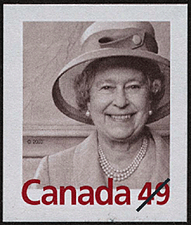
In December, 2003 Canada Post issued a new 49 cent definitive stamp bearing the image of the Queen, using a photograph taken by rock star Bryan Adams
. A similar redenominated stamp was issued in 2005 as a 50 cent denomination, and a 51 cent denomination in 2006 (see Queen Elizabeth II definitive stamp (Canada)
).
See also: List of people on stamps of Canada, People on stamps of Canadian provinces
Postal history
Postal history is the study of postal systems and how they operate and, or, the study of postage stamps and covers and associated material illustrating historical episodes of postal systems...
of Canada
Canada
Canada is a North American country consisting of ten provinces and three territories. Located in the northern part of the continent, it extends from the Atlantic Ocean in the east to the Pacific Ocean in the west, and northward into the Arctic Ocean...
falls into four major periods: French
New France
New France was the area colonized by France in North America during a period beginning with the exploration of the Saint Lawrence River by Jacques Cartier in 1534 and ending with the cession of New France to Spain and Great Britain in 1763...
control (1604–1763), British
Canada under British Imperial Control (1764-1867)
Territories, colonies and provinces that would become part of modern Canada were under control of the English, and later British, Empire from the sixteenth century, when France also had claims in the area. However, the most populous areas of Canada in the St...
control (1763–1841), colonial government
British North America
British North America is a historical term. It consisted of the colonies and territories of the British Empire in continental North America after the end of the American Revolutionary War and the recognition of American independence in 1783.At the start of the Revolutionary War in 1775 the British...
control (1841–1867), and the Dominion of Canada, since 1867.
Origins
It was at St. John'sSt. John's, Newfoundland and Labrador
St. John's is the capital and largest city in Newfoundland and Labrador, and is the oldest English-founded city in North America. It is located on the eastern tip of the Avalon Peninsula on the island of Newfoundland. With a population of 192,326 as of July 1, 2010, the St...
, Newfoundland
Newfoundland and Labrador
Newfoundland and Labrador is the easternmost province of Canada. Situated in the country's Atlantic region, it incorporates the island of Newfoundland and mainland Labrador with a combined area of . As of April 2011, the province's estimated population is 508,400...
on 3 August 1527 that the first known letter was sent from North America. While in St. John's, John Rut
John Rut
John Rut was an English mariner, born in Essex, who was chosen by Henry VIII to command an expedition to North America in search of the Northwest Passage; on 10 June 1527 he set sail from Plymouth with two ships, the Samson and the Mary Guilford. The voyage was set up by Cardinal Wolsey at the...
had written a letter to King Henry VIII
Henry VIII of England
Henry VIII was King of England from 21 April 1509 until his death. He was Lord, and later King, of Ireland, as well as continuing the nominal claim by the English monarchs to the Kingdom of France...
on his findings and his planned voyage. The letter in part reads as follows;
The conclusion of the letter reads:
French control
Th earliest reference to a postal serviceMail
Mail, or post, is a system for transporting letters and other tangible objects: written documents, typically enclosed in envelopes, and also small packages are delivered to destinations around the world. Anything sent through the postal system is called mail or post.In principle, a postal service...
is of courier
Courier
A courier is a person or a company who delivers messages, packages, and mail. Couriers are distinguished from ordinary mail services by features such as speed, security, tracking, signature, specialization and individualization of express services, and swift delivery times, which are optional for...
s in 1705, namely the "first courier" Pedro da Silva
Pedro da Silva
For the Brazilian decathlete with the same name see Pedro da Silva Pedro da Silva was the first post courier in New France, in what was to become part of Canada...
, carrying the Governor's dispatches by boat, along with (for a fee) private letters. A regular postal system was proposed in 1721, but would have been too expensive at the time, and was not created until 1734, when a road existed between Montreal
Montreal
Montreal is a city in Canada. It is the largest city in the province of Quebec, the second-largest city in Canada and the seventh largest in North America...
and Quebec
Quebec
Quebec or is a province in east-central Canada. It is the only Canadian province with a predominantly French-speaking population and the only one whose sole official language is French at the provincial level....
. Post houses were established at intervals of nine miles (14 km) or so, along with ferries across the rivers. Fees were 10 sols between the two major cities, and 5 sols to Trois-Rivières, Quebec
Trois-Rivières, Quebec
Trois-Rivières is a city in the Mauricie region of Quebec, Canada, located at the confluence of the Saint-Maurice and Saint Lawrence Rivers. It is situated in the Mauricie administrative region, on the north shore of the Saint Lawrence River across from the city of Bécancour...
.
British control
The British captured Montreal in 1760, and shortly thereafter established a military postal system that handled letters between Quebec and Montreal, and from Montreal to Albany, New YorkAlbany, New York
Albany is the capital city of the U.S. state of New York, the seat of Albany County, and the central city of New York's Capital District. Roughly north of New York City, Albany sits on the west bank of the Hudson River, about south of its confluence with the Mohawk River...
.
The peace treaty of 1763 inaugurated the development of a civilian post. The Postmasters General
United States Postmaster General
The United States Postmaster General is the Chief Executive Officer of the United States Postal Service. The office, in one form or another, is older than both the United States Constitution and the United States Declaration of Independence...
of the American colonies, Benjamin Franklin
Benjamin Franklin
Dr. Benjamin Franklin was one of the Founding Fathers of the United States. A noted polymath, Franklin was a leading author, printer, political theorist, politician, postmaster, scientist, musician, inventor, satirist, civic activist, statesman, and diplomat...
and William Foxcroft surveyed a route between New York and Quebec, and contracted Quebec-Montreal mail to a Hugh Finlay, who provided a weekly service at 8d per letter. Mail to New York took two weeks and cost about a shilling. The service was quite successful, the Quebec-Montreal route increasing to twice/week, and eventually branching out to include Skenesborough.
The American Revolutionary War
American Revolutionary War
The American Revolutionary War , the American War of Independence, or simply the Revolutionary War, began as a war between the Kingdom of Great Britain and thirteen British colonies in North America, and ended in a global war between several European great powers.The war was the result of the...
disrupted mail to New York, and also showed the weakness in not having an all-British route to Halifax, Nova Scotia
Nova Scotia
Nova Scotia is one of Canada's three Maritime provinces and is the most populous province in Atlantic Canada. The name of the province is Latin for "New Scotland," but "Nova Scotia" is the recognized, English-language name of the province. The provincial capital is Halifax. Nova Scotia is the...
, and in 1787 a complicated route was set up through Riviere du Loup
Rivière du Loup
The Rivière du Loup is a river in southeastern Quebec which empties into the Saint Lawrence River at the city of Rivière-du-Loup, Quebec.There is a hydroelectric plant on the river near the city....
, Fredericton, Digby
Digby County, Nova Scotia
Digby County is a county in the Canadian province of Nova Scotia.Taking its name from the Township of Digby , which had been named in honour of Rear Admiral Robert Digby who dispatched HMS Atlanta to convey loyalists from New York City in the spring of 1783 to Conway, which became known as Digby,...
, and Annapolis
Annapolis Royal, Nova Scotia
Annapolis Royal is a town located in the western part of Annapolis County, Nova Scotia. Known as Port Royal until the Conquest of Acadia in 1710 by Britain, the town is the oldest continuous European settlement in North America, north of St...
. Upper Canada
Upper Canada
The Province of Upper Canada was a political division in British Canada established in 1791 by the British Empire to govern the central third of the lands in British North America and to accommodate Loyalist refugees from the United States of America after the American Revolution...
had its own semi-monthly route through Kingston
Kingston, Ontario
Kingston, Ontario is a Canadian city located in Eastern Ontario where the St. Lawrence River flows out of Lake Ontario. Originally a First Nations settlement called "Katarowki," , growing European exploration in the 17th Century made it an important trading post...
, Niagara
Niagara-on-the-Lake, Ontario
Niagara-on-the-Lake is a Canadian town located in Southern Ontario where the Niagara River meets Lake Ontario in the Niagara Region of the southern part of the province of Ontario. It is located across the Niagara river from Youngstown, New York, USA...
, Detroit
Detroit, Michigan
Detroit is the major city among the primary cultural, financial, and transportation centers in the Metro Detroit area, a region of 5.2 million people. As the seat of Wayne County, the city of Detroit is the largest city in the U.S. state of Michigan and serves as a major port on the Detroit River...
, and as far as Michilimackinac
Michilimackinac
Michilimackinac is a name for the region around the Straits of Mackinac between Lake Huron and Lake Michigan. Early settlers of North America applied the term to the entire region along Lakes Huron, Michigan, and Superior. Today it is mostly within the boundaries of Michigan, in the United States...
on Lake Huron
Lake Huron
Lake Huron is one of the five Great Lakes of North America. Hydrologically, it comprises the larger portion of Lake Michigan-Huron. It is bounded on the east by the Canadian province of Ontario and on the west by the state of Michigan in the United States...
.
Finlay was succeeded in 1800 by George Heriot
George Heriot (artist)
George Heriot was a Scottish-Canadian civil servant, author and artist. He is most notable as a major figure in early Canadian art.-Early life:...
, then in 1816 Daniel Sutherland
Daniel Sutherland
Daniel Alexander Sutherland , nicknamed "Fighting Dan", was an American businessperson and politician who served in the United States House of Representatives during the 1920s as the delegate from what was then the Alaska Territory.Sutherland was born in Pleasant Bay, Canada on Cape Breton Island...
took over as Postmaster General. By this time dozens of post offices were being opened. 1816 was also when the postal services of Prince Edward Island
Prince Edward Island
Prince Edward Island is a Canadian province consisting of an island of the same name, as well as other islands. The maritime province is the smallest in the nation in both land area and population...
and Nova Scotia
Nova Scotia
Nova Scotia is one of Canada's three Maritime provinces and is the most populous province in Atlantic Canada. The name of the province is Latin for "New Scotland," but "Nova Scotia" is the recognized, English-language name of the province. The provincial capital is Halifax. Nova Scotia is the...
were separated, and not rejoined until 1868.
Postmarks had been in use since 1764, Finlay having been introduced to them by Franklin. The earliest markings were town names in a straight line.
As is typical of the period, the postal service introduced ever-more-complicated systems of rates for mail, depending on destination and distance. In 1840 Rowland Hill
Rowland Hill (postal reformer)
Sir Rowland Hill KCB, FRS was an English teacher, inventor and social reformer. He campaigned for a comprehensive reform of the postal system, based on the concept of penny postage and his solution of prepayment, facilitating the safe, speedy and cheap transfer of letters...
proposed a uniform rate for Great Britain
Great Britain
Great Britain or Britain is an island situated to the northwest of Continental Europe. It is the ninth largest island in the world, and the largest European island, as well as the largest of the British Isles...
that could be prepaid by postage stamp
Postage stamp
A postage stamp is a small piece of paper that is purchased and displayed on an item of mail as evidence of payment of postage. Typically, stamps are made from special paper, with a national designation and denomination on the face, and a gum adhesive on the reverse side...
s, and on May 25, 1849, the Legislative Assembly of Canada resolved to adopt the use of stamps in the Province of Canada
Province of Canada
The Province of Canada, United Province of Canada, or the United Canadas was a British colony in North America from 1841 to 1867. Its formation reflected recommendations made by John Lambton, 1st Earl of Durham in the Report on the Affairs of British North America following the Rebellions of...
.
Colonial Governments
The colonies co-operated in the local control of the postal system after they assumed the administration from the General Post office in London in 1851, but each colony issued its own stamps until it joined confederation. All colonies ceased issuing postage stamps after joining confederationCanadian Confederation
Canadian Confederation was the process by which the federal Dominion of Canada was formed on July 1, 1867. On that day, three British colonies were formed into four Canadian provinces...
.
British Columbia
The colonies of British ColumbiaColony of British Columbia
The Colony of British Columbia was a crown colony in British North America from 1858 until 1866. At its creation, it physically constituted approximately half the present day Canadian province of British Columbia, since it did not include the Colony of Vancouver Island, the vast and still largely...
and Vancouver Island
Colony of Vancouver Island
The Colony of Vancouver Island , was a crown colony of British North America from 1849 to 1866, after which it was united with British Columbia. The united colony joined the Dominion of Canada through Confederation in 1871...
jointly issued stamps valid in both colonies in 1860. In 1865, each colony issued its own series. After the two colonies were merged
United Colonies of Vancouver Island and British Columbia
The Colony of British Columbia is a crown colony that resulted from the amalgamation of the two former colonies, the Colony of Vancouver Island and the mainland Colony of British Columbia...
in 1866, the united colony issued stamps from 1867 to 1869.
Province of Canada
The Province of CanadaProvince of Canada
The Province of Canada, United Province of Canada, or the United Canadas was a British colony in North America from 1841 to 1867. Its formation reflected recommendations made by John Lambton, 1st Earl of Durham in the Report on the Affairs of British North America following the Rebellions of...
began issuing stamps in 1851. The first were in the values of 3d, 6d, and 12d. Designed by Sir Sandford Fleming
Sandford Fleming
Sir Sandford Fleming, was a Scottish-born Canadian engineer and inventor, proposed worldwide standard time zones, designed Canada's first postage stamp, a huge body of surveying and map making, engineering much of the Intercolonial Railway and the Canadian Pacific Railway, and was a founding...
, the Threepenny Beaver depicted a beaver
Beaver
The beaver is a primarily nocturnal, large, semi-aquatic rodent. Castor includes two extant species, North American Beaver and Eurasian Beaver . Beavers are known for building dams, canals, and lodges . They are the second-largest rodent in the world...
in an oval frame, and is considered the first Canadian postage stamp. It was the first stamp to picture an animal and not a monarch. It was the first official postage stamp anywhere to picture an animal, though an unofficial postmaster's provisional from St. Louis, Missouri
St. Louis, Missouri
St. Louis is an independent city on the eastern border of Missouri, United States. With a population of 319,294, it was the 58th-largest U.S. city at the 2010 U.S. Census. The Greater St...
showed two bears in 1845. The 6d was a portrait of Prince Albert from a drawing by William Drummond Esq. The 12d (1 shilling) was reproduced from a full-length painting of Queen Victoria done by Alfred Edward Chalon. All three stamps were produced by the firm of Rawdon, Wright, Hatch and Edson of New York.
In April 1851, the rate for inland letters to Canada, Nova Scotia, New Brunswick, Cape Breton and Prince Edward Island was 3d per ½ oz. Letters to the USA was 6d per ½ oz, excluding California and Orgeon, which was 9d per ½ oz. The first issues were made on laid paper
Laid paper
Laid paper is a type of paper having a ribbed texture imparted by the manufacturing process. In the 19th century its use diminished as it was largely supplanted by wove paper...
, which did not stick as well to envelopes; thus in 1852 the printers switched to wove paper
Wove paper
Wove paper is a writing paper with a uniform surface, not ribbed or watermarked.The papermaking mould's wires run parallel to each other to produce laid paper, but they are woven together into a fine wire mesh for wove paper...
. All of these early stamps were imperforate issues. These earliest issues on laid paper
Postage stamp paper
Postage stamp paper is the foundation or substrate of the postage stamp to which the ink for the stamp's design is applied to one side and the adhesive is applied to the other...
are quite rare; a grand total of only 1,450 copies of the 12d were ever issued. Copies today, depending on their condition, may sell for US$50,000 or more.
Between 1852 and 1857, the postal service came out with new values: ½d, 7½d, and 10d, while removing the 12d. The first two depicting Victoria, and the 10d featuring a portrait of Jacques Cartier
Jacques Cartier
Jacques Cartier was a French explorer of Breton origin who claimed what is now Canada for France. He was the first European to describe and map the Gulf of Saint Lawrence and the shores of the Saint Lawrence River, which he named "The Country of Canadas", after the Iroquois names for the two big...
. The 7½d was unusual in that it was also denominated "6 Pence Sterling". In 1858 the first perforated perforated
Postage stamp separation
For postage stamps, separation is the means by which individual stamps are made easily detachable from each other.Methods of separation include:# perforation: cutting rows and columns of small holes...
stamps were issued in ½d, 3d, and 6d values, depicting Queen Victoria, a beaver and HRH Prince Albert.
In 1859 the province standardized on a single decimal monetary system, which also meant new stamps would be needed. Between 1859 and 1864, the American Bank Note Company, New York produced seven new stamps in: 1¢, 5¢, (two)10¢, 12½¢, 17¢ and 2¢ values. In general, the existing designs were used. These were the last stamps produced for the Province of Canada.
New Brunswick
New BrunswickNew Brunswick
New Brunswick is one of Canada's three Maritime provinces and is the only province in the federation that is constitutionally bilingual . The provincial capital is Fredericton and Saint John is the most populous city. Greater Moncton is the largest Census Metropolitan Area...
first issued stamps in 1851; they were imperforate and denominated in pence. They consisted of a 3d red, 6d olive yellow, 1/- bright red violet and a 1/- dull violet issues, all on bluish paper. All four stamps were diamond shaped and bore the New Brunswick coat of arms. In 1860, six new stamps, denominated in cents, were issued. The 1¢ depicted a steam locomotive, the 2¢, 5¢, and 10¢ values showed a young Queen Victoria, while the 12½¢ depicted a steamship and the 17¢ showed the Prince of Wales in Highland regalia.
Newfoundland
The colony and later the dominionDominion of Newfoundland
The Dominion of Newfoundland was a British Dominion from 1907 to 1949 . The Dominion of Newfoundland was situated in northeastern North America along the Atlantic coast and comprised the island of Newfoundland and Labrador on the continental mainland...
of Newfoundland had a 90-year history of issuing postage stamps. The first issues were in 1857. The last issue was in 1947, 2 years prior to Newfoundland joining the confederation
Canadian Confederation
Canadian Confederation was the process by which the federal Dominion of Canada was formed on July 1, 1867. On that day, three British colonies were formed into four Canadian provinces...
. Newfoundland stamps remain valid for postal mail delivered anywhere in Canada.
Nova Scotia
Nova ScotiaNova Scotia
Nova Scotia is one of Canada's three Maritime provinces and is the most populous province in Atlantic Canada. The name of the province is Latin for "New Scotland," but "Nova Scotia" is the recognized, English-language name of the province. The provincial capital is Halifax. Nova Scotia is the...
's first issue was from 1851 to 1857, in pence. The second issue, in cents, was from 1861 to 1863.
Prince Edward Island
Prince Edward IslandPrince Edward Island
Prince Edward Island is a Canadian province consisting of an island of the same name, as well as other islands. The maritime province is the smallest in the nation in both land area and population...
issued stamps in pence from 1862–1865, and a second series from 1868 to 1870. The third series, in cents, was issued in 1872.
Dominion of Canada, Victorian period
Canada 2c Large Queen on laid paper
The 2¢ Large Queen on laid paper is the rarest postage stamp of Canada. Printed in 1868, it was not discovered until 1925, and so far only two are known to exist....
are known, making it Canada's rarest stamp.
Except for the 15c value which was in use as late as 1897, the Large Queens had a relatively short life, being replaced in 1870 by the "Small Queens", smaller stamps of the same basic design, adopted to be able to produce more stamps more quickly. The Small Queens came in a number of printings between 1870 and 1897. In 1893 20¢ and 50¢ stamps came out with a 3/4 portrait of Victoria.
Prince Edward Island
Prince Edward Island is a Canadian province consisting of an island of the same name, as well as other islands. The maritime province is the smallest in the nation in both land area and population...
became a Canadian province in 1873, it sold off all of its remaining pre-Canadian stamps at discounted prices, flooding the market with over 1.5 million cheap stamps. Since these stamps had next to no value, forgers
Philatelic fakes and forgeries
In general, philatelic fakes and forgeries refers to labels that look like postage stamps but are not. Most have been produced to deceive or defraud...
had no compelling reason to make copies. Today, since forged versions of Prince Edward Island stamps are harder to find than the original, the forgeries are more valuable. Library and Archives Canada
Library and Archives Canada
Library and Archives Canada is a national memory institution dedicated to providing the best possible account of Canadian life through acquiring, preserving and making Canada's documentary heritage accessible for use in the 21st century and beyond...
holds a forged, lithographed version of a stamp from 1870 that features an engraving of Queen Victoria.
In 1897 the American Bank Note Company
American Bank Note Company
The American Bank Note Company was a major worldwide engraver of national currency and postage stamps. Currently it engraves and prints stock and bond certificates.-History:Robert Scot, the first official engraver of the young U.S...
secured the contract to print stamps for Canada, which lasted until 1923. The company's first job was to print a series for the Diamond Jubilee
Diamond Jubilee
A Diamond Jubilee is a celebration held to mark a 60th anniversary in the case of a person or a 75th anniversary in the case of an event.- Thailand :...
celebrating the 60th year of Queen Victoria and the 30th year of confederation, the first commemorative stamps of Canada. The design was a side-by-side of the Chalon vignette of the young Victoria and the likeness photographed by Alexander Bassano
Alexander Bassano
Alexander Bassano was the leading high society portrait photographer in Victorian London.He was the second youngest child of Clemente Bassano, originally a fishmonger of Cranbourne Street, later an oilman and Italian warehouseman of Jermyn Street, London. He opened his first studio in 1850 in...
in 1887. The series included 16 denominations ranging from ½¢ to five dollars, a princely sum in those days, and more aimed at collectors than mailers. Only 9,937 of the $4 value were ever sold, and unsurprisingly they are rare and expensive today.
Maple
Acer is a genus of trees or shrubs commonly known as maple.Maples are variously classified in a family of their own, the Aceraceae, or together with the Hippocastanaceae included in the family Sapindaceae. Modern classifications, including the Angiosperm Phylogeny Group system, favour inclusion in...
leaves in each corner. It was in use for only a few months before being replaced by a modified design that replaced the lower leaves with numerals of value, motivated by the French-speaking population who found it difficult to read the textual denomination on the original design. (The Universal Postal Union
Universal Postal Union
The Universal Postal Union is an international organization that coordinates postal policies among member nations, in addition to the worldwide postal system. The UPU contains four bodies consisting of the Congress, the Council of Administration , the Postal Operations Council and the...
would require the use of Arabic numerals in 1907.)
In 1898, a first step towards Imperial Penny Postage happened when a number of Dominions agreed on a uniform rate of 1d (2¢ in Canada). Canada issued an interesting stamp depicting a map of the entire world, with British possessions marked in red, inscribed "XMAS 1898" (the rate took effect on Christmas Day), and "WE HOLD A VASTER EMPIRE THAN HAS BEEN" underneath, a line extracted from "A Song of Empire" composed by Sir Lewis Morris
Lewis Morris
Lewis Morris was an American landowner and developer from Morrisania, New York. He signed the U.S. Declaration of Independence as a delegate to the Continental Congress for New York....
in 1887.
The stamp was notable as the first multi-colour stamp of Canada, and also for the tremendous variability of the red highlighting, resulting in amusing geographical incongruities.
Philatelic literature
- The Large Queen Stamps of Canada and Their Use 1868-1872, H.E. & H.W. Duckworth, Vincent Graves Greene Philatelic Research Foundation (1986), hardcover, 488 pages; 2nd Edition (2008), 468 pages
- Large Queen-specific literature that has been published over the years or titles that include important information regarding other facets of Large Queen collecting
- Canada's Postage Stamps of the Small Queen Era 1870-1897, J. Hillson and J.E. Nixon, Vincent Graves Greene Philatelic Research Foundation (2008), hardcover, 240 pages
- Small Queens of Canada, John Hillson, Christie's-Robson Lowe; 2nd Revised edition (June 1989), hardcover, 112 pages, ISBN 978-0853974291
Edward VII
Upon the accession of King Edward VIIEdward VII of the United Kingdom
Edward VII was King of the United Kingdom and the British Dominions and Emperor of India from 22 January 1901 until his death in 1910...
, the basic maple leaf was retained but updated with a portrait of Edward wearing the ermine
Ermine
Ermine has several uses:* A common name for the stoat * The white fur and black tail end of this animal, which is historically worn by and associated with royalty and high officials...
Robes of State. Canada's first experiments with coil stamp
Coil stamp
A coil stamp is a type of postage stamp sold in strips one stamp wide. The name derives from the usual handling of long strips, which is to coil them into rolls, in a manner reminiscent of adhesive tape rolls...
s occurred during this period.
George V
George V of the United Kingdom
George V was King of the United Kingdom and the British Dominions, and Emperor of India, from 6 May 1910 through the First World War until his death in 1936....
was depicted in 1911 as Admiral of the Fleet
Admiral of the Fleet (Royal Navy)
Admiral of the fleet is the highest rank of the British Royal Navy and other navies, which equates to the NATO rank code OF-10. The rank still exists in the Royal Navy but routine appointments ceased in 1996....
in a widely-admired design that continued in use until 1928.
Bluenose (postage stamp)
The Bluenose is the nickname for a 50-cent definitive postage stamp issued by the Canadian Post Office on 8 January 1929 as part of the King George V "Scroll Issue”. Scott number is 158 with a perforation of 12...
portraying the legendary schooner
Schooner
A schooner is a type of sailing vessel characterized by the use of fore-and-aft sails on two or more masts with the forward mast being no taller than the rear masts....
Bluenose
Bluenose
Bluenose was a Canadian fishing and racing schooner from Nova Scotia built in 1921. She was later commemorated by a replica Bluenose II built in 1963. A celebrated racing ship and hard-working fishing vessel, Bluenose became a provincial icon for Nova Scotia as well as important Canadian symbol in...
.
The "Arch Issue" of 1930 was similarly elegant. The last issue for George V, in 1935, was called the "Dated Die Issue" because the year appeared in very small print in the design.
George VI
Because it was so short, no stamps were issued to commemorate the reign of Edward VIII.The dated die concept was used in 1937 as well, in the stamps issued for newly-crowned King George VI
George VI of the United Kingdom
George VI was King of the United Kingdom and the Dominions of the British Commonwealth from 11 December 1936 until his death...
. A group of three stamps in May 1939 marked a royal visit.
Ram tank
The Tank Cruiser, Ram was a cruiser tank designed and built by Canada in the Second World War, based on the U.S. M3 Medium tank. Due to the entrance of the United States into the war and the superior design of the American Sherman, it was used exclusively for training purposes and was never used in...
, a corvette
Corvette
A corvette is a small, maneuverable, lightly armed warship, originally smaller than a frigate and larger than a coastal patrol craft or fast attack craft , although many recent designs resemble frigates in size and role...
, and a destroyer
Destroyer
In naval terminology, a destroyer is a fast and maneuverable yet long-endurance warship intended to escort larger vessels in a fleet, convoy or battle group and defend them against smaller, powerful, short-range attackers. Destroyers, originally called torpedo-boat destroyers in 1892, evolved from...
.
In 1946 the "Peace issue" showed scenes and economic activities around the country. From the late 1940s on, the issuance of commemoratives became a regular event, with two in 1947, but gradually increasing. The last regular stamps of George VI came out in 1951.
Philatelic literature
- A STUDY OF THE PLATES, PAPERS & GUMS of the 1937 1¢, 2¢ & 3¢ MUFTI ISSUES OF CANADA prepared by Stephen F. Prest, November 2008, accessed January 22, 2011.
The Elizabethan era
The Karsh series was replaced in the following year by a new design based on the portrait by Dorothy Wilding
Dorothy Wilding
Dorothy Wilding was a noted English society photographer from Gloucester. She wanted to become an actress or artist but this career was disallowed by her uncle, in whose family she lived, so she chose the art of photography which she started to learn from the age of sixteen.By 1929 she had already...
that was also used in the United Kingdom. The 5¢ value was issued on April 1 with the introduction of the new domestic first class letter rate. Five more values in this series were introduced on June 10. It was with this series that the post office bean experimenting with fluorescence on stamps, resulting in a number of challenging varieties over the life of this and the next two series.
The Wilding series was replaced by the "Cameo" series, a horizontal design by Ernst Roch. The series began with the 5¢ value on 1962-10-03. The 1¢ and 4¢ values were released on 1963-02-04, and the 2¢ and 3¢ values followed on May 2.
In December, 2003 Canada Post issued a new 49 cent definitive stamp bearing the image of the Queen, using a photograph taken by rock star Bryan Adams
Bryan Adams
Bryan Adams, is a Canadian rock singer-songwriter, guitarist, bassist, producer, actor and photographer. Adams has won dozens of awards and nominations, including 20 Juno Awards among 56 nominations. He has also received 15 Grammy Award nominations including a win for Best Song Written...
. A similar redenominated stamp was issued in 2005 as a 50 cent denomination, and a 51 cent denomination in 2006 (see Queen Elizabeth II definitive stamp (Canada)
Queen Elizabeth II definitive stamp (Canada)
The Queen Elizabeth II definitive stamp is a domestic rate stamp issued by Canada Post, and bearing the image of Elizabeth II, Queen of Canada. Six versions of the stamp have been issued since 2003....
).
See also: List of people on stamps of Canada, People on stamps of Canadian provinces
Philatelic literature
- The Postage Stamps and Postal History of Canada, Winthrop Smillie Boggs, (1945) reprinted 1974.
- The Encyclopedia of British Empire Postage Stamps 1639-1952; Vol V North America, Robson LoweRobson LoweJohn Harry Robson Lowe , Robbie to his friends, was an English professional philatelist, stamp dealer and stamp auctioneer.- Life and career :...
, London, England (1973). - Stamps of British North America, Fred Jarrett
- Standard British North America Catalogue, Fred Jarrett, Toronto, 1929
- BNA Topics
- The Canadian Philatelist Searchable Database
- Holmes' specialized philatelic catalogue of Canada and British North AmericaHolmes' specialized philatelic catalogue of Canada and British North AmericaThe Holmes' specialized philatelic catalogue of Canada and British North America was edited by Lawrence Sealewyn Holmes together with the British North America Philatelic Society. The 1st edition of the stamp catalogue was published in 1935; the 11th edition, and apparently last, was published in...
published from 1935 to 1968. - Vincent Graves Greene Philatelic Research Foundation
Sources
- Stanley Gibbons Ltd: various catalogues
- Encyclopaedia of Postal History
- Stuart Rossiter & John Flower: The Stamp Atlas
- Winthrop Smillie BoggsWinthrop Smillie BoggsWinthrop Smillie Boggs was a philatelist renowned for his expertise and philatelic writing.-Philatelic accomplishments:Boggs wrote a number of the definitive books in philately:* The Foundations of Philately...
, The Postage Stamps and Postal History of Canada (1945, reprinted 1974) — Lawrence, Mass.: Quarterman Publications, [1974]. — 870 p. ISBN 0880000422 - Detecting the Truth: Fakes, Forgeries and Trickery, a virtual museum exhibition at Library and Archives Canada
- Dwight Robin Harris, 1952-53 Karsh, 1954-62 Wilding, 1962-66 Cameo definitives, 1998
External links and further reading
- Canadian Encyclopedia
- The Canadian Museum of Civilization - The Image of the Worker on Canadian Postage Stamps
- Library & Archives Canada Postage Stamp Page
- The British North American Philatelic Society
- The Royal Philatelic Society of Canada (RPSC)
- The Canadian Philatelic Society of Great Britain
- The Canadian Forces Philatelic Society
- The Stamps of Canada, by Bertram Poole, c.1914