
Home      Discussion      Topics      Dictionary      Almanac
Signup       Login
University of Al Karaouine

University of Al Karaouine

Overview
The University of Al-Karaouine or Al-Qarawiyyin (other transliterations of the name include Qarawiyin, Kairouyine, Kairaouine, Qairawiyin, Qaraouyine, Quaraouiyine, Quarawin, and Qaraouiyn) is a university
University
A university is an institution of higher education and research, which grants academic degrees in a variety of subjects. A university provides both undergraduate education and postgraduate education...

 located in Fes
FES
Fes may refer to:* Fes, Morocco, also known as Fez, a city in Morocco* Persona 3 FES, an 'add-on' disk for Shin Megami Tensei:Persona 3.FES is a three-letter acronym that may refer to:...

, Morocco
Morocco
Morocco, officially the Kingdom of Morocco, is a country located in North Africa with a population of nearly 32 million and an area just under . Its capital is Rabat, and its largest city is Casablanca. Morocco has a coast on the Atlantic Ocean that reaches past the Strait of Gibraltar into the...

. Founded in 859, as a madrasah
Madrasah
Madrasah is the Arabic word for any type of educational institution, whether secular or religious...

, the university is one of the leading spiritual and educational centers of the Muslim world
Muslim world
The term Muslim world has several meanings. In a cultural sense it refers to the worldwide community of Muslims, adherents of Islam. This community numbers about 1.3-1.5 billion people, roughly one-fifth of the world population. This community is spread across many different nations and ethnic...

. It is considered the oldest continuously operating academic degree
Academic degree
A degree is any of a wide range of status levels conferred by institutions of higher education, such as universities, normally as the result of successfully completing a program of study.- History :...

-granting university in the world by the Guinness Book of World Records
Guinness World Records
Guinness World Records, known until 2000 as The Guinness Book of Records , is a reference book published annually, containing an internationally recognised...

.

Al Karaouine University played a leading role in the cultural and academic relations between the Islamic world and Europe
Europe
Europe is, by convention, one of the world's seven continents. Comprising the westernmost peninsula of Eurasia, Europe is generally divided from Asia to its east by the water divide of the Ural Mountains, the Ural River, the Caspian Sea, the Caucasus Mountains , and the Black Sea to the southeast...

 in the middle ages
Middle Ages
The Middle Ages of European history is a period of European history covering roughly a millennium in the 5th century through 16th centuries. More specific starting and ending points are sometimes adopted by scholars to suit their respective specializations or current focus...

.
Discussion
Ask a question about 'University of Al Karaouine'
Start a new discussion about 'University of Al Karaouine'
Answer questions from other users
Full Discussion Forum
 
Unanswered Questions
Encyclopedia
The University of Al-Karaouine or Al-Qarawiyyin (other transliterations of the name include Qarawiyin, Kairouyine, Kairaouine, Qairawiyin, Qaraouyine, Quaraouiyine, Quarawin, and Qaraouiyn) is a university
University
A university is an institution of higher education and research, which grants academic degrees in a variety of subjects. A university provides both undergraduate education and postgraduate education...

 located in Fes
FES
Fes may refer to:* Fes, Morocco, also known as Fez, a city in Morocco* Persona 3 FES, an 'add-on' disk for Shin Megami Tensei:Persona 3.FES is a three-letter acronym that may refer to:...

, Morocco
Morocco
Morocco, officially the Kingdom of Morocco, is a country located in North Africa with a population of nearly 32 million and an area just under . Its capital is Rabat, and its largest city is Casablanca. Morocco has a coast on the Atlantic Ocean that reaches past the Strait of Gibraltar into the...

. Founded in 859, as a madrasah
Madrasah
Madrasah is the Arabic word for any type of educational institution, whether secular or religious...

, the university is one of the leading spiritual and educational centers of the Muslim world
Muslim world
The term Muslim world has several meanings. In a cultural sense it refers to the worldwide community of Muslims, adherents of Islam. This community numbers about 1.3-1.5 billion people, roughly one-fifth of the world population. This community is spread across many different nations and ethnic...

. It is considered the oldest continuously operating academic degree
Academic degree
A degree is any of a wide range of status levels conferred by institutions of higher education, such as universities, normally as the result of successfully completing a program of study.- History :...

-granting university in the world by the Guinness Book of World Records
Guinness World Records
Guinness World Records, known until 2000 as The Guinness Book of Records , is a reference book published annually, containing an internationally recognised...

.

Al Karaouine University played a leading role in the cultural and academic relations between the Islamic world and Europe
Europe
Europe is, by convention, one of the world's seven continents. Comprising the westernmost peninsula of Eurasia, Europe is generally divided from Asia to its east by the water divide of the Ural Mountains, the Ural River, the Caspian Sea, the Caucasus Mountains , and the Black Sea to the southeast...

 in the middle ages
Middle Ages
The Middle Ages of European history is a period of European history covering roughly a millennium in the 5th century through 16th centuries. More specific starting and ending points are sometimes adopted by scholars to suit their respective specializations or current focus...

. The cartographer Mohammed al-Idrisi (d. 1166), whose maps aided European exploration
Age of Discovery
The Age of Discovery, also known as the Age of Exploration, was a period in history starting in the 15th century and continuing into the 17th century, during which Europeans and its descendants intensively explored and mapped the world...

 in the Renaissance
Renaissance
The Renaissance was a cultural movement that spanned roughly the 14th to the 17th century, beginning in Florence in the Late Middle Ages and later spreading to the rest of Europe...

 is said to have lived in Fes for some time, suggesting that he may have worked or studied at Al Karaouine. The university has produced numerous scholars who have strongly influenced the intellectual and academic history of the Muslim world. Among these are Ibn Rushayd al-Sabti (d. 1321), Mohammed Ibn al-Hajj al-Abdari al-Fasi (d. 1336), Abu Imran al-Fasi
Abu Imran al-Fasi
Abu Imran Yaqub al-Fasi was a Moroccan, Maliki writer. He is regarded a saint by later Sufi mystics. He played an important role in the history of the Almoravid dynasty. It was his teaching in Qayrawan that first stirred the Sanhaja. He wrote a commentary on the Mudawana of Sahnun.Sidi Kadi Abul...

 (d. 1015), a leading theorist of the Maliki
Maliki
The Maliki madhhab is one of the four schools of Fiqh or religious law within Sunni Islam. It is the third-largest of the four schools, followed by approximately 15% of Muslims, mostly in North Africa, West Africa, United Arab Emirates, some parts of Saudi Arabia.Madhabs are rites not sects. They...

 school of Islamic jurisprudence, and Leo Africanus
Leo Africanus
Joannes Leo Africanus, was an Arab diplomat and author who is best known for his book Descrittione dell’Africa describing the geography of North Africa.-Biography:Most of what is known about his life is gathered from autobiographical notes in his...

, a renowned traveler and writer.

History


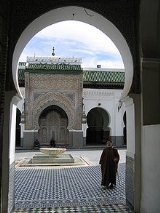
The University of Al-Karaouine is part of a mosque
Mosque
A mosque is a place of worship for followers of Islam. Muslims often refer to the mosque by its Arabic name, masjid, —...

, founded in 859 by Fatima al-Fihri
Fatima al-fihri
Fatima al-Fihri was the daughter of Mohammed al-Fihri, with whom she migrated to Fes, Morocco from Qairawan, located in present-day Tunisia...

, the daughter of a wealthy merchant named Mohammed Al-Fihri. The Al-Fihri family had migrated from Kairouan
Kairouan
Kairouan Kairouan (Arabic القيروان) Kairouan (Arabic القيروان) (also known as Kirwan, Al Qayrawan, it is the capital of the Kairouan Governorate in Tunisia. It was founded by the Arabs in around 670 in the period of Caliph Mu'awiya and the original name was derived from Arabic kairuwân, from...

 (hence the name of the university), Tunisia
Tunisia
Tunisia , officially the Tunisian Republic , is a country located in North Africa. It is bordered by Algeria to the west and Libya to the southeast. Tunisia is located southwest of the island of Sicily and south of Sardinia. Its size is almost 165,000 km² with an estimated population of just...

 to Fes
FES
Fes may refer to:* Fes, Morocco, also known as Fez, a city in Morocco* Persona 3 FES, an 'add-on' disk for Shin Megami Tensei:Persona 3.FES is a three-letter acronym that may refer to:...

 in the early 9th century, joining a community of other migrants from Kairouan who had settled in a western district of the city. Fatima and her sister Mariam, both of whom were well educated, inherited a large amount of money from their father. Fatima vowed to spend her entire inheritance on the construction of a mosque
Mosque
A mosque is a place of worship for followers of Islam. Muslims often refer to the mosque by its Arabic name, masjid, —...

 suitable for her community.

In addition to a place for worship
Worship
'Worship' is acts, expressions or a state of religious devotion typically directed to one or more deities.Worship is etymologically derived from Old English words meaning "worth-ship". Giving worth to something...

, the mosque soon developed into a place for religious instruction and political discussion, gradually extending its education to a broad range of subjects, particularly the natural sciences. In 1957, King Mohammed V
Mohammed V of Morocco
Mohammed V was Sultan of Morocco from 1927 to 1953, exiled from 1953-55, where he was again recognized as Sultan upon his return, and King from 1957 to 1961. His full name was Sidi Mohammed ben Yusef, or Son of Yusef, upon whose death he succeeded to the throne...

 introduced mathematics, physics, chemistry and foreign languages.

The university gained the patronage of politically powerful sultan
Sultan
Sultan is an Islamic title, with several historical meanings. Originally it was an Arabic language abstract noun meaning "strength", "authority", or "rulership", derived from the masdar سلطة , meaning "authority" or "power"...

s. It compiled a large selection of manuscripts that were kept at a library founded by the Marinid
Marinid
The Anglicised name used for this article derives from the Arabic Banu Marin or the Berber Ayt Mrin, which is the source of the Spanish name....

 Sultan Abu Inan Faris
Abu Inan Faris
Abu Inan Faris was a Marinid ruler. He succeeded his father Abu al-Hasan ibn Uthman as sultan of Morocco in 1348. He died strangled by his vizier in 1358.- History :...

 in 1349. Among the most precious manuscripts currently housed in the university library are volumes from the famous Al-Muwatta
Al-Muwatta
The Muwaṭṭa is an early collection of Muslim law, compiled and edited by Imam Malik.-Description:It is considered to be from the earliest extant collections of hadith that form the basis of Islamic jurisprudence alongside the Qur'an. Nonetheless, is not merely a collection of hadith; many of the...

of Malik
Malik ibn Anas
Mālik ibn Anas ibn Malik ibn 'Āmr al-Asbahi is known as "Imam Malik," the "Sheikh of Islam," the "Proof of the Community," and "Imam of the Abode of Emigration." He was one of the most highly respected scholars of fiqh in Sunni Islam...

 written on gazelle parchment
Parchment
Parchment is a thin material made from calfskin, sheepskin or goatskin, often split. Its most common use was as a material for writing on, for documents, notes, or the pages of a book, codex or manuscript. It is distinct from leather in that parchment is limed but not tanned, therefore it is very...

, the Sirat Ibn Ishaq, a copy of the Qur'an given to the university by Sultan Ahmad al-Mansur in 1602, and the original copy of Ibn Khaldun
Ibn Khaldun
Ibn Khaldūn or Ibn Khaldoun Ibn Khaldūn or Ibn Khaldoun Ibn Khaldūn or Ibn Khaldoun (full name, , , (May 27, 1332 AD/732 AH – March 19, 1406 AD/808 AH) was a North African polymath — an astronomer, economist, historian, Islamic scholar, Islamic theologian, hafiz, jurist, lawyer,...

's book Al-'Ibar. Among the subjects taught, alongside the Qur'an
Qur'an
The Qur’an is the central religious text of Islam...

 and Fiqh
Fiqh
Fiqh is Islamic jurisprudence. Fiqh is an expansion of the Sharia Islamic law—based directly on the Quran and Sunnah—that complements Shariah with evolving rulings/interpretations of Islamic jurists....

 (Islamic jurisprudence), are grammar
Grammar
In linguistics, grammar is the set of logical and structural rules that govern the composition of sentences, phrases, and words in any given natural language. The term refers also to the study of such rules, and this field includes morphology and syntax, often complemented by phonetics, phonology,...

, rhetoric
Rhetoric
Rhetoric is one of the arts of using language as a means to persuade. Along with grammar and logic or dialectic, rhetoric is one of the three ancient arts of discourse. From ancient Greece to the late 19th Century, it was a central part of Western education, filling the need to train public...

, logic
Logic
Logic, from the Greek λογική is the art and science of reasoning. More specifically, it is defined by the Penguin Encyclopedia to be "The formal systematic study of the principles of valid inference and correct reasoning". As a discipline, logic dates back to Aristotle, who established its...

, medicine
Medicine
Medicine is the art and science of healing. It encompasses a range of health care practices evolved to maintain and restore health by the prevention and treatment of illness....

, mathematics
Mathematics
Mathematics is the science and study of quantity, structure, space, and change. Mathematicians seek out patterns, formulate new conjectures, and establish truth by rigorous deduction from appropriately chosen axioms and definitions....

, astronomy
Astronomy
Astronomy is the scientific study of celestial objects and phenomena that originate outside the Earth's atmosphere...

, chemistry
Chemistry
Chemistry is the science concerned with the composition, behavior, structure, and properties of matter, as well as the changes it undergoes during chemical reactions...

, history
History
History is the study of the human past, with special attention to the written record. Scholars who write about history are called historians. It is a field of research which uses a narrative to examine and analyse the sequence of events, and it often attempts to investigate objectively the patterns...

, geography
Geography
Geography is the study of the Earth and its lands, features, inhabitants, and phenomena. A literal translation would be "to describe or write about the Earth". The first person to use the word "geography" was Eratosthenes...

 and music
Music
Music is an art form whose medium is sound. Common elements of music are pitch , rhythm , dynamics, and the sonic qualities of timbre and texture...

.

Al-Karaouine played, in medieval times, a leading role in the cultural exchange and transfer of knowledge between Muslims and Europeans. Pioneer scholars such as Ibn Maimun (Maimonides
Maimonides
Moses Maimonides, also known as Rabbi Moshe ben Maimon or the acronym the Rambam , was born in Cordoba, Spain on March 30, 1135, and died in Egypt on December 13, 1204....

), (1135-1204), Al-Idrissi (d.1166 AD), Ibn al-Arabi
Ibn al-Arabi
*For the Sufi scholar, see Ibn Arabi.Ibn al-Arabi is not the famous Sufi Ibn Arabi, although the name sounds similar. He was an Islamic scholar from Spain. It is reported that he was a student of Al-Ghazali for some time. He was a master of Al-Maliki Jurisprudence. His father was a student of Ibn...

 (1165-1240 AD), Ibn Khaldun
Ibn Khaldun
Ibn Khaldūn or Ibn Khaldoun Ibn Khaldūn or Ibn Khaldoun Ibn Khaldūn or Ibn Khaldoun (full name, , , (May 27, 1332 AD/732 AH – March 19, 1406 AD/808 AH) was a North African polymath — an astronomer, economist, historian, Islamic scholar, Islamic theologian, hafiz, jurist, lawyer,...

 (1332-1395 AD), Ibn al-Khatib
Ibn al-Khatib
Lisan al-Din ibn al-Khatib or Muhammad ibn Abd Allah ibn Said ibn Ali ibn Ahmad al-Salmani Lisan al-Din ibn al-Khatib or Muhammad ibn Abd Allah ibn Said ibn Ali ibn Ahmad al-Salmani Lisan al-Din ibn al-Khatib or Muhammad ibn Abd Allah ibn Said ibn Ali ibn Ahmad al-Salmani (1313 (in Loja near...

, Al-Bitruji (Alpetragius), Ibn Hirzihim
Ibn Hirzihim
For the teacher of Ash-Shadhili see Abu Abdallah ibn HarzihimSidi Ali ibn Harzihim or Abul Hasan Ali ibn Ismail ibn Mohammed ibn Abdallah ibn Harzihim/Hirzihim was born in Fes, Morocco and died in that same city in 559/1163. He was a Sufi teacher, leader of a Ghazalian zawiya in Fes and was the...

, and Al-Wazzan were all connected with the university either as students or lecturers. Among Christian scholars visiting Al-Karaouine were the Belgian Nicolas Cleynaerts
Nicolas Cleynaerts
Nicolas Cleynaerts , Flemish grammarian and traveller, was born at Diest, in Brabant....

 and the Dutch Golius.

Architecture of the mosque


Successive dynasties expanded the Al Karaouine mosque until it became the largest in North Africa
North Africa
North Africa or Northern Africa is the northernmost region of the African continent, linked by the Sahara to Sub-Saharan Africa.Geopolitically, the UN definition of Northern Africa includes the following seven countries or territories; Algeria, Egypt, Libya, Morocco, Sudan, Tunisia,Mauritania, and...

, with a capacity of more than 20,000 worshipers. Compared with the great mosques of Isfahan or Istanbul
Istanbul
Istanbul is the largest city in Turkey and fifth largest city proper in the world with a population of 12.6 million. Istanbul is also a megacity, as well as the cultural and financial centre of Turkey. The city covers 39 districts of the Istanbul province...

, the design is austere. The columns and arches are plain white; the floors are covered in reed mats, not lush carpets. Yet the seemingly endless forest of arches creates a sense of infinite majesty and intimate privacy, while the simplicity of the design compliments the finely decorated niches, pulpit and outer courtyard, with its superb tiles, plasterwork, woodcarvings and paintings.

The present form of the mosque is the result of a long historical evolution over the course of more than 1,000 years. Originally the mosque was about 30 meters long with a courtyard and four transverse aisles. The first expansion was undertaken in 956, by Umayyad
Umayyad
The Umayyad Caliphate was the second of the four Islamic caliphates established after the death of Muhammad. It was ruled by the Umayyad dynasty, whose name derives from Umayya ibn Abd Shams, the great-grandfather of the first Umayyad caliph. Although the Umayyad family originally came from the...

 Caliph of Córdoba, Abd-ar-Rahman III
Abd-ar-Rahman III
Abd-ar-Rahman III was the Emir and Caliph of Córdoba of the Ummayad dynasty in al-Andalus. Called al-Nasir , he ascended the throne when he was twenty-two years of age and reigned for half a century as the most powerful prince of Iberia...

. The prayer hall was extended and the minaret
Minaret
Minarets are distinctive architectural features of Islamic mosques. Minarets are generally tall spires with onion-shaped or conical crowns, usually either free standing or taller than any associated support structure.-Functions of minarets:The earliest mosques were built without minarets, the adhan...

 was relocated, taking on a square form that served as a model for countless North African minaret
Minaret
Minarets are distinctive architectural features of Islamic mosques. Minarets are generally tall spires with onion-shaped or conical crowns, usually either free standing or taller than any associated support structure.-Functions of minarets:The earliest mosques were built without minarets, the adhan...

s. At this time it became a tradition that other mosques of Fes would make the call to prayer only after they heard Al Karaouine. In the minaret of the Al-Karaouine mosque there is a special room, the Dar al-Muwaqqit
Dar al-Muwaqqit
The Dar al-Muwaqqit is a room in the minaret of the Al-Karaouine mosque in Fes. It was the chamber of the muwaqqit, the officer charged with the regulation and maintenance of the clocks and with communicating the correct times of prayer to the muezzin. The most important object of the Dar...

, where the times of prayer are established.

The most extensive reconstruction was carried out in 1135 under the patronage of the Almoravid ruler sultan Ali Ibn Yusuf
Ali ibn Yusuf
Ali ibn Yusuf was an Almoravid ruler in North Africa and Al-Andalus who was an ethnic Berber, reigned 1106–1142....

 who ordered the extension of the mosque from 18 to 21 aisles, expanding the structure to more than 3,000 square meters. Some accounts suggest that Ali Ibn Yusuf
Ali ibn Yusuf
Ali ibn Yusuf was an Almoravid ruler in North Africa and Al-Andalus who was an ethnic Berber, reigned 1106–1142....

 employed two Andalusian architects who also built the central aisle of the Great Mosque of Tlemcen
Great Mosque of Tlemcen
The Great Mosque of Tlemcen was first built in Tlemcen, Algeria in 1082. It is one of the best preserved examples of Almoravid architecture. It was built under sultan Yusuf ibn Tashfin, but substantially reconstructed and enlarged by his son Ali ibn Yusuf. An inscription dates this reconstruction...

, Algeria
Algeria
Algeria , officially the People's Democratic Republic of Algeria, is a country located in North Africa. It is the largest country on the Mediterranean sea, the second largest on the African continent and the eleventh-largest country in the world in terms of land area.It is bordered by Tunisia in...

, in 1136. The mosque acquired its present, Córdoba
Córdoba, Spain
||-||-||}Córdoba is a city in Andalusia, southern Spain, and the capital of the province of Córdoba. Located at 37.88° North, 4.77° West, on the Guadalquivir river, it was founded in ancient Roman times as Corduba by Claudius Marcellus...

n appearance at this time, featuring horseshoe arches and ijmiz frames decorated with beautiful geometrical and floral Andalusian art, bordered with Kufic calligraphy.

In the 16th century, the Saadi
Saadi
Saadi or Sadi may refer to:geography:* Sədi, village in Azerbaijan*Sadi, Nepalfamily name:* Saadi dynasty, a dynasty of Morocco* Saadi , medieval Persian Sufi poet* Dheyaa al-Saadi, Iraqi lawyer...

s restored the mosque, adding two patios to the northern and southern ends of the courtyard.

See also


  • Dar al-Muwaqqit
    Dar al-Muwaqqit
    The Dar al-Muwaqqit is a room in the minaret of the Al-Karaouine mosque in Fes. It was the chamber of the muwaqqit, the officer charged with the regulation and maintenance of the clocks and with communicating the correct times of prayer to the muezzin. The most important object of the Dar...

     (the 'clock-house' of Al-Karaouine)
  • List of oldest universities in continuous operation
  • Al-Azhar University
    Al-Azhar University
    Al-Azhar University in Egypt, founded in 970~972, is the chief centre of Arabic literature and Sunni Islamic learning in the world and the world's second oldest surviving degree granting university. It is associated with Al-Azhar mosque in Islamic Cairo. The university's mission includes the...

  • Islamic architecture
    Islamic architecture
    Islamic architecture encompasses a wide range of both secular and religious styles from the foundation of Islam to the present day, influencing the design and construction of buildings and structures in Islamic culture....

  • List of universities in Morocco
  • Madrasah
    Madrasah
    Madrasah is the Arabic word for any type of educational institution, whether secular or religious...


External links