

Political views on the Macedonian language

Encyclopedia
The existence and distinctiveness of the Macedonian language
is disputed among the politicians, linguists and common people from the neighboring countries. Macedonian dialects are indeed a part of dialectal continuum which stretches from Croatian, Bosnian and Serbia
n Shtokavian dialect
through Torlakian
on the northwest, to western and eastern Bulgarian
dialects on the East, and the Macedonian language, like Bulgarian, Serbian
, Croatian
and Bosnian
, is a standardized form of (some of) these dialects.
and St. Methodius's introduction of Slavic literacy language through the Glagolitic script, that was based on Southern Macedonian dialect from the neighbourhood of Thessaloniki
, the home of the two saints. Later on, Macedonia fell under the rule of Bulgarians, and the Byzantines
regarded all Slavic Macedonians as Bulgarians. According to a minority view, supported in the Republic of Macedonia, Tsar Samuil's realm in the early Middle Ages
was allegedly the first Macedonian Slavic state. However, Krste Misirkov
, who allegedly set the principles of the Macedonian literary language in the late 19th century, stated: "We speak a Bulgarian language and we believed with Bulgaria is our strong power."
 Although Bulgaria was the first country to recognize the independence of the Republic of Macedonia, most of its academics, as well as the general public, regard the language spoken there as a form of Bulgarian. However after years of diplomatic impasse caused by an academic dispute, in 1999 the government in Sofia solved the problem with the Macedonian Language under the formula: "the official language of the country (Republic of Macedonia) in accordance with its constitution".
Most Bulgarian linguists consider the Slavic dialects spoken in the region of Macedonia
as a part of the Bulgarian diasystem
. Numerous shared features of these dialects with Bulgarian are cited as proof. Bulgarian scholars also claim that the overwhelming majority of the Macedonian population had no conscience of a Macedonian language separate from Bulgarian prior to 1945. Russian scholars cite the early references to the language in Slavic literature from the middle of 10th century to the end of 19th century as "bulgarski" or "bolgarski" as proof of that claim. From that, the conclusion is drawn that modern standard Macedonian is not a language separate from Bulgarian either but just another written "norm" based on a set of Bulgarian dialects. See dialect
and dialect continuum
to assess the validity of these arguments. Moreover, Bulgarian linguists assert that the Macedonian and Yugoslav linguists who were involved in codifying the new language artificially introduced differences from literary Bulgarian to bring it closer to Serbian.. They are also said to have resorted to falsifications and deliberate misinterpretations of history and documents in order to further the claim that there was a consciousness of a separate Macedonian ethnicity before 1944. Part of Bulgarian scholars and people hold the view that Macedonian is one of three "norms" of the Bulgarian language, the other two being standard Bulgarian and the language of the Banat Bulgarians
. This formulation was detailed in 1978 in a document of the Bulgarian Academy of Sciences
entitled "The Unity of the Bulgarian Language Today and in the Past". Although Bulgaria was the first country to recognize the independence of the Republic of Macedonia
, it has refused to recognise the existence of a separate Macedonian ethnicity and a separate Macedonian language. This was a major obstacle to the development of diplomatic relations between the two countries until a compromise solution was worked out in 1999.

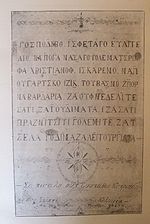 Bulgarian ethnos in Macedonia existed long before the earliest articulations of the idea that Macedonian Slavs
might form a separate ethnic group from the Bulgarians
in Danubian Bulgaria and Thrace
. Throughout the period of Ottoman
rule, the Slav-speaking people of the geographic regions of Moesia
, Thrace and Macedonia
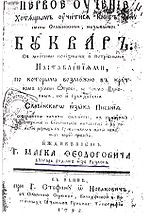
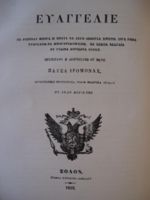
referred to their language as Bulgarian and called themselves Bulgarians. For instance, the Serbian researcher St. Verković who was a long term teacher in Macedonia, sent by the Serbian government with special assimilatory mission wrote in the preface of his collection of Bulgarian folk songs: "I named these songs Bulgarian, and not Slavic because today when you ask any Macedonian Slav: Who are you? he immediately answers: I am Bulgarian and call my language Bulgarian...." The name "Bulgarian" for various Macedonian dialects can be seen from early vernacular texts such as the four-language dictionary of Daniil of Moschopole, the early works of Kiril Pejchinovich and Ioakim Kurchovski and some vernacular gospels written in the Greek alphabet. These written works influenced by or completely written in the Bulgarian vernacular were registered in Macedonia in the 18th and beginning of the 19th century and their authors referred to their language as Bulgarian. The first samples of Bulgarian speech and the first grammar of modern Bulgarian language were written by the leading Serbian literator Vuk Karadjić on the basis of the Macedonian Razlog dialect. In those early years the re-emerging Bulgarian written language was still heavily influenced by Church Slavonic forms so dialectical differences were not very prominent between the Eastern and Western regions. Indeed, in those early years many Bulgarian activists sometimes even communicated in Greek in their writing.
When the Bulgarian national movement got under way in the second quarter of the 19th century some cities in Macedonia were among the first to demand education in Bulgarian and Bulgarian-speaking clerics for their churches. By the 1860s however, it was clear that the Central Balkan regions of Bulgaria were assuming leadership in linguistic and literary affairs. This was to a large extent due to the fact that the affluent towns on both sides of the Central Balkan range were able to produce more intellectuals educated in Europe than the relatively more backward other Bulgarian regions. Consequently, when the idea that the vernacular rather than Church Slavonic should be represented in the written language gained preponderance, it was the dialects of the Central Balkan region between Veliko Tarnovo
and Plovdiv
that were most represented..
Some prominent Bulgarian educators from Macedonia like Parteniy Zografski
and Kuzman Shapkarev
called for a stronger representation of Macedonian dialects in the Bulgarian literary language but their advice was not heeded at the time and sometimes met with hostility. In the article The Macedonian Question by Petko Rachev Slaveykov
, published on 18 January 1871 in the Makedoniya
newspaper in Constantinople, Macedonism was criticized, his adherents were named Macedonists, and this is the earliest surviving indirect reference to it, although Slaveykov never used the word Macedonism.The term's first recorded use is from 1887 by Stojan Novaković
to describe Macedonism as a potential ally for the Serbian strategy to expand its territory toward Macedonia, whose population was regarded by almost all neutral sources as Bulgarian at the time.
The consternation of certain Macedonians with what they saw as the domineering attitude of Northern Bulgarians towards their vernacular was later deftly exploited by the Serbian state, which had begun to fear the rise of Bulgarian nationalism in Macedonia.
Up until 1912/18 it was the standard Bulgarian language that most Macedonians learned (and taught) in the Exarchate schools. All activists and leaders of the Macedonian movement, including those of the left, used standard Bulgarian in documents, press publications, correspondence and memoirs and nothing indicates they viewed it as a foreign language. This is characteristic even of the members of IMRO (United) well into the 1920s and 1930s, when the idea of a distinct Macedonian nation was taking shape.
From the 1930s onwards the Bulgarian Communist Party and the Comintern sought to foster a separate Macedonian nationality as a means of achieving autonomy for Macedonia within a Balkan federation. Consequently it was Bulgarian-educated Macedonians who were the first to develop a distinct Macedonian language, culture and literature. When Socialist Macedonia was formed as part of Federal Yugoslavia, these Bulgarian-trained cadres got into a conflict over the language with the more Serbian-leaning activists, who had been working within the Yugoslav Communist Party. Since the latter held most of the political power, they managed to impose their views on the direction the new language was to follow, much to the dismay of the former group.
After 1944 the communist-dominated government sought to create a Bulgarian-Yugoslav federation (see Balkan Communist Federation
) and part of this entailed giving "cultural autonomy" to the Pirin region. Consequently, Bulgarian communists recognised the Macedonian language as distinct from Bulgarian. After the Tito-Stalin split
in 1948, those plans were abandoned. This date also coincided with the first claims of Bulgarian linguists as to the Serbianisation
of the Macedonian language. Officially Bulgaria continued to support the idea of a Macedonian unification
and a Macedonian nation but within the framework of a Balkan Federation and not within Yugoslavia. However, a reversal in the Macedonisation policy was already announced in the secret April plenum of the BCP in 1956 and openly proclaimed in the plenum of 1963. 1958 was the first time that a "serious challenge" to the Macedonian position was launched by Bulgaria. These developments led to violent polemics between Yugoslav and Bulgarian scholars and sometimes reflected on the bilateral relations of the two countries.
officially recognises the Macedonian Language as separate language to Bulgarian
. In the 2002 census c.26,000 people declared themselves as Macedonians.
point of view, there can be only one meaning for the term Macedonia, and that is in reference to ancient Macedon
and the modern Greek region of Macedonia
. It follows that the term cannot properly be used for a Slavic language.
Demetrius Andreas Floudas, Senior Associate of Hughes Hall, Cambridge
, explains that it was only in 1944 that Josip Broz Tito
, in order to increase his regional influence, gave to the southernmost province of Yugoslavia
(hitherto officially known as Vardarska banovina) the new name of People's Republic of Macedonia. At the same time, in a "political master-stroke", the local language - which was until
then held to be a western Bulgarian
dialect - was unilaterally christened "Macedonian" and became one of Yugoslavia's official
languages. Greece similarly rejects
the name "Republic of Macedonia
", seeing it as an implicit territorial claim on the whole of the region.
Books have been published in Greece which purport to expose the artificial character of the Macedonian language. Some Greeks believe that the Slavic dialects spoken in Greek Macedonia are actually a mixture of Slavic and Greek http://www.uoc.es/euromosaic/web/document/macedoni/fr/i1/i1.html (see Slavic language (Greece)).
, a Harvard professor, who wrote the first English language grammar
of the Macedonian language in the early 1950s, "Bulgarian scholars, who argue that the concept of a Macedonian language was unknown before World War II, or who continue to claim that a Macedonian language does not exist look not only dishonest, but silly, while Greek scholars who make similar claims are displaying arrogant ignorance of their Slavic neighbours"; (Lunt 1984:110, 120). Loring Danforth
, professor of Anthropology at Bates College
in Lewiston, Maine, addresses the stance of linguists, who attribute the origin of the Macedonian language to their will, stressing that all languages in the standardisation process have a certain political and historical context to them and the fact that Macedonian language had a political context in which it was standardised doesn't mean it's not a language. Italian linguist Vittore Pisani stated "the Macedonian language is actually an artifact produced for primarily political reasons". Venko Markovski
, writer, poet and Communist
politician from Macedonia
, who in 1945 participated in the Commission for the Creation of the Macedonian Alphabet and once wrote in the Macedonian language and published what was the first contemporary book written in standardized Macedonian, stated in an interview for Bulgarian National Television
only seven days prior to his death, that ethnic Macedonians and the Macedonian language do not exist and that they were a result of Comintern
manipulation. German linguist Friedrich Scholz, argues that the Macedonian national conscience and from that conscientious promotion of Macedonian as a written language, first appears just in the beginning of our century and is strengthened particularly during in the years between the two world wars. Austrian linguist Otto Kronsteiner, states that the Macedonian linguists artificially introduced differences from the literary Bulgarian language to bring Macedonian closer to Serbian, jesting that the Macedonian language is a Bulgarian one, but written on a Serbian typewriter. Dennis P. Hupchick, American professor of history, states that "the obviously plagiarized historical argument of the Macedonian nationalists for a separate Macedonian ethnicity could be supported only by linguistic reality, and that worked against them until the 1940s. Until a modern Macedonian literary language was mandated by the socialist-led partisan movement from Macedonia in 1944, most outside observers and linguists agreed with the Bulgarians in considering the vernacular spoken by the Macedonian Slavs as a western dialect of Bulgarian".
Macedonian language
Macedonian is a South Slavic language spoken as a first language by approximately 2–3 million people principally in the region of Macedonia but also in the Macedonian diaspora...
is disputed among the politicians, linguists and common people from the neighboring countries. Macedonian dialects are indeed a part of dialectal continuum which stretches from Croatian, Bosnian and Serbia
Serbia
Serbia , officially the Republic of Serbia , is a landlocked country located at the crossroads of Central and Southeast Europe, covering the southern part of the Carpathian basin and the central part of the Balkans...
n Shtokavian dialect
Shtokavian dialect
Shtokavian or Štokavian is the prestige dialect of the Serbo-Croatian language, and the basis of its Bosnian, Croatian, Serbian, and Montenegrin standards...
through Torlakian
Torlakian dialect
Torlakian or Torlak is a name given to the group of South Slavic dialects of southeastern Serbia , northeastern Macedonia , western Bulgaria , which is intermediate between Serbian, Bulgarian and Macedonian.Some linguists classify it as an Old-Shtokavian dialect of Serbian or a fourth dialect of...
on the northwest, to western and eastern Bulgarian
Bulgarian language
Bulgarian is an Indo-European language, a member of the Slavic linguistic group.Bulgarian, along with the closely related Macedonian language, demonstrates several linguistic characteristics that set it apart from all other Slavic languages such as the elimination of case declension, the...
dialects on the East, and the Macedonian language, like Bulgarian, Serbian
Serbian language
Serbian is a form of Serbo-Croatian, a South Slavic language, spoken by Serbs in Serbia, Bosnia and Herzegovina, Montenegro, Croatia and neighbouring countries....
, Croatian
Croatian language
Croatian is the collective name for the standard language and dialects spoken by Croats, principally in Croatia, Bosnia and Herzegovina, the Serbian province of Vojvodina and other neighbouring countries...
and Bosnian
Bosnian language
Bosnian is a South Slavic language, spoken by Bosniaks. As a standardized form of the Shtokavian dialect, it is one of the three official languages of Bosnia and Herzegovina....
, is a standardized form of (some of) these dialects.
Macedonian view
According to the Macedonian view, now prevalent and official in the books in Republic of Macedonia, Macedonian was the first official language of the Slavs, thanks to the St. CyrilSaints Cyril and Methodius
Saints Cyril and Methodius were two Byzantine Greek brothers born in Thessaloniki in the 9th century. They became missionaries of Christianity among the Slavic peoples of Bulgaria, Great Moravia and Pannonia. Through their work they influenced the cultural development of all Slavs, for which they...
and St. Methodius's introduction of Slavic literacy language through the Glagolitic script, that was based on Southern Macedonian dialect from the neighbourhood of Thessaloniki
Thessaloniki
Thessaloniki , historically also known as Thessalonica, Salonika or Salonica, is the second-largest city in Greece and the capital of the region of Central Macedonia as well as the capital of the Decentralized Administration of Macedonia and Thrace...
, the home of the two saints. Later on, Macedonia fell under the rule of Bulgarians, and the Byzantines
Byzantine Empire
The Byzantine Empire was the Eastern Roman Empire during the periods of Late Antiquity and the Middle Ages, centred on the capital of Constantinople. Known simply as the Roman Empire or Romania to its inhabitants and neighbours, the Empire was the direct continuation of the Ancient Roman State...
regarded all Slavic Macedonians as Bulgarians. According to a minority view, supported in the Republic of Macedonia, Tsar Samuil's realm in the early Middle Ages
Middle Ages
The Middle Ages is a periodization of European history from the 5th century to the 15th century. The Middle Ages follows the fall of the Western Roman Empire in 476 and precedes the Early Modern Era. It is the middle period of a three-period division of Western history: Classic, Medieval and Modern...
was allegedly the first Macedonian Slavic state. However, Krste Misirkov
Krste Misirkov
Krste Petkov Misirkov was a philologist, slavist, historian, ethnographer, publicist author of the first book and scientific magazine in Macedonian, where he for the first time outlined the principles of the literary Macedonian language...
, who allegedly set the principles of the Macedonian literary language in the late 19th century, stated: "We speak a Bulgarian language and we believed with Bulgaria is our strong power."
Bulgarian view
Most Bulgarian linguists consider the Slavic dialects spoken in the region of Macedonia
Macedonia (region)
Macedonia is a geographical and historical region of the Balkan peninsula in southeastern Europe. Its boundaries have changed considerably over time, but nowadays the region is considered to include parts of five Balkan countries: Greece, the Republic of Macedonia, Bulgaria, Albania, Serbia, as...
as a part of the Bulgarian diasystem
Bulgarian dialects
Bulgarian dialects are the regional spoken varieties of the Bulgarian language, a South Slavic language. Bulgarian dialectology dates to the 1830s and the pioneering work of Neofit Rilski, Bolgarska gramatika...
. Numerous shared features of these dialects with Bulgarian are cited as proof. Bulgarian scholars also claim that the overwhelming majority of the Macedonian population had no conscience of a Macedonian language separate from Bulgarian prior to 1945. Russian scholars cite the early references to the language in Slavic literature from the middle of 10th century to the end of 19th century as "bulgarski" or "bolgarski" as proof of that claim. From that, the conclusion is drawn that modern standard Macedonian is not a language separate from Bulgarian either but just another written "norm" based on a set of Bulgarian dialects. See dialect
Dialect
The term dialect is used in two distinct ways, even by linguists. One usage refers to a variety of a language that is a characteristic of a particular group of the language's speakers. The term is applied most often to regional speech patterns, but a dialect may also be defined by other factors,...
and dialect continuum
Dialect continuum
A dialect continuum, or dialect area, was defined by Leonard Bloomfield as a range of dialects spoken across some geographical area that differ only slightly between neighboring areas, but as one travels in any direction, these differences accumulate such that speakers from opposite ends of the...
to assess the validity of these arguments. Moreover, Bulgarian linguists assert that the Macedonian and Yugoslav linguists who were involved in codifying the new language artificially introduced differences from literary Bulgarian to bring it closer to Serbian.. They are also said to have resorted to falsifications and deliberate misinterpretations of history and documents in order to further the claim that there was a consciousness of a separate Macedonian ethnicity before 1944. Part of Bulgarian scholars and people hold the view that Macedonian is one of three "norms" of the Bulgarian language, the other two being standard Bulgarian and the language of the Banat Bulgarians
Banat Bulgarians
The Banat Bulgarians are a distinct Bulgarian minority group which settled in the 18th century in the region of the Banat, which was then ruled by the Habsburgs and after World War I was divided between Romania, Serbia, and Hungary...
. This formulation was detailed in 1978 in a document of the Bulgarian Academy of Sciences
Bulgarian Academy of Sciences
The Bulgarian Academy of Sciences is the National Academy of Bulgaria, established in 1869. The Academy is autonomous and has a Society of Academicians, Correspondent Members and Foreign Members...
entitled "The Unity of the Bulgarian Language Today and in the Past". Although Bulgaria was the first country to recognize the independence of the Republic of Macedonia
Republic of Macedonia
Macedonia , officially the Republic of Macedonia , is a country located in the central Balkan peninsula in Southeast Europe. It is one of the successor states of the former Yugoslavia, from which it declared independence in 1991...
, it has refused to recognise the existence of a separate Macedonian ethnicity and a separate Macedonian language. This was a major obstacle to the development of diplomatic relations between the two countries until a compromise solution was worked out in 1999.
Historical overview
Macedonians (ethnic group)
The Macedonians also referred to as Macedonian Slavs: "... the term Slavomacedonian was introduced and was accepted by the community itself, which at the time had a much more widespread non-Greek Macedonian ethnic consciousness...
might form a separate ethnic group from the Bulgarians
Bulgarians
The Bulgarians are a South Slavic nation and ethnic group native to Bulgaria and neighbouring regions. Emigration has resulted in immigrant communities in a number of other countries.-History and ethnogenesis:...
in Danubian Bulgaria and Thrace
Thrace
Thrace is a historical and geographic area in southeast Europe. As a geographical concept, Thrace designates a region bounded by the Balkan Mountains on the north, Rhodope Mountains and the Aegean Sea on the south, and by the Black Sea and the Sea of Marmara on the east...
. Throughout the period of Ottoman
Ottoman Empire
The Ottoman EmpireIt was usually referred to as the "Ottoman Empire", the "Turkish Empire", the "Ottoman Caliphate" or more commonly "Turkey" by its contemporaries...
rule, the Slav-speaking people of the geographic regions of Moesia
Moesia
Moesia was an ancient region and later Roman province situated in the Balkans, along the south bank of the Danube River. It included territories of modern-day Southern Serbia , Northern Republic of Macedonia, Northern Bulgaria, Romanian Dobrudja, Southern Moldova, and Budjak .-History:In ancient...
, Thrace and Macedonia
Macedonia (region)
Macedonia is a geographical and historical region of the Balkan peninsula in southeastern Europe. Its boundaries have changed considerably over time, but nowadays the region is considered to include parts of five Balkan countries: Greece, the Republic of Macedonia, Bulgaria, Albania, Serbia, as...
referred to their language as Bulgarian and called themselves Bulgarians. For instance, the Serbian researcher St. Verković who was a long term teacher in Macedonia, sent by the Serbian government with special assimilatory mission wrote in the preface of his collection of Bulgarian folk songs: "I named these songs Bulgarian, and not Slavic because today when you ask any Macedonian Slav: Who are you? he immediately answers: I am Bulgarian and call my language Bulgarian...." The name "Bulgarian" for various Macedonian dialects can be seen from early vernacular texts such as the four-language dictionary of Daniil of Moschopole, the early works of Kiril Pejchinovich and Ioakim Kurchovski and some vernacular gospels written in the Greek alphabet. These written works influenced by or completely written in the Bulgarian vernacular were registered in Macedonia in the 18th and beginning of the 19th century and their authors referred to their language as Bulgarian. The first samples of Bulgarian speech and the first grammar of modern Bulgarian language were written by the leading Serbian literator Vuk Karadjić on the basis of the Macedonian Razlog dialect. In those early years the re-emerging Bulgarian written language was still heavily influenced by Church Slavonic forms so dialectical differences were not very prominent between the Eastern and Western regions. Indeed, in those early years many Bulgarian activists sometimes even communicated in Greek in their writing.
When the Bulgarian national movement got under way in the second quarter of the 19th century some cities in Macedonia were among the first to demand education in Bulgarian and Bulgarian-speaking clerics for their churches. By the 1860s however, it was clear that the Central Balkan regions of Bulgaria were assuming leadership in linguistic and literary affairs. This was to a large extent due to the fact that the affluent towns on both sides of the Central Balkan range were able to produce more intellectuals educated in Europe than the relatively more backward other Bulgarian regions. Consequently, when the idea that the vernacular rather than Church Slavonic should be represented in the written language gained preponderance, it was the dialects of the Central Balkan region between Veliko Tarnovo
Veliko Tarnovo
Veliko Tarnovo is a city in north central Bulgaria and the administrative centre of Veliko Tarnovo Province. Often referred to as the "City of the Tsars", Veliko Tarnovo is located on the Yantra River and is famous as the historical capital of the Second Bulgarian Empire, attracting many tourists...
and Plovdiv
Plovdiv
Plovdiv is the second-largest city in Bulgaria after Sofia with a population of 338,153 inhabitants according to Census 2011. Plovdiv's history spans some 6,000 years, with traces of a Neolithic settlement dating to roughly 4000 BC; it is one of the oldest cities in Europe...
that were most represented..
Some prominent Bulgarian educators from Macedonia like Parteniy Zografski
Parteniy Zografski
Parteniy Zografski was a 19th-century cleric, philologist, folklorist and enlightener from Macedonia, one of the early figures of the Bulgarian National Revival...
and Kuzman Shapkarev
Kuzman Shapkarev
Kuzman Anastasov Shapkarev, , was a Bulgarian folklorist, ethnographer and scientist from Macedonia, author of textbooks and ethnographic studies and a significant figure of the Bulgarian National Revival. He is considered an ethnic Macedonian in the Republic of Macedonia.- Biography :Kuzman...
called for a stronger representation of Macedonian dialects in the Bulgarian literary language but their advice was not heeded at the time and sometimes met with hostility. In the article The Macedonian Question by Petko Rachev Slaveykov
Petko Slaveykov
Petko Rachov Slaveykov was a noted nineteenth-century Bulgarian poet, publicist, public figure and folklorist.-Early years and educational activity:...
, published on 18 January 1871 in the Makedoniya
Makedoniya (newspaper)
Makedonia was a Bulgarian newspaper edited and published by Petko Slaveykov in Istanbul with aim to help the foundation of an independent Bulgarian Church...
newspaper in Constantinople, Macedonism was criticized, his adherents were named Macedonists, and this is the earliest surviving indirect reference to it, although Slaveykov never used the word Macedonism.The term's first recorded use is from 1887 by Stojan Novaković
Stojan Novakovic
Stojan Novaković , was a Serbian literary critic, scholar, politician and diplomat, and the foremost Serbian historian of nineteenth century, holding the post of Prime Minister of the Kingdom of Serbia on two occasions.He was born in the western Serbian city of Šabac and died in the southern city of...
to describe Macedonism as a potential ally for the Serbian strategy to expand its territory toward Macedonia, whose population was regarded by almost all neutral sources as Bulgarian at the time.
The consternation of certain Macedonians with what they saw as the domineering attitude of Northern Bulgarians towards their vernacular was later deftly exploited by the Serbian state, which had begun to fear the rise of Bulgarian nationalism in Macedonia.
Up until 1912/18 it was the standard Bulgarian language that most Macedonians learned (and taught) in the Exarchate schools. All activists and leaders of the Macedonian movement, including those of the left, used standard Bulgarian in documents, press publications, correspondence and memoirs and nothing indicates they viewed it as a foreign language. This is characteristic even of the members of IMRO (United) well into the 1920s and 1930s, when the idea of a distinct Macedonian nation was taking shape.
From the 1930s onwards the Bulgarian Communist Party and the Comintern sought to foster a separate Macedonian nationality as a means of achieving autonomy for Macedonia within a Balkan federation. Consequently it was Bulgarian-educated Macedonians who were the first to develop a distinct Macedonian language, culture and literature. When Socialist Macedonia was formed as part of Federal Yugoslavia, these Bulgarian-trained cadres got into a conflict over the language with the more Serbian-leaning activists, who had been working within the Yugoslav Communist Party. Since the latter held most of the political power, they managed to impose their views on the direction the new language was to follow, much to the dismay of the former group.
After 1944 the communist-dominated government sought to create a Bulgarian-Yugoslav federation (see Balkan Communist Federation
Balkan Communist Federation
The Balkan Federation was a project about the creation of a Balkan federation or confederation, based mainly on left political ideas.The concept of a Balkan federation emerged at the late 19th century from among left political forces in the region...
) and part of this entailed giving "cultural autonomy" to the Pirin region. Consequently, Bulgarian communists recognised the Macedonian language as distinct from Bulgarian. After the Tito-Stalin split
Tito-Stalin Split
The Tito–Stalin Split was a conflict between the leaders of Socialist Federal Republic of Yugoslavia and the Union of Soviet Socialist Republics, which resulted in Yugoslavia's expulsion from the Communist Information Bureau in 1948...
in 1948, those plans were abandoned. This date also coincided with the first claims of Bulgarian linguists as to the Serbianisation
Serbianisation
Serbianisation or Serbification or Serbisation is the spread of Serbian culture, people, or politics, either by integration or assimilation.-Serbianisation:...
of the Macedonian language. Officially Bulgaria continued to support the idea of a Macedonian unification
United Macedonia
United Macedonia is an irredentist concept among ethnic Macedonian nationalists that aims to unify the transnational region of Macedonia in southeastern Europe, which they claim as their homeland, and which they assert was wrongfully divided under the Treaty of Bucharest in 1913, into a single...
and a Macedonian nation but within the framework of a Balkan Federation and not within Yugoslavia. However, a reversal in the Macedonisation policy was already announced in the secret April plenum of the BCP in 1956 and openly proclaimed in the plenum of 1963. 1958 was the first time that a "serious challenge" to the Macedonian position was launched by Bulgaria. These developments led to violent polemics between Yugoslav and Bulgarian scholars and sometimes reflected on the bilateral relations of the two countries.
Claims of Serbianisation
Although the original aim of the codifiers of Macedonian was to distance it from both Bulgarian and Serbian, Bulgarians today view the standard Macedonian language as heavily Serbianised, especially with regards to its vocabulary. Bulgarian scholars such as Kosta Tsrnushanov claim there are several ways in which standard Macedonian was influenced by Serbian.Serbian view
SerbiaSerbia
Serbia , officially the Republic of Serbia , is a landlocked country located at the crossroads of Central and Southeast Europe, covering the southern part of the Carpathian basin and the central part of the Balkans...
officially recognises the Macedonian Language as separate language to Bulgarian
Bulgarian language
Bulgarian is an Indo-European language, a member of the Slavic linguistic group.Bulgarian, along with the closely related Macedonian language, demonstrates several linguistic characteristics that set it apart from all other Slavic languages such as the elimination of case declension, the...
. In the 2002 census c.26,000 people declared themselves as Macedonians.
Greek view
From the GreekGreece
Greece , officially the Hellenic Republic , and historically Hellas or the Republic of Greece in English, is a country in southeastern Europe....
point of view, there can be only one meaning for the term Macedonia, and that is in reference to ancient Macedon
Macedon
Macedonia or Macedon was an ancient kingdom, centered in the northeastern part of the Greek peninsula, bordered by Epirus to the west, Paeonia to the north, the region of Thrace to the east and Thessaly to the south....
and the modern Greek region of Macedonia
Macedonia (Greece)
Macedonia is a geographical and historical region of Greece in Southern Europe. Macedonia is the largest and second most populous Greek region...
. It follows that the term cannot properly be used for a Slavic language.
Demetrius Andreas Floudas, Senior Associate of Hughes Hall, Cambridge
Hughes Hall, Cambridge
Hughes Hall, is a constituent college of the University of Cambridge in Cambridge, England. It is often informally called Hughes, and is the oldest of the four Cambridge colleges which admit only mature students...
, explains that it was only in 1944 that Josip Broz Tito
Josip Broz Tito
Marshal Josip Broz Tito – 4 May 1980) was a Yugoslav revolutionary and statesman. While his presidency has been criticized as authoritarian, Tito was a popular public figure both in Yugoslavia and abroad, viewed as a unifying symbol for the nations of the Yugoslav federation...
, in order to increase his regional influence, gave to the southernmost province of Yugoslavia
Yugoslavia
Yugoslavia refers to three political entities that existed successively on the western part of the Balkans during most of the 20th century....
(hitherto officially known as Vardarska banovina) the new name of People's Republic of Macedonia. At the same time, in a "political master-stroke", the local language - which was until
then held to be a western Bulgarian
Bulgarian dialects
Bulgarian dialects are the regional spoken varieties of the Bulgarian language, a South Slavic language. Bulgarian dialectology dates to the 1830s and the pioneering work of Neofit Rilski, Bolgarska gramatika...
dialect - was unilaterally christened "Macedonian" and became one of Yugoslavia's official
languages. Greece similarly rejects
Macedonia naming dispute
A diplomatic dispute over the use of the name Macedonia has been an ongoing issue in the bilateral relations between Greece and the Republic of Macedonia since the latter became independent from former Yugoslavia in 1991...
the name "Republic of Macedonia
Republic of Macedonia
Macedonia , officially the Republic of Macedonia , is a country located in the central Balkan peninsula in Southeast Europe. It is one of the successor states of the former Yugoslavia, from which it declared independence in 1991...
", seeing it as an implicit territorial claim on the whole of the region.
Books have been published in Greece which purport to expose the artificial character of the Macedonian language. Some Greeks believe that the Slavic dialects spoken in Greek Macedonia are actually a mixture of Slavic and Greek http://www.uoc.es/euromosaic/web/document/macedoni/fr/i1/i1.html (see Slavic language (Greece)).
Other views
In the word of Horace LuntHorace Lunt
Horace Gray Lunt was a linguist working in the field of Slavic Studies, Professor Emeritus at the Slavic Language and Literature Department and the Ukrainian Institute at Harvard University....
, a Harvard professor, who wrote the first English language grammar
Grammar
In linguistics, grammar is the set of structural rules that govern the composition of clauses, phrases, and words in any given natural language. The term refers also to the study of such rules, and this field includes morphology, syntax, and phonology, often complemented by phonetics, semantics,...
of the Macedonian language in the early 1950s, "Bulgarian scholars, who argue that the concept of a Macedonian language was unknown before World War II, or who continue to claim that a Macedonian language does not exist look not only dishonest, but silly, while Greek scholars who make similar claims are displaying arrogant ignorance of their Slavic neighbours"; (Lunt 1984:110, 120). Loring Danforth
Loring Danforth
Loring M. Danforth is a professor of anthropology and epistemology, and an author working at Bates College in the United States.Danforth received a B.A. from Amherst College in 1971 and a M.A. and Ph.D. from Princeton University in 1974 and 1978. He has written many books and articles on...
, professor of Anthropology at Bates College
Bates College
Bates College is a highly selective, private liberal arts college located in Lewiston, Maine, in the United States. and was most recently ranked 21st in the nation in the 2011 US News Best Liberal Arts Colleges rankings. The college was founded in 1855 by abolitionists...
in Lewiston, Maine, addresses the stance of linguists, who attribute the origin of the Macedonian language to their will, stressing that all languages in the standardisation process have a certain political and historical context to them and the fact that Macedonian language had a political context in which it was standardised doesn't mean it's not a language. Italian linguist Vittore Pisani stated "the Macedonian language is actually an artifact produced for primarily political reasons". Venko Markovski
Venko Markovski
Venko Markovski, in Bulgarian and Macedonian Венко Марковски, born as Veniamin Milanov Toshev; was a Bulgarian and Macedonian writer, poet and Communist politician.-Biography:...
, writer, poet and Communist
Communism
Communism is a social, political and economic ideology that aims at the establishment of a classless, moneyless, revolutionary and stateless socialist society structured upon common ownership of the means of production...
politician from Macedonia
Macedonia (region)
Macedonia is a geographical and historical region of the Balkan peninsula in southeastern Europe. Its boundaries have changed considerably over time, but nowadays the region is considered to include parts of five Balkan countries: Greece, the Republic of Macedonia, Bulgaria, Albania, Serbia, as...
, who in 1945 participated in the Commission for the Creation of the Macedonian Alphabet and once wrote in the Macedonian language and published what was the first contemporary book written in standardized Macedonian, stated in an interview for Bulgarian National Television
Bulgarian National Television
The Bulgarian National Television or BNT is the public broadcaster of Bulgaria. The company was founded in 1959 and began broadcasting on December 26 of the same year. It began broadcasting in color in 1970...
only seven days prior to his death, that ethnic Macedonians and the Macedonian language do not exist and that they were a result of Comintern
Comintern
The Communist International, abbreviated as Comintern, also known as the Third International, was an international communist organization initiated in Moscow during March 1919...
manipulation. German linguist Friedrich Scholz, argues that the Macedonian national conscience and from that conscientious promotion of Macedonian as a written language, first appears just in the beginning of our century and is strengthened particularly during in the years between the two world wars. Austrian linguist Otto Kronsteiner, states that the Macedonian linguists artificially introduced differences from the literary Bulgarian language to bring Macedonian closer to Serbian, jesting that the Macedonian language is a Bulgarian one, but written on a Serbian typewriter. Dennis P. Hupchick, American professor of history, states that "the obviously plagiarized historical argument of the Macedonian nationalists for a separate Macedonian ethnicity could be supported only by linguistic reality, and that worked against them until the 1940s. Until a modern Macedonian literary language was mandated by the socialist-led partisan movement from Macedonia in 1944, most outside observers and linguists agreed with the Bulgarians in considering the vernacular spoken by the Macedonian Slavs as a western dialect of Bulgarian".
External links
- Otto Kronsteiner, The Fathering of the Macedonian Literary Language
- James F. Clarke, Macedonia from S. S. Cyril and Methodius to Horace Lunt and Blazhe Koneski: Language and Nationality
- Коста Църнушанов, "Сърбизиране на македонския казионен "литeратурен език"" (част I)
- Коста Църнушанов, "Сърбизиране на македонския казионен "литeратурен език"" (част II)
- Ив. Кочев и Ив. Александров, ДОКУМЕНТИ ЗА СЪЧИНЯВАНЕТО НА МАКЕДОНСКИЯ КНИЖОВЕН ЕЗИК
- И. И. Калиганов, "Размышления о македонском "срезе" палеоболгаристики"
- А.М.Селищев, "Македонские говоры"
- Любомир Андрейчин, Из историята на нашето езиково строителство
- Стојан Киселиновски "Кодификација на македонскиот литературен јазик", Дневник, 1339, сабота, 18 март 2006.