Bulgarian dialects are the regional spoken varieties of the
Bulgarian languageBulgarian is an Indo-European language, a member of the Slavic linguistic group.Bulgarian, along with the closely related Macedonian language, demonstrates several linguistic characteristics that set it apart from all other Slavic languages such as the elimination of case declension, the...
, a South Slavic language. Bulgarian
dialectologyDialectology is the scientific study of linguistic dialect, a sub-field of sociolinguistics. It studies variations in language based primarily on geographic distribution and their associated features...
dates to the 1830s and the pioneering work of
Neofit RilskiNeofit Rilski or Neophyte of Rila , born Nikola Poppetrov Benin was a 19th-century Bulgarian monk, teacher and artist, and an important figure of the Bulgarian National Revival....
,
Bolgarska gramatika (published 1835 in
KragujevacKragujevac is the fourth largest city in Serbia, the main city of the Šumadija region and the administrative centre of Šumadija District. It is situated on the banks of the Lepenica River...
,
SerbiaSerbia , officially the Republic of Serbia , is a landlocked country located at the crossroads of Central and Southeast Europe, covering the southern part of the Carpathian basin and the central part of the Balkans...
, then
Ottoman EmpireThe Ottoman EmpireIt was usually referred to as the "Ottoman Empire", the "Turkish Empire", the "Ottoman Caliphate" or more commonly "Turkey" by its contemporaries...
). Other notable researchers in this field include
Marin DrinovProfessor Marin Stoyanov Drinov was a Bulgarian historian and philologist from the National Revival period who lived and worked in Russia through most of his life...
,
Konstantin Josef JirečekKonstantin Josef Jireček , son of Josef Jireček, was a Czech historian, diplomat and slavist.He entered the Bulgarian service in 1879, and in 1881 became minister of education at Sofia...
,
Lyubomir MiletichLyubomir Miletich was a leading Bulgarian linguist, ethnographer, dialectologist and historian, as well as the chairman of the Bulgarian Academy of Sciences from 1926 to his death....
,
Aleksandar Teodorov-BalanAleksandar Stoyanov Teodorov-Balan was a Bulgarian linguist, historian and bibliographer.Balan was born in the Bessarabian village of Kubey, today Chervonoarmiyske near Bolhrad in Odessa Oblast, Ukraine , to a Bulgarian family. The general Georgi Todorov was his brother...
,
Stoyko StoykovStoyko Ivanov Stoykov was a Bulgarian linguist.- Biography :Graduated Slavic Philology at Sofia University "St. Kliment Ohridski", . Specialized phonetics, dialectology and Slavic linguistics in Prague, Czech Republic . Was granted Ph.D. by the Univerzita Karlova...
.
Bulgarian dialects are part of the South Slavic
dialect continuumA dialect continuum, or dialect area, was defined by Leonard Bloomfield as a range of dialects spoken across some geographical area that differ only slightly between neighboring areas, but as one travels in any direction, these differences accumulate such that speakers from opposite ends of the...
, linked with
SerbianSerbian is a form of Serbo-Croatian, a South Slavic language, spoken by Serbs in Serbia, Bosnia and Herzegovina, Montenegro, Croatia and neighbouring countries....
and
MacedonianMacedonian is a South Slavic language spoken as a first language by approximately 2–3 million people principally in the region of Macedonia but also in the Macedonian diaspora...
to the west and bordering
AlbanianAlbanian is an Indo-European language spoken by approximately 7.6 million people, primarily in Albania and Kosovo but also in other areas of the Balkans in which there is an Albanian population, including western Macedonia, southern Montenegro, southern Serbia and northwestern Greece...
,
GreekGreek is an independent branch of the Indo-European family of languages. Native to the southern Balkans, it has the longest documented history of any Indo-European language, spanning 34 centuries of written records. Its writing system has been the Greek alphabet for the majority of its history;...
and
TurkishTurkish is a language spoken as a native language by over 83 million people worldwide, making it the most commonly spoken of the Turkic languages. Its speakers are located predominantly in Turkey and Northern Cyprus with smaller groups in Iraq, Greece, Bulgaria, the Republic of Macedonia, Kosovo,...
to the south, and
RomanianRomanian Romanian Romanian (or Daco-Romanian; obsolete spellings Rumanian, Roumanian; self-designation: română, limba română ("the Romanian language") or românește (lit. "in Romanian") is a Romance language spoken by around 24 to 28 million people, primarily in Romania and Moldova...
to the north.
The
dialects of MacedoniaThe dialects of Macedonian comprise the Slavic dialects spoken in the Republic of Macedonia as well as some varieties spoken in the wider geographic region of Macedonia. They exist as part of the dialect continuum of South Slavic languages that joins the Macedonian language with Bulgarian to the...
were for the most part classified as part of Bulgarian in the older literature. The Bulgarian linguistics continue to treat it as such in.
Since the second half of the 20th century, foreign authors have mostly adopted the convention of treating these in terms of a separate
Macedonian languageMacedonian is a South Slavic language spoken as a first language by approximately 2–3 million people principally in the region of Macedonia but also in the Macedonian diaspora...
, following the codification of Macedonian as the literary standard language of Yugoslav Macedonia. However, some contemporary linguists still consider Macedonian as a dialect of Bulgarian. Macedonian authors in turn tend to treat all dialects spoken in the geographical region of Macedonia as Macedonian, including those spoken in Bulgarian Macedonia. The present article treats all these dialects together, because of their close structural similarity and the fact that many important dialect boundaries intersect both territories.
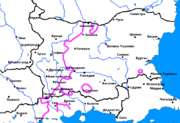
The main
isoglossAn isogloss—also called a heterogloss —is the geographical boundary of a certain linguistic feature, such as the pronunciation of a vowel, the meaning of a word, or use of some syntactic feature...
separating the Bulgarian dialects into
Eastern and
Western is the Yat border, marking the different mutations of the
Old BulgarianOld Church Slavonic or Old Church Slavic was the first literary Slavic language, first developed by the 9th century Byzantine Greek missionaries Saints Cyril and Methodius who were credited with standardizing the language and using it for translating the Bible and other Ancient Greek...
yat form (ѣ, *
ě), pronounced as either
/ʲa/ or
/ɛ/ to the east (
byal, but plural
beli, "white") and strictly as /ɛ/ to the west of it (
bel, plural
beli). In order to avoid political issues, many linguists use interchangeably Western Bulgarian and Macedonian in national and geographical contexts, respectively; however, this is not precise because Western Bulgarian dialects include also non-Macedonian dialects while some dialects in the region of Macedonia (
DramaDrama is the specific mode of fiction represented in performance. The term comes from a Greek word meaning "action" , which is derived from "to do","to act" . The enactment of drama in theatre, performed by actors on a stage before an audience, presupposes collaborative modes of production and a...
-
SerSerres is a city in Greece, seat of the Serres prefecture.Serres may also refer to:Places:* Serres, Germany, a part of Wiernsheim in Baden-WürttembergIn France:* Serres, Aude in the Aude département...
,
SolunThessaloniki , historically also known as Thessalonica, Salonika or Salonica, is the second-largest city in Greece and the capital of the region of Central Macedonia as well as the capital of the Decentralized Administration of Macedonia and Thrace...
, and
KorcaKorča is a village in the municipality of Hadžići, Bosnia and Herzegovina.-References:...
dialects) are classified as Eastern Bulgarian on the basis of the Yat vowel.
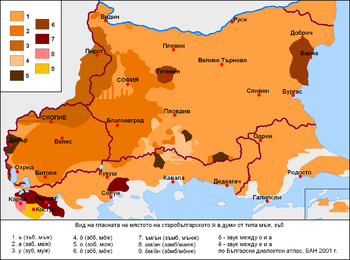
Bulgarian dialects can be divided into the following dialectal groups and individual dialects:
Eastern Bulgarian dialects:
- Moesian dialects
The Moesian dialects are a group of closely related dialects of the Bulgarian language, part of the Eastern Bulgarian dialects. The Moesian dialects are spoken in northeastern Bulgaria and in the regions of Karnobat, Aytos, Burgas and Yambol in southern Bulgaria...
- Shumen dialect
The Shumen dialect is a Bulgarian dialect, member of the Moesian dialects. It is one of the best preserved Moesian dialects and is spoken in the regions of Shumen and Kaspichan.-Phonological and morphological characteristics:...
- Balkan dialects
The Balkan dialects are the most extensive group of dialects of the Bulgarian language, covering almost half of the present-day territory of Bulgaria and slightly less than a third of the territory on the Balkans where Bulgarian is spoken. Their range includes north-central Bulgaria and most of the...
- Central Balkan dialect
The Central Balkan dialect is a Bulgarian dialect, which is part of the Balkan group of the Eastern Bulgarian dialects. Its range includes most of north-central Bulgaria , as well as the regions of Karlovo, Kazanlak and Plovdiv in southern Bulgaria, all the way down to the northernmost ridges of...
- Kotel-Elena-Dryanovo dialect
The Kotel-Elena-Dryanovo dialect is a Bulgarian dialect, which is part of the Balkan group of the Eastern Bulgarian dialects. Its range includes the eastern parts of the Balkan Mountains, i.e. the regions of Dryanovo, Kotel and Elena)...
- Panagyurishte dialect
The Panagyurishte dialect is a Bulgarian dialect, which is part of the Balkan group of the Eastern Bulgarian dialects. Its range includes the town of Panagyurishte, as well as a number of neighbouring villages...
- Pirdop dialect
The Pirdop dialect is a Bulgarian dialect, which is part of the Balkan group of the Eastern Bulgarian dialects. Its range includes the towns of Pirdop, Zlatitsa and Koprivshtitsa, as well as several neighbouring villages...
- Teteven dialect
The Teteven dialect is a Bulgarian dialect, which is part of the Balkan group of the Eastern Bulgarian dialects. It is spoken in the town of Teteven and several neighbouring villages and is almost completely surrounded by the Central Balkan dialect, except on the west where it borders on the...
- Erkech dialect
The Erkech dialect is a Bulgarian dialect, which is part of the Balkan group of the Eastern Bulgarian dialects. It originates from two villages in the eastern parts of the Balkan Mountains, Kozichino near Pomorie and Golitsa south of Varna...
- Subbalkan dialect
The Subbalkan dialect is a Bulgarian dialect, which is part of the Balkan group of the Eastern Bulgarian dialects. Its range includes the northeastern part of Bulgarian Thrace, i.e. the regions of Burgas, Sliven, Yambol, Stara Zagora and Chirpan...
- Transitional Balkan dialects
- Rup dialects
The Rup dialects, or the Southeastern dialects, are a group of Bulgarian dialects located east of the yat boundary, thus being part of the Eastern Bulgarian dialects. The range of the Rup dialects includes the southern part of Thrace, i.e. Strandzha, the region of Haskovo, the Rhodopes and the...
- Strandzha dialect
The Strandzha dialect is a dialect of the Bulgarian language, member of the Rup or Southeastern Bulgarian dialects. The present range of the dialect includes the Bulgarian part of Strandzha. In the past, the dialect was spoken on a much larger territory and extended far down into Eastern Thrace,...
- Thracian dialect
The Thracian dialect is a dialect of the Bulgarian language, member of the Rup or Southeastern Bulgarian dialects. The present range of the dialect includes the regions of Haskovo, Parvomay, Elhovo, Harmanli, Svilengrad, Topolovgrad and Ivaylovgrad...
- Hvoyna dialect
The Hvoyna dialect is a Bulgarian dialect of the Rhodopean group of the Rup dialects. Its range includes the northern part of the Central Rhodopes and the town of Batak in the Western Rhodopes...
- Chepino dialect
The Chepino dialect is a Bulgarian dialect of the Rhodopean group of the Rup dialects. Its range includes the northwestern Rhodopes, i.e. the towns of Velingrad, Rakitovo and Kostandovo and the villages of Dragichevo and Dorkovo...
- Paulician dialect
The Paulician dialect is a Bulgarian dialect of the Rhodopean group of the Rup dialects. The Paulician dialect is spoken by some 40,000 people, nearly all of them Catholic Bulgarians, in the region of Rakovski in southern Bulgaria and Svishtov in northern Bulgaria...
- Zlatograd dialect
The Zlatograd dialect is a Bulgarian dialect, member of the Rup or Southeastern Bulgarian dialects. The Zlatograd dialect is spoken in the southwestern part of the Eastern Rhodopes, i.e. in the town of Zlatograd, as well as a number of neighbouring villages and towns, e.g. Nedelino, Kirkovo, etc...
- Smolyan dialect
The Smolyan dialect or Central Rhodope dialect is a Bulgarian dialect of the Rhodopean group of the Rup dialects. Its range includes most of the Central Rhodopes, i.e. the region of Smolyan...
- Pomak dialect (Greece)
- Babyak dialect
The Babyak dialect is a Bulgarian dialect, member of the Rup or Southeastern Bulgarian dialects. It is spoken in several mountainous villages on the western fringes of the Rhodopes and is thus sandwiched between the Chepino dialect on the east and northeast and the Razlog dialect to the south and...
- Razlog dialect
The Razlog dialect is a Bulgarian dialect, member of the Rup or Southeastern Bulgarian dialects. Its range includes the valley of Razlog in southwestern Bulgaria and its immediate neighbours are the Rup Serres-Nevrokop dialect to the south, the Babyak dialect to the east, the Samokov and Ihtiman...
- Serres-Nevrokop dialect
- Solun dialect
|
Western Bulgarian dialects:
- Northwestern Bulgarian dialects
The Northwestern Bulgarian dialects are two closely related dialects of the Bulgarian language, which are located west of the yat boundary and thus are part of the Western Bulgarian dialects. The range of the dialects includes most of northwestern Bulgaria, to the west of the line between Nikopol,...
- Byala Slatina-Pleven dialect
The Byala Slatina-Pleven dialect is a Bulgarian dialect spoken in the regions of Pleven, Byala Slatina and Kula in northwestern Bulgaria. The dialect is part of the Northwestern Bulgarian dialects...
- Vidin-Lom dialect
The Vidin-Lom dialect is a Bulgarian dialect spoken in the regions of Vidin and Lom and partially in the regions of Berkovitsa and Montana in northwestern Bulgaria. The dialect is part of the Northwestern Bulgarian dialects...
- Southwestern Bulgarian dialects
The Southwestern Bulgarian dialects are a group of Bulgarian dialects which are located west of the yat boundary and are part of the Western Bulgarian dialects. The range of the Southwestern dialects on the territory of Bulgaria includes most of west central and southwestern Bulgaria...
- Botevgrad dialect
The Botevgrad dialect is a Bulgarian dialect, member of the Southwestern Bulgarian dialects, which is spoken in the region of Botevgrad and Etropole in northwestern Bulgaria...
- Vratsa dialect
The Vratsa dialect is a Bulgarian dialect, member of the Southwestern Bulgarian dialects, which is spoken in the region of Vratsa in northwestern Bulgaria...
- Ihtiman dialect
The Ihtiman dialect is a Bulgarian dialect, member of the Southwestern Bulgarian dialects, which is spoken in the regions of Ihtiman, Kostenets and Septemvri in central western Bulgaria. It is transitional between the Botevgrad and Samokov dialect....
- Elin Pelin dialect
The Elin Pelin dialect is a Bulgarian dialect, member of the Southwestern Bulgarian dialects, which is spoken in the eastern part of the Sofia valley in central western Bulgaria...
- Sofia dialect
The Sofia dialect is a Bulgarian dialect, member of the Southwestern Bulgarian dialects, which is spoken in western part of the Sofia valley in central western Bulgaria...
- Samokov dialect
The Samokov dialect is a Bulgarian dialect, member of the Southwestern Bulgarian dialects, which is spoken in the region of Samokov in central western Bulgaria...
- Dupnitsa dialect
The Dupnitsa dialect is a Bulgarian dialect, member of the Southwestern Bulgarian dialects, which is spoken in the region of Dupnitsa in central western Bulgaria...
- Kyustendil dialect
The Kyustendil dialect is a Bulgarian dialect, member of the Southwestern Bulgarian dialects, which is spoken in the region of Kyustendil in central western Bulgaria. It borders on the Transitional dialects to the north, the Dupnitsa dialect to the east and the Blagoevgrad-Petrich dialect to the...
- Pirin-Malashevo dialects
The term Maleševo-Pirin dialect is used in South Slavic linguistics to refer to a group of related varieties that are spoken on both sides of the border between Bulgaria and the Republic of Macedonia. Some linguists treat them as dialects of the Bulgarian diasystem. while Victor Friedman views...
- Blagoevgrad dialect
The term Maleševo-Pirin dialect is used in South Slavic linguistics to refer to a group of related varieties that are spoken on both sides of the border between Bulgaria and the Republic of Macedonia. Some linguists treat them as dialects of the Bulgarian diasystem. while Victor Friedman views...
- Petrich dialect
The term Maleševo-Pirin dialect is used in South Slavic linguistics to refer to a group of related varieties that are spoken on both sides of the border between Bulgaria and the Republic of Macedonia. Some linguists treat them as dialects of the Bulgarian diasystem. while Victor Friedman views...
- Pianec-Kamenitsa-Kraishte dialect
The term Maleševo-Pirin dialect is used in South Slavic linguistics to refer to a group of related varieties that are spoken on both sides of the border between Bulgaria and the Republic of Macedonia. Some linguists treat them as dialects of the Bulgarian diasystem. while Victor Friedman views...
- Malashevo dialect
The term Maleševo-Pirin dialect is used in South Slavic linguistics to refer to a group of related varieties that are spoken on both sides of the border between Bulgaria and the Republic of Macedonia. Some linguists treat them as dialects of the Bulgarian diasystem. while Victor Friedman views...
- Transitional Bulgarian dialects
The Transitional Bulgarian dialects are a group of Bulgarian dialects, which are located west of the yat boundary and are part of the Western Bulgarian dialects. On Bulgarian territory, the Transitional dialects occupy a narrow strip of land along the Bulgarian border with Serbia, including the...
- Tran dialect
The Tran dialect is a Bulgarian dialect, member of the Transitional dialects, which is spoken in the regions of Tran and Godech in central western Bulgaria and in the Western Outlands...
- Breznik dialect
The Breznik dialect is a Bulgarian dialect, member of the Transitional dialects, which is spoken in the region of Graovo in central western Bulgaria...
- Belogradchik dialect
The Belogradchik dialect is a Bulgarian dialect, member of the Transitional dialects, which is spoken on the westernmost northern slopes of the Balkan mountains in northwestern Bulgaria...
- Bosilegrad dialect
- Tsaribrod dialect
|
Dialects from Vardar MacedoniaThe dialects of Macedonian comprise the Slavic dialects spoken in the Republic of Macedonia as well as some varieties spoken in the wider geographic region of Macedonia. They exist as part of the dialect continuum of South Slavic languages that joins the Macedonian language with Bulgarian to the...
(traditionally treated as part of Bulgarian in Bulgarian sources.)
- Northern dialects
- Tetovo dialect
The Lower Polog dialect is a member of the western subgroup of the Northern group of dialects of the Macedonian language. It is spoken by the population in north-western Republic of Macedonia. This dialect is spoken in the city Tetovo, in the bigger villages Jegunovce, Vratnica, Tearce, Lešok,...
- Veles dialect
The Skopje-Veles dialect is a member of the central subgroup of the Western group of dialects of the Macedonian language. The dialect is spoken by a larger group of people in the cities Skopje and Veles and in the surrounding villages: Volkovo, Katlanovo, Petrovec and Čaška among others...
- Prilep-Mariovo dialect
The Prilep-Bitola dialect is a member of the central subgroup of the western group of dialects of the Macedonian language. This dialect is spoken in much of the Pelagonia region , as well as by the Macedonian-speaking minority population in and around Florina in neighbouring Greek Macedonia...
- Bitola dialect
The Prilep-Bitola dialect is a member of the central subgroup of the western group of dialects of the Macedonian language. This dialect is spoken in much of the Pelagonia region , as well as by the Macedonian-speaking minority population in and around Florina in neighbouring Greek Macedonia...
- Debar dialect
The Debar dialect is a member of the subgroup of the western and north-western dialects of the western group of dialects of the Macedonian language. The dialect is mainly spoken in the city of Debar and the surrounding areas in Macedonia. The Debar dialect is closed with the Reka dialect and the...
- Ohrid-Struga dialect
The Struga Dialect is a member of the western and north western subgroup of the western group of dialects of the Macedonian language. The dialect is spoken in Struga, Pogradec, Pustec and up to the Golo Brdo and in the surrounding hinterland...
- Prespa dialect
The Lower Prespa dialect , is a member of the western subgroup of the western group of dialects of the Macedonian language. This dialect is mainly spoken on the Eastern shore of Prespa Lake and Small Prespa Lake, both in the Republic of Macedonia and by the Slavic-speaking community on the Greek...
- Korca dialect
- Dialects from Aegean Macedonia
(traditionally treated as part of Bulgarian in Bulgarian sources.)
- Kostur dialect
The Kostur dialect , is a member of the South-Western subgroup of the Southern group of dialects of the Macedonian language. This dialect is mainly spoken in and around the town of Kastoria, known locally in Macedonian as Kostur, and in the surrounding Korešta region which encompasses most of the...
- Doyran dialect
- Lerin dialect
- Kukush-Voden dialect
The Solun-Voden dialect, Lower Vardar dialect, or Kukush-Voden dialect is a South Slavic dialect spoken in parts of the Greek periphery of Central Macedonia, and the vicinity of Gevgelija and Dojran in the Republic of Macedonia...
Among the traditional diaspora:
- Banat Bulgarian dialect
- Wallachia
Wallachia or Walachia is a historical and geographical region of Romania. It is situated north of the Danube and south of the Southern Carpathians...
n Bulgarian dialects
- Transylvania
Transylvania is a historical region in the central part of Romania. Bounded on the east and south by the Carpathian mountain range, historical Transylvania extended in the west to the Apuseni Mountains; however, the term sometimes encompasses not only Transylvania proper, but also the historical...
n Bulgarian dialects
- Bulgarian dialects in the former Soviet Union
The Soviet Union , officially the Union of Soviet Socialist Republics , was a constitutionally socialist state that existed in Eurasia between 1922 and 1991....
- Anatolian
The Anatolian Bulgarians or Bulgarians of Asia Minor were Eastern Orthodox Bulgarians who settled in Ottoman-ruled northwestern Anatolia , possibly in the 18th century, and remained there until 1914....
dialect |
See also
- History of the Bulgarian language
The History of the Bulgarian language can be divided into four major periods:* prehistoric period ;...
- Bulgarian lexis
- Native lexical items :Around three-quarters of the word-stock in the standard, academy dictionaries of Bulgarian, consists of native lexical items. Some 2,000 of these items are directly inherited from proto-Slavonic through Old and Middle Bulgarian...
- Bulgarian grammar
Bulgarian grammar is the grammar of the Bulgarian language. Bulgarian language is a South Slavic language, historically Bulgarian language evolved from the Old Bulgarian language, also known as Old Slavonic language which was the written norm for the Slavic languages in the Middle ages, and before...
- Torlak dialect
- Macedonian language
Macedonian is a South Slavic language spoken as a first language by approximately 2–3 million people principally in the region of Macedonia but also in the Macedonian diaspora...
- Slavic dialects of Greece
The source of this article is
wikipedia, the free encyclopedia. The text of this article is licensed under the
GFDL.