


Paintball

Encyclopedia
Paintball is a sport in which players compete, in teams or individually, to eliminate opponents by tagging them with capsules containing water soluble dye and gelatin shell outside (referred to as paintballs) propelled from a device called a paintball marker
(commonly referred to as a paintball gun). Paintballs have a non-toxic, biodegradable, water soluble mineral-oil. The game is regularly played at a sporting level with organized competition involving worldwide leagues, tournaments, professional teams, and players. Paintball technology is also used by military forces, law enforcement, para-military and security organizations to supplement military training, riot response, and non-lethal suppression of dangerous suspects.
Games are played on outdoor or indoor fields of varying sizes. A game field is scattered with natural or artificial terrain
, which players use for tactical cover. Rules for playing paintball vary, but can include capture the flag
, elimination, ammunition limits, defending or attacking a particular point or area, or capturing objects of interest hidden in the playing area. Depending on the variant played, games can last from seconds to hours, or even days in scenario play.
The legality of paintball varies among countries and regions. In most areas where regulated play is offered, players are required to wear protective masks, and game rules are strictly enforced.
, speedball
, or scenarioball; on how much money one is willing to spend on equipment; and personal preference. Almost every player, however, will utilize three basic pieces of equipment:
, which are specified before the game begins. The most basic game rule is that players must attempt to accomplish a goal without being shot and marked with a paintball. A variety of different rules govern the legality of a hit, ranging from "anything counts" (hits cause elimination whether the paintball broke and left a mark or not) to the most common variation: the paintball must break and leave a mark the size of a US quarter or larger. Eliminated players are expected to leave the field of play; eliminations may also earn the opposing team points. Depending on the agreed upon game rules, the player may return to the field and continue playing, or is eliminated from the game completely.
The particular goal of the game is determined before play begins; examples include capture the flag
or Elimination. Paintball has spawned popular variants, including woodsball
, which is played in the natural environment and spans across a large area. Conversely, the variant of speedball
is played on a smaller field and has a very fast pace (with games lasting up to five minutes). Another variant is scenario paintball
, in which players attempt to recreate historical, or fictional settings; the largest being Oklahoma D-Day
's World War II
re-enactment.
Almost all of the paintballs are bio degradable.
, being one of the most popular events. Some players even wear the uniforms worn by the soldiers during that time period.
In North America certain parks (D-Day Adventure Park, NPF, Bigfoot Paintball) gained worldwide recognition with their Big Games like Oklahoma D-Day
, Diamond Wars & Mega War Game, with its thousands of players.
In Québec, one of the most spectacular events was played at Bigfoot Paintball, with a record 976 players for the Mega War Game in 2009. "A couple of times a year, something strange happens in the foothills of Québec…500 players get together for one of the most intense paintball battles in the world. This year was no different."
There are a lot of different mil-sim teams, with their dress code, rank system & game rules that try to simulate actual military ops. The equipment that is available to them has evolved greatly since the time of hand cocked guns and fluorescent colors. Paintball markers can be bought or made to look almost identical to real guns such as the MP5
, M16
, and AK-47
with the aid of shrouds. Smoke grenades, paint grenades, bazookas, ballistic helmets, and tactical vests are also available.
; a broken ball means elimination. Field operators may specify variations to this rule, such as requiring a tag to certain body locations only – such as the head and torso only. There are game rules that can be enforced depending on the venue, in order to ensure safety, balance the fairness of the game or eliminate cheating.
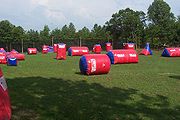 Paintball is played at both commercial venues, which require paid admission, and private land; both of which may include multiple fields of varying size and layout. Fields can be scattered with either natural or artificial terrain, and may also be themed to simulate a particular environment, such as a wooded or urban area
, and may involve a historical context. Smaller fields (such as those used for Speedball and tournaments) may include an assortment of various inflatable bunkers.
Commercial venues may provide amenities such as bathrooms, picnic areas, lockers, equipment rentals, air refills and food service. Countries may have paintball sports guidelines, with rules on specific safety and insurance standards, and paid staff (including referees) who must ensure players are instructed in proper play to ensure participants' safety. Some fields are "BYOP" (Bring Your Own Paint), allowing players to buy paint at unrelated retail stores or online and use it at their field. However, most fields are FPO (Field Paint Only,) meaning players must buy paint at the venue or at a pro shop affiliated with the park. This is largely for revenue reasons; field and rental fees generally do not cover expenses of a paintball park. However, other reasons relating to player safety are generally cited, and have some merit as poor quality or poorly-stored paint can cause gun failures or personal injury to targeted players
Playing on a non-established field is sometimes referred to as renegade or gonzo play or outlaw ball (with the players nicknamed renegade ballers or outlaws). Though less expensive and less structured than play at a commercial facility, the lack of safety protocols, instruction, and oversight
can lead to higher incidence of injuries.
is an organization that provides a regulated competition for paintball players to compete. Leagues can be of various sizes (for example, regional, national or international) and offer organized tournaments for professional, semi-professional
, and amateur
teams, sometimes with financial prizes. The first British national league was the British Paintball League created in 1989 by Gary Morhall, Richard Hart and Derek Wildermuth in Essex England.
, major leagues include the NPPL and PSP in the United States, the Millennium Series in western Europe, the Centurio series in Eastern Europe
, and the National Collegiate Paintball Association in the US and Canada (A league was also created for high school and college players, the NCPA.). They are supplemented by various regional and local leagues spread worldwide.
A match in a tournament is refereed by a judge, whose authority and decisions are final. Tournament rules can vary as specified by the league, but may include for example – not allowing players to use devices to communicate with other persons during a game, or not allowing players to unduly alter the layout of terrain on the field. In contrast to a casual game designed for fun, a tournament is much stricter and violations of rules may result in penalties for the players or entire teams.
Though tournament paintball was originally played in the woods, speedball
became the standard competitive format in the 1990s. The smaller fields made use of artificial terrain such as bunkers, allowing symmetrical fields that eliminate terrain advantages for either team; woodsball fields having no such guarantee. Most recently, fields using inflatable bunkers, tethered to the ground with stakes, have become standard for most tournament formats; the soft, yielding bunkers reduce the occurrence of injuries, the bunkers deflate to store in a compact space and anchor to the ground with tent stakes, allowing for temporary fields to be set up and torn down with less impact on the ground underneath, and the arrangement of bunkers can be easily re-configured to maintain novelty of play or to simulate a predetermined field layout for an upcoming event.
, according to the complaint against them.
Similarly, 11 men, convicted in 2003–04 of composing the Virginia Jihad Network
, engaged in paintball training in Spotsylvania County, Virginia
, to simulate small-unit tactical operations and develop combat skills to prepare for jihad, according to prosecutors. In 2006, Ali Asad Chandia
of the Virginia Jihad Network was also sentenced to 15 years in prison for providing support to a Pakistani terrorist organization, Lashkar-e-Taiba
, including helping Lashkar ship 50,000 paintballs from the U.S. to Pakistan.
In addition, two of the 2005 London 7/7 bombers were filmed in June 2005 at a paintball center in Tonbridge, Kent, ducking behind oil barrels and shooting paintball at cut out figures before lining up to pray at the end of the day. Also, the suspects in the 2006 Toronto Terrorism case
played paintball to prepare for their attack. In 2007, paintball training was engaged in by five terrorists to prepare for an attack aimed at killing American soldiers
in Fort Dix, New Jersey
; they were later convicted.
Research published by the Minnesota Paintball Association has argued that paintball is one of the statistically safest sports to participate in, with 20 injuries per 100,000 players annually, and these injuries tend to be incidental to outdoor physical activity (e.g. trips). A 2003 study of the 24 patients with modern sports eye injuries presenting to the eye emergency department of Porto S João Hospital between April 1992 and March 2002 included five paintball eye injuries. Furthermore, a one-year study undertaken by the Eye Emergency Department, Massachusetts Eye and Ear Infirmary in Boston
has shown that most sports eye injuries are caused by basketball
, baseball
, hockey
, and racquetball
. Another analysis concluded that eye injuries incurred from paintball were in settings where protective equipment such as masks were not enforced, or were removed by the player.
Eye injuries can occur when protective equipment is not properly used and such injuries often cause devastating visual loss. For safety, most regulated paintball fields strictly enforce a 'masks-on' policy, and most eject players who consistently disobey.
Regardless, paintball has received criticism due to incidents of injury. In Canada in 2007, an eleven year old boy lifted his mask and was shot point blank in the eye by an adult playing on the same field, leading to calls by the Montreal Children's Hospital
to restrict the minimum age of paintball participants to 16 years. In Australia, the sport attracted criticism when a 39 year old man playing at a registered field in Victoria
died of a suspected heart attack, after being struck in the chest
.
Additionally, the use of paintball markers outside a regulated environment has caused concern. In the United States in 1998, 14 year old Jorel Lynn Travis was shot with a paintball gun while standing outside a Fort Collins, Colorado
ice cream parlor
– blinding her in one eye. In 2001, a series of pre-meditated and racially motivated drive-by shootings
targeted Alaska Natives
in Anchorage, Alaska
, using a paintball marker. In Ottawa
, Canada in 2007, Ashley Roos was shot in the eye and blinded with a paintball gun while waiting for a bus.
and Western Australia, 15 for Queensland, 16 for New South Wales
and Australian Capital Territory
, and 18 in Victoria
. Paintball has been banned in Tasmania
since the events of the Port Arthur massacre in 1996.
Operators must adhere to particular rules on gun storage, safety training and field sizes. In all states, in order to own a paintball marker, players must have a paintball gun licence, be at least 18 years old, and have the marker safely stored in a category 2 safe
. Until 2005, Victoria was the only state which required players to have a long-arm firearm licence; a law which was criticized on the grounds it drew players to real firearms.
, German lawmakers announced plans to ban games such as paintball as they allegedly trivialised and encouraged violence but the plans were retracted a few days later.
ammunition which breaks up on contact rather than inflicting a penetrating injury. Owners do not require a license unless the marker fires above 300 feet per second (91.4 m/s). Only approved paintballs can be used, and the marker must not be fully automatic. The minimum age to be in possession of a marker is seventeen, except in target shooting clubs or galleries, or on private property so long as projectiles are not fired beyond the premises. It is prohibited to be in possession of a paintball marker in public places. The absolute minimum legal age for a commercial venue is 11, although facilities exist with lower-powered guns for children of a younger age.
, paintball markers have transport requirements, cannot be used against anyone not participating in a paintball activity, and cannot be used for property damage. New Hampshire
and Rhode Island
require players be at least eighteen years of age to own a marker, with students in New Hampshire faced with the possibility of expulsion from school for possessing a marker. In Illinois
, owners must be over the age of twelve and can only use their markers in private land or on safely constructed target ranges. There is no age limit.
Virginia
is one of two states that permit its towns to adopt ordinances on paintball guns, allowing its local authorities to do so. Delaware
on the other hand only authorizes Wilmington
to do so, but does allow paintball to be played on farms as it is considered an agritourism
activity. Florida
and Texas
limit government liability if a government entity allows paintball on its property.
In virtually all jurisdictions, the use of a paintball marker in a manner other than its intended purpose and/or outside the confines of a sanctioned game or field can result in criminal charges such as disturbing the peace, disorderly conduct, vandalism, criminal mischief or even assault.
, Chennai
(Kottivakam), Pune
and Bangalore
. Currently, players must be 18 years of age or older. Paintball is mostly played by corporates IT teams in Chennai.
Paintball vs. airsoft.
Paintball marker
A paintball marker, also known as a paintball gun, is the main piece of equipment in the sport of paintball. Markers use an expanding gas, such as carbon dioxide or compressed air, to propel paintballs through the barrel. Some paintball players refer to the piece of equipment as a "marker" rather...
(commonly referred to as a paintball gun). Paintballs have a non-toxic, biodegradable, water soluble mineral-oil. The game is regularly played at a sporting level with organized competition involving worldwide leagues, tournaments, professional teams, and players. Paintball technology is also used by military forces, law enforcement, para-military and security organizations to supplement military training, riot response, and non-lethal suppression of dangerous suspects.
Games are played on outdoor or indoor fields of varying sizes. A game field is scattered with natural or artificial terrain
Terrain
Terrain, or land relief, is the vertical and horizontal dimension of land surface. When relief is described underwater, the term bathymetry is used...
, which players use for tactical cover. Rules for playing paintball vary, but can include capture the flag
Capture the flag
Capture the Flag is a traditional outdoor sport generally played by children, where two teams each have a flag and the objective is to capture the other team's flag, located at the team's "base," and bring it safely back to their own base...
, elimination, ammunition limits, defending or attacking a particular point or area, or capturing objects of interest hidden in the playing area. Depending on the variant played, games can last from seconds to hours, or even days in scenario play.
The legality of paintball varies among countries and regions. In most areas where regulated play is offered, players are required to wear protective masks, and game rules are strictly enforced.
Equipment in paintball
The paintball equipment used may depend on the game type, for example: woodsballWoodsball
Woodsball is a format of paintball gaming, in which players compete in a natural outdoors area using paintball markers to tag opponents....
, speedball
Speedball
Speedball is one of the two distinct game variants in the sport of paintball, the other being woodsball. It is a general term for a game in which the playing field is composed of bunkers, of the same location and number on each side of the field, that provide an equal playing field for each team...
, or scenarioball; on how much money one is willing to spend on equipment; and personal preference. Almost every player, however, will utilize three basic pieces of equipment:
- Paintball marker: also known as a "paintball gun" or "marker", this is the primary piece of equipment, used to tag the opposing player with paintballs. The paintball marker must have attached a loader or "hopper" to keep the marker fed with paint, and will be either gravity-fed (where balls drop into the loading chamber), or electronically force-fed. A marker will require a compressed air tank or carbon dioxide for propellant.
- Paintballs: The ammunitionAmmunitionAmmunition is a generic term derived from the French language la munition which embraced all material used for war , but which in time came to refer specifically to gunpowder and artillery. The collective term for all types of ammunition is munitions...
used in the marker, paintballs are spherical gelatinGelatinGelatin is a translucent, colorless, brittle , flavorless solid substance, derived from the collagen inside animals' skin and bones. It is commonly used as a gelling agent in food, pharmaceuticals, photography, and cosmetic manufacturing. Substances containing gelatin or functioning in a similar...
capsules containing primarily polyethylene glycolPolyethylene glycolPolyethylene glycol is a polyether compound with many applications from industrial manufacturing to medicine. It has also been known as polyethylene oxide or polyoxyethylene , depending on its molecular weight, and under the tradename Carbowax.-Available forms:PEG, PEO, or POE refers to an...
, other non-toxic and water-soluble substances, and dye. The quality of paintballs is dependent on the brittleness of the ball's shell, the roundness of the sphere, and the thickness of the fill; higher-quality balls are almost perfectly spherical, with a very thin shell to guarantee breaking upon impact, and a thick, brightly-colored fill that is difficult to hide or wipe off during the game. - Mask or goggles: Masks are safety devices players are required to wear at all times on the field, to protect them from paintballs. They completely cover the eyes, mouth, ears and nostrils of the wearer, and masks can also feature throat guards. Modern masks have evolved to be less bulky compared with older designs. Some players may remove the mouth and/or ear protection for aesthetic or comfort reasons, but this is not recommended nor often allowed at commercial venues.
Gameplay
Paintball is played with a potentially limitless variety of rules and variationsPaintball variations
Paintball is played with a potentially limitless variety of rules and variations, all of which are specified before the game begins. The most basic of all game rules is that players must attempt to accomplish a goal without being tagged with paintballs...
, which are specified before the game begins. The most basic game rule is that players must attempt to accomplish a goal without being shot and marked with a paintball. A variety of different rules govern the legality of a hit, ranging from "anything counts" (hits cause elimination whether the paintball broke and left a mark or not) to the most common variation: the paintball must break and leave a mark the size of a US quarter or larger. Eliminated players are expected to leave the field of play; eliminations may also earn the opposing team points. Depending on the agreed upon game rules, the player may return to the field and continue playing, or is eliminated from the game completely.
The particular goal of the game is determined before play begins; examples include capture the flag
Capture the flag
Capture the Flag is a traditional outdoor sport generally played by children, where two teams each have a flag and the objective is to capture the other team's flag, located at the team's "base," and bring it safely back to their own base...
or Elimination. Paintball has spawned popular variants, including woodsball
Woodsball
Woodsball is a format of paintball gaming, in which players compete in a natural outdoors area using paintball markers to tag opponents....
, which is played in the natural environment and spans across a large area. Conversely, the variant of speedball
Speedball
Speedball is one of the two distinct game variants in the sport of paintball, the other being woodsball. It is a general term for a game in which the playing field is composed of bunkers, of the same location and number on each side of the field, that provide an equal playing field for each team...
is played on a smaller field and has a very fast pace (with games lasting up to five minutes). Another variant is scenario paintball
Scenario paintball
Scenario paintball is a type of paintball game in which players participate in a scenario, or story; and may include historical re-enactments, futuristic or video game simulations. Games tend to last in the range of hours or days, and may include a large group of players...
, in which players attempt to recreate historical, or fictional settings; the largest being Oklahoma D-Day
Oklahoma D-Day
Oklahoma D-Day is the world's largest scenario game of paintball that recreates events of World War II, held at Oklahoma's D-Day Adventure Park in Wyandotte, Oklahoma every June. The game was created by Dewayne Convirs, and was first held in 1997 - with attendance of 135 players...
's World War II
World War II
World War II, or the Second World War , was a global conflict lasting from 1939 to 1945, involving most of the world's nations—including all of the great powers—eventually forming two opposing military alliances: the Allies and the Axis...
re-enactment.
Woodsball
"Woodsball" is a term developed late in the history of the game to refer to what was the original form of the game: teams competing in a wooded or natural environment. Recently the term has been adopted to refer to virtually any form of paintball played in natural surroundings, as opposed to arena or artificial fields. a lot of the time people played outdoors.Almost all of the paintballs are bio degradable.
Scenario Paintball
The scenarios are more evolutionary, more tactical, and more complex than the regular game which was at the base "capture the flag". Certain Big games relive historic moments like D-Day from World War IIWorld War II
World War II, or the Second World War , was a global conflict lasting from 1939 to 1945, involving most of the world's nations—including all of the great powers—eventually forming two opposing military alliances: the Allies and the Axis...
, being one of the most popular events. Some players even wear the uniforms worn by the soldiers during that time period.
In North America certain parks (D-Day Adventure Park, NPF, Bigfoot Paintball) gained worldwide recognition with their Big Games like Oklahoma D-Day
Oklahoma D-Day
Oklahoma D-Day is the world's largest scenario game of paintball that recreates events of World War II, held at Oklahoma's D-Day Adventure Park in Wyandotte, Oklahoma every June. The game was created by Dewayne Convirs, and was first held in 1997 - with attendance of 135 players...
, Diamond Wars & Mega War Game, with its thousands of players.
In Québec, one of the most spectacular events was played at Bigfoot Paintball, with a record 976 players for the Mega War Game in 2009. "A couple of times a year, something strange happens in the foothills of Québec…500 players get together for one of the most intense paintball battles in the world. This year was no different."
There are a lot of different mil-sim teams, with their dress code, rank system & game rules that try to simulate actual military ops. The equipment that is available to them has evolved greatly since the time of hand cocked guns and fluorescent colors. Paintball markers can be bought or made to look almost identical to real guns such as the MP5
Heckler & Koch MP5
The Heckler & Koch MP5 is a 9mm submachine gun of German design, developed in the 1960s by a team of engineers from the German small arms manufacturer Heckler & Koch GmbH of Oberndorf am Neckar....
, M16
M16 rifle
The M16 is the United States military designation for the AR-15 rifle adapted for both semi-automatic and full-automatic fire. Colt purchased the rights to the AR-15 from ArmaLite, and currently uses that designation only for semi-automatic versions of the rifle. The M16 fires the 5.56×45mm NATO...
, and AK-47
AK-47
The AK-47 is a selective-fire, gas-operated 7.62×39mm assault rifle, first developed in the Soviet Union by Mikhail Kalashnikov. It is officially known as Avtomat Kalashnikova . It is also known as a Kalashnikov, an "AK", or in Russian slang, Kalash.Design work on the AK-47 began in the last year...
with the aid of shrouds. Smoke grenades, paint grenades, bazookas, ballistic helmets, and tactical vests are also available.
Speedball
Speedball is described as any paintball using an open and/or partial wooded fields filled with manmade bunkers used for protection. These games were started as a way to make the game safer for players who were tripping on debris in the woods. Speedball is generally a fast-paced game where many more paintballs are used than in the traditional game of woodsball. The original speedball field was any field made of manmade bunkers. To make the game move faster, field owners began using black drainage pipes anchored into the ground to create a new fast-paced game called hyperball. It is important to know that hyper ball is still speedball. The next major leap for paintball was the invention of airball. Players were getting bored of the same field over and over again and so they invented flexible high-strength PVC fabric bunkers filled with air. These were easily moved, so that now a field can be made into infinite variations. Over the years a standard in airball was established of a snake side and a dorito side, referring to the type of bunker used on those sides of the field. The field became identical or mirrored on both sides so as to not give one team an advantage. Also a giant center bunker began to be utilized in many fields. The newest advance in paintball is the use of artificial turf on fields. This allows less maintenance of fields, faster play and a much more even match between tho two teams, as it is as close to identical on both sides as possible.Enforcement of game rules
Regulated games are overseen by referees or marshals, who patrol the course to ensure enforcement of the rules and the safety of the players. If a player is marked with paint, they will call them out, but competitors may also be expected to follow the honor codeHonor code
An honour code or honour system is a set of rules or principles governing a community based on a set of rules or ideals that define what constitutes honorable behavior within that community. The use of an honor code depends on the idea that people can be trusted to act honorably...
; a broken ball means elimination. Field operators may specify variations to this rule, such as requiring a tag to certain body locations only – such as the head and torso only. There are game rules that can be enforced depending on the venue, in order to ensure safety, balance the fairness of the game or eliminate cheating.
- Masks On – Even when a game is not in progress, virtually all venues enforce a masks-on rule while players are within the playing area. More generally, within any given area of the park, either all players'/spectators'/officials' masks must be on, or all players' markers must either have a barrel block in place or be disconnected from their gas source, to ensure that a paintball cannot be fired from any nearby marker and cause eye injury. Some fields encourage players to aim away from opponents' heads during play if possible; splatter from mask hits can penetrate ventilation holes in the goggles and cause eye irritation, close-range hits to the mask can cause improperly-maintained lenses to fail, and hits to unprotected areas of the face, head and neck are especially painful and can cause more serious injury.
- Minimum distance – When being tagged, depending on the distance from where the shot was fired, getting marked directly can cause a bruise. Being marked may even leave a welt. Because of the pain associated with being hit by a paintball, commercial venues may enforce a minimum distance rule; such as 15 feet (4.5 m), whereby players cannot shoot an opponent if they are closer than this distance. Many fields enforce a modified minimum distance surrender rule; a player who advances to within minimum range must offer his opponent the chance to surrender before shooting. This generally prevents injury and discord at recreational games, however it is seldom used in tournaments as it confers a real disadvantage to the attacking player; he must hesitate while his opponent is free to shoot immediately. The act of shooting a player at close range is colloquially called "bunkering"; it happens most often when a player uses covering fire to force his opponent behind a bunker, then advances on that bunker while still shooting to eliminate the opponent point-blank.
- Hits - A player is hit if a paintball leaves a solid, quarter-sized mark anywhere on the player's body or equipment. Some variations of paintball don't count gun hits or require multiple hits on the arms or legs. Most professional fields and tournaments, though, count any hit on a person or their equipment. Splatter often occurs when a paintball does not break on a person but on a nearby surface and then paint bounces onto the player, but this does not count as a hit unless it forms a solid mark on the player.
- Overshooting – Fields may discourage players from overshooting (also regarded as bonus balling, "overkill" or lighting up), which is to repeatedly shoot a player after they are eliminated from the game. It is also considered overshooting if a player knew the opponent was eliminated but continued to shoot, disregarding the safety of the opposing player and risking dangerous injury to others.
- Ramping – Ramping is a feature of many electronic markers, where after a certain number of rapid shots or upon a threshold rate-of-fire being achieved by the player, the gun will begin firing faster than the trigger is being pulled. Ramping of rate of fire is widely prohibited at most paintball fields, however it is allowed in some tournament formats under specific conditions.
- Wiping – Players may attempt to cheat by wiping paint from themselves, to pretend they were not hit and stay in the game.
Playing venues
Urban area
An urban area is characterized by higher population density and vast human features in comparison to areas surrounding it. Urban areas may be cities, towns or conurbations, but the term is not commonly extended to rural settlements such as villages and hamlets.Urban areas are created and further...
, and may involve a historical context. Smaller fields (such as those used for Speedball and tournaments) may include an assortment of various inflatable bunkers.
Commercial venues may provide amenities such as bathrooms, picnic areas, lockers, equipment rentals, air refills and food service. Countries may have paintball sports guidelines, with rules on specific safety and insurance standards, and paid staff (including referees) who must ensure players are instructed in proper play to ensure participants' safety. Some fields are "BYOP" (Bring Your Own Paint), allowing players to buy paint at unrelated retail stores or online and use it at their field. However, most fields are FPO (Field Paint Only,) meaning players must buy paint at the venue or at a pro shop affiliated with the park. This is largely for revenue reasons; field and rental fees generally do not cover expenses of a paintball park. However, other reasons relating to player safety are generally cited, and have some merit as poor quality or poorly-stored paint can cause gun failures or personal injury to targeted players
Playing on a non-established field is sometimes referred to as renegade or gonzo play or outlaw ball (with the players nicknamed renegade ballers or outlaws). Though less expensive and less structured than play at a commercial facility, the lack of safety protocols, instruction, and oversight
Regulation
Regulation is administrative legislation that constitutes or constrains rights and allocates responsibilities. It can be distinguished from primary legislation on the one hand and judge-made law on the other...
can lead to higher incidence of injuries.
Organized play
The first organized paintball game in record was held by Charles Gaines, Bob Guernsey and friends in New Hampshire in 1981, with the first paintball field opening approximately a year later in Sutton, NH (opened by founder Bob Gurnsey) In 1983 the first National Survival Game (NSG) national championship was held, with a $14,000 cash award for the winning team. , tournaments are largely organized by paintball leagues.Leagues
A paintball leagueSports league
League is a term commonly used to describe a group of sports teams or individual athletes that compete against each other in a specific sport. At its simplest, it may be a local group of amateur athletes who form teams among themselves and compete on weekends; at its most complex, it can be an...
is an organization that provides a regulated competition for paintball players to compete. Leagues can be of various sizes (for example, regional, national or international) and offer organized tournaments for professional, semi-professional
Semi-professional
A semi-professional athlete is one who is paid to play and thus is not an amateur, but for whom sport is not a full-time occupation, generally because the level of pay is too low to make a reasonable living based solely upon that source, thus making the athlete not a full professional...
, and amateur
Amateur
An amateur is generally considered a person attached to a particular pursuit, study, or science, without pay and often without formal training....
teams, sometimes with financial prizes. The first British national league was the British Paintball League created in 1989 by Gary Morhall, Richard Hart and Derek Wildermuth in Essex England.
, major leagues include the NPPL and PSP in the United States, the Millennium Series in western Europe, the Centurio series in Eastern Europe
Eastern Europe
Eastern Europe is the eastern part of Europe. The term has widely disparate geopolitical, geographical, cultural and socioeconomic readings, which makes it highly context-dependent and even volatile, and there are "almost as many definitions of Eastern Europe as there are scholars of the region"...
, and the National Collegiate Paintball Association in the US and Canada (A league was also created for high school and college players, the NCPA.). They are supplemented by various regional and local leagues spread worldwide.
Tournament format
The nature and timing of paintball events are specified by the league running the tournament, with the league also defining match rules – such as number of players per team, or acceptable equipment for use. The number of matches in a tournament is largely defined by the number of available teams playing.A match in a tournament is refereed by a judge, whose authority and decisions are final. Tournament rules can vary as specified by the league, but may include for example – not allowing players to use devices to communicate with other persons during a game, or not allowing players to unduly alter the layout of terrain on the field. In contrast to a casual game designed for fun, a tournament is much stricter and violations of rules may result in penalties for the players or entire teams.
Though tournament paintball was originally played in the woods, speedball
Speedball
Speedball is one of the two distinct game variants in the sport of paintball, the other being woodsball. It is a general term for a game in which the playing field is composed of bunkers, of the same location and number on each side of the field, that provide an equal playing field for each team...
became the standard competitive format in the 1990s. The smaller fields made use of artificial terrain such as bunkers, allowing symmetrical fields that eliminate terrain advantages for either team; woodsball fields having no such guarantee. Most recently, fields using inflatable bunkers, tethered to the ground with stakes, have become standard for most tournament formats; the soft, yielding bunkers reduce the occurrence of injuries, the bunkers deflate to store in a compact space and anchor to the ground with tent stakes, allowing for temporary fields to be set up and torn down with less impact on the ground underneath, and the arrangement of bunkers can be easily re-configured to maintain novelty of play or to simulate a predetermined field layout for an upcoming event.
Professional teams
A professional paintball team is one that plays paintball with the financial, equipment or other kind of support of one or more sponsors, often in return for advertising rights. Professional teams can have different names in different leagues due to franchising and sponsorship issues.Accused terrorists' usage
Mohamed Mahmood Alessa and Carlos "Omar" Eduardo Almonte, two men arrested in June 2010 as they were bound for Somalia, and charged with terrorism and conspiring to kill, maim, and kidnap people outside the U.S., had simulated combat at an outdoor paintball facility in West Milford, New JerseyWest Milford, New Jersey
West Milford is a township in Passaic County, New Jersey, United States. As of the 2010 United States Census, the township population was 25,850.-History:...
, according to the complaint against them.
Similarly, 11 men, convicted in 2003–04 of composing the Virginia Jihad Network
Virginia Jihad Network
The Virginia jihad network was a network of jihadists centered in Northern Virginia.Ali al-Timimi was convicted in 2005 of exhorting his followers to join the Taliban and fight US troops. The young men played paintball in 2000 and 2001 as a means of training for holy war around the globe...
, engaged in paintball training in Spotsylvania County, Virginia
Spotsylvania County, Virginia
As of the census of 2000, there were 90,395 people, 31,308 households, and 24,639 families residing in the county. The population density was 226 people per square mile . There were 33,329 housing units at an average density of 83 per square mile...
, to simulate small-unit tactical operations and develop combat skills to prepare for jihad, according to prosecutors. In 2006, Ali Asad Chandia
Ali Asad Chandia
Ali Asad Chandia was a third-grade teacher at the Al-Huda School, of Dar-us-Salaam mosque, in College Park, Maryland in the USA....
of the Virginia Jihad Network was also sentenced to 15 years in prison for providing support to a Pakistani terrorist organization, Lashkar-e-Taiba
Lashkar-e-Taiba
Lashkar-e-Taiba – also transliterated as Lashkar-i-Tayyaba, Lashkar-e-Tayyaba, Lashkar-e-Tayyiba, Lashkar-i-Taiba, Lashkar Taiba or LeT – is one of the largest and most active militant Islamist terrorist organizations in South Asia, operating mainly from Pakistan.It was founded by Hafiz Muhammad...
, including helping Lashkar ship 50,000 paintballs from the U.S. to Pakistan.
In addition, two of the 2005 London 7/7 bombers were filmed in June 2005 at a paintball center in Tonbridge, Kent, ducking behind oil barrels and shooting paintball at cut out figures before lining up to pray at the end of the day. Also, the suspects in the 2006 Toronto Terrorism case
2006 Toronto terrorism case
The 2006 Ontario terrorism case refers to the plotting of a series of attacks against targets in Southern Ontario, Canada, and the June 2, 2006, counter-terrorism raids in and around the Greater Toronto Area that resulted in the arrest of 18 people found to be Al-Qaeda members of an Islamic...
played paintball to prepare for their attack. In 2007, paintball training was engaged in by five terrorists to prepare for an attack aimed at killing American soldiers
2007 Fort Dix attack plot
The 2007 Fort Dix attack plot involved a group of six radical Islamist men who conspired to stage an attack against U.S. Military personnel stationed at Fort Dix, New Jersey. The alleged aim of the group was to "kill as many soldiers as possible"....
in Fort Dix, New Jersey
Fort Dix, New Jersey
JB MDL Dix , better known as Fort Dix, is a United States Army base located approximately south-southeast of Trenton, New Jersey. Dix is under the jurisdiction of the United States Army Reserve Command...
; they were later convicted.
Safety statistics
The rate of injury to paintball participants has been estimated as 45 injuries per 100,000 participants per year.Research published by the Minnesota Paintball Association has argued that paintball is one of the statistically safest sports to participate in, with 20 injuries per 100,000 players annually, and these injuries tend to be incidental to outdoor physical activity (e.g. trips). A 2003 study of the 24 patients with modern sports eye injuries presenting to the eye emergency department of Porto S João Hospital between April 1992 and March 2002 included five paintball eye injuries. Furthermore, a one-year study undertaken by the Eye Emergency Department, Massachusetts Eye and Ear Infirmary in Boston
Boston
Boston is the capital of and largest city in Massachusetts, and is one of the oldest cities in the United States. The largest city in New England, Boston is regarded as the unofficial "Capital of New England" for its economic and cultural impact on the entire New England region. The city proper had...
has shown that most sports eye injuries are caused by basketball
Basketball
Basketball is a team sport in which two teams of five players try to score points by throwing or "shooting" a ball through the top of a basketball hoop while following a set of rules...
, baseball
Baseball
Baseball is a bat-and-ball sport played between two teams of nine players each. The aim is to score runs by hitting a thrown ball with a bat and touching a series of four bases arranged at the corners of a ninety-foot diamond...
, hockey
Hockey
Hockey is a family of sports in which two teams play against each other by trying to maneuver a ball or a puck into the opponent's goal using a hockey stick.-Etymology:...
, and racquetball
Racquetball
For other sports often called "paddleball", see Paddleball .Racquetball is a racquet sport played with a hollow rubber ball in an indoor or outdoor court...
. Another analysis concluded that eye injuries incurred from paintball were in settings where protective equipment such as masks were not enforced, or were removed by the player.
Eye injuries can occur when protective equipment is not properly used and such injuries often cause devastating visual loss. For safety, most regulated paintball fields strictly enforce a 'masks-on' policy, and most eject players who consistently disobey.
Regardless, paintball has received criticism due to incidents of injury. In Canada in 2007, an eleven year old boy lifted his mask and was shot point blank in the eye by an adult playing on the same field, leading to calls by the Montreal Children's Hospital
Montreal Children's Hospital
The Montreal Children's Hospital is a tertiary care pediatric teaching Hospital affiliated with the McGill University Health Centre. It is also the only pediatric facility serving the McGill Réseau Universitaire Intégré Santé...
to restrict the minimum age of paintball participants to 16 years. In Australia, the sport attracted criticism when a 39 year old man playing at a registered field in Victoria
Victoria (Australia)
Victoria is the second most populous state in Australia. Geographically the smallest mainland state, Victoria is bordered by New South Wales, South Australia, and Tasmania on Boundary Islet to the north, west and south respectively....
died of a suspected heart attack, after being struck in the chest
Chest
The chest is a part of the anatomy of humans and various other animals. It is sometimes referred to as the thorax or the bosom.-Chest anatomy - Humans and other hominids:...
.
Additionally, the use of paintball markers outside a regulated environment has caused concern. In the United States in 1998, 14 year old Jorel Lynn Travis was shot with a paintball gun while standing outside a Fort Collins, Colorado
Fort Collins, Colorado
Fort Collins is a Home Rule Municipality situated on the Cache La Poudre River along the Colorado Front Range, and is the county seat and most populous city of Larimer County, Colorado, United States. Fort Collins is located north of the Colorado State Capitol in Denver. With a 2010 census...
ice cream parlor
Ice cream parlor
Ice cream parlors are places that sell ice cream and frozen yogurt to consumers. Ice cream is normally sold in two varieties in these stores: soft-serve ice cream , and hard-packed, which has an assortment of flavors, as well as frozen yogurt, which is a low-fat alternative and tastes slightly...
– blinding her in one eye. In 2001, a series of pre-meditated and racially motivated drive-by shootings
Anchorage paintball attacks
The Anchorage paintball attacks of January 14, 2001 were a series of pre-meditated and racially motivated drive-by shootings targeted at Alaska Natives in downtown Anchorage that night...
targeted Alaska Natives
Alaska Natives
Alaska Natives are the indigenous peoples of Alaska. They include: Aleut, Inuit, Tlingit, Haida, Tsimshian, Eyak, and a number of Northern Athabaskan cultures.-History:In 1912 the Alaska Native Brotherhood was founded...
in Anchorage, Alaska
Anchorage, Alaska
Anchorage is a unified home rule municipality in the southcentral part of the U.S. state of Alaska. It is the northernmost major city in the United States...
, using a paintball marker. In Ottawa
Ottawa
Ottawa is the capital of Canada, the second largest city in the Province of Ontario, and the fourth largest city in the country. The city is located on the south bank of the Ottawa River in the eastern portion of Southern Ontario...
, Canada in 2007, Ashley Roos was shot in the eye and blinded with a paintball gun while waiting for a bus.
Australia
Paintballing in Australia is controlled by the police in each state, with differing minimum age requirements. Players under 18 are required to have a guardian sign a consent form. The minimum ages are 12 for South AustraliaSouth Australia
South Australia is a state of Australia in the southern central part of the country. It covers some of the most arid parts of the continent; with a total land area of , it is the fourth largest of Australia's six states and two territories.South Australia shares borders with all of the mainland...
and Western Australia, 15 for Queensland, 16 for New South Wales
New South Wales
New South Wales is a state of :Australia, located in the east of the country. It is bordered by Queensland, Victoria and South Australia to the north, south and west respectively. To the east, the state is bordered by the Tasman Sea, which forms part of the Pacific Ocean. New South Wales...
and Australian Capital Territory
Australian Capital Territory
The Australian Capital Territory, often abbreviated ACT, is the capital territory of the Commonwealth of Australia and is the smallest self-governing internal territory...
, and 18 in Victoria
Victoria (Australia)
Victoria is the second most populous state in Australia. Geographically the smallest mainland state, Victoria is bordered by New South Wales, South Australia, and Tasmania on Boundary Islet to the north, west and south respectively....
. Paintball has been banned in Tasmania
Tasmania
Tasmania is an Australian island and state. It is south of the continent, separated by Bass Strait. The state includes the island of Tasmania—the 26th largest island in the world—and the surrounding islands. The state has a population of 507,626 , of whom almost half reside in the greater Hobart...
since the events of the Port Arthur massacre in 1996.
Operators must adhere to particular rules on gun storage, safety training and field sizes. In all states, in order to own a paintball marker, players must have a paintball gun licence, be at least 18 years old, and have the marker safely stored in a category 2 safe
Safe
A safe is a secure lockable box used for securing valuable objects against theft or damage. A safe is usually a hollow cuboid or cylinder, with one face removable or hinged to form a door. The body and door may be cast from metal or formed out of plastic through blow molding...
. Until 2005, Victoria was the only state which required players to have a long-arm firearm licence; a law which was criticized on the grounds it drew players to real firearms.
Germany
In Germany, paintball is restricted to players over 18 years of age. Paintball markers are classified as weapons that do not require a license or permit; they are legal to buy and use, but restricted to adults. In May 2009, reacting to the Winnenden school shootingWinnenden school shooting
The Winnenden school shooting occurred on the morning of 11 March 2009 at a secondary school in Winnenden, Baden-Württemberg, in southwestern Germany, followed by a shootout at a car dealership in nearby Wendlingen. The shooting spree resulted in 16 deaths, including the suicide of the perpetrator,...
, German lawmakers announced plans to ban games such as paintball as they allegedly trivialised and encouraged violence but the plans were retracted a few days later.
Ireland
Paintballing is widely accepted as a recreational pastime in Ireland and is not directly subject to any governing regulations. However, Irish Law defines any device capable of launching a projectile with 1 joule of energy as a firearm. Many paintball markers available today would fall into this category and so by definition, require a firearms licence. Under Irish Legislation, most modern paintball markers fall under the same classification as a shotgun or rifle. A gap exists in the law since there are no provisions to license a paintball marker and yet an individual could be arrested and charged for possessing an unlicensed firearm if the unit exceeds the 1 joule limitation as they commonly do.United Kingdom
Laws pertaining to paintball markers in the United Kingdom classify them as Air Weapons, as they fire frangibleFrangible
A material is said to be frangible if through deformation it tends to break up into fragments, rather than deforming plastically and retaining its cohesion as a single object...
ammunition which breaks up on contact rather than inflicting a penetrating injury. Owners do not require a license unless the marker fires above 300 feet per second (91.4 m/s). Only approved paintballs can be used, and the marker must not be fully automatic. The minimum age to be in possession of a marker is seventeen, except in target shooting clubs or galleries, or on private property so long as projectiles are not fired beyond the premises. It is prohibited to be in possession of a paintball marker in public places. The absolute minimum legal age for a commercial venue is 11, although facilities exist with lower-powered guns for children of a younger age.
United States
In the United States of America, eight states define explicit legislation for paintball guns. In PennsylvaniaPennsylvania
The Commonwealth of Pennsylvania is a U.S. state that is located in the Northeastern and Mid-Atlantic regions of the United States. The state borders Delaware and Maryland to the south, West Virginia to the southwest, Ohio to the west, New York and Ontario, Canada, to the north, and New Jersey to...
, paintball markers have transport requirements, cannot be used against anyone not participating in a paintball activity, and cannot be used for property damage. New Hampshire
New Hampshire
New Hampshire is a state in the New England region of the northeastern United States of America. The state was named after the southern English county of Hampshire. It is bordered by Massachusetts to the south, Vermont to the west, Maine and the Atlantic Ocean to the east, and the Canadian...
and Rhode Island
Rhode Island
The state of Rhode Island and Providence Plantations, more commonly referred to as Rhode Island , is a state in the New England region of the United States. It is the smallest U.S. state by area...
require players be at least eighteen years of age to own a marker, with students in New Hampshire faced with the possibility of expulsion from school for possessing a marker. In Illinois
Illinois
Illinois is the fifth-most populous state of the United States of America, and is often noted for being a microcosm of the entire country. With Chicago in the northeast, small industrial cities and great agricultural productivity in central and northern Illinois, and natural resources like coal,...
, owners must be over the age of twelve and can only use their markers in private land or on safely constructed target ranges. There is no age limit.
Virginia
Virginia
The Commonwealth of Virginia , is a U.S. state on the Atlantic Coast of the Southern United States. Virginia is nicknamed the "Old Dominion" and sometimes the "Mother of Presidents" after the eight U.S. presidents born there...
is one of two states that permit its towns to adopt ordinances on paintball guns, allowing its local authorities to do so. Delaware
Delaware
Delaware is a U.S. state located on the Atlantic Coast in the Mid-Atlantic region of the United States. It is bordered to the south and west by Maryland, and to the north by Pennsylvania...
on the other hand only authorizes Wilmington
Wilmington, Delaware
Wilmington is the largest city in the state of Delaware, United States, and is located at the confluence of the Christina River and Brandywine Creek, near where the Christina flows into the Delaware River. It is the county seat of New Castle County and one of the major cities in the Delaware Valley...
to do so, but does allow paintball to be played on farms as it is considered an agritourism
Agritourism
Agritourism, as it is defined most broadly, involves any agriculturally-based operation or activity that brings visitors to a farm or ranch. Agritourism has different definitions in different parts of the world, and sometimes refers specifically to farm stays, as in Italy...
activity. Florida
Florida
Florida is a state in the southeastern United States, located on the nation's Atlantic and Gulf coasts. It is bordered to the west by the Gulf of Mexico, to the north by Alabama and Georgia and to the east by the Atlantic Ocean. With a population of 18,801,310 as measured by the 2010 census, it...
and Texas
Texas
Texas is the second largest U.S. state by both area and population, and the largest state by area in the contiguous United States.The name, based on the Caddo word "Tejas" meaning "friends" or "allies", was applied by the Spanish to the Caddo themselves and to the region of their settlement in...
limit government liability if a government entity allows paintball on its property.
In virtually all jurisdictions, the use of a paintball marker in a manner other than its intended purpose and/or outside the confines of a sanctioned game or field can result in criminal charges such as disturbing the peace, disorderly conduct, vandalism, criminal mischief or even assault.
Canada
Certain paintball fields opened in the Eastern Townships and in the Laurentians offering to the ever growing of paintball players to play on fields that were created for this sport. In the beginning it was mostly fields with regular open fields with barricades of wood, old tires and barrels, very basic infrastructures. In 1995 Bigfoot Paintball opened up its doors in St. Alphonse-Rodriguez in the region of Lanaudière. After only a few years it became more and more important in Québec, Canada and the world. "Less than 1 hour from Montréal, in Canada’s beautiful Québec sits one of the most Amazing Paintball sites in the World. Some Distributors even believe it to be the largest Paintball Activity in North America"India
In India, organized paintball began in late 2009 and is seeing an increase in interest as entertainment for teenagers. It is available in MumbaiMumbai
Mumbai , formerly known as Bombay in English, is the capital of the Indian state of Maharashtra. It is the most populous city in India, and the fourth most populous city in the world, with a total metropolitan area population of approximately 20.5 million...
, Chennai
Chennai
Chennai , formerly known as Madras or Madarasapatinam , is the capital city of the Indian state of Tamil Nadu, located on the Coromandel Coast off the Bay of Bengal. Chennai is the fourth most populous metropolitan area and the sixth most populous city in India...
(Kottivakam), Pune
Pune
Pune , is the eighth largest metropolis in India, the second largest in the state of Maharashtra after Mumbai, and the largest city in the Western Ghats. Once the centre of power of the Maratha Empire, it is situated 560 metres above sea level on the Deccan plateau at the confluence of the Mula ...
and Bangalore
Bangalore
Bengaluru , formerly called Bengaluru is the capital of the Indian state of Karnataka. Bangalore is nicknamed the Garden City and was once called a pensioner's paradise. Located on the Deccan Plateau in the south-eastern part of Karnataka, Bangalore is India's third most populous city and...
. Currently, players must be 18 years of age or older. Paintball is mostly played by corporates IT teams in Chennai.
South Africa
In South Africa organised paintball has been played for over a decade. The South African Paintball League has been in existence since 2002 and counts team Liquidbox as the top team in the country. The last major tournament was held by the SAPL in 2011 and saw team Liquidbox crush team Druff in the final of the tournament. This tournament final was of particular interest to South African players as more players from a single team (team Druff) were seriously injured than had ever been injured in previous South African matches.Paintball vs. airsoft.
See also
- AirsoftAirsoftAirsoft is a sport in which participants shoot round non-metallic pellets launched via replica firearms.Gameplay varies in style and composition but often range from short-term skirmishes, organized scenarios, military simulations, historical reenactments, to competition target shooting events...
- Laser tagLaser tagLaser tag is a team or individual sport or recreational activity where players attempt to score points by tagging targets, typically with a hand-held infrared-emitting targeting device. Infrared-sensitive targets are commonly worn by each player and are sometimes integrated within the arena in...
- Paintball markerPaintball markerA paintball marker, also known as a paintball gun, is the main piece of equipment in the sport of paintball. Markers use an expanding gas, such as carbon dioxide or compressed air, to propel paintballs through the barrel. Some paintball players refer to the piece of equipment as a "marker" rather...
- Paintball equipmentPaintball equipmentPaintball is an equipment intensive sport and in order to safely conduct a game, every player requires a marker with propellant to fire the paint, a mask to protect the eyes and face, paintballs, and a loader to hold them...
- Player positions (paintball)Player positions (paintball)The idea of player positions in paintball refers to the general mindsets and roles of play assumed by players of the sport. There are various levels of complexity used by players when referring to such positions, and there is no official or universal set of player positions.- Tournament Paintball...