
|
|
|
|
The Greatest Show on Earth
|
| |
|
| |
The Greatest Show on Earth is a 1952 drama film set in the Ringling Bros. and Barnum & Bailey Circus. The film was produced, directed, and narrated by Cecil B. DeMille, and won the Academy Award for Best Picture. The film's storyline is supported by lavish production values, actual circus acts, and documentary, behind-the-rings looks at the massive logistics effort which made big top circuses possible.
The film stars Betty Hutton and Cornel Wilde as trapeze artists competing for the center ring, and Charlton Heston as the circus manager running the show.

Discussion
Ask a question about 'The Greatest Show on Earth'
Start a new discussion about 'The Greatest Show on Earth'
Answer questions from other users
|
Encyclopedia
The Greatest Show on Earth is a 1952 drama film set in the Ringling Bros. and Barnum & Bailey Circus. The film was produced, directed, and narrated by Cecil B. DeMille, and won the Academy Award for Best Picture. The film's storyline is supported by lavish production values, actual circus acts, and documentary, behind-the-rings looks at the massive logistics effort which made big top circuses possible.
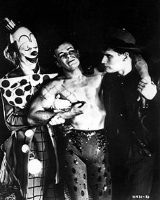
The film stars Betty Hutton and Cornel Wilde as trapeze artists competing for the center ring, and Charlton Heston as the circus manager running the show. James Stewart also stars as a mysterious clown who never removes his make-up, even between shows.
In addition to the film actors, the real Ringling Bros. and Barnum & Bailey's Circus' 1951 troupe appears in the film, with its complement of 1400 people, hundreds of animals, and 60 carloads of equipment and tents. The actors learned their respective circus roles and participated in the acts.
Adjusted for inflation, the film's box office is among the highest-grossing films in the United States and Canada.
A television series, also called The Greatest Show on Earth, was inspired by the film, but with Jack Palance in the role of Charlton Heston. The program ran on Tuesday evenings for thirty episodes on ABC during the 1963—1964 season.
Main cast
The film features about 85 Ringling Bros. and Barnum & Bailey Circus acts, including clowns Emmett Kelly and Lou Jacobs, midget Cucciola, and aerialist Antoinette Concello.
Plot
Brad (Heston) is the no-nonsense general manager of what was at the time the world's largest performing troupe. He is troubled from above, as home-office administrators plan to cut the season short, rather than risk losing thousands in the shaky post-WWII economy. He bargains with them to keep the circus on the road as long as they are making a profit, thus keeping 1400 people working.
Troubles from below come from Holly (Hutton) and The Great Sebastian (Wilde), who engage in a fierce aerial duel to show which act is the best, and from a crooked sideshow promoter and his henchman.
Another problem — unbeknownst to Brad — is the mysterious Buttons the Clown (Stewart), who is never seen without his clown paint. Early in the film, he meets with a woman who tells him that and unnamed "they" are asking questions. We discover only that she is Buttons' mother, and that they see each other only once a year. Hints to his former life come as he gives first aid to performers, then Holly finds a newspaper article about a doctor who had killed his wife — she connects a figure of speech used in the headline and by Buttons.
The competition between Holly and Sebastian develops into a romance triangle, with both Sebastian and Brad vying for her love, as the aerialists' acts become increasingly daring — and dangerous. The duel ends when Sebastian falls, after having cut his safety net away. He returns to the circus, but is unable to resume his act due to debilitating injuries. A guilt-ridden Holly professes her love for her former rival.
As they are about to leave one town, a detective intercepts Brad, asking if the circus doctor looked like a photograph of Stewart (without makeup). He boards the train to continue his investigation. Brad mentions this to Buttons, who tells him that Sebastian has feeling in his injured hand — a sign that his disability is not permanent. Brad makes the connection between Buttons and the fugitive doctor, and comments that the police will be taking fingerprints.
The joy of Sebastian's potential recovery is smashed in the massive collision of the circus' two trains. Buttons unmasks himself to save Brad's life, right in front of the detective.
Holly discovers that she is in love with Brad, and she takes over to get the circus moving and ready for the next show.
Other subplots involve performers played by Dorothy Lamour and Gloria Grahame, while there are a number of unbilled cameo appearances (mostly in the circus audiences) including Bob Hope and Bing Crosby, Lamour's co-stars in the Road to... movies. Edmond O'Brien has a cameo as an announcer.
Production
Lucille Ball was offered a part in the picture by DeMille, but ruled it out as too much of a burden between her pregnancy with her second child, Desi Arnaz Jr., and her I Love Lucy commitments.
Reception
Bosley Crowther called The Greatest Show on Earth a "lusty triumph of circus showmanship and movie skill" and a "piece of entertainment that will delight movie audiences for years":
- Sprawling across a mammoth canvas, crammed with the real-life acts and thrills, as well as the vast backstage minutiae, that make the circus the glamorous thing it is and glittering in marvelous Technicolor—truly marvelous color, we repeat—this huge motion picture of the big-top is the dandiest ever put upon the screen.
Time magazine called it a "mammoth merger of two masters of malarkey for the masses: P. T. Barnum and Cecil B. de Mille"; a film that "fills the screen with pageants and parades [and] finds a spot for 60-odd circus acts" with a plot that "does not quite hold all this pageantry together."
Variety said the film "effectively serve[s] the purpose of a framework for all the atmosphere and excitement of the circus on both sides of the big canvas."
In 2006, in an article for MSNBC about the 78th Academy Awards selection of Crash as Best Picture, Erik Lundegaard called Crash the "worst best picture winner since the "dull, bloated" film The Greatest Show on Earth"
Awards At the 25th Academy Awards, the movie won an Oscar Best Picture
(earning that recognition over films such as High Noon and The Quiet Man); it also won Best Story. It received nominations for Best Director, Best Film Editing, and Best Costume Design, Color.
Many consider this film among the worst to have ever won the Academy Award for Best Picture. The American film magazine Premiere placed the movie on its list of the 10 worst Oscar winners and the British film magazine Empire rated it #3 on their list of the 10 worst Oscar winners. It has the lowest spot on Rotten Tomatoes' list of the 81 films to win Best Picture.
There have been allegations that the film's Best Picture Oscar was due to the political climate in Hollywood in 1952. Senator Joseph McCarthy was pursuing Communists at the time, and Cecil B. DeMille was one of his supporters; another Best Picture nominee, High Noon, was produced by Carl Foreman, who would soon be on the Hollywood blacklist.
Trivia
James Stewart plays Buttons, the mysterious clown who never takes off his make-up even between shows. There are subtle hints as to his motives and background: he wraps bandages around a trapeze bar in an expert manner; he holds a discreet conversation with a member of the audience who turns out to be his mother; and, when an acrobat has a nasty fall, a doctor expresses admiration for the way Buttons handles his injuries, the clown explaining that he used to be a pharmacist's mate. It turns out that he is in fact on the run from the law, in a way similar to that of Doctor Richard Kimble in the classic TV series The Fugitive, which was made some ten years later.
A barker, kept anonymous until the very end, is heard in the closing moments of the film. The voice is finally revealed to be that of Edmond O'Brien.
The self-titled closing theme song later served as the theme for WGN-TV's long running The Bozo Show.
The Greatest Show on Earth was the first film that director Steven Spielberg saw and he credits it as one of the major inspirations that led him into a film career.
External links
|
| |
|
|