
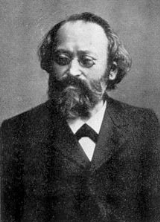
Max Christian Friedrich Bruch (6 January 18382 October 1920), also known as
Max Karl August Bruch, was a German
RomanticRomantic music or music in the Romantic Period is a musicological and artistic term referring to a particular period, theory, compositional practice, and canon in Western music history, from 1810 to 1900....
composerA composer is a person who creates music, either by musical notation or oral tradition, for interpretation and performance, or through direct manipulation of sonic material through electronic media...
and
conductorConducting is the art of directing a musical performance by way of visible gestures. The primary duties of the conductor are to unify performers, set the tempo, execute clear preparations and beats, and to listen critically and shape the sound of the ensemble...
who wrote over 200 works, including three
violin concertoA violin concerto is a concerto for solo violin and instrumental ensemble, customarily orchestra. Such works have been written since the Baroque period, when the solo concerto form was first developed, up through the present day...
s, the first of which has become a staple of the violin repertoire.
Life
Bruch was born in
CologneCologne is Germany's fourth-largest city , and is the largest city both in the Germany Federal State of North Rhine-Westphalia and within the Rhine-Ruhr Metropolitan Area, one of the major European metropolitan areas with more than ten million inhabitants.Cologne is located on both sides of the...
,
Rhine ProvinceThe Rhine Province , also known as Rhenish Prussia or synonymous to the Rhineland , was the westernmost province of the Kingdom of Prussia and the Free State of Prussia, within the German Reich, from 1822-1946. It was created from the provinces of the Lower Rhine and Jülich-Cleves-Berg...
, where he received his early musical training under the composer and pianist
Ferdinand HillerFerdinand Hiller was a German composer, conductor, writer and music-director.-Biography:Ferdinand Hiller was born to a wealthy Jewish family in Frankfurt am Main, where his father Justus was a merchant in English textiles – a business eventually continued by Ferdinand’s brother Joseph...
, to whom
Robert SchumannRobert Schumann, sometimes known as Robert Alexander Schumann, was a German composer, aesthete and influential music critic. He is regarded as one of the greatest and most representative composers of the Romantic era....
dedicated his piano concerto.
Ignaz Moscheles Ignaz Moscheles was a Bohemian composer and piano virtuoso, whose career after his early years was based initially in London, and later at Leipzig, where he succeeded his friend and sometime pupil Felix Mendelssohn as head of the Conservatoire.-Sources:Much of what we know about Moscheles's life...
recognized his aptitude. Bruch had a long career as a teacher, conductor and composer, moving among musical posts in Germany:
MannheimMannheim is a city in southwestern Germany. With about 315,000 inhabitants, Mannheim is the second-largest city in the Bundesland of Baden-Württemberg, following the capital city of Stuttgart....
(1862-1864),
KoblenzKoblenz is a German city situated on both banks of the Rhine at its confluence with the Moselle, where the Deutsches Eck and its monument are situated.As Koblenz was one of the military posts established by Drusus about 8 BC, the...
(1865-1867),
SondershausenSondershausen is a town in Thuringia, Germany, capital of the Kyffhäuserkreis district, situated about 50 km north of Erfurt. On 1 December 2007, the former municipality Schernberg was incorporated by Sondershausen....
, (1867-1870),
BerlinBerlin is the capital city of Germany and is one of the 16 states of Germany. With a population of 3.45 million people, Berlin is Germany's largest city. It is the second most populous city proper and the seventh most populous urban area in the European Union...
(1870-1872), and
BonnBonn is the 19th largest city in Germany. Located in the Cologne/Bonn Region, about 25 kilometres south of Cologne on the river Rhine in the State of North Rhine-Westphalia, it was the capital of West Germany from 1949 to 1990 and the official seat of government of united Germany from 1990 to 1999....
, where he spent 1873-78 working privately. At the height of his reputation he spent three seasons as conductor of the Liverpool Philharmonic Society (1880-83). There he met his wife, Clara Tuczek. He taught composition at the
Berlin Hochschule für MusikThe Universität der Künste Berlin, UdK is a public art school in Berlin, Germany, one of the four universities in the city...
from 1890 until his retirement in 1910. Bruch died in his house in Berlin-
FriedenauFriedenau is a locality within the borough of Tempelhof-Schöneberg in Berlin, Germany. Per population density it is the highest one into the city.- Etymology :...
.
Works
His conservatively structured works, in the German romantic musical tradition, placed him in the camp of Romantic classicism exemplified by
Johannes BrahmsJohannes Brahms was a German composer and pianist, and one of the leading musicians of the Romantic period. Born in Hamburg, Brahms spent much of his professional life in Vienna, Austria, where he was a leader of the musical scene...
, rather than the opposing "New Music" of
Franz LisztFranz Liszt ; ), was a 19th-century Hungarian composer, pianist, conductor, and teacher.Liszt became renowned in Europe during the nineteenth century for his virtuosic skill as a pianist. He was said by his contemporaries to have been the most technically advanced pianist of his age...
and
Richard WagnerWilhelm Richard Wagner was a German composer, conductor, theatre director, philosopher, music theorist, poet, essayist and writer primarily known for his operas...
. In his time, he was known primarily as a choral composer.
His
Violin Concerto No. 1 in G minorMax Bruch's Violin Concerto No. 1 in G minor, Op. 26, is one of the most popular violin concertos in the repertoire. It continues to be performed and recorded by many violinists and is arguably Bruch's most famous composition.- History :...
, Op. 26 (1866) is one of the most popular
RomanticRomantic music or music in the Romantic Period is a musicological and artistic term referring to a particular period, theory, compositional practice, and canon in Western music history, from 1810 to 1900....
violin concertos. It uses several techniques from
Felix MendelssohnJakob Ludwig Felix Mendelssohn Barthóldy , use the form 'Mendelssohn' and not 'Mendelssohn Bartholdy'. The Grove Dictionary of Music and Musicians gives ' Felix Mendelssohn' as the entry, with 'Mendelssohn' used in the body text...
's
Violin Concerto in E minorFelix Mendelssohn's Violin Concerto in E minor, Op. 64 is his last large orchestral work. It forms an important part of the violin repertoire and is one of the most popular and most frequently performed violin concertos of all time...
. These include the linking of movements, and a departure from the customary orchestral exposition and rigid form of earlier concertos. It is a singularly melodic composition which many critics have said represents the apex of the romantic tradition.
Other pieces which are also well-known and widely played include the
Scottish FantasyThe Scottish Fantasy in E-flat major, Op. 46, is a composition for violin and orchestra by Max Bruch. Completed in 1880, it was dedicated to the virtuoso violinist Pablo de Sarasate.It is a four movement fantasy on Scottish folk melodies...
for
violinThe violin is a string instrument, usually with four strings tuned in perfect fifths. It is the smallest, highest-pitched member of the violin family of string instruments, which includes the viola and cello....
and
orchestraAn orchestra is a sizable instrumental ensemble that contains sections of string, brass, woodwind, and percussion instruments. The term orchestra derives from the Greek ορχήστρα, the name for the area in front of an ancient Greek stage reserved for the Greek chorus...
, which includes an arrangement of the tune "Hey Tuttie Tatie", best known for its use in the song
Scots Wha HaeScots Wha Hae is a patriotic song of Scotland which served for centuries as an unofficial national anthem of the country, but has lately been largely supplanted by Scotland the Brave and Flower of Scotland....
by
Robert BurnsRobert Burns was a Scottish poet and a lyricist. He is widely regarded as the national poet of Scotland, and is celebrated worldwide...
. Bruch also wrote
Kol Nidrei, Op. 47, a popular work for
celloThe cello is a bowed string instrument with four strings tuned in perfect fifths. It is a member of the violin family of musical instruments, which also includes the violin, viola, and double bass. Old forms of the instrument in the Baroque era are baryton and viol .A person who plays a cello is...
and
orchestraAn orchestra is a sizable instrumental ensemble that contains sections of string, brass, woodwind, and percussion instruments. The term orchestra derives from the Greek ορχήστρα, the name for the area in front of an ancient Greek stage reserved for the Greek chorus...
(its subtitle is "Adagio on Hebrew Melodies for Violoncello and Orchestra"). This piece was based on Hebrew melodies, principally the melody of the
Kol NidreKol Nidre is an Aramaic declaration recited in the synagogue before the beginning of the evening service on every Yom Kippur, the Day of Atonement...
incantation from the Jewish
Yom KippurYom Kippur , also known as Day of Atonement, is the holiest and most solemn day of the year for the Jews. Its central themes are atonement and repentance. Jews traditionally observe this holy day with a 25-hour period of fasting and intensive prayer, often spending most of the day in synagogue...
service, which gives the piece its name.
The success of this work has made many assume that Bruch himself had Jewish ancestry - indeed, under the
National Socialist PartyParties in various contexts have referred to themselves as National Socialist parties. Because there is no clear definition of national socialism, the term has been used to mean very different things...
his music ceased to be programmed because of the possibility of his being a Jew; as a result of this, his music was completely forgotten in German speaking countries - but there is no evidence for his being Jewish. As far as can be ascertained, none of his ancestors were Jews, and Bruch himself was raised
Rhenish-CatholicCatholicism is a broad term for the body of the Catholic faith, its theologies and doctrines, its liturgical, ethical, spiritual, and behavioral characteristics, as well as a religious people as a whole....
.
He wrote the
Concerto in A flat minor for Two Pianos and OrchestraThe Concerto for Two Pianos and Orchestra, Op. 88a, was written by Max Bruch in 1912. It is in 4 movements, written in the rarely seen key of A flat minor, and takes about 25 minutes to perform....
, Op. 88a, in 1912 for the American duo-pianists
Rose and Ottilie SutroRose Sutro and Ottilie Sutro were American sisters who were notable as one of the first recognised duo-piano teams. It has been claimed they were the first such team, but Willi and Louis Thern preceded them by almost 30 years...
, but they never played the original version; they only ever played the work twice, in two different versions of their own. The score was withdrawn in 1917 and discovered only after Ottilie Sutro's death in 1970. The Sutro sisters also had a major part to play in the fate of the manuscript of the Violin Concerto No. 1. Bruch sent it to them to be sold in the United States, but they kept it and sold it for profit themselves.
Other works include two other concerti for violin and orchestra,
No. 2 in D minorMax Bruch's Violin Concerto No. 2 in D minor, Op. 44 was composed around 1878, and dedicated to the great Spanish violinist, Pablo de Sarasate. It was premiered in London by Sarasate, conducted by Bruch, in November 1878. The concerto has three movements:...
and
No. 3 in D minorMax Bruch's Violin Concerto No. 3 in D minor, Op. 58, was composed in 1891.The work takes approximately 35–40 minutes to perform. It was dedicated to his friend the violinist/composer Joseph Joachim...
(which Bruch himself regarded as at least as fine as the famous first); and a
Concerto for Clarinet, Viola and OrchestraThe Concerto for Clarinet, Viola, and Orchestra in E minor, Op. 88, by Max Bruch was composed in 1911 for his son, Max Felix Bruch, and received its first performance in 1912, with Willy Hess and Max Felix Bruch as the soloists...
. There are also 3 symphonies, which, while not displaying any originality in form or structure, nevertheless show Bruch at his best as a composer of fine melodic talent and a gift for orchestration, firmly in the tradition of the Romantics. He wrote a number of chamber works, including a set of eight pieces for piano, clarinet, and viola; and a string octet.
The violinists
Joseph JoachimJoseph Joachim was a Hungarian violinist, conductor, composer and teacher. A close collaborator of Johannes Brahms, he is widely regarded as one of the most significant violinists of the 19th century.-Origins:...
and
Willy HessWilly Hess was a German violin virtuoso and violin teacher.-Biography:Will Hess was born in Mannheim in 1859. He was a student of Joseph Joachim and he also studied with his father, who was a pupil of Louis Spohr....
advised Bruch on composing for strings, and Hess performed the premieres of a number of works by Bruch, including the
Concert Piece for Violin and Orchestra, Op. 84, which was composed for him.
External links