
The
Canton of Glarus (ˈɡlarʊs) is a
cantonThe 26 cantons of Switzerland are the member states of the federal state of Switzerland. Each canton was a fully sovereign state with its own borders, army and currency from the Treaty of Westphalia until the establishment of the Swiss federal state in 1848...
in east central
SwitzerlandSwitzerland name of one of the Swiss cantons. ; ; ; or ), in its full name the Swiss Confederation , is a federal republic consisting of 26 cantons, with Bern as the seat of the federal authorities. The country is situated in Western Europe,Or Central Europe depending on the definition....
. The capital is
GlarusGlarus is the capital of the Canton of Glarus in Switzerland. Glarus municipality since 1 January 2011 incorporates the former municipalities of Ennenda, Netstal and Riedern....
.
The population speaks a variety of
Alemannic GermanAlemannic is a group of dialects of the Upper German branch of the Germanic language family. It is spoken by approximately ten million people in six countries: Switzerland, Germany, Austria, Liechtenstein, France and Italy...
.
The majority of the population (81%) identifies as Christian, about evenly split between the
ProtestantThe Reformed branch of Protestantism in Switzerland was started in Zürich by Huldrych Zwingli and spread within a few years to Basel , Bern , St...
and
CatholicRoman Catholicism in Switzerland, organised in the six dioceses and two territorial abbeys, comprises approximately 3 million Catholics, about 42% of the Swiss population.The dioceses are the bishoprics of*Basel, currently headed by Bishop Felix Gmür...
confessions.
History
According to legend, the inhabitants of the
LinthThe Linth is a Swiss river starting above Linthal the mountains of Glarus near the Klausen Pass and flowing from there north through the Glarus valley passing Schwanden, where it is joined by its main tributary Sernft, Ennenda, the town of Glarus, Netstal, and Näfels, from where it is channeled to...
Valley were converted to Christianity in the 6th century by the
IrishThe Hiberno-Scottish mission was a mission led by Irish and Scottish monks which spread Christianity and established monasteries in Great Britain and continental Europe during the Middle Ages...
monk
Saint FridolinSaint Fridolin, otherwise Fridolin of Säckingen, traditionally believed to have been born in Ireland, was a missionary, and the founder of Säckingen Abbey, Baden, in the 6th or 7th century. He is honoured as the apostle of the Alamanns.-Life:...
, the founder of
Säckingen AbbeySäckingen Abbey is a former Roman Catholic abbey located in Bad Säckingen, Baden-Württemberg in Germany. The Abbey was founded in the 6th or 7th Century by Fridolin of Säckingen, an Irish monk...
(d. 538).
The Alemanni began to settle in the valley from the early 8th century. The Alemannic German language took hold only gradually, and was dominant by the 11th century.
From the 9th century, the area around
GlarusGlarus is the capital of the Canton of Glarus in Switzerland. Glarus municipality since 1 January 2011 incorporates the former municipalities of Ennenda, Netstal and Riedern....
was owned by the Säckingen Abbey, town of Glarus being recorded as
Clarona.
By 1288 the
HabsburgThe House of Habsburg , also found as Hapsburg, and also known as House of Austria is one of the most important royal houses of Europe and is best known for being an origin of all of the formally elected Holy Roman Emperors between 1438 and 1740, as well as rulers of the Austrian Empire and...
s claimed all the abbey's rights.
Glarus joined the
Old Swiss ConfederacyThe Old Swiss Confederacy was the precursor of modern-day Switzerland....
in 1352 as one of the foundational eight cantons (
Acht Orte) of the period of 1353–1481. The first recorded
LandsgemeindeThe Landsgemeinde or "cantonal assembly" is one of the oldest forms of direct democracy. The first historically documented assembly took place in 1294...
of Glarus took place in 1387. Habsburgian attempts to reconquer the valley are repelled in the
Battle of NäfelsThe Battle of Näfels was fought on 9 April 1388 between Glarus with their allies, the Old Swiss Confederation, and the Habsburgs. It was a decisive Glarner victory despite being outnumbered sixteen to one.-History:...
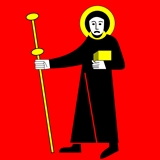
of 1388. A banner depicting Saint Fridolin was used to rally the people of Glarus in that battle, and from that time Glarus has used the image of Saint Fridolin on its flags and in its coat of arms.
The county of
WerdenbergWerdenberg may be* Werdenberg ** County of Werdenberg Sargans** Werdenberg *** Hartmann I. von Werdenberg , also Count of Kraiburg and Marquartstein...
was annexed to Glarus in 1517.
Between 1506 and 1516 the later reformer
Huldrych ZwingliUlrich Zwingli was a leader of the Reformation in Switzerland. Born during a time of emerging Swiss patriotism and increasing criticism of the Swiss mercenary system, he attended the University of Vienna and the University of Basel, a scholarly centre of humanism...
was priest in Glarus, but Glarus remained Catholic, and by 1564 all of Zwingli's followers were eliminated. This, however, did not end the struggles between the Protestants and the Catholics in the area. To secure peace it was decided that each party should have its own assembly (
LandsgemeindeThe Landsgemeinde or "cantonal assembly" is one of the oldest forms of direct democracy. The first historically documented assembly took place in 1294...
) in 1623, and at a later stage in 1683, each side was granted the right to have its own tribunals.
Between 1798 and 1803 Glarus was part of the
Canton of LinthLinth was a canton of the Helvetic Republic from 1798 to 1803, consisting of Glarus and its subject County of Werdenberg, the Höfe and March districts of Schwyz and the Züricher subject Lordship of Sax, along with a handful of shared territories....
as established by Napoleon. In 1836 the constitution was adapted to unite the assemblies and establish a single
Landsgemeinde.
On May 6, 2007 Glarus became the first Swiss canton to lower the voting age to 16.
Geography
The canton of Glarus is dominated by the deep valley of the
LinthThe Linth is a Swiss river starting above Linthal the mountains of Glarus near the Klausen Pass and flowing from there north through the Glarus valley passing Schwanden, where it is joined by its main tributary Sernft, Ennenda, the town of Glarus, Netstal, and Näfels, from where it is channeled to...
River and the smaller
SernftalThe Sernftal or Kleintal is an alpine valley within Glarus Süd, in the canton of Glarus, Switzerland. It is formed by the Sernf, a right tributary of the Linth. Situated in the Sernftal are the villages of Elm and Engi...
on the east. Most of the area is
mountainousThe Swiss Alps are the portion of the Alps mountain range that lies within Switzerland. Because of their central position within the entire Alpine range, they are also known as the Central Alps....
. The highest peak in the
Glarus AlpsThe Glarus Alps are a mountain range in central Switzerland. They extend from the Oberalp Pass to the Klausen Pass, and are bordered by the Urner Alps to the west, the Lepontine Alps to the south and the Appenzell Alps to the northeast...
is the
TödiThe Tödi , or Piz Russein, is the highest mountain in the Glarus Alps and the highest summit in the Canton of Glarus, Switzerland. It is located on the border between the cantons of Graubünden and Glarus...
at 3614 metres (11,857 ft) Other mountains include the
HausstockThe Hausstock is a mountain in the Glarus Alps, on the border between the cantons of Glarus and Graubünden. It overlooks the valleys of Linthal and Surselva . The Hausstock was the site of the 1799 withdrawal of the Russian army under General Alexander Suvorov...
(3158 metres (10,360.9 ft)) and the
GlärnischThe Glärnisch is a mountain of the Glarus Alps, overlooking the valley of the Linth in the canton of Glarus. It consists of several summits of which the highest is distinguished by the name Bächistock, followed by the Vrenelisgärtli and the Ruchen .The massif of the Glärnisch consists of two...
(2910 metres (9,547.2 ft)). The canton contains part of a thrust fault that was declared a geologic
UNESCOThe United Nations Educational, Scientific and Cultural Organization is a specialized agency of the United Nations...
world heritage siteA UNESCO World Heritage Site is a place that is listed by the UNESCO as of special cultural or physical significance...
, under the name
Swiss Tectonic Arena SardonaThe Glarus thrust is a major thrust fault in the Alps of eastern Switzerland. Along the thrust the Helvetic nappes were thrusted more than 100 km to the north over the external Aarmassif and Infrahelvetic complex...
, in 2008. Famous outcrops in ths Swiss Tectonic Arena Sardona include those at Lochsite near
GlarusGlarus is the capital of the Canton of Glarus in Switzerland. Glarus municipality since 1 January 2011 incorporates the former municipalities of Ennenda, Netstal and Riedern....
and in a mountain cliff called
TschingelhörnerTschingelhörner is a mountain in the Glarus Alps, located on the border between the cantons of Glarus and Graubünden in Switzerland. It is in fact composed of differents summits on a 1 km long ridge, situated south-west of Piz Segnas. The mountain is part of the Swiss Tectonic Arena Sardona...
between
Elm-Culture:In 1981, the Wakker Prize was awarded to Elm for the development and preservation of its architectural heritage....
and
FlimsFlims is a municipality in the district of Imboden in the Swiss canton of Graubünden. The town of Flims is dominated by the Flimserstein which you can see from almost anywhere in the area....
(in the same cliff is a natural hole called the Martinsloch). There is also a large lake called Walensee (
Lake WalenWalensee is one of the larger lakes in Switzerland, for about 2/3 of its surface in the Canton of St. Gallen and for 1/3 in the Canton of Glarus. It is also known as Lake Walen or Lake Walenstadt, after Walenstadt. Other towns and villages at the lake include: Weesen, Quinten, Quarten, and Murg.The...
) on the north. The total area of the canton of Glarus is 685 square kilometres (264.5 sq mi), of which about half is considered productive. Forestry is an important branch of industry in the canton.
Municipalities
With the
LandsgemeindeThe Landsgemeinde or "cantonal assembly" is one of the oldest forms of direct democracy. The first historically documented assembly took place in 1294...
(cantonal assembly) of 2006, it was decided that the 25 municipalities of Glarus be reduced to only three:
Glarus NordGlarus Nord is one of three municipalities of the canton of Glarus, Switzerland .Effective from 1 January 2011, Glarus Nord incorporates the former municipalities of Bilten, Filzbach, Mollis, Mühlehorn, Näfels, Niederurnen, Oberurnen and Obstalden....
,
GlarusGlarus is the capital of the Canton of Glarus in Switzerland. Glarus municipality since 1 January 2011 incorporates the former municipalities of Ennenda, Netstal and Riedern....
and
Glarus SüdGlarus Süd is one of three municipalities of the canton of Glarus, Switzerland .Effective from 1 January 2011, Glarus Süd incorporates the former municipalities of Betschwanden, Braunwald, Elm, Engi, Haslen, Linthal, Luchsingen, Matt, Mitlödi, Rüti, Schwanden, Schwändi and Sool.With an area of ,...
. The reform has taken effect on 1 January 2011.
The following are the 25 municipalities as they stood until 31 December 2010:
- Betschwanden
Betschwanden is a former municipality in the canton of Glarus in Switzerland. Effective from 1 January 2011, Betschwanden is part of the municipality of Glarus Süd.-Geography:...
- Bilten
Bilten is a former municipality in the canton of Glarus in Switzerland. Effective from 1 January 2011, Bilten is part of the municipality of Glarus Nord.-Geography:...
- Braunwald
Braunwald is a former municipality in the canton of Glarus in Switzerland. Effective from 1 January 2011, Braunwald is part of the municipality of Glarus Süd.-Geography:...
- Elm
-Culture:In 1981, the Wakker Prize was awarded to Elm for the development and preservation of its architectural heritage....
- Engi
- Ennenda
Ennenda is a former municipality in the canton of Glarus in Switzerland. Effective from 1 January 2011, Ennenda is part of the municipality of Glarus.-History:Ennenda is first mentioned around 1303-07 as Obront-Ennant-A and Nydern-Ennant-A....
- Filzbach
Filzbach is a former municipality in the canton of Glarus in Switzerland. Effective from 1 January 2011, Filzbach is part of the municipality of Glarus Nord.-Geography:...
- Glarus
Glarus is the capital of the Canton of Glarus in Switzerland. Glarus municipality since 1 January 2011 incorporates the former municipalities of Ennenda, Netstal and Riedern....
- Haslen
Haslen is a former municipality in the canton of Glarus in Switzerland. On July 1, 2006, Haslen incorporated the neighbouring municipalities of Leuggelbach and Nidfurn.Effective from 1 January 2011, Haslen is part of the municipality of Glarus Süd.... (united former municipalities LeuggelbachLeuggelbach is a village and former municipality in the canton of Glarus, Switzerland.It was formerly a municipality of its own, having been incorporated into Haslen in 2006. At that time Leuggelbach municipality had a population of 171.-References:... , NidfurnNidfurn is a village and former municipality in the canton of Glarus, Switzerland.It was formerly a municipality of its own, having been incorporated into Haslen in 2006. At that time Nidfurn municipality had a population of 255.-References:... and Haslen)
- Linthal
Linthal is a former municipality in the canton of Glarus in Switzerland. Effective from 1 January 2011, Linthal is part of the municipality of Glarus Süd.-Geography:...
- Luchsingen
Luchsingen is a former municipality in the canton of Glarus in Switzerland. Since 2004 the former municipalities of Hätzingen and Diesbach have been part of Luchsingen. Effective from 1 January 2011, Luchsingen is part of the municipality of Glarus Süd.... (united former municipalities DiesbachDiesbach is a village and former municipality in the canton of Glarus, Switzerland.It was formerly a municipality of its own, having been incorporated into Luchsingen in 2004. At that time Diesbach municipality had a population of 221.... , HätzingenHätzingen is a village and former municipality in the canton of Glarus, Switzerland.It was formerly a municipality of its own, having been incorporated into Luchsingen in 2004. At that time Hätzingen municipality had a population of 359.-References:... and Luchsingen)
- Matt
Matt is a former municipality in the canton of Glarus in Switzerland. It is located in Sernftal . Effective from 1 January 2011, Matt is part of the municipality of Glarus Süd.-Geography:...
|
Mitlödi Mitlödi is a former municipality in the canton of Glarus in Switzerland. Effective from 1 January 2011, Mitlödi is part of the municipality of Glarus Süd.-Geography:...
MollisMollis is a former municipality in the canton of Glarus in Switzerland. Effective from 1 January 2011, Mollis is part of the municipality of Glarus Nord.-Geography:...
MühlehornMühlehorn is a former municipality in the canton of Glarus in Switzerland. Effective from 1 January 2011, Mühlehorn is part of the municipality of Glarus Nord.-Geography:...
NäfelsNäfels is a former municipality in the canton of Glarus in Switzerland. Effective from 1 January 2011, Näfels is part of the municipality of Glarus Nord.-History:Näfels is first mentioned in 1240 as Nevels....
NetstalNetstal is a former municipality in the canton of Glarus in Switzerland. Effective from 1 January 2011, Netstal is part of the municipality of Glarus.-Geography:...
NiederurnenNiederurnen is a former municipality in the canton of Glarus in Switzerland. Effective from 1 January 2011, Niederurnen is part of the municipality of Glarus Nord.-History:...
OberurnenOberurnen is a former municipality in the canton of Glarus in Switzerland. Effective from 1 January 2011, Oberurnen is part of the municipality of Glarus Nord.-Geography:...
ObstaldenObstalden is a former municipality in the canton of Glarus in Switzerland. Effective from 1 January 2011, Obstalden is part of the municipality of Glarus Nord.-Geography:...
RiedernRiedern is a former municipality in the canton of Glarus in Switzerland. Effective from 1 January 2011, Riedern is part of the municipality of Glarus.-Geography:...
RütiRüti is a former municipality in the canton of Glarus in Switzerland. Effective from 1 January 2011, Rüti is part of the municipality of Glarus Süd.-Geography:...
SchwandenSchwanden is a former municipality in the canton of Glarus in Switzerland. Effective from 1 January 2011, Schwanden is part of the municipality of Glarus Süd.-Geography:...
SchwändiSchwändi is a former municipality in the canton of Glarus in Switzerland. Effective from 1 January 2011, Schwändi is part of the municipality of Glarus Süd.-Geography:...
SoolSool is a former municipality in the canton of Glarus in Switzerland. Effective from 1 January 2011, Sool is part of the municipality of Glarus Süd.-Geography:...
|
|
|
|
Demographics
The population of the canton (as of ) is . , the population included 7,314 foreigners (or 19.13% of the total population).
The population is nearly evenly split between
ProtestantsProtestantism is one of the three major groupings within Christianity. It is a movement that began in Germany in the early 16th century as a reaction against medieval Roman Catholic doctrines and practices, especially in regards to salvation, justification, and ecclesiology.The doctrines of the...
(44%) and Roman Catholics (37%).
83.6% is
GermanSwiss German is any of the Alemannic dialects spoken in Switzerland and in some Alpine communities in Northern Italy. Occasionally, the Alemannic dialects spoken in other countries are grouped together with Swiss German as well, especially the dialects of Liechtenstein and Austrian Vorarlberg...
-speaking and 6.8% is
ItalianItalian is a Romance language spoken mainly in Europe: Italy, Switzerland, San Marino, Vatican City, by minorities in Malta, Monaco, Croatia, Slovenia, France, Libya, Eritrea, and Somalia, and by immigrant communities in the Americas and Australia...
-speaking.
Economy
The geography of the canton helped to establish slate works in the 17th century. The mountainous surroundings of Glarus were also an advantage in industrialisation. Cotton spinning was important in the 18th century, complementing traditional woolen spinning. Industrialisation also brought cotton printing, hydroelectric plants and later metal and machinery factories, as well as paper mills.
Dairy farmingDairy farming is a class of agricultural, or an animal husbandry, enterprise, for long-term production of milk, usually from dairy cows but also from goats and sheep, which may be either processed on-site or transported to a dairy factory for processing and eventual retail sale.Most dairy farms...
and
cattle breedingAnimal husbandry is the agricultural practice of breeding and raising livestock.- History :Animal husbandry has been practiced for thousands of years, since the first domestication of animals....
were not replaced by industrial advances. Cattle graze on mountain pastures. Cattle breeding and dairying are important on the mountain pastures.
External links