

Three Leagues

Encyclopedia
The Three Leagues was the alliance of 1471 of the League of God's House
, the League of the Ten Jurisdictions
and the Grey League
, leading eventually to the formation of the Swiss canton of Graubünden
. Most of the lands of Graubünden were part of the Roman
province Raetia
in 15 BC. The area later was part of the lands of the Bishopric of Chur.
 On January 29, 1367, the League of God's House
, was founded to resist the rising power of the Bishopric of Chur and the House of Habsburg. Bishop Peter Gelyto reacted by transferring the bishopric to the Habsburgs in exchange for a pension
from the ducal house.
The instrument of union was signed by envoys of the cathedral chapter, the episcopal Ministerialis
, the city of Chur
and the districts of Domleschg
, Schams
, Oberhalbstein, Oberengadin
, Unterengadin
and Bergell. Other districts joined the league subsequently, including the Poschiavo in 1408 and the Vier Dörfer in 1450.
For some time, Unterengadin, Münstertal
and the upper Vinschgau were disputed between the Bishopric of Chur and the County of Tyrol
. While the first two could shake off the rule of the Habsburgs as count of Tyrol, in 1618, Untercalven was separated from the League as the last part of the Vinschgau.
With its capital in Chur, the League was composed of the following districts:

 The Grey League
was founded in 1395 in the Upper Rhine valley, as a reaction to various feuds between the Barony of Belmont, the Lordship of Sax, the Barony of Rhäzüns, the Barony of Vaz, County of Werdenberg, Disentis Abbey
and the Bishopric of Chur. The capital of the League was Ilanz
. The name Grey League is derived from the homespun grey clothes worn by the people; the name of this league later gave its name to the canton of Graubünden.
In Trun
, on March 16, 1424, a governing federation was established, comprising:
Even before 1440, the lordships of Löwenberg, Thusis
, Tschappina
and Heinzenberg
joined the League, despite the count of Werdenberg-Sargans having forbidden them from doing so. In 1441 Cazis Abbey joined; in 1480, the neighborhoods of Mesocco
and Soazza
in Misox and, in 1496, Gian Giacomo Trivulzio
assisted with the union of the remainder of the county of Misox, with the districts of Misox and Calanca.
The Grey League was administered in eight districts:

 A third league was established on June 8, 1436 by the people of ten bailiwick
s in the former county of Toggenburg, as the dynasty of Toggenburg had become extinct. The league was called League of the Ten Jurisdictions
, with its capital in Davos
, and was composed of:
The alliance was mainly designed to resist Habsburg
expansion into the region and was administered in seven districts:

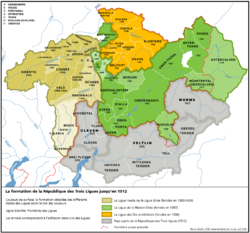 The three separate Leagues initially worked together informally, such as in 1450, in the Schamserfehde, a conflict with the house of Werdenberg-Sargans, during which the League of the Ten Jurisdictions
allied with the League of God's House
. Joint meetings of the three Leagues are evidenced from 1461; closer links date to 1471, when the two leagues allied with the Grey League
, but there is no documentary proof of this date. In 1497 and 1498 the Leagues allied with the Old Swiss Confederacy
after the Habsburgs acquired the possessions of the extinct Toggenburg dynasty in 1496, siding with the Confederacy in the Swabian War
three years later. The Habsburgs were defeated at Calven Gorge
and Dornach
, helping the Swiss Confederacy and the allied Leagues to be recognised.
After 1499, the Free State de facto
separated from the Holy Roman Empire
and developed, during the 16th century into a political entity that was unique in early modern Europe
. In the early 17th century, it was the only territory in Europe where all decisions were made by communalism
, with the Leagues founded, governed and defended by cooperative decisions.
With the of 23 September 1524 was created a constitution that endured until the Napoleonic dissolution of the Free State. The supreme power in the Free State was a Bundestag, composed of 63 deputies with responsible to constituencies; this Bundestag alternated between Ilanz
, Chur
and Davos
. By today's standards, the Three Leagues would be considered a federation of three states, rather than a single, unified state; the union had few competencies and virtually all affairs of the Free State were settled by referendum
.
The last traces of the bishop of Chur's jurisdiction were abolished in 1526. The Musso war
of 1520 drove the Three Leagues closer to the Swiss Confederacy.
With the invasion of Switzerland by the French Revolutionary Armies, the Three Leagues were absorbed into the Helvetic Republic
, as the canton of Raetia
. With the Napoleonic Act of Mediation
, the Leagues were incorporated into a restored Swiss Confederacy
— as the canton of Graubünden
— in 1803; the current constitution of the canton dates from 1892.
The districts of Chiavenna, Valtellina
and Bormio
, previously dependencies of the Leagues, were never a part of the canton of Raetia, however, having permanently been detached from the Leagues after Revolutionary France fomented revolt there, leading them to be annexed to the Cisalpine Republic
on October 10, 1797. The districts subsequently joined the Austrian
client
kingdom of Lombardy-Venetia after the Congress of Vienna
and eventually become the Italian
province of Sondrio
. The town of Campione was similarly detached from the Landvogtei of Lugano at the same time, leading to its current position as an Italian enclave within Ticino
.
League of God's House
The League of God's House was formed in what is now Switzerland on January 29, 1367 to resist the rising power of the Bishopric of Chur and the House of Habsburg. The League allied with the Grey League and the League of the Ten Jurisdictions in 1471 to form the Three Leagues...
, the League of the Ten Jurisdictions
League of the Ten Jurisdictions
The League of the Ten Jurisdictions was the last of the Three Leagues founded during the Middle Ages in what is now Canton Graubünden of Switzerland. The League was created in the County of Toggenburg after the counts of Toggenburg died out. The League initially existed to resist the power of the...
and the Grey League
Grey League
The Grey League , sometimes called Oberbund, formed in 1395 in the Vorderrhein and Hinterrhein valleys, Raetia. The name Grey League is derived from the homespun grey clothes worn by the people. The league became part of the canton of Graubünden. The Grey League allied itself to the two other...
, leading eventually to the formation of the Swiss canton of Graubünden
Graubünden
Graubünden or Grisons is the largest and easternmost canton of Switzerland. The canton shares borders with the cantons of Ticino, Uri, Glarus and St. Gallen and international borders with Italy, Austria and Liechtenstein...
. Most of the lands of Graubünden were part of the Roman
Ancient Rome
Ancient Rome was a thriving civilization that grew on the Italian Peninsula as early as the 8th century BC. Located along the Mediterranean Sea and centered on the city of Rome, it expanded to one of the largest empires in the ancient world....
province Raetia
Raetia
Raetia was a province of the Roman Empire, named after the Rhaetian people. It was bounded on the west by the country of the Helvetii, on the east by Noricum, on the north by Vindelicia, on the west by Cisalpine Gaul and on south by Venetia et Histria...
in 15 BC. The area later was part of the lands of the Bishopric of Chur.
League of God's House
League of God's House
The League of God's House was formed in what is now Switzerland on January 29, 1367 to resist the rising power of the Bishopric of Chur and the House of Habsburg. The League allied with the Grey League and the League of the Ten Jurisdictions in 1471 to form the Three Leagues...
, was founded to resist the rising power of the Bishopric of Chur and the House of Habsburg. Bishop Peter Gelyto reacted by transferring the bishopric to the Habsburgs in exchange for a pension
Pension
In general, a pension is an arrangement to provide people with an income when they are no longer earning a regular income from employment. Pensions should not be confused with severance pay; the former is paid in regular installments, while the latter is paid in one lump sum.The terms retirement...
from the ducal house.
The instrument of union was signed by envoys of the cathedral chapter, the episcopal Ministerialis
Ministerialis
Ministerialis ; a post-classical Latin word, used in English, meaning originally servitor, agent, in a broad range of senses...
, the city of Chur
Chur
Chur or Coire is the capital of the Swiss canton of Graubünden and lies in the northern part of the canton.-History:The name "chur" derives perhaps from the Celtic kora or koria, meaning "tribe", or from the Latin curia....
and the districts of Domleschg
Domleschg (Kreis)
The Kreis Domleschg forms, together with the sub-districts of Avers, Rheinwald, Schams and Thusis, the Hinterrhein of the Canton Graubünden in Switzerland. The district office is located in Fürstenau.- Geography :...
, Schams
Schams (Kreis)
The Kreis Schams forms, together with the sub-districts of Avers, Domleschg, Rheinwald and Thusis, the Hinterrhein of the Canton Graubünden in Switzerland. The district office is located in Zillis-Reischen.- Geography :...
, Oberhalbstein, Oberengadin
Engadin
The Engadin or Engadine is a long valley in the Swiss Alps located in the canton of Graubünden in southeast Switzerland. It follows the route of the Inn River from its headwaters at Maloja Pass running northeast until the Inn flows into Austria one hundred kilometers downstream...
, Unterengadin
Engadin
The Engadin or Engadine is a long valley in the Swiss Alps located in the canton of Graubünden in southeast Switzerland. It follows the route of the Inn River from its headwaters at Maloja Pass running northeast until the Inn flows into Austria one hundred kilometers downstream...
and Bergell. Other districts joined the league subsequently, including the Poschiavo in 1408 and the Vier Dörfer in 1450.
For some time, Unterengadin, Münstertal
Val Müstair
Val Müstair is a municipality in the district of Inn in the Swiss canton of Graubünden. It was formed on 1 January 2009 through the merger of Tschierv, Fuldera, Lü, Valchava, Santa Maria Val Müstair and Müstair.-Demographics:...
and the upper Vinschgau were disputed between the Bishopric of Chur and the County of Tyrol
County of Tyrol
The County of Tyrol, Princely County from 1504, was a State of the Holy Roman Empire, from 1814 a province of the Austrian Empire and from 1867 a Cisleithanian crown land of Austria-Hungary...
. While the first two could shake off the rule of the Habsburgs as count of Tyrol, in 1618, Untercalven was separated from the League as the last part of the Vinschgau.
With its capital in Chur, the League was composed of the following districts:
- ChurChurChur or Coire is the capital of the Swiss canton of Graubünden and lies in the northern part of the canton.-History:The name "chur" derives perhaps from the Celtic kora or koria, meaning "tribe", or from the Latin curia....
- Bergell: districts of Ober- and Unterporta
- Calven: districts of Obercalven (Münstertal) and Untercalven (Upper Vinschgau)
- DomleschgDomleschgThe Domleschg is a valley in Graubünden in Switzerland. Geographically, the name "Domleschg" covers both sides of the valley. Politically, the villages on the left bank of the Poserior Rhine form the Kreis of Thusis and those on the right bank form the Kreis of Domleschg. Thusis is the main...
: districts of OrtensteinOrtensteinOrtenstein is a castle located in Switzerland, near Tomils, in Graubünden.The initial castle at the location was destroyed in a conflict called "Schamserfehde" in 1451 but obtained the privilege to be rebuilt unlike other castles then....
(since 1788 divided into: Ortenstein im Boden and Ortenstein im Berg) and FürstenauFürstenau, SwitzerlandFürstenau is a municipality in the district of Hinterrhein in the Swiss canton of Graubünden and the smalles town to hold city rights with a market right received from Charles IV, Holy Roman Emperor in 1354.-History:... - GreifensteinGreifensteinGreifenstein is a community in the Lahn-Dill-Kreis in Hesse, Germany. Its administrative seat is Beilstein. Greifenstein covers 67.43 km² on the eastern slope of the Westerwald range...
: districts of BergünBergünBergün/Bravuogn , is a municipality in the district of Albula in the canton of Graubünden in Switzerland. The double name has been the official name since 1943.-Geography:...
and Obervaz - Oberengadin: (divided since 1438) districts of SurSurSur was a literary journal published in Buenos Aires. Its main backer was Victoria Ocampo, and it was supported intellectually by the Spanish philosopher José Ortega y Gasset. Many of the earliest editions of Sur carry the colophon of Ortega's Revista de Occidente...
and Suot Funtauna Merla - Oberhalbstein: districts of Oberhalbstein and TiefencastelTiefencastelTiefencastel is a municipality in the district of Albula in the canton of Graubünden in Switzerland.-History:Tiefencastel is first mentioned in 831 as in Castello Impitinis. Starting around in the 14th Century it was known as Tüffenkasten.-Geography:Tiefencastel has an area, , of...
- PoschiavoPoschiavoPoschiavo is a municipality in the district of Bernina in the canton of Graubünden in Switzerland.-History:Poschiavo is first mentioned in 824 as in Postclave though this comes from a later copy of the original document.. In 1140 it was mentioned as de Pusclauio. It was formerly known by the...
- Ramosch-Stalla-Avers: districts of RamoschRamoschRamosch is a municipality in the district of Inn in the Swiss canton of Graubünden.-History:In 1956-58, on the hill Mottata , a significant prehistoric site was discovered...
and Stalla (Bivio)BivioBivio is a municipality in the district of Albula of the Swiss canton of Graubünden.-History:Bivio is first mentioned about 840 as de stabulo Bivio. At one time it was known, in German, as Stallen and until 1895/1903 by its Italian name Stalla.-Geography:Bivio has an area, , of...
–AversAversAvers is a municipality in the district of Hinterrhein in the Swiss canton of Graubünden. It includes Juf, the highest-altitude year-round settlement in Europe.-History:... - Unterengadin: districts of Ober- and Untertasna
- Vier Dörfer
Grey League
Grey League
The Grey League , sometimes called Oberbund, formed in 1395 in the Vorderrhein and Hinterrhein valleys, Raetia. The name Grey League is derived from the homespun grey clothes worn by the people. The league became part of the canton of Graubünden. The Grey League allied itself to the two other...
was founded in 1395 in the Upper Rhine valley, as a reaction to various feuds between the Barony of Belmont, the Lordship of Sax, the Barony of Rhäzüns, the Barony of Vaz, County of Werdenberg, Disentis Abbey
Disentis Abbey
Disentis Abbey is a Benedictine monastery in the Canton of Graubünden in eastern Switzerland, around which the present town of Disentis grew up.-Foundation to 19th century:...
and the Bishopric of Chur. The capital of the League was Ilanz
Ilanz
Ilanz is a municipality in the district of Surselva in the Swiss canton of Graubünden.-History:Ilanz is first mentioned in 765 as Iliande. Ilanz became the capital of the newly formed Grey League in 1395. The Grey League was the second of Three Leagues which eventually formed canton Graubünden...
. The name Grey League is derived from the homespun grey clothes worn by the people; the name of this league later gave its name to the canton of Graubünden.
In Trun
Trun, Switzerland
Trun is a municipality in the district of Surselva in the canton of Graubünden in Switzerland.-Geography:Trun has an area, , of . Of this area, 23.6% is used for agricultural purposes, while 34% is forested...
, on March 16, 1424, a governing federation was established, comprising:
-
 The abbotAbbotThe word abbot, meaning father, is a title given to the head of a monastery in various traditions, including Christianity. The office may also be given as an honorary title to a clergyman who is not actually the head of a monastery...
and court of Disentis AbbeyDisentis AbbeyDisentis Abbey is a Benedictine monastery in the Canton of Graubünden in eastern Switzerland, around which the present town of Disentis grew up.-Foundation to 19th century:...
; -
 The Baron of RhäzünsRhäzünsRhäzüns is a municipality in the district of Imboden in the Swiss canton of Graubünden.-Geography:Rhäzüns has an area, , of . Of this area, 23.3% is used for agricultural purposes, while 69.1% is forested...
— for himself, his lordship and his subject communities of SafienSafienSafien is a municipality in the district of Surselva in the Swiss canton of Graubünden.-Geography:Safien has an area, , of . Of this area, 45.6% is used for agricultural purposes, while 18.2% is forested...
, TennaTennawas a after Enpō and before Jōkyō. This period spanned the years from September 1681 through February 1684. The reigning emperor was .-Change of era:...
and ObersaxenObersaxenObersaxen is a municipality in the district of Surselva in the Swiss canton of Graubünden.-History:Obersaxen is first mentioned in 765 as Supersaxa though this is from a copy which dates from later...
; -
 The Baron of Sax-Misox — for himself and his subjects IlanzIlanzIlanz is a municipality in the district of Surselva in the Swiss canton of Graubünden.-History:Ilanz is first mentioned in 765 as Iliande. Ilanz became the capital of the newly formed Grey League in 1395. The Grey League was the second of Three Leagues which eventually formed canton Graubünden...
, Gruob, LugnezLugnezLugnez is a municipality in the district of Porrentruy in the canton of Jura in Switzerland.-References:...
, ValsVals, SwitzerlandVals is a municipality in the district of Surselva in the canton of Graubünden in Switzerland.-History:Archeological finds from the Bronze Age around the thermal baths and Tomül pass as well as Iron Age items on the slopes of the Valserberg indicate that this area was used before written history...
, CastrischCastrischCastrisch is a municipality in the district of Surselva in the Swiss canton of Graubünden. Until 1943, it was officially known as Kästris.-Geography:...
and FlimsFlimsFlims is a municipality in the district of Imboden in the Swiss canton of Graubünden. The town of Flims is dominated by the Flimserstein which you can see from almost anywhere in the area....
; -
 The Count of Werdenberg-Heiligenberg with all his subjects, including TrinTrinTrin is a municipality in the district of Imboden in the Swiss canton of Graubünden. Crestasee is located in Trin.-Geography:Trin is perched on the mountain-side above the Rhine valley on the road between Domat/Ems and Flims. The village of Mulin is at the foot of the slope on the edge of the...
and TaminsTaminsTamins is a municipality in the district of Imboden in the Swiss canton of Graubünden.-History:Tamins is first mentioned in 1224 as Tuminne. In 1225 it was mentioned as Tvminnis and in 1399 as Tumins.-Geography:...
; -
 Communities above the FlimsFlimsFlims is a municipality in the district of Imboden in the Swiss canton of Graubünden. The town of Flims is dominated by the Flimserstein which you can see from almost anywhere in the area....
erwald, including RheinwaldRheinwaldThe Rheinwald is a valley in the Canton of Graubünden in Switzerland...
and SchamsSchamsthumb | The Schams north of [[Andeer]]. In the top left, the ruins of [[Cagliatscha Castle]]The Schams is a section of the Hinterrhein valley in the Swiss Canton of Graubünden.- Geography :...
.
Even before 1440, the lordships of Löwenberg, Thusis
Thusis
Thusis is a municipality in the district of Hinterrhein in the Swiss canton of Graubünden.-Geography:Thusis has an area, , of . Of this area, 18% is used for agricultural purposes, while 58.2% is forested...
, Tschappina
Tschappina
Tschappina is a municipality in the district of Hinterrhein in the Swiss canton of Graubünden.-Geography:Tschappina has an area, , of . Of this area, 42.2% is used for agricultural purposes, while 26.8% is forested...
and Heinzenberg
Heinzenberg
Heinzenberg is a municipality in the district of Bad Kreuznach in Rhineland-Palatinate, in western Germany....
joined the League, despite the count of Werdenberg-Sargans having forbidden them from doing so. In 1441 Cazis Abbey joined; in 1480, the neighborhoods of Mesocco
Mesocco
Mesocco is a municipality in the district of Moesa in the Swiss canton of Graubünden.-History:The first human settlement in the area dates back to the Mesolithic era. Stone tools dating to about 6000 BC have been found in the Silex section of the municipality. At the same site, Neolithic fire pits...
and Soazza
Soazza
Soazza is a municipality in the district of Moesa in the Swiss canton of Graubünden.-Geography:Soazza has an area, , of . Of this area, 7.2% is used for agricultural purposes, while 53.7% is forested...
in Misox and, in 1496, Gian Giacomo Trivulzio
Gian Giacomo Trivulzio
Gian Giacomo Trivulzio was an Italian aristocrat and condottiero who held several military commands during the Italian Wars.-Biography:...
assisted with the union of the remainder of the county of Misox, with the districts of Misox and Calanca.
The Grey League was administered in eight districts:
- DisentisDisentis/Mustér-Demographics:Disentis/Mustér has a population of . , 8.9% of the population was made up of foreign nationals. Over the last 10 years the population has decreased at a rate of -4.7%....
- LugnezVal LumneziaThe Val Lumnezia is a Swiss high Alpine valley made up of the main Lumnezia valley, and a side valley, the Valser valley to the south-east. Located at , it forms also Municipality, which is composed of the communities Vella, Vignogn, Degen, Suraua, Vrin, Cumbel, Morissen, Vals and Lumbrein. Its...
: districts of LugnezVal LumneziaThe Val Lumnezia is a Swiss high Alpine valley made up of the main Lumnezia valley, and a side valley, the Valser valley to the south-east. Located at , it forms also Municipality, which is composed of the communities Vella, Vignogn, Degen, Suraua, Vrin, Cumbel, Morissen, Vals and Lumbrein. Its...
and ValsVals, SwitzerlandVals is a municipality in the district of Surselva in the canton of Graubünden in Switzerland.-History:Archeological finds from the Bronze Age around the thermal baths and Tomül pass as well as Iron Age items on the slopes of the Valserberg indicate that this area was used before written history... - Gruob: districts of Gruob, Schleuis and TennaTenna, SwitzerlandTenna is a municipality in the district of Surselva in the canton of Graubünden in Switzerland.-Coat of arms:The blazon of the municipal coat of arms is Gules St. Valentin clad Argent and caped Or with his dexter raised in blessing and holding in sinister a crosier of the last...
- Waltensburg: districts of Waltensburg, LaaxLaaxLaax is a municipality in the district of Surselva in the Swiss canton of Graubünden.-Geography:Laax has an area, , of . Of this area, 35.8% is used for agricultural purposes, while 30.6% is forested...
and ObersaxenObersaxenObersaxen is a municipality in the district of Surselva in the Swiss canton of Graubünden.-History:Obersaxen is first mentioned in 765 as Supersaxa though this is from a copy which dates from later... - RhäzünsRhäzünsRhäzüns is a municipality in the district of Imboden in the Swiss canton of Graubünden.-Geography:Rhäzüns has an area, , of . Of this area, 23.3% is used for agricultural purposes, while 69.1% is forested...
: districts of RhäzünsRhäzünsRhäzüns is a municipality in the district of Imboden in the Swiss canton of Graubünden.-Geography:Rhäzüns has an area, , of . Of this area, 23.3% is used for agricultural purposes, while 69.1% is forested...
, Hohentrins and FlimsFlimsFlims is a municipality in the district of Imboden in the Swiss canton of Graubünden. The town of Flims is dominated by the Flimserstein which you can see from almost anywhere in the area.... - Schams-Rheinwald: districts of RheinwaldRheinwaldThe Rheinwald is a valley in the Canton of Graubünden in Switzerland...
and SchamsSchamsthumb | The Schams north of [[Andeer]]. In the top left, the ruins of [[Cagliatscha Castle]]The Schams is a section of the Hinterrhein valley in the Swiss Canton of Graubünden.- Geography :... - ThusisThusisThusis is a municipality in the district of Hinterrhein in the Swiss canton of Graubünden.-Geography:Thusis has an area, , of . Of this area, 18% is used for agricultural purposes, while 58.2% is forested...
: districts of ThusisThusisThusis is a municipality in the district of Hinterrhein in the Swiss canton of Graubünden.-Geography:Thusis has an area, , of . Of this area, 18% is used for agricultural purposes, while 58.2% is forested...
, Heinzenberg, TschappinaTschappinaTschappina is a municipality in the district of Hinterrhein in the Swiss canton of Graubünden.-Geography:Tschappina has an area, , of . Of this area, 42.2% is used for agricultural purposes, while 26.8% is forested...
and SafienSafienSafien is a municipality in the district of Surselva in the Swiss canton of Graubünden.-Geography:Safien has an area, , of . Of this area, 45.6% is used for agricultural purposes, while 18.2% is forested... - Misox: districts of Misox, RoveredoRoveredoRoveredo is a municipality in the district of Moësa in the canton of Graubünden in Switzerland.-Geography:Roveredo has an area, , of . Of this area, 8.6% is used for agricultural purposes, while 75% is forested...
and Calanca
League of the Ten Jurisdictions
Bailiwick
A bailiwick is usually the area of jurisdiction of a bailiff, and may also apply to a territory in which the sheriff's functions were exercised by a privately appointed bailiff under a royal or imperial writ. The word is now more generally used in a metaphorical sense, to indicate a sphere of...
s in the former county of Toggenburg, as the dynasty of Toggenburg had become extinct. The league was called League of the Ten Jurisdictions
League of the Ten Jurisdictions
The League of the Ten Jurisdictions was the last of the Three Leagues founded during the Middle Ages in what is now Canton Graubünden of Switzerland. The League was created in the County of Toggenburg after the counts of Toggenburg died out. The League initially existed to resist the power of the...
, with its capital in Davos
Davos
Davos is a municipality in the district of Prättigau/Davos in the canton of Graubünden, Switzerland. It has a permanent population of 11,248 . Davos is located on the Landwasser River, in the Swiss Alps, between the Plessur and Albula Range...
, and was composed of:
- Belfort
- Davos

- Klosters
 KlostersKlosters-Serneus is a municipality in the district of Prättigau/Davos in the Swiss canton of Graubünden.Its well-known ski resort lies from Zurich, the nearest international airport. Transfer time is about 1.5 hours. Klosters is from Davos...
 - Castels
- Schiers
 Schiers-Heritage sites of national significance:The Salginatobel Bridge is listed as a Swiss heritage site of national significance.The Salginatobel Bridge is a reinforced concrete arch bridge designed by renowned Swiss civil engineer Robert Maillart. It was constructed across an alpine valley in Schiers...
 - Schanfigg (St. Peter)
- Langwies
 LangwiesLangwies is a municipality in the district of Plessur in the canton of Graubünden in Switzerland.-Geography:Langwies has an area, , of . Of this area, 48.8% is used for agricultural purposes, while 22.6% is forested...
 - Strassberg (Churwalden
 ChurwaldenChurwalden is a municipality in the district of Plessur in the canton of Graubünden in Switzerland. On 1 January 2010 the municipalities of Malix and Parpan merged into Churwalden.-History:...
) - Maienfeld
 MaienfeldMaienfeld is a municipality in the district of Landquart in the Swiss canton of Graubünden. It is a tourist destination in the Alps, both because of the local wine and because it was the setting of the story Heidi.- History :...
(the town and the castle) - Neu-Aspermont (which had jurisdiction over JeninsJeninsJenins is a municipality in the district of Landquart in the Swiss canton of Graubünden.-History:Jenins is first mentioned in 1139 as Uienennes. In 1142 it was mentioned as Gininnes.-Geography:...
and MalansMalansMalans is the name of the following municipalities:* Malans, Doubs, a commune in the Doubs department in France* Malans, Haute-Saône, a commune in the Haute-Saône department in France* Malans, Switzerland, a municipality in the Swiss canton of Graubünden...
)
The alliance was mainly designed to resist Habsburg
Habsburg
The House of Habsburg , also found as Hapsburg, and also known as House of Austria is one of the most important royal houses of Europe and is best known for being an origin of all of the formally elected Holy Roman Emperors between 1438 and 1740, as well as rulers of the Austrian Empire and...
expansion into the region and was administered in seven districts:
- Davos
- Klosters: districts of Klosters-Innerschnitz and Klosters-Ausserschnitz
- Castels: (partitioned from 1622) districts of LuzeinLuzeinLuzein is a municipality in the district of Prättigau/Davos in the Swiss canton of Graubünden.-Neighboring municipalities:-Geography:Luzein has an area, , of . Of this area, 41.8% is used for agricultural purposes, while 46.6% is forested...
and JenazJenazJenaz is a municipality in the district of Prättigau/Davos in the Swiss canton of Graubünden.-Geography:Jenaz has an area, , of . Of this area, 48.1% is used for agricultural purposes, while 38.8% is forested... - Schiers-Seewis: (partitioned from 1679) districts of Schiers and Seewis
- Maienfeld: districts of Maienfeld and MalansMalansMalans is the name of the following municipalities:* Malans, Doubs, a commune in the Doubs department in France* Malans, Haute-Saône, a commune in the Haute-Saône department in France* Malans, Switzerland, a municipality in the Swiss canton of Graubünden...
- Belfort: districts of Churwalden and (partitioned from 1613) Inner- and Ausserbelfort
- Schanfigg: districts of St. Peter (Ausserschanfigg) and Langwies
Union of the leagues
League of the Ten Jurisdictions
The League of the Ten Jurisdictions was the last of the Three Leagues founded during the Middle Ages in what is now Canton Graubünden of Switzerland. The League was created in the County of Toggenburg after the counts of Toggenburg died out. The League initially existed to resist the power of the...
allied with the League of God's House
League of God's House
The League of God's House was formed in what is now Switzerland on January 29, 1367 to resist the rising power of the Bishopric of Chur and the House of Habsburg. The League allied with the Grey League and the League of the Ten Jurisdictions in 1471 to form the Three Leagues...
. Joint meetings of the three Leagues are evidenced from 1461; closer links date to 1471, when the two leagues allied with the Grey League
Grey League
The Grey League , sometimes called Oberbund, formed in 1395 in the Vorderrhein and Hinterrhein valleys, Raetia. The name Grey League is derived from the homespun grey clothes worn by the people. The league became part of the canton of Graubünden. The Grey League allied itself to the two other...
, but there is no documentary proof of this date. In 1497 and 1498 the Leagues allied with the Old Swiss Confederacy
Old Swiss Confederacy
The Old Swiss Confederacy was the precursor of modern-day Switzerland....
after the Habsburgs acquired the possessions of the extinct Toggenburg dynasty in 1496, siding with the Confederacy in the Swabian War
Swabian War
The Swabian War of 1499 was the last major armed conflict between the Old Swiss Confederacy and the House of Habsburg...
three years later. The Habsburgs were defeated at Calven Gorge
Battle of Calven
The Battle of Calven took place on May 22, 1499 at the exit of the Val Müstair in the Grisons to the Vinschgau in County of Tyrol between the forces of king Maximilian I of the House of Habsburg and those of the free federation of the Three Leagues of the Grisons...
and Dornach
Battle of Dornach
The Battle of Dornach was a battle fought on 22 July 1499 between the troops of Emperor Maximilian I and the Old Swiss Confederacy close to the Swiss village of Dornach....
, helping the Swiss Confederacy and the allied Leagues to be recognised.
After 1499, the Free State de facto
De facto
De facto is a Latin expression that means "concerning fact." In law, it often means "in practice but not necessarily ordained by law" or "in practice or actuality, but not officially established." It is commonly used in contrast to de jure when referring to matters of law, governance, or...
separated from the Holy Roman Empire
Holy Roman Empire
The Holy Roman Empire was a realm that existed from 962 to 1806 in Central Europe.It was ruled by the Holy Roman Emperor. Its character changed during the Middle Ages and the Early Modern period, when the power of the emperor gradually weakened in favour of the princes...
and developed, during the 16th century into a political entity that was unique in early modern Europe
Early modern Europe
Early modern Europe is the term used by historians to refer to a period in the history of Europe which spanned the centuries between the end of the Middle Ages and the beginning of the Industrial Revolution, roughly the late 15th century to the late 18th century...
. In the early 17th century, it was the only territory in Europe where all decisions were made by communalism
Communalism
Communalism is a term with three distinct meanings according to the Random House Unabridged Dictionary'.'These include "a theory of government or a system of government in which independent communes participate in a federation". "the principles and practice of communal ownership"...
, with the Leagues founded, governed and defended by cooperative decisions.
With the of 23 September 1524 was created a constitution that endured until the Napoleonic dissolution of the Free State. The supreme power in the Free State was a Bundestag, composed of 63 deputies with responsible to constituencies; this Bundestag alternated between Ilanz
Ilanz
Ilanz is a municipality in the district of Surselva in the Swiss canton of Graubünden.-History:Ilanz is first mentioned in 765 as Iliande. Ilanz became the capital of the newly formed Grey League in 1395. The Grey League was the second of Three Leagues which eventually formed canton Graubünden...
, Chur
Chur
Chur or Coire is the capital of the Swiss canton of Graubünden and lies in the northern part of the canton.-History:The name "chur" derives perhaps from the Celtic kora or koria, meaning "tribe", or from the Latin curia....
and Davos
Davos
Davos is a municipality in the district of Prättigau/Davos in the canton of Graubünden, Switzerland. It has a permanent population of 11,248 . Davos is located on the Landwasser River, in the Swiss Alps, between the Plessur and Albula Range...
. By today's standards, the Three Leagues would be considered a federation of three states, rather than a single, unified state; the union had few competencies and virtually all affairs of the Free State were settled by referendum
Referendum
A referendum is a direct vote in which an entire electorate is asked to either accept or reject a particular proposal. This may result in the adoption of a new constitution, a constitutional amendment, a law, the recall of an elected official or simply a specific government policy. It is a form of...
.
The last traces of the bishop of Chur's jurisdiction were abolished in 1526. The Musso war
Musso war
The Musso war was an armed conflict between the federation of the Three Leagues in the Grisons, an associate state of the Old Swiss Confederacy, and the Duchy of Milan early in the 16th century....
of 1520 drove the Three Leagues closer to the Swiss Confederacy.
With the invasion of Switzerland by the French Revolutionary Armies, the Three Leagues were absorbed into the Helvetic Republic
Helvetic Republic
In Swiss history, the Helvetic Republic represented an early attempt to impose a central authority over Switzerland, which until then consisted mainly of self-governing cantons united by a loose military alliance, and conquered territories such as Vaud...
, as the canton of Raetia
Canton of Raetia
Raetia was the name of a canton of the Helvetic Republic from 1798 to 1803, corresponding to modern Graubünden and composed of the Free State of the Three Leagues...
. With the Napoleonic Act of Mediation
Act of Mediation
The Act of Mediation was issued by Napoleon Bonaparte on 19 February 1803 establishing the Swiss Confederation. The act also abolished the previous Helvetic Republic, which had existed since the invasion of Switzerland by French troops in 1798. After the withdrawal of French troops in July 1802,...
, the Leagues were incorporated into a restored Swiss Confederacy
Switzerland in the Napoleonic era
During the French Revolutionary Wars, the revolutionary armies marched eastward, enveloping Switzerland in their battles against Austria. In 1798 Switzerland was completely overrun by the French and became the Helvetic Republic. The Helvetic Republic encountered severe economic and political problems...
— as the canton of Graubünden
Graubünden
Graubünden or Grisons is the largest and easternmost canton of Switzerland. The canton shares borders with the cantons of Ticino, Uri, Glarus and St. Gallen and international borders with Italy, Austria and Liechtenstein...
— in 1803; the current constitution of the canton dates from 1892.
The districts of Chiavenna, Valtellina
Valtellina
Valtellina or the Valtelline valley ; is a valley in the Lombardy region of northern Italy, bordering Switzerland. Today it is known for its skiing, its hot spring spas, its cheeses and its wines...
and Bormio
Bormio
Bormio is a town and comune located in the province of Sondrio, Lombardy region of the Alps in northern Italy. It has a population of 4,200...
, previously dependencies of the Leagues, were never a part of the canton of Raetia, however, having permanently been detached from the Leagues after Revolutionary France fomented revolt there, leading them to be annexed to the Cisalpine Republic
Cisalpine Republic
The Cisalpine Republic was a French client republic in Northern Italy that lasted from 1797 to 1802.-Birth:After the Battle of Lodi in May 1796, Napoleon Bonaparte proceeded to organize two states: one to the south of the Po River, the Cispadane Republic, and one to the north, the Transpadane...
on October 10, 1797. The districts subsequently joined the Austrian
Austrian Empire
The Austrian Empire was a modern era successor empire, which was centered on what is today's Austria and which officially lasted from 1804 to 1867. It was followed by the Empire of Austria-Hungary, whose proclamation was a diplomatic move that elevated Hungary's status within the Austrian Empire...
client
Client state
Client state is one of several terms used to describe the economic, political and/or military subordination of one state to a more powerful state in international affairs...
kingdom of Lombardy-Venetia after the Congress of Vienna
Congress of Vienna
The Congress of Vienna was a conference of ambassadors of European states chaired by Klemens Wenzel von Metternich, and held in Vienna from September, 1814 to June, 1815. The objective of the Congress was to settle the many issues arising from the French Revolutionary Wars, the Napoleonic Wars,...
and eventually become the Italian
Italy
Italy , officially the Italian Republic languages]] under the European Charter for Regional or Minority Languages. In each of these, Italy's official name is as follows:;;;;;;;;), is a unitary parliamentary republic in South-Central Europe. To the north it borders France, Switzerland, Austria and...
province of Sondrio
Province of Sondrio
The Province of Sondrio is in the Lombardy region of Italy. Its capital is the town of Sondrio.It has an area of 3,212 km², and a total population of 176,856...
. The town of Campione was similarly detached from the Landvogtei of Lugano at the same time, leading to its current position as an Italian enclave within Ticino
Ticino
Canton Ticino or Ticino is the southernmost canton of Switzerland. Named after the Ticino river, it is the only canton in which Italian is the sole official language...
.