

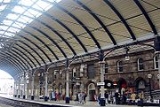
Newcastle Central station

Encyclopedia
Newcastle railway station (also known as Newcastle Central Station, or simply Central Station within Tyne & Wear), is the mainline station
of the city of Newcastle upon Tyne
, England
and is a principal stop on the East Coast Main Line
. It opened in 1850 and is a Grade I listed building. The railway station is connected to the adjacent underground Central Station Metro station
on the Tyne and Wear Metro
.
East Coast
is the primary operator at the station providing Inter-city rail
services southbound to York
, Doncaster
and London
and northbound to Edinburgh
and Glasgow
. Other mainline services are operated by CrossCountry
southbound to Leeds
, Sheffield
, Derby
, Birmingham
, Bournemouth
, Bristol
, Cardiff
, Plymouth
and Reading
and also northbound to Scotland
while First TransPennine Express
provides services to Liverpool
and Manchester
via Leeds. Northern Rail
operates local and regional services across the North East
and Cumbria
, notably along the Tyne Valley Line to Carlisle
via MetroCentre and Hexham
, northbound to Morpeth
and southbound to Middlesbrough
and Sunderland while East Coast provides services to Durham
and Darlington
.
for two companies: the York, Newcastle and Berwick Railway (YN&BR) and the Newcastle and Carlisle Railway
(N&CR). The YN&BR merged with other companies in 1854 to form the North Eastern Railway
(NER), which later absorbed the N&CR in 1862. The station was constructed in collaboration with Robert Stephenson
(also responsible for the High Level Bridge
) between 1845 and 1850. The opening ceremony, attended by Queen Victoria
, took place on 29 August 1850. Originally named Newcastle-on-Tyne Central, the station name was simplified to Newcastle at some point between 1948 and 1953.
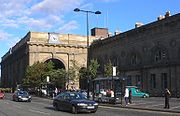
The building has a neoclassical
styled frontage, and its trainshed
has a distinctive roof with three curved, arch
ed spans
— the first example of its kind, which set the 'house style' for the NER's subsequent main stations, culminating in the very last major British example half a century later, the rebuilt and enlarged Hull Paragon
in 1904. A portico
, designed by Thomas Prosser, was added to the station entrance in 1863, and the trainshed was extended southwards in the 1890s with a new span designed by William Bell
.
An underground station for Tyne and Wear Metro
trains was constructed during the late 1970s, and opened in 1981. Part of the portico was temporarily dismantled while excavation work for this station took place. The metro station sees 5 million passengers a year and is the third busiest station on the system.
 The National Rail station has 12 platforms. The arrangement is:
. Passenger services are operated by several companies:
on one of two bridges. The High Level Bridge
, to the south-east of the station, was designed by Robert Stephenson
and opened on 27 September 1849, and is the older of the two. Its location meant that north-south trains had to reverse in the station to continue their journey. The King Edward VII Bridge
, to the south-west of the station, was opened on 10 July 1906, allowing north-south trains to continue without reversing. With these two bridges, the trackwork
north and south of the river forms a complete circle, allowing trains to be turned around if necessary. The former Gateshead depot
, situated next to the connecting tracks on the south side of the Tyne, mirrored Newcastle station.
The station was famed for its highly complex diamond crossing
to the east of the station. This facilitated access to the High Level Bridge and northbound East Coast Main Line and was said to be the greatest such crossing in the world. The crossing has been greatly simplified in recent years, however, as the opening of the Metro
brought about the withdrawal of many heavy-rail suburban services and the closure of the platforms they operated from, and removed the need for such a complex crossing. Heaton depot
is to the north of the station, on the East Coast Main Line.
, one of five underground stations serving the city centre. Central is an interchange between the Yellow and Green lines, and is the last stop prior to crossing the River Tyne
towards Gateshead
.
Train station
A train station, also called a railroad station or railway station and often shortened to just station,"Station" is commonly understood to mean "train station" unless otherwise qualified. This is evident from dictionary entries e.g...
of the city of Newcastle upon Tyne
Newcastle upon Tyne
Newcastle upon Tyne is a city and metropolitan borough of Tyne and Wear, in North East England. Historically a part of Northumberland, it is situated on the north bank of the River Tyne...
, England
England
England is a country that is part of the United Kingdom. It shares land borders with Scotland to the north and Wales to the west; the Irish Sea is to the north west, the Celtic Sea to the south west, with the North Sea to the east and the English Channel to the south separating it from continental...
and is a principal stop on the East Coast Main Line
East Coast Main Line
The East Coast Main Line is a long electrified high-speed railway link between London, Peterborough, Doncaster, Wakefield, Leeds, York, Darlington, Newcastle and Edinburgh...
. It opened in 1850 and is a Grade I listed building. The railway station is connected to the adjacent underground Central Station Metro station
Central Station Metro station
Newcastle Central Station is a underground station on the Tyne and Wear Metro in Newcastle upon Tyne, England. It is located below Newcastle railway station, from which the Metro station gets its name. There are entrances to it from both inside and outside the main line station...
on the Tyne and Wear Metro
Tyne and Wear Metro
The Tyne and Wear Metro, also known as the Metro, is a light rail system in North East England, serving Newcastle upon Tyne, Gateshead, South Tyneside, North Tyneside and Sunderland. It opened in 1980 and in 2007–2008 provided 40 million public journeys on its network of nearly...
.
East Coast
East Coast (train operating company)
East Coast is a British train operating company running high-speed passenger services on the East Coast Main Line between London, Yorkshire, the North East and Scotland...
is the primary operator at the station providing Inter-city rail
Inter-city rail
Inter-city rail services are express passenger train services that cover longer distances than commuter or regional trains.There is no precise definition of inter-city rail. Its meaning may vary from country to country...
services southbound to York
York
York is a walled city, situated at the confluence of the Rivers Ouse and Foss in North Yorkshire, England. The city has a rich heritage and has provided the backdrop to major political events throughout much of its two millennia of existence...
, Doncaster
Doncaster
Doncaster is a town in South Yorkshire, England, and the principal settlement of the Metropolitan Borough of Doncaster. The town is about from Sheffield and is popularly referred to as "Donny"...
and London
London
London is the capital city of :England and the :United Kingdom, the largest metropolitan area in the United Kingdom, and the largest urban zone in the European Union by most measures. Located on the River Thames, London has been a major settlement for two millennia, its history going back to its...
and northbound to Edinburgh
Edinburgh
Edinburgh is the capital city of Scotland, the second largest city in Scotland, and the eighth most populous in the United Kingdom. The City of Edinburgh Council governs one of Scotland's 32 local government council areas. The council area includes urban Edinburgh and a rural area...
and Glasgow
Glasgow
Glasgow is the largest city in Scotland and third most populous in the United Kingdom. The city is situated on the River Clyde in the country's west central lowlands...
. Other mainline services are operated by CrossCountry
CrossCountry
CrossCountry is the brand name of XC Trains Ltd., a British train operating company owned by Arriva...
southbound to Leeds
Leeds
Leeds is a city and metropolitan borough in West Yorkshire, England. In 2001 Leeds' main urban subdivision had a population of 443,247, while the entire city has a population of 798,800 , making it the 30th-most populous city in the European Union.Leeds is the cultural, financial and commercial...
, Sheffield
Sheffield
Sheffield is a city and metropolitan borough of South Yorkshire, England. Its name derives from the River Sheaf, which runs through the city. Historically a part of the West Riding of Yorkshire, and with some of its southern suburbs annexed from Derbyshire, the city has grown from its largely...
, Derby
Derby
Derby , is a city and unitary authority in the East Midlands region of England. It lies upon the banks of the River Derwent and is located in the south of the ceremonial county of Derbyshire. In the 2001 census, the population of the city was 233,700, whilst that of the Derby Urban Area was 229,407...
, Birmingham
Birmingham
Birmingham is a city and metropolitan borough in the West Midlands of England. It is the most populous British city outside the capital London, with a population of 1,036,900 , and lies at the heart of the West Midlands conurbation, the second most populous urban area in the United Kingdom with a...
, Bournemouth
Bournemouth
Bournemouth is a large coastal resort town in the ceremonial county of Dorset, England. According to the 2001 Census the town has a population of 163,444, making it the largest settlement in Dorset. It is also the largest settlement between Southampton and Plymouth...
, Bristol
Bristol
Bristol is a city, unitary authority area and ceremonial county in South West England, with an estimated population of 433,100 for the unitary authority in 2009, and a surrounding Larger Urban Zone with an estimated 1,070,000 residents in 2007...
, Cardiff
Cardiff
Cardiff is the capital, largest city and most populous county of Wales and the 10th largest city in the United Kingdom. The city is Wales' chief commercial centre, the base for most national cultural and sporting institutions, the Welsh national media, and the seat of the National Assembly for...
, Plymouth
Plymouth
Plymouth is a city and unitary authority area on the coast of Devon, England, about south-west of London. It is built between the mouths of the rivers Plym to the east and Tamar to the west, where they join Plymouth Sound...
and Reading
Reading, Berkshire
Reading is a large town and unitary authority area in England. It is located in the Thames Valley at the confluence of the River Thames and River Kennet, and on both the Great Western Main Line railway and the M4 motorway, some west of London....
and also northbound to Scotland
Scotland
Scotland is a country that is part of the United Kingdom. Occupying the northern third of the island of Great Britain, it shares a border with England to the south and is bounded by the North Sea to the east, the Atlantic Ocean to the north and west, and the North Channel and Irish Sea to the...
while First TransPennine Express
First TransPennine Express
First TransPennine Express is a British train operating company. It is a joint operation between First Group and Keolis . It operates regular passenger services in northern England, including services linking the west and east coasts across the Pennines...
provides services to Liverpool
Liverpool
Liverpool is a city and metropolitan borough of Merseyside, England, along the eastern side of the Mersey Estuary. It was founded as a borough in 1207 and was granted city status in 1880...
and Manchester
Manchester
Manchester is a city and metropolitan borough in Greater Manchester, England. According to the Office for National Statistics, the 2010 mid-year population estimate for Manchester was 498,800. Manchester lies within one of the UK's largest metropolitan areas, the metropolitan county of Greater...
via Leeds. Northern Rail
Northern Rail
Northern Rail is a British train operating company that has operated local passenger services in Northern England since 2004. Northern Rail's owner, Serco-Abellio, is a consortium formed of Abellio and Serco, an international operator of public transport systems...
operates local and regional services across the North East
North East England
North East England is one of the nine official regions of England. It covers Northumberland, County Durham, Tyne and Wear, and Teesside . The only cities in the region are Durham, Newcastle upon Tyne and Sunderland...
and Cumbria
Cumbria
Cumbria , is a non-metropolitan county in North West England. The county and Cumbria County Council, its local authority, came into existence in 1974 after the passage of the Local Government Act 1972. Cumbria's largest settlement and county town is Carlisle. It consists of six districts, and in...
, notably along the Tyne Valley Line to Carlisle
Carlisle railway station
Carlisle railway station, also known as Carlisle Citadel station, is a railway station whichserves the Cumbrian City of Carlisle, England, and is a major station on the West Coast Main Line, lying south of Glasgow Central, and north of London Euston...
via MetroCentre and Hexham
Hexham
Hexham is a market town and civil parish in Northumberland, England, located south of the River Tyne, and was the administrative centre for the Tynedale district from 1974 to 2009. The three major towns in Tynedale were Hexham, Prudhoe and Haltwhistle, although in terms of population, Prudhoe was...
, northbound to Morpeth
Morpeth
Morpeth may mean:*Morpeth, Northumberland, England**Morpeth , a former parliamentary constituency*Morpeth, New South Wales, Australia*Morpeth, Ontario, Canada*Morpeth School - a secondary school in the East End of London, England...
and southbound to Middlesbrough
Middlesbrough
Middlesbrough is a large town situated on the south bank of the River Tees in north east England, that sits within the ceremonial county of North Yorkshire...
and Sunderland while East Coast provides services to Durham
Durham
Durham is a city in north east England. It is within the County Durham local government district, and is the county town of the larger ceremonial county...
and Darlington
Darlington
Darlington is a market town in the Borough of Darlington, part of the ceremonial county of County Durham, England. It lies on the small River Skerne, a tributary of the River Tees, not far from the main river. It is the main population centre in the borough, with a population of 97,838 as of 2001...
.
Construction and opening
The station was designed by John DobsonJohn Dobson (architect)
John Dobson was a 19th-century English architect in the neoclassical tradition. He became the most noted architect in the North of England. Churches and houses by him dot the North East - Nunnykirk Hall, Meldon Park, Mitford Hall, Lilburn Tower, St John the Baptist Church in Otterburn,...
for two companies: the York, Newcastle and Berwick Railway (YN&BR) and the Newcastle and Carlisle Railway
Newcastle and Carlisle Railway
The Newcastle and Carlisle Railway, occasionally referred to as the Tyne Valley Line, is a railway line in northern England. The line was built in the 1830s, and links the city of Newcastle upon Tyne in Tyne and Wear with in Cumbria. Formal opening took place on 18 June 1838.The line follows the...
(N&CR). The YN&BR merged with other companies in 1854 to form the North Eastern Railway
North Eastern Railway (UK)
The North Eastern Railway , was an English railway company. It was incorporated in 1854, when four existing companies were combined, and was absorbed into the London and North Eastern Railway at the Grouping in 1923...
(NER), which later absorbed the N&CR in 1862. The station was constructed in collaboration with Robert Stephenson
Robert Stephenson
Robert Stephenson FRS was an English civil engineer. He was the only son of George Stephenson, the famed locomotive builder and railway engineer; many of the achievements popularly credited to his father were actually the joint efforts of father and son.-Early life :He was born on the 16th of...
(also responsible for the High Level Bridge
High Level Bridge
The High Level Bridge is a road and railway bridge spanning the River Tyne between Newcastle upon Tyne and Gateshead in North East England.-Design:...
) between 1845 and 1850. The opening ceremony, attended by Queen Victoria
Victoria of the United Kingdom
Victoria was the monarch of the United Kingdom of Great Britain and Ireland from 20 June 1837 until her death. From 1 May 1876, she used the additional title of Empress of India....
, took place on 29 August 1850. Originally named Newcastle-on-Tyne Central, the station name was simplified to Newcastle at some point between 1948 and 1953.
The building has a neoclassical
Neoclassical architecture
Neoclassical architecture was an architectural style produced by the neoclassical movement that began in the mid-18th century, manifested both in its details as a reaction against the Rococo style of naturalistic ornament, and in its architectural formulas as an outgrowth of some classicizing...
styled frontage, and its trainshed
Train shed
A train shed is an adjacent building to a railway station where the tracks and platforms are covered by a roof. It is also known as an overall roof...
has a distinctive roof with three curved, arch
Arch
An arch is a structure that spans a space and supports a load. Arches appeared as early as the 2nd millennium BC in Mesopotamian brick architecture and their systematic use started with the Ancient Romans who were the first to apply the technique to a wide range of structures.-Technical aspects:The...
ed spans
Span (architecture)
Span is the distance between two intermediate supports for a structure, e.g. a beam or a bridge.A span can be closed by a solid beam or of a rope...
— the first example of its kind, which set the 'house style' for the NER's subsequent main stations, culminating in the very last major British example half a century later, the rebuilt and enlarged Hull Paragon
Hull Paragon railway station
Hull Paragon Interchange is a transport complex in the centre of the city of Kingston upon Hull , England, which opened in September 2007. It integrates the city's railway station with the formerly separate bus and coach station...
in 1904. A portico
Portico
A portico is a porch leading to the entrance of a building, or extended as a colonnade, with a roof structure over a walkway, supported by columns or enclosed by walls...
, designed by Thomas Prosser, was added to the station entrance in 1863, and the trainshed was extended southwards in the 1890s with a new span designed by William Bell
William Bell
-Musicians:* William Bell * William Bell * William Henry Bell , composer -Politicians:* Dr. William Bell , founder of Manitou Springs, Colorado...
.
An underground station for Tyne and Wear Metro
Tyne and Wear Metro
The Tyne and Wear Metro, also known as the Metro, is a light rail system in North East England, serving Newcastle upon Tyne, Gateshead, South Tyneside, North Tyneside and Sunderland. It opened in 1980 and in 2007–2008 provided 40 million public journeys on its network of nearly...
trains was constructed during the late 1970s, and opened in 1981. Part of the portico was temporarily dismantled while excavation work for this station took place. The metro station sees 5 million passengers a year and is the third busiest station on the system.
Layout
- Platform 1 is an east facing bay platform which handles terminating local services and also some terminating long distance CrossCountryCrossCountryCrossCountry is the brand name of XC Trains Ltd., a British train operating company owned by Arriva...
services from the south over the High Level BridgeHigh Level BridgeThe High Level Bridge is a road and railway bridge spanning the River Tyne between Newcastle upon Tyne and Gateshead in North East England.-Design:...
. - Platforms 2 & 3 are main through platforms for East Coast Main LineEast Coast Main LineThe East Coast Main Line is a long electrified high-speed railway link between London, Peterborough, Doncaster, Wakefield, Leeds, York, Darlington, Newcastle and Edinburgh...
long distance services. They also have train watering equipment so are used for terminating trains that return south. - Platform 4 is used mainly for long distance services heading south.
- Platforms 5/6 share the northbound side, and Platforms 7/8 the southbound side, of the newer island platform, and are used mainly by Northern Rail services.
- Platforms 9 to 12 are west facing bay platforms for various services, including Transpennine ExpressFirst TransPennine ExpressFirst TransPennine Express is a British train operating company. It is a joint operation between First Group and Keolis . It operates regular passenger services in northern England, including services linking the west and east coasts across the Pennines...
and some terminating services from the Carlisle direction, and on rare occasions, CrossCountry services. First ScotRailFirst ScotRailScotRail Railways Ltd. is the FirstGroup-owned train operating company running domestic passenger trains within Scotland, northern England and the cross-border Caledonian Sleeper service to London using the brand ScotRail which is the property of the Scottish Government...
services from Glasgow Central normally use platform 12.
Train services
Newcastle is a principal stop on the East Coast Main LineEast Coast Main Line
The East Coast Main Line is a long electrified high-speed railway link between London, Peterborough, Doncaster, Wakefield, Leeds, York, Darlington, Newcastle and Edinburgh...
. Passenger services are operated by several companies:
- East CoastEast Coast (train operating company)East Coast is a British train operating company running high-speed passenger services on the East Coast Main Line between London, Yorkshire, the North East and Scotland...
trains run south to London King's Cross via YorkYork railway stationYork railway station is a main-line railway station in the city of York, England. It lies on the East Coast Main Line north of London's King's Cross station towards Edinburgh's Waverley Station...
, DoncasterDoncaster railway stationDoncaster railway station serves the town of Doncaster, in South Yorkshire, England. It is situated on the East Coast Main Line north of London Kings Cross, and is about five minutes walk from Doncaster town centre. The station is managed by East Coast...
and PeterboroughPeterborough railway stationPeterborough railway station serves the city of Peterborough, England. It is located approximately north of London Kings Cross on the East Coast Main Line...
; and north to Edinburgh WaverleyEdinburgh Waverley railway stationEdinburgh Waverley railway station is the main railway station in the Scottish capital Edinburgh. Covering an area of over 25 acres in the centre of the city, it is the second-largest main line railway station in the United Kingdom in terms of area, the largest being...
, Glasgow CentralGlasgow Central stationGlasgow Central is the larger of the two present main-line railway terminals in Glasgow, the largest city in Scotland. The station was opened by the Caledonian Railway on 31 July 1879 and is currently managed by Network Rail...
, AberdeenAberdeen railway stationAberdeen railway station is the main railway station in Aberdeen, Scotland. It is the busiest railway station in Scotland north of the major cities of Glasgow and Edinburgh.- History :...
and InvernessInverness railway stationInverness railway station is the railway station serving the Scottish city of Inverness.- History :Opened on 5 November 1855 as the western terminus of the Inverness and Nairn Railway, it is now the terminus of the Highland Main Line, the Aberdeen-Inverness Line , the Kyle of Lochalsh Line and the...
. - CrossCountryCrossCountryCrossCountry is the brand name of XC Trains Ltd., a British train operating company owned by Arriva...
services run south to their Birmingham New Street hub via YorkYork railway stationYork railway station is a main-line railway station in the city of York, England. It lies on the East Coast Main Line north of London's King's Cross station towards Edinburgh's Waverley Station...
, Leeds/DoncasterDoncaster railway stationDoncaster railway station serves the town of Doncaster, in South Yorkshire, England. It is situated on the East Coast Main Line north of London Kings Cross, and is about five minutes walk from Doncaster town centre. The station is managed by East Coast...
, Sheffield and Derby and onwards to ReadingReading railway stationReading railway station is a major rail transport hub in the English town of Reading. It is situated on the northern edge of the town centre, close to the main retail and commercial areas, and also the River Thames...
via OxfordOxford railway stationOxford railway station is a mainline railway station serving the city of Oxford, England. It is about west of the city centre, northwest of Frideswide Square and the eastern end of Botley Road, and on the line linking with . It is also on the line for trains between and Hereford via...
; PlymouthPlymouth railway stationPlymouth railway station serves the city of Plymouth, Devon, England. It is situated on the northern edge of the city centre close to the North Cross roundabout...
or PenzancePenzance railway stationPenzance railway station serves the town of Penzance, Cornwall, UK. The station is the western terminus of the Cornish Main Line from London Paddington station. The current journey time to or from London is about five hours....
via Cheltenham SpaCheltenham Spa railway stationCheltenham Spa railway station is in Gloucestershire, England, on the Bristol-Birmingham main line. It is managed by First Great Western and is about one mile from the town centre.-History:...
and Bristol Temple MeadsBristol Temple Meads railway stationBristol Temple Meads railway station is the oldest and largest railway station in Bristol, England. It is an important transport hub for public transport in Bristol, with bus services to various parts of the city and surrounding districts, and a ferry service to the city centre in addition to the...
; and north to EdinburghEdinburgh Waverley railway stationEdinburgh Waverley railway station is the main railway station in the Scottish capital Edinburgh. Covering an area of over 25 acres in the centre of the city, it is the second-largest main line railway station in the United Kingdom in terms of area, the largest being...
, Glasgow and AberdeenAberdeen railway stationAberdeen railway station is the main railway station in Aberdeen, Scotland. It is the busiest railway station in Scotland north of the major cities of Glasgow and Edinburgh.- History :...
. - First TransPennine ExpressFirst TransPennine ExpressFirst TransPennine Express is a British train operating company. It is a joint operation between First Group and Keolis . It operates regular passenger services in northern England, including services linking the west and east coasts across the Pennines...
trains run to Manchester AirportManchester Airport railway stationManchester Airport railway station is the railway station that serves Manchester Airport and is built into the airport's terminal buildings. The station was opened together with the second airport terminal in 1993.- Description:...
and Liverpool Lime StreetLiverpool Lime Street railway stationLiverpool Lime Street is a railway station serving the city centre of Liverpool, England. The station lies on a branch of the West Coast Main Line from London Euston, and on the Wirral Line of the Merseyrail network...
via York, Leeds, HuddersfieldHuddersfield railway stationHuddersfield railway station serves the town of Huddersfield in West Yorkshire, England.The station is managed by First TransPennine Express who provide trains between the North East, North and East Yorkshire, and Leeds to the east and Manchester Piccadilly and North West.It is also served by local...
and Manchester PiccadillyManchester Piccadilly stationManchester Piccadilly is the principal railway station in Manchester, England. It serves intercity routes to London Euston, Birmingham New Street, South Wales, the south coast of England, Edinburgh and Glasgow Central, and routes throughout northern England...
. - First ScotRailFirst ScotRailScotRail Railways Ltd. is the FirstGroup-owned train operating company running domestic passenger trains within Scotland, northern England and the cross-border Caledonian Sleeper service to London using the brand ScotRail which is the property of the Scottish Government...
operates daily services to Glasgow Central along the Tyne ValleyNewcastle and Carlisle RailwayThe Newcastle and Carlisle Railway, occasionally referred to as the Tyne Valley Line, is a railway line in northern England. The line was built in the 1830s, and links the city of Newcastle upon Tyne in Tyne and Wear with in Cumbria. Formal opening took place on 18 June 1838.The line follows the...
and Glasgow South Western LineGlasgow South Western LineThe Glasgow South Western Line is a mainline railway in Scotland that runs from Glasgow to Kilmarnock, and then either via Dumfries, or Stranraer via Ayr, with a branch to East Kilbride.- History :...
s via Carlisle and DumfriesDumfries railway stationDumfries railway station serves the town of Dumfries in Dumfries and Galloway, Scotland. It is located on the Glasgow South Western Line and is managed by First ScotRail who provide all passenger train services...
. - Northern RailNorthern RailNorthern Rail is a British train operating company that has operated local passenger services in Northern England since 2004. Northern Rail's owner, Serco-Abellio, is a consortium formed of Abellio and Serco, an international operator of public transport systems...
operates local and regional services; north along the East Coast Main Line to MorpethMorpeth railway stationMorpeth railway station is a railway station on the East Coast Main Line in Northumberland, northern England, serving the town of Morpeth.- History :The station was opened by the Newcastle and Berwick Railway on 1 March 1847...
and ChathillChathill railway stationChathill railway station is a railway station that serves the village of Chathill in Northumberland, England, and the nearby villages of Seahouses, Embleton, Bamburgh and Belford....
; south along the Durham Coast LineDurham Coast LineThe Durham Coast Line is the name given to the railway line which links Newcastle upon Tyne with Middlesbrough, via Sunderland and Hartlepool...
to SunderlandSunderland stationSunderland Station is a National Rail and Tyne and Wear Metro station in the city centre of Sunderland, North East England. It is the only station in the country where both heavy rail and light rail services use the same platforms...
, MiddlesbroughMiddlesbrough railway stationMiddlesbrough railway station serves the large town of Middlesbrough in the borough of Middlesbrough and the ceremonial county of North Yorkshire, England. The station is managed by First TransPennine Express and has two platforms...
and NunthorpeNunthorpe railway stationNunthorpe railway station serves the town of Nunthorpe within the borough of Middlesbrough in the ceremonial county of North Yorkshire, England. It is located on the Esk Valley Line and is operated by Northern Rail who provide all of the station's passenger services. One of the two passing loops...
(plus a limited service via the East Coast Main Line to DarlingtonDarlington railway stationDarlington railway station, also known as Darlington Bank Top, is the main railway station for the town of Darlington, in the ceremonial county of County Durham, England. The station is located on the East Coast Main Line north of London Kings Cross....
and onwards along the Tees Valley LineTees Valley LineThe Tees Valley Line is a name for the railway route between Bishop Auckland and Saltburn via Darlington and Middlesbrough. Also operated on the line are services from Newcastle-upon-Tyne to Middlesbrough and Saltburn via Darlington....
to Middlesbrough and SaltburnSaltburn railway stationSaltburn Railway Station serves the town of Saltburn-by-the-Sea in the borough of Redcar and Cleveland and the ceremonial county of North Yorkshire, England. It is the terminus of the Tees Valley Line and is operated by Northern Rail who provide all passenger train services...
); and west along the Tyne Valley Line to MetroCentreMetroCentre railway stationMetroCentre railway station is a railway station that serves the MetroCentre shopping and leisure complex in Gateshead, Tyne and Wear. It is located on the Tyne Valley Line from Newcastle upon Tyne to Carlisle, and is managed by Northern Rail....
, HexhamHexham railway stationHexham railway station serves the town of Hexham in Northumberland, England. It is located on the Tyne Valley Line which runs from Newcastle upon Tyne to Carlisle, and is managed by Northern Rail who provide most passenger train services.-History:...
, CarlisleCarlisle railway stationCarlisle railway station, also known as Carlisle Citadel station, is a railway station whichserves the Cumbrian City of Carlisle, England, and is a major station on the West Coast Main Line, lying south of Glasgow Central, and north of London Euston...
and WhitehavenWhitehaven railway stationWhitehaven Railway Station serves the town of Whitehaven in Cumbria, England. The railway station is a stop on the scenic Cumbrian Coast Line south west of Carlisle....
.
Railway infrastructure
Trains may cross the River TyneRiver Tyne
The River Tyne is a river in North East England in Great Britain. It is formed by the confluence of two rivers: the North Tyne and the South Tyne. These two rivers converge at Warden Rock near Hexham in Northumberland at a place dubbed 'The Meeting of the Waters'.The North Tyne rises on the...
on one of two bridges. The High Level Bridge
High Level Bridge
The High Level Bridge is a road and railway bridge spanning the River Tyne between Newcastle upon Tyne and Gateshead in North East England.-Design:...
, to the south-east of the station, was designed by Robert Stephenson
Robert Stephenson
Robert Stephenson FRS was an English civil engineer. He was the only son of George Stephenson, the famed locomotive builder and railway engineer; many of the achievements popularly credited to his father were actually the joint efforts of father and son.-Early life :He was born on the 16th of...
and opened on 27 September 1849, and is the older of the two. Its location meant that north-south trains had to reverse in the station to continue their journey. The King Edward VII Bridge
King Edward VII Bridge
The King Edward VII Bridge is a railway bridge spanning the River Tyne between Newcastle upon Tyne and Gateshead, in North East England.-History:...
, to the south-west of the station, was opened on 10 July 1906, allowing north-south trains to continue without reversing. With these two bridges, the trackwork
Rail tracks
The track on a railway or railroad, also known as the permanent way, is the structure consisting of the rails, fasteners, sleepers and ballast , plus the underlying subgrade...
north and south of the river forms a complete circle, allowing trains to be turned around if necessary. The former Gateshead depot
Gateshead TMD
Gateshead TMD was a railway Traction Maintenance Depot situated in Gateshead, England. The depot was closed in 1991. The depot code was 52A during the steam era and GD later on.-External links:*An of the depot site.*-References:...
, situated next to the connecting tracks on the south side of the Tyne, mirrored Newcastle station.
The station was famed for its highly complex diamond crossing
Level junction
In U.S. railroad practice, a level junction is a railway junction that has a track configuration in which merging or crossing railroad lines provide track connections with each other that require trains to cross over in front of opposing traffic at grade In U.S. railroad practice, a level junction...
to the east of the station. This facilitated access to the High Level Bridge and northbound East Coast Main Line and was said to be the greatest such crossing in the world. The crossing has been greatly simplified in recent years, however, as the opening of the Metro
Tyne and Wear Metro
The Tyne and Wear Metro, also known as the Metro, is a light rail system in North East England, serving Newcastle upon Tyne, Gateshead, South Tyneside, North Tyneside and Sunderland. It opened in 1980 and in 2007–2008 provided 40 million public journeys on its network of nearly...
brought about the withdrawal of many heavy-rail suburban services and the closure of the platforms they operated from, and removed the need for such a complex crossing. Heaton depot
Heaton TMD
Heaton TMD is a railway Traction Maintenance Depot situated in the Heaton area of Newcastle upon Tyne, England. It is located next to the East Coast Main Line, around east of Newcastle railway station. The depot is operated by Northern Rail, and mostly houses stock operated by them and Grand Central...
is to the north of the station, on the East Coast Main Line.
Tyne & Wear Metro
Newcastle station is located above Central metro station on the Tyne and Wear MetroTyne and Wear Metro
The Tyne and Wear Metro, also known as the Metro, is a light rail system in North East England, serving Newcastle upon Tyne, Gateshead, South Tyneside, North Tyneside and Sunderland. It opened in 1980 and in 2007–2008 provided 40 million public journeys on its network of nearly...
, one of five underground stations serving the city centre. Central is an interchange between the Yellow and Green lines, and is the last stop prior to crossing the River Tyne
River Tyne
The River Tyne is a river in North East England in Great Britain. It is formed by the confluence of two rivers: the North Tyne and the South Tyne. These two rivers converge at Warden Rock near Hexham in Northumberland at a place dubbed 'The Meeting of the Waters'.The North Tyne rises on the...
towards Gateshead
Gateshead
Gateshead is a town in Tyne and Wear, England and is the main settlement in the Metropolitan Borough of Gateshead. Historically a part of County Durham, it lies on the southern bank of the River Tyne opposite Newcastle upon Tyne and together they form the urban core of Tyneside...
.
See also
- Blyth & Tyne RailwayBlyth & Tyne RailwayThe Blyth and Tyne Railway was a railway in Northumberland, England chiefly constructed to link the collieries in Ashington, Seghill and Blyth to the River Tyne at Percy Main. It later expanded to link Tynemouth and Newcastle upon Tyne, providing a passenger service to Whitley Bay...
- Central Station Metro stationCentral Station Metro stationNewcastle Central Station is a underground station on the Tyne and Wear Metro in Newcastle upon Tyne, England. It is located below Newcastle railway station, from which the Metro station gets its name. There are entrances to it from both inside and outside the main line station...
- Newcastle & North Shields Railway
- North Tyneside LoopNorth Tyneside LoopThe North Tyneside Loop refers to the railway lines in North Tyneside from Newcastle upon Tyne via Wallsend, North Shields, Whitley Bay, Backworth, Benton and South Gosforth back to Newcastle...
- Tyneside ElectricsTyneside ElectricsThe Tyneside Electrics refers to the suburban railways on Tyneside that were electrified by the North Eastern Railway and the London and North Eastern Railway. The North Tyneside loop was electrified from 1904 onwards and formed one of the earliest suburban electric networks, the South Tyneside...
External links
- Newcastle Central Station - Part of the 2000 art exhibition "Stephenson's Legacy." Includes old photographs of the station.