

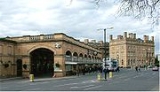
York railway station

Encyclopedia
York railway station is a main-line railway station
in the city of York
, England
. It lies on the East Coast Main Line
(ECML) 188.5 miles (303 km) north of London
's King's Cross station towards Edinburgh
's Waverley Station
. Originally it was part of the North Eastern Railway
.
York is one of the most important railway junction stations on the British railway network, approximately halfway between London and Edinburgh; it is also a few miles north of the point where the Cross Country and Trans-Pennine routes via Leeds leave the ECML. The junction was historically a major site for rolling stock manufacture, maintenance and repair.
, opened in 1839 by the York and North Midland Railway
. It was succeeded in 1841, inside the walls, by what is now York old railway station
. In due course, the irksome requirement that through trains between London and Newcastle needed to reverse out of the old York station in order to continue their journey necessitated the construction of a new through station outside the walls. This was the present station, designed by the North Eastern Railway
architects Thomas Prosser and William Peachey, which opened in 1877. It had 13 platforms and was at that time the largest station in the world. As part of the new station project, the Royal Station Hotel (now The Royal York Hotel
), designed by Peachey, opened in 1878.
In 1909 new platforms were added, and in 1938 the current footbridge was built and the station resignalled. The building was damaged during the Second World War and extensively repaired in 1947. The track layout through and around the station was remodelled again in 1988 as part of the resignalling scheme that was carried out prior to the electrification
of the ECML shortly afterwards. This resulted in several bay platforms (mainly on the eastern side) being taken out of service and the track to them removed. At the same time a new signalling centre (York IECC
) was commissioned on the western side of the station to control the new layout and also take over the function of several other signal boxes on the main line. The IECC here now supervises the main line from Temple Hirst (near Doncaster) through to , along with sections of the various routes branching from it. It has also (since 2001–2) taken over responsibility for the control area of the former power box at and thus signals trains as far away as and .
In 2006–7, in order to improve facilities for bus, taxi and car users as well as pedestrians and cyclists, the approaches to the station were reorganised. The former motive power depot and goods station now house the National Railway Museum
.
) or via lifts and either of two pedestrian tunnels.
s (similar to those in Leeds) were planned, but the City of York Council wished to avoid spoiling the historic nature of the station. The then operator National Express East Coast planned to appeal the decision but the plans were scrapped altogether upon handover to East Coast.
Platforms 10 and 11 exist outside the main body of the station. Another siding (the former fruit dock) exists opposite Platform 11.
 The station is operated by East Coast
on behalf of Network Rail
, and provides services to:
The station is used by the following TOCs
Train station
A train station, also called a railroad station or railway station and often shortened to just station,"Station" is commonly understood to mean "train station" unless otherwise qualified. This is evident from dictionary entries e.g...
in the city of York
York
York is a walled city, situated at the confluence of the Rivers Ouse and Foss in North Yorkshire, England. The city has a rich heritage and has provided the backdrop to major political events throughout much of its two millennia of existence...
, England
England
England is a country that is part of the United Kingdom. It shares land borders with Scotland to the north and Wales to the west; the Irish Sea is to the north west, the Celtic Sea to the south west, with the North Sea to the east and the English Channel to the south separating it from continental...
. It lies on the East Coast Main Line
East Coast Main Line
The East Coast Main Line is a long electrified high-speed railway link between London, Peterborough, Doncaster, Wakefield, Leeds, York, Darlington, Newcastle and Edinburgh...
(ECML) 188.5 miles (303 km) north of London
London
London is the capital city of :England and the :United Kingdom, the largest metropolitan area in the United Kingdom, and the largest urban zone in the European Union by most measures. Located on the River Thames, London has been a major settlement for two millennia, its history going back to its...
's King's Cross station towards Edinburgh
Edinburgh
Edinburgh is the capital city of Scotland, the second largest city in Scotland, and the eighth most populous in the United Kingdom. The City of Edinburgh Council governs one of Scotland's 32 local government council areas. The council area includes urban Edinburgh and a rural area...
's Waverley Station
Edinburgh Waverley railway station
Edinburgh Waverley railway station is the main railway station in the Scottish capital Edinburgh. Covering an area of over 25 acres in the centre of the city, it is the second-largest main line railway station in the United Kingdom in terms of area, the largest being...
. Originally it was part of the North Eastern Railway
North Eastern Railway (UK)
The North Eastern Railway , was an English railway company. It was incorporated in 1854, when four existing companies were combined, and was absorbed into the London and North Eastern Railway at the Grouping in 1923...
.
York is one of the most important railway junction stations on the British railway network, approximately halfway between London and Edinburgh; it is also a few miles north of the point where the Cross Country and Trans-Pennine routes via Leeds leave the ECML. The junction was historically a major site for rolling stock manufacture, maintenance and repair.
History
The first York railway station was a temporary wooden building on Queen Street outside the walls of the cityYork city walls
The English city of York has, since Roman times, been defended by walls of one form or another. To this day, substantial portions of the walls remain, and York has more miles of intact wall than any other city in England...
, opened in 1839 by the York and North Midland Railway
York and North Midland Railway
The York and North Midland Railway was a railway company in the United Kingdom which opened in 1839, connecting York, with the Leeds and Selby Railway and in 1840 with the North Midland Railway at Normanton near Leeds.-Origins:...
. It was succeeded in 1841, inside the walls, by what is now York old railway station
York old railway station
York old railway station is a former railway station in the historic city of York, England. It is a Grade II* Listed building.-Origins:The first York railway station was a temporary building on Queen Street outside the walls of the city...
. In due course, the irksome requirement that through trains between London and Newcastle needed to reverse out of the old York station in order to continue their journey necessitated the construction of a new through station outside the walls. This was the present station, designed by the North Eastern Railway
North Eastern Railway (UK)
The North Eastern Railway , was an English railway company. It was incorporated in 1854, when four existing companies were combined, and was absorbed into the London and North Eastern Railway at the Grouping in 1923...
architects Thomas Prosser and William Peachey, which opened in 1877. It had 13 platforms and was at that time the largest station in the world. As part of the new station project, the Royal Station Hotel (now The Royal York Hotel
The Royal York Hotel
The Royal York Hotel is an historic Grade II listed building adjacent to York railway station. It is a five-storey building of yellow Scarborough brick and was completed in 1878, a year after the present station opened. The architect was William Peachey of the North Eastern Railway...
), designed by Peachey, opened in 1878.
In 1909 new platforms were added, and in 1938 the current footbridge was built and the station resignalled. The building was damaged during the Second World War and extensively repaired in 1947. The track layout through and around the station was remodelled again in 1988 as part of the resignalling scheme that was carried out prior to the electrification
Electrification
Electrification originally referred to the build out of the electrical generating and distribution systems which occurred in the United States, England and other countries from the mid 1880's until around 1940 and is in progress in developing countries. This also included the change over from line...
of the ECML shortly afterwards. This resulted in several bay platforms (mainly on the eastern side) being taken out of service and the track to them removed. At the same time a new signalling centre (York IECC
York IECC
York Integrated Electronic control centre is a major signal control centre on the East Coast Main Line railway between London and Edinburgh. The centre also contains the electric control centre for the line, and the LNE regional control office of Network Rail....
) was commissioned on the western side of the station to control the new layout and also take over the function of several other signal boxes on the main line. The IECC here now supervises the main line from Temple Hirst (near Doncaster) through to , along with sections of the various routes branching from it. It has also (since 2001–2) taken over responsibility for the control area of the former power box at and thus signals trains as far away as and .
In 2006–7, in order to improve facilities for bus, taxi and car users as well as pedestrians and cyclists, the approaches to the station were reorganised. The former motive power depot and goods station now house the National Railway Museum
National Railway Museum
The National Railway Museum is a museum in York forming part of the British National Museum of Science and Industry and telling the story of rail transport in Britain and its impact on society. It has won many awards, including the European Museum of the Year Award in 2001...
.
Layout
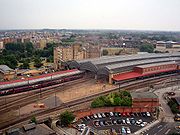
All the platforms except 9/10/11 are under the large, curved, glass and iron roof. They are accessed via a long footbridge (which also connects to the National Railway MuseumNational Railway Museum
The National Railway Museum is a museum in York forming part of the British National Museum of Science and Industry and telling the story of rail transport in Britain and its impact on society. It has won many awards, including the European Museum of the Year Award in 2001...
) or via lifts and either of two pedestrian tunnels.
Major renovation
The station was renovated in 2009. Platform 9 has been reconstructed and extensive lighting alterations were put in place. New automated ticket gateTurnstile
A turnstile, also called a baffle gate, is a form of gate which allows one person to pass at a time. It can also be made so as to enforce one-way traffic of people, and in addition, it can restrict passage only to people who insert a coin, a ticket, a pass, or similar...
s (similar to those in Leeds) were planned, but the City of York Council wished to avoid spoiling the historic nature of the station. The then operator National Express East Coast planned to appeal the decision but the plans were scrapped altogether upon handover to East Coast.
Platforms
The platforms at York have been renumbered several times, the current use is:- Platform 1: South-facing bay platformBay platformBay platform is a railway-related term commonly used in the UK and Australia to describe a dead-end platform at a railway station that has through lines...
mostly used for services to HullKingston upon HullKingston upon Hull , usually referred to as Hull, is a city and unitary authority area in the ceremonial county of the East Riding of Yorkshire, England. It stands on the River Hull at its junction with the Humber estuary, 25 miles inland from the North Sea. Hull has a resident population of...
and for stabling empty stock. - Platform 2: North-facing bay platformBay platformBay platform is a railway-related term commonly used in the UK and Australia to describe a dead-end platform at a railway station that has through lines...
connected only to the Scarborough branch, used mostly for stabling a spare TPX unit (along with the accompanying station siding). - Platform 3: Main southbound platform (but is signalled bi-directionally), accessible directly from the station concourse. Most southbound East CoastEast Coast (train operating company)East Coast is a British train operating company running high-speed passenger services on the East Coast Main Line between London, Yorkshire, the North East and Scotland...
or CrossCountryCrossCountryCrossCountry is the brand name of XC Trains Ltd., a British train operating company owned by Arriva...
services and some Westbound First Trans-Pennine Express services use this. - Platform 4: Northward continuation of platform 3 connected only to the Scarborough branch, used by most First Trans-Pennine Express services from Scarborough.
- Platform 5: Main northbound platform (but is signalled bi-directionally), accessible by footbridge or tunnel. Most northbound East CoastEast Coast (train operating company)East Coast is a British train operating company running high-speed passenger services on the East Coast Main Line between London, Yorkshire, the North East and Scotland...
or CrossCountryCrossCountryCrossCountry is the brand name of XC Trains Ltd., a British train operating company owned by Arriva...
services and some North/Eastbound First Trans-Pennine Express services use this. - Platform 6: South-facing bay platformBay platformBay platform is a railway-related term commonly used in the UK and Australia to describe a dead-end platform at a railway station that has through lines...
used mostly by Northern RailNorthern RailNorthern Rail is a British train operating company that has operated local passenger services in Northern England since 2004. Northern Rail's owner, Serco-Abellio, is a consortium formed of Abellio and Serco, an international operator of public transport systems...
commuter services, and sometimes by East Midlands TrainsEast Midlands TrainsEast Midlands Trains is a British passenger train operating company. Based in Derby, it provides train services in the East Midlands, chiefly in the counties of Lincolnshire, South Yorkshire, Nottinghamshire, Leicestershire, Derbyshire and Northamptonshire, and between the East Midlands and London...
services to London St. Pancras. - Platform 7: South-facing bay platformBay platformBay platform is a railway-related term commonly used in the UK and Australia to describe a dead-end platform at a railway station that has through lines...
used mostly by Northern RailNorthern RailNorthern Rail is a British train operating company that has operated local passenger services in Northern England since 2004. Northern Rail's owner, Serco-Abellio, is a consortium formed of Abellio and Serco, an international operator of public transport systems...
commuter services. - Platform 8: North-facing bay platformBay platformBay platform is a railway-related term commonly used in the UK and Australia to describe a dead-end platform at a railway station that has through lines...
used almost exclusively by Northern RailNorthern RailNorthern Rail is a British train operating company that has operated local passenger services in Northern England since 2004. Northern Rail's owner, Serco-Abellio, is a consortium formed of Abellio and Serco, an international operator of public transport systems...
trains on the Harrogate LineHarrogate LineThe Harrogate Line is the name given to a passenger rail service through parts of North Yorkshire and the West Yorkshire Metro area of northern England connecting Leeds to York by way of Harrogate and Knaresborough. The service is operated by Northern Rail, with a few additional workings by East...
. - Platforms 9, 10, 11: Bidirectional platforms used by East CoastEast Coast (train operating company)East Coast is a British train operating company running high-speed passenger services on the East Coast Main Line between London, Yorkshire, the North East and Scotland...
, Cross-Country and First TransPennine ExpressFirst TransPennine ExpressFirst TransPennine Express is a British train operating company. It is a joint operation between First Group and Keolis . It operates regular passenger services in northern England, including services linking the west and east coasts across the Pennines...
services.
Platforms 10 and 11 exist outside the main body of the station. Another siding (the former fruit dock) exists opposite Platform 11.
Services
East Coast (train operating company)
East Coast is a British train operating company running high-speed passenger services on the East Coast Main Line between London, Yorkshire, the North East and Scotland...
on behalf of Network Rail
Network Rail
Network Rail is the government-created owner and operator of most of the rail infrastructure in Great Britain .; it is not responsible for railway infrastructure in Northern Ireland...
, and provides services to:
- DoncasterDoncasterDoncaster is a town in South Yorkshire, England, and the principal settlement of the Metropolitan Borough of Doncaster. The town is about from Sheffield and is popularly referred to as "Donny"...
, RetfordRetfordRetford is a market town in Nottinghamshire in the East Midlands of England, located 31 miles from the city of Nottingham, and 23 miles west of Lincoln, in the district of Bassetlaw. The town is situated in a valley with the River Idle and the Chesterfield Canal running through the centre of the...
, GranthamGranthamGrantham is a market town within the South Kesteven district of Lincolnshire, England. It bestrides the East Coast Main Line railway , the historic A1 main north-south road, and the River Witham. Grantham is located approximately south of the city of Lincoln, and approximately east of Nottingham...
, NewarkNewark-on-TrentNewark-on-Trent is a market town in Nottinghamshire in the East Midlands region of England. It stands on the River Trent, the A1 , and the East Coast Main Line railway. The origins of the town are possibly Roman as it lies on an important Roman road, the Fosse Way...
, PeterboroughPeterboroughPeterborough is a cathedral city and unitary authority area in the East of England, with an estimated population of in June 2007. For ceremonial purposes it is in the county of Cambridgeshire. Situated north of London, the city stands on the River Nene which flows into the North Sea...
, StevenageStevenageStevenage is a town and borough in Hertfordshire, England. It is situated to the east of junctions 7 and 8 of the A1, and is between Letchworth Garden City to the north, and Welwyn Garden City to the south....
, LondonLondonLondon is the capital city of :England and the :United Kingdom, the largest metropolitan area in the United Kingdom, and the largest urban zone in the European Union by most measures. Located on the River Thames, London has been a major settlement for two millennia, its history going back to its...
and other stations on the ECML south - DarlingtonDarlingtonDarlington is a market town in the Borough of Darlington, part of the ceremonial county of County Durham, England. It lies on the small River Skerne, a tributary of the River Tees, not far from the main river. It is the main population centre in the borough, with a population of 97,838 as of 2001...
, DurhamDurhamDurham is a city in north east England. It is within the County Durham local government district, and is the county town of the larger ceremonial county...
, Newcastle upon TyneNewcastle upon TyneNewcastle upon Tyne is a city and metropolitan borough of Tyne and Wear, in North East England. Historically a part of Northumberland, it is situated on the north bank of the River Tyne...
, EdinburghEdinburghEdinburgh is the capital city of Scotland, the second largest city in Scotland, and the eighth most populous in the United Kingdom. The City of Edinburgh Council governs one of Scotland's 32 local government council areas. The council area includes urban Edinburgh and a rural area...
, GlasgowGlasgowGlasgow is the largest city in Scotland and third most populous in the United Kingdom. The city is situated on the River Clyde in the country's west central lowlands...
, AberdeenAberdeenAberdeen is Scotland's third most populous city, one of Scotland's 32 local government council areas and the United Kingdom's 25th most populous city, with an official population estimate of ....
, InvernessInvernessInverness is a city in the Scottish Highlands. It is the administrative centre for the Highland council area, and is regarded as the capital of the Highlands of Scotland...
and other stations on the ECML north - LeedsLeedsLeeds is a city and metropolitan borough in West Yorkshire, England. In 2001 Leeds' main urban subdivision had a population of 443,247, while the entire city has a population of 798,800 , making it the 30th-most populous city in the European Union.Leeds is the cultural, financial and commercial...
, SheffieldSheffieldSheffield is a city and metropolitan borough of South Yorkshire, England. Its name derives from the River Sheaf, which runs through the city. Historically a part of the West Riding of Yorkshire, and with some of its southern suburbs annexed from Derbyshire, the city has grown from its largely...
, DerbyDerbyDerby , is a city and unitary authority in the East Midlands region of England. It lies upon the banks of the River Derwent and is located in the south of the ceremonial county of Derbyshire. In the 2001 census, the population of the city was 233,700, whilst that of the Derby Urban Area was 229,407...
, BirminghamBirminghamBirmingham is a city and metropolitan borough in the West Midlands of England. It is the most populous British city outside the capital London, with a population of 1,036,900 , and lies at the heart of the West Midlands conurbation, the second most populous urban area in the United Kingdom with a...
, BristolBristolBristol is a city, unitary authority area and ceremonial county in South West England, with an estimated population of 433,100 for the unitary authority in 2009, and a surrounding Larger Urban Zone with an estimated 1,070,000 residents in 2007...
via CrossCountryCrossCountryCrossCountry is the brand name of XC Trains Ltd., a British train operating company owned by Arriva...
services on to ExeterExeterExeter is a historic city in Devon, England. It lies within the ceremonial county of Devon, of which it is the county town as well as the home of Devon County Council. Currently the administrative area has the status of a non-metropolitan district, and is therefore under the administration of the...
and PlymouthPlymouthPlymouth is a city and unitary authority area on the coast of Devon, England, about south-west of London. It is built between the mouths of the rivers Plym to the east and Tamar to the west, where they join Plymouth Sound... - HarrogateHarrogateHarrogate is a spa town in North Yorkshire, England. The town is a tourist destination and its visitor attractions include its spa waters, RHS Harlow Carr gardens, and Betty's Tea Rooms. From the town one can explore the nearby Yorkshire Dales national park. Harrogate originated in the 17th...
and KnaresboroughKnaresboroughKnaresborough is an old and historic market town, spa town and civil parish in the Borough of Harrogate, North Yorkshire, England, located on the River Nidd, four miles east of the centre of Harrogate.-History:...
(going on to Leeds) on the Harrogate LineHarrogate LineThe Harrogate Line is the name given to a passenger rail service through parts of North Yorkshire and the West Yorkshire Metro area of northern England connecting Leeds to York by way of Harrogate and Knaresborough. The service is operated by Northern Rail, with a few additional workings by East... - LiverpoolLiverpoolLiverpool is a city and metropolitan borough of Merseyside, England, along the eastern side of the Mersey Estuary. It was founded as a borough in 1207 and was granted city status in 1880...
, Manchester Piccadilly and Manchester Airport to the west and MiddlesbroughMiddlesbroughMiddlesbrough is a large town situated on the south bank of the River Tees in north east England, that sits within the ceremonial county of North Yorkshire...
to the north via First TransPennine ExpressFirst TransPennine ExpressFirst TransPennine Express is a British train operating company. It is a joint operation between First Group and Keolis . It operates regular passenger services in northern England, including services linking the west and east coasts across the Pennines...
services - HartlepoolHartlepoolHartlepool is a town and port in North East England.It was founded in the 7th century AD, around the Northumbrian monastery of Hartlepool Abbey. The village grew during the Middle Ages and developed a harbour which served as the official port of the County Palatine of Durham. A railway link from...
, EaglescliffeEaglescliffeEaglescliffe is a small town in the borough of Stockton-on-Tees in North East England. It is on the north bank of the River Tees and for ceremonial purposes is in County Durham. The bridge at Eaglescliffe on the border with Yarm marked the last crossing point of tidal section of the River Tees...
and Sunderland via Grand Central Railway - BradfordBradfordBradford lies at the heart of the City of Bradford, a metropolitan borough of West Yorkshire, in Northern England. It is situated in the foothills of the Pennines, west of Leeds, and northwest of Wakefield. Bradford became a municipal borough in 1847, and received its charter as a city in 1897...
, HalifaxHalifax, West YorkshireHalifax is a minster town, within the Metropolitan Borough of Calderdale in West Yorkshire, England. It has an urban area population of 82,056 in the 2001 Census. It is well-known as a centre of England's woollen manufacture from the 15th century onward, originally dealing through the Halifax Piece...
, Hebden BridgeHebden BridgeHebden Bridge is a market town within the Metropolitan Borough of Calderdale, in West Yorkshire, England. It forms part of the Upper Calder Valley and lies 8 miles west of Halifax and 14 miles north east of Rochdale, at the confluence of the River Calder and the River Hebden .A 2004 profile of...
and stations to Preston and BlackpoolBlackpoolBlackpool is a borough, seaside town, and unitary authority area of Lancashire, in North West England. It is situated along England's west coast by the Irish Sea, between the Ribble and Wyre estuaries, northwest of Preston, north of Liverpool, and northwest of Manchester...
or Manchester Victoria by Northern RailNorthern RailNorthern Rail is a British train operating company that has operated local passenger services in Northern England since 2004. Northern Rail's owner, Serco-Abellio, is a consortium formed of Abellio and Serco, an international operator of public transport systems...
's commuter services - LeicesterLeicesterLeicester is a city and unitary authority in the East Midlands of England, and the county town of Leicestershire. The city lies on the River Soar and at the edge of the National Forest...
, KetteringKetteringKettering is a market town in the Borough of Kettering, Northamptonshire, England. It is situated about from London. Kettering is mainly situated on the west side of the River Ise, a tributary of the River Nene which meets at Wellingborough...
, BedfordBedfordBedford is the county town of Bedfordshire, in the East of England. It is a large town and the administrative centre for the wider Borough of Bedford. According to the former Bedfordshire County Council's estimates, the town had a population of 79,190 in mid 2005, with 19,720 in the adjacent town...
, LutonLutonLuton is a large town and unitary authority of Bedfordshire, England, 30 miles north of London. Luton and its near neighbours, Dunstable and Houghton Regis, form the Luton/Dunstable Urban Area with a population of about 250,000....
and other stations on the Midland Main LineMidland Main LineThe Midland Main Line is a major railway route in the United Kingdom, part of the British railway system.The present-day line links London St...
served by East Midlands TrainsEast Midlands TrainsEast Midlands Trains is a British passenger train operating company. Based in Derby, it provides train services in the East Midlands, chiefly in the counties of Lincolnshire, South Yorkshire, Nottinghamshire, Leicestershire, Derbyshire and Northamptonshire, and between the East Midlands and London...
through Sheffield. - HullKingston upon HullKingston upon Hull , usually referred to as Hull, is a city and unitary authority area in the ceremonial county of the East Riding of Yorkshire, England. It stands on the River Hull at its junction with the Humber estuary, 25 miles inland from the North Sea. Hull has a resident population of...
on the Hull to York LineHull to York LineThe Hull to York Line is a railway line in northern England. It runs from Hull north west to York, via Selby.Between Selby and York services can take one of two routes. Most services run via Sherburn-in-Elmet, but there is also a more direct route which follows the East Coast Main Line to...
(One train continues to Bridlington), SelbySelbySelby is a town and civil parish in North Yorkshire, England. Situated south of the city of York, along the course of the River Ouse, Selby is the largest and, with a population of 13,012, most populous settlement of the wider Selby local government district.Historically a part of the West Riding...
, and Scarborough on the North TransPennine Line to the east.
The station is used by the following TOCs
- East CoastEast Coast (train operating company)East Coast is a British train operating company running high-speed passenger services on the East Coast Main Line between London, Yorkshire, the North East and Scotland...
- Inter-City 225 (Class 91Class 91Class 91 may refer to:* British Rail Class 91* DRG or DR Class 91 2-6-0T tank locomotives with the Deutsche Reichsbahn:** Class 91.0-1: Prussian T 9, BLE Nos. 36 to 43, PKP Class Tki2** Class 91.201 + 202: BLE Nos. 32 and 33...
electric locomotiveElectric locomotiveAn electric locomotive is a locomotive powered by electricity from overhead lines, a third rail or an on-board energy storage device...
and DVTDriving Van TrailerA Driving Van Trailer is a purpose-built railway vehicle that allows the driver to operate a locomotive at the opposite end of a train. Trains operating with a DVT therefore do not require the locomotive to be moved around to the other end of the train at terminal stations...
) and Inter-City 125 (HSTHigh Speed TrainThere are three types of trains in Britain that have been traditionally viewed as high speed trains:* Advanced Passenger Train - Tilting trains which never entered into regular revenue-earning service....
) services between London and the North East and Scotland. - First TransPennine ExpressFirst TransPennine ExpressFirst TransPennine Express is a British train operating company. It is a joint operation between First Group and Keolis . It operates regular passenger services in northern England, including services linking the west and east coasts across the Pennines...
- Class 185British Rail Class 185The Class 185 Pennine Desiro is a diesel multiple-unit passenger train of the Desiro type built by Siemens in Germany for the British train operating company First TransPennine Express.51 units were acquired, representing an investment of £250 million....
"Pennine" diesel multiple units between Manchester and Liverpool and Scarborough, Newcastle or Middlesbrough. - Northern RailNorthern RailNorthern Rail is a British train operating company that has operated local passenger services in Northern England since 2004. Northern Rail's owner, Serco-Abellio, is a consortium formed of Abellio and Serco, an international operator of public transport systems...
- assorted SprinterSprinter (train)The Sprinter is a family of diesel multiple unit trains in use on the UK railway system. They were built in the 1980s and early 1990s by BREL, Metro Cammell and Leyland. Most are based around a Cummins engine with Voith hydraulic transmission, although some class 158s have a Perkins engine...
(Class 15x) and PacerPacer (train)Pacer is the operational name of the British Rail Classes 140, 141, 142, 143 and 144 diesel multiple unit railbuses, built between 1984 and 1987...
(Class 14x) diesel multiple units operating 'stopping' services across Yorkshire, Greater Manchester and Lancashire. - CrossCountryCrossCountryCrossCountry is the brand name of XC Trains Ltd., a British train operating company owned by Arriva...
- Class 220British Rail Class 220The Class 220 Voyager are a class of diesel-electric high-speed multiple-unit trains built by Bombardier Transportation in 2000 and 2001....
and Class 221British Rail Class 221The Class 221 Super Voyager is a class of British diesel-electric multiple-unit express trains built by Bombardier Transportation between 2001 and 2002, entering service on 12 April 2002....
'VoyagerBritish Rail Class 220The Class 220 Voyager are a class of diesel-electric high-speed multiple-unit trains built by Bombardier Transportation in 2000 and 2001....
' diesel multiple units on cross-country services linking the MidlandsEnglish MidlandsThe Midlands, or the English Midlands, is the traditional name for the area comprising central England that broadly corresponds to the early medieval Kingdom of Mercia. It borders Southern England, Northern England, East Anglia and Wales. Its largest city is Birmingham, and it was an important...
and South West with the North East, South East WalesWalesWales is a country that is part of the United Kingdom and the island of Great Britain, bordered by England to its east and the Atlantic Ocean and Irish Sea to its west. It has a population of three million, and a total area of 20,779 km²...
and ScotlandScotlandScotland is a country that is part of the United Kingdom. Occupying the northern third of the island of Great Britain, it shares a border with England to the south and is bounded by the North Sea to the east, the Atlantic Ocean to the north and west, and the North Channel and Irish Sea to the...
. They also now operate intercity 125 HSTs. - East Midlands TrainsEast Midlands TrainsEast Midlands Trains is a British passenger train operating company. Based in Derby, it provides train services in the East Midlands, chiefly in the counties of Lincolnshire, South Yorkshire, Nottinghamshire, Leicestershire, Derbyshire and Northamptonshire, and between the East Midlands and London...
- very limited weekend-only service, run by Class 222British Rail Class 222The British Rail Class 222 is a diesel-electric multiple unit high-speed train capable of . Twenty-seven units have been built by Bombardier Transportation....
Meridian diesel multiple units. East Midlands TrainsEast Midlands TrainsEast Midlands Trains is a British passenger train operating company. Based in Derby, it provides train services in the East Midlands, chiefly in the counties of Lincolnshire, South Yorkshire, Nottinghamshire, Leicestershire, Derbyshire and Northamptonshire, and between the East Midlands and London...
terminate at York in the winter and run on to Scarborough in the summer. East Midlands TrainsEast Midlands TrainsEast Midlands Trains is a British passenger train operating company. Based in Derby, it provides train services in the East Midlands, chiefly in the counties of Lincolnshire, South Yorkshire, Nottinghamshire, Leicestershire, Derbyshire and Northamptonshire, and between the East Midlands and London...
offers an alternative (but much slower) route to the South along the Midland Main LineMidland Main LineThe Midland Main Line is a major railway route in the United Kingdom, part of the British railway system.The present-day line links London St...
via LeicesterLeicesterLeicester is a city and unitary authority in the East Midlands of England, and the county town of Leicestershire. The city lies on the River Soar and at the edge of the National Forest...
to London St PancrasSt Pancras railway stationSt Pancras railway station, also known as London St Pancras and since 2007 as St Pancras International, is a central London railway terminus celebrated for its Victorian architecture. The Grade I listed building stands on Euston Road in St Pancras, London Borough of Camden, between the...
(now the home of EurostarEurostarEurostar is a high-speed railway service connecting London with Paris and Brussels. All its trains traverse the Channel Tunnel between England and France, owned and operated separately by Eurotunnel....
international services). - Grand Central - Inter-City 125 between London and the North East and Sunderland.
External links
- The Railway Revolution - on 'History of York' website