

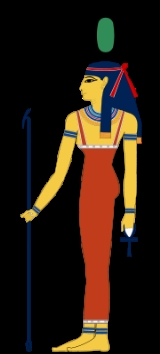
Neith

Encyclopedia
In Egyptian mythology, Neith (also known as Nit, Net, and Neit) was an early goddess in the Egyptian pantheon
. She was the patron deity of Sais
, where her cult was centered in the Western Nile Delta
of Egypt
and attested as early as the First Dynasty. The Ancient Egypt
ian name of this city was Zau.
Neith also was one of the three tutelary deities of the ancient Egypt
ian southern city of Ta-senet or Iunyt now known as Esna
(Arabic: إسنا), Greek: Λατόπολις (Latopolis), or πόλις Λάτων (Polis Laton), or Λάττων (Laton); Latin: Lato), which is located on the west bank of the River Nile, some 55 km south of Luxor, in the modern Qena Governorate.
Her name also may be interpreted as meaning water. In time, this led to her being considered as the personification of the primordial waters of creation. She is identified as a great mother goddess in this role as a creator.
Neith's symbol and part of her hieroglyph also bore a resemblance to a loom
, and so later in the history of Egyptian myths, she also became goddess of weaving, and gained this version of her name, Neith, which means weaver. At this time her role as a creator changed from being water-based to that of the deity who wove all of the world and existence into being on her loom
.
In art, Neith sometimes appears as a woman with a weavers’ shuttle atop her head, holding a bow and arrows in her hands. At other times she is depicted as a woman with the head of a lioness, as a snake, or as a cow.
Sometimes Neith was pictured as a woman nursing
a baby crocodile, and she was titled "Nurse of Crocodiles". As the personification of the concept of the primordial waters of creation in the Ogdoad
theology, she had no gender. As mother of Ra, she was sometimes described as the "Great Cow who gave birth to Ra".
Neith was considered to be a goddess of wisdom and was appealed to as an arbiter in the dispute between Horus and Seth.
dead as a gift to them, and thus she began to be viewed as a protector of one of the Four sons of Horus
, specifically, of Duamutef
, the deification of the canopic jar
storing the stomach, since the abdomen (often mistakenly associated as the stomach) was the most vulnerable portion of the body and a prime target during battle. It was said that she shot arrows at any evil spirits who attacked the canopic jar she protected.
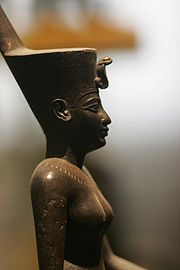 In the late pantheon
of the Ogdoad
myths, she became identified as the mother of Ra
and Apep
. When she was identified as a water goddess, she was also viewed as the mother of Sobek
, the crocodile
. It was this association with water, i.e. the Nile
, that led to her sometimes being considered the wife of Khnum, and associated with the source of the River Nile. She was associated with the Nile Perch
as well as the goddess of the triad in that cult center.
As the goddess of creation and weaving, she was said to reweave the world on her loom daily. An interior wall of the temple
at Esna
records an account of creation in which Neith brings forth from the primeval waters of the Nun
the first land ex nihilo
. All that she conceived in her heart comes into being including the thirty gods. Having no known husband she has been described as "Virgin Mother Goddess":
Proclus
(412–485 AD) wrote that the adyton
of the temple of Neith in Sais
(of which nothing now remains) carried the following inscription:
It was said that Neith interceded in the kingly war between Horus
and Set, over the Egyptian throne
, recommending that Horus rule.
A great festival, called the Feast of Lamps, was held annually in her honor and, according to Herodotus
, her devotees burned a multitude of lights in the open air all night during the celebration.
There also is evidence of a resurrection
cult involving a woman dying and being brought back to life
that was connected with Neith.
 It is thought that Neith may correspond to the goddess Tanit
, worshipped in north Africa by the early Berber
culture (existing from the beginnings of written records) and through the first Punic culture originating from the founding of Carthage
by Dido.
Ta-nit, meaning in Egyptian the land of Nit, also was a sky-dwelling goddess of war, a virginal
mother goddess
and nurse, and, less specifically, a symbol of fertility
. Her symbol is remarkably similar to the Egyptian ankh
and her shrine, excavated at Sarepta
in southern Phoenicia, revealed an inscription that related her securely to the Phoenician goddess Astarte
(Ishtar
). Several of the major Greek
goddesses also were identified with Tanit by the syncretic, interpretatio graeca
, which recognized as Greek deities in foreign guise the deities of most of the surrounding non-Hellene cultures.
A Hellenistic royal family ruled over Egypt for three centuries, a period called the Ptolemaic dynasty
until the Roman conquest in 30 B.C. Anouke, a goddess from Asia Minor was worshiped by immigrants to ancient Egypt. This war goddess was shown wearing a curved and feathered crown and carrying a spear, or bow and arrows. Within Egypt, she was later assimilated and identified as Neith, who by that time had developed her aspects as a war goddess.
The Greek historian, Herodotus
(c. 484-425 BC), noted that the Egyptian citizens of Sais
in Egypt worshipped Neith and that they identified her with Athena
. The Timaeus
, a Socratic
dialogue
written by Plato
, mirrors that identification with Athena, possibly as a result of the identification of both goddesses with war and weaving.
E. A. Wallis Budge
argued that the spread of Christianity in Egypt was influenced by the likeness of attributes between the Mother of Christ and goddesses such as Isis and Neith. Partheno-genesis
was associated with Neith long before the birth of Christ and other properties belonging to her and Isis were transferred to the Mother of Christ by way of the apocryphal gospels as a mark of honour.
Egyptian pantheon
The Egyptian pantheon consisted of the many gods worshipped by the Ancient Egyptians. A number of major deities are addressed as the creator of the cosmos. These include Atum, Ra, Amun and Ptah amongst others, as well as composite forms of these gods such as Amun-Ra. This was not seen as...
. She was the patron deity of Sais
Sais, Egypt
Sais or Sa el-Hagar was an ancient Egyptian town in the Western Nile Delta on the Canopic branch of the Nile. It was the provincial capital of Sap-Meh, the fifth nome of Lower Egypt and became the seat of power during the Twenty-fourth dynasty of Egypt and the Saite Twenty-sixth dynasty of Egypt ...
, where her cult was centered in the Western Nile Delta
Nile Delta
The Nile Delta is the delta formed in Northern Egypt where the Nile River spreads out and drains into the Mediterranean Sea. It is one of the world's largest river deltas—from Alexandria in the west to Port Said in the east, it covers some 240 km of Mediterranean coastline—and is a rich...
of Egypt
Egypt
Egypt , officially the Arab Republic of Egypt, Arabic: , is a country mainly in North Africa, with the Sinai Peninsula forming a land bridge in Southwest Asia. Egypt is thus a transcontinental country, and a major power in Africa, the Mediterranean Basin, the Middle East and the Muslim world...
and attested as early as the First Dynasty. The Ancient Egypt
Ancient Egypt
Ancient Egypt was an ancient civilization of Northeastern Africa, concentrated along the lower reaches of the Nile River in what is now the modern country of Egypt. Egyptian civilization coalesced around 3150 BC with the political unification of Upper and Lower Egypt under the first pharaoh...
ian name of this city was Zau.
Neith also was one of the three tutelary deities of the ancient Egypt
Ancient Egypt
Ancient Egypt was an ancient civilization of Northeastern Africa, concentrated along the lower reaches of the Nile River in what is now the modern country of Egypt. Egyptian civilization coalesced around 3150 BC with the political unification of Upper and Lower Egypt under the first pharaoh...
ian southern city of Ta-senet or Iunyt now known as Esna
Esna
Esna , known to the ancient Egyptians as Egyptian: Iunyt or Ta-senet; Greek: or or ; Latin: Lato, is a city in Egypt. It is located on the west bank of the River Nile, some 55 km south of Luxor...
(Arabic: إسنا), Greek: Λατόπολις (Latopolis), or πόλις Λάτων (Polis Laton), or Λάττων (Laton); Latin: Lato), which is located on the west bank of the River Nile, some 55 km south of Luxor, in the modern Qena Governorate.
Name and symbolism
Neith was a goddess of war and of hunting and had as her symbol, two crossed arrows over a shield. Her symbol also identified the city of Sais. This symbol was displayed on top of her head in Egyptian art. In her form as a goddess of war, she was said to make the weapons of warriors and to guard their bodies when they died.Her name also may be interpreted as meaning water. In time, this led to her being considered as the personification of the primordial waters of creation. She is identified as a great mother goddess in this role as a creator.
Neith's symbol and part of her hieroglyph also bore a resemblance to a loom
Loom
A loom is a device used to weave cloth. The basic purpose of any loom is to hold the warp threads under tension to facilitate the interweaving of the weft threads...
, and so later in the history of Egyptian myths, she also became goddess of weaving, and gained this version of her name, Neith, which means weaver. At this time her role as a creator changed from being water-based to that of the deity who wove all of the world and existence into being on her loom
Loom
A loom is a device used to weave cloth. The basic purpose of any loom is to hold the warp threads under tension to facilitate the interweaving of the weft threads...
.
In art, Neith sometimes appears as a woman with a weavers’ shuttle atop her head, holding a bow and arrows in her hands. At other times she is depicted as a woman with the head of a lioness, as a snake, or as a cow.
Sometimes Neith was pictured as a woman nursing
Breastfeeding
Breastfeeding is the feeding of an infant or young child with breast milk directly from female human breasts rather than from a baby bottle or other container. Babies have a sucking reflex that enables them to suck and swallow milk. It is recommended that mothers breastfeed for six months or...
a baby crocodile, and she was titled "Nurse of Crocodiles". As the personification of the concept of the primordial waters of creation in the Ogdoad
Ogdoad
In Egyptian mythology, the Ogdoad were eight deities worshipped in Hermopolis during what is called the Old Kingdom, the third through sixth dynasties, dated between 2686 to 2134 BC...
theology, she had no gender. As mother of Ra, she was sometimes described as the "Great Cow who gave birth to Ra".
Neith was considered to be a goddess of wisdom and was appealed to as an arbiter in the dispute between Horus and Seth.
Attributes
As a goddess of weaving and the domestic arts she was a protector of women and a guardian of marriage, so royal women often named themselves after Neith, in her honor. Since she also was goddess of war, and thus had an additional association with death, it was said that she wove the bandages and shrouds worn by the mummifiedMummy
A mummy is a body, human or animal, whose skin and organs have been preserved by either intentional or incidental exposure to chemicals, extreme coldness , very low humidity, or lack of air when bodies are submerged in bogs, so that the recovered body will not decay further if kept in cool and dry...
dead as a gift to them, and thus she began to be viewed as a protector of one of the Four sons of Horus
Four sons of Horus
The four sons of Horus were a group of four gods in Egyptian religion, who were essentially the personifications of the four canopic jars, which accompanied mummified bodies. Since the heart was thought to embody the soul, it was left inside the body. The brain was thought only to be the origin of...
, specifically, of Duamutef
Duamutef
Duamutef was one of the Four Sons of Horus and a protectiongod of the Canopic jars. Commonly he is said to be the son of the god Horus the Elder and the goddess Isis. There is another myth that describes...
, the deification of the canopic jar
Canopic jar
Canopic jars were used by the Ancient Egyptians during the mummification process to store and preserve the viscera of their owner for the afterlife. They were commonly either carved from limestone or were made of pottery...
storing the stomach, since the abdomen (often mistakenly associated as the stomach) was the most vulnerable portion of the body and a prime target during battle. It was said that she shot arrows at any evil spirits who attacked the canopic jar she protected.
Mythology
Egyptian pantheon
The Egyptian pantheon consisted of the many gods worshipped by the Ancient Egyptians. A number of major deities are addressed as the creator of the cosmos. These include Atum, Ra, Amun and Ptah amongst others, as well as composite forms of these gods such as Amun-Ra. This was not seen as...
of the Ogdoad
Ogdoad
In Egyptian mythology, the Ogdoad were eight deities worshipped in Hermopolis during what is called the Old Kingdom, the third through sixth dynasties, dated between 2686 to 2134 BC...
myths, she became identified as the mother of Ra
Ra
Ra is the ancient Egyptian sun god. By the Fifth Dynasty he had become a major deity in ancient Egyptian religion, identified primarily with the mid-day sun...
and Apep
Apep
In Egyptian mythology, Apep was an evil god, the deification of darkness and chaos , and thus opponent of light and Ma'at , whose existence was believed from the 8th Dynasty onwards...
. When she was identified as a water goddess, she was also viewed as the mother of Sobek
Sobek
Sobek , and in Greek, Suchos was the deification of crocodiles, as crocodiles were deeply feared in the nation so dependent on the Nile River...
, the crocodile
Crocodile
A crocodile is any species belonging to the family Crocodylidae . The term can also be used more loosely to include all extant members of the order Crocodilia: i.e...
. It was this association with water, i.e. the Nile
Nile
The Nile is a major north-flowing river in North Africa, generally regarded as the longest river in the world. It is long. It runs through the ten countries of Sudan, South Sudan, Burundi, Rwanda, Democratic Republic of the Congo, Tanzania, Kenya, Ethiopia, Uganda and Egypt.The Nile has two major...
, that led to her sometimes being considered the wife of Khnum, and associated with the source of the River Nile. She was associated with the Nile Perch
Nile perch
The Nile perch is a species of freshwaterfish in family Latidae of order Perciformes. It is widespread throughout muchof the Afrotropic ecozone, being native to the Congo, Nile, Senegal, Niger, and Lake Chad, Volta, Lake Turkana and other river basins. It also occurs in the brackish waters of...
as well as the goddess of the triad in that cult center.
As the goddess of creation and weaving, she was said to reweave the world on her loom daily. An interior wall of the temple
Egyptian temple
Egyptian temples were built for the official worship of the gods and commemoration of pharaohs in Ancient Egypt and in regions under Egyptian control. These temples were seen as houses for the gods or kings to whom they were dedicated...
at Esna
Esna
Esna , known to the ancient Egyptians as Egyptian: Iunyt or Ta-senet; Greek: or or ; Latin: Lato, is a city in Egypt. It is located on the west bank of the River Nile, some 55 km south of Luxor...
records an account of creation in which Neith brings forth from the primeval waters of the Nun
Naunet
In Egyptian mythology, Nu or Nun is the deification of the primordial watery abyss. In the Ogdoad cosmogony, the name nu means "abyss"....
the first land ex nihilo
Ex nihilo
Ex nihilo is a Latin phrase meaning "out of nothing". It often appears in conjunction with the concept of creation, as in creatio ex nihilo, meaning "creation out of nothing"—chiefly in philosophical or theological contexts, but also occurs in other fields.In theology, the common phrase creatio ex...
. All that she conceived in her heart comes into being including the thirty gods. Having no known husband she has been described as "Virgin Mother Goddess":
Proclus
Proclus
Proclus Lycaeus , called "The Successor" or "Diadochos" , was a Greek Neoplatonist philosopher, one of the last major Classical philosophers . He set forth one of the most elaborate and fully developed systems of Neoplatonism...
(412–485 AD) wrote that the adyton
Adyton
The adyton or adytum was a restricted area within the cella of a Greek or Roman temple. Its name meant "inaccessible" or "do not enter". The adyton was frequently a small area at the farthest end of the cella from the entrance: at Delphi it measured just nine by twelve feet. The adyton would...
of the temple of Neith in Sais
SAIS
SAIS can refer to:* Paul H. Nitze School of Advanced International Studies, part of The Johns Hopkins University.* Sharjah American International School* Southern Association of Independent Schools...
(of which nothing now remains) carried the following inscription:
It was said that Neith interceded in the kingly war between Horus
Horus
Horus is one of the oldest and most significant deities in the Ancient Egyptian religion, who was worshipped from at least the late Predynastic period through to Greco-Roman times. Different forms of Horus are recorded in history and these are treated as distinct gods by Egyptologists...
and Set, over the Egyptian throne
Throne
A throne is the official chair or seat upon which a monarch is seated on state or ceremonial occasions. "Throne" in an abstract sense can also refer to the monarchy or the Crown itself, an instance of metonymy, and is also used in many expressions such as "the power behind the...
, recommending that Horus rule.
A great festival, called the Feast of Lamps, was held annually in her honor and, according to Herodotus
Herodotus
Herodotus was an ancient Greek historian who was born in Halicarnassus, Caria and lived in the 5th century BC . He has been called the "Father of History", and was the first historian known to collect his materials systematically, test their accuracy to a certain extent and arrange them in a...
, her devotees burned a multitude of lights in the open air all night during the celebration.
There also is evidence of a resurrection
Resurrection
Resurrection refers to the literal coming back to life of the biologically dead. It is used both with respect to particular individuals or the belief in a General Resurrection of the dead at the end of the world. The General Resurrection is featured prominently in Jewish, Christian, and Muslim...
cult involving a woman dying and being brought back to life
Life-death-rebirth deity
A dying god, also known as a dying-and-rising or resurrection deity, is a god who dies and is resurrected or reborn, in either a literal or symbolic sense. Male examples include the ancient Near Eastern and Greek deities Baal, Melqart, Adonis, Eshmun, Attis Tammuz, Asclepius, Orpheus, as well as...
that was connected with Neith.
Syncretic relationships
Tanit
Tanit was a Phoenician lunar goddess, worshipped as the patron goddess at Carthage. Tanit was worshiped in Punic contexts in the Western Mediterranean, from Malta to Gades into Hellenistic times. From the fifth century BCE onwards Tanit is associated with that of Baal Hammon...
, worshipped in north Africa by the early Berber
Berber people
Berbers are the indigenous peoples of North Africa west of the Nile Valley. They are continuously distributed from the Atlantic to the Siwa oasis, in Egypt, and from the Mediterranean to the Niger River. Historically they spoke the Berber language or varieties of it, which together form a branch...
culture (existing from the beginnings of written records) and through the first Punic culture originating from the founding of Carthage
Carthage
Carthage , implying it was a 'new Tyre') is a major urban centre that has existed for nearly 3,000 years on the Gulf of Tunis, developing from a Phoenician colony of the 1st millennium BC...
by Dido.
Ta-nit, meaning in Egyptian the land of Nit, also was a sky-dwelling goddess of war, a virginal
Parthenogenesis
Parthenogenesis is a form of asexual reproduction found in females, where growth and development of embryos occur without fertilization by a male...
mother goddess
Mother goddess
Mother goddess is a term used to refer to a goddess who represents motherhood, fertility, creation or embodies the bounty of the Earth. When equated with the Earth or the natural world such goddesses are sometimes referred to as Mother Earth or as the Earth Mother.Many different goddesses have...
and nurse, and, less specifically, a symbol of fertility
Fertility goddess
A fertility deity is a god or goddess in mythology associated with fertility, pregnancy, and birth. In some cases these deities are directly associated with sex, and in others they simply embody related attributes...
. Her symbol is remarkably similar to the Egyptian ankh
Ankh
The ankh , also known as key of life, the key of the Nile or crux ansata, was the ancient Egyptian hieroglyphic character that read "eternal life", a triliteral sign for the consonants ʻ-n-ḫ...
and her shrine, excavated at Sarepta
Sarepta
Sarepta was a Phoenician city on the Mediterranean coast between Sidon and Tyre. Most of the objects by which we characterise Phoenician culture are those that have been recovered scattered among Phoenician colonies and trading posts; such carefully excavated colonial sites are in Spain, Sicily,...
in southern Phoenicia, revealed an inscription that related her securely to the Phoenician goddess Astarte
Astarte
Astarte is the Greek name of a goddess known throughout the Eastern Mediterranean from the Bronze Age to Classical times...
(Ishtar
Ishtar
Ishtar is the Assyrian and Babylonian goddess of fertility, love, war, and sex. She is the counterpart to the Sumerian Inanna and to the cognate north-west Semitic goddess Astarte.-Characteristics:...
). Several of the major Greek
Greek mythology
Greek mythology is the body of myths and legends belonging to the ancient Greeks, concerning their gods and heroes, the nature of the world, and the origins and significance of their own cult and ritual practices. They were a part of religion in ancient Greece...
goddesses also were identified with Tanit by the syncretic, interpretatio graeca
Interpretatio graeca
Interpretatio graeca is a Latin term for the common tendency of ancient Greek writers to equate foreign divinities to members of their own pantheon. Herodotus, for example, refers to the ancient Egyptian gods Amon, Osiris and Ptah as "Zeus", "Dionysus" and "Hephaestus", respectively.-Roman...
, which recognized as Greek deities in foreign guise the deities of most of the surrounding non-Hellene cultures.
A Hellenistic royal family ruled over Egypt for three centuries, a period called the Ptolemaic dynasty
Ptolemaic dynasty
The Ptolemaic dynasty, was a Macedonian Greek royal family which ruled the Ptolemaic Empire in Egypt during the Hellenistic period. Their rule lasted for 275 years, from 305 BC to 30 BC...
until the Roman conquest in 30 B.C. Anouke, a goddess from Asia Minor was worshiped by immigrants to ancient Egypt. This war goddess was shown wearing a curved and feathered crown and carrying a spear, or bow and arrows. Within Egypt, she was later assimilated and identified as Neith, who by that time had developed her aspects as a war goddess.
The Greek historian, Herodotus
Herodotus
Herodotus was an ancient Greek historian who was born in Halicarnassus, Caria and lived in the 5th century BC . He has been called the "Father of History", and was the first historian known to collect his materials systematically, test their accuracy to a certain extent and arrange them in a...
(c. 484-425 BC), noted that the Egyptian citizens of Sais
SAIS
SAIS can refer to:* Paul H. Nitze School of Advanced International Studies, part of The Johns Hopkins University.* Sharjah American International School* Southern Association of Independent Schools...
in Egypt worshipped Neith and that they identified her with Athena
Athena
In Greek mythology, Athena, Athenê, or Athene , also referred to as Pallas Athena/Athene , is the goddess of wisdom, courage, inspiration, civilization, warfare, strength, strategy, the arts, crafts, justice, and skill. Minerva, Athena's Roman incarnation, embodies similar attributes. Athena is...
. The Timaeus
Timaeus (dialogue)
Timaeus is one of Plato's dialogues, mostly in the form of a long monologue given by the title character, written circa 360 BC. The work puts forward speculation on the nature of the physical world and human beings. It is followed by the dialogue Critias.Speakers of the dialogue are Socrates,...
, a Socratic
Socrates
Socrates was a classical Greek Athenian philosopher. Credited as one of the founders of Western philosophy, he is an enigmatic figure known chiefly through the accounts of later classical writers, especially the writings of his students Plato and Xenophon, and the plays of his contemporary ...
dialogue
Dialogue
Dialogue is a literary and theatrical form consisting of a written or spoken conversational exchange between two or more people....
written by Plato
Plato
Plato , was a Classical Greek philosopher, mathematician, student of Socrates, writer of philosophical dialogues, and founder of the Academy in Athens, the first institution of higher learning in the Western world. Along with his mentor, Socrates, and his student, Aristotle, Plato helped to lay the...
, mirrors that identification with Athena, possibly as a result of the identification of both goddesses with war and weaving.
E. A. Wallis Budge
E. A. Wallis Budge
Sir Ernest Alfred Thompson Wallis Budge was an English Egyptologist, Orientalist, and philologist who worked for the British Museum and published numerous works on the ancient Near East.-Earlier life:...
argued that the spread of Christianity in Egypt was influenced by the likeness of attributes between the Mother of Christ and goddesses such as Isis and Neith. Partheno-genesis
Parthenogenesis
Parthenogenesis is a form of asexual reproduction found in females, where growth and development of embryos occur without fertilization by a male...
was associated with Neith long before the birth of Christ and other properties belonging to her and Isis were transferred to the Mother of Christ by way of the apocryphal gospels as a mark of honour.
See also
People named after Neith:- NeithhotepNeithhotepNeithhotep was the first queen of ancient Egypt, cofounder of the First dynasty, and is the earliest woman in history whose name is known. The name Neithhotep means "[The Goddess] Neith is satisfied".- Biography :...
, first recorded Egyptian queen - MerneithMerneithMerneith was a consort and a regent of Ancient Egypt during the first dynasty. She may have been a ruler of Egypt in her own right. The possibility is based on several official records. Her rule occurred the thirtieth century B.C., for an undetermined period of time...
, queen regent