


Nazca culture

Encyclopedia
Archaeological culture
An archaeological culture is a recurring assemblage of artifacts from a specific time and place, which are thought to constitute the material culture remains of a particular past human society. The connection between the artifacts is based on archaeologists' understanding and interpretation and...
that flourished from 100 to 800 CE beside the dry southern coast of Peru
Peru
Peru , officially the Republic of Peru , is a country in western South America. It is bordered on the north by Ecuador and Colombia, on the east by Brazil, on the southeast by Bolivia, on the south by Chile, and on the west by the Pacific Ocean....
in the river valleys of the Rio Grande de Nazca drainage and the Ica Valley
Ica Region
Ica is a region in Peru. It borders the Pacific Ocean on the west; the Lima Region on the north; the Huancavelica and Ayacucho regions on the east; and the Arequipa Region on the south. Its capital is the city of Ica.- Geography :...
(Silverman and Proulx, 2002). Having been heavily influenced by the preceding Paracas culture
Paracas culture
The Paracas culture was an important Andean society between approximately 800 BCE and 100 BCE, with an extensive knowledge of irrigation and water management. It developed in the Paracas Peninsula, located in what today is the Paracas District of the Pisco Province in the Ica Region...
, which was known for extremely complex textiles, the Nazca produced an array of beautiful crafts and technologies such as ceramics, textiles, and geoglyph
Geoglyph
A geoglyph is a large design or motif produced on the ground and typically formed by clastic rocks or similarly durable elements of the geography, such as stones, stone fragments, gravel, or earth...
s (most commonly known as the Nazca lines
Nazca Lines
The Nazca Lines are a series of ancient geoglyphs located in the Nazca Desert in southern Peru. They were designated a UNESCO World Heritage Site in 1994. The high, arid plateau stretches more than between the towns of Nazca and Palpa on the Pampas de Jumana about 400 km south of Lima...
). They also built an impressive system of underground aqueduct
Aqueduct
An aqueduct is a water supply or navigable channel constructed to convey water. In modern engineering, the term is used for any system of pipes, ditches, canals, tunnels, and other structures used for this purpose....
s, known as puquios
Puquios
The Puquios are an old system of aqueducts near the city of Nazca, Peru. Out of 36 Puquios, most are still functioning and relied upon to bring fresh water into the arid desert. The Puquios have never been fully mapped, nor have any been excavated ....
, that still function today. The Nazca Province
Nazca Province
The Nazca Province is one of five provinces of the Ica Region of Peru. The capital of the province is the city of Nazca.- Political division :The Nasca Province is divided into five districts , each of which is headed by a mayor :...
in the Ica Region
Ica Region
Ica is a region in Peru. It borders the Pacific Ocean on the west; the Lima Region on the north; the Huancavelica and Ayacucho regions on the east; and the Arequipa Region on the south. Its capital is the city of Ica.- Geography :...
was named for this people.
Time frame
Nazca society developed during the Early Intermediate Period and is generally divided into the Proto Nazca (phase 1, 100 BCE – CE 1), the Early Nazca (phases 2-4, CE 1-450), Middle Nazca (phase 5, CE 450-550) and Late Nazca (phases 6-7, CE 550-750) cultures (Vaughn, 2006).Decline and fall of the civilization
From 500 CE, the civilization started to decline and by 750 CE the civilization had fallen completely. This was due to El Niño which triggered widespread and destructive flooding. Evidence also suggests that the Nazca people may have exacerbated the effects of these floods by gradually cutting down Prosopis pallidaProsopis pallida
Prosopis pallida is a species of mesquite tree. It has the common names kiawe, huarango, and American carob, as well as "bayahonda" and "algarrobo blanco" . It is a thorny legume, native to Colombia, Ecuador and Peru, particularly drier areas near the coast...
trees to make room for maize and cotton agriculture. These trees play an extremely important role as the ecological keystone
Keystone species
A keystone species is a species that has a disproportionately large effect on its environment relative to its abundance. Such species play a critical role in maintaining the structure of an ecological community, affecting many other organisms in an ecosystem and helping to determine the types and...
of this landscape: in particular preventing river and wind erosion. Gradual removal of trees would have exposed the landscape to the effects of climate perturbations such as El Niño, leading to erosion
Erosion
Erosion is when materials are removed from the surface and changed into something else. It only works by hydraulic actions and transport of solids in the natural environment, and leads to the deposition of these materials elsewhere...
and leaving irrigation
Irrigation
Irrigation may be defined as the science of artificial application of water to the land or soil. It is used to assist in the growing of agricultural crops, maintenance of landscapes, and revegetation of disturbed soils in dry areas and during periods of inadequate rainfall...
systems high and dry (see Beresford-Jones et al. 2009).
Social structure
Early Nazca society was made up of local chiefdoms and regional centers of power centered around CahuachiCahuachi
Cahuachi, in Peru, was a major ceremonial center of the Nazca culture and overlooked some of the Nazca lines from 1 CE to about 500 CE. Italian archaeologist Giuseppe Orefici has been excavating the site for the past few decades, bringing a team down every year. The site contains over 40 mounds...
, a non-urban
Urban area
An urban area is characterized by higher population density and vast human features in comparison to areas surrounding it. Urban areas may be cities, towns or conurbations, but the term is not commonly extended to rural settlements such as villages and hamlets.Urban areas are created and further...
ceremonial site of earthwork mound
Mound
A mound is a general term for an artificial heaped pile of earth, gravel, sand, rocks, or debris. The most common use is in reference to natural earthen formation such as hills and mountains, particularly if they appear artificial. The term may also be applied to any rounded area of topographically...
s and plazas (Valdez, 1994). Scholars have developed theories resulting from various excavations at Cahuachi and suggest that the site was the center for rituals and feasting relating to agriculture, water, and fertility
Fertility
Fertility is the natural capability of producing offsprings. As a measure, "fertility rate" is the number of children born per couple, person or population. Fertility differs from fecundity, which is defined as the potential for reproduction...
. This may have been as a result of environmental deterioration; the eventual collapse of the center may have also been a result of that decline (Valdez, 1994). Cahuachi lies in the lower portion of the Nazca Valley and was initially occupied during the late Paracas
Paracas culture
The Paracas culture was an important Andean society between approximately 800 BCE and 100 BCE, with an extensive knowledge of irrigation and water management. It developed in the Paracas Peninsula, located in what today is the Paracas District of the Pisco Province in the Ica Region...
phase. It is unique among all other Nazca sites in the region and it is the most important site for the study of ancient Nazca culture (Valdez, 1995). The people modified the natural 'huacas (hills) into pyramid
Pyramid
A pyramid is a structure whose outer surfaces are triangular and converge at a single point. The base of a pyramid can be trilateral, quadrilateral, or any polygon shape, meaning that a pyramid has at least three triangular surfaces...
mounds for ceremonial and religious purposes.
Excavations at Cahuachi have given archaeologists key insights into the culture
Culture
Culture is a term that has many different inter-related meanings. For example, in 1952, Alfred Kroeber and Clyde Kluckhohn compiled a list of 164 definitions of "culture" in Culture: A Critical Review of Concepts and Definitions...
. The material remains found at the site included large amounts of polychrome
Polychrome
Polychrome is one of the terms used to describe the use of multiple colors in one entity. It has also been defined as "The practice of decorating architectural elements, sculpture, etc., in a variety of colors." Polychromatic light is composed of a number of different wavelengths...
pottery, plain and fancy textiles, trace amounts of gold and spondylus
Spondylus
Spondylus is a genus of bivalve molluscs, the only genus in the family Spondylidae. As well as being the systematic or scientific name, Spondylus is also the most often used common name for these animals, though they are also known as thorny oysters or spiny oysters.There are many species of...
shell, and an array of ritual paraphernalia. The remains of pottery
Pottery
Pottery is the material from which the potteryware is made, of which major types include earthenware, stoneware and porcelain. The place where such wares are made is also called a pottery . Pottery also refers to the art or craft of the potter or the manufacture of pottery...
found at Cahuachi led archaeologists to believe that the site was specifically non-urban and ceremonial in nature. The ratio of plain, utilitarian pottery to fine, polychrome pottery was 30% to 70% (Silverman, 1988). If it was an urban center, for example, the amount of utilitarian ceramics would have probably been higher. Among the foodstuffs found were the Three Sisters
Three Sisters (agriculture)
The Three Sisters are the three main agricultural crops of various Native American groups in North America: squash, maize, and climbing beans ....
: maize
Maize
Maize known in many English-speaking countries as corn or mielie/mealie, is a grain domesticated by indigenous peoples in Mesoamerica in prehistoric times. The leafy stalk produces ears which contain seeds called kernels. Though technically a grain, maize kernels are used in cooking as a vegetable...
, squash, and beans; as well as peanuts, and some fish.
Construction at Cahuachi ceased. It appears that the site was abandoned at the very end of Nazca 3/early Nazca 4. Although there are many possible reasons for the collapse of Cahuachi, most scholars believe that the cessation of ceremonial use of the site is associated with the pan-Andean drought (Valdez, 1994). Later (post-Cahuachi) Nazca society was structured in a similar fashion as it had been before, but less of an emphasis was made in constructing large architectural complexes like those at Cahuachi (Silverman and Proulx, 2002).
Religion
Likely related to the arid and extreme nature of the environment, Nazca religious beliefs were centered around agricultureAgriculture
Agriculture is the cultivation of animals, plants, fungi and other life forms for food, fiber, and other products used to sustain life. Agriculture was the key implement in the rise of sedentary human civilization, whereby farming of domesticated species created food surpluses that nurtured the...
and fertility. Much of Nazca art depicts powerful nature gods, such as the mythical killer whale, the harvesters, the mythical spotted cat, the serpentine creature, and the most prevalent of worshiped figures, the anthropomorphic mythical being. Much as in the contemporary Moche
Moche
'The Moche civilization flourished in northern Peru from about 100 AD to 800 AD, during the Regional Development Epoch. While this issue is the subject of some debate, many scholars contend that the Moche were not politically organized as a monolithic empire or state...
culture based in northwest Peru, shamans apparently used hallucinogenic drugs, such as extractions from the San Pedro cactus, to induce visions. The use of such substances is also depicted in art found on pottery related to the Nazca (Silverman and Proulx, 2002). Religious events and ceremonies took place in Cahuachi
Cahuachi
Cahuachi, in Peru, was a major ceremonial center of the Nazca culture and overlooked some of the Nazca lines from 1 CE to about 500 CE. Italian archaeologist Giuseppe Orefici has been excavating the site for the past few decades, bringing a team down every year. The site contains over 40 mounds...
. The people worshipped the nature gods to aid in the growth of agriculture.
During this time, all members of the society in surrounding villages would migrate to the center and participate in feasting as well. Non-elites could obtain highly valued goods, such as fancy polychrome pottery, through feasting. In exchange, the elites could enhance their political power and status while co-opting the commoners into labor and construction of the site (Silverman, 1988).
"Trophy Heads"
The debate over the purpose of trophy heads continues to this day, whether they were trophies of warWar trophy
In ancient Greece and Rome, military victories were commemorated with a display of captured arms and standards. A trophy was originally a war memorial assembled from such items on a battlefield. The Roman triumph also displayed these items as well as cultural objects, which later came to be...
or objects of ritual. Visual depictions of decapitation
Decapitation
Decapitation is the separation of the head from the body. Beheading typically refers to the act of intentional decapitation, e.g., as a means of murder or execution; it may be accomplished, for example, with an axe, sword, knife, wire, or by other more sophisticated means such as a guillotine...
s often associate the decapitators with weapons and military-like dress, but such garments could have been worn in purely ceremonial circumstances as well (DeLeonardis, 2000). The term 'trophy head' was coined by the archaeologist Max Uhle
Max Uhle
Max Uhle was a German archaeologist, whose work in Peru, Chile, Ecuador and Bolivia at the turn of the Twentieth Century had a significant impact on the practice of archaeology of South America....
, who considered the depiction of severed heads in ancient Peruvian art to correspond to trophies of warfare (Silverman and Proulx, 2002). Researchers noted that all the heads had one modification in common- a hole in the forehead through which a rope could be affixed, presumably so that the severed head can be displayed or carried. This added to the consensus that these were trophy heads (Browne, Silverman, and Garcia, 1993).
Many burials of Nazca individuals are what is known as 'partial burials'. Partial burials typically include bundles of limbs, caches of severed heads, or bodies that are missing several parts (DeLeonardis, 2000). Several burials have been discovered in which the head of the skeleton is missing and is replaced with what is most commonly referred to as a 'head jar'. The head jar is a ceramic vessel with a human head painted on it, along with trees and plants sprouting from the head.
During the Middle Nazca period, the number of severed heads appeared to have increased dramatically, judging from the remains. In the late Nazca period, the number tapered off, although the practice of decapitation remained a popular one in this period (DeLeonardis, 2000). Late Nazca iconography
Iconography
Iconography is the branch of art history which studies the identification, description, and the interpretation of the content of images. The word iconography literally means "image writing", and comes from the Greek "image" and "to write". A secondary meaning is the painting of icons in the...
suggests that the prestige of the leaders of Late Nazca society was enhanced by successful headhunting
Headhunting
Headhunting is the practice of taking a person's head after killing them. Headhunting was practised in historic times in parts of China, India, Nigeria, Nuristan, Bangladesh, Myanmar, Borneo, Indonesia, the Philippines, Taiwan, Japan, Micronesia, Melanesia, New Zealand, and the Amazon Basin, as...
(Browne, Silverman, and Garcia, 2003).
Economy
Nazca subsistence was based largely on agricultureAgriculture
Agriculture is the cultivation of animals, plants, fungi and other life forms for food, fiber, and other products used to sustain life. Agriculture was the key implement in the rise of sedentary human civilization, whereby farming of domesticated species created food surpluses that nurtured the...
. Iconography on ceramics and excavated remains indicate that the Nazca people had a varied diet, composed of maize
Maize
Maize known in many English-speaking countries as corn or mielie/mealie, is a grain domesticated by indigenous peoples in Mesoamerica in prehistoric times. The leafy stalk produces ears which contain seeds called kernels. Though technically a grain, maize kernels are used in cooking as a vegetable...
, squash, sweet potato, manioc
Cassava
Cassava , also called yuca or manioc, a woody shrub of the Euphorbiaceae native to South America, is extensively cultivated as an annual crop in tropical and subtropical regions for its edible starchy tuberous root, a major source of carbohydrates...
and achira
Canna (plant)
Canna is a genus of nineteen species of flowering plants. The closest living relations to cannas are the other plant families of the order Zingiberales, that is the gingers, bananas, marantas, heliconias, strelitzias, etc.Canna is the only genus in the family Cannaceae...
, and even a small trace of various fish. They also used several non-food crops, such as cotton for textiles, coca
Coca
Coca, Erythroxylum coca, is a plant in the family Erythroxylaceae, native to western South America. The plant plays a significant role in many traditional Andean cultures...
, San Pedro cactus, and gourds. The latter were decorated to illustrate activities in daily life. The evidence of coca in society can be seen through remains but also through ceramics. This is the same for the hallucinogenic San Pedro cactus, which has been illustrated in ceremonies on several polychrome pots and bowls. In terms of animal resources, the Nazca made sacrifices of llama
Llama
The llama is a South American camelid, widely used as a meat and pack animal by Andean cultures since pre-Hispanic times....
s and guinea pig
Guinea pig
The guinea pig , also called the cavy, is a species of rodent belonging to the family Caviidae and the genus Cavia. Despite their common name, these animals are not in the pig family, nor are they from Guinea...
s at Cahuachi. Llamas were also commonly exploited as pack animals, for their wool
Wool
Wool is the textile fiber obtained from sheep and certain other animals, including cashmere from goats, mohair from goats, qiviut from muskoxen, vicuña, alpaca, camel from animals in the camel family, and angora from rabbits....
, and as a source of meat (Silverman and Proulx, 2002).
As archaeological evidence indicates thus far, sometime during the Middle Nazca period, the Nazca people created an aqueduct system to sustain life in the exceedingly arid environment. The exact date of construction of the puquios
Puquios
The Puquios are an old system of aqueducts near the city of Nazca, Peru. Out of 36 Puquios, most are still functioning and relied upon to bring fresh water into the arid desert. The Puquios have never been fully mapped, nor have any been excavated ....
has been under contention for some time now. Dating of the puquios is quite difficult because of the materials involved in their construction. Attempts at dating the trenches have also been difficult as the puquios were found by excavation. This destroyed early context that might have been interpreted (Schreiber and Rojas, 1995). The most promising techniques used to date them thus far has been the AMS (accelerator mass spectrometry
Accelerator mass spectrometry
Accelerator mass spectrometry differs from other forms of mass spectrometry in that it accelerates ions to extraordinarily high kinetic energies before mass analysis. The special strength of AMS among the mass spectrometric methods is its power to separate a rare isotope from an abundant...
) analysis of varnish
Desert varnish
Desert varnish, or rock varnish is a orange-yellow to black coating found on exposed rock surfaces in arid environments. Desert varnish is usually around one micron thick and present nanometre-scale layering...
that has collected on the rocks inside the puquios, as well as the study of settlement patterns in the area (Clarkson and Dorn, 1995). These techniques have placed the original construction of the puquios at the Middle Nazca period, as indicated above.
The irrigation
Irrigation
Irrigation may be defined as the science of artificial application of water to the land or soil. It is used to assist in the growing of agricultural crops, maintenance of landscapes, and revegetation of disturbed soils in dry areas and during periods of inadequate rainfall...
system was made up of underground channels, known as puquios, which tapped into the subsurface water
Groundwater
Groundwater is water located beneath the ground surface in soil pore spaces and in the fractures of rock formations. A unit of rock or an unconsolidated deposit is called an aquifer when it can yield a usable quantity of water. The depth at which soil pore spaces or fractures and voids in rock...
. The channels were dug into the mountainside until they reached the aquifer
Aquifer
An aquifer is a wet underground layer of water-bearing permeable rock or unconsolidated materials from which groundwater can be usefully extracted using a water well. The study of water flow in aquifers and the characterization of aquifers is called hydrogeology...
s under the surface. The channels were lined with river rocks. They did not use any mortar so that the water would pass into the channels. The water was transported to irrigation canals (acequia
Acequia
An acequia or séquia is a community-operated waterway used in Spain and former Spanish colonies in the Americas for irrigation. Particularly in Spain, the Andes, northern Mexico, and the modern-day American Southwest, acequias are usually historically engineered canals that carry snow runoff or...
s) in order to directly supply water for agricultural purposes, or the water was deposited into small reservoirs (kochas) for later use (Schreiber and Rojas, 1995). Numerous access holes or ojos (eyes) were placed along the surface of the underground channels and operated much in the same way that modern manhole
Manhole
A manhole is an opening used to gain access to sewers or other underground structures, usually for maintenance.Manhole may also refer to:* Manhole , a metal band from Los Angeles* The Manhole, a computer game...
s do. People would descend into the puquios in order to clear obstructions or make repairs (Schreiber and Rojas, 1995). It is difficult to tell how long these underground channels are because extant puquios have been altered and many of the puquios are too dangerous to explore underground. The length of the puquios are estimated by measuring the distances covered by the ojos (Schreiber and Rojas, 1995).
Many of the channels remain in use to this day. This also testifies to their importance to generations of ancient people in the arid environment. With modern use, people have altered the puquios to be used more efficiently, including installing motorized pumps. In some cases, the kochas have been lined with concrete in order to hold the water better (Schreiber and Rojas, 1995). Some of the best-preserved channels are those located in Cantalloc. (Silverman, 1988)
Pottery
.png)
Polychrome
Polychrome is one of the terms used to describe the use of multiple colors in one entity. It has also been defined as "The practice of decorating architectural elements, sculpture, etc., in a variety of colors." Polychromatic light is composed of a number of different wavelengths...
pottery, painted with at least 15 distinct colors. The shift from post-fire resin painting to pre-fire slip
Slip (ceramics)
A slip is a suspension in water of clay and/or other materials used in the production of ceramic ware. Deflocculant, such as sodium silicate, can be added to the slip to disperse the raw material particles...
painting marked the end of Paracas
Paracas culture
The Paracas culture was an important Andean society between approximately 800 BCE and 100 BCE, with an extensive knowledge of irrigation and water management. It developed in the Paracas Peninsula, located in what today is the Paracas District of the Pisco Province in the Ica Region...
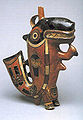
-style pottery and the beginning of Nazca-style pottery. The use of pre-fire slip painting meant that a great deal of experimentation took place in order to know which slips produced certain colors. Major pottery shapes include double-spout bottles
Double spout and bridge vessel
The double spout and bridge was a form of usually ceramic drinking vessel developed sometime before 500 BC by Indigenous peoples of the Americas groups on the Peruvian coast. True to its name, this type of bottle is distinguished by two spouts with a handle bridging them. First used by the Paracas...
, bowls, cups, vases, effigy
Effigy
An effigy is a representation of a person, especially in the form of sculpture or some other three-dimensional form.The term is usually associated with full-length figures of a deceased person depicted in stone or wood on church monuments. These most often lie supine with hands together in prayer,...
forms, and mythical creatures. Archaeologists have excavated highly valued polychrome pottery among all classes of Nazca society, illustrating that it was not just the elite that had access to them. Commoners were able to obtain these goods through feasting and pilgrimage
Pilgrimage
A pilgrimage is a journey or search of great moral or spiritual significance. Typically, it is a journey to a shrine or other location of importance to a person's beliefs and faith...
s to Cahuachi
Cahuachi
Cahuachi, in Peru, was a major ceremonial center of the Nazca culture and overlooked some of the Nazca lines from 1 CE to about 500 CE. Italian archaeologist Giuseppe Orefici has been excavating the site for the past few decades, bringing a team down every year. The site contains over 40 mounds...
. In addition, clays matching the chemical signature of polychrome pottery found all over the Southern Nazca Region have been found near Cahuachi. However, there is no substantial evidence of pottery production at Cahuachi. The site was most likely a redistribution center for ceramics (Vaughn and Neff, 2000).
The Nazca pottery sequence
Sequence Dating
Sequence Dating, a relative dating method, was a method of dating developed by the Egyptologist William Matthew Flinders Petrie. By linking styles of pottery with periods, he was the first to use seriation in Egyptology, a new method for establishing the chronology of a site...
has been divided into nine phases. Visual depictions found on pottery from Phase 1 (also called Proto-Nazca) incorporated realistic subject matter such as fruits, plants, people, and animals. Realism increased in importance in the following three phases (2, 3, 4) referred to as the Monumental phases. The pottery from these phases include renditions of their main subject matter against a bold red, black, or white background.
In the next phase, Nazca 5, considerable experimentation occurred, including the addition of rays, volutes, and other "proliferous" attachments to the supernatural motifs on the vessels. Phase 5 is called Transitional, since it bridges the change in style between the naturalism of Phases 2-4 and the proliferous elements added to the motifs in Phases 6 and 7.
Nazca 6, and 7 include some of the earlier motifs but also emphasizes militaristic ones, suggesting a shift in social organization. The motifs in these phases include abstract elements as part of the design. Large numbers of rays and tassels are appended to many of the designs, particularly those depicting mythical subjects, producing a visual impression of almost infinitely multiplied elements, an impression which accounts for the use of the term 'proliferous' (Roark 1965:2). Art found on pottery in relation to Nazca phases 6 and 7 also display an influence from the Moche
Moche
'The Moche civilization flourished in northern Peru from about 100 AD to 800 AD, during the Regional Development Epoch. While this issue is the subject of some debate, many scholars contend that the Moche were not politically organized as a monolithic empire or state...
culture of north coastal Peru
Peru
Peru , officially the Republic of Peru , is a country in western South America. It is bordered on the north by Ecuador and Colombia, on the east by Brazil, on the southeast by Bolivia, on the south by Chile, and on the west by the Pacific Ocean....
. Finally, Nazca 8 saw the introduction of completely disjointed figures and a geometric iconography which is difficult to decipher. Phases 8 and 9 are now believed to date to the Middle Horizon, reflecting a shift in power from the coast to the highlands with the advent of the Wari
Wari
Wari may refer to:*Wari', Amerindian nation**Wari’ language, spoken by Wari'*Wari culture, Middle Horizon civilization that flourished in Peru*Wari Empire, political formation that emerged around AD500 in Peru...
culture about 650 CE. (Silverman and Proulx, 2002).
The Nazca, like all other Pre-Columbian
Pre-Columbian era
The pre-Columbian era incorporates all period subdivisions in the history and prehistory of the Americas before the appearance of significant European influences on the American continents, spanning the time of the original settlement in the Upper Paleolithic period to European colonization during...
societies in South America including the Inca, had no writing system
Writing system
A writing system is a symbolic system used to represent elements or statements expressible in language.-General properties:Writing systems are distinguished from other possible symbolic communication systems in that the reader must usually understand something of the associated spoken language to...
, in contrast to the contemporary Maya
Maya civilization
The Maya is a Mesoamerican civilization, noted for the only known fully developed written language of the pre-Columbian Americas, as well as for its art, architecture, and mathematical and astronomical systems. Initially established during the Pre-Classic period The Maya is a Mesoamerican...
of Mesoamerica
Mesoamerica
Mesoamerica is a region and culture area in the Americas, extending approximately from central Mexico to Belize, Guatemala, El Salvador, Honduras, Nicaragua, and Costa Rica, within which a number of pre-Columbian societies flourished before the Spanish colonization of the Americas in the 15th and...
. The iconography or symbols on their ceramics served as a means of communication. The motifs depicted on Nazca pottery fall into two major categories: sacred and profane. The Nazca believed in powerful nature spirits who were thought to control most aspects of life. The Nazca visualized these nature spirits in the form of mythical beings, creatures having a combination of human and animal/bird/fish characteristics, and painted them onto their pottery. These Mythical Beings include such varieties as the Anthropomorphic Mythical Being, Horrible Bird, Mythical Killer Whale, Spotted Cat, etc. (Proulx 2006). Scenes of warfare, decapitation, and the ritual use of human trophy heads by shamans reflect other aspects of Nazca culture.
Textiles
Cotton
Cotton is a soft, fluffy staple fiber that grows in a boll, or protective capsule, around the seeds of cotton plants of the genus Gossypium. The fiber is almost pure cellulose. The botanical purpose of cotton fiber is to aid in seed dispersal....
and wool
Wool
Wool is the textile fiber obtained from sheep and certain other animals, including cashmere from goats, mohair from goats, qiviut from muskoxen, vicuña, alpaca, camel from animals in the camel family, and angora from rabbits....
(Silverman and Proulx, 2002). The textiles would have been made using a backstrap loom. This is similar to the way textiles are made in the region today (Silverman and Proulx, 2002). Textiles were woven with the common motifs earlier than they appeared painted on pottery. The dry desert has preserved the textiles of both the Nazca and Paracas culture
Paracas culture
The Paracas culture was an important Andean society between approximately 800 BCE and 100 BCE, with an extensive knowledge of irrigation and water management. It developed in the Paracas Peninsula, located in what today is the Paracas District of the Pisco Province in the Ica Region...
s, which comprise most of what is known about early textiles in the region.
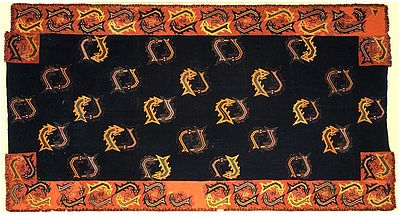
Shawls, dresses, tunics, belts, and bags have been found through excavations at Cahuachi and elsewhere. Many textiles associated with the Nazca culture are garments that were included with grave goods found at burial sites. Almost every body found is wrapped (sometimes partially) in a textile as a part of burial ritual. These textiles are found with partial burials as well. Often piles of bones are found wrapped in a textile garment (DeLeonardis, 2000). The deposits of dresses and shawls contained both high-status garments (with feathers, painting, embroidery
Embroidery
Embroidery is the art or handicraft of decorating fabric or other materials with needle and thread or yarn. Embroidery may also incorporate other materials such as metal strips, pearls, beads, quills, and sequins....
) and plain garments, suggesting different social roles or responsibilities. Mary Frame's extensive analysis of textiles from Cahuachi has revealed more about Nazca women. She noted that although the women are rarely recognized in the archaeological record, they had ready access to high-status materials and the right to wear potent imagery on their garments (Frame, 2003), which gave an indication of their status. A large portion of dresses were found portraying birds with speckled bodies, double-headed serpentine figures, and anthropomorphic figures.
Nazca Lines
The geoglyphGeoglyph
A geoglyph is a large design or motif produced on the ground and typically formed by clastic rocks or similarly durable elements of the geography, such as stones, stone fragments, gravel, or earth...
s of Nazca or "Nazca Lines
Nazca Lines
The Nazca Lines are a series of ancient geoglyphs located in the Nazca Desert in southern Peru. They were designated a UNESCO World Heritage Site in 1994. The high, arid plateau stretches more than between the towns of Nazca and Palpa on the Pampas de Jumana about 400 km south of Lima...
" are a series of geometric shapes, miles of lines, and large drawings of animal figures (some as large as a football field) constructed on the desert floor in the Nazca region (Aveni, 2000). Many theories have arisen about the great geoglyphs. A large number of people over an extended period of time could have constructed the lines. Researchers have demonstrated techniques to see how this was done.
By extending a rope between two posts and removing the red pebbles on the desert surface along the rope, the lines could be constructed. The contrast of the red desert pebbles and the lighter earth beneath would make the lines visible from a high altitude. Due to the simplistic construction of the geoglyphs, regular amounts of rainfall would have easily eroded the drawings but the dry desert environment has preserved the lines for hundreds of years.
The purpose of the lines continues to be debated. Some researchers theorize they were created for the gods to look upon them from above, while others suggest they were some sort of calendar with astronomical alignments that would aid in planting and harvesting of crops. Others have thought the lines were the pathways for important ceremonial processions (Aveni, 2000). The lines have been studied by experts of several disciplines. Anthropologists, archaeologists, and astronomers have all studied the lines (Silverman and Proulx, 2002) have not found conclusive evidence for any of the theories as to purpose (Aveni, 2000). It is unlikely that we will discover the true purpose of the geoglyphs.
Trephination and cranial manipulation
TrephinationTrepanation
Trepanning, also known as trephination, trephining or making a burr hole, is a surgical intervention in which a hole is drilled or scraped into the human skull, exposing the dura mater in order to treat health problems related to intracranial diseases. It may also refer to any "burr" hole created...
was a primitive skull surgery used by the Nazca that relieved pressure on the brain from battle wounds or for ritual purposes. It entails the removal of one or more sections of bone from the skull
Skull
The skull is a bony structure in the head of many animals that supports the structures of the face and forms a cavity for the brain.The skull is composed of two parts: the cranium and the mandible. A skull without a mandible is only a cranium. Animals that have skulls are called craniates...
(while the person is still alive). Evidence of trephination has been seen through the analysis of excavated skulls. Some of the skulls show signs of healing, evidence that some individuals who underwent the procedure had survived.
Elongated skulls, as a result of skull manipulation
Artificial cranial deformation
Artificial cranial deformation, head flattening, or head binding is a form of permanent body alteration in which the skull of a human being is intentionally deformed. It is done by distorting the normal growth of a child's skull by applying force...
, were also seen in the excavations from Cahuachi. This effect was achieved by binding a cushion to an infant's forehead and a board to the back of the head. Archaeologists can only speculate as to why this was done to some of the skulls. Several theories suggest skull manipulation created an ethnic identity, formed the individual into a social being, or may have illustrated social status. (Silverman and Proulx, 2002)