


Musique concrète

Encyclopedia
Musique concrète is a form of electroacoustic music
that utilises acousmatic sound as a compositional resource. The compositional material is not restricted to the inclusion of sounds derived from musical instruments or voice
s, nor to elements traditionally thought of as "musical" (melody
, harmony
, rhythm
, metre
and so on). The theoretical underpinnings of the aesthetic were developed by Pierre Schaeffer
, beginning in the early 1940s.
." In the same period the American composer Henry Cowell
, in referring to the projects of Nikolai Loptatnikoff, believed that "there was a wide field open for the composition of music for phonographic discs." This sentiment was echoed further in 1930 by Igor Stravinsky
, when he stated in the revue Kultur und Schalplatte that "there will be a greater interest in creating music in a way that will be peculiar to the gramophone record." The following year, 1931, Boris de Schloezer also expressed the opinion that one could write for the gramophone or for the wireless
just as one can for the piano or the violin (Battier 2007, 190). Shortly after, Rudolf Arnheim discussed the effects of microphonic recording in an essay entitled Radio, published in 1936. In it the idea of a creative role for the recording medium was introduced and Amheim stated that: "The rediscovery of the musicality of sound in noise and in language, and the reunification of music, noise and language in order to obtain a unity of material: that is one of the chief artistic tasks of radio" (Battier 2007, 193).
The development of Schaeffer’s practice was informed by encounters with voice actors and microphone usage and radiophonic art played an important part in inspiring and consolidating Schaeffer's conception of sound based composition (Dack 1994, 3–11). Another important influence on Schaeffer’s practice was cinema and the techniques of recording and montage, which were originally associated with cinematographic practice, came to "serve as the substrate of musique concrète." Marc Battier notes that, prior to Schaeffer, Jean Epstein
drew attention to the manner is which sound recording revealed what was hidden in the act of basic acoustic listening. Epstein's reference to this "phenomenon of an epiphanic being", which appears through the transduction of sound, proved influential on Schaeffer’s concept of reduced listening. Schaeffer would explicitly cite Jean Epstein with reference to his use of extra-musical sound material. Epstein had already imagined that "through the transposition of natural sounds, it becomes possible to create chords and dissonances, melodies and symphonies of noise, which are a new and specifically cinematographic music" (Battier 2007, 191).
, then an a student in Cairo
, was independently experimenting with tape music
. He recorded the sounds of an ancient zaar
ceremony using a cumbersome wire recorder
and at the Middle East Radio studios processed the material using reverberation, echo, voltage controls, and re-recording. The resulting tape based composition, entitled The Expression of Zaar, was presented in 1944 at an art gallery event in Cairo. El-Dabh has described his initial activities as an attempt to unlock "the inner sound" of the recordings. While his early compositional work was not widely known outside of Egypt at the time, El-Dabh would eventually gain recognition for his influential work at the Columbia-Princeton Electronic Music Center
in the late 1950s (Holmes 2008, 156–57).
in 1946 and in the same year Schaeffer discussed, in writing, the question surrounding the transformation of time perceived through recording. The essay evidenced knowledge of sound manipulation techniques he would further exploit compositionally. In 1948 Schaeffer formally initiated “research in to noises” at the Club d'Essai (Palombini 1993, 14) and on the 5th October 1948 the results of his initial experimentation were premiered at a concert given in Paris (Chion 1983). Five works for phonograph
(known collectively as Cinq études de bruits
—Five Studies of Noises) including Etude violette (Study in Purple) and Etude aux chemins de fer (Study of the Railroads), were presented.
as a primary compositional resource. The aesthetic also emphasised the importance of play (jeu) in the practice of sound based composition. Schaeffer's use of the word jeu, from the verb jouer, carries the same double meaning as the English verb play: 'to enjoy oneself by interacting with one's surroundings', as well as 'to operate a musical instrument' (Dack 2002).
was established at RTF in Paris, the ancestor of the ORTF (Lange 2009, 173). At RTF the GRMC established the first purpose-built electroacoustic music
studio. It quickly attracted many who either were or were later to become notable composers, including Olivier Messiaen
, Pierre Boulez
, Jean Barraqué
, Karlheinz Stockhausen
, Edgard Varèse
, Iannis Xenakis
, Michel Philippot
, and Arthur Honegger
. Compositional output from 1951 to 1953 comprised Étude I (1951) and Étude II (1951) by Boulez, Timbres-durées (1952) by Messiaen, Konkrete Etüde
(1952) by Stockhausen, Le microphone bien tempéré (1952) and La voile d’Orphée (1953) by Henry, Étude I (1953) by Philippot, Étude (1953) by Barraqué, the mixed pieces Toute la lyre (1951) and Orphée 53 (1953) by Schaeffer/Henry, and the film music Masquerage (1952) by Schaeffer and Astrologie (1953) by Henry. In 1954 Varèse and Honegger visited to work on the tape parts of Déserts
and La rivière endormie (Palombini 1999).
Between 1952 and 1956 Schaeffer's commitments to RTF led him to appoint Philippe Arthuys with responsibility for the GRMC, with Pierre Henry operating as Director of Works. Pierre Henry’s composing talent developed greatly during this period at the GRMC and he worked with experimental film
makers such as Max de Haas, Jean Gremillon
, Enrico Fulchignoni, and Jean Rouch
, and with choreographers
including Dick Sanders and Maurice Béjart (Gayou 2007, 206). Schaeffer returned to run the group at the end of 1957, and immediately stated his disapproval of the direction the GRMC had taken. A proposal was then made to "renew completely the spirit, the methods and the personnel of the Group, with a view to undertake research and to offer a much needed welcome to young composers" (Gayou 2007, 207).
, François-Bernard Mâche
, Iannis Xenakis
, Bernard Parmegiani
, and Mireille Chamass-Kyrou. Later arrivals included Ivo Malec
, Philippe Carson, Romuald Vandelle, Edgardo Canton and François Bayle
(Gayou 2007, 207).
GRM was one of several theoretical and experimental groups working under the umbrella of the Schaeffer-led Service de la Recherche at ORTF (1960–74). Together with the GRM, three other groups existed: the Groupe de Recherches Image GRI, the Groupe de Recherches Technologiques GRT and the Groupe de Recherches Langage which became the Groupe d’Etudes Critiques (Gayou 2007, 207). Communication was the one theme that unified the various groups, all of which were devoted to production and creation. In terms of the question "who says what to whom?" Schaeffer added "how?", thereby creating a platform for research into audiovisual communication and mass media, audible phenomena and music in general (including non-Western musics) (Beatriz Ferreyra, new preface to Schaeffer and Reibel 1967, reedition of 1998, 9). At the GRM the theoretical teaching remained based on practice and could be summed up in the catch phrase ‘do and listen’ (Gayou 2007, 207).
Schaeffer kept up a practice established with the GRMC of delegating the functions (though not the title) of Group Director to colleagues. Since 1961 GRM has had six Group Directors: Michel Philippot (1960–61), Luc Ferrari (1962–63), Bernard Baschet and François Vercken (1964–66). From the beginning of 1966, François Bayle took over the direction for the duration of thirty-one years, to 1997. He was then replaced by Daniel Teruggi (Gayou 2007, 206).
(Peignot 1960, 111–23). Schaeffer had borrowed the term acousmatic from Pythagoras
and defined it as: "Acousmatic, adjective
: referring to a sound that one hears without seeing the causes behind it" (Schaeffer 1966, 91). In 1966 Schaeffer published the book Traité des objets musicaux (Treatise on Musical Objects) which represented the culmination of some 20 years of research in the field of musique concrète. In conjunction with this publication, a set of sound recordings was produced, entitled Le solfège de l'objet sonore (Music Theory of the Acoustic Object), to provide examples of concepts dealt with in the treatise.
in post-war Europe. Access to microphones, phonographs, and later magnetic tape recorders
(created in 1939 and acquired by the Schaeffer's Groupe de Recherche de Musique Concrète (Research Group on Concrete Music) in 1952), facilitated by an association with the French national broadcasting organization, at that time the Radiodiffusion-Télévision Française, gave Schaeffer and his colleagues an opportunity to experiment with recording technology and tape manipulation.
record players
, a shellac record recorder, a mixing desk, with rotating potentiometer
s, a mechanical reverberation, filters
, and microphone
s. This technology made a number of limited operations available to a composer (Teruggi 2007):
The application of the above technologies in the creation of musique concrete led to the development of a number of sound manipulation techniques including (Teruggi 2007):
, a machine with ten playback heads to replay tape loops in echo (the morphophone), a keyboard-controlled machine to replay tape loops at twenty-four preset speeds (the keyboard, chromatic, or Tolana phonogène), a slide-controlled machine to replay tape loops at a continuously variable range of speeds (the handle, continuous, or Sareg phonogène), and a device to distribute an encoded track across four loudspeakers, including one hanging from the centre of the ceiling (the potentiomètre d’espace) (Palombini 1999).
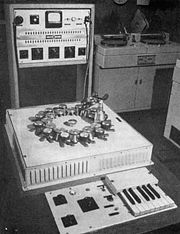 Speed variation was a powerful tool for sound design applications. It had been identified that transformations brought about by varying playback speed lead to modification in the character of the sound material:
The phonogène was a machine capable of modifying sound structure significantly and it provided composers with a means to adapt sound to meet specific compositional contexts. The initial phonogènes were manufactured in 1953 by two subcontractors: the chromatic phonogène by a company called Tolana, and the sliding version by the SAREG Company (Poullin 1999). A third version was developed later at ORTF. An outline of the unique capabilities of the various phonogènes can be seen here:
. The three-head tape recorder superposed three magnetic tapes that were dragged by a common motor, each tape having an independent spool
. The objective was to keep the three tapes synchronised from a common starting point. Works could then be conceived polyphonically, and thus each head conveyed a part of the information and was listened to through a dedicated loudspeaker. It was an ancestor of the multi-track player (four then eight tracks) that appeared in the 1960s. Timbres Durées by Olivier Messiaen with the technical assistance of Pierre Henry was the first work composed for this tape recorder in 1952. A rapid rhythmic polyphony was distributed over the three channels (Teruggi 2007, 218).
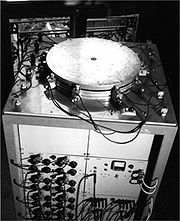
, filtering and feedback
. It consisted of a large rotating disk, 50 cm in diameter, on which was stuck a tape with its magnetic side facing outward. A series of twelve movable magnetic heads
(one each recording head
and erasing head, and ten playback heads) were positioned around the disk, in contact with the tape. A sound up to four seconds long could be recorded on the looped tape and the ten playback heads would then read the information with different delays, according to their (adjustable) positions around the disk. A separate amplifier
and band-pass filter
for each head could modify the spectrum of the sound, and additional feedback loops could transmit the information to the recording head. The resulting repetitions of a sound occurred at different time intervals, and could be filtered or modified through feedback. This system was also easily capable of producing artificial reverberation or continuous sounds (Teruggi 2007, 218).

sound source (Teruggi 2007, 218). One of five tracks, provided by a purpose-built tape machine, was controlled by the performer and the other four tracks each supplied a single loudspeaker. This provided a mixture of live and preset sound positions (Poullin, 1957). The placement of loudspeakers in the performance space included two loudspeakers at the front right and left of the audience, one placed at the rear, and in the centre of the space a loudspeaker was placed in a high position above the audience. The sounds could therefore be moved around the audience, rather than just across the front stage. On stage, the control system allowed a performer to position a sound either to the left or right, above or behind the audience, simply by moving a small, hand held transmitter coil towards or away from four somewhat larger receiver coils arranged around the performer in a manner reflecting the loudspeaker positions (Teruggi 2007, 218). A contemporary eyewitness described the potentiomètre d'espace in normal use:
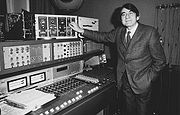 After the longstanding rivalry with the "electronic music
" of the Cologne studio had subsided, in 1970 the GRM finally created an electronic studio using tools developed by the physicist Enrico Chiarucci, called the Studio 54, which featured the "Coupigny modular synthesiser" and a Moog synthesiser with VCA (Gayou 2007, 208). The Coupigny synthesiser
, named for its designer François Coupigny, director of the Group for Technical Research (Battier 2007, 200), and the Studio 54 mixing desk had a major influence on the evolution of GRM and from the point of their introduction on they brought a new quality to the music (Teruggi 2007, 220). The mixing desk and synthesiser were combined in one unit and were created specifically for the creation of musique concrète.
The design of the desk was influenced by trade union
rules at French National Radio that required technicians and production staff to have clearly defined duties. The solitary practice of musique concrète composition did not suit a system that involved three operators: one in charge of the machines, a second controlling the mixing desk, and third to provide guidance to the others. Because of this the synthesiser and desk were combined and organised in a manner that allowed it to be used easily by a composer. Independently of the mixing tracks (twenty-four in total), it had a coupled connection patch that permitted the organisation of the machines within the studio. It also had a number of remote controls for operating tape recorders. The system was easily adaptable to any context, particularly that of interfacing with external equipment (Teruggi 2007, 219).
Before the late 1960s the musique concrète produced at GRM had largely been based on the recording and manipulation of sounds, but synthesised sounds had featured in a number of works prior to the introduction of the Coupigny. Pierre Henry had used oscillators to produce sounds as early as 1955. But a synthesiser with parametrical control
was something Pierre Schaeffer was against, since it favoured the preconception of music and therefore deviated from Schaeffer's principal of ‘making through listening’ (Teruggi 2007, 219). Because of Schaeffer's concerns the Coupigny synthesiser was conceived as a sound-event generator with parameters controlled globally, without a means to define values as precisely as some other synthesisers of the day (Teruggi 2007, 219–20).
The development of the machine was constrained by several factors. It needed to be modular and the modules had to be easily interconnected (so that the synthesiser would have more modules than slots and it would have an easy-to-use patch). It also needed to include all the major functions of a modular synthesiser including oscillators
, noise-generators, filters
, ring-modulators
, but an intermodulation
facility was viewed as the primary requirement; to enable complex synthesis processes such as frequency modulation
, amplitude modulation
, and modulation via an external source. No keyboard was attached to the synthesiser and instead a specific and somewhat complex envelope generator was used to shape sound. This synthesiser was well-adapted to the production of continuous and complex sounds using intermodulation techniques such as cross-synthesis and frequency modulation but was less effective in generating precisely defined frequencies and triggering specific sounds (Teruggi 2007, 220).
The Coupigny synthesiser also served as the model for a smaller, portable unit, which has been used down to the present day (Battier 2007, 200).
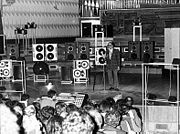 In 1966 composer and technician François Bayle
was placed in charge of the Groupe de Recherches Musicales and in 1975, GRM was integrated with the new Institut national de l'audiovisuel
(INA - Audiovisual National Institute) with Bayle as its head. In taking the lead on work that began in the early 1950s, with Jacques Poullin's potentiomètre d’espace, a system designed to move monophonic
sound sources across four speakers, Bayle and the engineer Jean-Claude Lallemand created an orchestra of loudspeakers (un orchestra de haut-parleurs) known as the Acousmonium
in 1974. An inaugural concert took place at the Espace Pierre Cardin in Paris with a presentation of Bayle's Expérience acoustique (Gayou 2007, 209).
The Acousmonium is a specialised sound reinforcement system
consisting of between 50 and 100 loudspeakers, depending on the character of the concert, of varying shape and size. The system was designed specifically for the concert presentation of musique-concrète-based
works but with the added enhancement of sound spatialisation. Loudspeakers are placed both on stage and at positions throughout the performance space (Gayou 2007, 209) and a mixing console is used to manipulate the placement of acousmatic material across the speaker array, using a performative
technique known as sound diffusion (Austin 2000, 10-21). Bayle has commented that the purpose of the Acousmonium is to "substitute a momentary classical disposition of sound making, which diffuses the sound from the circumference towards the centre of the hall, by a group of sound projectors which form an ‘orchestration’ of the acoustic image" (Bayle 1993, 44).
Electroacoustic music
Electroacoustic music originated in Western art music during its modern era following the incorporation of electric sound production into compositional practice. The initial developments in electroacoustic music composition during the mid-20th century are associated with the activities of composers...
that utilises acousmatic sound as a compositional resource. The compositional material is not restricted to the inclusion of sounds derived from musical instruments or voice
Human voice
The human voice consists of sound made by a human being using the vocal folds for talking, singing, laughing, crying, screaming, etc. Its frequency ranges from about 60 to 7000 Hz. The human voice is specifically that part of human sound production in which the vocal folds are the primary...
s, nor to elements traditionally thought of as "musical" (melody
Melody
A melody , also tune, voice, or line, is a linear succession of musical tones which is perceived as a single entity...
, harmony
Harmony
In music, harmony is the use of simultaneous pitches , or chords. The study of harmony involves chords and their construction and chord progressions and the principles of connection that govern them. Harmony is often said to refer to the "vertical" aspect of music, as distinguished from melodic...
, rhythm
Rhythm
Rhythm may be generally defined as a "movement marked by the regulated succession of strong and weak elements, or of opposite or different conditions." This general meaning of regular recurrence or pattern in time may be applied to a wide variety of cyclical natural phenomena having a periodicity or...
, metre
Meter (music)
Meter or metre is a term that music has inherited from the rhythmic element of poetry where it means the number of lines in a verse, the number of syllables in each line and the arrangement of those syllables as long or short, accented or unaccented...
and so on). The theoretical underpinnings of the aesthetic were developed by Pierre Schaeffer
Pierre Schaeffer
Pierre Henri Marie Schaeffer was a French composer, writer, broadcaster, engineer, musicologist and acoustician of the 20th century. His innovative work in both the sciences —particularly communications and acoustics— and the various arts of music, literature and radio presentation after the end...
, beginning in the early 1940s.
Beginnings
In 1928 the music critic Andre Coeuroy, wrote in the Panorama of Contemporary Music that "perhaps the time is not far off when a composer will be able to represent through recording, music specifically composed for the gramophonePhonograph
The phonograph record player, or gramophone is a device introduced in 1877 that has had continued common use for reproducing sound recordings, although when first developed, the phonograph was used to both record and reproduce sounds...
." In the same period the American composer Henry Cowell
Henry Cowell
Henry Cowell was an American composer, music theorist, pianist, teacher, publisher, and impresario. His contribution to the world of music was summed up by Virgil Thomson, writing in the early 1950s:...
, in referring to the projects of Nikolai Loptatnikoff, believed that "there was a wide field open for the composition of music for phonographic discs." This sentiment was echoed further in 1930 by Igor Stravinsky
Igor Stravinsky
Igor Fyodorovich Stravinsky ; 6 April 1971) was a Russian, later naturalized French, and then naturalized American composer, pianist, and conductor....
, when he stated in the revue Kultur und Schalplatte that "there will be a greater interest in creating music in a way that will be peculiar to the gramophone record." The following year, 1931, Boris de Schloezer also expressed the opinion that one could write for the gramophone or for the wireless
Wireless
Wireless telecommunications is the transfer of information between two or more points that are not physically connected. Distances can be short, such as a few meters for television remote control, or as far as thousands or even millions of kilometers for deep-space radio communications...
just as one can for the piano or the violin (Battier 2007, 190). Shortly after, Rudolf Arnheim discussed the effects of microphonic recording in an essay entitled Radio, published in 1936. In it the idea of a creative role for the recording medium was introduced and Amheim stated that: "The rediscovery of the musicality of sound in noise and in language, and the reunification of music, noise and language in order to obtain a unity of material: that is one of the chief artistic tasks of radio" (Battier 2007, 193).
Pierre Schaeffer and Studio d'Essai
In 1942 the French composer and theoretician Pierre Schaeffer, began his exploration of radiophony when he joined Jacques Copeau and his pupils in the foundation of the Studio d'Essai de la Radiodiffusion Nationale. The studio originally functioned as a center for the Resistance movement in French radio, which in August 1944 was responsible for the first broadcasts in liberated Paris. It was here that Schaeffer began to experiment with creative radiophonic techniques using the sound technologies of the time (Palombini 1993, 14).The development of Schaeffer’s practice was informed by encounters with voice actors and microphone usage and radiophonic art played an important part in inspiring and consolidating Schaeffer's conception of sound based composition (Dack 1994, 3–11). Another important influence on Schaeffer’s practice was cinema and the techniques of recording and montage, which were originally associated with cinematographic practice, came to "serve as the substrate of musique concrète." Marc Battier notes that, prior to Schaeffer, Jean Epstein
Jean Epstein
Jean Epstein was a French filmmaker, film theorist, literary critic, and novelist. Although he is remembered today primarily for his adaptation of Edgar Allan Poe's The Fall of the House of Usher, Epstein directed three dozen films and was an influential critic of literature and film from the...
drew attention to the manner is which sound recording revealed what was hidden in the act of basic acoustic listening. Epstein's reference to this "phenomenon of an epiphanic being", which appears through the transduction of sound, proved influential on Schaeffer’s concept of reduced listening. Schaeffer would explicitly cite Jean Epstein with reference to his use of extra-musical sound material. Epstein had already imagined that "through the transposition of natural sounds, it becomes possible to create chords and dissonances, melodies and symphonies of noise, which are a new and specifically cinematographic music" (Battier 2007, 191).
Halim El-Dabh's tape music
At around the same time as Schaeffer was conducting his preliminary experiments into sound manipulation, the Egyptian composer Halim El-DabhHalim El-Dabh
Halim Abdul Messieh El-Dabh is an Egyptian-born American composer, performer, ethnomusicologist, and educator, who has had a career spanning six decades...
, then an a student in Cairo
Cairo
Cairo , is the capital of Egypt and the largest city in the Arab world and Africa, and the 16th largest metropolitan area in the world. Nicknamed "The City of a Thousand Minarets" for its preponderance of Islamic architecture, Cairo has long been a centre of the region's political and cultural life...
, was independently experimenting with tape music
Tape Music
Tape Music is an experimental 10" vinyl release by Jack Dangers. The vinyl release was coupled with the album Sounds Of The 20th Century No2 when released as a flexi disc vinyl....
. He recorded the sounds of an ancient zaar
Zar
- Places :* Zar, Armenia, a town in the Kotayk Province* Zar, Azerbaijan, a village in the Kalbajar Rayon currently controlled by the Nagorno-Karabakh Republic* Žár , a village in the Czech Republic* Żar, Łódź Voivodeship, Poland...
ceremony using a cumbersome wire recorder
Wire recording
Wire recording is a type of analog audio storage in which a magnetic recording is made on thin steel or stainless steel wire.The wire is pulled rapidly across a recording head which magnetizes each point along the wire in accordance with the intensity and polarity of the electrical audio signal...
and at the Middle East Radio studios processed the material using reverberation, echo, voltage controls, and re-recording. The resulting tape based composition, entitled The Expression of Zaar, was presented in 1944 at an art gallery event in Cairo. El-Dabh has described his initial activities as an attempt to unlock "the inner sound" of the recordings. While his early compositional work was not widely known outside of Egypt at the time, El-Dabh would eventually gain recognition for his influential work at the Columbia-Princeton Electronic Music Center
Computer Music Center
The Computer Music Center at Columbia University is the oldest center for electronic and computer music research in the United States. The Center was founded in the 1950s as the Columbia-Princeton Electronic Music Center....
in the late 1950s (Holmes 2008, 156–57).
Club d 'Essai and Cinq études de bruits
Following Schaeffer's work with Studio d'Essai at Radiodiffusion Nationale during the early 1940s he was credited with originating the theory and practice of musique concrète. The Studio d'Essai was renamed Club d 'Essai de la Radiodiffusion–Télévision FranglaiseFranglais
Franglais , a portmanteau combining the French words "français" and "anglais" , is a slang term for an interlanguage, although the word has different overtones in French and English....
in 1946 and in the same year Schaeffer discussed, in writing, the question surrounding the transformation of time perceived through recording. The essay evidenced knowledge of sound manipulation techniques he would further exploit compositionally. In 1948 Schaeffer formally initiated “research in to noises” at the Club d'Essai (Palombini 1993, 14) and on the 5th October 1948 the results of his initial experimentation were premiered at a concert given in Paris (Chion 1983). Five works for phonograph
Phonograph
The phonograph record player, or gramophone is a device introduced in 1877 that has had continued common use for reproducing sound recordings, although when first developed, the phonograph was used to both record and reproduce sounds...
(known collectively as Cinq études de bruits
Cinq études de bruits
Cinq études de bruits is a collection of musical compositions by Pierre Schaeffer. The five études were composed in 1948 and are the earliest pieces of musique concrète, a form of electroacoustic music that utilises recorded sounds as a compositional resource.The five études were composed at the...
—Five Studies of Noises) including Etude violette (Study in Purple) and Etude aux chemins de fer (Study of the Railroads), were presented.
Musique concrète
By 1949 Schaeffer's compositional work was known publicly as musique concrète (Palombini 1993, 14). Schaeffer stated: "when I proposed the term 'musique concrète,' I intended … to point out an opposition with the way musical work usually goes. Instead of notating musical ideas on paper with the symbols of solfege and entrusting their realization to well-known instruments, the question was to collect concrete sounds, wherever they came from, and to abstract the musical values they were potentially containing" (Reydellet 1996, 10). According to Pierre Henry, "musique concrète was not a study of timbre, it is focused on envelopes, forms. It must be presented by means of non-traditional characteristics, you see … one might say that the origin of this music is also found in the interest in ‘plastifying’ music, of rendering it plastic like sculpture…musique concrète, in my opinion … led to a manner of composing, indeed, a new mental framework of composing" (James 1981, 79). Schaeffer had developed an aesthetic that was centred upon the use of soundSound
Sound is a mechanical wave that is an oscillation of pressure transmitted through a solid, liquid, or gas, composed of frequencies within the range of hearing and of a level sufficiently strong to be heard, or the sensation stimulated in organs of hearing by such vibrations.-Propagation of...
as a primary compositional resource. The aesthetic also emphasised the importance of play (jeu) in the practice of sound based composition. Schaeffer's use of the word jeu, from the verb jouer, carries the same double meaning as the English verb play: 'to enjoy oneself by interacting with one's surroundings', as well as 'to operate a musical instrument' (Dack 2002).
Groupe de Recherche de Musique Concrète
By 1951 the work of Schaeffer, composer-percussionist Pierre Henry, and sound engineer Jacques Poullin had received official recognition and The Groupe de Recherches de Musique Concrète, Club d 'Essai de la Radiodiffusion-Télévision FranglaiseFranglais
Franglais , a portmanteau combining the French words "français" and "anglais" , is a slang term for an interlanguage, although the word has different overtones in French and English....
was established at RTF in Paris, the ancestor of the ORTF (Lange 2009, 173). At RTF the GRMC established the first purpose-built electroacoustic music
Electroacoustic music
Electroacoustic music originated in Western art music during its modern era following the incorporation of electric sound production into compositional practice. The initial developments in electroacoustic music composition during the mid-20th century are associated with the activities of composers...
studio. It quickly attracted many who either were or were later to become notable composers, including Olivier Messiaen
Olivier Messiaen
Olivier Messiaen was a French composer, organist and ornithologist, one of the major composers of the 20th century. His music is rhythmically complex ; harmonically and melodically it is based on modes of limited transposition, which he abstracted from his early compositions and improvisations...
, Pierre Boulez
Pierre Boulez
Pierre Boulez is a French composer of contemporary classical music, a pianist, and a conductor.-Early years:Boulez was born in Montbrison, Loire, France. As a child he began piano lessons and demonstrated aptitude in both music and mathematics...
, Jean Barraqué
Jean Barraqué
Jean-Henri-Alphonse Barraqué was a French composer and writer on music who developed an individual form of serialism which is displayed in a small output of highly complex but passionate works.-Life:...
, Karlheinz Stockhausen
Karlheinz Stockhausen
Karlheinz Stockhausen was a German composer, widely acknowledged by critics as one of the most important but also controversial composers of the 20th and early 21st centuries. Another critic calls him "one of the great visionaries of 20th-century music"...
, Edgard Varèse
Edgard Varèse
Edgard Victor Achille Charles Varèse, , whose name was also spelled Edgar Varèse , was an innovative French-born composer who spent the greater part of his career in the United States....
, Iannis Xenakis
Iannis Xenakis
Iannis Xenakis was a Romanian-born Greek ethnic, naturalized French composer, music theorist, and architect-engineer. He is commonly recognized as one of the most important post-war avant-garde composers...
, Michel Philippot
Michel Philippot
Michel Paul Philippot was a French composer, mathematician, acoustician, musicologist, aesthetician, broadcaster, and educator.-Life:...
, and Arthur Honegger
Arthur Honegger
Arthur Honegger was a Swiss composer, who was born in France and lived a large part of his life in Paris. He was a member of Les six. His most frequently performed work is probably the orchestral work Pacific 231, which is interpreted as imitating the sound of a steam locomotive.-Biography:Born...
. Compositional output from 1951 to 1953 comprised Étude I (1951) and Étude II (1951) by Boulez, Timbres-durées (1952) by Messiaen, Konkrete Etüde
Etude (Stockhausen)
The Konkrete Etüde is the earliest work of electroacoustic tape music by Karlheinz Stockhausen, composed in 1952 and lasting just three-and-a-quarter minutes...
(1952) by Stockhausen, Le microphone bien tempéré (1952) and La voile d’Orphée (1953) by Henry, Étude I (1953) by Philippot, Étude (1953) by Barraqué, the mixed pieces Toute la lyre (1951) and Orphée 53 (1953) by Schaeffer/Henry, and the film music Masquerage (1952) by Schaeffer and Astrologie (1953) by Henry. In 1954 Varèse and Honegger visited to work on the tape parts of Déserts
Déserts
Déserts is a piece by Edgard Varèse for brass , percussion , piano, and tape. Percussion instruments are exploited for their resonant potential, rather than used solely as accompaniment...
and La rivière endormie (Palombini 1999).
Between 1952 and 1956 Schaeffer's commitments to RTF led him to appoint Philippe Arthuys with responsibility for the GRMC, with Pierre Henry operating as Director of Works. Pierre Henry’s composing talent developed greatly during this period at the GRMC and he worked with experimental film
Experimental film
Experimental film or experimental cinema is a type of cinema. Experimental film is an artistic practice relieving both of visual arts and cinema. Its origins can be found in European avant-garde movements of the twenties. Experimental cinema has built its history through the texts of theoreticians...
makers such as Max de Haas, Jean Gremillon
Jean Grémillon
Jean Grémillon was a French film director. After directing a number of documentaries during the 1920s, many now lost, he had his first substantial success with the dramatic feature Maldone in 1928...
, Enrico Fulchignoni, and Jean Rouch
Jean Rouch
Jean Rouch was a French filmmaker and anthropologist.He is considered to be one of the founders of the cinéma vérité in France, which shared the aesthetics of the direct cinema spearheaded by Richard Leacock, D.A. Pennebaker and Albert and David Maysles...
, and with choreographers
Choreography
Choreography is the art of designing sequences of movements in which motion, form, or both are specified. Choreography may also refer to the design itself, which is sometimes expressed by means of dance notation. The word choreography literally means "dance-writing" from the Greek words "χορεία" ...
including Dick Sanders and Maurice Béjart (Gayou 2007, 206). Schaeffer returned to run the group at the end of 1957, and immediately stated his disapproval of the direction the GRMC had taken. A proposal was then made to "renew completely the spirit, the methods and the personnel of the Group, with a view to undertake research and to offer a much needed welcome to young composers" (Gayou 2007, 207).
Groupe de Recherches Musicales
Following the emergence of differences within the GRMC Pierre Henry, Philippe Arthuys, and several of their colleagues, resigned in April 1958. Schaeffer created a new collective, called Groupe de Recherches Musicales (GRM) and set about recruiting new members including Luc FerrariLuc Ferrari
Luc Ferrari was of an Italian heritage but French born composer, particularly noted for his tape music.-Biography:...
, François-Bernard Mâche
François-Bernard Mâche
François-Bernard Mâche is a French composer of contemporary music. Born into a family of musicians, he is a former student of Émile Passani and Olivier Messiaen and has also received a diploma in Greek archaeology and a teaching certificate...
, Iannis Xenakis
Iannis Xenakis
Iannis Xenakis was a Romanian-born Greek ethnic, naturalized French composer, music theorist, and architect-engineer. He is commonly recognized as one of the most important post-war avant-garde composers...
, Bernard Parmegiani
Bernard Parmegiani
Bernard Parmegiani is a composer best known for his electronic or acousmatic music.-Biography:Between 1957 and 1961 he studied mime with Jacques Lecoq, a period he later regarded as important to his work as a composer...
, and Mireille Chamass-Kyrou. Later arrivals included Ivo Malec
Ivo Malec
Ivo Malec is a Croatian composer and music educator. One of the earliest Yugoslav composers to obtain high international regard, his works have been performed by symphony orchestras throughout Europe and North America. A graduate of the Academy of Fine Arts Zagreb and the Conservatoire de Paris,...
, Philippe Carson, Romuald Vandelle, Edgardo Canton and François Bayle
François Bayle
François Bayle is a composer of Musique concrète or acousmatic music.In the 1950s he studied with Olivier Messiaen, Pierre Schaeffer and Karlheinz Stockhausen. In 1960 he joined the Office de Radiodiffusion Télévision Française, and in 1966 was put in charge of the Groupe de Recherches Musicales...
(Gayou 2007, 207).
GRM was one of several theoretical and experimental groups working under the umbrella of the Schaeffer-led Service de la Recherche at ORTF (1960–74). Together with the GRM, three other groups existed: the Groupe de Recherches Image GRI, the Groupe de Recherches Technologiques GRT and the Groupe de Recherches Langage which became the Groupe d’Etudes Critiques (Gayou 2007, 207). Communication was the one theme that unified the various groups, all of which were devoted to production and creation. In terms of the question "who says what to whom?" Schaeffer added "how?", thereby creating a platform for research into audiovisual communication and mass media, audible phenomena and music in general (including non-Western musics) (Beatriz Ferreyra, new preface to Schaeffer and Reibel 1967, reedition of 1998, 9). At the GRM the theoretical teaching remained based on practice and could be summed up in the catch phrase ‘do and listen’ (Gayou 2007, 207).
Schaeffer kept up a practice established with the GRMC of delegating the functions (though not the title) of Group Director to colleagues. Since 1961 GRM has had six Group Directors: Michel Philippot (1960–61), Luc Ferrari (1962–63), Bernard Baschet and François Vercken (1964–66). From the beginning of 1966, François Bayle took over the direction for the duration of thirty-one years, to 1997. He was then replaced by Daniel Teruggi (Gayou 2007, 206).
Traité des objets musicaux
The group continued to refine Schaeffer's ideas and strengthened the concept of musique acousmatiqueAcousmatic music
Acousmatic music is a form of electroacoustic music that deals specifically with acousmatic sound as a compositional resource. The practice has a historical basis in musique concrète. It can be created using non-acoustic technology, exists only in a recorded format , and is composed for reception...
(Peignot 1960, 111–23). Schaeffer had borrowed the term acousmatic from Pythagoras
Pythagoras
Pythagoras of Samos was an Ionian Greek philosopher, mathematician, and founder of the religious movement called Pythagoreanism. Most of the information about Pythagoras was written down centuries after he lived, so very little reliable information is known about him...
and defined it as: "Acousmatic, adjective
Adjective
In grammar, an adjective is a 'describing' word; the main syntactic role of which is to qualify a noun or noun phrase, giving more information about the object signified....
: referring to a sound that one hears without seeing the causes behind it" (Schaeffer 1966, 91). In 1966 Schaeffer published the book Traité des objets musicaux (Treatise on Musical Objects) which represented the culmination of some 20 years of research in the field of musique concrète. In conjunction with this publication, a set of sound recordings was produced, entitled Le solfège de l'objet sonore (Music Theory of the Acoustic Object), to provide examples of concepts dealt with in the treatise.
Technology
The development of musique concrète was facilitated by the emergence of new music technologyMusic technology
Music technology is a term that refers to all forms of technology involved with the musical arts, particularly the use of electronic devices and computer software to facilitate playback, recording, composition, storage and performance. This subject is taught at many different educational levels,...
in post-war Europe. Access to microphones, phonographs, and later magnetic tape recorders
Tape recorder
An audio tape recorder, tape deck, reel-to-reel tape deck, cassette deck or tape machine is an audio storage device that records and plays back sounds, including articulated voices, usually using magnetic tape, either wound on a reel or in a cassette, for storage...
(created in 1939 and acquired by the Schaeffer's Groupe de Recherche de Musique Concrète (Research Group on Concrete Music) in 1952), facilitated by an association with the French national broadcasting organization, at that time the Radiodiffusion-Télévision Française, gave Schaeffer and his colleagues an opportunity to experiment with recording technology and tape manipulation.
Initial tools of musique concrète
In 1948, a typical radio studio consisted of a series of shellacShellac
Shellac is a resin secreted by the female lac bug, on trees in the forests of India and Thailand. It is processed and sold as dry flakes , which are dissolved in ethyl alcohol to make liquid shellac, which is used as a brush-on colorant, food glaze and wood finish...
record players
Phonograph
The phonograph record player, or gramophone is a device introduced in 1877 that has had continued common use for reproducing sound recordings, although when first developed, the phonograph was used to both record and reproduce sounds...
, a shellac record recorder, a mixing desk, with rotating potentiometer
Potentiometer
A potentiometer , informally, a pot, is a three-terminal resistor with a sliding contact that forms an adjustable voltage divider. If only two terminals are used , it acts as a variable resistor or rheostat. Potentiometers are commonly used to control electrical devices such as volume controls on...
s, a mechanical reverberation, filters
Audio filter
An audio filter is a frequency dependent amplifier circuit, working in the audio frequency range, 0 Hz to beyond 20 kHz. Many types of filters exist for applications including graphic equalizers, synthesizers, sound effects, CD players and virtual reality systems.Being a frequency dependent...
, and microphone
Microphone
A microphone is an acoustic-to-electric transducer or sensor that converts sound into an electrical signal. In 1877, Emile Berliner invented the first microphone used as a telephone voice transmitter...
s. This technology made a number of limited operations available to a composer (Teruggi 2007):
- Shellac record players: could read a sound normally and in reverse mode, could change speed at fixed ratios thus permitting octaveOctaveIn music, an octave is the interval between one musical pitch and another with half or double its frequency. The octave relationship is a natural phenomenon that has been referred to as the "basic miracle of music", the use of which is "common in most musical systems"...
transpositionTranspositionTransposition may refer to:Mathematics* Transposition , a permutation which exchanges two elements and keeps all others fixed* Transposition, producing the transpose of a matrix AT, which is computed by swapping columns for rows in the matrix AGames* Transposition , different moves or a different...
. - Shellac recorder: would record any result coming out of the mixing desk.
- Mixing desk: would permit several sources to be mixed together with an independent control of the gain or volume of the sound. The result of the mixing was sent to the recorder and to the monitoring loudspeakers. Signals could be sent to the filters or the reverberation unit.
- Mechanical reverberation: made of a metal plate or a series of springs that created the reverberation effect, indispensable to force sounds to ‘fuse’ together.
- Filters: two kinds of filters, 1/3 octave filters and, high and low-pass filters. They allow the elimination or enhancement of selected frequenciesAudio frequencyAn audio frequency or audible frequency is characterized as a periodic vibration whose frequency is audible to the average human...
. - Microphones: essential tool for capturing sound.
The application of the above technologies in the creation of musique concrete led to the development of a number of sound manipulation techniques including (Teruggi 2007):
- Sound transposition: reading a sound at a different speed than the one at which it was recorded.
- Sound looping: composers developed a skilled technique in order to create loops at specific locations within a recording.
- Sound-sample extraction: a hand-controlled method that required delicate manipulation to get a clean sampleSampling (music)In music, sampling is the act of taking a portion, or sample, of one sound recording and reusing it as an instrument or a different sound recording of a song or piece. Sampling was originally developed by experimental musicians working with musique concrète and electroacoustic music, who physically...
of sound. It entailed letting the stylusMagnetic cartridgeA magnetic cartridge is a transducer used for the playback of gramophone records on a turntable or phonograph. It converts mechanical vibrational energy from a stylus riding in a spiral record groove into an electrical signal that is subsequently amplified and then converted back to sound by a...
read a small segment of a recordPhonographThe phonograph record player, or gramophone is a device introduced in 1877 that has had continued common use for reproducing sound recordings, although when first developed, the phonograph was used to both record and reproduce sounds...
. Used in the Symphonie pour un homme seul. - Filtering: by eliminating most of the central frequencies of a signal, the remains would keep some trace of the original sound but without making it recognisable.
Magnetic tape
The first tape recorders start arriving at ORTF in 1949; however, their functioning was much less reliable than the shellac players, to the point that the Symphonie pour un homme seul, which was composed in 1950–51, was mainly composed with records, even if the tape recorder was available (Teruggi 2007, 216). In 1950, when the machines finally functioned correctly, the techniques of musique concrete were expanded. A range of new sound manipulation practices were explored using improved media manipulation methods and operations such as speed variation. A completely new possibility of organising sounds appears with tape editing, which permits tape to be spliced and arranged with an extraordinary new precision. The ‘axe-cut junctions’ were replaced with micrometric junctions and a whole new technique of production, less dependency on performance skills, could be developed. Tape editing brought a new technique called ‘micro-editing’, in which very tiny fragments of sound, representing milliseconds of time, were edited together, thus creating completely new sounds or structures (Teruggi 2007, 217).Development of novel devices
During the GRMC period from 1951–1958 time Schaeffer and Jacques Poullin developed a number of novel sound creation tools including a three-track tape recorderMultitrack recording
Multitrack recording is a method of sound recording that allows for the separate recording of multiple sound sources to create a cohesive whole...
, a machine with ten playback heads to replay tape loops in echo (the morphophone), a keyboard-controlled machine to replay tape loops at twenty-four preset speeds (the keyboard, chromatic, or Tolana phonogène), a slide-controlled machine to replay tape loops at a continuously variable range of speeds (the handle, continuous, or Sareg phonogène), and a device to distribute an encoded track across four loudspeakers, including one hanging from the centre of the ceiling (the potentiomètre d’espace) (Palombini 1999).
The phonogène
- Variation in the sounds' length, in a manner directly proportional to the ratio of speed variation.
- Variation in length is coupled with a variation in pitchPitch (music)Pitch is an auditory perceptual property that allows the ordering of sounds on a frequency-related scale.Pitches are compared as "higher" and "lower" in the sense associated with musical melodies,...
, and is also proportional to the ratio of speed variation. - A sounds attack characteristic is altered, whereby it is either dislocated from succeeding events, or the energy of the attack is more sharply focused.
- The distribution of spectral energy is altered, thereby influencing how the resulting timbre might be perceived, relative to its original unaltered state.
The phonogène was a machine capable of modifying sound structure significantly and it provided composers with a means to adapt sound to meet specific compositional contexts. The initial phonogènes were manufactured in 1953 by two subcontractors: the chromatic phonogène by a company called Tolana, and the sliding version by the SAREG Company (Poullin 1999). A third version was developed later at ORTF. An outline of the unique capabilities of the various phonogènes can be seen here:
- Chromatic: The chromatic phonogène was controlled through a one-octave keyboard. Multiple capstans of differing diameters vary the tape speed over a single stationary magnetic tape head. A tape loop was put into the machine, and when a key was played, it would act on an individual pinch roller / capstan arrangement and cause the tape to be played at a specific speed. The machine worked with short sounds only (Poullin 1999).
- Sliding: The sliding phonogène (also called continuous-variation phonogène) provided continuous variation of tape speed using a control rod (Poullin 1999). The range allowed the motor to arrive at almost a stop position, always through a continuous variation. It was basically a normal tape recorder but with the ability to control its speed, so it could modify any length of tape. One of the earliest examples of its use can by heard in Voile d’Orphée by Pierre Henry (1953), where a lengthy glissandoGlissandoIn music, a glissando is a glide from one pitch to another. It is an Italianized musical term derived from the French glisser, to glide. In some contexts it is distinguished from the continuous portamento...
is used to symbolise the removal of Orpheus'sOrpheusOrpheus was a legendary musician, poet, and prophet in ancient Greek religion and myth. The major stories about him are centered on his ability to charm all living things and even stones with his music; his attempt to retrieve his wife from the underworld; and his death at the hands of those who...
veil as he enters hell.
- Universal: A final version called the universal phonogène was completed in 1963. The device's main ability was that it enabled the dissociation of pitch variation from time variation. This was the starting point for methods that would later become widely available using digital technology, for instance harmonising (transposing sound without modifying duration) and time stretchingTime stretchingTime stretching can refer to:* Audio timescale-pitch modification, in audio* Time stretching, in video* Time dilation, in physics * Time stretch analog-to-digital converter, in electronics...
(modifying duration without pitch modification). This was obtained through a rotating magnetic head called the Springer temporal regulator, an ancestor of the rotating heads used in video machines.
The three-head tape recorder
This original tape recorder was one of the first machines permitting the simultaneous listening of several synchronised sources. Until 1958 musique concrète, radio and the studio machines were monophonicMonaural
Monaural or monophonic sound reproduction is single-channel. Typically there is only one microphone, one loudspeaker, or channels are fed from a common signal path...
. The three-head tape recorder superposed three magnetic tapes that were dragged by a common motor, each tape having an independent spool
Spool
Spool can mean one of the following:*Spool, a usually low-flanged or unflanged cylinder on which thread, wire, cable, paper, film, or tape is wound for distribution or use....
. The objective was to keep the three tapes synchronised from a common starting point. Works could then be conceived polyphonically, and thus each head conveyed a part of the information and was listened to through a dedicated loudspeaker. It was an ancestor of the multi-track player (four then eight tracks) that appeared in the 1960s. Timbres Durées by Olivier Messiaen with the technical assistance of Pierre Henry was the first work composed for this tape recorder in 1952. A rapid rhythmic polyphony was distributed over the three channels (Teruggi 2007, 218).
The morphophone
This machine was conceived to build complex forms through repetition, and accumulation of events through delaysDelay (audio effect)
Delay is an audio effect which records an input signal to an audio storage medium, and then plays it back after a period of time. The delayed signal may either be played back multiple times, or played back into the recording again, to create the sound of a repeating, decaying echo.-Early delay...
, filtering and feedback
Feedback
Feedback describes the situation when output from an event or phenomenon in the past will influence an occurrence or occurrences of the same Feedback describes the situation when output from (or information about the result of) an event or phenomenon in the past will influence an occurrence or...
. It consisted of a large rotating disk, 50 cm in diameter, on which was stuck a tape with its magnetic side facing outward. A series of twelve movable magnetic heads
Tape head
A tape head is a type of transducer used in tape recorders to convert electrical signals to magnetic fluctuations and vice versa.-Principles of operation:...
(one each recording head
Recording head
A recording head is the physical interface between a recording apparatus and a moving recording medium. Recording heads are generally classified according to the physical principle that allows them to impress their data upon their medium...
and erasing head, and ten playback heads) were positioned around the disk, in contact with the tape. A sound up to four seconds long could be recorded on the looped tape and the ten playback heads would then read the information with different delays, according to their (adjustable) positions around the disk. A separate amplifier
Amplifier
Generally, an amplifier or simply amp, is a device for increasing the power of a signal.In popular use, the term usually describes an electronic amplifier, in which the input "signal" is usually a voltage or a current. In audio applications, amplifiers drive the loudspeakers used in PA systems to...
and band-pass filter
Band-pass filter
A band-pass filter is a device that passes frequencies within a certain range and rejects frequencies outside that range.Optical band-pass filters are of common usage....
for each head could modify the spectrum of the sound, and additional feedback loops could transmit the information to the recording head. The resulting repetitions of a sound occurred at different time intervals, and could be filtered or modified through feedback. This system was also easily capable of producing artificial reverberation or continuous sounds (Teruggi 2007, 218).
Early sound spatialisation system
At the premiere of Pierre Schaeffer's Symphonie pour un homme seul in 1951, a system that was designed for the spatial control of sound was tested. It was called a "relief desk" (pupitre de relief, but also referred to as pupitre d'espace or potentiomètre d'espace) and was intended to control the dynamic level of music played from several shellac players. This created a stereophonic effect by controlling the positioning of a monophonicMonaural
Monaural or monophonic sound reproduction is single-channel. Typically there is only one microphone, one loudspeaker, or channels are fed from a common signal path...
sound source (Teruggi 2007, 218). One of five tracks, provided by a purpose-built tape machine, was controlled by the performer and the other four tracks each supplied a single loudspeaker. This provided a mixture of live and preset sound positions (Poullin, 1957). The placement of loudspeakers in the performance space included two loudspeakers at the front right and left of the audience, one placed at the rear, and in the centre of the space a loudspeaker was placed in a high position above the audience. The sounds could therefore be moved around the audience, rather than just across the front stage. On stage, the control system allowed a performer to position a sound either to the left or right, above or behind the audience, simply by moving a small, hand held transmitter coil towards or away from four somewhat larger receiver coils arranged around the performer in a manner reflecting the loudspeaker positions (Teruggi 2007, 218). A contemporary eyewitness described the potentiomètre d'espace in normal use:
One found one’s self sitting in a small studio which was equipped with four loudspeakers—two in front of one—right and left; one behind one and a fourth suspended above. In the front center were four large loops and an “executant” moving a small magnetic unit through the air. The four loops controlled the four speakers, and while all four were giving off sounds all the time, the distance of the unit from the loops determined the volume of sound sent out from each.The central concept underlying this method was the notion that music should be controlled during public presentation in order to create a performance situation; an attitude that has stayed with acousmatic music to the present day (Teruggi 2007, 218).
The music thus came to one at varying intensity from various parts of the room, and this “spatial projection” gave new sense to the rather abstract sequence of sound originally recorded. (Gradenwitz 1953)
The Coupigny synthesiser and Studio 54 mixing desk
Electronic music
Electronic music is music that employs electronic musical instruments and electronic music technology in its production. In general a distinction can be made between sound produced using electromechanical means and that produced using electronic technology. Examples of electromechanical sound...
" of the Cologne studio had subsided, in 1970 the GRM finally created an electronic studio using tools developed by the physicist Enrico Chiarucci, called the Studio 54, which featured the "Coupigny modular synthesiser" and a Moog synthesiser with VCA (Gayou 2007, 208). The Coupigny synthesiser
Synthesizer
A synthesizer is an electronic instrument capable of producing sounds by generating electrical signals of different frequencies. These electrical signals are played through a loudspeaker or set of headphones...
, named for its designer François Coupigny, director of the Group for Technical Research (Battier 2007, 200), and the Studio 54 mixing desk had a major influence on the evolution of GRM and from the point of their introduction on they brought a new quality to the music (Teruggi 2007, 220). The mixing desk and synthesiser were combined in one unit and were created specifically for the creation of musique concrète.
The design of the desk was influenced by trade union
Trade union
A trade union, trades union or labor union is an organization of workers that have banded together to achieve common goals such as better working conditions. The trade union, through its leadership, bargains with the employer on behalf of union members and negotiates labour contracts with...
rules at French National Radio that required technicians and production staff to have clearly defined duties. The solitary practice of musique concrète composition did not suit a system that involved three operators: one in charge of the machines, a second controlling the mixing desk, and third to provide guidance to the others. Because of this the synthesiser and desk were combined and organised in a manner that allowed it to be used easily by a composer. Independently of the mixing tracks (twenty-four in total), it had a coupled connection patch that permitted the organisation of the machines within the studio. It also had a number of remote controls for operating tape recorders. The system was easily adaptable to any context, particularly that of interfacing with external equipment (Teruggi 2007, 219).
Before the late 1960s the musique concrète produced at GRM had largely been based on the recording and manipulation of sounds, but synthesised sounds had featured in a number of works prior to the introduction of the Coupigny. Pierre Henry had used oscillators to produce sounds as early as 1955. But a synthesiser with parametrical control
Parametrization
Parametrization is the process of deciding and defining the parameters necessary for a complete or relevant specification of a model or geometric object....
was something Pierre Schaeffer was against, since it favoured the preconception of music and therefore deviated from Schaeffer's principal of ‘making through listening’ (Teruggi 2007, 219). Because of Schaeffer's concerns the Coupigny synthesiser was conceived as a sound-event generator with parameters controlled globally, without a means to define values as precisely as some other synthesisers of the day (Teruggi 2007, 219–20).
The development of the machine was constrained by several factors. It needed to be modular and the modules had to be easily interconnected (so that the synthesiser would have more modules than slots and it would have an easy-to-use patch). It also needed to include all the major functions of a modular synthesiser including oscillators
Electronic oscillator
An electronic oscillator is an electronic circuit that produces a repetitive electronic signal, often a sine wave or a square wave. They are widely used in innumerable electronic devices...
, noise-generators, filters
Voltage-controlled filter
A voltage-controlled filter is a filter whose operating characteristics can be controlled by means of a control voltage applied to one or more inputs...
, ring-modulators
Ring modulation
Ring modulation is a signal-processing effect in electronics, an implementation of amplitude modulation or frequency mixing, performed by multiplying two signals, where one is typically a sine-wave or another simple waveform. It is referred to as "ring" modulation because the analog circuit of...
, but an intermodulation
Intermodulation
Intermodulation or intermodulation distortion is the amplitude modulation of signals containing two or more different frequencies in a system with nonlinearities...
facility was viewed as the primary requirement; to enable complex synthesis processes such as frequency modulation
Frequency modulation
In telecommunications and signal processing, frequency modulation conveys information over a carrier wave by varying its instantaneous frequency. This contrasts with amplitude modulation, in which the amplitude of the carrier is varied while its frequency remains constant...
, amplitude modulation
Amplitude modulation
Amplitude modulation is a technique used in electronic communication, most commonly for transmitting information via a radio carrier wave. AM works by varying the strength of the transmitted signal in relation to the information being sent...
, and modulation via an external source. No keyboard was attached to the synthesiser and instead a specific and somewhat complex envelope generator was used to shape sound. This synthesiser was well-adapted to the production of continuous and complex sounds using intermodulation techniques such as cross-synthesis and frequency modulation but was less effective in generating precisely defined frequencies and triggering specific sounds (Teruggi 2007, 220).
The Coupigny synthesiser also served as the model for a smaller, portable unit, which has been used down to the present day (Battier 2007, 200).
The Acousmonium
François Bayle
François Bayle is a composer of Musique concrète or acousmatic music.In the 1950s he studied with Olivier Messiaen, Pierre Schaeffer and Karlheinz Stockhausen. In 1960 he joined the Office de Radiodiffusion Télévision Française, and in 1966 was put in charge of the Groupe de Recherches Musicales...
was placed in charge of the Groupe de Recherches Musicales and in 1975, GRM was integrated with the new Institut national de l'audiovisuel
Institut national de l'audiovisuel
The Institut national de l'audiovisuel , is a repository of all French radio and television audiovisual archives. Additionally it provides customers with a free and immediate access to archives of countries such as Afghanistan and Cambodia...
(INA - Audiovisual National Institute) with Bayle as its head. In taking the lead on work that began in the early 1950s, with Jacques Poullin's potentiomètre d’espace, a system designed to move monophonic
Monaural
Monaural or monophonic sound reproduction is single-channel. Typically there is only one microphone, one loudspeaker, or channels are fed from a common signal path...
sound sources across four speakers, Bayle and the engineer Jean-Claude Lallemand created an orchestra of loudspeakers (un orchestra de haut-parleurs) known as the Acousmonium
Acousmonium
The Acousmonium is the sound diffusion system designed in 1974 by Francois Bayle and used originally by the Groupe de Recherches Musicales at the Maison de Radio France. It consists of 80 loudspeakers of differing size and shape, and was designed for tape playback...
in 1974. An inaugural concert took place at the Espace Pierre Cardin in Paris with a presentation of Bayle's Expérience acoustique (Gayou 2007, 209).
The Acousmonium is a specialised sound reinforcement system
Sound reinforcement system
A sound reinforcement system is the combination of microphones, signal processors, amplifiers, and loudspeakers that makes live or pre-recorded sounds louder and may also distribute those sounds to a larger or more distant audience...
consisting of between 50 and 100 loudspeakers, depending on the character of the concert, of varying shape and size. The system was designed specifically for the concert presentation of musique-concrète-based
Acousmatic music
Acousmatic music is a form of electroacoustic music that deals specifically with acousmatic sound as a compositional resource. The practice has a historical basis in musique concrète. It can be created using non-acoustic technology, exists only in a recorded format , and is composed for reception...
works but with the added enhancement of sound spatialisation. Loudspeakers are placed both on stage and at positions throughout the performance space (Gayou 2007, 209) and a mixing console is used to manipulate the placement of acousmatic material across the speaker array, using a performative
Performance
A performance, in performing arts, generally comprises an event in which a performer or group of performers behave in a particular way for another group of people, the audience. Choral music and ballet are examples. Usually the performers participate in rehearsals beforehand. Afterwards audience...
technique known as sound diffusion (Austin 2000, 10-21). Bayle has commented that the purpose of the Acousmonium is to "substitute a momentary classical disposition of sound making, which diffuses the sound from the circumference towards the centre of the hall, by a group of sound projectors which form an ‘orchestration’ of the acoustic image" (Bayle 1993, 44).
Other notable composers
- Hugh Le CaineHugh Le CaineHugh Le Caine was a Canadian physicist, composer, and instrument builder.Le Caine was brought up in Port Arthur in northwestern Ontario...
- Delia DerbyshireDelia DerbyshireDelia Ann Derbyshire was an English musician and composer of electronic music and musique concrète. She is best known for her electronic realisation of Ron Grainer's theme music to the British science fiction television series Doctor Who and for her work with the BBC Radiophonic Workshop.-Early...
- Francis DhomontFrancis DhomontFrancis Dhomont is a French composer of electroacoustic / acousmatic music.-Biography:He studied composition under Ginette Waldmeier, Charles Koechlin and Nadia Boulanger...
- Jonty HarrisonJonty HarrisonJonty Harrison is an electroacoustic music composer born April 27, 1952 in Scunthorpe, UK, and currently living in Birmingham, UK.Jonty Harrison is an electroacoustic music composer born April 27, 1952 in Scunthorpe, UK, and currently living in Birmingham, UK.Jonty Harrison is an electroacoustic...
- Robert NormandeauRobert NormandeauRobert Normandeau is a Canadian electroacoustic music composer.Normandeau studied at the Université Laval in Quebec City, and at the Université de Montréal, where he studied with Marcelle Deschênes and Francis Dhomont...
- Denis SmalleyDenis SmalleyDenis Arthur Smalley is a composer of electroacoustic music, with a special interest in acousmatic music.-Biography:...
- Trevor WishartTrevor WishartTrevor Wishart is an English composer, based in York. Wishart has contributed to composing with digital audio media, both fixed and interactive...
See also
- AudiumAudium (theater)Audium is a unique sound art phenomenon that has been presented weekly in San Francisco since 1967. Audium is a creation of composer Stan Shaff that is performed on original equipment designed by Doug McEachern...
- Birmingham ElectroAcoustic Sound TheatreBirmingham ElectroAcoustic Sound TheatreBirmingham ElectroAcoustic Sound Theatre, or as it is more commonly known, BEAST, is a sound diffusion system specifically designed for the performance of electroacoustic music. Created in 1982, it is a long-running project of the Electroacoustic Music Studios at the University of Birmingham under...
- Canadian Electroacoustic CommunityCanadian Electroacoustic CommunityFounded in 1986, La Communauté électroacoustique canadienne / The Canadian Electroacoustic Community is Canada’s national electroacoustic / computer music / sonic arts organization and as such is dedicated to promoting this progressive art form in its broadest definition: from “pure” acousmatic...
- Computer musicComputer musicComputer music is a term that was originally used within academia to describe a field of study relating to the applications of computing technology in music composition; particularly that stemming from the Western art music tradition...
- Electronic musicElectronic musicElectronic music is music that employs electronic musical instruments and electronic music technology in its production. In general a distinction can be made between sound produced using electromechanical means and that produced using electronic technology. Examples of electromechanical sound...
- Electroacoustic musicElectroacoustic musicElectroacoustic music originated in Western art music during its modern era following the incorporation of electric sound production into compositional practice. The initial developments in electroacoustic music composition during the mid-20th century are associated with the activities of composers...
- Experimental musicExperimental musicExperimental music refers, in the English-language literature, to a compositional tradition which arose in the mid-20th century, applied particularly in North America to music composed in such a way that its outcome is unforeseeable. Its most famous and influential exponent was John Cage...
- Noise (music)
- Sound engineering
- Sound designSound designSound design is the process of specifying, acquiring, manipulating or generating audio elements. It is employed in a variety of disciplines including filmmaking, television production, theatre, sound recording and reproduction, live performance, sound art, post-production and video game software...
- Sound artSound artSound art is a diverse group of art practices that considers wide notions of sound, listening and hearing as its predominant focus. There are often distinct relationships forged between the visual and aural domains of art and perception by sound artists....
- Sound collageSound collageIn music, montage or sound collage is a technique where sound objects or compositions, including songs, are created from collage, also known as montage, the use of portions of previous recordings or scores...
- Tape musicTape MusicTape Music is an experimental 10" vinyl release by Jack Dangers. The vinyl release was coupled with the album Sounds Of The 20th Century No2 when released as a flexi disc vinyl....
Further reading
- Dack, John (1994). "Pierre Schaeffer and the Significance of Radiophonic Art". Contemporary Music Review 10, no. 2: 3–11.
- Dack, John (1993a). "La Recherche de l'Instrument Perdu". Electroacoustic Music: Journal of the Electroacoustic Music Association of Great Britain 7:.
- Dwyer, Terence (1971). Composing with Tape Recorders: Musique Concrète for Beginners. London and New York: Oxford University Press. ISBN 0193119129.
- Kane, Brian (2007). "L’Objet Sonore Maintenant: Pierre Schaeffer, Sound Objects and the Phenomenological Reduction". Organised Sound, 12, no.1:15–24.
- Schaeffer, Pierre (1952b). "L'objet musical". La Revue Musicale: L'œuvre du XXe siècle, no. 212: 65-76.
- Schaeffer, Pierre (1967). La musique concrète. Paris: Presses Universitaires de France.
External links
- INA-GRM website
- François Bayle's personal website
- Electroacoustic Music Studies Network
- Bernard Parmegiani's personal website
- ElectroAcoustic Resource Site at De Montfort University
- INA-GRM 31st Season (2008/2009). Multiphonies program of events.
- Organised Sound: An International Journal of Music and Technology.
- Audium A Theatre Of Sound-Sculptured Space