


Computer music

Encyclopedia
Computer music is a term that was originally used within academia to describe a field of study relating to the applications of computing technology in music composition
; particularly that stemming from the Western art music tradition. It includes the theory and application of new and existing technologies in music, such as sound synthesis, digital signal processing
, sound design
, sonic diffusion, acoustics
, and psychoacoustics
. The field of computer music can trace its roots back to the origin of electronic music
, and the very first experiments and innovations with electronic instruments at the turn of the 20th century. More recently, with the advent of personal computing, and the growth of home recording
, the term computer music is now sometimes used to describe any music
that has been created using computing technology.
and mathematics
.
The world's first computer to play music was CSIRAC
which was designed and built by Trevor Pearcey
and Maston Beard. Mathematician Geoff Hill programmed the CSIRAC to play popular musical melodies from the very early 1950s. In 1951 it publicly played the Colonel Bogey March
of which no known recordings exist.
However, CSIRAC
played standard repertoire and was not used to extend musical thinking or composition practice which is current computer-music practice.
The oldest known recordings of computer generated music were played by the Ferranti Mark 1 computer, a commercial version of the Baby Machine from the University of Manchester
in the autumn of 1951. The music program was written by Christopher Strachey
. During a session recorded by the BBC
, the machine managed to work its way through "Baa Baa Black Sheep", "God Save the King" and part of "In the Mood".
Two further major 1950s developments were the origins of digital sound synthesis by computer, and of algorithmic composition programs beyond rote playback. Max Mathews
at Bell Laboratories developed the influential MUSIC I
program and its descendents, further popularising computer music through a 1962 article in Science. Amongst other pioneers, the musical chemists Lejaren Hiller
and Leonard Isaacson worked on a series of algorithmic composition experiments from 1956-9, manifested in the 1957 premiere of the Illiac Suite for string quartet.
Early computer-music programs typically did not run in real time
. Programs would run for hours or days, on multi-million-dollar computers, to generate a few minutes of music. John Chowning
's work on FM synthesis from the 1960s to the 1970s, and the advent of inexpensive digital chips and microcomputers opened the door to real-time generation of computer music. By the early 1990s, the performance of microprocessor-based computers reached the point that real-time generation of computer music using more general programs and algorithms became possible.
(International Computer Music Association), IRCAM
, GRAME, SEAMUS
(Society for Electro Acoustic Music in the United States), CEC
(Canadian Electroacoustic Community), and a great number of institutions of higher learning around the world.
by, or with the extensive aid of, a computer. Although any music which uses computers in its composition or realisation is computer-generated to some extent, the use of computers is now so widespread (in the editing of pop songs, for instance) that the phrase computer-generated music is generally used to mean a kind of music which could not have been created without the use of computers.
We can distinguish two groups of computer-generated music: music in which a computer generated the score, which could be performed by humans, and music which is both composed and performed by computers. There is a large genre of music that is organized, synthesized, and created on computers.
(Musical dice game; 18th century), a system which used throws of the dice to randomly select measures from a large collection of small phrases. When patched together, these phrases combined to create musical pieces which could be performed by human players. Although these works were not actually composed with a computer in the modern sense, it uses a rudimentary form of the random combinatorial techniques sometimes used in computer-generated composition.
The world's first digital computer music was generated in Australia by programmer Geoff Hill on the CSIRAC
computer which was designed and built by Trevor Pearcey and Maston Beard, although it was only used to play standard tunes of the day. Subsequently, one of the first composers to write music with a computer was Iannis Xenakis
. He wrote programs in the FORTRAN
language that generated numeric data that he transcribed into scores to be played by traditional musical instrument
s. An example is ST/48 of 1962. Although Xenakis could well have composed this music by hand, the intensity of the calculations needed to transform probabilistic mathematics into musical notation was best left to the number-crunching power of the computer.
Computers have also been used in an attempt to imitate the music of great composers of the past, such as Mozart
. A present exponent of this technique is David Cope
. He wrote computer programs that analyse works of other composers to produce new works in a similar style. He has used this program to great effect with composers such as Bach and Mozart (his program Experiments in Musical Intelligence is famous for creating "Mozart's 42nd Symphony"), and also within his own pieces, combining his own creations with that of the computer.
had computers generate the sounds of the composition as well as the score. Koenig produced algorithmic composition
programs which were a generalisation of his own serial composition practice. This is not exactly similar to Xenakis' work as he used mathematical abstractions and examined how far he could explore these musically. Koenig's software translated the calculation of mathematical equations into codes which represented musical notation. This could be converted into musical notation by hand and then performed by human players. His programs Project 1 and Project 2 are examples of this kind of software. Later, he extended the same kind of principles into the realm of synthesis, enabling the computer to produce the sound directly. SSP is an example of a program which performs this kind of function. All of these programs were produced by Koenig at the Institute of Sonology
in Utrecht
in the 1970s.
Procedures such as those used by Koenig and Xenakis are still in use today. Since the invention of the MIDI system in the early 1980s, for example, some people have worked on programs which map MIDI notes to an algorithm and then can either output sounds or music through the computer's sound card
or write an audio file
for other programs to play.
Some of these simple programs are based on fractal geometry, and can map midi notes to specific fractal
s, or fractal equations. Although such programs are widely available and are sometimes seen as clever toys for the non-musician, some professional musicians have given them attention also. The resulting 'music' can be more like noise, or can sound quite familiar and pleasant. As with much algorithmic music, and algorithmic art
in general, more depends on the way in which the parameters are mapped to aspects of these equations than on the equations themselves. Thus, for example, the same equation can be made to produce both a lyrical and melodic piece of music in the style of the mid-nineteenth century, and a fantastically dissonant cacophony more reminiscent of the avant-garde music of the 1950s and 1960s.
Other programs can map mathematical formulae and constants to produce sequences of notes. In this manner, an irrational number
can give an infinite sequence of notes where each note is a digit in the decimal expression of that number. This sequence can in turn be a composition in itself, or simply the basis for further elaboration.
Operations such as these, and even more elaborate operations can also be performed in computer music programming languages such as Max/MSP, SuperCollider
, Csound
, Pure Data
(Pd), Keykit
, and ChucK
. These programs now easily run on most personal computers, and are often capable of more complex functions than those which would have necessitated the most powerful mainframe computers several decades ago.
There exist programs that generate "human-sounding" melodies by using a vast database of phrases. One example is Band-in-a-Box
, which is capable of creating jazz
, blues
and rock
instrumental solos with almost no user interaction. Another is Impro-Visor
, which uses a stochastic context-free grammar
to generate phrases and complete solos.
Another 'cybernetic' approach to computer composition uses specialized hardware to detect external stimuli which are then mapped by the computer to realize the performance. Examples of this style of computer music can be found in the middle-80's work of David Rokeby
(Very Nervous System) where audience/performer motions are 'translated' to MIDI segments. Computer controlled music is also found in the performance pieces by the Canadian composer Udo Kasemets
such as the Marce(ntennia)l Circus C(ag)elebrating Duchamp (1987), a realization of the Marcel Duchamp
process piece Erratum Musical using an electric model train to collect a hopper-car of stones to be deposited on a drum wired to an Analog:Digital converter, mapping the stone impacts to a score display (performed in Toronto by pianist Gordon Monahan
during the 1987 Duchamp Centennial), or his installations and performance works (e.g. Spectrascapes) based on his Geo(sono)scope (1986) 15x4-channel computer-controlled audio mixer. In these latter works, the computer generates sound-scapes from tape-loop sound samples, live shortwave or sine-wave generators.
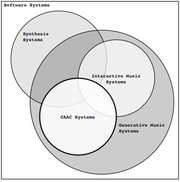 Computer-Aided Algorithmic Composition (CAAC, pronounced "sea-ack") is the implementation and use of algorithmic composition
techniques in software. This label is derived from the combination of two labels, each too vague for continued use. The label computer-aided composition lacks the specificity of using generative algorithms. Music produced with notation or sequencing software could easily be considered computer-aided composition. The label algorithmic composition is likewise too broad, particularly in that it does not specify the use of a computer. The term computer-aided
, rather than computer-assisted, is used in the same manner as Computer-Aided Design
.
, for users to create their own music based on their video pictures or slideshows. The process involves an analysis of the color saturation in the pictures, together with the calculation of the duration of the footage. The user then chooses a style of music and a soundtrack is created using the video analysis information combined with the rules of the chosen musical style. The music generated is royalty-free since the user is the originator of the music.
on existing music materials. This is usually done by sophisticated recombination of musical phrases extracted from existing music, either live or pre-recorded. In order to achieve credible improvisation in particular style, machine improvisation uses machine learning
and pattern matching
algorithms to analyze existing musical examples. The resulting patterns are then used to create new variations "in the style" of the original music, developing a notion of stylistic reinjection.
This is different from other improvisation methods with computers that use algorithmic composition
to generate new music without performing analysis of existing music examples.
for incremental parsing, prediction suffix tree
and string searching by factor oracle
algorithm (basically a factor oracle is a finite state automaton constructed in linear time and space in an incremental fashion).
imaginary machine.
toolbox.
OMax is a software environment developed in IRCAM. OMax uses OpenMusic
and Max. It is based on researches on stylistic modeling carried out by Gerard Assayag and Shlomo Dubnov and on researches on improvisation with the computer by G. Assayag, M. Chemillier and G. Bloch (aka the OMax Brothers) in the Ircam Music Representations group.
Jeremy Baguyos
(University of Nebraska at Omaha, USA)
Tim Blackwell (Goldsmiths College, Great Britain),
George Bloch (Composer, France),
Marc Chemiller (IRCAM/CNRS, France),
Nick Collins (University of Sussex, UK)
Shlomo Dubnov (Composer, Israel / USA),
Mari Kimura (Juilliard, New York City),
George Lewis (Columbia University, New York City),
Bernard Lubat (Pianist, France),
Joel Ryan (Institute of Sonology
, Netherlands),
Michel Waisvisz (STEIM, Netherlands),
David Wessel (CNMAT, California),
Michael Young (Goldsmiths College, Great Britain),
Pietro Grossi
(CNUCE, Institute of the National Research Council, Pisa, Italy),
Toby Gifford and Andrew Brown (Griffith University, Brisbane, Australia).
. Historically, similar techniques were used to produce early computer art
, but recently it has been explored as a more rigorous alternative to laptop musicians who, live coders often feel, lack the charisma and pizzazz of musicians performing live.
Generally, this practice stages a more general approach: one of interactive programming, of writing (parts of) programs while they are interpreted. Traditionally most computer music programs have tended toward the old write/compile/run model which evolved when computers were much less powerful. This approach has locked out code-level innovation by people whose programming skills are more modest. Some programs have gradually integrated real-time controllers and gesturing (for example, MIDI-driven software synthesis and parameter control). Until recently, however, the musician/composer rarely had the capability of real-time modification of program code itself. This legacy distinction is somewhat erased by languages such as ChucK
, SuperCollider
, and Impromptu
.
TOPLAP, an ad-hoc conglomerate of artists interested in live coding was formed in 2004, and promotes the use, proliferation and exploration of a range of software, languages and techniques to implement live coding. This is a parallel and collaborative effort e.g. with research at the Princeton Sound Lab
, the University of Cologne
, and the Computational Arts Research Group at Queensland University of Technology
.
Musical composition
Musical composition can refer to an original piece of music, the structure of a musical piece, or the process of creating a new piece of music. People who practice composition are called composers.- Musical compositions :...
; particularly that stemming from the Western art music tradition. It includes the theory and application of new and existing technologies in music, such as sound synthesis, digital signal processing
Digital signal processing
Digital signal processing is concerned with the representation of discrete time signals by a sequence of numbers or symbols and the processing of these signals. Digital signal processing and analog signal processing are subfields of signal processing...
, sound design
Sound design
Sound design is the process of specifying, acquiring, manipulating or generating audio elements. It is employed in a variety of disciplines including filmmaking, television production, theatre, sound recording and reproduction, live performance, sound art, post-production and video game software...
, sonic diffusion, acoustics
Acoustics
Acoustics is the interdisciplinary science that deals with the study of all mechanical waves in gases, liquids, and solids including vibration, sound, ultrasound and infrasound. A scientist who works in the field of acoustics is an acoustician while someone working in the field of acoustics...
, and psychoacoustics
Psychoacoustics
Psychoacoustics is the scientific study of sound perception. More specifically, it is the branch of science studying the psychological and physiological responses associated with sound...
. The field of computer music can trace its roots back to the origin of electronic music
Electronic music
Electronic music is music that employs electronic musical instruments and electronic music technology in its production. In general a distinction can be made between sound produced using electromechanical means and that produced using electronic technology. Examples of electromechanical sound...
, and the very first experiments and innovations with electronic instruments at the turn of the 20th century. More recently, with the advent of personal computing, and the growth of home recording
Home recording
Home recording is the practice of recording in a private home, rather than in a professional recording studio. A studio set up for home recording is called a "project studio" or "home studio". Home recording is practiced by indie bands, singer-songwriters, hobbyists, podcasters, documentarians,...
, the term computer music is now sometimes used to describe any music
Music
Music is an art form whose medium is sound and silence. Its common elements are pitch , rhythm , dynamics, and the sonic qualities of timbre and texture...
that has been created using computing technology.
History
Much of the work on computer music has drawn on the relationship between music theoryMusic theory
Music theory is the study of how music works. It examines the language and notation of music. It seeks to identify patterns and structures in composers' techniques across or within genres, styles, or historical periods...
and mathematics
Mathematics
Mathematics is the study of quantity, space, structure, and change. Mathematicians seek out patterns and formulate new conjectures. Mathematicians resolve the truth or falsity of conjectures by mathematical proofs, which are arguments sufficient to convince other mathematicians of their validity...
.
The world's first computer to play music was CSIRAC
CSIRAC
CSIRAC , originally known as CSIR Mk 1, was Australia's first digital computer, and the fourth stored program computer in the world. It was first to play digital music and is one of only a few surviving first-generation computers .The CSIRAC was constructed by a team led by Trevor Pearcey and...
which was designed and built by Trevor Pearcey
Trevor Pearcey
Trevor Pearcey was a British-born Australian scientist, who created CSIRAC, one of the first ever stored-program electronic computers in the world....
and Maston Beard. Mathematician Geoff Hill programmed the CSIRAC to play popular musical melodies from the very early 1950s. In 1951 it publicly played the Colonel Bogey March
Colonel Bogey March
The "Colonel Bogey March" is a popular march that was written in 1914 by Lieutenant F. J. Ricketts , a British army bandmaster who later became director of music for the Royal Marines at Plymouth...
of which no known recordings exist.
However, CSIRAC
CSIRAC
CSIRAC , originally known as CSIR Mk 1, was Australia's first digital computer, and the fourth stored program computer in the world. It was first to play digital music and is one of only a few surviving first-generation computers .The CSIRAC was constructed by a team led by Trevor Pearcey and...
played standard repertoire and was not used to extend musical thinking or composition practice which is current computer-music practice.
The oldest known recordings of computer generated music were played by the Ferranti Mark 1 computer, a commercial version of the Baby Machine from the University of Manchester
Victoria University of Manchester
The Victoria University of Manchester was a university in Manchester, England. On 1 October 2004 it merged with the University of Manchester Institute of Science and Technology to form a new entity, "The University of Manchester".-1851 - 1951:The University was founded in 1851 as Owens College,...
in the autumn of 1951. The music program was written by Christopher Strachey
Christopher Strachey
Christopher Strachey was a British computer scientist. He was one of the founders of denotational semantics, and a pioneer in programming language design...
. During a session recorded by the BBC
BBC
The British Broadcasting Corporation is a British public service broadcaster. Its headquarters is at Broadcasting House in the City of Westminster, London. It is the largest broadcaster in the world, with about 23,000 staff...
, the machine managed to work its way through "Baa Baa Black Sheep", "God Save the King" and part of "In the Mood".
Two further major 1950s developments were the origins of digital sound synthesis by computer, and of algorithmic composition programs beyond rote playback. Max Mathews
Max Mathews
Max Vernon Mathews was a pioneer in the world of computer music.-Biography:...
at Bell Laboratories developed the influential MUSIC I
MUSIC-N
MUSIC-N refers to a family of computer music programs and programming languages descended from or influenced by MUSIC, a program written by Max Mathews in 1957 at Bell Labs. MUSIC was the first computer program for generating digital audio waveforms through direct synthesis...
program and its descendents, further popularising computer music through a 1962 article in Science. Amongst other pioneers, the musical chemists Lejaren Hiller
Lejaren Hiller
Lejaren Arthur Hiller was an American composer. In 1957 he collaborated on the first significant computer music composition, Illiac Suite, with Leonard Issacson. It was his fourth string quartet. In 1958 he founded the Experimental Music Studio at the University of Illinois at Urbana-Champaign...
and Leonard Isaacson worked on a series of algorithmic composition experiments from 1956-9, manifested in the 1957 premiere of the Illiac Suite for string quartet.
Early computer-music programs typically did not run in real time
Real-time computing
In computer science, real-time computing , or reactive computing, is the study of hardware and software systems that are subject to a "real-time constraint"— e.g. operational deadlines from event to system response. Real-time programs must guarantee response within strict time constraints...
. Programs would run for hours or days, on multi-million-dollar computers, to generate a few minutes of music. John Chowning
John Chowning
John M. Chowning is an American composer, musician, inventor, and professor best known for his work at Stanford University and his invention of FM synthesis while there.-Contribution:...
's work on FM synthesis from the 1960s to the 1970s, and the advent of inexpensive digital chips and microcomputers opened the door to real-time generation of computer music. By the early 1990s, the performance of microprocessor-based computers reached the point that real-time generation of computer music using more general programs and algorithms became possible.
Interesting sounds must have a fluidity and changeability that allows them to remain fresh to the ear. In computer music this subtle ingredient is bought at a high computational cost, both in terms of the number of items requiring detail in a score and in the amount of interpretive work the instruments must produce to realize this detail in sound.
Advances
Advances in computing power and software for manipulation of digital media have dramatically affected the way computer music is generated and performed. Current-generation micro-computers are powerful enough to perform very sophisticated audio synthesis using a wide variety of algorithms and approaches. Computer music systems and approaches are now ubiquitous, and so firmly embedded in the process of creating music that we hardly give them a second thought: computer-based synthesizers, digital mixers, and effects units have become so commonplace that use of digital rather than analog technology to create and record music is the norm, rather than the exception.Research
Despite the ubiquity of computer music in contemporary culture, there is considerable activity in the field of computer music, as researchers continue to pursue new and interesting computer-based synthesis, composition, and performance approaches. Throughout the world there are many organizations and institutions dedicated to the area of computer and electronic music study and research, including the ICMAInternational Computer Music Association
The International Computer Music Association is an international affiliation of individuals and institutions involved in the technical, creative, and performance aspects of computer music. It serves composers, engineers, researchers and musicians who are interested in the integration of music and...
(International Computer Music Association), IRCAM
IRCAM
IRCAM is a European institute for science about music and sound and avant garde electro-acoustical art music. It is situated next to, and is organizationally linked with, the Centre Pompidou in Paris...
, GRAME, SEAMUS
Seamus
Séamus , is a male first name of Celtic origin. It is the Gaelic equivalent of the name James. The name James is the English New Testament variant for the Hebrew name Jacob...
(Society for Electro Acoustic Music in the United States), CEC
CEC
CEC may refer to:People*Chief Executive Committee*Chairman Executive Committee*Chief Election Commissioner of IndiaEducation*College of Engineering Chengannur, College of Engineering Chengannur, Kerala, India....
(Canadian Electroacoustic Community), and a great number of institutions of higher learning around the world.
Computer-generated music
Computer-generated music is music composedMusical composition
Musical composition can refer to an original piece of music, the structure of a musical piece, or the process of creating a new piece of music. People who practice composition are called composers.- Musical compositions :...
by, or with the extensive aid of, a computer. Although any music which uses computers in its composition or realisation is computer-generated to some extent, the use of computers is now so widespread (in the editing of pop songs, for instance) that the phrase computer-generated music is generally used to mean a kind of music which could not have been created without the use of computers.
We can distinguish two groups of computer-generated music: music in which a computer generated the score, which could be performed by humans, and music which is both composed and performed by computers. There is a large genre of music that is organized, synthesized, and created on computers.
Computer-generated scores for performance by human players
Many systems for generating musical scores actually existed well before the time of computers. One of these was Musikalisches WürfelspielMusikalisches Würfelspiel
A Musikalisches Würfelspiel was a system for using dice to randomly 'generate' music. These games were quite popular throughout Western Europe in the 18th century...
(Musical dice game; 18th century), a system which used throws of the dice to randomly select measures from a large collection of small phrases. When patched together, these phrases combined to create musical pieces which could be performed by human players. Although these works were not actually composed with a computer in the modern sense, it uses a rudimentary form of the random combinatorial techniques sometimes used in computer-generated composition.
The world's first digital computer music was generated in Australia by programmer Geoff Hill on the CSIRAC
CSIRAC
CSIRAC , originally known as CSIR Mk 1, was Australia's first digital computer, and the fourth stored program computer in the world. It was first to play digital music and is one of only a few surviving first-generation computers .The CSIRAC was constructed by a team led by Trevor Pearcey and...
computer which was designed and built by Trevor Pearcey and Maston Beard, although it was only used to play standard tunes of the day. Subsequently, one of the first composers to write music with a computer was Iannis Xenakis
Iannis Xenakis
Iannis Xenakis was a Romanian-born Greek ethnic, naturalized French composer, music theorist, and architect-engineer. He is commonly recognized as one of the most important post-war avant-garde composers...
. He wrote programs in the FORTRAN
Fortran
Fortran is a general-purpose, procedural, imperative programming language that is especially suited to numeric computation and scientific computing...
language that generated numeric data that he transcribed into scores to be played by traditional musical instrument
Musical instrument
A musical instrument is a device created or adapted for the purpose of making musical sounds. In principle, any object that produces sound can serve as a musical instrument—it is through purpose that the object becomes a musical instrument. The history of musical instruments dates back to the...
s. An example is ST/48 of 1962. Although Xenakis could well have composed this music by hand, the intensity of the calculations needed to transform probabilistic mathematics into musical notation was best left to the number-crunching power of the computer.
Computers have also been used in an attempt to imitate the music of great composers of the past, such as Mozart
Wolfgang Amadeus Mozart
Wolfgang Amadeus Mozart , baptismal name Johannes Chrysostomus Wolfgangus Theophilus Mozart , was a prolific and influential composer of the Classical era. He composed over 600 works, many acknowledged as pinnacles of symphonic, concertante, chamber, piano, operatic, and choral music...
. A present exponent of this technique is David Cope
David Cope
David Cope is an American author, composer, scientist, and professor emeritus of music at the University of California, Santa Cruz...
. He wrote computer programs that analyse works of other composers to produce new works in a similar style. He has used this program to great effect with composers such as Bach and Mozart (his program Experiments in Musical Intelligence is famous for creating "Mozart's 42nd Symphony"), and also within his own pieces, combining his own creations with that of the computer.
Music composed and performed by computers
Later, composers such as Gottfried Michael KoenigGottfried Michael Koenig
Gottfried Michael Koenig is a contemporary German-Dutch composer.-Biography:Koenig studied church music in Braunschweig, composition, piano, analysis and acoustics in Detmold, music representation techniques in Cologne and computer technique in Bonn. He attended and later lectured at the...
had computers generate the sounds of the composition as well as the score. Koenig produced algorithmic composition
Algorithmic composition
Algorithmic composition is the technique of using algorithms to create music.Algorithms have been used to compose music for centuries; the procedures used to plot voice-leading in Western counterpoint, for example, can often be reduced to algorithmic determinacy...
programs which were a generalisation of his own serial composition practice. This is not exactly similar to Xenakis' work as he used mathematical abstractions and examined how far he could explore these musically. Koenig's software translated the calculation of mathematical equations into codes which represented musical notation. This could be converted into musical notation by hand and then performed by human players. His programs Project 1 and Project 2 are examples of this kind of software. Later, he extended the same kind of principles into the realm of synthesis, enabling the computer to produce the sound directly. SSP is an example of a program which performs this kind of function. All of these programs were produced by Koenig at the Institute of Sonology
Institute of Sonology
The Institute of Sonology is an education and research center for electronic music and computer music based at the Royal Conservatory of The Hague in the Netherlands.-Background:...
in Utrecht
Utrecht (city)
Utrecht city and municipality is the capital and most populous city of the Dutch province of Utrecht. It is located in the eastern corner of the Randstad conurbation, and is the fourth largest city of the Netherlands with a population of 312,634 on 1 Jan 2011.Utrecht's ancient city centre features...
in the 1970s.
Procedures such as those used by Koenig and Xenakis are still in use today. Since the invention of the MIDI system in the early 1980s, for example, some people have worked on programs which map MIDI notes to an algorithm and then can either output sounds or music through the computer's sound card
Sound card
A sound card is an internal computer expansion card that facilitates the input and output of audio signals to and from a computer under control of computer programs. The term sound card is also applied to external audio interfaces that use software to generate sound, as opposed to using hardware...
or write an audio file
Audio file format
An audio file format is a file format for storing digital audio data on a computer system. This data can be stored uncompressed, or compressed to reduce the file size. It can be a raw bitstream, but it is usually a container format or an audio data format with defined storage layer.-Types of...
for other programs to play.
Some of these simple programs are based on fractal geometry, and can map midi notes to specific fractal
Fractal
A fractal has been defined as "a rough or fragmented geometric shape that can be split into parts, each of which is a reduced-size copy of the whole," a property called self-similarity...
s, or fractal equations. Although such programs are widely available and are sometimes seen as clever toys for the non-musician, some professional musicians have given them attention also. The resulting 'music' can be more like noise, or can sound quite familiar and pleasant. As with much algorithmic music, and algorithmic art
Algorithmic art
Algorithmic art, also known as algorithm art, is art, mostly visual art, of which the design is generated by an algorithm. Algorithmic artists are sometimes called algorists.- Overview :...
in general, more depends on the way in which the parameters are mapped to aspects of these equations than on the equations themselves. Thus, for example, the same equation can be made to produce both a lyrical and melodic piece of music in the style of the mid-nineteenth century, and a fantastically dissonant cacophony more reminiscent of the avant-garde music of the 1950s and 1960s.
Other programs can map mathematical formulae and constants to produce sequences of notes. In this manner, an irrational number
Irrational number
In mathematics, an irrational number is any real number that cannot be expressed as a ratio a/b, where a and b are integers, with b non-zero, and is therefore not a rational number....
can give an infinite sequence of notes where each note is a digit in the decimal expression of that number. This sequence can in turn be a composition in itself, or simply the basis for further elaboration.
Operations such as these, and even more elaborate operations can also be performed in computer music programming languages such as Max/MSP, SuperCollider
Supercollider
A Supercollider is a high energy particle accelerator. The term may refer to:* Superconducting Super Collider, planned 80 km project in Texas, canceled in 1993...
, Csound
Csound
Csound is a computer programming language for dealing with sound, also known as a sound compiler or an audio programming language, or more precisely, a C-based audio DSL. It is called Csound because it is written in C, as opposed to some of its predecessors...
, Pure Data
Pure Data
Pure Data is a visual programming language developed by Miller Puckette in the 1990s for creating interactive computer music and multimedia works. While Puckette is the main author of the program, Pd is an open source project with a large developer base working on new extensions to it. It is...
(Pd), Keykit
Keykit
KeyKit is a graphical environment and programming language for MIDI synthesis and algorithmic composition. It was originally developed by Tim Thompson and released by AT&T.- Overview :...
, and ChucK
ChucK
ChucK is a concurrent, strongly timed audio programming language for real-time synthesis, composition, and performance, which runs on Mac OS X, Linux, Microsoft Windows, and iPhone/iPad. It is designed to favor readability and flexibility for the programmer over other considerations such...
. These programs now easily run on most personal computers, and are often capable of more complex functions than those which would have necessitated the most powerful mainframe computers several decades ago.
There exist programs that generate "human-sounding" melodies by using a vast database of phrases. One example is Band-in-a-Box
Band-in-a-Box
Band-in-a-Box is a MIDI music arranger software package for Windows and Mac OS produced by PG Music Incorporated. It was first introduced in 1990 for the Atari ST. Since then, PG MUSIC has been a recipient of numerous awards....
, which is capable of creating jazz
Jazz
Jazz is a musical style that originated at the beginning of the 20th century in African American communities in the Southern United States. It was born out of a mix of African and European music traditions. From its early development until the present, jazz has incorporated music from 19th and 20th...
, blues
Blues
Blues is the name given to both a musical form and a music genre that originated in African-American communities of primarily the "Deep South" of the United States at the end of the 19th century from spirituals, work songs, field hollers, shouts and chants, and rhymed simple narrative ballads...
and rock
Rock music
Rock music is a genre of popular music that developed during and after the 1960s, particularly in the United Kingdom and the United States. It has its roots in 1940s and 1950s rock and roll, itself heavily influenced by rhythm and blues and country music...
instrumental solos with almost no user interaction. Another is Impro-Visor
Impro-Visor
Impro-Visor is an educational tool for creating and playing a lead sheet, with a particular orientation toward representing jazz solos.- Improvisation Advisor :...
, which uses a stochastic context-free grammar
Stochastic context-free grammar
A stochastic context-free grammar is a context-free grammar in which each production is augmented with a probability...
to generate phrases and complete solos.
Another 'cybernetic' approach to computer composition uses specialized hardware to detect external stimuli which are then mapped by the computer to realize the performance. Examples of this style of computer music can be found in the middle-80's work of David Rokeby
David Rokeby
David Rokeby is an artist who has been making works of electronic, video and installation art since 1982.His early work Very Nervous System is acknowledged as a pioneering work of interactive art, translating physical gestures into real-time interactive sound environments...
(Very Nervous System) where audience/performer motions are 'translated' to MIDI segments. Computer controlled music is also found in the performance pieces by the Canadian composer Udo Kasemets
Udo Kasemets
Udo Kasemets is an Estonian-born Canadian composer of orchestral, chamber, vocal, piano, and electroacoustic works. He was one of the first to adopt the methods of John Cage, and is also a conductor, lecturer, pianist, organist, teacher and writer.Kasemets was born in Tallinn, Estonia, and trained...
such as the Marce(ntennia)l Circus C(ag)elebrating Duchamp (1987), a realization of the Marcel Duchamp
Marcel Duchamp
Marcel Duchamp was a French artist whose work is most often associated with the Dadaist and Surrealist movements. Considered by some to be one of the most important artists of the 20th century, Duchamp's output influenced the development of post-World War I Western art...
process piece Erratum Musical using an electric model train to collect a hopper-car of stones to be deposited on a drum wired to an Analog:Digital converter, mapping the stone impacts to a score display (performed in Toronto by pianist Gordon Monahan
Gordon Monahan
Gordon Monahan is a Canadian pianist and composer of experimental music. He has been active since at least 1978. Along with his own work, he has performed works by other composers such as John Cage, James Tenney, Udo Kasemets and Roberto Paci Dalò...
during the 1987 Duchamp Centennial), or his installations and performance works (e.g. Spectrascapes) based on his Geo(sono)scope (1986) 15x4-channel computer-controlled audio mixer. In these latter works, the computer generates sound-scapes from tape-loop sound samples, live shortwave or sine-wave generators.
Computer-Aided Algorithmic Composition
Algorithmic composition
Algorithmic composition is the technique of using algorithms to create music.Algorithms have been used to compose music for centuries; the procedures used to plot voice-leading in Western counterpoint, for example, can often be reduced to algorithmic determinacy...
techniques in software. This label is derived from the combination of two labels, each too vague for continued use. The label computer-aided composition lacks the specificity of using generative algorithms. Music produced with notation or sequencing software could easily be considered computer-aided composition. The label algorithmic composition is likewise too broad, particularly in that it does not specify the use of a computer. The term computer-aided
Computer-aided
Computer-aided- or computer-assisted- is a prefix that hints to the use of a computer as an indispensable tool in a certain field, usually derived from more traditional fields of science and engineering...
, rather than computer-assisted, is used in the same manner as Computer-Aided Design
Computer-aided design
Computer-aided design , also known as computer-aided design and drafting , is the use of computer technology for the process of design and design-documentation. Computer Aided Drafting describes the process of drafting with a computer...
.
Video-Driven Soundtrack Composer
A new concept insofar as the music generated is driven by an associated video. This process has been developed by Tunepresto and is available as a commercial product, Abaltat MuseAbaltat Muse
Tunepresto's Abaltat Muse is a software application that enables users to create original soundtracks for their video, regardless of musical knowledge. It is developed by Abaltat.- Overview :...
, for users to create their own music based on their video pictures or slideshows. The process involves an analysis of the color saturation in the pictures, together with the calculation of the duration of the footage. The user then chooses a style of music and a soundtrack is created using the video analysis information combined with the rules of the chosen musical style. The music generated is royalty-free since the user is the originator of the music.
Machine Improvisation
Machine Improvisation uses computer algorithms to create improvisationImprovisation
Improvisation is the practice of acting, singing, talking and reacting, of making and creating, in the moment and in response to the stimulus of one's immediate environment and inner feelings. This can result in the invention of new thought patterns, new practices, new structures or symbols, and/or...
on existing music materials. This is usually done by sophisticated recombination of musical phrases extracted from existing music, either live or pre-recorded. In order to achieve credible improvisation in particular style, machine improvisation uses machine learning
Machine learning
Machine learning, a branch of artificial intelligence, is a scientific discipline concerned with the design and development of algorithms that allow computers to evolve behaviors based on empirical data, such as from sensor data or databases...
and pattern matching
Pattern matching
In computer science, pattern matching is the act of checking some sequence of tokens for the presence of the constituents of some pattern. In contrast to pattern recognition, the match usually has to be exact. The patterns generally have the form of either sequences or tree structures...
algorithms to analyze existing musical examples. The resulting patterns are then used to create new variations "in the style" of the original music, developing a notion of stylistic reinjection.
This is different from other improvisation methods with computers that use algorithmic composition
Algorithmic composition
Algorithmic composition is the technique of using algorithms to create music.Algorithms have been used to compose music for centuries; the procedures used to plot voice-leading in Western counterpoint, for example, can often be reduced to algorithmic determinacy...
to generate new music without performing analysis of existing music examples.
Statistical style modeling
Style modeling implies building a computational representation of the musical surface that captures important stylistic features from data. Statistical approaches are used to capture the redundancies in terms of pattern dictionaries or repetitions, which are later recombined to generate new musical data. Style mixing can be realized by analysis of a database containing multiple musical examples in different styles. Machine Improvisation builds upon a long musical tradition of statistical modeling that began with Hiller and Isaacson's Illiac Suite for String Quartet (1957) and Xenakis' uses of Markov chains and stochastic processes. Modern methods include the use of lossless data compressionLossless data compression
Lossless data compression is a class of data compression algorithms that allows the exact original data to be reconstructed from the compressed data. The term lossless is in contrast to lossy data compression, which only allows an approximation of the original data to be reconstructed, in exchange...
for incremental parsing, prediction suffix tree
Prediction Suffix Tree
- Prediction Suffix Tree :The concept of the Markov chain of order L, which we essentially owe to the Russianmathematician Andrej Andreevic Markov , has two drawbacks. First, the number of...
and string searching by factor oracle
Factor oracle
A factor oracle is a finite state automaton that can efficiently search for factors in a body of text. Older techniques, such as suffix trees, were time-efficient but required significant amounts of memory...
algorithm (basically a factor oracle is a finite state automaton constructed in linear time and space in an incremental fashion).
Uses of Machine Improvisation
Machine Improvisation encourages musical creativity by providing automatic modeling and transformation structures for existing music. This creates a natural interface with the musician without need for coding musical algorithms. In live performance, the system re-injects the musician's material in several different ways, allowing a semantics-level representation of the session and a smart recombination and transformation of this material in real-time. In offline version, Machine Improvisation can be used to achieve style mixing, an approach inspired by Vannevar Bush's memexMemex
The memex is the name given by Vannevar Bush to the hypothetical proto-hypertext system he described in his 1945 The Atlantic Monthly article As We May Think...
imaginary machine.
Implementations
Matlab implementation of the Factor Oracle machine improvisation can be found as part of Computer AuditionComputer Audition
Computer Audition is general field of study of algorithms and systems for audio understanding by machine. Since the notion of what it means for a machine to "hear" is very broad and somewhat vague, computer audition attempts to bring together several disciplines that originally dealt with specific...
toolbox.
OMax is a software environment developed in IRCAM. OMax uses OpenMusic
OpenMusic
OpenMusic is an object-oriented visual programming environment for musical composition based on Common Lisp.It may also be used as an all-purpose visual interface to Lisp programming.-History:...
and Max. It is based on researches on stylistic modeling carried out by Gerard Assayag and Shlomo Dubnov and on researches on improvisation with the computer by G. Assayag, M. Chemillier and G. Bloch (aka the OMax Brothers) in the Ircam Music Representations group.
Musicians working with machine improvisation
Gerard Assayag (IRCAM, France),Jeremy Baguyos
Jeremy Castro Baguyos
Jeremy Castro Baguyos is a musician-researcher and college professor specializing in the realization of live interactive computer music....
(University of Nebraska at Omaha, USA)
Tim Blackwell (Goldsmiths College, Great Britain),
George Bloch (Composer, France),
Marc Chemiller (IRCAM/CNRS, France),
Nick Collins (University of Sussex, UK)
Shlomo Dubnov (Composer, Israel / USA),
Mari Kimura (Juilliard, New York City),
George Lewis (Columbia University, New York City),
Bernard Lubat (Pianist, France),
Joel Ryan (Institute of Sonology
Institute of Sonology
The Institute of Sonology is an education and research center for electronic music and computer music based at the Royal Conservatory of The Hague in the Netherlands.-Background:...
, Netherlands),
Michel Waisvisz (STEIM, Netherlands),
David Wessel (CNMAT, California),
Michael Young (Goldsmiths College, Great Britain),
Pietro Grossi
Pietro Grossi
Pietro Grossi was an Italian composer pioneer of computer music, visual artist and hacker ahead of his time...
(CNUCE, Institute of the National Research Council, Pisa, Italy),
Toby Gifford and Andrew Brown (Griffith University, Brisbane, Australia).
Live coding
Live coding (sometimes known as 'interactive programming', 'on-the-fly programming', 'just in time programming') is the name given to the process of writing software in realtime as part of a performancePerformance
A performance, in performing arts, generally comprises an event in which a performer or group of performers behave in a particular way for another group of people, the audience. Choral music and ballet are examples. Usually the performers participate in rehearsals beforehand. Afterwards audience...
. Historically, similar techniques were used to produce early computer art
Computer art
Computer art is any art in which computers play a role in production or display of the artwork. Such art can be an image, sound, animation, video, CD-ROM, DVD-ROM, videogame, web site, algorithm, performance or gallery installation...
, but recently it has been explored as a more rigorous alternative to laptop musicians who, live coders often feel, lack the charisma and pizzazz of musicians performing live.
Generally, this practice stages a more general approach: one of interactive programming, of writing (parts of) programs while they are interpreted. Traditionally most computer music programs have tended toward the old write/compile/run model which evolved when computers were much less powerful. This approach has locked out code-level innovation by people whose programming skills are more modest. Some programs have gradually integrated real-time controllers and gesturing (for example, MIDI-driven software synthesis and parameter control). Until recently, however, the musician/composer rarely had the capability of real-time modification of program code itself. This legacy distinction is somewhat erased by languages such as ChucK
ChucK
ChucK is a concurrent, strongly timed audio programming language for real-time synthesis, composition, and performance, which runs on Mac OS X, Linux, Microsoft Windows, and iPhone/iPad. It is designed to favor readability and flexibility for the programmer over other considerations such...
, SuperCollider
Supercollider
A Supercollider is a high energy particle accelerator. The term may refer to:* Superconducting Super Collider, planned 80 km project in Texas, canceled in 1993...
, and Impromptu
Impromptu (programming environment)
Impromptu is a Mac OS X programming environment for live coding. Impromptu is built around the Scheme language, which is a member of the Lisp family of languages...
.
TOPLAP, an ad-hoc conglomerate of artists interested in live coding was formed in 2004, and promotes the use, proliferation and exploration of a range of software, languages and techniques to implement live coding. This is a parallel and collaborative effort e.g. with research at the Princeton Sound Lab
Princeton Sound Lab
The Princeton Sound Lab is a research laboratory in the Department of Computer Science at Princeton University, in collaboration with the Department of Music...
, the University of Cologne
University of Cologne
The University of Cologne is one of the oldest universities in Europe and, with over 44,000 students, one of the largest universities in Germany. The university is part of the Deutsche Forschungsgemeinschaft, an association of Germany's leading research universities...
, and the Computational Arts Research Group at Queensland University of Technology
Queensland University of Technology
Queensland University of Technology is an Australian university with an applied emphasis in courses and research. Based in Brisbane, it has 40,000 students, including 6,000 international students, over 4,000 staff members, and an annual budget of more than A$750 million.QUT is marketed as "A...
.
See also
- Acousmatic art
- ChiptuneChiptuneA chiptune, also known as chip music, is synthesized electronic music often produced with the sound chips of vintage computers and video game consoles, as well as with other methods such as emulation. In the early 1980s, personal computers became cheaper and more accessible than they had previously...
- Comparison of audio synthesis environmentsComparison of audio synthesis environmentsSoftware audio synthesis environments typically consist of an audio programming language and a user environment to design/run the language in. Although many of these environments are comparable in their abilities to produce high-quality audio, their differences and specialties are what draw users...
- CsoundCsoundCsound is a computer programming language for dealing with sound, also known as a sound compiler or an audio programming language, or more precisely, a C-based audio DSL. It is called Csound because it is written in C, as opposed to some of its predecessors...
- Digital audio workstationDigital audio workstationA digital audio workstation is an electronic system designed solely or primarily for recording, editing and playing back digital audio. DAWs were originally tape-less, microprocessor-based systems such as the Synclavier and Fairlight CMI...
- Digital synthesizerDigital synthesizerA digital synthesizer is a synthesizer that uses digital signal processing techniques to make musical sounds.Electronic keyboards make music through sound waves.-History:...
- Electronic musicElectronic musicElectronic music is music that employs electronic musical instruments and electronic music technology in its production. In general a distinction can be made between sound produced using electromechanical means and that produced using electronic technology. Examples of electromechanical sound...
- Fast Fourier TransformFast Fourier transformA fast Fourier transform is an efficient algorithm to compute the discrete Fourier transform and its inverse. "The FFT has been called the most important numerical algorithm of our lifetime ." There are many distinct FFT algorithms involving a wide range of mathematics, from simple...
- Human-computer interaction
- Interactive music
- LaptronicaLaptronicaLaptronica is a form of live electronic music in which laptops are used as musical instruments. The term is a portmanteau of "laptop computer" and "electronica"...
- Music information retrievalMusic information retrievalMusic information retrieval is the interdisciplinary science of retrieving information from music. MIR is a small but growing field of research with many real-world applications...
- Music Macro LanguageMusic Macro LanguageMusic Macro Language is a music description language used in sequencing music on a number of computer and video game system platforms.MML is also sometimes known as Music Markup Language, by conflation with the XML musical notation markup language of that name...
- Music notation softwareMusic notation softwareMusic notation software are computer programs that are used to create and print sheet music. Also known as "score writers".Traditional classical music from Western culture is extremely complex and music notation software is a challenging application...
- Music sequencerMusic sequencerThe music sequencer is a device or computer software to record, edit, play back the music, by handling note and performance information in several forms, typically :...
- New interfaces for musical expressionNew Interfaces for Musical ExpressionNew Interfaces for Musical Expression, also known as NIME, is an international conference dedicated to scientific research on the development of new technologies for musical expression and artistic performance...
- Physical modeling
- Sampling (music)Sampling (music)In music, sampling is the act of taking a portion, or sample, of one sound recording and reusing it as an instrument or a different sound recording of a song or piece. Sampling was originally developed by experimental musicians working with musique concrète and electroacoustic music, who physically...
- Sound and Music ComputingSound and music computingSound and Music Computing is a research field that studies the whole sound and music communication chain from a multidisciplinary point of view...
- sound synthesis
- Tracker
- Video game music
- VocaloidVocaloidis a singing synthesizer application, with its signal processing part developed through a joint research project between the Pompeu Fabra University in Spain and Japan's Yamaha Corporation, who backed the development financially—and later developed the software into the commercial product...
Further reading
- Ariza, C. 2005. "Navigating the Landscape of Computer-Aided Algorithmic Composition Systems: A Definition, Seven Descriptors, and a Lexicon of Systems and Research." In Proceedings of the International Computer Music Conference. San Francisco: International Computer Music Association. 765-772. Internet: http://www.flexatone.net/docs/nlcaacs.pdf
- Ariza, C. 2005. An Open Design for Computer-Aided Algorithmic Music Composition: athenaCL. Ph.D. Dissertation, New York University. Internet: http://www.flexatone.net/docs/odcaamca.pdf
- Berg, P. 1996. "Abstracting the future: The Search for Musical Constructs" Computer Music Journal 20(3): 24-27.
- Chadabe, Joel. 1997. Electric Sound: The Past and Promise of Electronic Music. Upper Saddle River, New Jersey: Prentice Hall.
- Chowning, John. 1973. "The Synthesis of Complex Audio Spectra by Means of Frequency Modulation". Journal of the Audio Engineering Society 21, no. 7:526–34.
- Doornbusch, P. 2009. "A Chronology / History of Electronic and Computer Music and Related Events 1906 - 2011" http://www.doornbusch.net/chronology/
- Perry, Mark, and Thomas Margoni. 2010. "From Music Tracks to Google Maps: Who Owns Computer-Generated Works?". Computer Law and Security Review 26: 621–29.
- Supper, M. 2001. "A Few Remarks on Algorithmic Composition." Computer Music Journal 25(1): 48-53.