

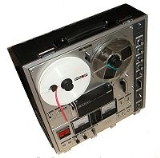
Tape recorder

Encyclopedia
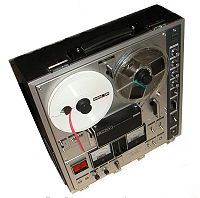
Reel-to-reel audio tape recording
Reel-to-reel, open reel tape recording is the form of magnetic tape audio recording in which the recording medium is held on a reel, rather than being securely contained within a cassette....
, cassette deck
Cassette deck
A cassette deck is a type of tape recorder for playing or recording audio compact cassettes. A deck was formerly distinguished from a recorder as being part of a stereo component system, while a recorder had a self-contained power amplifier...
or tape machine is an audio storage
Sound recording and reproduction
Sound recording and reproduction is an electrical or mechanical inscription and re-creation of sound waves, such as spoken voice, singing, instrumental music, or sound effects. The two main classes of sound recording technology are analog recording and digital recording...
device that records and plays back sounds, including articulated voices, usually using magnetic tape
Magnetic tape
Magnetic tape is a medium for magnetic recording, made of a thin magnetizable coating on a long, narrow strip of plastic. It was developed in Germany, based on magnetic wire recording. Devices that record and play back audio and video using magnetic tape are tape recorders and video tape recorders...
, either wound on a reel or in a cassette
Compact Cassette
The Compact Cassette, often referred to as audio cassette, cassette tape, cassette, or simply tape, is a magnetic tape sound recording format. It was designed originally for dictation, but improvements in fidelity led the Compact Cassette to supplant the Stereo 8-track cartridge and reel-to-reel...
, for storage. In its present day form, it records a fluctuating signal
Signal processing
Signal processing is an area of systems engineering, electrical engineering and applied mathematics that deals with operations on or analysis of signals, in either discrete or continuous time...
by moving the tape across a tape head
Tape head
A tape head is a type of transducer used in tape recorders to convert electrical signals to magnetic fluctuations and vice versa.-Principles of operation:...
that polarizes the magnetic domains
Magnetic domains
A magnetic domain describes a region within a magnetic material which has uniform magnetization. This means that the individual magnetic moments of the atoms are aligned with one another and they point in the same direction...
in the tape in proportion to the audio signal.
History
Earliest variant: non-magnetic wax strip recorder
Likely the earliest known audio tape recorder was a non-magneticMagnetism
Magnetism is a property of materials that respond at an atomic or subatomic level to an applied magnetic field. Ferromagnetism is the strongest and most familiar type of magnetism. It is responsible for the behavior of permanent magnets, which produce their own persistent magnetic fields, as well...
, non-electric
Electricity
Electricity is a general term encompassing a variety of phenomena resulting from the presence and flow of electric charge. These include many easily recognizable phenomena, such as lightning, static electricity, and the flow of electrical current in an electrical wire...
version invented by Alexander Graham Bell
Alexander Graham Bell
Alexander Graham Bell was an eminent scientist, inventor, engineer and innovator who is credited with inventing the first practical telephone....
's Volta Laboratory and patented in 1886 . It employed a 3/16 in strip of wax-covered paper that was coated by dipping it in a solution of beeswax
Beeswax
Beeswax is a natural wax produced in the bee hive of honey bees of the genus Apis. It is mainly esters of fatty acids and various long chain alcohols...
and paraffin
Paraffin
In chemistry, paraffin is a term that can be used synonymously with "alkane", indicating hydrocarbons with the general formula CnH2n+2. Paraffin wax refers to a mixture of alkanes that falls within the 20 ≤ n ≤ 40 range; they are found in the solid state at room temperature and begin to enter the...
and then had one side scraped clean, with the other side allowed to harden. The machine was of sturdy wood and metal construction, and hand-powered by means of a knob fastened to the flywheel
Flywheel
A flywheel is a rotating mechanical device that is used to store rotational energy. Flywheels have a significant moment of inertia, and thus resist changes in rotational speed. The amount of energy stored in a flywheel is proportional to the square of its rotational speed...
. The wax strip passed from one eight-inch reel around the periphery of a pulley (with guide flanges) mounted above the V-pulleys on the main vertical shaft, where it came in contact with either its recording or playback stylus
Stylus
A stylus is a writing utensil, or a small tool for some other form of marking or shaping, for example in pottery. The word is also used for a computer accessory . It usually refers to a narrow elongated staff, similar to a modern ballpoint pen. Many styli are heavily curved to be held more easily...
. The tape was then taken up on the other reel. The sharp recording stylus, actuated by a vibrating mica diaphragm, cut the wax from the strip. In playback mode, a dull, loosely mounted stylus, attached to a rubber diaphragm, carried the reproduced sounds through an ear tube to its listener.
Both recording
Recording
Recording is the process of capturing data or translating information to a recording format stored on some storage medium, which is often referred to as a record or, if an auditory medium, a recording....
and reproducing heads, mounted alternately on the same two posts, could be adjusted vertically so that several recordings could be cut on the same 3/16 in strip. While the machine was never developed commercially, it was an interesting ancestor to the modern magnetic tape recorder which it resembled somewhat in design. The tapes and machine created by Bell's associates, examined at one of the Smithsonian Institution
Smithsonian Institution
The Smithsonian Institution is an educational and research institute and associated museum complex, administered and funded by the government of the United States and by funds from its endowment, contributions, and profits from its retail operations, concessions, licensing activities, and magazines...
's museums, became brittle, and the heavy paper reels warped. The machine's playback head was also missing. Otherwise, with some reconditioning, they could be placed into working condition.
Photoelectric variant
In 1932, after six years of developmental work, Merle Duston, a Detroit radio engineer created a tape recorder that used a low-cost chemically-treated paper tape, capable of recording both sounds and voice. During the recording process, the tape moved through a pair of electrodes which immediately imprinted the modulated sound signals as visible black stripes into the paper tape's surface. The sound track could be immediately replayed from the same recorder unit, which also contained photoelectric sensors, somewhat similar to the various motion picture sound-on-filmSound-on-film
Sound-on-film refers to a class of sound film processes where the sound accompanying picture is physically recorded onto photographic film, usually, but not always, the same strip of film carrying the picture. Sound-on-film processes can either record an analog sound track or digital sound track,...
technologies of the era.
On August 13, 1931, Duston filed USPTO Patent Application #556,743 for "Method Of And Apparatus For Electrically Recording And Reproducing Sound And Other Vibrations", and which was renewed in 1934.
Steel wire magnetic recorder variant
The first wire recorder was the Valdemar PoulsenValdemar Poulsen
Valdemar Poulsen was a Danish engineer who developed a magnetic wire recorder in 1899.-Biography:He was born on 23 November 1869 in Copenhagen...
Telegraphone of the late 1890s, and wire recorders for law/office dictation and telephone recording were made almost continuously by various companies (mainly the American Telegraphone Company) through the 1920s and 1930s. These devices were mostly sold as consumer technologies after World War II.
Widespread use of the wire recording device occurred within the decades spanning from 1940 until 1960, following the development of inexpensive designs licensed internationally by the Brush Development Company of Cleveland, Ohio and the Armour Research Foundation of the Armour Institute of Technology (later Illinois Institute of Technology
Illinois Institute of Technology
Illinois Institute of Technology, commonly called Illinois Tech or IIT, is a private Ph.D.-granting university located in Chicago, Illinois, with programs in engineering, science, psychology, architecture, business, communications, industrial technology, information technology, design, and law...
). These two organizations licensed dozens of manufacturers in the U.S., Japan, and Europe. Wire was also used as a recording medium in black box
Flight recorder
A flight recorder is an electronic recording device placed in an aircraft for the purpose of facilitating the investigation of an aircraft accident or incident. For this reason, flight recorders are required to be capable of surviving the conditions likely to be encountered in a severe aircraft...
voice recorders for aviation in the 1950s.
Consumer wire recorders were marketed for home entertainment or as an inexpensive substitute for commercial office dictation recorders, but the development of consumer magnetic tape recorders starting in 1948 quickly drove wire recorders from the market.
Early magnetic tape recorders
Early magnetic tape recorders were created by replacing the steel wireWire
A wire is a single, usually cylindrical, flexible strand or rod of metal. Wires are used to bear mechanical loads and to carry electricity and telecommunications signals. Wire is commonly formed by drawing the metal through a hole in a die or draw plate. Standard sizes are determined by various...
of a wire recorder
Wire recording
Wire recording is a type of analog audio storage in which a magnetic recording is made on thin steel or stainless steel wire.The wire is pulled rapidly across a recording head which magnetizes each point along the wire in accordance with the intensity and polarity of the electrical audio signal...
with a thin steel tape. The first of these modified wire recorders was the Blattnerphone, created in 1929 or 1930 by the Ludwig Blattner Picture Corporation. The first practical tape recorder from AEG
AEG
Allgemeine Elektricitäts-Gesellschaft was a German producer of electrical equipment founded in 1883 by Emil Rathenau....
was the Magnetophon
Magnetophon
Magnetophon was the brand or model name of the pioneering reel-to-reel tape recorder developed by engineers of the German electronics company AEG in the 1930s, based on the magnetic tape invention by Fritz Pfleumer...
K1, demonstrated in Germany in 1935. Friedrich Matthias of IG Farben/BASF developed the recording tape, including the oxide, the binder, and the backing material. Development of magnetic tape recorders in the late 1940s and early 1950s is associated with Ampex
Ampex
Ampex is an American electronics company founded in 1944 by Alexander M. Poniatoff. The name AMPEX is an acronym, created by its founder, which stands for Alexander M. Poniatoff Excellence...
; the equally important development of magnetic tape media itself was led by Minnesota Mining and Manufacturing Company (now known as 3M
3M
3M Company , formerly known as the Minnesota Mining and Manufacturing Company, is an American multinational conglomerate corporation based in Maplewood, Minnesota, United States....
).
- Further information: Further information: Magnetic tape sound recording –Early steel tape recorders
Electrical
Electric currentElectric current
Electric current is a flow of electric charge through a medium.This charge is typically carried by moving electrons in a conductor such as wire...
flowing in the coils of the tape head creates a fluctuating magnetic field. This causes the magnetic material on the tape, which is moving past and in contact with the head, to align in a manner proportional to the original signal. The signal can be reproduced by running the tape back across the tape head, where the reverse process occurs – the magnetic imprint on the tape induces
Faraday's law of induction
Faraday's law of induction dates from the 1830s, and is a basic law of electromagnetism relating to the operating principles of transformers, inductors, and many types of electrical motors and generators...
a small current in the read head which approximates the original signal and is then amplified for playback. Many tape recorders are capable of recording and playing back at once by means of separate record and playback heads in line or combined in one unit.
Mechanical
Modern professional recorders usually use a three-motor scheme. One motor with a constant rotational speed drives the capstan. This, usually combined with a rubber pinch roller, ensures that the tape speed does not fluctuate. The other two motors, which are called Torque Motors, apply equal and opposite torques to the supply and take up reels during recording and play back functions and maintain the tape's tension. During fast winding operations the pinch roller is disengaged and the take up reel motor is supplied with a higher voltage than the supply motor. The cheapest models use a single motor for all required functions; the motor drives the capstan directly and the supply and take-up reels are loosely coupled to the capstan motor with slipping belts or clutches. There are also variants with two motors, in which one motor is used for rewinding only.Later developments
Since their first introduction, analog tape recorders have experienced a long series of progressive developments resulting in increased sound quality, convenience, and versatility.- Two-track and, later, multi-track heads permitted discrete recording and playback of individual sound sources, such as two stereophonic channels, or different microphones during live recording. The more versatile machines could be switched to record on some tracks while playing back others, permitting additional tracks to be "laid down" to match previously recorded material such as a rhythm track.
- Use of separate heads for recording vs. playback (three heads total, counting the erase head) enabled monitoring of the recorded signal a fraction of a second after recording. Mixing the playback signal back into the record input also created a primitive echo generator.
- Dynamic range compression during recording and expansion during playback expanded the available dynamic range and improved the signal-to-noise ratio. dbxDbxdbx or DBX may refer to:* dbx , a Unix source-level debugger* dbx, Inc., a professional audio recording equipment company** dbx , a noise reduction system invented by dbx, Inc....
and Dolby LaboratoriesDolby LaboratoriesDolby Laboratories, Inc. , often shortened to Dolby Labs, is an American company specializing in audio noise reduction and audio encoding/compression.-History:...
introduced add-on products in this area, originally for studio use, and later in versions for the consumer market. In particular, "Dolby B" noise reduction became very common in all but the least expensive cassette tape recorders.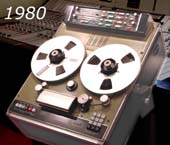
- Computer-controlled analog tape recorders were introduced by Oscar Bonello in Argentina. The mechanical transport used three DC motors and introduced two new advances: automated microprocessor transport control and automatic adjustment of bias and frequency responseFrequency responseFrequency response is the quantitative measure of the output spectrum of a system or device in response to a stimulus, and is used to characterize the dynamics of the system. It is a measure of magnitude and phase of the output as a function of frequency, in comparison to the input...
. In 30 seconds the recorder adjusted its bias for minimum THDTotal harmonic distortionThe total harmonic distortion, or THD, of a signal is a measurement of the harmonic distortion present and is defined as the ratio of the sum of the powers of all harmonic components to the power of the fundamental frequency...
and best frequency response to match the brand and batch of magnetic tape used. The microprocessor control of transport allowed fast location of any point on the tape.
Limitations
The storage of an analogue signalAnalog signal
An analog or analogue signal is any continuous signal for which the time varying feature of the signal is a representation of some other time varying quantity, i.e., analogous to another time varying signal. It differs from a digital signal in terms of small fluctuations in the signal which are...
on tape works well, but is not perfect. In particular, the granular nature of the magnetic material adds high-frequency noise to the signal, generally referred to as tape hiss. Also, the magnetic characteristics of tape are not linear
Linear
In mathematics, a linear map or function f is a function which satisfies the following two properties:* Additivity : f = f + f...
. They exhibit a characteristic hysteresis
Hysteresis
Hysteresis is the dependence of a system not just on its current environment but also on its past. This dependence arises because the system can be in more than one internal state. To predict its future evolution, either its internal state or its history must be known. If a given input alternately...
curve, which causes unwanted distortion
Distortion
A distortion is the alteration of the original shape of an object, image, sound, waveform or other form of information or representation. Distortion is usually unwanted, and often many methods are employed to minimize it in practice...
of the signal. Some of this distortion is overcome by using an inaudible high-frequency AC bias
Tape bias
Tape bias is the term for two phenomena, DC bias and AC bias, that improve the fidelity of analogue magnetic tape sound recordings. DC bias is the addition of a direct current to the audio signal that is being recorded. AC bias is the addition of an inaudible high-frequency signal to the audio...
signal when recording, though the amount of bias needs careful adjustment for best results. Different tape material requires differing amounts of bias, which is why most recorders have a switch to select this (or, in a cassette recorder, switch automatically based on cutouts in the cassette shell). Additionally, systems such as Dolby noise reduction system
Dolby noise reduction system
Dolby NR is the name given to a series of noise reduction systems developed by Dolby Laboratories for use in analog magnetic tape recording. The first was Dolby A, a professional broadband noise reduction for recording studios in 1966, but the best-known is Dolby B , a sliding band system for the...
s (Dolby B, Dolby C and Dolby HX-Pro) have been devised to ameliorate some of the noise and distortion problems. Variations in tape speed cause flutter, which can be reduced by using dual capstans. Higher speeds used in professional recorders are prone to cause "head bumps," which are fluctuations in low-frequency response.
Tape recorder variety
There are a wide variety of tape recorders in existence, from small hand-held devices to large multitrackMultitrack recording
Multitrack recording is a method of sound recording that allows for the separate recording of multiple sound sources to create a cohesive whole...
machines. A machine with built-in speakers and audio power amplification to drive them is usually called a "tape recorder" or – if it has no record functionality – a "tape player," while one that requires external amplification for playback is usually called a "tape deck" (regardless of whether it can record).
Multitrack technology enabled the development of modern art music
Art music
Art music is an umbrella term used to refer to musical traditions implying advanced structural and theoretical considerations and a written musical tradition...
and one such artist, Brian Eno
Brian Eno
Brian Peter George St. John le Baptiste de la Salle Eno , commonly known as Brian Eno or simply as Eno , is an English musician, composer, record producer, singer and visual artist, known as one of the principal innovators of ambient music.Eno studied at Colchester Institute art school in Essex,...
, described the tape recorder as "an automatic musical collage device".
Use of tape recorders
An important use of tape recorders is the recording of video. Video cassette recordersVideocassette recorder
The videocassette recorder , is a type of electro-mechanical device that uses removable videocassettes that contain magnetic tape for recording analog audio and analog video from broadcast television so that the images and sound can be played back at a more convenient time...
differ substantially from audio recorders due to the use of a rotating magnetic head that uses a helical scan
Helical scan
Helical scan is a method of recording high bandwidth signals onto magnetic tape. It is used in reel-to-reel video tape recorders, video cassette recorders, digital audio tape recorders, and some computer tape drives....
over the tape medium. Helical scans increase the relative speed of the tape surface over the head.
While they are primarily used for sound recording
Sound recording and reproduction
Sound recording and reproduction is an electrical or mechanical inscription and re-creation of sound waves, such as spoken voice, singing, instrumental music, or sound effects. The two main classes of sound recording technology are analog recording and digital recording...
, tape machines were also important for data storage before the advent of floppy disk
Floppy disk
A floppy disk is a disk storage medium composed of a disk of thin and flexible magnetic storage medium, sealed in a rectangular plastic carrier lined with fabric that removes dust particles...
s and CDs
Compact Disc
The Compact Disc is an optical disc used to store digital data. It was originally developed to store and playback sound recordings exclusively, but later expanded to encompass data storage , write-once audio and data storage , rewritable media , Video Compact Discs , Super Video Compact Discs ,...
, and are still used today, although primarily to provide an offline backup to hard disk drives.
Tapedeck speeds
Professional decks will use higher tape speeds, with 15 and 30 inches per second being most common, while lower tape speeds are usually used for smaller recorders and cassette players, in order to save space where fidelity is not as critical as in professional recorders. By providing a range of tape speeds, users can trade-off recording time against signal quality with higher tape speeds providing greater frequency response.There are many different tape speeds which are in use in all sorts of tape recorders. Speed may be expressed in centimeters per second
Second
The second is a unit of measurement of time, and is the International System of Units base unit of time. It may be measured using a clock....
(cm/s) or in inches per second
Inches per second
The inch per second is a unit of speed or velocity. It expresses the distance in inches traveled or displaced, divided by time in seconds...
(in/s).
| cm/s | in/s |
|---|---|
| 1.2 | 15/32 |
| 2.4 | 15/16 |
| 4.75 | 1 |
| 9.5 | 3 |
| 19 | 7 |
| 38 | 15 |
| 76 | 30 |
See also
- Audio editingAudio engineeringAn audio engineer, also called audio technician, audio technologist or sound technician, is a specialist in a skilled trade that deals with the use of machinery and equipment for the recording, mixing and reproduction of sounds. The field draws on many artistic and vocational areas, including...
- Audio formatAudio formatAn audio format is a medium for storing sound and music. The term is applied to both the physical recording media and the recording formats of the audio content – in computer science it is often limited to the audio file format, but its wider use usually refers to the physical method used to...
- Digital voice recorder
- Electronic musicElectronic musicElectronic music is music that employs electronic musical instruments and electronic music technology in its production. In general a distinction can be made between sound produced using electromechanical means and that produced using electronic technology. Examples of electromechanical sound...
- ElectromagnetismElectromagnetismElectromagnetism is one of the four fundamental interactions in nature. The other three are the strong interaction, the weak interaction and gravitation...
- Sound recordingSound recording and reproductionSound recording and reproduction is an electrical or mechanical inscription and re-creation of sound waves, such as spoken voice, singing, instrumental music, or sound effects. The two main classes of sound recording technology are analog recording and digital recording...
- Volta Laboratory-Sound recording
- Wire recordingWire recordingWire recording is a type of analog audio storage in which a magnetic recording is made on thin steel or stainless steel wire.The wire is pulled rapidly across a recording head which magnetizes each point along the wire in accordance with the intensity and polarity of the electrical audio signal...
See also: tape formats
- 8-track tape
- Cassette deckCassette deckA cassette deck is a type of tape recorder for playing or recording audio compact cassettes. A deck was formerly distinguished from a recorder as being part of a stereo component system, while a recorder had a self-contained power amplifier...
- Compact audio cassetteCompact CassetteThe Compact Cassette, often referred to as audio cassette, cassette tape, cassette, or simply tape, is a magnetic tape sound recording format. It was designed originally for dictation, but improvements in fidelity led the Compact Cassette to supplant the Stereo 8-track cartridge and reel-to-reel...
- Digital Audio TapeDigital Audio TapeDigital Audio Tape is a signal recording and playback medium developed by Sony and introduced in 1987. In appearance it is similar to a compact audio cassette, using 4 mm magnetic tape enclosed in a protective shell, but is roughly half the size at 73 mm × 54 mm × 10.5 mm. As...
(DAT) - ElcasetElcasetElcaset was a short-lived audio format created by Sony in 1976, building on an idea introduced 20 years earlier in the RCA tape cartridge.In 1976, it was widely felt that the compact cassette was never likely to be capable of the same levels of performance that was available from reel-to-reel...
- Helical scanHelical scanHelical scan is a method of recording high bandwidth signals onto magnetic tape. It is used in reel-to-reel video tape recorders, video cassette recorders, digital audio tape recorders, and some computer tape drives....
- Reel-to-reel audio tape recordingReel-to-reel audio tape recordingReel-to-reel, open reel tape recording is the form of magnetic tape audio recording in which the recording medium is held on a reel, rather than being securely contained within a cassette....
- Wire recordingWire recordingWire recording is a type of analog audio storage in which a magnetic recording is made on thin steel or stainless steel wire.The wire is pulled rapidly across a recording head which magnetizes each point along the wire in accordance with the intensity and polarity of the electrical audio signal...
External links
- Tape Recorder - Interactive Java Tutorial National High Magnetic Field Laboratory
- WikiRecording's Guide to Analog Tape