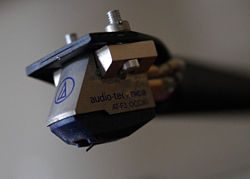
A
magnetic cartridge is a
transducerA transducer is a device, electrical, electronic, electro-mechanical, electromagnetic, photonic, or photovoltaic, that converts one type of energy or physical attribute to another for various purposes including measurement or information transfer .There are two kinds of transducers...
used for the playback of
gramophone recordA gramophone record, commonly known as phonograph record, vinyl record, or simply record, is an analog sound storage medium consisting of a flat disc with an inscribed modulated spiral groove usually starting near the periphery and ending near the centre of the disc...
s on a
turntable or phonographThe record player, phonograph or gramophone was the most common device for playing recorded sound from the late 1870s until the late 1980s.- Terminology :...
. It converts mechanical vibrational energy from a stylus riding in a spiral record groove into an electrical signal that is subsequently amplified and then converted back to sound by a
loudspeakerA loudspeaker is an electroacoustic transducer that converts an electrical signal into sound. The speaker pulses in accordance with the variations of an electrical signal and causes sound waves to propagate through a medium such as air or water.Loudspeakers are the most variable elements in a...
system.
History
The first electric pick-ups were developed in about 1925. They used a
piezo-electricPiezoelectricity is the ability of some materials to generate an electric field or electric potential in response to applied mechanical stress. The effect is closely related to a change of polarization density within the material's volume...
crystalA crystal or crystalline solid is a solid material whose constituent atoms, molecules, or ions are arranged in an orderly repeating pattern extending in all three spatial dimensions. The scientific study of crystals and crystal formation is crystallography...
of
quartzQuartz is the second most abundant mineral in the Earth's continental crust . It is made up of a continuous framework of SiO
4 silicon-oxygen tetrahedra, with each oxygen being shared between two tetrahedra, giving an overall formula SiO
2.There are many different varieties of...
, stimulated by a
stylusA stylus is a writing utensil. The word is also used for a computer accessory . It usually refers to a narrow elongated staff, similar to a modern ballpoint pen. Many styluses are heavily curved to be held more easily...
made of
sapphireSapphire refers to gemstone varieties of the mineral corundum, an aluminium oxide , when it is a color other than red, in which case the gem would instead be a ruby. Trace amounts of other elements such as iron, titanium, or chromium can give corundum blue, yellow, pink, purple, orange, or...
or
diamondIn mineralogy, diamond is an allotrope of carbon, where the carbon atoms are arranged in a variation of the face-centered cubic crystal structure called a diamond lattice. Diamond is the second most stable form of carbon, after graphite; however, the conversion rate from diamond to graphite is...
.
The magnetic cartridge is presently the most common form of sound pickup used and came into use in the 1950s, following the introduction of magnetic cutter heads around 1945 for mastering records.
Types
In high-fidelity systems, crystal and ceramic pickups have been replaced by the
magnetic cartridgeA magnetic cartridge is a transducer used for the playback of gramophone records on a turntable or phonograph. It converts mechanical vibrational energy from a stylus riding in a spiral record groove into an electrical signal that is subsequently amplified and then converted back to sound by a...
, using either a moving magnet or a
moving coil.
Compared to the crystal and ceramic pickups, the magnetic cartridge gives improved playback fidelity and reduces record wear by tracking the groove with lighter pressure. Magnetic cartridges use much lower tracking forces and thus damage the record grooves less. They also have a lower output voltage than a crystal or ceramic pickup, in the range of only a few millivolts, thus requiring greater amplification.
Moving Magnet (MM) cartridges
In a moving magnet cartridge, the stylus cantilever carries a tiny permanent
magnetA magnet is a material or object that produces a magnetic field. This magnetic field is invisible but is responsible for the most notable property of a magnet: a force that pulls on other ferromagnetic materials and attracts or repels other magnets.A permanent magnet is an object made from a...
, which is positioned between two sets of fixed coils (in a stereophonic cartridge), forming a tiny electromagnetic generator. As the magnet vibrates in response to the stylus following the record groove, it
inducesElectromagnetic induction is the production of voltage across a conductor situated in a changing magnetic field or a conductor moving through a stationary magnetic field....
a tiny current in the coils.
Because the magnet is small and has little mass, and is not coupled mechanically to the generator (as in a ceramic cartridge), a properly adjusted stylus follows the groove more faithfully while requiring less tracking force (the downward pressure on the stylus).
There is a sub-category. Moving iron and induced magnet types (ADC being a well known example) which have the magnet fixed and move a piece of iron or other ferrous alloy in the field of the magnet to produce the signal within the fixed coils.
Moving Coil (MC) cartridges
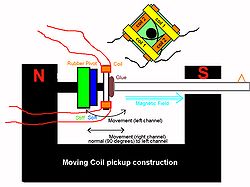
The MC design is again a tiny electromagnetic generator, but (unlike an MM design) with the magnet and coils reversed: the coils are attached to the stylus, and move within the field of a permanent magnet. The coils are tiny and made from very fine wire, so are even lighter than the small magnet used in an MM cartridge, thus improving the tracking ability of the cartridge. This can give extended frequency response as well as greater fidelity.
A disadvantage however is that moving-coil cartridges generate an even lower voltage signal than an moving-magnet type cartridge. This is because the moving coil cannot be large enough (it would be too heavy) to generate equivalent voltage levels. The resulting signal is only a few hundred microvolts, and thus more easily swamped by noise, induced hum, etc. Thus it is more challenging to design a
preamplifierA preamplifier , or control amp in some parts of the world, is an electronic amplifier which precedes another amplifier to prepare an electronic signal for further amplification or processing...
with the extremely low noise inputs needed for moving-coil cartridge, therefore a "step up transformer" are sometimes used instead.
Moving coil cartridges are extremely small precision instruments and are therefore generally expensive, but are frequently preferred by audiophiles due to their better performance.
Moving Micro Cross (MMC) cartridges
The MMC design was invented and patented by
Bang & OlufsenBang & Olufsen is a Danish company that designs and manufactures audio products, television sets, and telephones. It was founded in 1925 by Peter Bang and Svend Olufsen, whose first significant product was a radio that worked with alternating current, when most radios were run from batteries...
. Since it often uses a special mounting, it can be mostly found in Bang & Olufsen turntables (which also cannot use another type of cartridge). Apart from being produced for the Bang & Olufsen mounting system, the SP12 and SP14 were also available in standard 1/2" mount.
The MMC cartridge is a
moving iron design. Magnets and coils are stationary while the
micro cross moves with the stylus, thereby varying the distances between the arms of the cross and the magnets. The design obviously offers more freedom concerning magnet and coil mass (compared to MC and MM cartridges). For example, the MMC20 (presented in 1978) uses four coils wound around the magnetic cores with 1200 turns each. Minimizing the moving mass also reduces the unavoidable wear on the records.
It is also claimed that the MMC design allows for superior channel separation, since each channel's movements appear on a separate axis.
Moving Magnet vs. Moving Coil debate
The debate as to whether MM or MC designs can ultimately produce the better sound is often heated and subjective. The distinction between the two is often blurred by cost and design considerations - i.e. can an MC cartridge requiring another step-up amplification outperform well made MM cartridges that need simpler front-end stages? Every now and then a design comes along to re-open this debate. A good example being the Linn K9 (now discontinued) - regarded by some as one of the better MM designs and competitive with MC alternatives costing more. Amongst others, Grace, ADC and Grado also manufactured notably good designs.
"Decca" Cartridges
The Decca phono cartridges were a unique design, with fixed magnets and coils. The stylus shaft was composed of the diamond tip, a short piece of soft iron, and an L-shaped
cantileverA cantilever is a beam supported on only one end. The beam carries the load to the support where it is resisted by moment and shear stress. Cantilever construction allows for overhanging structures without external bracing. Cantilevers can also be constructed with trusses or slabs.This is in...
made of non-magnetic steel. Since the iron was placed very close to the tip (within 1 mm), the motions of the tip could be tracked very accurately. Decca engineers called this "positive scanning". Vertical and lateral compliance was controlled by the shape and thickness of the cantilever. Decca cartidges had a reputation for being very musical; however early versions required more tracking force than competitive designs - making record wear a concern.
Stereo reproduction
One reason that magnetic cartridges superseded the crystal pick-up was the relative ease with which it could be made to reproduce
stereoStereophonic sound, commonly called stereo, is the reproduction of sound using two or more independent audio channels through a symmetrical configuration of loudspeakers in such a way as to create the impression of sound heard from various directions, as in natural hearing...
recordings, which were introduced in 1958. In a stereo recording, the two channels are arranged to drive the record cutter head at an angle of 45° to the vertical, effectively encoding each channel in the left and right V-shaped walls of the record groove. This system worked well, since it provided full compatibility with a monaural pick-up, so stereo records could be played on older mono equipment. To reproduce the stereo signal, the cartridge simply arranges pairs of coils at 45° to complement the cutting process. With careful design, the coils can be shielded from each other electrically and mechanically such that stereo separation is maximised.
Comparison with crystal technology
Piezoelectric crystal or ceramic pickups had a few clear advantages. They were much easier and cheaper to make and were more robust than the delicate magnetic pickup. In addition, the output voltage from a crystal pickup is relatively large, requiring less amplification, which helped improve the
signal-to-noise ratioSignal-to-noise ratio is an electrical engineering measurement, also used in other fields , defined as the ratio of a signal power to the noise power corrupting the signal...
. However, the signal from a crystal is not an accurate reproduction of the recording, as there is a lot of
distortionA distortion is the alteration of the original shape of an object, image, sound, waveform or other form of information or representation. Distortion is usually unwanted...
introduced. The stylus is coupled to the crystal in a fairly rigid manner, which is also not as good at following rapid changes in the record grooves, so
frequency responseFrequency response is the measure of any system's output spectrum in response to an input signal. In the audible range it is usually referred to in connection with electronic amplifiers, microphones and loudspeakers. Radio spectrum frequency response can refer to measurements of coaxial cables,...
also suffers. This requires a greater tracking force, which in turn wears the records out faster. (This has earned cheap portable record players, the nickname "portable grinding wheel", in some circles.)
By contrast, since the magnetic cartridge is not mechanically coupled, the stylus and lever arm weight can be made exceedingly small. This gives extended frequency response and low distortion. The distortion is further minimised by the fact that there is more inherent linearity in the induction principle than there is in the piezo-electric one. Since the lighter stylus requires very low tracking forces, it requires a more sophisticated counterweighted arm, but reduces record wear.
The output from the magnetic cartridge is only a few millivolts compared to several tenths of a volt from a crystal or ceramic pickup. This requires an additional preamplifier stage. Careful design and shielding in the signal cables and amplifier is needed to prevent unwanted noise (
shot noiseShot noise is a type of electronic noise that occurs when the finite number of particles that carry energy, such as electrons in an electronic circuit or photons in an optical device, is small enough to give rise to detectable statistical fluctuations in a measurement...
or
EMIElectromagnetic interference is a disturbance that affects an electrical circuit due to either electromagnetic conduction or electromagnetic radiation emitted from an external source. The disturbance may interrupt, obstruct, or otherwise degrade or limit the effective performance of the circuit...
). The magnetic induction principle also naturally leads to a linearly rising response with increasing frequency, and this needs to be compensated for to give correct (flat) frequency reproduction. Conversely, the very low bass frequencies are not efficiently picked up, so a strong bass boost is needed. This can amplify unwanted low frequency noise such as that from the turntable motor and drive mechanism itself (rumble). Crystal pickups do not suffer from these drawbacks and give a much better bass performance, so they may be preferred in some applications (such as DJ-ing), where robustness and good bass are favoured over highest fidelity reproduction. The moving coil pickups tend to have an even lower level of output, and so usually require a step-up transformer or very special preamplifiers to bring these signals up to the level of input that a standard amplifier requires. These special preamplifiers must have very low noise indeed (some have even been
cryogenicallyIn physics, cryogenics is the study of the production of very low temperature and the behavior of materials at those temperatures. Rather than the familiar temperature scales of Fahrenheit and Celsius, cryogenicists use the Kelvin scales...
cooled), and hence tend to be expensive. Many
audiophileAn audiophile, from Latin audio "I hear" and Greek philos "loving," is a hobbyist who seeks high-quality audio reproduction via the use of non-mass-produced high-end audio electronics....
s claim that the benefits are worthwhile. There are higher output moving coil pickup cartridges that can be used directly into a normal moving magnet input, but these are in the minority.
The bass boost and high frequency rolloff can be conveniently incorporated into the preamplifier which implements the
RIAA equalizationRIAA equalization is a specification for the correct playback of gramophone records, established by the Recording Industry Association of America...
curve, a noise reduction technique used on all modern records.
The magnetic nature of the modern pickup means it must be shielded from external fields, especially from the loudspeakers of the same system, or unpleasant and possibly damaging feedback can occur. For this reason, the cartridge itself has a shield, usually of
mu-metalMu-metal is a nickel-iron alloy that has very high magnetic permeability. The high permeability makes mu-metal very effective at screening static or low-frequency magnetic fields, which cannot be attenuated by other methods...
, to help screen out unwanted fields.
The stylus
The stylus, or "needle", is a crucial part of the phonograph (or gramophone,
Brit.British English, or UK English or English English , is the broad term used to distinguish the forms of the English language used in the United Kingdom from forms used elsewhere...
), as it is the one part of the system that actually contacts the recorded disc and transfers its vibrations to the rest of the system. It is the part which also suffers the greatest wear. There are two desired qualities in a stylus: first, that it faithfully follows the contours of the recorded groove and transfers the vibration to the system, and second, that it does not damage the recorded disc.
History of materials
Early phonograph styli in mechanical players were steel, or even fibre, needles, usually with a shank about 1/8" (3 mm) in diameter, ground to a sharp point. These were easily replaceable by the user, as they had a very limited life and wore out fairly rapidly with use. Extensive play tended to wear records out as well as needles.
When the electronic phonograph was introduced, styli were included as part of the pickup cartridge.
In early times, wear of cylinders and glass styli was problematic. By 1908,
sapphireSapphire refers to gemstone varieties of the mineral corundum, an aluminium oxide , when it is a color other than red, in which case the gem would instead be a ruby. Trace amounts of other elements such as iron, titanium, or chromium can give corundum blue, yellow, pink, purple, orange, or...
styli were being attached to the rice paper diaphragms, and in 1912 Edison began to use the
diamondIn mineralogy, diamond is an allotrope of carbon, where the carbon atoms are arranged in a variation of the face-centered cubic crystal structure called a diamond lattice. Diamond is the second most stable form of carbon, after graphite; however, the conversion rate from diamond to graphite is...
stylus. Typical low cost crystal cartridges of the 1950s tracked at 5-8
grams of forceThe unit kilogram-force or kilopond is defined as the magnitude of the force exerted on one kilogram of mass by a gravitational field . So one kilogram-force is by definition equal to newtons...
and used replaceable
osmiumOsmium is a chemical element that has the symbol Os and atomic number 76. Osmium is a hard, brittle, blue-gray or blue-black transition metal in the platinum family, and is the densest natural element. The density of osmium is , slightly greater than that of iridium, the second densest element....
tipped steel styli called
needles, which styli might last only five to ten plays before needing replacement. To help make the stylus last longer, sapphire styli for 78 rpm records or diamond styli for 33 1/3 rpm LPs were re-introduced. A 78 rpm stylus typically has a 3
milA thou A thou A thou . It is sometimes used in engineering and in the specification of:...
(0.08 mm) diameter while a stylus for 33 1/3 rpm
microgroove LP discs has a 1 mil (0.03 mm) diameter tip to fit the narrower groove. Sapphire might be good for 40 or 50 hours while a diamond would last at least ten times that long. Typically, these early cartridges were of the "flip-over" type; the cartridge had a stylus on either side, one for 78 rpm discs, the other for 33 and 45 rpm ("microgroove") records. The entire cartridge could be rotated 180° by means of a knob or lever at the end of the tonearm to use the desired stylus.
Later, starting in the 1960s, most manufacturers settled on diamond-tipped styli for all cartridges. Magnetic cartridges lowered tracking forces to 1-2 grams, and with the obsolescence of 78's, diamond became the standard stylus material. Moving magnet cartridges often have replaceable styli; most moving coil cartridges do not offer user-replaceable styli, although some manufacturers offer a trade-in or a re-tipping service.
Magnetic cartridge manufacturers usually provide a specialized range of styli for DJ use. More rugged conical styli are required due to the frequent reversals of direction involved in
scratchingScratching is a DJ or turntablist technique used to produce distinctive sounds by moving a vinyl record back and forth on a turntable while manipulating the crossfader on a DJ mixer. While scratching is most commonly associated with hip hop music, since the 1990s, it has been used in some styles of...
and back-cueing, see Ortofon or Stanton.
Stylus shape
The physical shape of the stylus has a bearing on its performance. The most obvious shape is the spherical stylus (also known as "conical"), where the tip of the stylus is ground to a
hemisphereA sphere is a perfectly round geometrical object in three-dimensional space, such as the shape of a round ball. Like a circle in two dimensions, a perfect sphere is completely symmetrical around its center, with all points on the surface lying the same distance r from the center point...
for playing
monophonicMonaural or monophonic sound reproduction is single-channel. Typically there is only one microphone, one loudspeaker, or channels are fed from a common signal path...
recordings or for rugged use. However, this shape is unable to faithfully track all possible variations in a record groove. Better quality LP styli use an
ellipticalIn mathematics, an ellipse is the bounded case of a conic section, the geometric shape that results from cutting a circular conical or cylindrical surface with an oblique plane...
or "line contact" shape, arranged with its 0.02 mm (0.0007 inch) long axis across the record groove. The short axis may be from 0.005 to 0.01 mm (.0002 to .0004 inch) depending on the particular design. This shape followed the undulations of the groove better than spherical styli because they more closely resembled the triangular cutter used to create the groove.
In later years, bi-radial styli appeared where, in the perpendicular axis, the tip of the stylus was ground to a smaller radius than the main body. The result was a stylus that rode slightly lower in the groove and even more closely matched the shape of the triangular cutter than the elliptical design. There were several variations on the basic bi-radial design depending on the manufacturer who produced them.
Cantilevers
The
cantileverA cantilever is a beam supported on only one end. The beam carries the load to the support where it is resisted by moment and shear stress. Cantilever construction allows for overhanging structures without external bracing. Cantilevers can also be constructed with trusses or slabs.This is in...
is the arm that connects the stylus to the magnet or pickup coils. Most cartridges have cantilevers made from aluminium or
boronBoron is the chemical element with atomic number 5 and the chemical symbol B. Boron is a trivalent metalloid element which occurs abundantly in the evaporite ores borax and ulexite....
; some very expensive models have
rubyA ruby is a pink to blood-red gemstone, a variety of the mineral corundum . The red color is caused mainly by the presence of the element chromium. Its name comes from ruber, Latin for red. Other varieties of gem-quality corundum are called sapphires...
,
diamondIn mineralogy, diamond is an allotrope of carbon, where the carbon atoms are arranged in a variation of the face-centered cubic crystal structure called a diamond lattice. Diamond is the second most stable form of carbon, after graphite; however, the conversion rate from diamond to graphite is...
, beryllium or
carbon fiberCarbon fiber is a material consisting of extremely thin fibers about 0.005–0.010 mm in diameter and composed mostly of carbon atoms. The carbon atoms are bonded together in microscopic crystals that are more or less aligned parallel to the long axis of the fiber...
cantilevers chosen for their exceptional stiffness.
TurntablismTurntablism is the art of manipulating sounds and creating music using phonograph turntables and a DJ mixer. The word 'turntablist' was coined in 1995 by DJ Babu to describe the difference between a DJ who just plays records, and one who performs by touching and moving the records, stylus and mixer...
also places great demands on the cantilever of the cartridge.
External links