

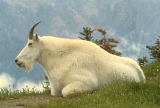
Mountain goat

Encyclopedia
The Mountain Goat also known as the Rocky Mountain Goat, is a large-hoofed mammal found only in North America
. Despite its vernacular name, it is not a member of Capra
, the genus of true goats. It stays at high elevations and is a sure-footed climber, often resting on rocky cliffs that predators cannot reach.
of the order Artiodactyla and the family Bovidae that includes antelopes, gazelles, and cattle
. It belongs to the subfamily Caprinae (goat-antelopes), along with thirty-two other species including true goat
s, sheep, the chamois
, and the musk ox
. The mountain goat is the only species
in the genus Oreamnos
. The name Oreamnos is derived from the Greek term oros (stem ore-) "mountain" (or, alternatively, oreas "mountain nymph") and the word amnos "lamb".
 Both male
and female
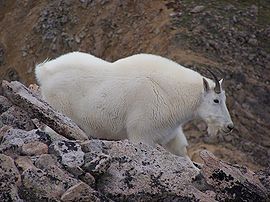
mountain goats have beards, short tails, and long black horns, 15–28 cm in length, which contain yearly growth rings. They are protected from the elements by their woolly white double coats. The fine, dense wool of their undercoats is covered by an outer layer of longer, hollow hairs. In spring, mountain goats moult by rubbing against rocks and trees, with the adult bucks (males) shedding their extra wool first and the pregnant does (females) shedding last. In the winter, their coats help them to withstand temperatures as low as -50 F and winds of up to 100 mph (160 km/h).
A buck stands about three feet (1 m) at the shoulder to the waist. Male goats also have longer horns and a longer beard than does. Mountain goats typically weigh between 100 and 300 lbs (45–136 kg); females are usually 10–30% lighter than males.
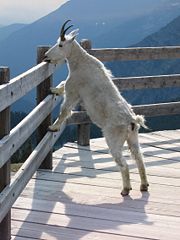
The mountain goat's feet are well-suited for climbing steep, rocky slopes, sometimes with pitches of 60 degrees or more, with inner pads that provide traction and cloven hooves that can be spread apart as needed. Also, the tips of their feet have dewclaw
s that are sharp to keep them from slipping.
and Cascade Range
regions of North America, from northern Washington, Idaho
and Montana
through British Columbia
and Alberta
, into the southern Yukon
and southeastern Alaska
. Its northernmost range is said to be along the northern fringe of the Chugach Mountains
in southcentral Alaska. Introduced populations can also be found in such areas as Wyoming
, Utah
, Nevada
, Oregon
, Colorado
, Texas
, South Dakota
and the Olympic Peninsula
of Washington.
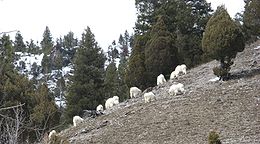
Mountain goats are the largest mammals found in their high-altitude habitat
s, which reach elevations of 13,000 feet (4,000 m) or more. Although they sometimes descend to sea level in coastal areas, they are primarily an alpine
and subalpine
species. Throughout the year, the animals usually stay above the tree line, but they will migrate seasonally to higher or lower elevations within that range. Winter migrations to low-elevation mineral licks
often take them several or more kilometers through forested areas.
and security from predators or disturbance. Seasonal movements primarily reflect nutritional needs (e.g., movements to and from mineral licks/salt lick
), reproductive needs (i.e., movement of pre-parturient females to “kidding” areas; movement to rutting areas), and climatic influences (i.e., movement to areas in response to foraging conditions). In general, seasonal movements are likely to exhibit a strong elevational component, whereby lower, forested elevations are used during the spring-summer (security cover effects) to access lower elevation mineral licks, and during winter (thermal cover effects) to access forage. The farthest movements are expected to be by dispersing mountain goats. Such movements are likely to involve mountain goats crossing forested valleys as they move between mountain blocks.

es, herb
s, sedge
s, fern
s, moss
, lichen
, twigs and leaves from the low-growing shrubs and conifers of their high-altitude habitat.
In captivity, the mountain goat's diet can also include grain, alfalfa
, fruits, and vegetables.
Life cycle and mating=
Mountain goats like to mate in cold weather. In the wild, mountain goats usually live twelve to fifteen years, with their lifespan limited by the wearing down of their teeth. In zoos, however, they can live for sixteen to twenty years. Kids are born in the spring (late May or early June) after a six month gestation period. Nannies give birth, usually to a single offspring, after moving to an isolated ledge; post-partum, they lick the baby dry and ingest the placenta
. Kids weigh a little over 3 kg (7 lb) at birth and begin to run and climb (or attempt to do so) within hours. Although they are mostly weaned within one month, kids follow their mothers closely for the first year of life (or until the nanny gives birth again, if this does not occur the next breeding season); nannies protect their young by leading them out of danger, standing over them when faced by predators, and positioning themselves below their kids on steep slopes to stop free falls. Mountain goats reach sexual maturity at about thirty months. Nannies in a herd undergo synchronized estrus in late October through early December, at which time males and females participate in a mating ritual. Mature billies will stare at nannies for long periods, dig rutting pits, and fight each other in showy (though occasionally dangerous) scuffles. Young billies sometimes try to participate, but they are ignored by nannies; nannies will also sometimes pursue inattentive billies. Both males and females usually mate with multiple individuals during breeding season, although some billies try to keep other males away from certain nannies. After the breeding season is over, males and females move away from each other, with the adult billies breaking up into small bands of two or three individuals. Nannies form loose-knit nursery groups of up to 50 animals.
In lower regions below the tree line, nannies also use their fighting abilities to protect themselves and their offspring from predators, such as wolves, wolverine
s, cougars, lynx
and bear
s. Even though their size protects them from most potential predators in higher altitudes, nannies still must defend their young from golden eagle
s, which can be a threat to very young kids. Nannies have even been observed trying to dominate the more passive bighorn sheep
that share some of their territory.
Mountain goats can occasionally be aggressive towards humans, with at least one reported fatality resulting from an attack by a mountain goat.
and commercialized
for their wool
, pre-columbian
Indigenous peoples of the Pacific Northwest Coast
did incorporate their wool into their weaving
by collecting spring moulted wool left by wild goats.
North America
North America is a continent wholly within the Northern Hemisphere and almost wholly within the Western Hemisphere. It is also considered a northern subcontinent of the Americas...
. Despite its vernacular name, it is not a member of Capra
Capra (genus)
Capra is a genus of mammals, the goats or wild goats, composed of up to nine species including the wild goat, the markhor and several species known as ibex....
, the genus of true goats. It stays at high elevations and is a sure-footed climber, often resting on rocky cliffs that predators cannot reach.
Classification
The mountain goat is an even-toed ungulateUngulate
Ungulates are several groups of mammals, most of which use the tips of their toes, usually hoofed, to sustain their whole body weight while moving. They make up several orders of mammals, of which six to eight survive...
of the order Artiodactyla and the family Bovidae that includes antelopes, gazelles, and cattle
Cattle
Cattle are the most common type of large domesticated ungulates. They are a prominent modern member of the subfamily Bovinae, are the most widespread species of the genus Bos, and are most commonly classified collectively as Bos primigenius...
. It belongs to the subfamily Caprinae (goat-antelopes), along with thirty-two other species including true goat
Capra (genus)
Capra is a genus of mammals, the goats or wild goats, composed of up to nine species including the wild goat, the markhor and several species known as ibex....
s, sheep, the chamois
Chamois
The chamois, Rupicapra rupicapra, is a goat-antelope species native to mountains in Europe, including the Carpathian Mountains of Romania, the European Alps, the Tatra Mountains, the Balkans, parts of Turkey, and the Caucasus. The chamois has also been introduced to the South Island of New Zealand...
, and the musk ox
Musk Ox
The muskox is an Arctic mammal of the family Bovidae, noted for its thick coat and for the strong odor emitted by males, from which its name derives. This musky odor is used to attract females during mating season...
. The mountain goat is the only species
Monotypic
In biology, a monotypic taxon is a taxonomic group with only one biological type. The term's usage differs slightly between botany and zoology. The term monotypic has a separate use in conservation biology, monotypic habitat, regarding species habitat conversion eliminating biodiversity and...
in the genus Oreamnos
Oreamnos
Oreamnos is a genus of North American caprines. The Mountain goat is the only living species. Until the end of the Pleistocene another species, Oreamnos harringtoni, was distributed to the south of the recent form....
. The name Oreamnos is derived from the Greek term oros (stem ore-) "mountain" (or, alternatively, oreas "mountain nymph") and the word amnos "lamb".
General appearance and characteristics
Male
Male refers to the biological sex of an organism, or part of an organism, which produces small mobile gametes, called spermatozoa. Each spermatozoon can fuse with a larger female gamete or ovum, in the process of fertilization...
and female
Female
Female is the sex of an organism, or a part of an organism, which produces non-mobile ova .- Defining characteristics :The ova are defined as the larger gametes in a heterogamous reproduction system, while the smaller, usually motile gamete, the spermatozoon, is produced by the male...
mountain goats have beards, short tails, and long black horns, 15–28 cm in length, which contain yearly growth rings. They are protected from the elements by their woolly white double coats. The fine, dense wool of their undercoats is covered by an outer layer of longer, hollow hairs. In spring, mountain goats moult by rubbing against rocks and trees, with the adult bucks (males) shedding their extra wool first and the pregnant does (females) shedding last. In the winter, their coats help them to withstand temperatures as low as -50 F and winds of up to 100 mph (160 km/h).
A buck stands about three feet (1 m) at the shoulder to the waist. Male goats also have longer horns and a longer beard than does. Mountain goats typically weigh between 100 and 300 lbs (45–136 kg); females are usually 10–30% lighter than males.
The mountain goat's feet are well-suited for climbing steep, rocky slopes, sometimes with pitches of 60 degrees or more, with inner pads that provide traction and cloven hooves that can be spread apart as needed. Also, the tips of their feet have dewclaw
Dewclaw
A dewclaw is a vestigial digit on the foot of many mammals, birds, and reptiles . It commonly grows high on the leg so that in digitigrade species, when the animal is standing, it does not make contact with the ground...
s that are sharp to keep them from slipping.
Range and habitat
The mountain goat inhabits the Rocky MountainsRocky Mountains
The Rocky Mountains are a major mountain range in western North America. The Rocky Mountains stretch more than from the northernmost part of British Columbia, in western Canada, to New Mexico, in the southwestern United States...
and Cascade Range
Cascade Range
The Cascade Range is a major mountain range of western North America, extending from southern British Columbia through Washington and Oregon to Northern California. It includes both non-volcanic mountains, such as the North Cascades, and the notable volcanoes known as the High Cascades...
regions of North America, from northern Washington, Idaho
Idaho
Idaho is a state in the Rocky Mountain area of the United States. The state's largest city and capital is Boise. Residents are called "Idahoans". Idaho was admitted to the Union on July 3, 1890, as the 43rd state....
and Montana
Montana
Montana is a state in the Western United States. The western third of Montana contains numerous mountain ranges. Smaller, "island ranges" are found in the central third of the state, for a total of 77 named ranges of the Rocky Mountains. This geographical fact is reflected in the state's name,...
through British Columbia
British Columbia
British Columbia is the westernmost of Canada's provinces and is known for its natural beauty, as reflected in its Latin motto, Splendor sine occasu . Its name was chosen by Queen Victoria in 1858...
and Alberta
Alberta
Alberta is a province of Canada. It had an estimated population of 3.7 million in 2010 making it the most populous of Canada's three prairie provinces...
, into the southern Yukon
Yukon
Yukon is the westernmost and smallest of Canada's three federal territories. It was named after the Yukon River. The word Yukon means "Great River" in Gwich’in....
and southeastern Alaska
Alaska
Alaska is the largest state in the United States by area. It is situated in the northwest extremity of the North American continent, with Canada to the east, the Arctic Ocean to the north, and the Pacific Ocean to the west and south, with Russia further west across the Bering Strait...
. Its northernmost range is said to be along the northern fringe of the Chugach Mountains
Chugach Mountains
The Chugach Mountains of southern Alaska are the northernmost of the several mountain ranges that make up the Pacific Coast Ranges of the western edge of North America. The range is about 500 km long, running generally east-west. Its highest point is Mount Marcus Baker, at , but most of its...
in southcentral Alaska. Introduced populations can also be found in such areas as Wyoming
Wyoming
Wyoming is a state in the mountain region of the Western United States. The western two thirds of the state is covered mostly with the mountain ranges and rangelands in the foothills of the Eastern Rocky Mountains, while the eastern third of the state is high elevation prairie known as the High...
, Utah
Utah
Utah is a state in the Western United States. It was the 45th state to join the Union, on January 4, 1896. Approximately 80% of Utah's 2,763,885 people live along the Wasatch Front, centering on Salt Lake City. This leaves vast expanses of the state nearly uninhabited, making the population the...
, Nevada
Nevada
Nevada is a state in the western, mountain west, and southwestern regions of the United States. With an area of and a population of about 2.7 million, it is the 7th-largest and 35th-most populous state. Over two-thirds of Nevada's people live in the Las Vegas metropolitan area, which contains its...
, Oregon
Oregon
Oregon is a state in the Pacific Northwest region of the United States. It is located on the Pacific coast, with Washington to the north, California to the south, Nevada on the southeast and Idaho to the east. The Columbia and Snake rivers delineate much of Oregon's northern and eastern...
, Colorado
Colorado
Colorado is a U.S. state that encompasses much of the Rocky Mountains as well as the northeastern portion of the Colorado Plateau and the western edge of the Great Plains...
, Texas
Texas
Texas is the second largest U.S. state by both area and population, and the largest state by area in the contiguous United States.The name, based on the Caddo word "Tejas" meaning "friends" or "allies", was applied by the Spanish to the Caddo themselves and to the region of their settlement in...
, South Dakota
South Dakota
South Dakota is a state located in the Midwestern region of the United States. It is named after the Lakota and Dakota Sioux American Indian tribes. Once a part of Dakota Territory, South Dakota became a state on November 2, 1889. The state has an area of and an estimated population of just over...
and the Olympic Peninsula
Olympic Peninsula
The Olympic Peninsula is the large arm of land in western Washington state of the USA, that lies across Puget Sound from Seattle. It is bounded on the west by the Pacific Ocean, the north by the Strait of Juan de Fuca, and the east by Puget Sound. Cape Alava, the westernmost point in the contiguous...
of Washington.
Mountain goats are the largest mammals found in their high-altitude habitat
Habitat
* Habitat , a place where a species lives and grows*Human habitat, a place where humans live, work or play** Space habitat, a space station intended as a permanent settlement...
s, which reach elevations of 13,000 feet (4,000 m) or more. Although they sometimes descend to sea level in coastal areas, they are primarily an alpine
Alpine climate
Alpine climate is the average weather for a region above the tree line. This climate is also referred to as mountain climate or highland climate....
and subalpine
Subalpine
The subalpine zone is the biotic zone immediately below tree line around the world. Species that occur in this zone depend on the location of the zone on the Earth, for example, Snow Gum in Australia, or Subalpine Larch, Mountain Hemlock and Subalpine Fir in western North America.Trees in the...
species. Throughout the year, the animals usually stay above the tree line, but they will migrate seasonally to higher or lower elevations within that range. Winter migrations to low-elevation mineral licks
Salt lick
A mineral lick is a natural mineral deposit where animals in nutrient-poor ecosystems can obtain essential mineral nutrients...
often take them several or more kilometers through forested areas.
Movement patterns
Daily movements by individual mountain goats are primarily confined to areas on the same mountain face, drainage basin, or alpine opening. Daily movements reflect an individual’s needs for foraging, resting, thermoregulationThermoregulation
Thermoregulation is the ability of an organism to keep its body temperature within certain boundaries, even when the surrounding temperature is very different...
and security from predators or disturbance. Seasonal movements primarily reflect nutritional needs (e.g., movements to and from mineral licks/salt lick
Salt lick
A mineral lick is a natural mineral deposit where animals in nutrient-poor ecosystems can obtain essential mineral nutrients...
), reproductive needs (i.e., movement of pre-parturient females to “kidding” areas; movement to rutting areas), and climatic influences (i.e., movement to areas in response to foraging conditions). In general, seasonal movements are likely to exhibit a strong elevational component, whereby lower, forested elevations are used during the spring-summer (security cover effects) to access lower elevation mineral licks, and during winter (thermal cover effects) to access forage. The farthest movements are expected to be by dispersing mountain goats. Such movements are likely to involve mountain goats crossing forested valleys as they move between mountain blocks.
Diet
Mountain goats are herbivores and spend most of their time grazing. Their diet includes grassGrass
Grasses, or more technically graminoids, are monocotyledonous, usually herbaceous plants with narrow leaves growing from the base. They include the "true grasses", of the Poaceae family, as well as the sedges and the rushes . The true grasses include cereals, bamboo and the grasses of lawns ...
es, herb
Herb
Except in botanical usage, an herb is "any plant with leaves, seeds, or flowers used for flavoring, food, medicine, or perfume" or "a part of such a plant as used in cooking"...
s, sedge
Cyperaceae
Cyperaceae are a family of monocotyledonous graminoid flowering plants known as sedges, which superficially resemble grasses or rushes. The family is large, with some 5,500 species described in about 109 genera. These species are widely distributed, with the centers of diversity for the group...
s, fern
Fern
A fern is any one of a group of about 12,000 species of plants belonging to the botanical group known as Pteridophyta. Unlike mosses, they have xylem and phloem . They have stems, leaves, and roots like other vascular plants...
s, moss
Moss
Mosses are small, soft plants that are typically 1–10 cm tall, though some species are much larger. They commonly grow close together in clumps or mats in damp or shady locations. They do not have flowers or seeds, and their simple leaves cover the thin wiry stems...
, lichen
Lichen
Lichens are composite organisms consisting of a symbiotic organism composed of a fungus with a photosynthetic partner , usually either a green alga or cyanobacterium...
, twigs and leaves from the low-growing shrubs and conifers of their high-altitude habitat.
In captivity, the mountain goat's diet can also include grain, alfalfa
Alfalfa
Alfalfa is a flowering plant in the pea family Fabaceae cultivated as an important forage crop in the US, Canada, Argentina, France, Australia, the Middle East, South Africa, and many other countries. It is known as lucerne in the UK, France, Australia, South Africa and New Zealand, and known as...
, fruits, and vegetables.
Life cycle and mating=
Mountain goats like to mate in cold weather. In the wild, mountain goats usually live twelve to fifteen years, with their lifespan limited by the wearing down of their teeth. In zoos, however, they can live for sixteen to twenty years. Kids are born in the spring (late May or early June) after a six month gestation period. Nannies give birth, usually to a single offspring, after moving to an isolated ledge; post-partum, they lick the baby dry and ingest the placenta
Placenta
The placenta is an organ that connects the developing fetus to the uterine wall to allow nutrient uptake, waste elimination, and gas exchange via the mother's blood supply. "True" placentas are a defining characteristic of eutherian or "placental" mammals, but are also found in some snakes and...
. Kids weigh a little over 3 kg (7 lb) at birth and begin to run and climb (or attempt to do so) within hours. Although they are mostly weaned within one month, kids follow their mothers closely for the first year of life (or until the nanny gives birth again, if this does not occur the next breeding season); nannies protect their young by leading them out of danger, standing over them when faced by predators, and positioning themselves below their kids on steep slopes to stop free falls. Mountain goats reach sexual maturity at about thirty months. Nannies in a herd undergo synchronized estrus in late October through early December, at which time males and females participate in a mating ritual. Mature billies will stare at nannies for long periods, dig rutting pits, and fight each other in showy (though occasionally dangerous) scuffles. Young billies sometimes try to participate, but they are ignored by nannies; nannies will also sometimes pursue inattentive billies. Both males and females usually mate with multiple individuals during breeding season, although some billies try to keep other males away from certain nannies. After the breeding season is over, males and females move away from each other, with the adult billies breaking up into small bands of two or three individuals. Nannies form loose-knit nursery groups of up to 50 animals.
Aggressive behavior
Nannies can be very competitive and protective of their space and food sources. They will fight with one another for dominance in conflicts that can ultimately include all the nannies in the herd. In these battles, nannies will circle each other with their heads lowered, showing off their horns. As with fights between billies during breeding season, these conflicts can occasionally lead to injury or even death, but they are largely harmless. To avoid fighting, an animal may show a posture of non-aggression by stretching low to the ground.In lower regions below the tree line, nannies also use their fighting abilities to protect themselves and their offspring from predators, such as wolves, wolverine
Wolverine
The wolverine, pronounced , Gulo gulo , also referred to as glutton, carcajou, skunk bear, or quickhatch, is the largest land-dwelling species of the family Mustelidae . It is a stocky and muscular carnivore, more closely resembling a small bear than other mustelids...
s, cougars, lynx
Lynx
A lynx is any of the four Lynx genus species of medium-sized wildcats. The name "lynx" originated in Middle English via Latin from Greek word "λύγξ", derived from the Indo-European root "*leuk-", meaning "light, brightness", in reference to the luminescence of its reflective eyes...
and bear
Bear
Bears are mammals of the family Ursidae. Bears are classified as caniforms, or doglike carnivorans, with the pinnipeds being their closest living relatives. Although there are only eight living species of bear, they are widespread, appearing in a wide variety of habitats throughout the Northern...
s. Even though their size protects them from most potential predators in higher altitudes, nannies still must defend their young from golden eagle
Golden Eagle
The Golden Eagle is one of the best known birds of prey in the Northern Hemisphere. Like all eagles, it belongs to the family Accipitridae. Once widespread across the Holarctic, it has disappeared from many of the more heavily populated areas...
s, which can be a threat to very young kids. Nannies have even been observed trying to dominate the more passive bighorn sheep
Bighorn Sheep
The bighorn sheep is a species of sheep in North America named for its large horns. These horns can weigh up to , while the sheep themselves weigh up to . Recent genetic testing indicates that there are three distinct subspecies of Ovis canadensis, one of which is endangered: Ovis canadensis sierrae...
that share some of their territory.
Mountain goats can occasionally be aggressive towards humans, with at least one reported fatality resulting from an attack by a mountain goat.
Wool
Although the Mountain goat has never been domesticatedDomestication
Domestication or taming is the process whereby a population of animals or plants, through a process of selection, becomes accustomed to human provision and control. In the Convention on Biological Diversity a domesticated species is defined as a 'species in which the evolutionary process has been...
and commercialized
Commercialization
Commercialization is the process or cycle of introducing a new product or production method into the market. The actual launch of a new product is the final stage of new product development, and the one where the most money will have to be spent for advertising, sales promotion, and other marketing...
for their wool
Wool
Wool is the textile fiber obtained from sheep and certain other animals, including cashmere from goats, mohair from goats, qiviut from muskoxen, vicuña, alpaca, camel from animals in the camel family, and angora from rabbits....
, pre-columbian
Pre-Columbian
The pre-Columbian era incorporates all period subdivisions in the history and prehistory of the Americas before the appearance of significant European influences on the American continents, spanning the time of the original settlement in the Upper Paleolithic period to European colonization during...
Indigenous peoples of the Pacific Northwest Coast
Indigenous peoples of the Pacific Northwest Coast
The Indigenous peoples of the Pacific Northwest Coast are the pre-Columbian inhabitants of the Pacific Northwest Coast, their descendants, and many ethnic groups who identify with those historical peoples. They are now situated within the Canadian Province of British Columbia and the U.S...
did incorporate their wool into their weaving
Chilkat weaving
Chilkat weaving is a traditional form of weaving practiced by Tlingit, Haida, Tsimshian, and other Northwest coastal tribes of Alaska and British Columbia. Chilkat blankets are worn by high-ranking tribal members on civic or ceremonial occasions, including dances.-Background:The name derives from...
by collecting spring moulted wool left by wild goats.
External links
- A.W.F. Banfield (1974). The Mammals of Canada. University of Toronto Press. ISBN 0-8020-2137-9
- D. Chadwick (1983). A Beast the Color of Winter – The Mountain Goat Observed. Sierra Club BooksSierra Club BooksSierra Club Books is the publishing division of the Sierra Club, founded in 1960 by then Sierra Club President David Brower. Volumes intended for club members had been published prior to 1960. In addition, books under their name had been published before 1960, but done through already established...
. San Francisco. 208 p. - Loyal J. Johnson (1994) Alaska Department of Fish & Game
- US Forest Service - Mountain Goats