

Dewclaw

Encyclopedia


Vestigial structure
Vestigiality describes homologous characters of organisms that have seemingly lost all or most of their original function in a species through evolution. These may take various forms such as anatomical structures, behaviors and biochemical pathways. Some of these disappear early in embryonic...
on the foot
Foot
The foot is an anatomical structure found in many vertebrates. It is the terminal portion of a limb which bears weight and allows locomotion. In many animals with feet, the foot is a separate organ at the terminal part of the leg made up of one or more segments or bones, generally including claws...
of many mammal
Mammal
Mammals are members of a class of air-breathing vertebrate animals characterised by the possession of endothermy, hair, three middle ear bones, and mammary glands functional in mothers with young...
s, bird
Bird
Birds are feathered, winged, bipedal, endothermic , egg-laying, vertebrate animals. Around 10,000 living species and 188 families makes them the most speciose class of tetrapod vertebrates. They inhabit ecosystems across the globe, from the Arctic to the Antarctic. Extant birds range in size from...
s, and reptile
Reptile
Reptiles are members of a class of air-breathing, ectothermic vertebrates which are characterized by laying shelled eggs , and having skin covered in scales and/or scutes. They are tetrapods, either having four limbs or being descended from four-limbed ancestors...
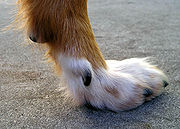
s (including some extinct orders, like certain theropods). It commonly grows high on the leg so that in digitigrade
Digitigrade
A digitigrade is an animal that stands or walks on its digits, or toes. Digitigrades include walking birds , cats, dogs, and many other mammals, but not plantigrades or unguligrades...
species, when the animal is standing, it does not make contact with the ground. Dewclaws are perhaps best known in dogs, and they are often removed in young puppies, though there is debate on whether this is necessary.
Dogs
DogDog
The domestic dog is a domesticated form of the gray wolf, a member of the Canidae family of the order Carnivora. The term is used for both feral and pet varieties. The dog may have been the first animal to be domesticated, and has been the most widely kept working, hunting, and companion animal in...
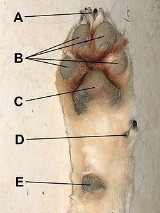
s almost always have dewclaws on the inside of the front legs and occasionally also on the hind legs. Unlike front dewclaws, rear dewclaws tend to have little bone or muscle structure in most breeds. Sometimes some dogs will even have more than one dewclaw on the same foot; often at least one of these dewclaws will be poorly connected to the leg and in this case it is often surgically removed. When a dog has extra dewclaws in addition to the usual one on each front leg, the dog is said to be double dewclawed. There is some debate about whether a dewclaw helps dogs to gain traction when they run because in some dogs, the dewclaw makes contact when they are running and the nail on the dewclaw often wears down in the same way that the nails on their other toes do, from contact with the ground. However, in many dogs the dewclaws never make contact with the ground; in this case, the dewclaw's nail never wears away, and it is then often trimmed to keep it to a safe length.
The dewclaws are not dead appendages. They can be used to lightly grip bones and other items that dogs hold with the paws. However, in some dogs these claws may not appear to be connected to the leg at all except by a flap of skin; in such dogs the claws do not have a use for gripping as the claw can easily fold or turn.
There is also some debate as to whether dewclaws should be surgically removed. The argument for removal states that dewclaws are a weak digit, barely attached to the leg, so that they can rip partway off or easily catch on something and break, which can be extremely painful and prone to infection. Others say the pain of removing a dewclaw is far greater than any other risk. For this reason, removal of dewclaws is illegal in many countries. There is, perhaps, an exception for hunting dogs, who can sometimes tear the dewclaw while running in overgrown vegetation. If a dewclaw is to be removed, this should be done when the dog is a puppy, sometimes as young as 3 days old, though it can also be performed on older dogs if necessary (though the surgery may be more difficult then). The surgery is fairly straight-forward and may even be done with only local anesthetics if the digit is not well connected to the leg. Unfortunately many dogs can't resist licking at their sore paws following the surgery, so owners need to remain vigilant.
In addition, for those dogs whose dewclaws make contact with the ground when they run, it is possible that removing them could be a disadvantage for a dog's speed in running and changing of direction, particularly in performance dog sports such as dog agility
Dog agility
Dog agility is a dog sport in which a handler directs a dog through an obstacle course in a race for both time and accuracy. Dogs run off-leash with no food or toys as incentives, and the handler can touch neither dog nor obstacles...
.
In America, some pups are commonly sold by breeders "dewclawed", that is with the dewclaws removed (as by a veterinarian
Veterinarian
A veterinary physician, colloquially called a vet, shortened from veterinarian or veterinary surgeon , is a professional who treats disease, disorder and injury in animals....
) for perceived health and safety reasons. A few breed standards also call for it.
Rear dewclaws
Canids have four claws on the rear feet, although some domestic dog breeds or individuals have an additional claw. A more technical term for this fifth claw on the rear legs is hind-limb-specific preaxial polydactylyPolydactyly
Polydactyly or polydactylism , also known as hyperdactyly, is a congenital physical anomaly in humans, dogs, and cats having supernumerary fingers or toes....
. Several genetic mechanisms can cause rear dewclaws; they involve the LMBR1
LMBR1
Limb region 1 protein homolog is a protein that in humans is encoded by the LMBR1 gene.-Further reading:...
gene and related parts of the genome. Rear dewclaws often have no phalanx bones
Phalanx bones
In anatomy, phalanx bones are those that form the fingers and toes. In primates such as humans and monkeys, the thumb and big toe have two phalanges, while the other fingers and toes consist of three. Phalanges are classified as long bones.The phalanges do not have individual names...
and are attached by skin only.
Hoofed animals
Hoof
A hoof , plural hooves or hoofs , is the tip of a toe of an ungulate mammal, strengthened by a thick horny covering. The hoof consists of a hard or rubbery sole, and a hard wall formed by a thick nail rolled around the tip of the toe. The weight of the animal is normally borne by both the sole...
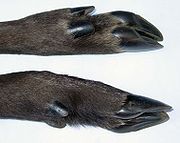
s. Cloven-hoofed animals walk on a central pair of hoofs, but many also have an outer pair of dewclaws on each foot. These are a little farther up the leg than the main hoofs, and similar in structure to them. In some species (such as cattle
Cattle
Cattle are the most common type of large domesticated ungulates. They are a prominent modern member of the subfamily Bovinae, are the most widespread species of the genus Bos, and are most commonly classified collectively as Bos primigenius...
) the dewclaws are much smaller than the hoofs and never touch the ground. In others (such as pig
Pig
A pig is any of the animals in the genus Sus, within the Suidae family of even-toed ungulates. Pigs include the domestic pig, its ancestor the wild boar, and several other wild relatives...
s and many deer
Deer
Deer are the ruminant mammals forming the family Cervidae. Species in the Cervidae family include white-tailed deer, elk, moose, red deer, reindeer, fallow deer, roe deer and chital. Male deer of all species and female reindeer grow and shed new antlers each year...
), they are only a little smaller than the hoofs, and may reach the ground in soft conditions or when jumping. Some hoofed animals (such as giraffe
Giraffe
The giraffe is an African even-toed ungulate mammal, the tallest of all extant land-living animal species, and the largest ruminant...
s and modern horse
Horse
The horse is one of two extant subspecies of Equus ferus, or the wild horse. It is a single-hooved mammal belonging to the taxonomic family Equidae. The horse has evolved over the past 45 to 55 million years from a small multi-toed creature into the large, single-toed animal of today...
s) have no dew claws.