
All Topics  
Dutch Golden Age painting

 
Dutch Golden Age Painting

   Email Print
   Bookmark   Link


Dutch Golden Age painting


"Dutch Masters" redirects here; for the cigar, see Dutch Masters (cigar)
Dutch Masters (cigar)

Dutch Masters is a brand of natural wrapped cigar sold in the USA since 1911. Dutch Masters cigars are manufactured by Altadis, which is the American subsidiary of France/Spain Altadis in Fort Lauderdale, Florida....
.


Dutch Golden Age painting is a period of painting in Dutch history. It occurred during the Dutch Golden Age
Dutch Golden Age

The Golden Age was a period in Netherlands history, roughly spanning the 17th century, in which Dutch trade, science, and art were among the most acclaimed in the world....
, a period in Dutch history generally spanning the 17th century, in which Dutch trade, science, and art were among the most acclaimed in the world.


Discussion
Ask a question about 'Dutch Golden Age painting'
Start a new discussion about 'Dutch Golden Age painting'
Answer questions from other users
Full Discussion Forum


Encyclopedia


"Dutch Masters" redirects here; for the cigar, see Dutch Masters (cigar)
Dutch Masters (cigar)

Dutch Masters is a brand of natural wrapped cigar sold in the USA since 1911. Dutch Masters cigars are manufactured by Altadis, which is the American subsidiary of France/Spain Altadis in Fort Lauderdale, Florida....
.


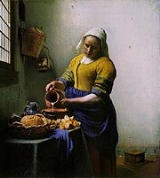
Vermeer   the Milkmaid
Dutch Golden Age painting is a period of painting in Dutch history. It occurred during the Dutch Golden Age
Dutch Golden Age

The Golden Age was a period in Netherlands history, roughly spanning the 17th century, in which Dutch trade, science, and art were among the most acclaimed in the world....
, a period in Dutch history generally spanning the 17th century, in which Dutch trade, science, and art were among the most acclaimed in the world. The painter
Painting

Painting is the practice of applying paint, pigment, color or other medium to a surface . In art, the term describes both the act and the result, which is called a painting....
s of this era have left a profound legacy.

At the time, there was a "hierarchy of genres
Hierarchy of genres

A hierarchy of genres is any formalization which ranks different types of genres in an art-form in terms of their value.In literature, the epic won hands down among classical critics, for the reason expressed by Samuel Johnson in his Life of John Milton: "By the general consent of criticks, the first praise of genius is due...
" in painting, whereby some types were regarded as more prestigous than others. In descending order of status:
  • history painting
    History painting

    History painting, as formulated in 1667 by Andr? F?libien, a historiographer, architect and theoretician of French classicism, was in the hierarchy of genres considered to be the grand genre....
    , including religious subjects
  • Portrait painting
    Portrait painting

    Portrait painting is a Hierarchy of genres in painting, where the intent is to depict the visual appearance of the subject. Beside human beings, animals, pets and even inanimate objects can be chosen as the subject for a portrait....
  • genre painting or scenes of everyday life
  • landscape
    Landscape art

    Landscape art depicts scenery such as mountains, valleys, trees, rivers, and forests. Sky is almost always included in the view, and weather usually is an element of the composition....
     and cityscape
  • still life
    Still life

    A still life is a work of art depicting mostly inanimate subject matter, typically commonplace objects which may be either natural or man-made in an artificial setting....


Combinations of these categories occurred. Allegories
Allegory

Allegory is generally treated as a figure of rhetoric, but an allegory does not have to be expressed in language: it may be addressed to the eye, and is often found in realistic painting, sculpture or some other form of Mimesis, or representative art....
, in which painted objects conveyed symbolic meaning about the subject, were often applied. For instance, a still life might include a skull, an hourglass and a snuffed out candle, symbols which all emphasized mortality. Seasons were often indicated by human activities that were typical for that time of the year (skating, sowing, harvesting, etc). Paintings often had a moralistic message hidden under the surface.

History painting

This category comprises not only paintings that depicted real historical events, but also paintings that showed biblical, mythological, literary and allegorical scenes. Large dramatic historical or Biblical scenes were produced less frequently than in other countries, where religious and noble patrons of art often sought to overawe the viewer. Dutch painters, especially in the northern provinces, tried instead to invoke emotion on the part of the viewer by letting him/her be a bystander on a scene of profound intimacy. As such Rembrandt
Rembrandt

Rembrandt Harmenszoon van Rijn was a Netherlands Painting and etching. He is generally considered one of the greatest painters and printmakers in European art history and the most important in History of the Netherlands....
 and Rubens
Peter Paul Rubens

Peter Paul Rubens was a prolific seventeenth-century Flemish Baroque painter, and a proponent of an exuberant Baroque style that emphasized movement, color, and sensuality....
 are striking examples of large differences in style between Dutch painters from the northern Low Countries, the Dutch Republic, and Flanders in the south.

Many great Dutch painters were inspired and influenced by Italian
Italy

Italy , officially the Italian Republic , is a country located on the Italian Peninsula in Southern Europe and on the two largest islands in the Mediterranean Sea, Sicily and Sardinia....
 painters during their formative years. Copies of Italian masterpieces circulated and suggested certain compositional schemes. Dutch painters became absolute masters of the treatment of light, which could partly be traced back to Italian predecessors, notably Caravaggio. Some Dutch painters also travelled to Italy to make firsthand observations.

(Group) portraits


Portrait painting thrived in the Netherlands in the 17th century. Many portraits were commissioned by wealthy individuals. Group portraits similarly were often ordered by prominent members of a city's civilian guard, by boards of trustees and regents, and the like.

Especially in the first half of the century, portraits were very formal and stiff in composition. Groups were often seated around a table, each person looking at the viewer. Much attention was paid to fine details in clothing, and where applicable, to furniture and other signs of a person's position in society. Later in the century groups became livelier and colours brighter.

Scientists often posed with instruments and objects of their study around them. Physicians sometimes posed together around a cadaver, a so called 'Anatomical Lesson', the most famous one being Rembrandt's Anatomy Lesson of Dr. Nicolaes Tulp
Anatomy Lesson of Dr. Nicolaes Tulp

The Anatomy Lesson of Dr. Nicolaes Tulp is a 1632 oil painting by Rembrandt housed in the Mauritshuis museum in The Hague, the Netherlands....
 (1632, Mauritshuis
Mauritshuis

The Royal Picture Gallery Mauritshuis is an art museum in The Hague, the Netherlands. Previously the residence of count John Maurice of Nassau, it now has a large art collection, including paintings by Dutch painters such as Johannes Vermeer, Rembrandt van Rijn, Jan Steen, Paulus Potter and Frans Hals and works of the German painter Hans Hol...
, The Hague
The Hague

The Hague is the third largest city in the Netherlands after Amsterdam and Rotterdam, with a population of 475,904 and an area of approximately 100 km?....
). Boards of trustees preferred an image of austerity and humility, posing in dark clothing (which by its refinement testified to their prominent standing in society), often seated around a table, with solemn expressions on their faces. Families often had themselves portrayed inside their luxurious homes.

Most group portraits of civilian guards (Dutch: schutterstuk) were commissioned in Haarlem
Haarlem

, in the past usually 'Harlem' in English, is a city in the Netherlands. It is also the Capital of the province of North Holland, the northern half of Holland, which at one time was one of the most powerful of the seven provinces of the Dutch Republic....
 and Amsterdam
Amsterdam

Amsterdam is the Capital of the Netherlands and List of cities in the Netherlands with over 100,000 people of the Netherlands, located in the Provinces of the Netherlands of North Holland in the west of the country....
. Here the portrayed favoured an image of might, status or even a joyous spirit. The arrangement around a table would give way in later years to a more dynamic composition, the most prominent example being Rembrandt's famous The Militia Company of Captain Frans Banning Cocq better known as the Night Watch
Night Watch (painting)

The Night Watch redirects here. For other uses of the phrase, please see Night WatchNight Watch or The Night Watch is the common name of one of the most famous works by Netherlands painter Rembrandt Harmenszoon van Rijn....
 (1642, Rijksmuseum
Rijksmuseum

The Rijksmuseum Amsterdam or Rijksmuseum is a Netherlands national museum in Amsterdam, located on the Museumplein. The museum is dedicated to arts, crafts, and history....
, Amsterdam
Amsterdam

Amsterdam is the Capital of the Netherlands and List of cities in the Netherlands with over 100,000 people of the Netherlands, located in the Provinces of the Netherlands of North Holland in the west of the country....
). In Amsterdam most of these paintings would ultimately end up in the possession of the city council. Many of these are now on display in the Amsterdam Historical Museum.

Often group portraits were paid for by each portrayed person individually. The amount paid determined each person's place in the picture, either head to toe in full regalia in the foreground or face only in the back of the group. Sometimes all group members paid an equal sum, which was likely to lead to quarrels when some members gained a more prominent place in the picture than others.

Scenes of every day life

Many genre paintings, which seemingly only depicted everyday life, actually illustrated Dutch proverbs and sayings, or conveyed a moralistic message, the meaning of which is not always easy to decipher in modern times. All walks of life were shown. Today these genre paintings provide many insights into the daily life of 17th century citizens of all classes.

Landscapes and cityscapes

Landscape painting
Landscape art

Landscape art depicts scenery such as mountains, valleys, trees, rivers, and forests. Sky is almost always included in the view, and weather usually is an element of the composition....
 was a major genre in the 17th century. Flemish landscapes (particularly from Antwerp
Antwerp (province)

Antwerp is the northernmost provinces of regions in Belgium both of the Flemish Region, also called Flanders, and of Belgium. It borders on the Netherlands and the Belgian provinces of Limburg , Flemish Brabant and East Flanders....
) of the 16th century first served as an example. These had been not particularly realistic, having been painted mostly in the studio, partly from imagination. Soon this trend changed, and real Dutch landscapes became prevalent. Drawings were made on site. Horizons were lowered, which made it possible to emphasize the often impressive cloud formations that were (and are) so typical in the climate of the region, and which cast a particular light. Favourite topics were the dunes along the western sea coast, rivers with their broad adjoining meadows where cattle grazed, often with the silhouette of a city in the distance. Winter landscapes with frozen canals and creeks also abounded. The sea was a favourite topic as well since the Low Countries depended on it for trade, battled with it for new land, and battled on it with competing nations. Pictures of sea battles told the stories of a Dutch navy at the peak of its glory.
Heda Lobster
Architecture also fascinated the Dutch, churches in particular. The exteriors and interiors of buildings were reproduced faithfully. During the century insights into the proper rendering of perspective grew and were enthusiastically applied.

Still lifes

Still lifes were a great opportunity to show one's aptitude in painting textures and surfaces in great detail and with realistic light effects. Food of all kinds laid out on a table, silver cutlery, intricate patterns and subtle folds in table cloths and flowers all challenged painters. Painters from Leiden
Leiden

Media:Nl-Leiden.ogg is a city and municipality in the province of South Holland in the Netherlands and has 118,000 inhabitants. It forms a single urban area with Oegstgeest, Leiderdorp, Voorschoten, Valkenburg, Rijnsburg and Katwijk, with 254,000 inhabitants....
, The Hague, and Amsterdam particularly excelled in the genre.

The most famous Dutch painters of the 17th century were: Ferdinand Bol
Ferdinand Bol

Ferdinand Bol was a The Netherlands artist, etcher, and draftsman. Although his surviving work is rare, it displays Rembrandt's influence; like his master, Bol favored historical subjects, portraits, numerous self-portraits, and single figures in exotic finery....
, Albert Cuyp, Gerard Dou
Gerard Dou

Gerard Dou, also known as Gerrit and Douw or Dow , was a Dutch Golden Age painting, whose small, highly-polished paintings are typical of the Leiden fijnschilders....
, Willem Drost
Willem Drost

Willem Drost was a Netherlands Baroque Painting and printmaker.He was born in what was then known as the Dutch Republic of the Netherlands. Although he lived and painted at a time when Dutch artists had their greatest impact on the development of European art, Drost is a painter about whom very little is known....
, Carel Fabritius
Carel Fabritius

Carel Fabritius was a Netherlands painter and one of Rembrandt Harmenszoon van Rijn's most gifted pupils.Fabritius was born in the ten-year old Beemster polder, as the son of schoolteacher....
, Govert Flinck
Govert Flinck

Govert Teuniszoon Flinck was a the Netherlands Painting of the Dutch Golden Age....
, Jan van Goyen
Jan van Goyen

Jan Josephszoon van Goyen was a Dutch landscape painter. Van Goyen was an extremely prolific artist; approximately twelve hundred paintings and more than one thousand drawings by him are known....
, Frans Hals
Frans Hals

Frans Hals was a Dutch Golden Age painter especially famous for Portrait painting. He is notable for his loose painterly brushwork, and helped introduce this lively style of painting into Dutch art....
, Pieter de Hooch
Pieter de Hooch

Pieter de Hooch was a Genre works during the Dutch Golden Age. He was a contemporary of Dutch Master Jan Vermeer, with whom his work shared themes and style....
, Pieter Pieterszoon Lastman
Pieter Lastman

Pieter Lastman was a Dutch painter . Lastman is important as a painter of history pieces and because his pupils included Rembrandt and Jan Lievens....
, Judith Leyster
Judith Leyster

Judith Jans Leyster was a Netherlands artist who worked in a various fields, including Genre works subjects, portraits and still lifes....
, Jan Lievens
Jan Lievens

Jan Lievens was a Netherlands painter, usually associated with Rembrandt, working in a similar style....
, Nicolaes Maes
Nicolaes Maes

Nicolaes Maes, also known as Nicolaes Maas was a Dutch Baroque painter of genre and portraits.Maes was the son of Gerrit Maes, a prosperous merchant, and Ida Herman Claesdr....
, Maria van Oosterwyck, Adriaen van Ostade
Adriaen van Ostade

Adriaen van Ostade was a Netherlands Genre works painter....
, Paulus Potter
Paulus Potter

Paulus Potter was a Dutch Republic Painting, specialized in animals in landscapes, usually with a low point of view. Before Potter died of tuberculosis, 28-years old, he succeeded in producing about a hundred paintings, working continuously....
, Rembrandt Harmenszoon van Rijn
Rembrandt

Rembrandt Harmenszoon van Rijn was a Netherlands Painting and etching. He is generally considered one of the greatest painters and printmakers in European art history and the most important in History of the Netherlands....
, Rachel Ruysch
Rachel Ruysch

Rachel Ruysch was a Netherlands artist who specialized in still-life paintings of flowers.She was born in The Hague, but moved to Amsterdam when she was three....
, Pieter Saenredam, Jan Steen
Jan Steen

Jan Havickszoon Steen was a The Netherlands Genre works Painting of the 17th century . Psychological insight, sense of humour and abundance of colour are marks of his trade....
, Johannes Vermeer
Johannes Vermeer

Johannes or Jan Vermeer was a Dutch people Baroque painting painter who specialized in exquisite, domestic interior scenes of ordinary life....
.