

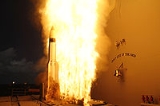

. Although primarily designed as an anti-ballistic missile, the SM-3 has also been employed in an anti-satellite
capacity against a satellite at the lower end of Low Earth orbit
. The SM-3 is primarily used and tested by the United States Navy
and also operated by the Japan Maritime Self-Defense Force
. The Royal Netherlands Navy
has already successfully tested the SM-3 on the HNLMS Tromp
and may purchase them in the future.
Development
The SM-3 evolved from the proven SM-2 Block IV design. The SM-3 uses the same booster and dual thrust rocket motor as the Block IV missile for the first and second stages and the same steering control section and midcourse missile guidance for maneuvering in the atmosphere. To support the extended range of an exo-atmospheric intercept, additional missile thrust is provided in a new third stage for the SM-3 missile, containing a dual pulse rocket motor for the early exo-atmospheric phase of flight.On 18 May 2010 the Missile Defense Agency responded to a report of problems with the SM-3 in the New York Times, calling the report flawed and stating that the missile tests had been successful.
Operation and performance
The ship's AN/SPY-1radar finds the ballistic missile target and the Aegis weapon system calculates a solution on the target. When the missile is ordered to launch, the Aerojet
MK 72 solid-fuel rocket booster launches the SM-3 out of the ship's Mark 41 vertical launching system
(VLS). The missile then establishes communication with the launching ship. Once the booster burns out, it detaches, and the Aerojet
MK 104 solid-fuel dual thrust rocket motor
(DTRM) takes over propulsion through the atmosphere. The missile continues to receive mid-course guidance information from the launching ship and is aided by GPS data. The ATK
MK 136 solid-fueled third stage rocket motor (TSRM) fires after the second stage burns out, and it takes the missile above the atmosphere (if needed). The TSRM is pulse fired and provides propulsion for the SM-3 until 30 seconds to intercept.
At that point the third stage separates, and the Lightweight Exo-Atmospheric Projectile
(LEAP) kinetic warhead (KW) begins to search for the target using pointing data from the launching ship. The ATK solid divert and attitude control system (SDACS) allows the kinetic warhead to maneuver in the final phase of the engagement. The KW's sensors identify the target, attempt to identify the most lethal part of the target and steers the KW to that point. If the KW intercepts the target, it provides 130 megajoules (96,000,000 ft·lbf, 31 kg TNT equivalent
) of kinetic energy at the point of impact.
Independent studies by some physics experts have raised some significant questions about the missile's success rate in hitting targets. In a published response, the Defense Department claimed that these findings were invalid, as the analysts used some early launches as their data, when those launches were not significant to the overall program. The DoD stated:
...the first tests [used] prototype interceptors; expensive mock warheads weren’t used in the tests since specific lethality capability wasn’t a test objective—the objective was to hit the target missile. Contrary to the assertions of Postol and Lewis, all three tests resulted in successful target hits with the unitary ballistic missile target destroyed. This provided empirical evidence that ballistic missile intercepts could in fact be accomplished at sea using interceptors launched from Aegis ships.
After successful completion of these early developmental tests, the test program progressed from just “hitting the target” to one of determining lethality and proving the operationally configured Aegis SM-3 Block I and SM-3 Block 1A system. These tests were the MDA’s most comprehensive and realistic test series, resulting in the Operational Test and Evaluation Force’s October 2008 Evaluation Report stating that Aegis Ballistic Missile Defense Block 04 3.6 System was operationally effective and suitable for transition to the Navy.
Since 2002, a total of 19 SM-3 missiles have been fired in 16 different test events resulting in 16 intercepts against threat-representative full-size and more challenging subscale unitary and full-size targets with separating warheads. In addition, a modified Aegis BMD/SM-3 system successfully destroyed a malfunctioning U.S. satellite by hitting the satellite in the right spot to negate the hazardous fuel tank at the highest closure rate of any ballistic missile defense technology ever attempted.
The authors of the SM-3 study cited only tests involving unitary targets, and chose not to cite the five successful intercepts in six attempts against separating targets, which, because of their increased speed and small size, pose a much more challenging target for the SM-3 than a much larger unitary target missile. They also did not mention the fact the system is successfully intercepting targets much smaller than probable threat missiles on a routine basis, and have attained test scores that many other Defense Department programs aspire to attain.
Missile defense
In September 2009, President Obama announced plans to scrap plans for missile defense sites in East Europe, in favor of missile defense systems located on US Navy warships. On 18 September 2009, Russian Prime Minister Putin welcomed Obama's plans for missile defense which may include stationing American Aegis armed warships in the Black Sea. This deployment began to occur that same month, with the deployment of Aegis-equipped warships with the RIM-161 SM-3 missile system, which complements the Patriot systems already deployed by American units.The SM-3 has shown some of the best results of any anti-missile system used by the US.
Anti-satellite
On February 14, 2008, U.S. officials announced plans to use a modified SM-3 missile launched from a group of three ships in the North Pacific to destroy the failed American satellite USA 193at an altitude of 130 nautical miles (240 kilometers) shortly before atmospheric reentry, stating that the intention was to "reduce the danger to human beings" due to the release of toxic hydrazine
fuel carried onboard. A spokesperson stated that software associated with the SM-3 had been modified to enhance the chances of the missile's sensors recognizing that the satellite was its target, since the missile was not designed for ASAT
operations.
On February 21, 2008 at 3:26 am (UTC) the , a Ticonderoga-class guided-missile cruiser, fired a single SM-3 missile, hit and successfully destroyed the satellite, with a closing velocity of about 22,783 mph (36,667 km/h) while the satellite was 247 kilometers (133 nautical miles) above the Pacific Ocean. , as well as other land, air, sea and space-based sensors were involved in the operation.
Israel
According to Defense Industry Daily, Israel was considering ordering a land based SM-3 system. While Israel currently uses the Arrow system, and the Patriot system, the country was looking for further protection. Israel chose to field its own upgraded Arrow 3 instead, but the idea of land based SM-3 defenses has caught on elsewhere, and will now play a key role in Europe.
Japan
In December 2007, Japan conducted a successful test of an SM-3 block IA aboard JDS Kongōagainst a ballistic missile. This was the first time a Japanese ship was employed to launch the interceptor missile during a test of the Aegis Ballistic Missile Defense System
. In previous tests the Japan Maritime Self-Defense Force
had provided tracking and communications.
In November 2008 a second Japanese-American joint test was performed from the JDS Chōkai
which was unsuccessful. Following a failure review board, JFTM-3 occurred launching from the JDS Myōkō
resulting in a successful intercept in October 2009.
October 28, 2010 a successful test was performed from the JDS Kirishima
. The U.S. Navy's Pacific Missile Range Facility on Kauai launched the ballistic missile target. The crew of the Kirishima, operating off the coast of Kauai, detected and tracked the target before firing a SM-3 Block IA missile.
Poland
On July 3, 2010, Poland and the United States signed an amended agreement for missile defense under whose terms land-based SM-3 systems would be installed in Poland. This configuration was accepted as a tested and available alternative to missile interceptors that were proposed during the Bush administration but which are still under development. U.S. Secretary of StateHillary Clinton, present at the signing in Kraków along with Polish Foreign Minister Radoslaw Sikorski
, stressed that the missile defense program was aimed at deterring threats from Iran, and posed no challenge to Russia.
Romania
The United States plans to station mobile land-based SM-3s (Block IB) in Romaniastarting in 2015.
Variants
The SM-3 Block IA version provides an incremental upgrade to improve reliability and maintainability at a reduced cost. The SM-3 Block IB, due in 2010, offers upgrades which include an advanced two-color infrared seeker, and a 10-thruster solid throttling divert and attitude control system (TDACS/SDACS) on the kill vehicle to give it improved capability against maneuvering ballistic missiles or warheads. Solid TDACS is a joint Raytheon/Aerojet project, but Boeing supplies some components of the kinetic warhead. With Block IB and associated ship-based upgrades, the Navy gains the ability to defend against medium range missiles and some Intermediate Range Ballistic Missiles. SM-3 Block II will widen the missile body to 21” and decrease the size of the maneuvering fins. It will still fit in Mk41 vertical launch systems, and the missile will be faster and have longer range. The SM-3 Block IIA will add a larger diameter kill vehicle that is more maneuverable, and carries another sensor/ discrimination upgrade. It’s currently scheduled to debut around 2015, whereupon the Navy will have a weapon that can engage some Intercontinental Ballistic Missiles.| Designation | Block | Notes |
|---|---|---|
| RIM-161A | SM-3 Block I | Development version. The SM-3 Block I uses the basic SM-2ER Block IVA airframe and propulsion
|
| RIM-161B | SM-3 Block IA |
|
| RIM-161C | SM-3 Block IB | Passed critical design review on 13 July 2009.
|
| RIM-161D | SM-3 Block II |
|
| None to date | SM-3 Block IIA |
|
Table sources, reference material: