

Radiological weapon

Encyclopedia
A radiological weapon or radiological dispersion device (RDD) is any weapon that is designed to spread radioactive material with the intent to kill, and cause disruption upon a city or nation.
It is primarily known as a dirty bomb
or salted bomb
because it is not a true nuclear weapon
and does not yield the same explosive power. It uses conventional explosives to spread radioactive material, most commonly the spent fuels from nuclear power plant
s or radioactive medical waste.
used to create panic and casualties in densely populated areas. They could also render a great deal of property useless for an extended period, unless costly remediation was undertaken. The radiological source and quality greatly impacts the effectiveness of a radiological weapon.
Factors such as: energy and type of radiation, half-life
, longevity, availability, shielding, portability, and the role of the environment will determine the effect of the radiological weapon. Radioisotopes that pose the greatest security risk include: , used in radiological medical equipment, , , , , , , and .
All of these isotopes, except for the latter, are created in nuclear power plants. While the amount of radiation dispersed from the event will likely be minimal, the fact of any radiation may be enough to cause panic and disruption.
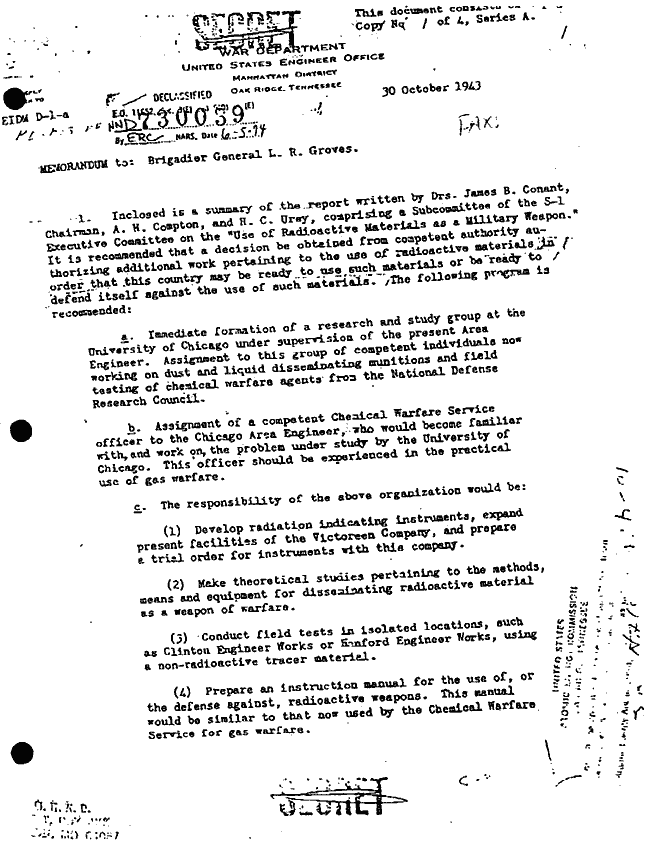
, Arthur Holly Compton, and Harold Urey
, to Brigadier General Leslie Groves
of the Manhattan Project
and to a 1940 science fiction
story, "Solution Unsatisfactory
" by Lt. J. G. Robert A. Heinlein, USN(R). Transmitting a report entitled, "Use of Radioactive Materials as a Military Weapon," the Groves memo states:
 The United States, however, chose not to pursue radiological weapons during World War II, though early on in the project considered it as a backup plan in case nuclear fission proved impossible to tame. Some US policymakers and scientists involved in the project felt that radiological weapons would qualify as chemical weapons and thus violate international law
.
, a conventional explosive which disperses radioactive material. Dirty bombs are not a type of nuclear weapon
, which requires a nuclear chain reaction
and the creation of a critical mass
. Whereas a nuclear weapon will usually create mass casualties immediately following the blast, a dirty bomb scenario would initially cause only minimal casualties from the conventional explosion.
Means of radiological warfare
that do not rely on any specific weapon, but rather on spreading radioactive contamination via a food chain
or water table
, seem to be more effective in some ways, but share many of the same problems as chemical warfare
.
caused by radioactive poisoning of the involved environment).
Furthermore, area-denial weapons are generally of limited use to an attacking army, as it slows the rate of advance.
There is currently (as of 2007) an ongoing debate about the damage that terrorists using such a weapon might inflict. Many experts believe that a dirty bomb
such that terrorists might reasonably be able to construct would be unlikely to harm more than a few people and hence it would be no more deadly than a conventional bomb. Furthermore, the casualties would be a result of the initial explosion, because alpha and beta emitting material needs to be inhaled to do damage to the human body. Gamma radiation emitting material is so radioactive that it can't be deployed without wrapping an amount of shielding material around the bomb that would make transport by car or plane impossible without risking detection.
Because of this a dirty bomb with radioactive material around an explosive device would be almost useless, unless said shielding was removed shortly before detonation. This is not only because of the effectiveness but also because this material would be easy to clean up. Furthermore, the possibility of terrorists making a gas or aerosol that is radioactive is very unlikely because of the complex chemical work to achieve this goal.
Hence, this line of argument goes, the objectively dominant effect would be the moral and economic damage due to the massive fear and panic such an incident would spur. On the other hand, some believe that the fatalities and injuries might be in fact much more severe. This point was made by physicist Peter D. Zimmerman (King's College London
) who reexamined the Goiânia accident
which is arguably comparable. and popularized in a subsequent fictionalized account produced by the BBC
and broadcast in the United States
by PBS
. The latter program showed how shielding might be used to minimize the detection risk.
designed to produce large quantities of radioactive fallout, rendering a large area uninhabitable. The term is derived both from the means of their manufacture, which involves the incorporation of additional elements to a standard atomic weapon, and from the expression "to salt the earth", meaning to render an area uninhabitable for generations. The idea originated with Hungarian-American physicist Leo Szilard
, in February 1950. His intent was not to propose that such a weapon be built, but to show that nuclear weapon technology would soon reach the point where it could end human life on Earth.
Salted versions of both fission and fusion weapons can be made, by a change in the materials used in their construction. The idea is to increase the normal production of radioactive fallout by placing inside the weapon a quantity of an element that can be converted to a highly radioactive isotope by neutron
bombardment. When the bomb explodes, the element absorbs neutrons released by the nuclear reaction, and is converted to its radioactive form. The explosion and mushroom cloud scatters the radioactive material over a wide area, leaving the targeted area highly radioactive, and uninhabitable to humans far longer than an area affected by typical nuclear weapons.
In a salted hydrogen bomb, the radiation case around the fusion fuel, which normally is made of some fissionable element
, is replaced with a metallic salting element. Salted fission bombs can be made by replacing the tamper
between the fissionable core and the explosive layer with a metallic element. The energy yield
from a salted weapon is usually lower than from an ordinary weapon of similar size as a consequence of these changes.
The radioactive isotope chosen for the fallout material is usually a high intensity gamma ray
emitter, with a half-life
long enough that it remains lethal for an extended period. It also must have a chemistry that causes it to return to earth as fallout, rather than stay in the atmosphere after being vaporized in the explosion.
One example of a salted bomb is a proposed cobalt bomb
, which uses the radioactive isotope cobalt-60 (60Co
). Other non-fissionable isotopes can be used, including gold-198
(198Au), tantalum-182 (182Ta) and zinc-65
(65Zn).
No salted bomb has ever been atmospherically tested and as far as is publicly known none have ever been built. The United Kingdom did test a 1 kiloton bomb incorporating a small amount of cobalt as an experimental radiochemical tracer
at their Tadje
testing site in Maralinga
range, Australia on September 14, 1957.
It is primarily known as a dirty bomb
Dirty bomb
A dirty bomb is a speculative radiological weapon that combines radioactive material with conventional explosives. The purpose of the weapon is to contaminate the area around the explosion with radioactive material, hence the attribute "dirty"....
or salted bomb
Salted bomb
A salted bomb is a variation of a nuclear weapon designed to produce enhanced quantities of radioactive fallout, rendering a large area uninhabitable...
because it is not a true nuclear weapon
Nuclear weapon
A nuclear weapon is an explosive device that derives its destructive force from nuclear reactions, either fission or a combination of fission and fusion. Both reactions release vast quantities of energy from relatively small amounts of matter. The first fission bomb test released the same amount...
and does not yield the same explosive power. It uses conventional explosives to spread radioactive material, most commonly the spent fuels from nuclear power plant
Nuclear power plant
A nuclear power plant is a thermal power station in which the heat source is one or more nuclear reactors. As in a conventional thermal power station the heat is used to generate steam which drives a steam turbine connected to a generator which produces electricity.Nuclear power plants are usually...
s or radioactive medical waste.
Explanation
Radiological weapons have been suggested as a possible weapon of terrorismTerrorism
Terrorism is the systematic use of terror, especially as a means of coercion. In the international community, however, terrorism has no universally agreed, legally binding, criminal law definition...
used to create panic and casualties in densely populated areas. They could also render a great deal of property useless for an extended period, unless costly remediation was undertaken. The radiological source and quality greatly impacts the effectiveness of a radiological weapon.
Factors such as: energy and type of radiation, half-life
Half-life
Half-life, abbreviated t½, is the period of time it takes for the amount of a substance undergoing decay to decrease by half. The name was originally used to describe a characteristic of unstable atoms , but it may apply to any quantity which follows a set-rate decay.The original term, dating to...
, longevity, availability, shielding, portability, and the role of the environment will determine the effect of the radiological weapon. Radioisotopes that pose the greatest security risk include: , used in radiological medical equipment, , , , , , , and .
All of these isotopes, except for the latter, are created in nuclear power plants. While the amount of radiation dispersed from the event will likely be minimal, the fact of any radiation may be enough to cause panic and disruption.
History
The professional history of radioactive weaponry may be traced to a 1943 memo from James Bryant ConantJames Bryant Conant
James Bryant Conant was a chemist, educational administrator, and government official. As thePresident of Harvard University he reformed it as a research institution.-Biography :...
, Arthur Holly Compton, and Harold Urey
Harold Urey
Harold Clayton Urey was an American physical chemist whose pioneering work on isotopes earned him the Nobel Prize in Chemistry in 1934...
, to Brigadier General Leslie Groves
Leslie Groves
Lieutenant General Leslie Richard Groves, Jr. was a United States Army Corps of Engineers officer who oversaw the construction of the Pentagon and directed the Manhattan Project that developed the atomic bomb during World War II. As the son of a United States Army chaplain, Groves lived at a...
of the Manhattan Project
Manhattan Project
The Manhattan Project was a research and development program, led by the United States with participation from the United Kingdom and Canada, that produced the first atomic bomb during World War II. From 1942 to 1946, the project was under the direction of Major General Leslie Groves of the US Army...
and to a 1940 science fiction
Science fiction
Science fiction is a genre of fiction dealing with imaginary but more or less plausible content such as future settings, futuristic science and technology, space travel, aliens, and paranormal abilities...
story, "Solution Unsatisfactory
Solution Unsatisfactory
"Solution Unsatisfactory" is a 1940 science fiction short story by Robert A. Heinlein. It describes the US effort to build a nuclear weapon in order to end the ongoing World War II, and its dystopian consequences to the nation and the world....
" by Lt. J. G. Robert A. Heinlein, USN(R). Transmitting a report entitled, "Use of Radioactive Materials as a Military Weapon," the Groves memo states:
International law
Public international law concerns the structure and conduct of sovereign states; analogous entities, such as the Holy See; and intergovernmental organizations. To a lesser degree, international law also may affect multinational corporations and individuals, an impact increasingly evolving beyond...
.
Deployment
One possible way of dispersing the material is by using a dirty bombDirty bomb
A dirty bomb is a speculative radiological weapon that combines radioactive material with conventional explosives. The purpose of the weapon is to contaminate the area around the explosion with radioactive material, hence the attribute "dirty"....
, a conventional explosive which disperses radioactive material. Dirty bombs are not a type of nuclear weapon
Nuclear weapon
A nuclear weapon is an explosive device that derives its destructive force from nuclear reactions, either fission or a combination of fission and fusion. Both reactions release vast quantities of energy from relatively small amounts of matter. The first fission bomb test released the same amount...
, which requires a nuclear chain reaction
Chain reaction
A chain reaction is a sequence of reactions where a reactive product or by-product causes additional reactions to take place. In a chain reaction, positive feedback leads to a self-amplifying chain of events....
and the creation of a critical mass
Critical mass
A critical mass is the smallest amount of fissile material needed for a sustained nuclear chain reaction. The critical mass of a fissionable material depends upon its nuclear properties A critical mass is the smallest amount of fissile material needed for a sustained nuclear chain reaction. The...
. Whereas a nuclear weapon will usually create mass casualties immediately following the blast, a dirty bomb scenario would initially cause only minimal casualties from the conventional explosion.
Means of radiological warfare
Radiological warfare
Radiological warfare is any form of warfare involving deliberate radiation poisoning, without relying on nuclear fission or nuclear fusion.Radiological weapons are normally considered weapons of mass destruction, and are very commonly equated with a radiological bomb often mis-called a "dirty bomb"...
that do not rely on any specific weapon, but rather on spreading radioactive contamination via a food chain
Food chain
A food web depicts feeding connections in an ecological community. Ecologists can broadly lump all life forms into one of two categories called trophic levels: 1) the autotrophs, and 2) the heterotrophs...
or water table
Water table
The water table is the level at which the submarine pressure is far from atmospheric pressure. It may be conveniently visualized as the 'surface' of the subsurface materials that are saturated with groundwater in a given vicinity. However, saturated conditions may extend above the water table as...
, seem to be more effective in some ways, but share many of the same problems as chemical warfare
Chemical warfare
Chemical warfare involves using the toxic properties of chemical substances as weapons. This type of warfare is distinct from Nuclear warfare and Biological warfare, which together make up NBC, the military acronym for Nuclear, Biological, and Chemical...
.
Military uses
Radiological weapons are widely considered to be militarily useless for a state-sponsored army and are initially not hoped to be used by any military forces. Firstly, the use of such a weapon is of no use to an occupying force, as the target area becomes uninhabitable (due to the falloutFallout
Fallout or nuclear fallout is the residual radiation hazard from a nuclear explosion.Fallout may also refer to:*Fallout , a 1997 post-apocalyptic computer role-playing game released by Interplay Entertainment...
caused by radioactive poisoning of the involved environment).
Furthermore, area-denial weapons are generally of limited use to an attacking army, as it slows the rate of advance.
Dirty bombs
A dirty bomb is a radiological weapon dispersed with conventional explosives.There is currently (as of 2007) an ongoing debate about the damage that terrorists using such a weapon might inflict. Many experts believe that a dirty bomb
Dirty bomb
A dirty bomb is a speculative radiological weapon that combines radioactive material with conventional explosives. The purpose of the weapon is to contaminate the area around the explosion with radioactive material, hence the attribute "dirty"....
such that terrorists might reasonably be able to construct would be unlikely to harm more than a few people and hence it would be no more deadly than a conventional bomb. Furthermore, the casualties would be a result of the initial explosion, because alpha and beta emitting material needs to be inhaled to do damage to the human body. Gamma radiation emitting material is so radioactive that it can't be deployed without wrapping an amount of shielding material around the bomb that would make transport by car or plane impossible without risking detection.
Because of this a dirty bomb with radioactive material around an explosive device would be almost useless, unless said shielding was removed shortly before detonation. This is not only because of the effectiveness but also because this material would be easy to clean up. Furthermore, the possibility of terrorists making a gas or aerosol that is radioactive is very unlikely because of the complex chemical work to achieve this goal.
Hence, this line of argument goes, the objectively dominant effect would be the moral and economic damage due to the massive fear and panic such an incident would spur. On the other hand, some believe that the fatalities and injuries might be in fact much more severe. This point was made by physicist Peter D. Zimmerman (King's College London
King's College London
King's College London is a public research university located in London, United Kingdom and a constituent college of the federal University of London. King's has a claim to being the third oldest university in England, having been founded by King George IV and the Duke of Wellington in 1829, and...
) who reexamined the Goiânia accident
Goiânia accident
The Goiânia accident was a radioactive contamination accident that occurred on September 13, 1987, at Goiânia, in the Brazilian State of Goiás after an old radiotherapy source was taken from an abandoned hospital site in the city...
which is arguably comparable. and popularized in a subsequent fictionalized account produced by the BBC
BBC
The British Broadcasting Corporation is a British public service broadcaster. Its headquarters is at Broadcasting House in the City of Westminster, London. It is the largest broadcaster in the world, with about 23,000 staff...
and broadcast in the United States
United States
The United States of America is a federal constitutional republic comprising fifty states and a federal district...
by PBS
Public Broadcasting Service
The Public Broadcasting Service is an American non-profit public broadcasting television network with 354 member TV stations in the United States which hold collective ownership. Its headquarters is in Arlington, Virginia....
. The latter program showed how shielding might be used to minimize the detection risk.
Salted Bomb
A salted bomb is a variation of a nuclear weaponNuclear weapon
A nuclear weapon is an explosive device that derives its destructive force from nuclear reactions, either fission or a combination of fission and fusion. Both reactions release vast quantities of energy from relatively small amounts of matter. The first fission bomb test released the same amount...
designed to produce large quantities of radioactive fallout, rendering a large area uninhabitable. The term is derived both from the means of their manufacture, which involves the incorporation of additional elements to a standard atomic weapon, and from the expression "to salt the earth", meaning to render an area uninhabitable for generations. The idea originated with Hungarian-American physicist Leo Szilard
Leó Szilárd
Leó Szilárd was an Austro-Hungarian physicist and inventor who conceived the nuclear chain reaction in 1933, patented the idea of a nuclear reactor with Enrico Fermi, and in late 1939 wrote the letter for Albert Einstein's signature that resulted in the Manhattan Project that built the atomic bomb...
, in February 1950. His intent was not to propose that such a weapon be built, but to show that nuclear weapon technology would soon reach the point where it could end human life on Earth.
Salted versions of both fission and fusion weapons can be made, by a change in the materials used in their construction. The idea is to increase the normal production of radioactive fallout by placing inside the weapon a quantity of an element that can be converted to a highly radioactive isotope by neutron
Neutron
The neutron is a subatomic hadron particle which has the symbol or , no net electric charge and a mass slightly larger than that of a proton. With the exception of hydrogen, nuclei of atoms consist of protons and neutrons, which are therefore collectively referred to as nucleons. The number of...
bombardment. When the bomb explodes, the element absorbs neutrons released by the nuclear reaction, and is converted to its radioactive form. The explosion and mushroom cloud scatters the radioactive material over a wide area, leaving the targeted area highly radioactive, and uninhabitable to humans far longer than an area affected by typical nuclear weapons.
In a salted hydrogen bomb, the radiation case around the fusion fuel, which normally is made of some fissionable element
Chemical element
A chemical element is a pure chemical substance consisting of one type of atom distinguished by its atomic number, which is the number of protons in its nucleus. Familiar examples of elements include carbon, oxygen, aluminum, iron, copper, gold, mercury, and lead.As of November 2011, 118 elements...
, is replaced with a metallic salting element. Salted fission bombs can be made by replacing the tamper
Tamper
Tamper can mean:*Tamp, a device used to compact or flatten an aggregate or other powdered or granular material, like ground coffee or gravel*A tool used to pack tobacco into a smoking pipe, as well as to flatten or scoop the ash; usually nail-shaped and sometimes combined into a pipe tool*Ballast...
between the fissionable core and the explosive layer with a metallic element. The energy yield
Nuclear weapon yield
The explosive yield of a nuclear weapon is the amount of energy discharged when a nuclear weapon is detonated, expressed usually in the equivalent mass of trinitrotoluene , either in kilotons or megatons , but sometimes also in terajoules...
from a salted weapon is usually lower than from an ordinary weapon of similar size as a consequence of these changes.
The radioactive isotope chosen for the fallout material is usually a high intensity gamma ray
Gamma ray
Gamma radiation, also known as gamma rays or hyphenated as gamma-rays and denoted as γ, is electromagnetic radiation of high frequency . Gamma rays are usually naturally produced on Earth by decay of high energy states in atomic nuclei...
emitter, with a half-life
Half-life
Half-life, abbreviated t½, is the period of time it takes for the amount of a substance undergoing decay to decrease by half. The name was originally used to describe a characteristic of unstable atoms , but it may apply to any quantity which follows a set-rate decay.The original term, dating to...
long enough that it remains lethal for an extended period. It also must have a chemistry that causes it to return to earth as fallout, rather than stay in the atmosphere after being vaporized in the explosion.
One example of a salted bomb is a proposed cobalt bomb
Cobalt bomb
A cobalt bomb is a theoretical type of "salted bomb": a nuclear weapon intended to contaminate an area by radioactive material, with a relatively small blast....
, which uses the radioactive isotope cobalt-60 (60Co
Cobalt-60
Cobalt-60, , is a synthetic radioactive isotope of cobalt. Due to its half-life of 5.27 years, is not found in nature. It is produced artificially by neutron activation of . decays by beta decay to the stable isotope nickel-60...
). Other non-fissionable isotopes can be used, including gold-198
(198Au), tantalum-182 (182Ta) and zinc-65
(65Zn).
No salted bomb has ever been atmospherically tested and as far as is publicly known none have ever been built. The United Kingdom did test a 1 kiloton bomb incorporating a small amount of cobalt as an experimental radiochemical tracer
Radioactive tracer
A radioactive tracer, also called a radioactive label, is a substance containing a radioisotope that is used to measure the speed of chemical processes and to track the movement of a substance through a natural system such as a cell or tissue...
at their Tadje
British nuclear tests at Maralinga
British nuclear tests at Maralinga occurred between 1955 and 1963 at the Maralinga site, part of the Woomera Prohibited Area, in South Australia. A total of seven major nuclear tests were performed, with approximate yields ranging from 1 to 27 kilotons of TNT equivalent...
testing site in Maralinga
British nuclear tests at Maralinga
British nuclear tests at Maralinga occurred between 1955 and 1963 at the Maralinga site, part of the Woomera Prohibited Area, in South Australia. A total of seven major nuclear tests were performed, with approximate yields ranging from 1 to 27 kilotons of TNT equivalent...
range, Australia on September 14, 1957.
See also
- Biological warfareBiological warfareBiological warfare is the use of biological toxins or infectious agents such as bacteria, viruses, and fungi with intent to kill or incapacitate humans, animals or plants as an act of war...
- Chemical warfareChemical warfareChemical warfare involves using the toxic properties of chemical substances as weapons. This type of warfare is distinct from Nuclear warfare and Biological warfare, which together make up NBC, the military acronym for Nuclear, Biological, and Chemical...
- Cobalt bombCobalt bombA cobalt bomb is a theoretical type of "salted bomb": a nuclear weapon intended to contaminate an area by radioactive material, with a relatively small blast....
- Lists of nuclear disasters and radioactive incidents
- Nuclear falloutNuclear falloutFallout is the residual radioactive material propelled into the upper atmosphere following a nuclear blast, so called because it "falls out" of the sky after the explosion and shock wave have passed. It commonly refers to the radioactive dust and ash created when a nuclear weapon explodes...
- Nuclear weaponNuclear weaponA nuclear weapon is an explosive device that derives its destructive force from nuclear reactions, either fission or a combination of fission and fusion. Both reactions release vast quantities of energy from relatively small amounts of matter. The first fission bomb test released the same amount...
- Radioactive contaminationRadioactive contaminationRadioactive contamination, also called radiological contamination, is radioactive substances on surfaces, or within solids, liquids or gases , where their presence is unintended or undesirable, or the process giving rise to their presence in such places...
- Weapon of mass destruction
- Nuclear terrorismNuclear terrorismNuclear terrorism denotes the use, or threat of the use, of nuclear weapons or radiological weapons in acts of terrorism, includingattacks against facilities where radioactive materials are present...