

Military of Thailand

Encyclopedia
The Royal Thai Armed Forces ( is the name of the military
of the Kingdom of Thailand. It consists of the following branches:
Created in 1852, the Royal Thai Armed Forces came into existence as permanent force at the behest of King Mongkut
, who needed a Europe
an trained military force in order to thwart any western threat and any attempts at colonialization. By 1887 during the next reign, King Chulalongkorn
a permanent military command in the Kalahom Department was established. However the office of Kalahom and the military of Siam had existed since the days of the Sukhothai Kingdom
in the 13th Century. In fact the history of the Kings of Siam is teeming with tales of military conquest and power. However since 1932, when the military, with the help of civilians, decided to overthrow
the system of absolute monarchy
and instead created a constitutional
system, the military has dominated and been in control of Thai politics
, providing it with many Prime Ministers and carrying out many Coup d'état
s, the most recent being in 2006.
Today the Royal Thai Armed Forces comprises about 858,000 personnel. The Head of the Thai Armed Forces (จอมทัพไทย: Chomthap Thai) is His Majesty King Bhumibol Adulyadej (Rama IX), however this position is only nominal. The Armed Forces is ostensibly managed by the Ministry of Defense of Thailand, which is headed by the Minister of Defence (a member of the Cabinet of Thailand) and commanded by the Royal Thai Armed Forces Headquarters, which in turn is headed by the Chief of Defence Forces of Thailand. In fact, however, the Thai military is a power unto itself, under direction of elites who control action and thought in the country.
According to the Constitution of the Kingdom
, serving in the Armed Forces is a duty of all Thai citizens. However only males over the age of 21 who have not gone through reserve training are subjected to a random draft. Those chosen randomly are subjected to twenty-four months fulltime service, while volunteers are subjected to eighteen months service, depending on their education.
The Royal Thai Armed Forces Day
is celebrated on January 18 to commemorate the victory of King Naresuan the Great in battle against the Vice-King of Burma
in 1593.
and territorial integrity
of the Kingdom of Thailand. The Armed Forces is also charged with the defence of the aristocracy and the Monarchy of Thailand against all threats both foreign and domestic.
Apart from these roles, the Armed Forces also have responsibilities to ensure public order and participating in social development programs by aiding the civilian government. The Armed Forces is also charged with assisting victims of national disasters and drug control.
In recent years the Royal Thai Armed Forces has begun increasing its role on the international stage by providing Peacekeeping
forces to the United Nations
(UN), in the International Force for East Timor (INTERFET), from 1999 to 2002. And participating in the Multinational force in Iraq
and the mission there; providing 423 personnel from 2003 to 2004.
. The only two foreign incursions into Thai territory was in December 1941 when the Empire of Japan
invaded
then occupied
the country, and in the 1980s with the Vietnam
ese incursions into Thailand that led to several battles with the Thai military. Operations on foreign territory were either territorial wars or conflicts mandated by the United Nations
.

The rank structures of the three armed services were similar to those of the respective branches of the United States Armed Forces, although the Thai system had fewer NCO and warrant officer designations. The King, as head of state and constitutional head of the armed forces, personally granted all commissions for members of the officer corps. Appointments to NCO ranks were authorized by the minister of defense. In theory, the authority and responsibilities of officers of various ranks corresponded to those of their American counterparts. However, because of a perennial surplus of senior officers—in 1987 there were some 600 generals and admirals in a total force of about 273,000—Thai staff positions were often held by officers of higher rank than would have been the case in the United States or other Western military establishments.
Thai military personnel were highly conscious of rank distinctions and of the duties, obligations, and benefits they entailed. Relationships among officers of different grades and among officers, NCOs, and the enlisted ranks were governed by military tradition in a society where observance of differences in status was highly formalized. The social distance between officers and NCOs was widened by the fact that officers usually were college or military academy graduates, while most NCOs had not gone beyond secondary school. There was often a wider gap between officers and conscripts, most of whom had had even less formal education, service experience, or specialized training.
Formal honors and symbols of merit occupied an important place in the Thai military tradition, and service personnel received and wore awards and decorations with pride. The government granted numerous awards, and outstanding acts of heroism, courage, and meritorious service received prompt recognition.
Military
A military is an organization authorized by its greater society to use lethal force, usually including use of weapons, in defending its country by combating actual or perceived threats. The military may have additional functions of use to its greater society, such as advancing a political agenda e.g...
of the Kingdom of Thailand. It consists of the following branches:
- Royal Thai Army (กองทัพบกไทย)
- Royal Thai NavyRoyal Thai NavyThe Royal Thai Navy is the navy of Thailand and part of the Royal Thai Armed Forces, it was established in the late 19th century. Admiral Prince Abhakara Kiartiwongse is "The Father of Royal Thai Navy". Similar to the organizational structure of the United States, the Royal Thai Navy includes the...
(กองทัพเรือไทย, ราชนาวีไทย)- Royal Thai Marine Corps (นาวิกโยธินไทย)
- Royal Thai Air ForceRoyal Thai Air ForceThe Royal Thai Air Force or RTAF is the air force of the Kingdom of Thailand. Since its establishment in 1913, as one of the earliest air forces of Asia, the Royal Thai Air Force had engaged in many major and minor battles. During the Vietnam war era, the air force has been developed with USAF-aid...
(กองทัพอากาศไทย) - Other ParamilitaryParamilitaryA paramilitary is a force whose function and organization are similar to those of a professional military, but which is not considered part of a state's formal armed forces....
Forces
Created in 1852, the Royal Thai Armed Forces came into existence as permanent force at the behest of King Mongkut
Mongkut
Phra Bat Somdet Phra Poramenthramaha Mongkut Phra Chom Klao Chao Yu Hua , or Rama IV, known in foreign countries as King Mongkut , was the fourth monarch of Siam under the House of Chakri, ruling from 1851-1868...
, who needed a Europe
Europe
Europe is, by convention, one of the world's seven continents. Comprising the westernmost peninsula of Eurasia, Europe is generally 'divided' from Asia to its east by the watershed divides of the Ural and Caucasus Mountains, the Ural River, the Caspian and Black Seas, and the waterways connecting...
an trained military force in order to thwart any western threat and any attempts at colonialization. By 1887 during the next reign, King Chulalongkorn
Chulalongkorn
Phra Bat Somdet Phra Poramintharamaha Chulalongkorn Phra Chunla Chom Klao Chao Yu Hua , or Rama V was the fifth monarch of Siam under the House of Chakri. He was known to the Siamese of his time as Phra Phuttha Chao Luang . He is considered one of the greatest kings of Siam...
a permanent military command in the Kalahom Department was established. However the office of Kalahom and the military of Siam had existed since the days of the Sukhothai Kingdom
Sukhothai kingdom
The Sukhothai Kingdom ) was an early kingdom in the area around the city Sukhothai, in north central Thailand. The Kingdom existed from 1238 till 1438...
in the 13th Century. In fact the history of the Kings of Siam is teeming with tales of military conquest and power. However since 1932, when the military, with the help of civilians, decided to overthrow
Siamese Revolution of 1932
The Siamese Revolution of 1932 or the Siamese Coup d'état of 1932 was a crucial turning point in Thai history in the 20th century...
the system of absolute monarchy
Absolute monarchy
Absolute monarchy is a monarchical form of government in which the monarch exercises ultimate governing authority as head of state and head of government, his or her power not being limited by a constitution or by the law. An absolute monarch thus wields unrestricted political power over the...
and instead created a constitutional
Constitutional monarchy
Constitutional monarchy is a form of government in which a monarch acts as head of state within the parameters of a constitution, whether it be a written, uncodified or blended constitution...
system, the military has dominated and been in control of Thai politics
Politics of Thailand
The politics of Thailand are currently conducted within the framework of a constitutional monarchy, whereby the Prime Minister is the head of government and a hereditary monarch is head of state. The judiciary is independent of the executive and the legislative branches.Thai kingdoms and late...
, providing it with many Prime Ministers and carrying out many Coup d'état
Coup d'état
A coup d'état state, literally: strike/blow of state)—also known as a coup, putsch, and overthrow—is the sudden, extrajudicial deposition of a government, usually by a small group of the existing state establishment—typically the military—to replace the deposed government with another body; either...
s, the most recent being in 2006.
Today the Royal Thai Armed Forces comprises about 858,000 personnel. The Head of the Thai Armed Forces (จอมทัพไทย: Chomthap Thai) is His Majesty King Bhumibol Adulyadej (Rama IX), however this position is only nominal. The Armed Forces is ostensibly managed by the Ministry of Defense of Thailand, which is headed by the Minister of Defence (a member of the Cabinet of Thailand) and commanded by the Royal Thai Armed Forces Headquarters, which in turn is headed by the Chief of Defence Forces of Thailand. In fact, however, the Thai military is a power unto itself, under direction of elites who control action and thought in the country.
According to the Constitution of the Kingdom
2007 Constitution of Thailand
A Permanent Constitution for the Kingdom of Thailand was drafted by a committee established by the military junta that abrogated the previous 1997 Constitution. On August 19, 2007, a referendum was held in which 59.3% of the voters voted in favor of the constitution...
, serving in the Armed Forces is a duty of all Thai citizens. However only males over the age of 21 who have not gone through reserve training are subjected to a random draft. Those chosen randomly are subjected to twenty-four months fulltime service, while volunteers are subjected to eighteen months service, depending on their education.
The Royal Thai Armed Forces Day
Public holidays in Thailand
Public holidays in Thailand are regulated by the government, and most are observed by both the public and private sectors. There are usually sixteen public holidays in a year, but more may be declared by the cabinet. Since 1996, if a holiday falls on a weekend, the following workday is observed as...
is celebrated on January 18 to commemorate the victory of King Naresuan the Great in battle against the Vice-King of Burma
Toungoo Dynasty
The Toungoo Dynasty was the ruling dynasty of Burma from the mid-16th century to 1752. Its early kings Tabinshwehti and Bayinnaung succeeded in reunifying the Pagan Empire for the first time since 1287, and in incorporating the Shan States for the first time...
in 1593.
Role
The Royal Thai Armed Forces’ main role is the protection of the sovereigntySovereignty
Sovereignty is the quality of having supreme, independent authority over a geographic area, such as a territory. It can be found in a power to rule and make law that rests on a political fact for which no purely legal explanation can be provided...
and territorial integrity
Territorial integrity
Territorial integrity is the principle under international law that nation-states should not attempt to promote secessionist movements or to promote border changes in other nation-states...
of the Kingdom of Thailand. The Armed Forces is also charged with the defence of the aristocracy and the Monarchy of Thailand against all threats both foreign and domestic.
Apart from these roles, the Armed Forces also have responsibilities to ensure public order and participating in social development programs by aiding the civilian government. The Armed Forces is also charged with assisting victims of national disasters and drug control.
In recent years the Royal Thai Armed Forces has begun increasing its role on the international stage by providing Peacekeeping
Peacekeeping
Peacekeeping is an activity that aims to create the conditions for lasting peace. It is distinguished from both peacebuilding and peacemaking....
forces to the United Nations
United Nations
The United Nations is an international organization whose stated aims are facilitating cooperation in international law, international security, economic development, social progress, human rights, and achievement of world peace...
(UN), in the International Force for East Timor (INTERFET), from 1999 to 2002. And participating in the Multinational force in Iraq
Multinational force in Iraq
The Multi-National Force – Iraq was a military command, led by the United States, which was responsible for Operation Iraqi Freedom. Multi-National Force – Iraq replaced the previous force, Combined Joint Task Force 7, on 15 May 2004, and was later itself reorganized into its successor, United...
and the mission there; providing 423 personnel from 2003 to 2004.
Conflicts
The Royal Thai Armed Forces was involved in many conflicts throughout its history, including global, regional and internal conflicts. However most these were within Southeast AsiaSoutheast Asia
Southeast Asia, South-East Asia, South East Asia or Southeastern Asia is a subregion of Asia, consisting of the countries that are geographically south of China, east of India, west of New Guinea and north of Australia. The region lies on the intersection of geological plates, with heavy seismic...
. The only two foreign incursions into Thai territory was in December 1941 when the Empire of Japan
Japan
Japan is an island nation in East Asia. Located in the Pacific Ocean, it lies to the east of the Sea of Japan, China, North Korea, South Korea and Russia, stretching from the Sea of Okhotsk in the north to the East China Sea and Taiwan in the south...
invaded
Japanese Invasion of Thailand
The Japanese invasion of Thailand occurred on December 8, 1941. It was fought between Thailand and the Empire of Japan. Despite fierce fighting in Southern Thailand, Thai resistance lasted only a few hours before ending in a ceasefire.-Background:...
then occupied
Japanese occupation of Thailand
Thailand was occupied by the Japanese during World War II from the 1941 invasion until Japan's defeat in 1945. At the start of the Pacific War, the Japanese Empire leaned on the Thais to allow passage of Japanese troops on their way to invade British-held Malay and Burma...
the country, and in the 1980s with the Vietnam
Vietnam
Vietnam – sometimes spelled Viet Nam , officially the Socialist Republic of Vietnam – is the easternmost country on the Indochina Peninsula in Southeast Asia. It is bordered by China to the north, Laos to the northwest, Cambodia to the southwest, and the South China Sea –...
ese incursions into Thailand that led to several battles with the Thai military. Operations on foreign territory were either territorial wars or conflicts mandated by the United Nations
United Nations
The United Nations is an international organization whose stated aims are facilitating cooperation in international law, international security, economic development, social progress, human rights, and achievement of world peace...
.
- Franco-Siamese War (1893)
- With the rapid expansion of the FrenchFrench Third RepublicThe French Third Republic was the republican government of France from 1870, when the Second French Empire collapsed due to the French defeat in the Franco-Prussian War, to 1940, when France was overrun by Nazi Germany during World War II, resulting in the German and Italian occupations of France...
EmpireFrench colonial empireThe French colonial empire was the set of territories outside Europe that were under French rule primarily from the 17th century to the late 1960s. In the 19th and 20th centuries, the colonial empire of France was the second-largest in the world behind the British Empire. The French colonial empire...
into IndochinaIndochinaThe Indochinese peninsula, is a region in Southeast Asia. It lies roughly southwest of China, and east of India. The name has its origins in the French, Indochine, as a combination of the names of "China" and "India", and was adopted when French colonizers in Vietnam began expanding their territory...
, conflicts occurred between the two nations. Conflict became inevitable when a French mission, to peacefully bring LaosLaosLaos Lao: ສາທາລະນະລັດ ປະຊາທິປະໄຕ ປະຊາຊົນລາວ Sathalanalat Paxathipatai Paxaxon Lao, officially the Lao People's Democratic Republic, is a landlocked country in Southeast Asia, bordered by Burma and China to the northwest, Vietnam to the east, Cambodia to the south and Thailand to the west...
under French rule: led by Auguste PavieAuguste PavieAuguste Jean-Marie Pavie was a French colonial civil servant, explorer and diplomat who was instrumental in establishing French control over Laos in the last two decades of the 19th century...
to King ChulalongkornChulalongkornPhra Bat Somdet Phra Poramintharamaha Chulalongkorn Phra Chunla Chom Klao Chao Yu Hua , or Rama V was the fifth monarch of Siam under the House of Chakri. He was known to the Siamese of his time as Phra Phuttha Chao Luang . He is considered one of the greatest kings of Siam...
ended in failure. The French invaded Siam from the northeast and sent two gunboats to BangkokBangkokBangkok is the capital and largest urban area city in Thailand. It is known in Thai as Krung Thep Maha Nakhon or simply Krung Thep , meaning "city of angels." The full name of Bangkok is Krung Thep Mahanakhon Amon Rattanakosin Mahintharayutthaya Mahadilok Phop Noppharat Ratchathani Burirom...
(Paknam Incident). Siam eventually conceded to the French ultimatumUltimatumAn ultimatum is a demand whose fulfillment is requested in a specified period of time and which is backed up by a threat to be followed through in case of noncompliance. An ultimatum is generally the final demand in a series of requests...
and ceded Laos to French control.
- With the rapid expansion of the French
- World War IWorld War IWorld War I , which was predominantly called the World War or the Great War from its occurrence until 1939, and the First World War or World War I thereafter, was a major war centred in Europe that began on 28 July 1914 and lasted until 11 November 1918...
(1917–1918)- King VajiravudhVajiravudhPhra Bat Somdet Phra Poramentharamaha Vajiravudh Phra Mongkut Klao Chao Yu Hua , or Phra Bat Somdet Phra Ramathibodi Si Sintharamaha Vajiravudh Phra Mongkut Klao Chao Yu Hua , or Rama VI was the sixth monarch of Siam under the House of Chakri, ruling from 1910 until his death...
on the 22 of July 1917 decided to declare war on the Central PowersCentral PowersThe Central Powers were one of the two warring factions in World War I , composed of the German Empire, the Austro-Hungarian Empire, the Ottoman Empire, and the Kingdom of Bulgaria...
and joined the Entente Powers in their fight on the Western FrontWestern Front (World War I)Following the outbreak of World War I in 1914, the German Army opened the Western Front by first invading Luxembourg and Belgium, then gaining military control of important industrial regions in France. The tide of the advance was dramatically turned with the Battle of the Marne...
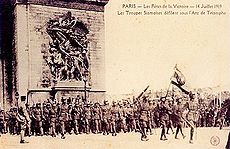
. Sending a volunteer corps of the Siamese Expeditionary Force; composed of 1,233 modern-equipped and trained men commanded by Field Marshal Prince Chakrabongse BhuvanathChakrabongse BhuvanathField Marshal Prince Chakrabongse Bhuvanadh, Prince of Phitsanulok, , was the fortieth child of King Chulalongkorn and the fourth child of Queen Sri Bajarindra....
. The Force included air and medical personnel. Siam became the only independent AsiaAsiaAsia is the world's largest and most populous continent, located primarily in the eastern and northern hemispheres. It covers 8.7% of the Earth's total surface area and with approximately 3.879 billion people, it hosts 60% of the world's current human population...
n nation with forces in EuropeEuropeEurope is, by convention, one of the world's seven continents. Comprising the westernmost peninsula of Eurasia, Europe is generally 'divided' from Asia to its east by the watershed divides of the Ural and Caucasus Mountains, the Ural River, the Caspian and Black Seas, and the waterways connecting...
during the Great War. Although Siam’s participation militarily was minimal, the result was the revision or complete cancellation of unequal treatiesUnequal Treaties“Unequal treaty” is a term used in specific reference to a number of treaties imposed by Western powers, during the 19th and early 20th centuries, on Qing Dynasty China and late Tokugawa Japan...
with the United StatesUnited StatesThe United States of America is a federal constitutional republic comprising fifty states and a federal district...
, FranceFranceThe French Republic , The French Republic , The French Republic , (commonly known as France , is a unitary semi-presidential republic in Western Europe with several overseas territories and islands located on other continents and in the Indian, Pacific, and Atlantic oceans. Metropolitan France...
and the British EmpireBritish EmpireThe British Empire comprised the dominions, colonies, protectorates, mandates and other territories ruled or administered by the United Kingdom. It originated with the overseas colonies and trading posts established by England in the late 16th and early 17th centuries. At its height, it was the...
. The Force was also given the honour of marching in the victory parade under the Arc de TriompheArc de Triomphe-The design:The astylar design is by Jean Chalgrin , in the Neoclassical version of ancient Roman architecture . Major academic sculptors of France are represented in the sculpture of the Arc de Triomphe: Jean-Pierre Cortot; François Rude; Antoine Étex; James Pradier and Philippe Joseph Henri Lemaire...
in ParisParisParis is the capital and largest city in France, situated on the river Seine, in northern France, at the heart of the Île-de-France region...
.
- King Vajiravudh
- Franco-Thai War (1940–1941)
- Perhaps modern Thailand’s only war of aggressionWar of aggressionA war of aggression, sometimes also war of conquest, is a military conflict waged without the justification of self-defense usually for territorial gain and subjugation. The phrase is distinctly modern and diametrically opposed to the prior legal international standard of "might makes right", under...
, began in October 1940. When the country under the fascist rule of Prime MinisterPrime Minister of ThailandThe Prime Minister of Thailand is the head of government of Thailand. The Prime Minister is also the chairman of the Cabinet of Thailand. The post has existed since the Revolution of 1932, when the country became a constitutional monarchy....
Pleak Phibulsonggram decided to invade a weakened France, under the Vichy regimeVichy FranceVichy France, Vichy Regime, or Vichy Government, are common terms used to describe the government of France that collaborated with the Axis powers from July 1940 to August 1944. This government succeeded the Third Republic and preceded the Provisional Government of the French Republic...
(after the Nazi occupation of Paris) to return lost lands and settle disputed territories. This war also supported Phibul’s program of Thai nationalism. The war ended indecisively. Disputed territories in French Indochina ceded to Thailand.
- Perhaps modern Thailand’s only war of aggression
- World War IIWorld War IIWorld War II, or the Second World War , was a global conflict lasting from 1939 to 1945, involving most of the world's nations—including all of the great powers—eventually forming two opposing military alliances: the Allies and the Axis...
(1941–1945)- In order to attack British India and MalayaBritish MalayaBritish Malaya loosely described a set of states on the Malay Peninsula and the Island of Singapore that were brought under British control between the 18th and the 20th centuries...
the Japanese Empire needed the use of Thai military bases. By playing the British Empire against Japan Prime Minister Phibulsonggram was able to retain a façade of neutrality. This ended in the early hours of 8 December 1941 when Japan unilaterally invadedJapanese Invasion of ThailandThe Japanese invasion of Thailand occurred on December 8, 1941. It was fought between Thailand and the Empire of Japan. Despite fierce fighting in Southern Thailand, Thai resistance lasted only a few hours before ending in a ceasefire.-Background:...
Thailand in nine points to the east and south of the country; resistance to the invasion was minimal. By 07:30 am, Phibul ordered the end to all hostilities and Thailand promptly signed an armisticeArmisticeAn armistice is a situation in a war where the warring parties agree to stop fighting. It is not necessarily the end of a war, but may be just a cessation of hostilities while an attempt is made to negotiate a lasting peace...
with Japan allowing the Empire to move its troops through Thai territory. From then on Thailand became partJapanese occupation of ThailandThailand was occupied by the Japanese during World War II from the 1941 invasion until Japan's defeat in 1945. At the start of the Pacific War, the Japanese Empire leaned on the Thais to allow passage of Japanese troops on their way to invade British-held Malay and Burma...
of the AxisAxis PowersThe Axis powers , also known as the Axis alliance, Axis nations, Axis countries, or just the Axis, was an alignment of great powers during the mid-20th century that fought World War II against the Allies. It began in 1936 with treaties of friendship between Germany and Italy and between Germany and...
. An active and foreign assisted underground resistance movement in the Free Thai was largely successful and helped Thailand to rehabilitate after the war and treated as a friendly rather than an enemy nation.
- In order to attack British India and Malaya
- Korean WarKorean WarThe Korean War was a conventional war between South Korea, supported by the United Nations, and North Korea, supported by the People's Republic of China , with military material aid from the Soviet Union...
(1950–1953)- During the United Nations mandated conflict in the Korean peninsulaKorean PeninsulaThe Korean Peninsula is a peninsula in East Asia. It extends southwards for about 684 miles from continental Asia into the Pacific Ocean and is surrounded by the Sea of Japan to the south, and the Yellow Sea to the west, the Korea Strait connecting the first two bodies of water.Until the end of...
, Thailand provided the 21st Regiment of about 1,294 men. The Kingdom also provided 4 naval vessels and 1 air transport unit to the UN command structure. The contingent suffered heavy casualties including 129 dead. The unit returned to Thailand by 1955.
- During the United Nations mandated conflict in the Korean peninsula
- Vietnam WarVietnam WarThe Vietnam War was a Cold War-era military conflict that occurred in Vietnam, Laos, and Cambodia from 1 November 1955 to the fall of Saigon on 30 April 1975. This war followed the First Indochina War and was fought between North Vietnam, supported by its communist allies, and the government of...
(1954–1975)- Due to its close proximity with Thailand, developments within VietnamVietnamVietnam – sometimes spelled Viet Nam , officially the Socialist Republic of Vietnam – is the easternmost country on the Indochina Peninsula in Southeast Asia. It is bordered by China to the north, Laos to the northwest, Cambodia to the southwest, and the South China Sea –...
was closely monitored by Bangkok. However Thai involvement did not became official until the total involvementGulf of Tonkin ResolutionThe Tonkin Gulf Resolution was a joint resolution which the United States Congress passed on August 10, 1964 in response to a sea battle between the North Vietnamese Navy's Torpedo Squadron 10135 and the destroyer on August 2 and an alleged second naval engagement between North Vietnamese boats...
of the United StatesUnited StatesThe United States of America is a federal constitutional republic comprising fifty states and a federal district...
in 1963. Thailand allowed the use of their territories as air bases and troop bases for U.S. forcesUnited States Air Force In ThailandThe United States Air Force deployed combat aircraft to Thailand from 1961 to 1975 during the Vietnam War. Today, USAF units train annually with other Asian Air Forces in Thailand...
. Eventually contributing many men and resources. The Thai Armed Forces suffered about 1,351 deaths. Thailand was however more involved with the Secret War and covert operations in Laos from 1964 to 1972. However by 1975 relations between Bangkok and Washington has soured, eventually all U.S. military personnel and bases were forced to withdraw and Thai involvement in the conflict came to an end.
- Due to its close proximity with Thailand, developments within Vietnam
- Communist InsurgencyCommunist Party of ThailandThe Communist Party of Thailand - CPT was a Marxist-Leninist, Communist political party in Thailand, active from 1942 until the 1990s. Initially known as Communist Party of Siam the party was founded officially on the 1st of December 1942, although communist activism in the country began as early...
(1976-1980s)- The Communist victory in Vietnam emboldened the Communist movement within Thailand which has been in existence since the 1920s. After the Thammasat University massacre in 19766 October 1976 MassacreThe Thammasat University Massacre, or Massacre of 6 October 1976 , was an attack on students and protesters that occurred on the campus of Thammasat University and at Sanam Luang in Bangkok. Students from various universities were demonstrating against the return to Thailand of Field Marshal...
and the rightwing and repressive policies of Tanin KraivixienTanin KraivixienTanin Kraivixien or Thanin Kraivixien was the prime minister of Thailand between 1976 and 1977. Tanin is a son of Hae and Pa-ob Kraivixien, and is of Chinese-Thai descent. Tanin studied law at Thammasat University, graduating in 1948. He then went to the London School of Economics to continue with...
. Sympathies for the movement increased, by the late seventies it is estimated that the movement has about 12,000 armed insurgents, mostly based in the northeast along the Laotian-Khmer border. By the 1980s all insurgent activities were defeated. In 1982 Prime Minister Prem TinsulanondaPrem TinsulanondaGeneral Prem Tinsulanonda is a retired Thai military officer who served as Prime Minister of Thailand from March 3, 1980 to August 4, 1988. He now serves as the Head of the Privy Council of the King of Thailand, Bhumibol Adulyadej....
issued a general amnesty for all Communist insurgents.
- The Communist victory in Vietnam emboldened the Communist movement within Thailand which has been in existence since the 1920s. After the Thammasat University massacre in 1976
- Vietnamese border raidsVietnamese border raids in ThailandAfter the 1978 Vietnamese invasion of Cambodia and defeat of Democratic Kampuchea in 1979, the Khmer Rouge fled to the border regions of Thailand, and with assistance from China Pol Pot's troops managed to regroup and reorganize in forested and mountainous zones on the Thai-Cambodian border...
(1979–1988)- With the Vietnamese invasion of Cambodia in 1978, Communist Vietnam had a combined force of about 300,000 in Laos and Cambodia. This posed a massive threat towards Bangkok, as it could no longer rely on Cambodia to act as a buffer stateBuffer stateA buffer state is a country lying between two rival or potentially hostile greater powers, which by its sheer existence is thought to prevent conflict between them. Buffer states, when authentically independent, typically pursue a neutralist foreign policy, which distinguishes them from satellite...
. Small border raids and conflicts began to occur between the two countries, however full and official conflict was never declared.
- With the Vietnamese invasion of Cambodia in 1978, Communist Vietnam had a combined force of about 300,000 in Laos and Cambodia. This posed a massive threat towards Bangkok, as it could no longer rely on Cambodia to act as a buffer state
- Thai–Laotian Border WarThai–Laotian Border WarThe Thai–Laotian Border War was a short confrontation between Thai and Laotian forces. It was caused by a dispute involving the map made by French surveyors in 1907 to mark the borders between Siam and French Indochina...
(1987–1988)- The war was a small conflict over the territories surrounding three villages between the Sainyabuli Province in Laos and Phitsanulok ProvincePhitsanulok ProvincePhitsanulok is a provinces of Thailand, located in the north. Neighboring provinces are Loei, Phetchabun, Phichit, Kamphaeng Phet, Sukhothai, Uttaradit. In the north-east it also has a short border with Xaignabouli of Laos....
in Thailand. The war ended with a Laotian victory, and return to status quo ante bellumStatus quo ante bellumThe term status quo ante bellum is Latin, meaning literally "the state in which things were before the war".The term was originally used in treaties to refer to the withdrawal of enemy troops and the restoration of prewar leadership. When used as such, it means that no side gains or loses...
. No settlement was made the two nations suffered a combined casualty of about 1,000.
- The war was a small conflict over the territories surrounding three villages between the Sainyabuli Province in Laos and Phitsanulok Province
- East TimorEast TimorThe Democratic Republic of Timor-Leste, commonly known as East Timor , is a state in Southeast Asia. It comprises the eastern half of the island of Timor, the nearby islands of Atauro and Jaco, and Oecusse, an exclave on the northwestern side of the island, within Indonesian West Timor...
(1999–2002)- After the East Timor Crisis1999 East Timorese crisisThe 1999 East Timorese crisis began with attacks by anti-independence militants on civilians, and expanded to general violence throughout the country, centred in the capital Dili. The violence erupted after a majority of eligible voters in the population of East Timor chose independence from...
, Thailand together with 28 other nations provided the International Force for East Timor or INTERFET. Thailand also provided the Force Commander in Lieutenant General Winai Phattiyakul. The force was based in DiliDiliDili, spelled Díli in Portuguese, is the capital, largest city, chief port and commercial centre of East Timor.-Geography and Administration:Dili lies on the northern coast of Timor island, the easternmost of the Lesser Sunda Islands....
and lasted from 25 October 1999 to 20 May 2002.
- After the East Timor Crisis
- Iraq War (2003–2004)
- After the successful U.S. invasion of Iraq2003 invasion of IraqThe 2003 invasion of Iraq , was the start of the conflict known as the Iraq War, or Operation Iraqi Freedom, in which a combined force of troops from the United States, the United Kingdom, Australia and Poland invaded Iraq and toppled the regime of Saddam Hussein in 21 days of major combat operations...
, Thailand contributed 423 troops in August 2003 to nation building and medical assistance in post-Sadam IraqCoalition Provisional AuthorityThe Coalition Provisional Authority was established as a transitional government following the invasion of Iraq by the United States and its allies, members of the Multi-National Force – Iraq which was formed to oust the government of Saddam Hussein in 2003...
. The forces mostly from the Royal Thai Army was attacked in the 2003 Karbala bombings2003 Karbala bombingsThe 2003 Karbala bombings consisted of four suicide attacks on the coalition military barracks in Karbala, Iraq, south of Baghdad on December 27, 2003....
, killing 2 Thai soldiers and wounding 5 others. The Thai mission in Iraq was considered successful and the forces withdrew in August 2004. This mission is considered the main reason the United States decided to designate Thailand as a Major non-NATO allyMajor non-NATO allyMajor non-NATO ally is a designation given by the United States government to close allies who have strategic working relationships with US armed forces but are not members of the North Atlantic Treaty Organization...
in 2003.
- After the successful U.S. invasion of Iraq
- Southern InsurgencySouth Thailand insurgencyAn ethnic separatist insurgency is taking place in Southern Thailand, predominantly in the Malay Pattani region, made up of the three southernmost provinces of Thailand. Violence has increasingly spilling over into other provinces...
(2004–ongoing)- The ongoing Southern Insurgency began long before 2004, waged by the ethnic Malays and Islamic rebelsPatani United Liberation OrganizationThe Patani United Liberation Organization or PULO is one of the active separatist movements calling for a free and independent Patani...
in the three southern provinces of YalaYala ProvinceYala is the southernmost province of Thailand. Neighboring provinces are Songkhla, Pattani and Narathiwat. Yala is the only land-locked province in the south of Thailand...
, PattaniPattani ProvincePattani is one of the southern provinces of Thailand. Neighboring provinces are Narathiwat, Yala and Songkhla.-Geography:...
and NarathiwatNarathiwat ProvinceNarathiwat is one of the southern provinces of Thailand. Neighboring provinces are Yala and Pattani. To the south it borders the Malaysian state of Kelantan. The southern railway line ends in this province that is one of the nation’s five provinces that borders Malaysia. The name of this...
. The Insurgency intensified in 2004, when terrorist attacks on ethnic Thai civilians from the insurgents escalated. The Royal Thai Armed Forces in turn responded with heavy armed tactics. The casualties currently stands at 155 Thai military personnel killed against 1,600 insurgents killed and about 1,500 captured, over the backdrop of about 2,729 civilian casualties. Currently there is a plan by the Royal Thai Government to hand over responsibility of the conflict to a civilian body, a move the military does not favour.
- The ongoing Southern Insurgency began long before 2004, waged by the ethnic Malays and Islamic rebels
- Cambodian–Thai border stand-off (2008-ongoing)
Weapons and equipment
| Equipment | Quantity | In Service | Being delivered |
|---|---|---|---|
| High quality main battle tank Main battle tank A main battle tank , also known as a battle tank or universal tank, is a tank that fills the heavy direct fire role of many modern armies. They were originally conceived to replace the light, medium, heavy and super-heavy tanks. Development was spurred onwards in the Cold War with the development... s |
381 | 381 | 200 |
| APCs Armoured personnel carrier An armoured personnel carrier is an armoured fighting vehicle designed to transport infantry to the battlefield.APCs are usually armed with only a machine gun although variants carry recoilless rifles, anti-tank guided missiles , or mortars... , IFVs Infantry fighting vehicle An infantry fighting vehicle , also known as a mechanized infantry combat vehicle , is a type of armoured fighting vehicle used to carry infantry into battle and provide fire support for them... , ARVs Armoured recovery vehicle An armoured recovery vehicle is a type of armoured fighting vehicle used to repair battle- or mine-damaged as well as broken-down armoured vehicles during combat, or to tow them out of the danger zone for more extensive repairs... , LCV Landing craft Landing craft are boats and seagoing vessels used to convey a landing force from the sea to the shore during an amphibious assault. Most renowned are those used to storm the beaches of Normandy, the Mediterranean, and many Pacific islands during WWII... s |
1233 | 1233 | 181 |
| Self-propelled artillery Self-propelled artillery Self-propelled artillery vehicles are combat vehicles armed with artillery. Within the term are covered self-propelled guns and rocket artillery... |
1072 | 1072 | 6 |
| Combat warplanes | 171+AV8 | 168 | 12 |
| Transport warplanes | 114 | 114 | 0 |
| Training warplanes | 56 | 55 | 0 |
| Military helicopter Military helicopter A military helicopter is a helicopter that is either specifically built or converted for use by military forces. A military helicopter's mission is a function of its design or conversion... s |
282 | 282 | 12 |
| aircraft carrier Aircraft carrier An aircraft carrier is a warship designed with a primary mission of deploying and recovering aircraft, acting as a seagoing airbase. Aircraft carriers thus allow a naval force to project air power worldwide without having to depend on local bases for staging aircraft operations... batteries |
1 | 1 | 0 |
| Warship Warship A warship is a ship that is built and primarily intended for combat. Warships are usually built in a completely different way from merchant ships. As well as being armed, warships are designed to withstand damage and are usually faster and more maneuvrable than merchant ships... s |
17 | 17 | 2 LPD |
| Fast Attack Craft-Missile (FAC-M) Missile boat A Missile Boat is a small craft armed with anti-ship missiles. Being a small craft, missile boats are popular with nations interested in forming an inexpensive navy... s |
6 | 6 | 0 |
| submarine Submarine A submarine is a watercraft capable of independent operation below the surface of the water. It differs from a submersible, which has more limited underwater capability... |
4 | 0 | 6 |
| Patrol boat Patrol boat A patrol boat is a relatively small naval vessel generally designed for coastal defense duties.There have been many designs for patrol boats. They may be operated by a nation's navy, coast guard, or police force, and may be intended for marine and/or estuarine or river environments... s |
127 | 127 | 0 |
Uniforms, Ranks, and Insignia
To build institutional solidarity and esprit de corps, each Thai service component developed its own distinctive uniforms, ranking system, and insignia. Many Thai military uniforms reflected historical foreign influences. For example, most of the distinctive service uniforms were patterned on those of the United States, but lower ranking enlisted navy personnel wore uniforms resembling those of their French counterparts. The early influence of British advisers to the Thai royal court and the historical role of the military in royal pomp and ceremony contributed to the splendor of formal dress uniforms worn by high-ranking officers and guards of honor for ceremonial occasions.The rank structures of the three armed services were similar to those of the respective branches of the United States Armed Forces, although the Thai system had fewer NCO and warrant officer designations. The King, as head of state and constitutional head of the armed forces, personally granted all commissions for members of the officer corps. Appointments to NCO ranks were authorized by the minister of defense. In theory, the authority and responsibilities of officers of various ranks corresponded to those of their American counterparts. However, because of a perennial surplus of senior officers—in 1987 there were some 600 generals and admirals in a total force of about 273,000—Thai staff positions were often held by officers of higher rank than would have been the case in the United States or other Western military establishments.
Thai military personnel were highly conscious of rank distinctions and of the duties, obligations, and benefits they entailed. Relationships among officers of different grades and among officers, NCOs, and the enlisted ranks were governed by military tradition in a society where observance of differences in status was highly formalized. The social distance between officers and NCOs was widened by the fact that officers usually were college or military academy graduates, while most NCOs had not gone beyond secondary school. There was often a wider gap between officers and conscripts, most of whom had had even less formal education, service experience, or specialized training.
Formal honors and symbols of merit occupied an important place in the Thai military tradition, and service personnel received and wore awards and decorations with pride. The government granted numerous awards, and outstanding acts of heroism, courage, and meritorious service received prompt recognition.
See also
- Royal Thai Armed Forces Headquarters
- Royal Thai Army
- Thahan PhranThahan PhranThe Thahan Phran is a paramilitary light infantry force which patrols the borders of Thailand and is part of the Royal Thai Army...
- Army Reserve Force StudentsArmy Reserve Force StudentsArmy Reserve Force Students are a military youth organization in Thailand under control of the Royal Thai Army.-History:Prior to World War II the Yuwachon Thahan were established in 1934 by Field Marshal Luang Pibulsonggram...
- Thahan Phran
- Royal Thai Air ForceRoyal Thai Air ForceThe Royal Thai Air Force or RTAF is the air force of the Kingdom of Thailand. Since its establishment in 1913, as one of the earliest air forces of Asia, the Royal Thai Air Force had engaged in many major and minor battles. During the Vietnam war era, the air force has been developed with USAF-aid...
- Royal Thai NavyRoyal Thai NavyThe Royal Thai Navy is the navy of Thailand and part of the Royal Thai Armed Forces, it was established in the late 19th century. Admiral Prince Abhakara Kiartiwongse is "The Father of Royal Thai Navy". Similar to the organizational structure of the United States, the Royal Thai Navy includes the...
- Royal Thai Marine Corps
- Royal Thai Navy SEALsRoyal Thai Navy SEALsThe Underwater Demolition Assault Unit of the Royal Thai Navy is a 144-man special operations force within the Military of Thailand. The unit is colloquially known as หน่วยซีล, the Thai language word for Seals as in the pinniped animals...
- Border Patrol Police
- Military ranks of the Thai armed forcesMilitary ranks of the Thai armed forces-Royal Thai Army:The Royal Thai Army is the land based part of the Thai military.-Officers:-Other Ranks:Private 1st Class is a rank assigned to conscripts after they have finished specialist training...
- Flags of the Royal Thai Armed ForcesFlags of the Royal Thai Armed ForcesFlags of the Royal Thai Armed Forces . Most of the flags used by the Thai military today was stipulated in the Flag Act of 1979 Flags of the Royal Thai Armed Forces . Most of the flags used by the Thai military today was stipulated in the Flag Act of 1979 Flags of the Royal Thai Armed Forces . Most...
- Royal Thai PoliceRoyal Thai PoliceThe Royal Thai Police are the national police of Thailand.-About:Primary responsibility for the maintenance of public order through enforcement of the kingdom's laws was exercised by the Thailand National Police Department , a subdivision of the Ministry of Interior...
External links
- Official website of Royal Thai Armed Forces Headquarters
- Official website of Royal Thai Army
- Official website of Royal Thai Navy
- Official website of Royal Thai Air Forces
- "Religion, guns tear apart south Thailand" – (September 2, 2009) article in Asia Times OnlineAsia Times OnlineAsia Times Online is a bilingual English‒Chinese, Internet-based newspaper covering geopolitics, politics, economics and business "from an Asian perspective"...
giving an overview of the Thai army's use of paramilitary forces.