


Mongkut

Encyclopedia
Phra Bat Somdet Phra Poramenthramaha Mongkut Phra Chom Klao Chao Yu Hua , or Rama IV, known in foreign countries as King Mongkut (18 October 18041 October 1868), was the fourth monarch of Siam (Thailand) under the House of Chakri, ruling from 1851-1868. He was one of the most revered monarchs of the country.
Outside of Thailand, he is best known as the King in the 1951 play and 1956 film The King and I
, based on the 1946 film Anna and the King of Siamin turn based on the 1944 novel about Anna Leonowens
' years at his court, from 1862 to 1867.
During his reign, the pressure of Western expansionism
was felt for the first time in Siam. Mongkut embraced Western innovations and initiated the modernization of Siam, both in technology and culture—earning him the nickname "The Father of Science and Technology" in Siam.
Mongkut was also known for his appointment of his brother, Prince Chutamani, as vice-king. Prince Chutamani was crowned in 1851 as King Pinklao
. Mongkut himself assured the country that Pinklao should be respected with equal honor to himself. Mongkut's reign was also the time when the power of the House of Bunnag
reached its zenith and became the most powerful noble family of Siam.
, the first Chakri king of Siam, and Princess Bunreod; he was born in 1804 at the Old (Thonburi) Palace. He was later joined by his brother Prince Chutamani, who was born in 1808. In 1809, Prince Isarasundhorn was crowned as Buddha Loetla Nabhalai
. The prince himself was nine at the time and they all moved to the Grand Palace.
monk
(ordination
name Vajirayan; Pali
Vajirañāṇo), according to Siamese tradition that men aged 20 should become monks. The same year, his father died. By tradition, Mongkut would be crowned the next king, but the nobility instead put on the throne the influential Prince Jessadabodindra
, who was a son of a concubine rather than a queen. Perceiving that the throne was irredeemable and to avoid political intrigues, Mongkut chose to retain his monastic status.
Vajirayan became one of the members of the royal family who devoted his life to religion. He travelled the country as a monk and saw the relaxation of the rules of Pali Canon
among the Siamese monks he met, which he considered inappropriate. In 1829, at Phetchaburi
, he met a monk named Buddhawangso who strictly followed the canon. Vajirayan admired Buddhawangso for his obedience to the canon, and was inspired to pursue religious reforms. In 1833, he began a reform movement reinforcing the canon law that evolved into the Dhammayuttika Nikaya, or Thammayut sect. In 1836, Vajirayan arrived at Wat Bowonniwet
in what is now Bangkok's central district, but was then the city proper, and became the wat's first abbot . During this time, he discovered Western
knowledge, studying Latin
, English
, and astronomy
with missionaries
and sailors. Vicar
Pallegoix
of the Roman Catholic Archdiocese of Bangkok lived nearby, the two became close friends, and Vajirayan invited Pallegoix to preach Christian sermons in the Wat. Vajirayan admired Christian morals and achievements as presented by the vicar, but could make nothing of Christian doctrine. It was then he made the comment later attributed to him as king: "What you teach people to do is admirable but what you teach them to believe is foolish."
King Mongkut would later be noted for his excellent command of English, although it is said that his younger brother, Vice-King Pinklao
, could speak it even better. Mongkut's first son and heir, Chulalongkorn
, granted the Thammayut sect royal recognition in 1902 through the Ecclesiastical Polity Act; it became one of the two major Buddhist denominations
in modern Thailand. Chulalongkorn also persuaded his father's 47th child, Vajirañana
, to enter the order, and he rose to become the 10th Supreme Patriarch of Thailand
from 1910 to 1921.
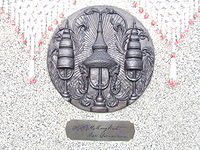 Accounts vary about Jessadabodindra's intentions regarding the succession. It is recorded that Jessadabodindra verbally dismissed the royal princes from succession for various reasons; Prince Mongkut was dismissed for encouraging monks to dress in the Mon
style.
Some said that, however, Jessadabodindra wished his throne to be passed to his son, Prince Annop, and that he gave his bracelet which had been passed down from Buddha Yodfa Chulaloke to the prince. However, Dis Bunnak switched the bracelet for a forged one, thus preventing Annop from inheriting the throne.
Prince Mongkut was indeed supported by a pro-British, Dis Bunnak, the Samuha Kalahom, or Armed Force Department's president, the most powerful noble during the reign of Rama III. Also some British merchants who were fearsome of the anti-West feeling growing during the previous reign, seeing the 'prince monk', Mongkut, who the 'champion' of European civilization among the royal elite, as their new hope.
Bunnak, with the supporting promise of British agents, sent his men to the leaving-from-monk-status ceremony for Prince Mongkut even before Jessadabodindra's death. With the support of powerful nobility and the Great Power, Britain, Mongkut's ascension to the throne was ensured.
After his twenty-seven years of pilgrimage, King Mongkut ascended the throne in 1851, aged 47. He took the name Phra Chom Klao, although foreigners continued to call him King Mongkut. The king was well-known among the foreigners particularly some British officers, as a pro-British. Sir James Brooke
, a British delegation
, even praised him 'our own king', and showed his support of him as a new king of Siam. Having been celibate for 27 years he now set about building the biggest Royal Family of the Chakri Dynasty. In the "Inside" of the Palace there was a veritable city of women — reports say three thousand or more. They were mostly servants, 'Amazons' for guards, officials, maids and so on, but Mongkut acquired thirty-two wives and by the time he died, aged sixty-four, he had eighty-two children..
His awareness of the threat from the British
and French
imperial powers, led him to institute many innovative activities. He ordered the nobility to wear shirts while attending his court; this was to show that Siam was no longer barbaric from the Western point of view.
However, Mongkut's own astrological calculations pointed out that his brother, Prince Isaret, was as well favored as himself to be the monarch. So, Mongkut then crowned his brother as King Pinklao, the second king. As a prince, Pinklao was known for his abilities in foreign languages and relations. Mongkut also raised his supporter Dis Bunnak to Somdet Chao Phraya Borom Maha Prayurawongse (Somdet Chao Phraya was the highest rank of nobility on a par with royalty) and made him his regent kingdom-wide. Mongkut also appointed Dis Bunnak's brother, Tat, as Somdet Chao Phraya Borom Maha Pichaiyat, as his regent in Bangkok. As the result, the administrative power of Siam rested largely in the hands of the two Bunnaks, Dis and Tat.
Upon his coronation, Mongkut married his first wife, Queen Somanat
. However, Queen Somanat died in the same year. He then married his half-grandniece, Mom Chao Rampoei Siriwongse, later Queen Debsirindra
.
kingdom in response to weakened Burmese influence. However, the two states then fought each other and Chiang Hung sought Siamese support. Jessadabodindra saw this as an opportunity to gain control over Shan states but he died in 1851 before this plan was realized. In 1852, Chiang Hung submitted the request again. Mongkut sent Siamese troops northwards but the armies were turned aside by the mountainous highlands. In 1855 the Siamese marched again and reached Kengtungthough with even greater difficulty. They laid siege on Kengtung for 21 days. However, the resources of the Siamese army ran out and the army had to retreat.
Mongkut claimed to have abandoned the Traiphum cosmology before 1836. He claimed that he already knew of the round state of earth 15 years before the arrival of American missionaries, but the debate about earth’s shape remained an issue for Siamese intellectuals throughout the 1800s.
Beginning in the early 1820s, two revolutions (both initiated by Mongkut during his monkhood) were taking place. Firstly, he fought for the people to embrace modern geography
, among other sciences considered “Western.” Secondly he sought reform in Buddhism and, as a result, a new sect was created in Siamese Theravada Buddhism. Both revolutions challenged the purity and validity of the Buddhist order as it was practiced in Siam at the time. A strong theme in Mongkut’s movement was that, “…true Buddhism was supposed to refrain from worldly matters and confine itself to spiritual and moral affairs.” Mongkut eventually came to power in 1851, as did his colleagues who had the same progressive mission. From that point on, Siam was more quickly embracing modernization.
had already reformed the printing and then resumed the publishing of Siam's first newspaper, the Bangkok Recorder. However, the missionaries were not as successful when it came to making religious conversions.
However, Mongkut didn't abandon the traditional culture of Siam. In 1852, he ordered the nobles of the court to wear upper garments. Previously, Siamese nobles were forbidden to wear any shirts to prevent them from hiding any weapons in it and met the king bare-chested. The practice was criticized by Westerners and so Mongkut ended it.
For Buddhism, Mongkut pioneered the rehabilitation of various temples. He also began the Magha Puja
(มาฆบูชา) festival in the full moon of the third lunar month, to celebrate Buddha's announcement of his main principles. And he instigated the Recompilation of Tripitaka
in Siam according to Theravada traditions. He also formally established the Thammayut sect as a rightful branch of Theravada.
Mongkut also improved women's rights in Siam. He released a large number of royal concubines to find their own husbands, in contrast to how his story has been dramatized. He banned forced marriages of all kinds and the selling of one's wife to pay off a debt.
In contrast to the previous king, Jessadabodindra, Mongkut didn't see the importance of sending envoys to the Qing dynasty
court, as the mission symbolised Siam's subjection to the Qing emperors and because the Qing dynasty was then not so powerful as it had once been, as it was itself threatened by Western powers.
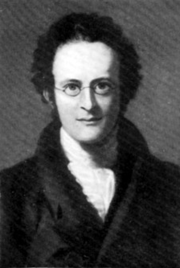
In 1854, John Bowring
, the Governor of Hong Kong
in the name of Queen Victoria of the United Kingdom, came to Siam to negotiate a treaty. For the first time Siam had to deal seriously with international laws. Prayurawongse negotiated on the behalf of the Siamese. The result was the Bowring Treaty, which was regarded as an unequal treaty imposed by the British Empire
on Siam. The main principle of the treaty was to abolish the Royal Storage (พระคลังสินค้า), which since Ayutthaya's times held the monopoly on foreign trade. The Royal Storage had been the source of Ayutthaya's prosperity as it collected immense taxation on foreign traders, including the taxation according to the width of the galleon and the tithe. Western products had to go through a series of tax barriers to reach Siamese people.
The Europeans had been attempting to undo this monopoly for a long time but no serious measures had been taken. For Siamese people, trading with foreigners subjected them to severe punishment. The taxation was partially reduced in the Burney Treaty
. However, in the world of liberalism
of the nineteenth century, such unequal and government-interfered trade was disappearing.
The abolition of such trade barriers replaced Siamese commerce with free trade. Import taxation was reduced to 3% and could only be collected once. This, of course, was a blow on the national revenue. However, this led to dramatic growth of commercial sectors as common people gained access to foreign trade. Never before in Siam could agricultural products be for sale and exports rather than subsistence farming (Before Bowring, those who traded rice with foreigners would be executed for treason). People rushed to acquire vast, previously empty fields to grow rice
and the competition eventually resulted in the lands ending up in the hands of nobility.
The Bowring Treaty also had a legal impact. Due to the horror of the Nakorn Bala methods of torture in judicial proceedings, the British chose not to be tried under the Siamese system, securing a grant of extraterritoriality
; British subjects in Siam were therefore subject only to British law, while the Siamese in Britain enjoyed no reciprocal privilege.
More treaties were then made with other powers, further undermining national revenue and legal rights. The Bowring treaty proved to be the economic and social revolution of Siam. Mongkut's reign saw immense commercial activities in Siam for the first time, which led to the introduction of coinage
in 1860. The first industries in Siam were rice milling
and sugar
production. Infrastructure was improved; there was a great deal of paving of roads and canal diggingfor transport and water reservoirs for plantations.
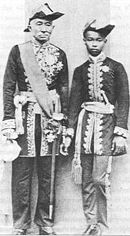 In 1862, recommended by Tan Kim Ching
in Singapore, an English woman named Anna Leonowens
, whose influence was later the subject of great Thai controversy, was hired by the court. It is still debated how much this affected the worldview of one of his sons, Prince Chulalongkorn
, who succeeded to the throne. Her story would become the inspiration for the Hollywood movie Anna and the King of Siam and the Rodgers and Hammerstein
musical The King and I
, which, because of their incorrect historical references and disrespectful treatment of King Mongkut, were initially banned in Thailand as the Thai government and people considered them to be lèse majesté
. To correct the record, well-known Thai intellectuals Seni
and Kukrit Pramoj
in 1948 wrote The King of Siam Speaks. The Pramoj brothers sent their manuscript to the American politician and diplomat Abbot Low Moffat (1901–1996), who drew on it for his 1961 biography, Mongkut the King of Siam. Moffat donated the Pramoj manuscript to the United States Library of Congress
in 1961. (Southeast Asian Collection, Asian Division, Library of Congress)
Anna claimed that her conversations with Prince Chulalongkorn about human freedom, and her relating to him the story of Uncle Tom's Cabin
, became the inspiration for his abolition of slavery
almost 40 years later. It should be noted, however, that the slavery system in Siam was very different from that in the United States. Slavery in Thailand was often voluntary and due to economic condition. One could be punished for torturing slaves in Siam and some slaves could buy their freedom. Western scholars and observers have commented that Siamese slaves were treated better than European servants.
, was changing the official Buddhist calendar, “which was seriously miscalculated and the times for auspicious moments were incorrect.”
In 1868, he invited high-ranking European and Siamese officials to accompany him to Wakor village in Prachuap Khiri Khan province
, south of Hua Hin
, where the solar eclipse that was to occur on 18 August could be best viewed as a total eclipse. Sir Harry Ord
, the British Governor of Straits Settlements
from Singapore
, was among those who were invited. King Mongkut predicted the solar eclipse, at (in his own words) "East Greenwich longitude
99 degrees 42' and latitude
North 11 degrees 39'." King Mongkut's calculations proved accurate. When he made calculations on the Wakor solar eclipse that was to occur, he used the Thai system of measuring time (mong and baht), but he implemented the Western method of longitude and latitude when he determined where on earth the eclipse would best be viewed. Upon returning from his journey to Wakor, he condemned the court astrologers “for their […] stupid statements because of their negligence of his detailed prediction and their inattention to measurement and calculation by modern instruments.”
During the expedition, King Mongkut and Prince Chulalongkorn were infected with malaria
. The king died six weeks later in the capital, and was succeeded by his son, who survived the malaria.
It has been argued that the assimilation of Western geography and astronomy into 19th century Siam "proved that Siam equaled the West in terms of knowledge, and therefore the imperialists
' claim that Siam was uncivilized and had to be colonized was unreasonable." This suggests that the Western form of these sciences may have saved Siam from actually being colonized by Western powers.
argues that Mongkut's efforts to popularize Western geography helped bring reform to education in Siam.
s to President Abraham Lincoln
during the American Civil War
for use against the Confederacy
. He did, however, offer to send some domesticated elephants to President James Buchanan
, to use as beasts of burden and means of transportation. The royal letter of February 14, 1861, which was written even before the Civil War started, took some time to arrive in Washington DC, and by the time it reached its destination, President Buchanan was not in office any longer. (Text of the royal letter here http://www.2bangkok.com/news03e.shtml#letter. Although the Smithsonian Institution
describes it as the "translation", in fact it was written by the King himself in his "self-educated" English.) Lincoln, who succeeded Buchanan, is said to have been asked what the elephants could be used for, and in reply he said that he did not know, unless "they were used to stamp out the rebellion."http://www.archive.org/stream/ivorykingpopular00hold2/ivorykingpopular00hold2_djvu.txt However, in his replying letter dated February 3, 1862 http://www.thelincolnlog.org/view/1862/2/3 Lincoln did not mention anything about the Civil War. The President merely politely declined to accept King Mongkut's proposal, explaining to the King that the American climate might not be suitable for elephants and that American steam engines could also be used as beasts of burden and means of transportation. http://www.americanambassadors.org/index.cfm?fuseaction=Publications.article&articleid=171http://www.archives.gov/press/press-releases/1999/nr99-122.html
A century later, during his state visit to the US, King Bhumibol of Thailand, who is Mongkut's great-grandson, referred to this event in his address before the US Congress on June 29, 1960. He said, "my great-grandfather offered to send the President and Congress elephants to be turned loose in the uncultivated land of America for breeding purposes. That offer was made with no other objective than to provide a friend with what he lacks, in the same spirit in which the American aid program is likewise offered."
Outside of Thailand, he is best known as the King in the 1951 play and 1956 film The King and I
The King and I
The King and I is a stage musical, the fifth by the team of Richard Rodgers and Oscar Hammerstein II. The work is based on the 1944 novel Anna and the King of Siam by Margaret Landon and derives from the memoirs of Anna Leonowens, who became governess to the children of King Mongkut of Siam in...
, based on the 1946 film Anna and the King of Siamin turn based on the 1944 novel about Anna Leonowens
Anna Leonowens
Anna Leonowens was an English travel writer, educator, and social activist. She worked in Siam from 1862 to 1868, where she taught the wives and children of Mongkut, king of Siam. She also co-founded the Nova Scotia College of Art and Design...
' years at his court, from 1862 to 1867.
During his reign, the pressure of Western expansionism
Colonialism
Colonialism is the establishment, maintenance, acquisition and expansion of colonies in one territory by people from another territory. It is a process whereby the metropole claims sovereignty over the colony and the social structure, government, and economics of the colony are changed by...
was felt for the first time in Siam. Mongkut embraced Western innovations and initiated the modernization of Siam, both in technology and culture—earning him the nickname "The Father of Science and Technology" in Siam.
Mongkut was also known for his appointment of his brother, Prince Chutamani, as vice-king. Prince Chutamani was crowned in 1851 as King Pinklao
Pinklao
Phrabat Somdet Phra Pinklao Chaoyuhua was the younger brother of King Mongkut and the Second King of Siam, who crowned him as a monarch with equal honor to himself.-Early life:...
. Mongkut himself assured the country that Pinklao should be respected with equal honor to himself. Mongkut's reign was also the time when the power of the House of Bunnag
Bunnag
The House of Bunnag was a powerful Siamese noble family of the Persian descent of the early Rattanakosin. By the nineteenth century, its power and influence reached its zenith. The family was favored by Chakri monarchs and monopolized high-ranking titles. Three Somdet Chao Phrayas came from the...
reached its zenith and became the most powerful noble family of Siam.
Early life
Mongkut was the second son of to Prince Isarasundhorn, son of Buddha Yodfa ChulalokeBuddha Yodfa Chulaloke
Phra Bat Somdet Phra Poramintharamaha Chakri Borommanat Phra Buddha Yodfa Chulaloke , posthumously titled "the Great", or Rama I , was the founder and the first monarch of the reigning House of Chakri of Siam . He ascended the throne in 1782, after defeating a rebellion which had deposed King...
, the first Chakri king of Siam, and Princess Bunreod; he was born in 1804 at the Old (Thonburi) Palace. He was later joined by his brother Prince Chutamani, who was born in 1808. In 1809, Prince Isarasundhorn was crowned as Buddha Loetla Nabhalai
Buddha Loetla Nabhalai
Phra Bat Somdet Phra Poramenthramaha Isarasundhorn Phra Buddha Loetla Nabhalai , or Rama II , was the second monarch of Siam under the House of Chakri, ruling from 1809-1824. In 1809, Isarasundhorn succeeded his father Buddha Yodfa Chulaloke, the founder of Chakri dynasty, as Buddha Loetla Nabhalai...
. The prince himself was nine at the time and they all moved to the Grand Palace.
Monastic Life and Thammayut sect
In 1824, at age 20, Mongkut became a BuddhistBuddhism
Buddhism is a religion and philosophy encompassing a variety of traditions, beliefs and practices, largely based on teachings attributed to Siddhartha Gautama, commonly known as the Buddha . The Buddha lived and taught in the northeastern Indian subcontinent some time between the 6th and 4th...
monk
Bhikkhu
A Bhikkhu or Bhikṣu is an ordained male Buddhist monastic. A female monastic is called a Bhikkhuni Nepali: ). The life of Bhikkhus and Bhikkhunis is governed by a set of rules called the patimokkha within the vinaya's framework of monastic discipline...
(ordination
Upasampada
Upasampadā literally means "approaching or nearing the ascetic tradition." In more common parlance it specifically refers to the rite of ordination by which one undertakes the Buddhist monastic life....
name Vajirayan; Pali
Páli
- External links :* *...
Vajirañāṇo), according to Siamese tradition that men aged 20 should become monks. The same year, his father died. By tradition, Mongkut would be crowned the next king, but the nobility instead put on the throne the influential Prince Jessadabodindra
Jessadabodindra
Phra Bat Somdet Phra Poramintharamaha Jessadabodindra Phra Nangklao Chao Yu Hua , or Rama III , was the third monarch of Siam under the House of Chakri, ruling from 21 July 1824 to 2 April 1851. He succeeded his father, Buddha Loetla Nabhalai, as the King of Siam...
, who was a son of a concubine rather than a queen. Perceiving that the throne was irredeemable and to avoid political intrigues, Mongkut chose to retain his monastic status.
Vajirayan became one of the members of the royal family who devoted his life to religion. He travelled the country as a monk and saw the relaxation of the rules of Pali Canon
Pāli Canon
The Pāli Canon is the standard collection of scriptures in the Theravada Buddhist tradition, as preserved in the Pāli language. It is the only completely surviving early Buddhist canon, and one of the first to be written down...
among the Siamese monks he met, which he considered inappropriate. In 1829, at Phetchaburi
Phetchaburi
Phetchaburi , also known as Phetburi, is a town in central Thailand, capital of the Phetchaburi Province. In Thai, Phetchaburi means city of diamonds . It is approximately 160km south of Bangkok, at the northern end of the Thai Peninsula...
, he met a monk named Buddhawangso who strictly followed the canon. Vajirayan admired Buddhawangso for his obedience to the canon, and was inspired to pursue religious reforms. In 1833, he began a reform movement reinforcing the canon law that evolved into the Dhammayuttika Nikaya, or Thammayut sect. In 1836, Vajirayan arrived at Wat Bowonniwet
Wat Bowonniwet
Wat Bowonniwet Vihara Rajavaravihara is a major Buddhist temple in Phra Nakhon district, Bangkok, Thailand. The temple is a center of the Thammayut Nikaya school of Thai Theravada Buddhism and has been a major temple of patronage for the Chakri dynasty. It is the shrine-hall of Phra...
in what is now Bangkok's central district, but was then the city proper, and became the wat's first abbot . During this time, he discovered Western
Western world
The Western world, also known as the West and the Occident , is a term referring to the countries of Western Europe , the countries of the Americas, as well all countries of Northern and Central Europe, Australia and New Zealand...
knowledge, studying Latin
Latin
Latin is an Italic language originally spoken in Latium and Ancient Rome. It, along with most European languages, is a descendant of the ancient Proto-Indo-European language. Although it is considered a dead language, a number of scholars and members of the Christian clergy speak it fluently, and...
, English
English language
English is a West Germanic language that arose in the Anglo-Saxon kingdoms of England and spread into what was to become south-east Scotland under the influence of the Anglian medieval kingdom of Northumbria...
, and astronomy
Astronomy
Astronomy is a natural science that deals with the study of celestial objects and phenomena that originate outside the atmosphere of Earth...
with missionaries
Missionary
A missionary is a member of a religious group sent into an area to do evangelism or ministries of service, such as education, literacy, social justice, health care and economic development. The word "mission" originates from 1598 when the Jesuits sent members abroad, derived from the Latin...
and sailors. Vicar
Apostolic vicariate
An apostolic vicariate is a form of territorial jurisdiction of the Roman Catholic Church established in missionary regions and countries that do not have a diocese. It is essentially provisional, though it may last for a century or more...
Pallegoix
Jean-Baptiste Pallegoix
Jean-Baptiste Pallegoix, M.E.P. was vicar apostolic of Eastern Siam.Born in Combertault, France, he was consecrated as a priest of the Société des Missions Etrangères on May 31, 1828. On June 3, 1838 he was assigned as Coadjutor Vicar Apostolic of Siam and titular bishop of Mallus...
of the Roman Catholic Archdiocese of Bangkok lived nearby, the two became close friends, and Vajirayan invited Pallegoix to preach Christian sermons in the Wat. Vajirayan admired Christian morals and achievements as presented by the vicar, but could make nothing of Christian doctrine. It was then he made the comment later attributed to him as king: "What you teach people to do is admirable but what you teach them to believe is foolish."
King Mongkut would later be noted for his excellent command of English, although it is said that his younger brother, Vice-King Pinklao
Pinklao
Phrabat Somdet Phra Pinklao Chaoyuhua was the younger brother of King Mongkut and the Second King of Siam, who crowned him as a monarch with equal honor to himself.-Early life:...
, could speak it even better. Mongkut's first son and heir, Chulalongkorn
Chulalongkorn
Phra Bat Somdet Phra Poramintharamaha Chulalongkorn Phra Chunla Chom Klao Chao Yu Hua , or Rama V was the fifth monarch of Siam under the House of Chakri. He was known to the Siamese of his time as Phra Phuttha Chao Luang . He is considered one of the greatest kings of Siam...
, granted the Thammayut sect royal recognition in 1902 through the Ecclesiastical Polity Act; it became one of the two major Buddhist denominations
Buddhism in Thailand
Buddhism in Thailand is largely of the Theravada school. Nearly 95% of Thailand's population is Buddhist of the Theravada school, though Buddhism in this country has become integrated with folk beliefs as well as Chinese religions from the large Thai-Chinese population.Buddhist temples in Thailand...
in modern Thailand. Chulalongkorn also persuaded his father's 47th child, Vajirañana
Vajirananavarorasa
Vajirananavarorasa was the 10th Supreme Patriarch of Thailand from 1910 to 1921...
, to enter the order, and he rose to become the 10th Supreme Patriarch of Thailand
Supreme Patriarch of Thailand
The Supreme Patriarch or Sangharaja is the head of the order of Buddhist monks in Thailand. The position is formally appointed by the King of Thailand, although the actual selection is made by senior clergymen...
from 1910 to 1921.
Reign as King
Mon people
The Mon are an ethnic group from Burma , living mostly in Mon State, Bago Division, the Irrawaddy Delta, and along the southern Thai–Burmese border. One of the earliest peoples to reside in Southeast Asia, the Mon were responsible for the spread of Theravada Buddhism in Burma and Thailand...
style.
Some said that, however, Jessadabodindra wished his throne to be passed to his son, Prince Annop, and that he gave his bracelet which had been passed down from Buddha Yodfa Chulaloke to the prince. However, Dis Bunnak switched the bracelet for a forged one, thus preventing Annop from inheriting the throne.
Prince Mongkut was indeed supported by a pro-British, Dis Bunnak, the Samuha Kalahom, or Armed Force Department's president, the most powerful noble during the reign of Rama III. Also some British merchants who were fearsome of the anti-West feeling growing during the previous reign, seeing the 'prince monk', Mongkut, who the 'champion' of European civilization among the royal elite, as their new hope.
Bunnak, with the supporting promise of British agents, sent his men to the leaving-from-monk-status ceremony for Prince Mongkut even before Jessadabodindra's death. With the support of powerful nobility and the Great Power, Britain, Mongkut's ascension to the throne was ensured.
After his twenty-seven years of pilgrimage, King Mongkut ascended the throne in 1851, aged 47. He took the name Phra Chom Klao, although foreigners continued to call him King Mongkut. The king was well-known among the foreigners particularly some British officers, as a pro-British. Sir James Brooke
James Brooke
James, Rajah of Sarawak, KCB was the first White Rajah of Sarawak. His father, Thomas Brooke, was an English Judge Court of Appeal at Bareilly, British India; his mother, Anna Maria, born in Hertfordshire, was the illegitimate daughter of Scottish peer Colonel William Stuart, 9th Lord Blantyre,...
, a British delegation
Delegation
Delegation is the assignment of authority and responsibility to another person to carry out specific activities. However the person who delegated the work remains accountable for the outcome of the delegated work. Delegation empowers a subordinate to make decisions, i.e...
, even praised him 'our own king', and showed his support of him as a new king of Siam. Having been celibate for 27 years he now set about building the biggest Royal Family of the Chakri Dynasty. In the "Inside" of the Palace there was a veritable city of women — reports say three thousand or more. They were mostly servants, 'Amazons' for guards, officials, maids and so on, but Mongkut acquired thirty-two wives and by the time he died, aged sixty-four, he had eighty-two children..
His awareness of the threat from the British
United Kingdom
The United Kingdom of Great Britain and Northern IrelandIn the United Kingdom and Dependencies, other languages have been officially recognised as legitimate autochthonous languages under the European Charter for Regional or Minority Languages...
and French
France
The French Republic , The French Republic , The French Republic , (commonly known as France , is a unitary semi-presidential republic in Western Europe with several overseas territories and islands located on other continents and in the Indian, Pacific, and Atlantic oceans. Metropolitan France...
imperial powers, led him to institute many innovative activities. He ordered the nobility to wear shirts while attending his court; this was to show that Siam was no longer barbaric from the Western point of view.
However, Mongkut's own astrological calculations pointed out that his brother, Prince Isaret, was as well favored as himself to be the monarch. So, Mongkut then crowned his brother as King Pinklao, the second king. As a prince, Pinklao was known for his abilities in foreign languages and relations. Mongkut also raised his supporter Dis Bunnak to Somdet Chao Phraya Borom Maha Prayurawongse (Somdet Chao Phraya was the highest rank of nobility on a par with royalty) and made him his regent kingdom-wide. Mongkut also appointed Dis Bunnak's brother, Tat, as Somdet Chao Phraya Borom Maha Pichaiyat, as his regent in Bangkok. As the result, the administrative power of Siam rested largely in the hands of the two Bunnaks, Dis and Tat.
Upon his coronation, Mongkut married his first wife, Queen Somanat
Somanat
Somdet Phranangchao Soamanat Vadhanavadi, or Queen Soamanat , was the first queen of Mongkut, though for only nine months. Princess Soamanas was a daughter of Prince Lakhananukun and Ngiu Suvarnnadat. Since her father was Phra Ong Chao, Somanat was destined to be Mom Chao...
. However, Queen Somanat died in the same year. He then married his half-grandniece, Mom Chao Rampoei Siriwongse, later Queen Debsirindra
Debsirindra
align=right|Queen Debsirindra of Siam was the second consort of King Mongkut , and mother of the future King Chulalongkorn . Mom Chao Rampoei was born in 1834 to Prince Siriwongse, the Krom Meun Matayapitak, who was the son of Jessadabodindra and Concubine Sap, and Lady Noi...
.
Shan campaigns
In 1849, there were upheavals in the Shan state of Kengtung and Chiang HungChiang Hung
Kingdom of Heokam or Kingdom of Chiang Hung was a political entity of Tai Lue people centered on the city of Chiang Hung or modern Jinghong the capital of Xishuangbanna Dai Autonomous Prefecture...
kingdom in response to weakened Burmese influence. However, the two states then fought each other and Chiang Hung sought Siamese support. Jessadabodindra saw this as an opportunity to gain control over Shan states but he died in 1851 before this plan was realized. In 1852, Chiang Hung submitted the request again. Mongkut sent Siamese troops northwards but the armies were turned aside by the mountainous highlands. In 1855 the Siamese marched again and reached Kengtungthough with even greater difficulty. They laid siege on Kengtung for 21 days. However, the resources of the Siamese army ran out and the army had to retreat.
Introducing Western Geography
Accompanying the influx of Western visitors to Siam was the notion of a round earth. By many Siamese, this was difficult to accept, particularly by religious standards, because Buddhist scripture described earth as being flat. The Traiphum, which was a geo-astrological map created before the arrival of Westerners, described “…a path between two mountain ranges through which the stars, planets, moon and sun pass." Religious scholars usually concluded that Buddhist scriptures “…were meant to be taken literally only when it came to matters of spiritual truth; details of natural science are revealed figuratively and allegorically.”Mongkut claimed to have abandoned the Traiphum cosmology before 1836. He claimed that he already knew of the round state of earth 15 years before the arrival of American missionaries, but the debate about earth’s shape remained an issue for Siamese intellectuals throughout the 1800s.
Beginning in the early 1820s, two revolutions (both initiated by Mongkut during his monkhood) were taking place. Firstly, he fought for the people to embrace modern geography
Geography
Geography is the science that studies the lands, features, inhabitants, and phenomena of Earth. A literal translation would be "to describe or write about the Earth". The first person to use the word "geography" was Eratosthenes...
, among other sciences considered “Western.” Secondly he sought reform in Buddhism and, as a result, a new sect was created in Siamese Theravada Buddhism. Both revolutions challenged the purity and validity of the Buddhist order as it was practiced in Siam at the time. A strong theme in Mongkut’s movement was that, “…true Buddhism was supposed to refrain from worldly matters and confine itself to spiritual and moral affairs.” Mongkut eventually came to power in 1851, as did his colleagues who had the same progressive mission. From that point on, Siam was more quickly embracing modernization.
Social Changes
1852 saw an influx of English and American missionaries into Siam as Mongkut hired them to teach the English language to the princes. He also hired Western mercenaries to train Siamese troops in Western style. In Bangkok, American Dan Beach BradleyDan Beach Bradley
Dan Beach Bradley M.D. was an American Protestant missionary to Siam from 1835 until his death. He is credited with numerous firsts, including bringing the first Thai-script printing press to Siam, publishing the first Thai newspaper and monolingual Thai dictionary, and introducing Western...
had already reformed the printing and then resumed the publishing of Siam's first newspaper, the Bangkok Recorder. However, the missionaries were not as successful when it came to making religious conversions.
However, Mongkut didn't abandon the traditional culture of Siam. In 1852, he ordered the nobles of the court to wear upper garments. Previously, Siamese nobles were forbidden to wear any shirts to prevent them from hiding any weapons in it and met the king bare-chested. The practice was criticized by Westerners and so Mongkut ended it.
For Buddhism, Mongkut pioneered the rehabilitation of various temples. He also began the Magha Puja
Magha Puja
Māgha Pūjā or Makha Bucha is an important Buddhist festival celebrated in Thailand, Cambodia, and Laos on the full moon day of the third lunar month . The third lunar month is known in the Thai language as Makha ; Bucha is also a Thai word , meaning "to venerate" or "to honor"...
(มาฆบูชา) festival in the full moon of the third lunar month, to celebrate Buddha's announcement of his main principles. And he instigated the Recompilation of Tripitaka
Tripiṭaka
' is a traditional term used by various Buddhist sects to describe their various canons of scriptures. As the name suggests, a traditionally contains three "baskets" of teachings: a , a and an .-The three categories:Tripitaka is the three main categories of texts that make up the...
in Siam according to Theravada traditions. He also formally established the Thammayut sect as a rightful branch of Theravada.
Mongkut also improved women's rights in Siam. He released a large number of royal concubines to find their own husbands, in contrast to how his story has been dramatized. He banned forced marriages of all kinds and the selling of one's wife to pay off a debt.
In contrast to the previous king, Jessadabodindra, Mongkut didn't see the importance of sending envoys to the Qing dynasty
Qing Dynasty
The Qing Dynasty was the last dynasty of China, ruling from 1644 to 1912 with a brief, abortive restoration in 1917. It was preceded by the Ming Dynasty and followed by the Republic of China....
court, as the mission symbolised Siam's subjection to the Qing emperors and because the Qing dynasty was then not so powerful as it had once been, as it was itself threatened by Western powers.
The Bowring Treaty
In 1854, John Bowring
John Bowring
Sir John Bowring, KCB was an English political economist, traveller, miscellaneous writer, polyglot, and the 4th Governor of Hong Kong.- Early life :...
, the Governor of Hong Kong
Governor of Hong Kong
The Governor of Hong Kong was the head of the government of Hong Kong during British rule from 1843 to 1997. The governor's roles were defined in the Hong Kong Letters Patent and Royal Instructions...
in the name of Queen Victoria of the United Kingdom, came to Siam to negotiate a treaty. For the first time Siam had to deal seriously with international laws. Prayurawongse negotiated on the behalf of the Siamese. The result was the Bowring Treaty, which was regarded as an unequal treaty imposed by the British Empire
British Empire
The British Empire comprised the dominions, colonies, protectorates, mandates and other territories ruled or administered by the United Kingdom. It originated with the overseas colonies and trading posts established by England in the late 16th and early 17th centuries. At its height, it was the...
on Siam. The main principle of the treaty was to abolish the Royal Storage (พระคลังสินค้า), which since Ayutthaya's times held the monopoly on foreign trade. The Royal Storage had been the source of Ayutthaya's prosperity as it collected immense taxation on foreign traders, including the taxation according to the width of the galleon and the tithe. Western products had to go through a series of tax barriers to reach Siamese people.
The Europeans had been attempting to undo this monopoly for a long time but no serious measures had been taken. For Siamese people, trading with foreigners subjected them to severe punishment. The taxation was partially reduced in the Burney Treaty
Burney Treaty
The Burney Treaty, so named after Henry Burney, head emissary from the East India Company, and known in Siamese history as the Treaty of Amity and Commerce , was concluded with King Rama III in the latter part of 1826. This followed Dr...
. However, in the world of liberalism
Liberalism
Liberalism is the belief in the importance of liberty and equal rights. Liberals espouse a wide array of views depending on their understanding of these principles, but generally, liberals support ideas such as constitutionalism, liberal democracy, free and fair elections, human rights,...
of the nineteenth century, such unequal and government-interfered trade was disappearing.
The abolition of such trade barriers replaced Siamese commerce with free trade. Import taxation was reduced to 3% and could only be collected once. This, of course, was a blow on the national revenue. However, this led to dramatic growth of commercial sectors as common people gained access to foreign trade. Never before in Siam could agricultural products be for sale and exports rather than subsistence farming (Before Bowring, those who traded rice with foreigners would be executed for treason). People rushed to acquire vast, previously empty fields to grow rice
Rice
Rice is the seed of the monocot plants Oryza sativa or Oryza glaberrima . As a cereal grain, it is the most important staple food for a large part of the world's human population, especially in East Asia, Southeast Asia, South Asia, the Middle East, and the West Indies...
and the competition eventually resulted in the lands ending up in the hands of nobility.
The Bowring Treaty also had a legal impact. Due to the horror of the Nakorn Bala methods of torture in judicial proceedings, the British chose not to be tried under the Siamese system, securing a grant of extraterritoriality
Extraterritoriality
Extraterritoriality is the state of being exempt from the jurisdiction of local law, usually as the result of diplomatic negotiations. Extraterritoriality can also be applied to physical places, such as military bases of foreign countries, or offices of the United Nations...
; British subjects in Siam were therefore subject only to British law, while the Siamese in Britain enjoyed no reciprocal privilege.
More treaties were then made with other powers, further undermining national revenue and legal rights. The Bowring treaty proved to be the economic and social revolution of Siam. Mongkut's reign saw immense commercial activities in Siam for the first time, which led to the introduction of coinage
Currency
In economics, currency refers to a generally accepted medium of exchange. These are usually the coins and banknotes of a particular government, which comprise the physical aspects of a nation's money supply...
in 1860. The first industries in Siam were rice milling
Gristmill
The terms gristmill or grist mill can refer either to a building in which grain is ground into flour, or to the grinding mechanism itself.- Early history :...
and sugar
Sugar
Sugar is a class of edible crystalline carbohydrates, mainly sucrose, lactose, and fructose, characterized by a sweet flavor.Sucrose in its refined form primarily comes from sugar cane and sugar beet...
production. Infrastructure was improved; there was a great deal of paving of roads and canal diggingfor transport and water reservoirs for plantations.
Anna Leonowens
Tan Kim Ching
Singapore-born Tan Kim Ching who lived from 1829 to Feb 1892 was the eldest of the three sons of Tan Tock Seng, the founder and financier of Tan Tock Seng Hospital. He was consul for Japan, Thailand and Russia, was a member of the Royal Court of Siam. He was one of Singapore’s leading Chinese...
in Singapore, an English woman named Anna Leonowens
Anna Leonowens
Anna Leonowens was an English travel writer, educator, and social activist. She worked in Siam from 1862 to 1868, where she taught the wives and children of Mongkut, king of Siam. She also co-founded the Nova Scotia College of Art and Design...
, whose influence was later the subject of great Thai controversy, was hired by the court. It is still debated how much this affected the worldview of one of his sons, Prince Chulalongkorn
Chulalongkorn
Phra Bat Somdet Phra Poramintharamaha Chulalongkorn Phra Chunla Chom Klao Chao Yu Hua , or Rama V was the fifth monarch of Siam under the House of Chakri. He was known to the Siamese of his time as Phra Phuttha Chao Luang . He is considered one of the greatest kings of Siam...
, who succeeded to the throne. Her story would become the inspiration for the Hollywood movie Anna and the King of Siam and the Rodgers and Hammerstein
Rodgers and Hammerstein
Richard Rodgers and Oscar Hammerstein II were a well-known American songwriting duo, usually referred to as Rodgers and Hammerstein. They created a string of popular Broadway musicals in the 1940s and 1950s during what is considered the golden age of the medium...
musical The King and I
The King and I
The King and I is a stage musical, the fifth by the team of Richard Rodgers and Oscar Hammerstein II. The work is based on the 1944 novel Anna and the King of Siam by Margaret Landon and derives from the memoirs of Anna Leonowens, who became governess to the children of King Mongkut of Siam in...
, which, because of their incorrect historical references and disrespectful treatment of King Mongkut, were initially banned in Thailand as the Thai government and people considered them to be lèse majesté
Lèse majesté
Lese-majesty is the crime of violating majesty, an offence against the dignity of a reigning sovereign or against a state.This behavior was first classified as a criminal offence against the dignity of the Roman republic in Ancient Rome...
. To correct the record, well-known Thai intellectuals Seni
Seni Pramoj
Mom Rajawongse Seni Pramoj was three times the prime minister of Thailand and a politician in the Democrat Party. A member of the Thai royal family, he was a descendant of King Rama II.-Biography:...
and Kukrit Pramoj
Kukrit Pramoj
Mom Rajawongse Kukrit Pramoj was a Thai politician and scholar. He was Speaker of the House of Representatives of Thailand 1973-1974 and was the thirteenth Prime Minister of Thailand, serving in office from 1975-1976.- Early years:Of royal descent, M.R...
in 1948 wrote The King of Siam Speaks. The Pramoj brothers sent their manuscript to the American politician and diplomat Abbot Low Moffat (1901–1996), who drew on it for his 1961 biography, Mongkut the King of Siam. Moffat donated the Pramoj manuscript to the United States Library of Congress
Library of Congress
The Library of Congress is the research library of the United States Congress, de facto national library of the United States, and the oldest federal cultural institution in the United States. Located in three buildings in Washington, D.C., it is the largest library in the world by shelf space and...
in 1961. (Southeast Asian Collection, Asian Division, Library of Congress)
Anna claimed that her conversations with Prince Chulalongkorn about human freedom, and her relating to him the story of Uncle Tom's Cabin
Uncle Tom's Cabin
Uncle Tom's Cabin; or, Life Among the Lowly is an anti-slavery novel by American author Harriet Beecher Stowe. Published in 1852, the novel "helped lay the groundwork for the Civil War", according to Will Kaufman....
, became the inspiration for his abolition of slavery
Slavery
Slavery is a system under which people are treated as property to be bought and sold, and are forced to work. Slaves can be held against their will from the time of their capture, purchase or birth, and deprived of the right to leave, to refuse to work, or to demand compensation...
almost 40 years later. It should be noted, however, that the slavery system in Siam was very different from that in the United States. Slavery in Thailand was often voluntary and due to economic condition. One could be punished for torturing slaves in Siam and some slaves could buy their freedom. Western scholars and observers have commented that Siamese slaves were treated better than European servants.
The Solar Eclipse at Wakor
During his monkhood, Mongkut studied both indigenous astrology and English texts on Western astronomy and mathematics, hence developing his skills in astronomical measurement. One way that he honed his mastery of astronomy, aside from the accurate prediction of the Wakor solar eclipseSolar eclipse of August 18, 1868
A total solar eclipse occurred on August 18, 1868. - Observations :Captain Bullock observed from the Celebes sea, sketching the appearance of the corona, while Gustav Fritsch accompanied an expedition to Aden. -Discovery of helium:...
, was changing the official Buddhist calendar, “which was seriously miscalculated and the times for auspicious moments were incorrect.”
In 1868, he invited high-ranking European and Siamese officials to accompany him to Wakor village in Prachuap Khiri Khan province
Prachuap Khiri Khan Province
Prachuap Khiri Khan is one of the central provinces of Thailand. Neighboring provinces are Phetchaburi in the north and Chumphon in the south. To the west it borders Tanintharyi Division of Myanmar....
, south of Hua Hin
Hua Hin
Hua Hin is a famous beach resort town in Thailand, in the northern part of the Malay Peninsula, some 200 km south of Bangkok. It has a population of 84,883 in an area of 911 km², and is one of eight districts of the Prachuap Khiri Khan province.Hua Hin is closely associated with the...
, where the solar eclipse that was to occur on 18 August could be best viewed as a total eclipse. Sir Harry Ord
Harry Ord
Major-General Sir Harry St. George Ord GCMG, CB, RE, was born on 4 August 1819 in North Cray, Kent, England. He was the son of Henry Gough Ord and grandson of Craven Ord of Greenstead Hall, Essex, a prominent antiquarian.-Education and career:...
, the British Governor of Straits Settlements
Straits Settlements
The Straits Settlements were a group of British territories located in Southeast Asia.Originally established in 1826 as part of the territories controlled by the British East India Company, the Straits Settlements came under direct British control as a crown colony on 1 April 1867...
from Singapore
Singapore
Singapore , officially the Republic of Singapore, is a Southeast Asian city-state off the southern tip of the Malay Peninsula, north of the equator. An island country made up of 63 islands, it is separated from Malaysia by the Straits of Johor to its north and from Indonesia's Riau Islands by the...
, was among those who were invited. King Mongkut predicted the solar eclipse, at (in his own words) "East Greenwich longitude
Geographic coordinate system
A geographic coordinate system is a coordinate system that enables every location on the Earth to be specified by a set of numbers. The coordinates are often chosen such that one of the numbers represent vertical position, and two or three of the numbers represent horizontal position...
99 degrees 42' and latitude
Geographic coordinate system
A geographic coordinate system is a coordinate system that enables every location on the Earth to be specified by a set of numbers. The coordinates are often chosen such that one of the numbers represent vertical position, and two or three of the numbers represent horizontal position...
North 11 degrees 39'." King Mongkut's calculations proved accurate. When he made calculations on the Wakor solar eclipse that was to occur, he used the Thai system of measuring time (mong and baht), but he implemented the Western method of longitude and latitude when he determined where on earth the eclipse would best be viewed. Upon returning from his journey to Wakor, he condemned the court astrologers “for their […] stupid statements because of their negligence of his detailed prediction and their inattention to measurement and calculation by modern instruments.”
During the expedition, King Mongkut and Prince Chulalongkorn were infected with malaria
Malaria
Malaria is a mosquito-borne infectious disease of humans and other animals caused by eukaryotic protists of the genus Plasmodium. The disease results from the multiplication of Plasmodium parasites within red blood cells, causing symptoms that typically include fever and headache, in severe cases...
. The king died six weeks later in the capital, and was succeeded by his son, who survived the malaria.
It has been argued that the assimilation of Western geography and astronomy into 19th century Siam "proved that Siam equaled the West in terms of knowledge, and therefore the imperialists
Imperialism
Imperialism, as defined by Dictionary of Human Geography, is "the creation and/or maintenance of an unequal economic, cultural, and territorial relationships, usually between states and often in the form of an empire, based on domination and subordination." The imperialism of the last 500 years,...
' claim that Siam was uncivilized and had to be colonized was unreasonable." This suggests that the Western form of these sciences may have saved Siam from actually being colonized by Western powers.
Education Reform
As the king of Siam, Mongkut urged his royal relatives to have “a European-style education.” The missionaries, as teachers, taught modern geography and astronomy, among other subjects. Six years after Mongkut’s death, the first Thai geography book was published in 1874, called Phumanithet by J.W. Van Dyke. However, geography was only taught in some schools, mainly those that were run by American missionaries with English programs for upper secondary students. Thongchai WinichakulThongchai Winichakul
Thongchai Winichakul is a Professor of Southeast Asian History at the University of Wisconsin–Madison. He is of Sino-Thai descent. Winichakul has had a major impact on the history of Thai nationalism. His best-known academic work is his book, Siam Mapped, which critiqued existing theories of Thai...
argues that Mongkut's efforts to popularize Western geography helped bring reform to education in Siam.
Elephant Story
Contrary to popular belief, King Mongkut did not offer a herd of war elephantWar elephant
A war elephant was an elephant trained and guided by humans for combat. Their main use was to charge the enemy, trampling them and breaking their ranks. A division of war elephants is known as elephantry....
s to President Abraham Lincoln
Abraham Lincoln
Abraham Lincoln was the 16th President of the United States, serving from March 1861 until his assassination in April 1865. He successfully led his country through a great constitutional, military and moral crisis – the American Civil War – preserving the Union, while ending slavery, and...
during the American Civil War
American Civil War
The American Civil War was a civil war fought in the United States of America. In response to the election of Abraham Lincoln as President of the United States, 11 southern slave states declared their secession from the United States and formed the Confederate States of America ; the other 25...
for use against the Confederacy
Confederate States of America
The Confederate States of America was a government set up from 1861 to 1865 by 11 Southern slave states of the United States of America that had declared their secession from the U.S...
. He did, however, offer to send some domesticated elephants to President James Buchanan
James Buchanan
James Buchanan, Jr. was the 15th President of the United States . He is the only president from Pennsylvania, the only president who remained a lifelong bachelor and the last to be born in the 18th century....
, to use as beasts of burden and means of transportation. The royal letter of February 14, 1861, which was written even before the Civil War started, took some time to arrive in Washington DC, and by the time it reached its destination, President Buchanan was not in office any longer. (Text of the royal letter here http://www.2bangkok.com/news03e.shtml#letter. Although the Smithsonian Institution
Smithsonian Institution
The Smithsonian Institution is an educational and research institute and associated museum complex, administered and funded by the government of the United States and by funds from its endowment, contributions, and profits from its retail operations, concessions, licensing activities, and magazines...
describes it as the "translation", in fact it was written by the King himself in his "self-educated" English.) Lincoln, who succeeded Buchanan, is said to have been asked what the elephants could be used for, and in reply he said that he did not know, unless "they were used to stamp out the rebellion."http://www.archive.org/stream/ivorykingpopular00hold2/ivorykingpopular00hold2_djvu.txt However, in his replying letter dated February 3, 1862 http://www.thelincolnlog.org/view/1862/2/3 Lincoln did not mention anything about the Civil War. The President merely politely declined to accept King Mongkut's proposal, explaining to the King that the American climate might not be suitable for elephants and that American steam engines could also be used as beasts of burden and means of transportation. http://www.americanambassadors.org/index.cfm?fuseaction=Publications.article&articleid=171http://www.archives.gov/press/press-releases/1999/nr99-122.html
A century later, during his state visit to the US, King Bhumibol of Thailand, who is Mongkut's great-grandson, referred to this event in his address before the US Congress on June 29, 1960. He said, "my great-grandfather offered to send the President and Congress elephants to be turned loose in the uncultivated land of America for breeding purposes. That offer was made with no other objective than to provide a friend with what he lacks, in the same spirit in which the American aid program is likewise offered."
Titles and styles
- 1804-1824: Somdet Phra Lukya Ther Chaofa Mongkut Sommuthiwongse Pong Isuarn Kasastriya Katiya Rajakumarn
- 1824 -1851: Vajirañāṇo (as a monk)
- 1851 -1868: Phra Bat Somdet Phra Poramenthramaha Mongkut Phra Chom Klao Chao Yu Hua
External links
- The King's Thai: Entry to Thai Historical Data - Mongkut's Edicts maintained by Doug Cooper of Center for Research in Computational Linguistics, Bangkok; accessed 2008-07-11.
- Captain John Bush, 1819-1905 Bangkok Harbour master