

Royal Thai Air Force

Encyclopedia
The Royal Thai Air Force or RTAF is the air force
of the Kingdom of Thailand
. Since its establishment in 1913, as one of the earliest air forces of Asia, the Royal Thai Air Force had engaged in many major and minor battles. During the Vietnam war
era, the air force has been developed with USAF-aid equipment. As of 2011, the Commander of the Air Force is Air Chief Marshal Itthaporn Subhawong.
pilot
Charles Van Den Born displayed the first aircraft in Thailand
at the Sa Pathum Horse Racing Course. The Thai authorities were impressed enough by the display that on 28 February 1912 they dispatched three officers to learn to fly in France
, a leading aviation country.
The three officers (Major Luang Sakdi Sanlayawut (Sunee Suwanprateep), Captain Luang Arwut Sikikorn (Long Sinsuk) and First Lieutenant Tip Ketuthat) learned to fly and on 2 November 1913 returned to Thailand with eight aircraft (four Breguets and four Nieuport
s). They are today regarded as the forefathers of the Royal Thai Air Force. In March of the next year they moved from Sa Pathum airfield to Don Muang
.
The Ministry of Defence put the early air force under the control of the Army Engineer Inspector General Department. Prince Purachatra, Commander of the Army Engineers, and his brother Prince Chakrabongse Bhuvanath
were instrumental in the development of the army's Royal Aeronautical Service, a forerunner to the Air Force.
During the French-Thai War
, the Thai Air Force scored several air-to-air-victories against the Vichy France Armée de l'Air. During World War II the Thai Air Force supported the Royal Thai Army in its occupation of the Burmese Shan States as allies of the Japanese in 1942 and defended Bangkok from allied air raids during the latter part of the war. Some RTAF personnels also assisted the anti-Japanese resistance. After World War II
, the Thai Air Force sent three C-47
s to support the United Nations
in Korean War
. The victorious Wings Unit, operating C-47, also joined the US Force in Vietnam War
. Along the border, Thai Air Force launched many campaign against the communists, such as Ban Nam Ta Airfield Raid in Laos
, and clashes between Thai and Vietnamese troops along the Thai-Cambodian border. When the cold war
ended, the Thai Air Force participated in Operation Border Post 9631 along the Thai-Burmese border in 1999, and launched the evacuation of Thais and foreigners during the 2003 Phnom Penh riots
in Cambodia
.
, who was appointed in 2008. The Royal Thai Air Force Headquarters is located in Don Muang Airbase, Bangkok
, Thailand
.
 The RTAF command structure consists of five groups: headquarters, logistics support, education, special services, and combat forces.
 The Royal Thai Air Force Combat Group is divided into 11 wings plus a training school, plus a few direct-reporting units.
is based at RTAFB Don Muang / Bangkok.

This 100 man unit, part of the Royal Thai Air Force's Special Combat Operations Squadron, has been in existence since the late 1970s. They are based near Don Muang Airport and provide anti-hijacking capabilities. They have three assault platoons, each divided into two smaller sections.
 The Royal Thai Air Force maintains a number of modern bases from which it conducts its administrative, transport, and training operations. The bases, which were constructed between 1954 and 1968, have permanent buildings and ground support equipment.
All but one were part of the network of airfields built and used by United States forces until their withdrawal from Thailand in 1976. Consolidating the equipment left by the departing units in accordance with government-to-government agreements, the Thai air force assumed use of the installations at Takhli
and Nakhon Ratchasima (Korat)
.
In the late 1980s, these bases and Don Muang Air Base
outside Bangkok
, which the air force shares with civil aviation, remains the primary operational holdings.
Maintenance of the facilities at other bases abandoned by the United States proved too costly and exceeded Thai needs. Nonetheless, all runways were still available for training and emergency use.
By 2004 the Royal Thai Air Force had its main base at Don Muang airport, adjacent to Don Mueang International Airport. The RTAF also had large air fields and facilities at Nakon Ratchasima Ubon Ratchathani
, and Takhli
.
! style="text-align: left; background: #aacccc;"|Origin
! style="text-align: left; background: #aacccc;"|Role
! style="text-align: left; background: #aacccc;"|Versions
! style="text-align: left; background: #aacccc;"|In service
! style="text-align: left; background: #aacccc;"|On order
! style="text-align: left; background: #aacccc;"|Note
|-----
! style="align: center; background: lavender;" colspan="8" | Trainer Aircraft
|-----
| Pacific Aerospace CT/4
|
| basic prop trainer
| CT-4A/E
| 20
|
| 24 were purchased, at least 3 crashed.
|-----
| Cessna T-41D Mescalero
|
| basic prop trainer
| T-41D
| 6
|
| For civil training. Due to be replaced.
|-----
| Pilatus PC-9
|
| advanced prop trainer
| PC-9M
| 23
|
| Cockpit and avionic were upgraded by Thai Aviation Industry
.
|-----
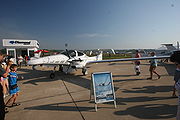
| Diamond DA42
|
| advanced prop trainer
| DA42
| 6
|
| Delivery in mid 2009.
|-----
! style="align: center; background: lavender;" colspan="8" | Combat Aircraft
|-----
| Saab JAS 39 Gripen
|
| multirole fighter
| JAS 39C/D
|6
|6
| First 6 Gripens (including 4-Gripen D and 2-Gripen C) delivered in 2011. Another 6 Gripens will be delivered in 2013.
|-----
| Lockheed Martin F-16 Fighting Falcon
|
| multirole fighter
| F-16A/B
|55
|
| 18 F-16s are going under MLU Upgrade by US
|-----
| Northrop F-5
|
| fighter-bomber
| F-5T Tigris
----
F-5E Tiger II
----
F-5B Freedom Fighter/F-5F Tiger II
| 14
----
~10
----
~5
----
|-----
|
|
|-----
Dual-seat training version of Northrop F-5. F-5B to be replaced by JAS 39D Gripen
in 2011.
|------
| Aero L-39 Albatros
|
| light strike aircraft/trainer
| L-39ZA/ART
| 36
|
| Westernized version of the Aero L-39 Albatros, equipped with Israeli avionics and AIM-9P.
|-----
| Dassault-Breguet/Dornier Alpha Jet
|
| light strike aircraft/trainer
| Alpha Jet A
| 19
|
| Ex-Luftwaffe
. Five airframe use for spare. One aircraft crashed.
|-----
| Pilatus AU-23A Peacemaker
|
| light strike aircraft/utility aircraft
| AU-23A
| ~40
|
| Armed version of the Pilatus PC-6. EX-USAF
|-----
! style="align: center; background: lavender;" colspan="8" | Reconnaissance
|-----
| GAF Nomad
|
| surveillance and patrol aircraft
| Nomad N.22B
| 19
|
| More than 10 completed service-life extension by Thai Aviation Industry
.
|-----
| Learjet 35
|
| patrol aircraft
| Learjet 35A
| 1
|
| 2 Delivered. 1 crash during training.
|-----
| Israel Aircraft Industries Arava
|
| patrol aircraft
| IAI 201
| 6
|
| 1 airframe stored.
|-----
| Saab 340
|
| AEW
| S-100B Argus
| 1
| 1
| First S-100B Argus have been delivered in 2010. Another Argus will be delivered in 2013. Equipped with Erieye radar.
|-----
|-----
| Aeronautics Defense Systems
|
| UAV
| Aerostar
| 1
|
| Ordered in 2011 with option for 3 more.
|-----
! style="align: center; background: lavender;" colspan="8" | Transport aircraft
|-----
| Saab 340
|
| Short Range Transport
| Saab 340
| 1
| 0
| Delivered on 2010,Used by 702 Sqn.
|-----
| Lockheed C-130 Hercules
|
| tactical transport
| C-130H
----
C-130H-30
| 6
----
6
|
| Underwent avionic and structural upgrade by Thai Aviation Industry
.
|-----
| Basler BT-67
|
| tactical transport
| BT-67
| +/-8
|
| Re-built version of Douglas C-47 Dakota. used for aerial firefighting and cloud seeding. one written in a crash in August 2006.
|-----
| Alenia G.222
|
| tactical transport
| G.222
| 6
|
| 3 additional airframes stored at Don Mueang RTAFB, used by 603 Sqn. Alenia has demonstrated its latest version of the G.222, the Alenia C-27J
recently to the Thai military.
|-----
| Avro 748
|
| short range transport
| 748 Series-2
| 4
|
| Phased out.
|-----
| ATR-72
|
| transport
| ATR-72-500
| 4
|
| Delivered.
|-----
| Boeing 737
|
| main royal family carrier
| B737-8Z6 (B737-800)
| 1
|
|-----
| Boeing 747-8
|
| royal family carrier
| B-747-8I (B-747-8I-BBJ)
|
|2
|RTAF ordered two B-747-8I-BBJ/VIP for the Royal family in June 2011, delivery expected in late 2014 and early 2015.
|-----
| Airbus A310
|
| royal family carrier
| A310-300
| 1
|
| Mainly used by military officer.
|-----
| Airbus A320
|
| royal family carrier
| A-319-115X CJ
| 1
| 1
| Mainly used by Government officer.
|-----
! style="align: center; background: lavender;" colspan="8" | Helicopter
|-----
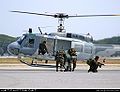
| Bell UH-1 Iroquois
|
| utility helicopter
/CSAR
| UH-1H
| 19
|
| Soon to be replaced.
|-----
| Sikorsky S-92 Superhawk
|
| royal family carrier
| S-92
| 3
|
| Three delivered April 2011
|-----
| Bell 412
|
| royal family carrier and VIP/VVIP transport
| 412EP/SP
| 12
|
|
|}
 Historic and remarkable aircraft of Royal Thai Air Force.
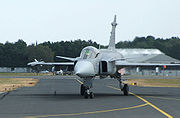
On a press conference on 17 October, the decision to buy six JAS 39 Gripen (version C/D), with an option for six more, was presented by Air Chief Marshal
Chalit Pookpasuk
. Twelve JAS 39 Gripen, two Saab 340
Erieye
AEW&C
, and one Saab 340
, training, technology transfer, and a number of RBS-15 anti-ship missile
s will be delivered to RTAF in two phases:
first phase: consists of six JAS 39 Gripen and one Saab 340 Erieye from 2008 to 2012.
second phase: consists of six JAS 39 Gripen, one Saab 340 Erieye, and one Saab 340 from
2013 to 2017.
On 8 Jan 2008, cabinet approved the budget for the first phase. The deal, worth 19 billion Baht, consists of six JAS 39 Gripen
: two single-seat C models and four dual-seat D model along with support, training, and spare parts. The offset includes one Saab 340
Erieye
, one Saab 340
, Datalink system, and 92 Master-degrees scholarships for Thai students to study in Sweden
. The first three aircraft will be delivered in January 2011 and another three in March 2011. Saab 340
and Saab 340
Erieye
will be delivered in 2010.
On 11 February 2008, the Gripen agreement was signed at FMV
in Sweden
, mark the start of the first batch.
Air force
An air force, also known in some countries as an air army, is in the broadest sense, the national military organization that primarily conducts aerial warfare. More specifically, it is the branch of a nation's armed services that is responsible for aerial warfare as distinct from an army, navy or...
of the Kingdom of Thailand
Thailand
Thailand , officially the Kingdom of Thailand , formerly known as Siam , is a country located at the centre of the Indochina peninsula and Southeast Asia. It is bordered to the north by Burma and Laos, to the east by Laos and Cambodia, to the south by the Gulf of Thailand and Malaysia, and to the...
. Since its establishment in 1913, as one of the earliest air forces of Asia, the Royal Thai Air Force had engaged in many major and minor battles. During the Vietnam war
Vietnam War
The Vietnam War was a Cold War-era military conflict that occurred in Vietnam, Laos, and Cambodia from 1 November 1955 to the fall of Saigon on 30 April 1975. This war followed the First Indochina War and was fought between North Vietnam, supported by its communist allies, and the government of...
era, the air force has been developed with USAF-aid equipment. As of 2011, the Commander of the Air Force is Air Chief Marshal Itthaporn Subhawong.
History
In February 1911 the BelgianBelgium
Belgium , officially the Kingdom of Belgium, is a federal state in Western Europe. It is a founding member of the European Union and hosts the EU's headquarters, and those of several other major international organisations such as NATO.Belgium is also a member of, or affiliated to, many...
pilot
Aviator
An aviator is a person who flies an aircraft. The first recorded use of the term was in 1887, as a variation of 'aviation', from the Latin avis , coined in 1863 by G. de la Landelle in Aviation Ou Navigation Aérienne...
Charles Van Den Born displayed the first aircraft in Thailand
Thailand
Thailand , officially the Kingdom of Thailand , formerly known as Siam , is a country located at the centre of the Indochina peninsula and Southeast Asia. It is bordered to the north by Burma and Laos, to the east by Laos and Cambodia, to the south by the Gulf of Thailand and Malaysia, and to the...
at the Sa Pathum Horse Racing Course. The Thai authorities were impressed enough by the display that on 28 February 1912 they dispatched three officers to learn to fly in France
France
The French Republic , The French Republic , The French Republic , (commonly known as France , is a unitary semi-presidential republic in Western Europe with several overseas territories and islands located on other continents and in the Indian, Pacific, and Atlantic oceans. Metropolitan France...
, a leading aviation country.
The three officers (Major Luang Sakdi Sanlayawut (Sunee Suwanprateep), Captain Luang Arwut Sikikorn (Long Sinsuk) and First Lieutenant Tip Ketuthat) learned to fly and on 2 November 1913 returned to Thailand with eight aircraft (four Breguets and four Nieuport
Nieuport
Nieuport, later Nieuport-Delage, was a French aeroplane company that primarily built racing aircraft before World War I and fighter aircraft during World War I and between the wars.-Beginnings:...
s). They are today regarded as the forefathers of the Royal Thai Air Force. In March of the next year they moved from Sa Pathum airfield to Don Muang
Don Muang Royal Thai Air Force Base
Don Muang Royal Thai Air Force Base is located approximately 25 miles north of Downtown Bangkok.It is the main operating and command base for the Royal Thai Air Force...
.
The Ministry of Defence put the early air force under the control of the Army Engineer Inspector General Department. Prince Purachatra, Commander of the Army Engineers, and his brother Prince Chakrabongse Bhuvanath
Chakrabongse Bhuvanath
Field Marshal Prince Chakrabongse Bhuvanadh, Prince of Phitsanulok, , was the fortieth child of King Chulalongkorn and the fourth child of Queen Sri Bajarindra....
were instrumental in the development of the army's Royal Aeronautical Service, a forerunner to the Air Force.
During the French-Thai War
French-Thai War
The Franco-Thai War was fought between Thailand and Vichy France over certain areas of French Indochina that had once belonged to Thailand....
, the Thai Air Force scored several air-to-air-victories against the Vichy France Armée de l'Air. During World War II the Thai Air Force supported the Royal Thai Army in its occupation of the Burmese Shan States as allies of the Japanese in 1942 and defended Bangkok from allied air raids during the latter part of the war. Some RTAF personnels also assisted the anti-Japanese resistance. After World War II
World War II
World War II, or the Second World War , was a global conflict lasting from 1939 to 1945, involving most of the world's nations—including all of the great powers—eventually forming two opposing military alliances: the Allies and the Axis...
, the Thai Air Force sent three C-47
C-47 Skytrain
The Douglas C-47 Skytrain or Dakota is a military transport aircraft that was developed from the Douglas DC-3 airliner. It was used extensively by the Allies during World War II and remained in front line operations through the 1950s with a few remaining in operation to this day.-Design and...
s to support the United Nations
United Nations
The United Nations is an international organization whose stated aims are facilitating cooperation in international law, international security, economic development, social progress, human rights, and achievement of world peace...
in Korean War
Korean War
The Korean War was a conventional war between South Korea, supported by the United Nations, and North Korea, supported by the People's Republic of China , with military material aid from the Soviet Union...
. The victorious Wings Unit, operating C-47, also joined the US Force in Vietnam War
Vietnam War
The Vietnam War was a Cold War-era military conflict that occurred in Vietnam, Laos, and Cambodia from 1 November 1955 to the fall of Saigon on 30 April 1975. This war followed the First Indochina War and was fought between North Vietnam, supported by its communist allies, and the government of...
. Along the border, Thai Air Force launched many campaign against the communists, such as Ban Nam Ta Airfield Raid in Laos
Laos
Laos Lao: ສາທາລະນະລັດ ປະຊາທິປະໄຕ ປະຊາຊົນລາວ Sathalanalat Paxathipatai Paxaxon Lao, officially the Lao People's Democratic Republic, is a landlocked country in Southeast Asia, bordered by Burma and China to the northwest, Vietnam to the east, Cambodia to the south and Thailand to the west...
, and clashes between Thai and Vietnamese troops along the Thai-Cambodian border. When the cold war
Cold War
The Cold War was the continuing state from roughly 1946 to 1991 of political conflict, military tension, proxy wars, and economic competition between the Communist World—primarily the Soviet Union and its satellite states and allies—and the powers of the Western world, primarily the United States...
ended, the Thai Air Force participated in Operation Border Post 9631 along the Thai-Burmese border in 1999, and launched the evacuation of Thais and foreigners during the 2003 Phnom Penh riots
2003 Phnom Penh riots
In January 2003, a Cambodian newspaper article falsely alleged that a Thai actress claimed that Angkor Wat belonged to Thailand. Other Cambodian print and radio media picked up the report and furthered the nationalistic sentiment which resulted in riots in Phnom Penh on January 29 where the Thai...
in Cambodia
Cambodia
Cambodia , officially known as the Kingdom of Cambodia, is a country located in the southern portion of the Indochina Peninsula in Southeast Asia...
.
Command and Control
The Royal Thai Air Force is commanded by the Commander of the Royal Thai Air Force (ผู้บัญชาการทหารอากาศไทย) currently Air Chief Marshal Itthaporn SubhawongItthaporn Subhawong
Air Chief Marshal Itthaporn Subhawong b. 1952 was appointed the 21st Commander-in-Chief of the Royal Thai Air Force on the 1st of October 2008.Itthaporn Subhawong was born on 6 January 1952 in Nakhon Ratchasima, Thailand...
, who was appointed in 2008. The Royal Thai Air Force Headquarters is located in Don Muang Airbase, Bangkok
Bangkok
Bangkok is the capital and largest urban area city in Thailand. It is known in Thai as Krung Thep Maha Nakhon or simply Krung Thep , meaning "city of angels." The full name of Bangkok is Krung Thep Mahanakhon Amon Rattanakosin Mahintharayutthaya Mahadilok Phop Noppharat Ratchathani Burirom...
, Thailand
Thailand
Thailand , officially the Kingdom of Thailand , formerly known as Siam , is a country located at the centre of the Indochina peninsula and Southeast Asia. It is bordered to the north by Burma and Laos, to the east by Laos and Cambodia, to the south by the Gulf of Thailand and Malaysia, and to the...
.
- Commander-in-Chief: Air Chief Marshal Itthaporn SubhawongItthaporn SubhawongAir Chief Marshal Itthaporn Subhawong b. 1952 was appointed the 21st Commander-in-Chief of the Royal Thai Air Force on the 1st of October 2008.Itthaporn Subhawong was born on 6 January 1952 in Nakhon Ratchasima, Thailand...
- Deputy Commander-in-Chief: Air Chief Marshal Dilok Songgalayanawat
- Assistant Commander-in-Chief: Air Chief Marshal Boonyarit Kerdsuk
- Assistant Commander-in-Chief: Air Chief Marshal Srichown Chanruang
- Chief of Staff of the Air Force: Air Chief Marshal Prajin Juntong
Organization
- The headquarters group in BangkokBangkokBangkok is the capital and largest urban area city in Thailand. It is known in Thai as Krung Thep Maha Nakhon or simply Krung Thep , meaning "city of angels." The full name of Bangkok is Krung Thep Mahanakhon Amon Rattanakosin Mahintharayutthaya Mahadilok Phop Noppharat Ratchathani Burirom...
performs the usual general staff functions, including planning and directing operations of the combat elements. - Combat Group.
- The support group provides engineering, communications, ordnance, transportation, quartermaster, and medical services support.
- The education group coordinates and supervises all air force training programmes.
- The special service group is responsible for the welfare of air force personnel and coordinates the activities of Thai civil aviation with those of the air force.
Combat Group
- Directorate of Air Operations Control, RTAF
- RTAF Security Force Command
- Flying Training School
- * The Flying Training School composes of three squadrons, the 1st Flying Training Squadron, 2nd Flying Training Squadron, and the 3rd Flying Training Squadron. The school is based at RTAFB Kamphang Saen in Nakhon Pathom ProvinceNakhon Pathom ProvinceNakhon Pathom ) is one of the central provinces of Thailand. Neighboring provinces are Suphan Buri, Ayutthaya, Nonthaburi, Bangkok, Samut Sakhon, Ratchaburi and Kanchanaburi...
- The Wing 1
- * The Wing 1 is an attack wing based at RTAFB Korat in Nakhon Ratchasima ProvinceNakhon Ratchasima ProvinceNakhon Ratchasima or , often shortened to Korat or Khorat , is one of the north-eastern provinces of Thailand...
.- The Wing 2
- * The Wing 2 is a rotary aviation wing that is used for basic utility needs and transport as well as search and rescue (SAR) operations. This wing is normally based at RTAFB Lop Buri in Lop Buri Province
- The Wing 4
- * The Wing 4 is a light attack / fighter wing based at RTAFB Takhli in Nakhon Sawan ProvinceNakhon Sawan ProvinceNakhon Sawan is one of the provinces of Thailand. Neighboring provinces are Kamphaeng Phet, Phichit, Phetchabun, Lop Buri, Sing Buri, Chai Nat, Uthai Thani and Tak.- Etymology :...
.- The Wing 5
- * The Wing 5 is a transport / observation wing based at RTAFB Prachuap Khiri Khan in Prachuap Khiri Khan ProvincePrachuap Khiri Khan ProvincePrachuap Khiri Khan is one of the central provinces of Thailand. Neighboring provinces are Phetchaburi in the north and Chumphon in the south. To the west it borders Tanintharyi Division of Myanmar....
.- The Wing 6
- * The Wing 6 is a non-combat wing used for a variety of functions including transport, mapping, communications and surveying. This wing
is based at RTAFB Don Muang / Bangkok.
- The Wing 7
- * The Wing 7 is an interceptor and attack wing based at RTAFB Surat Thani in Surat Thani ProvinceSurat Thani ProvinceSurat Thani is the largest of the southern provinces of Thailand, on the eastern shore of the Gulf of Thailand. Surat Thani means City of Good People, the title given to the city by King Vajiravudh ....
.- The Wing 21
- * The Wing 21 is an attack wing based at RTAFB Ubon Ratchathani in Ubon Ratchathani ProvinceUbon Ratchathani Province-History:The area was part of the Khmer Empire. Before the late eighteenth century, this area evidently was outside Siamese or Thai Ayutthaya Kingdom....
.- The Wing 23
- * The Wing 23 is a light attack wing based at RTAFB Udon in Udon Thani ProvinceUdon Thani ProvinceUdon Thani is one of the north-eastern provinces of Thailand. Neighboring provinces are Nong Khai, Sakon Nakhon, Kalasin, Khon Kaen, Nong Bua Lamphu and Loei.- Geography :...
.- The Wing 41
- * The Wing 41 is a light attack wing based at RTAFB Chiang Mai in Chiang Mai ProvinceChiang Mai ProvinceChiang Mai is the second-largest province of Thailand, located in the north of the country. Neighboring provinces are Chiang Rai, Lampang, Lamphun, Tak, and Mae Hong Son. In the north it borders Shan State of Burma...
.- The Wing 46
- * The Wing 46 is a transport / rainmaking wing based at RTAFB Phitsanulok in Phitsanulok ProvincePhitsanulok ProvincePhitsanulok is a provinces of Thailand, located in the north. Neighboring provinces are Loei, Phetchabun, Phichit, Kamphaeng Phet, Sukhothai, Uttaradit. In the north-east it also has a short border with Xaignabouli of Laos....
.- The Wing 56
- * The Wing 56 is a currently forming wing based at RTAFB Hatyai in Songkhla ProvinceSongkhla ProvinceSongkhla is one of the southern provinces of Thailand. Neighboring provinces are Satun, Phatthalung, Nakhon Si Thammarat, Pattani and Yala. To the south it borders Kedah and Perlis of Malaysia....
.
Royal Thai Air Force Commando Company
Main ArticleRoyal Thai Air Force Commando Company
The Royal Thai Air Force Commando Company is a 100 man unit in the Royal Thai Air Force's Special Combat Operations Squadron, has been in existence since the late 1970s. They are based near Don Muang Airport and provide anti-hijacking capabilities. They have three assault platoons, each divided...
This 100 man unit, part of the Royal Thai Air Force's Special Combat Operations Squadron, has been in existence since the late 1970s. They are based near Don Muang Airport and provide anti-hijacking capabilities. They have three assault platoons, each divided into two smaller sections.
Squadrons
The following squadrons are currently active with the Royal Thai Air Force and their assigned Wing and equipment.| Squadron | Wing | Equipment | Location | Notes |
|---|---|---|---|---|
| 201 Helicopter Squadron (Royal Guard) | Wing 2 | Bell 412 | RTAFB Khok ka thiem | |
| 203 Helicopter Squadron | Wing 2 | Bell UH-1H | RTAFB Khok ka thiem | SAR detachments at RTAFB Chiang Mai, RTAFB Korat/Nakhon Ratchasima, RTAFB Bangkok, RTAFB udon, RTAFB ubon, RTAFB surat and RTAFB hat yai |
| 102 Fighter Squadron | Wing 1 | Lockheed Martin F-16A/B(ADF) | RTAFB Korat | |
| 103 Fighter Squadron | Wing 1 | Lockheed Martin F-16A/B OCU Block 15 | RTAFB Korat | |
| 601 Transport Squadron | Wing 6 | Lockheed Martin C-130H/H-30 | RTAFB Bangkok | |
| 602 Royal Flight Squadron (Royal Guard) | Wing 6 | Airbus A310-300, A319, Boeing 737-800 | RTAFB Bangkok | |
| 603 Transport Squadron | Wing 6 | Alenia G.222(3), ATR72-500(3),4th on order HS-748-208 (one at least still in service as of mid October 2009, | RTAFB Bangkok | |
| 604 Civil Pilot Training Squadron | Wing 6 | CT-4A, T-41D | RTAFB Bangkok | |
| 211 Fighter Squadron | Wing 21 | Northrop F-5T Tigres | RTAFB Ubon Ratchathani | |
| 231 Attack Squadron | Wing 23 | Dornier/Dassault Alpha Jet A | RTAFB Udon Thani | |
| 401 Light Attack Squadron | Wing 4 | Aero L-39ZA/ART Albatros | RTAFB Takhli | |
| 402 Elint Squadron | Wing 4 | Learjet 35, IAI Arava | RTAFB Takhli | |
| 403 Fighter Squadron | Wing 4 | Lockheed Martin F-16A/B OCU Block 15 | RTAFB Takhli | 403's F-16A/Bs will be Midlife upgraded to be Block 50/52 standard. The first of totally 3 batches has been approved with $200Millions on Feb 2011. The first 6 F-16A/Bs would expect to be upgraded during 2011 to 2013. |
| 411 Fighter Squadron | Wing 41 | Aero L-39ZA/ART Albatros | RTAFB Chiang Mai | |
| 461 Transport/Rainmaking Squadron | Wing 46 | GAF Nomad, Basler BT-67 | RTAFB Phitsanulok | |
| 701 Fighter Squadron | Wing 7 | Saab Saab Saab AB is a Swedish aerospace and defence company, founded in 1937. From 1947 to 1990 it was the parent company of automobile manufacturer Saab Automobile, and between 1968 and 1995 the company was in a merger with commercial vehicle manufacturer Scania, known as Saab-Scania.-History:"Svenska... JAS-39 Gripen JAS 39 Gripen The Saab JAS 39 Gripen is a lightweight single-engine multirole fighter manufactured by the Swedish aerospace company Saab. It was designed to replace the Saab 35 Draken and 37 Viggen in the Swedish Air Force... |
RTAFB Surat Thani | Gripen replaced the Northrop F-5. the first 6 Gripens were delivered on 23 February 2011.http://www.bangkokpost.com/news/security/222825/new-era-for-air-force-with-modern-jets |
| 702 Squadron | Wing 7 | Saab 340/Saab 340 AEW | RTAFB Surat Thani | Code 70201 is Saab 340,Code 70202 is S-100B Argus |
| 501 Attack Squadron | Wing 5 | AU-23A Peacemaker | RTAFB Prachuap Khiri Khan | The former 531 Sqn was redesignated 501 Sqn on 1 April 2007 |
| 904 Aggessor Squadron | - | Northrop F-5E | RTAFB Bangkok | Former unit of Crown Prince Vajiralongkorn Mahidon, now an aggressor unit. |
| Tango Squadron | - | - | RTAFB Chiang Mai | Historical aircraft unit, not controlled by the Royal Thai Air Force |
| 1st Flying Training Squadron | Flying Training School | Pacific Aerospace PAC CT/4E | RTAFB Kamphang Saen | Primary flight training squadron |
| 2nd Flying Training Squadron | Flying Training School | Pilatus PC-9M | RTAFB Kamphang Saen | Basic flight training squadron |
| 3rd Flying Training Squadron | Flying Training School | Bell 206B(struck off charge 1 October 2006) | RTAFB Kamphang Saen | Rotary aviation training squadron |
Royal Thai Air Force Bases
All but one were part of the network of airfields built and used by United States forces until their withdrawal from Thailand in 1976. Consolidating the equipment left by the departing units in accordance with government-to-government agreements, the Thai air force assumed use of the installations at Takhli
Takhli Royal Thai Air Force Base
Takhli Royal Thai Air Force Base is a Royal Thai Air Force facility. It is located in Central Thailand, approximately 144 miles northwest of Bangkok in Takhli district, Nakhon Sawan Province, near the city of Nakhon Sawan.- Units :...
and Nakhon Ratchasima (Korat)
Korat Royal Thai Air Force Base
Korat Royal Thai Air Force Base is a base of the Royal Thai Air Force. It is located in northeast Thailand, located approximately 157 miles northeast of Bangkok and about 5 miles south of Nakhon Ratchasima , the second largest city in Thailand.During the Vietnam War, Korat RTAFB was the...
.
In the late 1980s, these bases and Don Muang Air Base
Don Muang Royal Thai Air Force Base
Don Muang Royal Thai Air Force Base is located approximately 25 miles north of Downtown Bangkok.It is the main operating and command base for the Royal Thai Air Force...
outside Bangkok
Bangkok
Bangkok is the capital and largest urban area city in Thailand. It is known in Thai as Krung Thep Maha Nakhon or simply Krung Thep , meaning "city of angels." The full name of Bangkok is Krung Thep Mahanakhon Amon Rattanakosin Mahintharayutthaya Mahadilok Phop Noppharat Ratchathani Burirom...
, which the air force shares with civil aviation, remains the primary operational holdings.
Maintenance of the facilities at other bases abandoned by the United States proved too costly and exceeded Thai needs. Nonetheless, all runways were still available for training and emergency use.
By 2004 the Royal Thai Air Force had its main base at Don Muang airport, adjacent to Don Mueang International Airport. The RTAF also had large air fields and facilities at Nakon Ratchasima Ubon Ratchathani
Ubon Royal Thai Air Force Base
Ubon Royal Thai Air Force Base is a Royal Thai Air Force facility and is the home of Wing 21 of the RTAF 2nd Air Division. It is located in East-Central Thailand, near the city of Ubon Ratchathani, in the Ubon Ratchathani Province. It is approximately 305 miles North-East of Bangkok...
, and Takhli
Takhli Royal Thai Air Force Base
Takhli Royal Thai Air Force Base is a Royal Thai Air Force facility. It is located in Central Thailand, approximately 144 miles northwest of Bangkok in Takhli district, Nakhon Sawan Province, near the city of Nakhon Sawan.- Units :...
.
Weaponry
| Type | Country of Origin | Role | Quantity | Program |
| Air-to-Air Missiles | ||||
| IRIS-T IRIS-T The IRIS-T is a German-led program to develop a short-range air-to-air missile to replace the venerable AIM-9 Sidewinder found in some of the NATO member countries... |
SRAAM | 220 | Gripen Deal | |
| AIM-9 Sidewinder AIM-9 Sidewinder The AIM-9 Sidewinder is a heat-seeking, short-range, air-to-air missile carried mostly by fighter aircraft and recently, certain gunship helicopters. The missile entered service with United States Air Force in the early 1950s, and variants and upgrades remain in active service with many air forces... |
SRAAM | 769< | PEACE NARESUAN, all variants | |
| AIM-120C5 AMRAAM AIM-120 AMRAAM The AIM-120 Advanced Medium-Range Air-to-Air Missile, or AMRAAM , is a modern beyond-visual-range air-to-air missile capable of all-weather day-and-night operations. Designed with the same form-factor as the previous generation of semi-active guided Sparrow missiles, it is a fire-and-forget... |
BVRAAM | 140> | ? | |
| Python-4 | AAM | 1000>? | ? | |
| Air-to-Surface Missiles/Rockets/Bombs | ||||
| GBU-10/GBU-12/GBU-22 Paveway II | Laser-Guided Bomb | 50 | ? | |
| GBU-31(V)1/B JDAM Joint Direct Attack Munition The Joint Direct Attack Munition is a guidance kit that converts unguided bombs, or "dumb bombs" into all-weather "smart" munitions. JDAM-equipped bombs are guided by an integrated inertial guidance system coupled to a Global Positioning System receiver, giving them a published range of up to... |
GPS/INS Guided Bomb | ? | ? | |
| GBU-38/B JDAM Joint Direct Attack Munition The Joint Direct Attack Munition is a guidance kit that converts unguided bombs, or "dumb bombs" into all-weather "smart" munitions. JDAM-equipped bombs are guided by an integrated inertial guidance system coupled to a Global Positioning System receiver, giving them a published range of up to... |
GPS/INS Guided Bomb | ? | ? | |
| GBU-54/B JDAM Joint Direct Attack Munition The Joint Direct Attack Munition is a guidance kit that converts unguided bombs, or "dumb bombs" into all-weather "smart" munitions. JDAM-equipped bombs are guided by an integrated inertial guidance system coupled to a Global Positioning System receiver, giving them a published range of up to... |
GPS/INS/Laser-Guided Bomb | ? | ? | |
| AGM-65B/D/G Maverick AGM-65 Maverick The AGM-65 Maverick is an air-to-ground tactical missile designed for close-air support. It is effective against a wide range of tactical targets, including armor, air defenses, ships, ground transportation and fuel storage facilities.... |
Air-to-Ground Missile | 800 | ? | |
| Mk 81 Mark 81 bomb The Mark 81 250 lb general purpose bomb was the smallest of the Mark 80 series of low-drag general-purpose bombs.-Development & deployment:... /Mk82 Mark 82 bomb The Mark 82 is an unguided, low-drag general-purpose bomb, part of the U.S. Mark 80 series. The explosive filling is tritonal.-Development and deployment:... /Mk84 Mark 84 bomb The Mark 84 is an American general-purpose bomb, it is also the largest of the Mark 80 series of weapons. Entering service during the Vietnam War, it became a commonly used US heavy unguided bomb to be dropped, second only to the BLU-82 "Daisy Cutter" then in service and presently third only to... |
(500/1000/2000 pound) General Purpose Bombs | 10000+ | Can be produced in the country. | |
| RBS-15 | (200 KG) Anti-ship missile | 12 | Gripen Deal | |
| Anti Aircraft Warfare System | ||||
| Oerlikon ADATS Air Defense Anti-Tank System The Air Defense Anti-Tank System is a dual-purpose short range surface-to-air and anti-tank missile system based on the M113A2 vehicle. It is manufactured by the Swiss company Oerlikon-Contraves, a member of the Rheinmetall Defence Group of Germany.... |
laser-guided supersonic missile | 40 | Fixed emplacement/ semi-mobile | |
| Saab Bofors Dynamics Saab Bofors Dynamics Saab Bofors Dynamics, located in Karlskoga and Linköping, Sweden, is a subsidiary of Saab AB that specializes in military materiel such as missile systems and anti-tank systems.... RBS 70 Mk.2 RBS 70 RBS 70 is a man-portable air-defense system designed for anti-aircraft warfare in all climate zones and with little to no support from other forces. Originally designed and manufactured by the Swedish defence firm of Bofors Defence... |
Short-range man-portable air-defence system (MANPAD) | ?? | ||
| QW-2 Vanguard II QW-2 Vanguard 2 The QW-2 Vanguard 2 is a Chinese all-aspect man-portable infrared guided surface to air missile. It isn't clear when the missile first entered service, but it is likely to have been between 1998 and 2002... |
 Mainland China Mainland China |
Short-range man-portable air-defence system (MANPAD) | ?? | |
| Rheinmetall Mauser Mk.30 mod.F | ?? | |||
| Bofors 40mm | 40mm L/70 | ?? | ||
| Type 74 Type 74 The is a main battle tank of the Japan Ground Self-Defense Force . It was built by Mitsubishi Heavy Industries as a replacement for the earlier Type 61. It was based on the best features of a number of contemporary designs, placing it in the same class as the US M60 or German Leopard 1. Like... |
Mainland China |
Twin 37mm Anti Aircraft Artillery | ?? | |
| Ground Weaponry | ||||
| Cadillac Gage V150 Commando | 4x4 amphibious armored car | 12 | With 12.7mm and 7.62mm MG | |
| Rheinmetall Condor Condor (APC) The Rheinmetall Condor is a 4x4 wheeled armoured personnel carrier originally designed by Thyssen-Henschel of Germany and manufactured by Henschel Wehrtechnik GmbH.... |
4x4 amphibious armored car | 18 | With 20mm and 7.62mm MG | |
Aircraft inventory
! style="text-align: left; background: #aacccc;"|Aircraft! style="text-align: left; background: #aacccc;"|Origin
! style="text-align: left; background: #aacccc;"|Role
! style="text-align: left; background: #aacccc;"|Versions
! style="text-align: left; background: #aacccc;"|In service
! style="text-align: left; background: #aacccc;"|On order
! style="text-align: left; background: #aacccc;"|Note
|-----
! style="align: center; background: lavender;" colspan="8" | Trainer Aircraft
Trainer (aircraft)
A trainer is a class of aircraft designed specifically to facilitate in-flight training of pilots and aircrews. The use of a dedicated trainer aircraft with additional safety features—such as tandem flight controls, forgiving flight characteristics and a simplified cockpit arrangement—allows...
|-----
| Pacific Aerospace CT/4
|
| basic prop trainer
| CT-4A/E
| 20
|
| 24 were purchased, at least 3 crashed.
|-----
| Cessna T-41D Mescalero
T-41 Mescalero
The Cessna T-41 Mescalero is a military version of the popular Cessna 172 used by the United States Air Force and Army as well as the armed forces of various other countries as a pilot training aircraft.-Design and development:...
|
| basic prop trainer
| T-41D
| 6
|
| For civil training. Due to be replaced.
|-----
| Pilatus PC-9
Pilatus PC-9
The Pilatus PC-9 is a single-engine, low-wing tandem-seat turboprop training aircraft manufactured by Pilatus Aircraft of Switzerland.-Design and development:...
|
| advanced prop trainer
| PC-9M
| 23
|
| Cockpit and avionic were upgraded by Thai Aviation Industry
Thai Aviation Industry
Thai Aviation Industry, or TAI is a Thailand's aircraft repair and maintenance service center. Thai 's government had approve to establish on 23 September 2003. Under founding shareholders by Royal Thai Air Force...
.
|-----
| Diamond DA42
Diamond DA42
The Diamond DA42 Twin Star is a four seat, twin engine, propeller-driven airplane manufactured by Diamond Aircraft Industries. Its airframe is molded largely of composite materials.-Development:...
|
| advanced prop trainer
| DA42
| 6
|
| Delivery in mid 2009.
|-----
! style="align: center; background: lavender;" colspan="8" | Combat Aircraft
Fighter aircraft
A fighter aircraft is a military aircraft designed primarily for air-to-air combat with other aircraft, as opposed to a bomber, which is designed primarily to attack ground targets...
|-----
| Saab JAS 39 Gripen
|
| multirole fighter
| JAS 39C/D
|6
|6
| First 6 Gripens (including 4-Gripen D and 2-Gripen C) delivered in 2011. Another 6 Gripens will be delivered in 2013.
|-----
| Lockheed Martin F-16 Fighting Falcon
|
| multirole fighter
| F-16A/B
|55
|
| 18 F-16s are going under MLU Upgrade by US
|-----
| Northrop F-5
|
| fighter-bomber
Fighter-bomber
A fighter-bomber is a fixed-wing aircraft with an intended primary role of light tactical bombing and also incorporating certain performance characteristics of a fighter aircraft. This term, although still used, has less significance since the introduction of rockets and guided missiles into aerial...
| F-5T Tigris
----
F-5E Tiger II
----
F-5B Freedom Fighter/F-5F Tiger II
| 14
----
~10
----
~5
----
|-----
|
|
|-----
Dual-seat training version of Northrop F-5. F-5B to be replaced by JAS 39D Gripen
JAS 39 Gripen
The Saab JAS 39 Gripen is a lightweight single-engine multirole fighter manufactured by the Swedish aerospace company Saab. It was designed to replace the Saab 35 Draken and 37 Viggen in the Swedish Air Force...
in 2011.
|------
| Aero L-39 Albatros
Aero L-39
The Aero L-39 Albatros is a high-performance jet trainer aircraft developed in Czechoslovakia to meet requirements for a "C-39" during the 1960s to replace the L-29 Delfín...
|
| light strike aircraft/trainer
| L-39ZA/ART
| 36
|
| Westernized version of the Aero L-39 Albatros, equipped with Israeli avionics and AIM-9P.
|-----
| Dassault-Breguet/Dornier Alpha Jet
Dassault-Breguet/Dornier Alpha Jet
The Dassault/Dornier Alpha Jet is a light attack jet and advanced trainer aircraft co-manufactured by Dornier of Germany and Dassault-Breguet of France.- Origins :...
|
| light strike aircraft/trainer
| Alpha Jet A
| 19
|
| Ex-Luftwaffe
Luftwaffe
Luftwaffe is a generic German term for an air force. It is also the official name for two of the four historic German air forces, the Wehrmacht air arm founded in 1935 and disbanded in 1946; and the current Bundeswehr air arm founded in 1956....
. Five airframe use for spare. One aircraft crashed.
|-----
| Pilatus AU-23A Peacemaker
Pilatus PC-6
|-See also:-References:* Lambert, Mark. Jane's All The World's Aircraft 1993–1994. Coulsdon, UK: Jane's Data Division, 1993. ISBN 0 7106 1066 1.* Taylor, John W. R. Janes's All The World's Aircraft 1965–66. London: Sampson Low, Marston & Company, 1965....
|
| light strike aircraft/utility aircraft
Utility aircraft
A utility aircraft is a general-purpose light plane or helicopter, usually used for transporting people or freight, but also for other duties when a more specialised aircraft is not required or available....
| AU-23A
| ~40
|
| Armed version of the Pilatus PC-6. EX-USAF
|-----
! style="align: center; background: lavender;" colspan="8" | Reconnaissance
Surveillance aircraft
A surveillance aircraft is an aircraft used for surveillance — collecting information over time. They are operated by military forces and other government agencies in roles such as intelligence gathering, battlefield surveillance, airspace surveillance, observation , border patrol and fishery...
|-----
| GAF Nomad
GAF Nomad
The GAF Nomad is a twin-engine turboprop, high-winged, "short take off and landing" aircraft . It was designed and built by the Australian Government Aircraft Factories at Fishermens Bend, Melbourne. Major users of the design have included the Royal Flying Doctor Service of Australia, the...
|
| surveillance and patrol aircraft
| Nomad N.22B
| 19
|
| More than 10 completed service-life extension by Thai Aviation Industry
Thai Aviation Industry
Thai Aviation Industry, or TAI is a Thailand's aircraft repair and maintenance service center. Thai 's government had approve to establish on 23 September 2003. Under founding shareholders by Royal Thai Air Force...
.
|-----
| Learjet 35
|
| patrol aircraft
| Learjet 35A
| 1
|
| 2 Delivered. 1 crash during training.
|-----
| Israel Aircraft Industries Arava
IAI Arava
|-See also:-References:* Cohen, Irvine J. "Arava: Israel's first-born bids for world market". Air Enthusiast International, February 1974, Vol 6, No 2. pp. 55–61, 92–93....
|
| patrol aircraft
| IAI 201
| 6
|
| 1 airframe stored.
|-----
| Saab 340
Saab 340
The Saab 340 is a discontinued Swedish two-engine turboprop aircraft designed and initially produced by a partnership between Saab and Fairchild Aircraft in a 65:35 ratio...
|
| AEW
| S-100B Argus
| 1
| 1
| First S-100B Argus have been delivered in 2010. Another Argus will be delivered in 2013. Equipped with Erieye radar.
|-----
|-----
| Aeronautics Defense Systems
|
| UAV
| Aerostar
| 1
|
| Ordered in 2011 with option for 3 more.
|-----
! style="align: center; background: lavender;" colspan="8" | Transport aircraft
Military transport aircraft
Military transport aircraft are typically fixed and rotary wing cargo aircraft which are used to deliver troops, weapons and other military equipment by a variety of methods to any area of military operations around the surface of the planet, usually outside of the commercial flight routes in...
|-----
| Saab 340
Saab 340
The Saab 340 is a discontinued Swedish two-engine turboprop aircraft designed and initially produced by a partnership between Saab and Fairchild Aircraft in a 65:35 ratio...
|
| Short Range Transport
| Saab 340
| 1
| 0
| Delivered on 2010,Used by 702 Sqn.
|-----
| Lockheed C-130 Hercules
|
| tactical transport
Military transport aircraft
Military transport aircraft are typically fixed and rotary wing cargo aircraft which are used to deliver troops, weapons and other military equipment by a variety of methods to any area of military operations around the surface of the planet, usually outside of the commercial flight routes in...
| C-130H
----
C-130H-30
| 6
----
6
|
| Underwent avionic and structural upgrade by Thai Aviation Industry
Thai Aviation Industry
Thai Aviation Industry, or TAI is a Thailand's aircraft repair and maintenance service center. Thai 's government had approve to establish on 23 September 2003. Under founding shareholders by Royal Thai Air Force...
.
|-----
| Basler BT-67
Basler BT-67
-See also:-External links:* * * * *...
|
| tactical transport
Military transport aircraft
Military transport aircraft are typically fixed and rotary wing cargo aircraft which are used to deliver troops, weapons and other military equipment by a variety of methods to any area of military operations around the surface of the planet, usually outside of the commercial flight routes in...
| BT-67
| +/-8
|
| Re-built version of Douglas C-47 Dakota. used for aerial firefighting and cloud seeding. one written in a crash in August 2006.
|-----
| Alenia G.222
Alenia G.222
The Aeritalia G.222 is a medium-sized STOL military transport aircraft. It was developed to meet a NATO specification, but Italy was initially the only NATO member to adopt the type. The United States purchased a small number of G.222s, designating them the C-27A Spartan...
|
| tactical transport
| G.222
| 6
|
| 3 additional airframes stored at Don Mueang RTAFB, used by 603 Sqn. Alenia has demonstrated its latest version of the G.222, the Alenia C-27J
Alenia C-27J
The Alenia C-27J Spartan is a medium-sized military transport aircraft. The C-27J is an advanced derivative of Alenia Aeronautica's G.222 , with the engines and systems of the Lockheed Martin C-130J Super Hercules...
recently to the Thai military.
|-----
| Avro 748
Avro 748
The Hawker Siddeley HS 748 is a medium-sized turboprop airliner originally designed by the British firm Avro in the late 1950s as a replacement for the now-aged DC-3s then in widespread service as feederliners. Avro concentrated on performance, notably for STOL operations, and found a dedicated...
|
| short range transport
| 748 Series-2
| 4
|
| Phased out.
|-----
| ATR-72
|
| transport
| ATR-72-500
| 4
|
| Delivered.
|-----
| Boeing 737
Boeing 737
The Boeing 737 is a short- to medium-range, twin-engine narrow-body jet airliner. Originally developed as a shorter, lower-cost twin-engine airliner derived from Boeing's 707 and 727, the 737 has developed into a family of nine passenger models with a capacity of 85 to 215 passengers...
|
| main royal family carrier
| B737-8Z6 (B737-800)
| 1
|
|-----
| Boeing 747-8
Boeing 747-8
The Boeing 747-8 is a wide-body jet airliner developed by Boeing Commercial Airplanes. Officially announced in 2005, the 747-8 is the fourth-generation Boeing 747 version, with lengthened fuselage, redesigned wings and improved efficiency...
|
| royal family carrier
| B-747-8I (B-747-8I-BBJ)
|
|2
|RTAF ordered two B-747-8I-BBJ/VIP for the Royal family in June 2011, delivery expected in late 2014 and early 2015.
|-----
| Airbus A310
Airbus A310
The Airbus A310 is a medium- to long-range twin-engine widebody jet airliner. Launched in July 1978, it was the second aircraft created by Airbus Industrie,a consortium of European aerospace companies, Airbus is now fully owned by EADS and since 2001 has been known as Airbus SAS. the consortium of...
|
| royal family carrier
| A310-300
| 1
|
| Mainly used by military officer.
|-----
| Airbus A320
Airbus A320 family
The Airbus A320 family is a family of short- to medium-range, narrow-body, commercial passenger jet airliners manufactured by Airbus Industrie.Airbus was originally a consortium of European aerospace companies, and is now fully owned by EADS. Airbus's name has been Airbus SAS since 2001...
|
| royal family carrier
| A-319-115X CJ
| 1
| 1
| Mainly used by Government officer.
|-----
! style="align: center; background: lavender;" colspan="8" | Helicopter
Helicopter
A helicopter is a type of rotorcraft in which lift and thrust are supplied by one or more engine-driven rotors. This allows the helicopter to take off and land vertically, to hover, and to fly forwards, backwards, and laterally...
|-----
| Bell UH-1 Iroquois
|
| utility helicopter
Utility helicopter
A Utility Helicopter is a multi-purpose helicopter. A utility military helicopter can fill roles such as ground attack, air assault, cargo, surveillance and troop transport. Their size is generally between cargo helicopters and light observation helicopters....
/CSAR
| UH-1H
| 19
|
| Soon to be replaced.
|-----
| Sikorsky S-92 Superhawk
Sikorsky S-92
The Sikorsky S-92 is a four-bladed twin-engine medium-lift helicopter built by Sikorsky Aircraft for the civil and military helicopter market. The S-92 was developed from the Sikorsky S-70 helicopter and has similar parts such as flight control and rotor systems.The H-92 Superhawk is a military...
|
| royal family carrier
| S-92
| 3
|
| Three delivered April 2011
|-----
| Bell 412
Bell 412
The Bell 412 is a utility helicopter manufactured by Bell Helicopter. It is a development of the Bell 212 model, the major difference being the composite four-blade main rotor.-Design and development:...
|
| royal family carrier and VIP/VVIP transport
| 412EP/SP
| 12
|
|
|}
Historic Aircraft
- NieuportNieuportNieuport, later Nieuport-Delage, was a French aeroplane company that primarily built racing aircraft before World War I and fighter aircraft during World War I and between the wars.-Beginnings:...
- First aircraft of RTAF. - Hawk IIIBF2C Goshawk-External links:*** Popular Science, July 1934...
- First RTAF fighter which engaged in dogfight with French Air ForceFrench Air ForceThe French Air Force , literally Army of the Air) is the air force of the French Armed Forces. It was formed in 1909 as the Service Aéronautique, a service arm of the French Army, then was made an independent military arm in 1933...
's Potez 25Potez 25|-See also:*Aerial operations in the Chaco War-References:Heinonen, Timo Heinonen: Thulinista Hornetiin, Keski-Suomen ilmailumuseon julkaisuja 3, 1992. ISBN 951-95688-2-4.-External links:* *...
. - O2U CorsairO2U Corsair|-References:NotesBibliography* Eden, Paul and Soph Moeng. The Complete Encyclopedia of World Aircraft. London: Amber Books Ltd., 2002. ISBN 0-7607-3432-1....
- First RTAF fighter which engaged in dogfight with French Air ForceFrench Air ForceThe French Air Force , literally Army of the Air) is the air force of the French Armed Forces. It was formed in 1909 as the Service Aéronautique, a service arm of the French Army, then was made an independent military arm in 1933...
's Potez 25Potez 25|-See also:*Aerial operations in the Chaco War-References:Heinonen, Timo Heinonen: Thulinista Hornetiin, Keski-Suomen ilmailumuseon julkaisuja 3, 1992. ISBN 951-95688-2-4.-External links:* *...
. - Ki-27 - During World War IIWorld War IIWorld War II, or the Second World War , was a global conflict lasting from 1939 to 1945, involving most of the world's nations—including all of the great powers—eventually forming two opposing military alliances: the Allies and the Axis...
5 Ki-27s fought in a dogfight with 8 P-51 MustangP-51 MustangThe North American Aviation P-51 Mustang was an American long-range, single-seat fighter and fighter-bomber used during World War II, the Korean War and in several other conflicts...
s and 9 P-38 LightningP-38 LightningThe Lockheed P-38 Lightning was a World War II American fighter aircraft built by Lockheed. Developed to a United States Army Air Corps requirement, the P-38 had distinctive twin booms and a single, central nacelle containing the cockpit and armament...
s over Lampang ProvinceLampang ProvinceLampang is one of the northern provinces of Thailand. Neighboring provinces are Chiang Rai, Phayao, Phrae, Sukhothai, Tak, Lamphun and Chiang Mai. The old name of Lampang is Khelang Nakhon.-Geography:...
in Thailand. The RTAF lost all Ki-27s and claimed they shot down 1 P-38P-38 LightningThe Lockheed P-38 Lightning was a World War II American fighter aircraft built by Lockheed. Developed to a United States Army Air Corps requirement, the P-38 had distinctive twin booms and a single, central nacelle containing the cockpit and armament...
and badly damaged 2 P-51P-51 MustangThe North American Aviation P-51 Mustang was an American long-range, single-seat fighter and fighter-bomber used during World War II, the Korean War and in several other conflicts...
s. - Ki-43Nakajima Ki-43The Nakajima Ki-43 Hayabusa was a single-engine land-based tactical fighter used by the Imperial Japanese Army Air Force in World War II...
- shot down 1 B-29 from USAF during World War IIWorld War IIWorld War II, or the Second World War , was a global conflict lasting from 1939 to 1945, involving most of the world's nations—including all of the great powers—eventually forming two opposing military alliances: the Allies and the Axis...
. - C-45B/FBeechcraft Model 18The Beechcraft Model 18, or "Twin Beech", as it is better known, is a 6-11 seat, twin-engine, low-wing, conventional-gear aircraft that was manufactured by the Beech Aircraft Corporation of Wichita, Kansas...
- First transport aircraft. In service between 1947 - 1971. - Supermarine SpitfireSupermarine SpitfireThe Supermarine Spitfire is a British single-seat fighter aircraft that was used by the Royal Air Force and many other Allied countries throughout the Second World War. The Spitfire continued to be used as a front line fighter and in secondary roles into the 1950s...
- In service shortly after World War II. - F8F BearcatF8F BearcatThe Grumman F8F Bearcat was an American single-engine naval fighter aircraft of the 1940s. It went on to serve into the mid-20th century in the United States Navy and other air forces, and would be the company's final piston engined fighter aircraft...
- The most numerous aircraft in RTAF with 204 Bearcats in service between 1951 - 1963. Nowadays, only one Bearcat is airworthy and able to fly. - Sikorsky H-5Sikorsky H-5The Sikorsky H-5, is a helicopter built by Sikorsky Aircraft Corporation, formerly used by the United States Air Force, and its predecessor, the United States Army Air Forces, as well as the United States Navy and United States Coast Guard The Sikorsky H-5, (aka R-5, S-51, HO3S-1, or Horse) (R-5...
- First Helicopter. In service between 1951 - 1953. - T-33 Shooting StarT-33 Shooting StarThe Lockheed T-33 Shooting Star is an American-built jet trainer aircraft. It was produced by Lockheed and made its first flight in 1948, piloted by Tony LeVier. The T-33 was developed from the Lockheed P-80/F-80 starting as TP-80C/TF-80C in development, then designated T-33A. It was used by the...
- First jet-engine aircraft. In service between 1955 - 1995. - F-84 ThunderjetF-84 ThunderjetThe Republic F-84 Thunderjet was an American turbojet fighter-bomber aircraft. Originating as a 1944 United States Army Air Forces proposal for a "day fighter", the F-84 flew in 1946...
- First jet-engine fighter. In service between 1956 - 1963. - F-86 SabreF-86 SabreThe North American F-86 Sabre was a transonic jet fighter aircraft. Produced by North American Aviation, the Sabre is best known as America's first swept wing fighter which could counter the similarly-winged Soviet MiG-15 in high speed dogfights over the skies of the Korean War...
and F-86L Sabre - First swept-wing fighter jets in RTAF.Later replaced by F-5E/Fs. - F-5A/B - First supersonic fighter. In service between 1966 - 2008. Include F-5B 'The Oldest Tiger', the first F-5B of the world.
- RFB FantrainerRFB Fantrainer-See also:-References:*"Concept Aircraft" by Jim Winchester, ISBN 978-84-662-1370-7, MMV International Master Publications BV-External links:***...
- joint developed aircraft between RTAF and Rhein-Flugzeugbau GmbH in GermanyGermanyGermany , officially the Federal Republic of Germany , is a federal parliamentary republic in Europe. The country consists of 16 states while the capital and largest city is Berlin. Germany covers an area of 357,021 km2 and has a largely temperate seasonal climate...
. - OV-10 BroncoOV-10 BroncoThe North American Aviation Rockwell OV-10 Bronco is a turboprop light attack and observation aircraft. It was developed in the 1960s as a special aircraft for counter-insurgency combat, and one of its primary missions was as a forward air control aircraft...
- One of the most outstanding ground attack aircraft during the cold war, this plane fought multiple battles against communist forces. 32 examples in service between. 1971 - 2004. Donated to Philippines Air Force in 2004.
Incidents
- October 18, 2010, One F-16A Block 15 crashed on Tak Province. One pilot was killed.
- February 14, 2011, Two F-16ADF crashed in Chaiyaphum ProvinceChaiyaphum ProvinceChaiyaphum is one of the north-eastern provinces of Thailand. Neighboring provinces are Khon Kaen, Nakhon Ratchasima, Lopburi and Phetchabun.- Etymology :...
, two pilots survived.
Combat and Trainer Aircraft
- New fighter procurement program - As it is known in Thailand as RTAF 20th fighter program, RTAF studied three models of the new fighter to replace its aging Northrop F-5 Freedom Fighters. Requirements were for twelve aircraft with an expected delivery date in 2011. Fighters being examined for the purchase were the American Lockheed MartinLockheed MartinLockheed Martin is an American global aerospace, defense, security, and advanced technology company with worldwide interests. It was formed by the merger of Lockheed Corporation with Martin Marietta in March 1995. It is headquartered in Bethesda, Maryland, in the Washington Metropolitan Area....
F-16C/D block 50/52, the Russian SukhoiSukhoiSukhoi Company is a major Russian aircraft manufacturer, headquartered in Begovoy District, Northern Administrative Okrug, Moscow, famous for its fighters...
Su-30MKIT, and the Swedish SaabSaabSaab AB is a Swedish aerospace and defence company, founded in 1937. From 1947 to 1990 it was the parent company of automobile manufacturer Saab Automobile, and between 1968 and 1995 the company was in a merger with commercial vehicle manufacturer Scania, known as Saab-Scania.-History:"Svenska...
JAS 39 GripenJAS 39 GripenThe Saab JAS 39 Gripen is a lightweight single-engine multirole fighter manufactured by the Swedish aerospace company Saab. It was designed to replace the Saab 35 Draken and 37 Viggen in the Swedish Air Force...
.
On a press conference on 17 October, the decision to buy six JAS 39 Gripen (version C/D), with an option for six more, was presented by Air Chief Marshal
Air Chief Marshal
Air chief marshal is a senior 4-star air-officer rank which originated in and continues to be used by the Royal Air Force...
Chalit Pookpasuk
Chalit Pookpasuk
Air Chief Marshal Chalit Pookpasuk was Thai air force officer, Commander of the Royal Thai Air Force, and acting chairman of Council for National Security, the junta that overthrew the government of former Prime Minister Thaksin Shinawatra in the 2006 coup d'état.-Biography:Chalit graduated from...
. Twelve JAS 39 Gripen, two Saab 340
Saab 340
The Saab 340 is a discontinued Swedish two-engine turboprop aircraft designed and initially produced by a partnership between Saab and Fairchild Aircraft in a 65:35 ratio...
Erieye
Erieye radar
The Erieye radar system, is an Airborne Early Warning and Control System developed by Saab Microwave Systems of Sweden. It is based on the Active Electronically Scanned Array . The Erieye is used on a variety of aircraft platforms, such as the Brazilian Embraer E-99 or EMB-145...
AEW&C
Airborne Early Warning
An airborne early warning and control system is an airborne radar system designed to detect aircraft at long ranges and control and command the battle space in an air engagement by directing fighter and attack plane strikes...
, and one Saab 340
Saab 340
The Saab 340 is a discontinued Swedish two-engine turboprop aircraft designed and initially produced by a partnership between Saab and Fairchild Aircraft in a 65:35 ratio...
, training, technology transfer, and a number of RBS-15 anti-ship missile
Anti-ship missile
Anti-ship missiles are guided missiles that are designed for use against ships and large boats. Most anti-ship missiles are of the sea-skimming type, many use a combination of inertial guidance and radar homing...
s will be delivered to RTAF in two phases:
first phase: consists of six JAS 39 Gripen and one Saab 340 Erieye from 2008 to 2012.
second phase: consists of six JAS 39 Gripen, one Saab 340 Erieye, and one Saab 340 from
2013 to 2017.
On 8 Jan 2008, cabinet approved the budget for the first phase. The deal, worth 19 billion Baht, consists of six JAS 39 Gripen
JAS 39 Gripen
The Saab JAS 39 Gripen is a lightweight single-engine multirole fighter manufactured by the Swedish aerospace company Saab. It was designed to replace the Saab 35 Draken and 37 Viggen in the Swedish Air Force...
: two single-seat C models and four dual-seat D model along with support, training, and spare parts. The offset includes one Saab 340
Saab 340
The Saab 340 is a discontinued Swedish two-engine turboprop aircraft designed and initially produced by a partnership between Saab and Fairchild Aircraft in a 65:35 ratio...
Erieye
Erieye radar
The Erieye radar system, is an Airborne Early Warning and Control System developed by Saab Microwave Systems of Sweden. It is based on the Active Electronically Scanned Array . The Erieye is used on a variety of aircraft platforms, such as the Brazilian Embraer E-99 or EMB-145...
, one Saab 340
Saab 340
The Saab 340 is a discontinued Swedish two-engine turboprop aircraft designed and initially produced by a partnership between Saab and Fairchild Aircraft in a 65:35 ratio...
, Datalink system, and 92 Master-degrees scholarships for Thai students to study in Sweden
Sweden
Sweden , officially the Kingdom of Sweden , is a Nordic country on the Scandinavian Peninsula in Northern Europe. Sweden borders with Norway and Finland and is connected to Denmark by a bridge-tunnel across the Öresund....
. The first three aircraft will be delivered in January 2011 and another three in March 2011. Saab 340
Saab 340
The Saab 340 is a discontinued Swedish two-engine turboprop aircraft designed and initially produced by a partnership between Saab and Fairchild Aircraft in a 65:35 ratio...
and Saab 340
Saab 340
The Saab 340 is a discontinued Swedish two-engine turboprop aircraft designed and initially produced by a partnership between Saab and Fairchild Aircraft in a 65:35 ratio...
Erieye
Erieye radar
The Erieye radar system, is an Airborne Early Warning and Control System developed by Saab Microwave Systems of Sweden. It is based on the Active Electronically Scanned Array . The Erieye is used on a variety of aircraft platforms, such as the Brazilian Embraer E-99 or EMB-145...
will be delivered in 2010.
On 11 February 2008, the Gripen agreement was signed at FMV
FMV
FMV may refer to:*Full motion video, Video sequences in computer games and video games*Fair market value, an estimate of the market value of a property*For Maximum Value , Kroger supermarket's store brand...
in Sweden
Sweden
Sweden , officially the Kingdom of Sweden , is a Nordic country on the Scandinavian Peninsula in Northern Europe. Sweden borders with Norway and Finland and is connected to Denmark by a bridge-tunnel across the Öresund....
, mark the start of the first batch.
- Indigenously developed trainer - On 5 Nov 2007, the new trainer prototype developed by Royal Thai Air Force was officially commissioned in the ceremony led by Air Chief MarshalAir Chief MarshalAir chief marshal is a senior 4-star air-officer rank which originated in and continues to be used by the Royal Air Force...
Chalit PookpasukChalit PookpasukAir Chief Marshal Chalit Pookpasuk was Thai air force officer, Commander of the Royal Thai Air Force, and acting chairman of Council for National Security, the junta that overthrew the government of former Prime Minister Thaksin Shinawatra in the 2006 coup d'état.-Biography:Chalit graduated from...
. The 30-million-Baht project was started two years ago, B.ThO.2 is the licensed reengineeringReengineeringReengineering can refer to:* Trouble shooting* Business process reengineering* Reengineering * Reengineering * User reengineering...
of AermacchiAermacchiAlenia Aermacchi is an Italian company designing and producing trainer aircraft for military pilots.-Profile:Alenia Aermacchi has sold about 2,000 trainers to more than 40 countries and has collaborated in major international military programs....
SF.260MT that once service in Thai Air Force. This prototype will be used for testing and researching for the next model RTAF-6 that aims to be a primary trainer for Thai Air Force Flying School, Kamphang Saen and 604 sqn. for civilian training.
- Multi-engine trainer - Royal Thai Air Force signed contact to buy 6 DA42 Twin StarDiamond DA42The Diamond DA42 Twin Star is a four seat, twin engine, propeller-driven airplane manufactured by Diamond Aircraft Industries. Its airframe is molded largely of composite materials.-Development:...
to meet its requirement of twin-engine training.
- Mid-life Upgrade for F-16A/B OCU Block 15 - on October 2010, Royal Thai Air force has requested for Mid-life Upgrade on 18 of F-16A/B OCU Block 15 equipped at 403 Sqn. The estimated cost is expected to be around $700 million which divided into 3 phases. Each phase will upgrade 6 aircraft over a three-year period, with each phase overlapping by one year. The program was scheduled for the first 6 F-16s on the first phase during end of 2011. The MLU with Modular Mission Computer includes APG-68(V)9 Radar, APX-113 Combined Interrogator and Transponder, ALQ-213 Electronic Warfare Management System, ALE-47 Countermeasures Dispenser System, JOINT HELMET MOUNTED CUEING SIGHT (JHMCS), Link 16 Technical Datalink, spare and repair parts, tools and support equipment, publications and technical data, personnel training and training equipment, U.S. Government and contractor engineering and technical support services, and other related elements of logistics support.
Transport Aircraft and Helicopter
- C-130 upgrade - Rockwell CollinsRockwell CollinsRockwell Collins, Inc. is a large United States-based international company headquartered in Cedar Rapids, Iowa, primarily providing aviation and information technology systems and services to governmental agencies and aircraft manufacturers.- History :...
has received a second-phase contract from Thai Aviation IndustryThai Aviation IndustryThai Aviation Industry, or TAI is a Thailand's aircraft repair and maintenance service center. Thai 's government had approve to establish on 23 September 2003. Under founding shareholders by Royal Thai Air Force...
to provide a communications, navigation, surveillance and air traffic management upgrade for six Royal Thai Air Force Lockheed MartinLockheed MartinLockheed Martin is an American global aerospace, defense, security, and advanced technology company with worldwide interests. It was formed by the merger of Lockheed Corporation with Martin Marietta in March 1995. It is headquartered in Bethesda, Maryland, in the Washington Metropolitan Area....
C-130 transports. The companies are upgrading a further six C-130s for Thailand under an earlier award.
See also
- Royal Thai Air Force MuseumRoyal Thai Air Force Museum-Overview:The Royal Thai Air Force Museum is located in Bangkok, Thailand. It is located on the Phanonyothin road just to the south of Wing 6 of the domestic terminal of the Don Muang Airport. The museum is open daily from 8am to 4pm....
- Royal Thai Armed Forces Headquarters
- Military of Thailand
- Royal Thai Army
- Royal Thai NavyRoyal Thai NavyThe Royal Thai Navy is the navy of Thailand and part of the Royal Thai Armed Forces, it was established in the late 19th century. Admiral Prince Abhakara Kiartiwongse is "The Father of Royal Thai Navy". Similar to the organizational structure of the United States, the Royal Thai Navy includes the...
- Military ranks of the Thai armed forcesMilitary ranks of the Thai armed forces-Royal Thai Army:The Royal Thai Army is the land based part of the Thai military.-Officers:-Other Ranks:Private 1st Class is a rank assigned to conscripts after they have finished specialist training...
External links
- RTAF Official website (English version)
- Royal Thai Air Force Whitebook on Gripen program (Thai)
- Royal Thai Air Force Press Release on Gripen program (Eng)
- Royal Thai Air Force VDO on Gripen program (Thai)
- Royal Thai Air Force Museum Many Historical Aircraft Here (English Page available)
- Reports with drawings and pictures about the Royal Thai Air Force
- Globalsecurity.org
- Early history of the Airports of Thailand Authority