

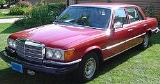
Mercedes-Benz 450SEL 6.9

Encyclopedia
The Mercedes-Benz 450SEL 6.9 is a high-performance version of the S-Class luxury saloon. It was built on its own assembly line by Daimler-Benz
in Stuttgart
, Germany
and based on the long-wheelbase version of the W116
chassis introduced in 1972. The model was generally referred to in the company's literature as the "6.9", to separate it from the regular 450SEL.
The 6.9 was first shown to the motoring press at the Geneva
Auto Show
in 1974, and produced between 1975 and 1981 in extremely limited numbers. It was billed as the flagship of the Mercedes-Benz car line, and the successor to Mercedes-Benz
's original high-performance sedan, the 300SEL 6.3
. The 6.9 also has the distinction of being among the first vehicles ever produced with optional electronically controlled anti-lock brakes
, first introduced by Mercedes-Benz and Bosch
in 1978. The 6.9's successor — the top of range 500 SEL
— continued the 6.9's remarkable self-leveling
hydropneumatic suspension as an extra-cost option.
system introduced by Citroën
in 1954, unlike the 600 and 6.3 which employed air suspension
s. Using a combination of fluid-filled struts and nitrogen-filled pressure vessels or "accumulators
" in lieu of conventional shock absorber
s and springs, the system was pressurized by a hydraulic pump driven by the engine's timing chain. Compared to the new Mercedes-Benz system, Citroën's was belt-driven, exactly like a conventional power steering pump; failure of the Citroën system thus might result in loss of suspension. Conversely, every unit of the 6.9 was shipped with hard rubber emergency dampers that served as temporary springs and allowed the car to be driven in the event of a hydraulic failure. The special hydraulic fluid required by the system was stored in a tank inside the engine compartment. Not only was the system totally self-adjusting, ride height
could be altered by a dash-mounted push-pull knob under the speedometer that raised the car an additional two inches (50 mm) for increased ground clearance. The National Highway Traffic Safety Administration
(NHTSA) made this feature illegal in the US market, but it could be enabled simply by removing a limiter at the tank-mounted control valve.
The suspension system gave the 4200 pound (1900 kg) car the benefits of a both a smooth ride
and handling
that allowed it, in the words of automotive journalist David E. Davis
, to be "tossed about like a Mini
." The car also featured a model W3B 050 three-speed automatic transmission
unique to the 6.9 and a standard ZF limited slip differential
both for enhanced roadholding performance on dry pavement and enhanced traction
in inclement weather.
Four-wheel disc brake
s and four-wheel independent suspension were standard across the W116 model range.
V8 with single overhead camshafts operating sodium
-filled valve
s (as are found in piston-driven aircraft) against hardened valve seats on each aluminium alloy cylinder head. Each hand-built unit was bench-tested for 265 minutes, 40 of which were under full load. Bosch "K-Jetronic" electromechanical fuel injection
was standard at a time when fuel-injected cars were uncommon. As in all Mercedes-Benz automobile engines, the crankshaft, connecting rods and pistons were forged
instead of cast. In non-US trim, the 6.9 l
(6814 cc or 417 in³) power plant was conservatively rated at 286 hp (213 kW) with 405 ft·lbf (549 N·m) of torque
helping to compensate for the 2.65 to 1 final drive ratio
necessary for sustained high-speed cruising. The North American version, introduced in 1977, was rated with 36 fewer horsepower
and 45 fewer ft-lb (250 and 360, respectively), due to more stringent emissions control requirements. In the interest of both engine longevity as well as creating some extra space under the hood, a "dry sump
" engine lubrication
system was used. Dry sump lubrication was originally developed for use in race cars as a way to prevent foaming of the engine oil by the crankshaft, which in turn would create a serious drop in oil pressure. The system circulated twelve quarts of oil between the storage tank and the engine, as opposed to the usual four or five quarts found in V8s with a standard oil pan and oil pump. As a result, the engine itself had no dipstick for checking the oil level. Rather, the dipstick was attached to the inside of the tank's filler cap (accessible from the engine compartment) and the oil level was checked with the engine running and at operating temperature
. The dry sump system also had the benefit of extending the oil change interval to 12,500 miles (20,000 km). This, along with hydraulic valve lifters which required no adjusting and special cylinder head gaskets which eliminated the need for periodic retorquing of the head bolts, made the 6.9 nearly maintenance-free for its first 50,000 miles (80,500 km). The 6.9 required little basic service other than coolant, minor tune-ups, oil changes, and replacement of the air, fuel, oil and power steering filters.
. Yates was approached by the factory to write promotional literature about the 6.9. He agreed, but under the condition that he could list the car's faults as well as its positives. Daimler-Benz agreed in turn, and Yates was given a US-spec 6.9 to drive from Manhattan
to the Road Atlanta
grand prix race track in Georgia
. There, Yates would drive the car in as-arrived condition at racing speeds for a full 40 laps or just over 100 miles (160 km). The only change made to the car upon its arrival at Road Atlanta was the necessary adjustment of tire pressure. Driving 40 laps was a difficult task even for a purpose-built race car, let alone a street-legal sedan designed and geared for high-speed Autobahn cruising. The 6.9 suffered no mechanical problems and averaged a very respectable 72 mph (116 km/h) throughout the test, completing it with little more than excess dust on the bodywork from the Michelin
radial street tires on which the car was driven to Atlanta. Yates was so comfortable driving the 6.9 around the track that he reported having run at least one lap with the sunroof open and the radio on, but the high price of the car made him think better of such risky driving and he finished the test with the radio off and both hands on the wheel.
 All of this technology came at a very high price. At a time when the most expensive Cadillacs, the mid-sized Seville
and full-sized Cadillac Fleetwood
Series Seventy-Five limousine
each listed for about US$16,000, the 6.9 listed for around $40,000, more than the Big Three but less than most Rolls-Royces. When the car was officially introduced into the North American market for the 1977 model year, the price was well past $40,000 and was $52,995 by the end of production. The only way to get a 6.9 in the US or Canada prior to 1977 was to import one through the grey market
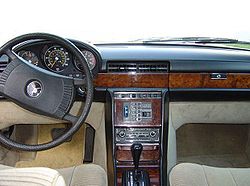
. Though the 6.9 was undeniably a luxury car, it was a rather austere one compared to the sheer opulence available in a Rolls-Royce or full-sized Cadillac. The interior was identical to that in the less expensive models except for the push-pull suspension control knob just under the speedometer, a low suspension pressure warning and height adjustment indicator lights in the instrument cluster, and wood trim finished in burled walnut
veneer on the dash and console. The rest of the W116 lineup was trimmed in striated zebrano veneer.
The 6.9 lacked expected luxury touches such as power-adjustable outside mirrors or front seats, although a unique power rear seat, heated seats and even orthopedically designed front seats were options. Buyers outside North America could also opt for headlight wipers and washers and/or headlights with a special vacuum-operated linkage whose aim could be adjusted at the dash depending on vehicle load. There was also a new standard feature in 1976: most Mercedes-Benz automobiles that year were equipped with a sophisticated electronic climate control system developed by Chrysler Corporation for use in their top models. The system turned on the heater, air conditioner or both, depending on the thermostat's setting and ambient temperature, automatically maintaining whatever temperature the driver selected. The compressor was an American import as well, supplied by the Harrison division of General Motors.
Far more modern than the contemporary Cadillac, which still had a live rear axle
, and both faster and larger inside than the either the Rolls-Royce or Cadillac, the 6.9 was indistinguishable from its W116 stablemates save for a modest "6.9" badge on the decklid and wider tires. US models also had different bumper rubbers fitted to the "park bench" impact absorbing bumpers. As discreet as the badge was, it could be deleted/ordered with option 261 omission of the displacement figure on the trunk lid at extra cost for those who wanted to avoid attention either from drivers of other high-performance cars or from law enforcement. In the words of David E. Davis
, the 6.9 was "a $50,000 exercise in going fast."
Still, for fans of the discontinued 6.3 or for those who simply had to have a car which Car and Driver proclaimed to be "the greatest Mercedes-Benz ever built," it seemed that money was no object. At its launch in 1975, the 450SEL 6.9 cost DM
69,930. In the last year of production, 1979, the car was available at a price of DM 81,247. Even though this was far from inexpensive, the courage of the Mercedes-Benz strategists in launching the car onto the market paid off. A total of 7,380 units were built by 1980, and most of these were exported to the USA. This volume figure looks rather small at first glance, but production figures tend to be significantly smaller in the top luxury segment where this model competes. Also, the 6.9 was not the only S-Class model, and was purchased by the rich, the famous, and the powerful despite the rising cost of gasoline brought on by the Arab oil embargo. Thus, the 7,380 total sales volume is quite respectable once the price and contemporary economic climate are taken into account.
Daimler-Benz
Daimler-Benz AG was a German manufacturer of automobiles, motor vehicles, and internal combustion engines; founded in 1926. An Agreement of Mutual Interest - which was valid until year 2000 - was signed on 1 May 1924 between Karl Benz's Benz & Cie., and Daimler Motoren Gesellschaft, which had...
in Stuttgart
Stuttgart
Stuttgart is the capital of the state of Baden-Württemberg in southern Germany. The sixth-largest city in Germany, Stuttgart has a population of 600,038 while the metropolitan area has a population of 5.3 million ....
, Germany
Germany
Germany , officially the Federal Republic of Germany , is a federal parliamentary republic in Europe. The country consists of 16 states while the capital and largest city is Berlin. Germany covers an area of 357,021 km2 and has a largely temperate seasonal climate...
and based on the long-wheelbase version of the W116
Mercedes-Benz W116
The Mercedes-Benz W116 was a series of flagship vehicles produced from September 1972 through 1979. The W116 automobiles were the first Mercedes-Benz models to be officially called S-Class, although earlier sedan models had already unofficially been designated with the letter 'S' - for...
chassis introduced in 1972. The model was generally referred to in the company's literature as the "6.9", to separate it from the regular 450SEL.
The 6.9 was first shown to the motoring press at the Geneva
Geneva
Geneva In the national languages of Switzerland the city is known as Genf , Ginevra and Genevra is the second-most-populous city in Switzerland and is the most populous city of Romandie, the French-speaking part of Switzerland...
Auto Show
Salon International de l'Auto
The International Geneva Motor Show is an annual auto show held in March in the Swiss city of Geneva. The show is hosted at the Geneva Palexpo, a convention centre located next to the Geneva Cointrin International Airport...
in 1974, and produced between 1975 and 1981 in extremely limited numbers. It was billed as the flagship of the Mercedes-Benz car line, and the successor to Mercedes-Benz
Mercedes-Benz
Mercedes-Benz is a German manufacturer of automobiles, buses, coaches, and trucks. Mercedes-Benz is a division of its parent company, Daimler AG...
's original high-performance sedan, the 300SEL 6.3
Mercedes-Benz 300SEL 6.3
The Mercedes-Benz 300 SEL 6.3 started out as a private venture in 1966 by company engineer Erich Waxenberger.- Concept :Waxenberger's principle was simple: take the powerful 6.3 litre V8 Mercedes-Benz M100 engine from the luxurious Mercedes-Benz 600 limousine, and fit it into the regular...
. The 6.9 also has the distinction of being among the first vehicles ever produced with optional electronically controlled anti-lock brakes
Anti-lock braking system
An anti-lock braking system is a safety system that allows the wheels on a motor vehicle to continue interacting tractively with the road surface as directed by driver steering inputs while braking, preventing the wheels from locking up and therefore avoiding skidding.An ABS generally offers...
, first introduced by Mercedes-Benz and Bosch
Robert Bosch GmbH
Robert Bosch GmbH is a multinational engineering and electronics company headquartered in Gerlingen, near Stuttgart, Germany. It is the world's largest supplier of automotive components...
in 1978. The 6.9's successor — the top of range 500 SEL
Mercedes-Benz W126
The Mercedes-Benz W126 is a series of flagship vehicles manufactured by German automotive marque Mercedes-Benz. Premiering in September 1979 as the successor to the earlier W116 line, the W126 was the second generation of the Mercedes-Benz flagship to officially bear the S-Class name referring to...
— continued the 6.9's remarkable self-leveling
Self-levelling suspension
Self-levelling refers to an automobile suspension system that maintains a constant ride height of the vehicle above the road, regardless of load....
hydropneumatic suspension as an extra-cost option.
Special features
The 6.9 was the first Mercedes-Benz to be fitted with the hydropneumatic self-levelling suspensionSelf-levelling suspension
Self-levelling refers to an automobile suspension system that maintains a constant ride height of the vehicle above the road, regardless of load....
system introduced by Citroën
Citroën
Citroën is a major French automobile manufacturer, part of the PSA Peugeot Citroën group.Founded in 1919 by French industrialist André-Gustave Citroën , Citroën was the first mass-production car company outside the USA and pioneered the modern concept of creating a sales and services network that...
in 1954, unlike the 600 and 6.3 which employed air suspension
Air suspension
Air suspension is a type of vehicle suspension powered by an engine driven or electric air pump or compressor. This pump pressurizes the air, using compressed air as a spring. Air suspension replaces conventional steel springs. If the engine is left off for an extended period, the car will settle...
s. Using a combination of fluid-filled struts and nitrogen-filled pressure vessels or "accumulators
Hydraulic accumulator
A 'hydraulic accumulator' is an energy storage device. It is a pressure storage reservoir in which a non-compressible hydraulic fluid is held under pressure by an external source. That external source can be a spring, a raised weight, or a compressed gas...
" in lieu of conventional shock absorber
Shock absorber
A shock absorber is a mechanical device designed to smooth out or damp shock impulse, and dissipate kinetic energy. It is a type of dashpot.-Nomenclature:...
s and springs, the system was pressurized by a hydraulic pump driven by the engine's timing chain. Compared to the new Mercedes-Benz system, Citroën's was belt-driven, exactly like a conventional power steering pump; failure of the Citroën system thus might result in loss of suspension. Conversely, every unit of the 6.9 was shipped with hard rubber emergency dampers that served as temporary springs and allowed the car to be driven in the event of a hydraulic failure. The special hydraulic fluid required by the system was stored in a tank inside the engine compartment. Not only was the system totally self-adjusting, ride height
Ride height
Ride height is the amount of space between the base of an automobile tire and the underside of the chassis; or, more properly, to the shortest distance between a flat, level surface, and any part of a vehicle other than those parts designed to contact the ground...
could be altered by a dash-mounted push-pull knob under the speedometer that raised the car an additional two inches (50 mm) for increased ground clearance. The National Highway Traffic Safety Administration
National Highway Traffic Safety Administration
The National Highway Traffic Safety Administration is an agency of the Executive Branch of the U.S. government, part of the Department of Transportation...
(NHTSA) made this feature illegal in the US market, but it could be enabled simply by removing a limiter at the tank-mounted control valve.
The suspension system gave the 4200 pound (1900 kg) car the benefits of a both a smooth ride
Ride quality
Ride quality refers to the degree of protection offered vehicle occupants from uneven elements in the road surface, or the terrain if driving off-road. A car with very good ride quality is also a comfortable car to ride in. Cars which disturb vehicle occupants with major or minor road...
and handling
Car handling
Automobile handling and vehicle handling are descriptions of the way wheeled vehicles perform transverse to their direction of motion, particularly during cornering and swerving. It also includes their stability when moving at rest. Handling and braking are the major components of a vehicle's...
that allowed it, in the words of automotive journalist David E. Davis
David E. Davis
David Evan Davis, Jr. was an automotive journalist and magazine publisher widely known as a contributing writer, editor and publisher at Car and Driver magazine and as the founder of Automobile magazine....
, to be "tossed about like a Mini
Mini
The Mini is a small car that was made by the British Motor Corporation and its successors from 1959 until 2000. The original is considered a British icon of the 1960s, and its space-saving front-wheel-drive layout influenced a generation of car-makers...
." The car also featured a model W3B 050 three-speed automatic transmission
Automatic transmission
An automatic transmission is one type of motor vehicle transmission that can automatically change gear ratios as the vehicle moves, freeing the driver from having to shift gears manually...
unique to the 6.9 and a standard ZF limited slip differential
Limited slip differential
A limited slip differential is a type of differential gear arrangement that allows for some difference in angular velocity of the output shafts, but imposes a mechanical bound on the disparity...
both for enhanced roadholding performance on dry pavement and enhanced traction
Traction (engineering)
Traction refers to the maximum frictional force that can be produced between surfaces without slipping.The units of traction are those of force, or if expressed as a coefficient of traction a ratio.-Traction:...
in inclement weather.
Four-wheel disc brake
Disc brake
The disc brake or disk brake is a device for slowing or stopping the rotation of a wheel while it is in motion.A brake disc is usually made of cast iron, but may in some cases be made of composites such as reinforced carbon–carbon or ceramic matrix composites. This is connected to the wheel and/or...
s and four-wheel independent suspension were standard across the W116 model range.
M-100 power plant
The engine was a cast ironCast iron
Cast iron is derived from pig iron, and while it usually refers to gray iron, it also identifies a large group of ferrous alloys which solidify with a eutectic. The color of a fractured surface can be used to identify an alloy. White cast iron is named after its white surface when fractured, due...
V8 with single overhead camshafts operating sodium
Sodium
Sodium is a chemical element with the symbol Na and atomic number 11. It is a soft, silvery-white, highly reactive metal and is a member of the alkali metals; its only stable isotope is 23Na. It is an abundant element that exists in numerous minerals, most commonly as sodium chloride...
-filled valve
Poppet valve
A poppet valve is a valve consisting of a hole, usually round or oval, and a tapered plug, usually a disk shape on the end of a shaft also called a valve stem. The shaft guides the plug portion by sliding through a valve guide...
s (as are found in piston-driven aircraft) against hardened valve seats on each aluminium alloy cylinder head. Each hand-built unit was bench-tested for 265 minutes, 40 of which were under full load. Bosch "K-Jetronic" electromechanical fuel injection
Fuel injection
Fuel injection is a system for admitting fuel into an internal combustion engine. It has become the primary fuel delivery system used in automotive petrol engines, having almost completely replaced carburetors in the late 1980s....
was standard at a time when fuel-injected cars were uncommon. As in all Mercedes-Benz automobile engines, the crankshaft, connecting rods and pistons were forged
Forging
Forging is a manufacturing process involving the shaping of metal using localized compressive forces. Forging is often classified according to the temperature at which it is performed: '"cold," "warm," or "hot" forging. Forged parts can range in weight from less than a kilogram to 580 metric tons...
instead of cast. In non-US trim, the 6.9 l
Litre
pic|200px|right|thumb|One litre is equivalent to this cubeEach side is 10 cm1 litre water = 1 kilogram water The litre is a metric system unit of volume equal to 1 cubic decimetre , to 1,000 cubic centimetres , and to 1/1,000 cubic metre...
(6814 cc or 417 in³) power plant was conservatively rated at 286 hp (213 kW) with 405 ft·lbf (549 N·m) of torque
Torque
Torque, moment or moment of force , is the tendency of a force to rotate an object about an axis, fulcrum, or pivot. Just as a force is a push or a pull, a torque can be thought of as a twist....
helping to compensate for the 2.65 to 1 final drive ratio
Mechanical advantage
Mechanical advantage is a measure of the force amplification achieved by using a tool, mechanical device or machine system. Ideally, the device preserves the input power and simply trades off forces against movement to obtain a desired amplification in the output force...
necessary for sustained high-speed cruising. The North American version, introduced in 1977, was rated with 36 fewer horsepower
Horsepower
Horsepower is the name of several units of measurement of power. The most common definitions equal between 735.5 and 750 watts.Horsepower was originally defined to compare the output of steam engines with the power of draft horses in continuous operation. The unit was widely adopted to measure the...
and 45 fewer ft-lb (250 and 360, respectively), due to more stringent emissions control requirements. In the interest of both engine longevity as well as creating some extra space under the hood, a "dry sump
Dry sump
A dry sump is a lubricating motor oil management method for four-stroke and large two-stroke piston internal combustion engines that uses external pumps and a secondary external reservoir for oil, as compared to a conventional wet sump system....
" engine lubrication
Lubrication
Lubrication is the process, or technique employed to reduce wear of one or both surfaces in close proximity, and moving relative to each another, by interposing a substance called lubricant between the surfaces to carry or to help carry the load between the opposing surfaces. The interposed...
system was used. Dry sump lubrication was originally developed for use in race cars as a way to prevent foaming of the engine oil by the crankshaft, which in turn would create a serious drop in oil pressure. The system circulated twelve quarts of oil between the storage tank and the engine, as opposed to the usual four or five quarts found in V8s with a standard oil pan and oil pump. As a result, the engine itself had no dipstick for checking the oil level. Rather, the dipstick was attached to the inside of the tank's filler cap (accessible from the engine compartment) and the oil level was checked with the engine running and at operating temperature
Operating temperature
An operating temperature is the temperature at which an electrical or mechanical device operates. The device will operate effectively within a specified temperature range which varies based on the device function and application context, and ranges from the minimum operating temperature to the...
. The dry sump system also had the benefit of extending the oil change interval to 12,500 miles (20,000 km). This, along with hydraulic valve lifters which required no adjusting and special cylinder head gaskets which eliminated the need for periodic retorquing of the head bolts, made the 6.9 nearly maintenance-free for its first 50,000 miles (80,500 km). The 6.9 required little basic service other than coolant, minor tune-ups, oil changes, and replacement of the air, fuel, oil and power steering filters.
Race track performance
Top speed was factory-rated at 140 mph (225 km/h), but some journalists testing the car saw speeds approaching 150 mph (241 km/h). Among those journalists was Brock YatesBrock Yates
Brock Yates is an American journalist and author. He was longtime executive editor of Car and Driver, an American automotive magazine. He was a pit reporter for CBS' coverage of certain NASCAR Sprint Cup series races in the 1980s, including the Daytona 500...
. Yates was approached by the factory to write promotional literature about the 6.9. He agreed, but under the condition that he could list the car's faults as well as its positives. Daimler-Benz agreed in turn, and Yates was given a US-spec 6.9 to drive from Manhattan
Manhattan
Manhattan is the oldest and the most densely populated of the five boroughs of New York City. Located primarily on the island of Manhattan at the mouth of the Hudson River, the boundaries of the borough are identical to those of New York County, an original county of the state of New York...
to the Road Atlanta
Road Atlanta
Road Atlanta is a 2.54-mile road course located just north of Braselton, Georgia, USA. The facility is utilized for a wide variety of events, including professional and amateur sports car and motorcycle races, racing and driving schools, corporate programs and testing for motorsports teams...
grand prix race track in Georgia
Georgia (U.S. state)
Georgia is a state located in the southeastern United States. It was established in 1732, the last of the original Thirteen Colonies. The state is named after King George II of Great Britain. Georgia was the fourth state to ratify the United States Constitution, on January 2, 1788...
. There, Yates would drive the car in as-arrived condition at racing speeds for a full 40 laps or just over 100 miles (160 km). The only change made to the car upon its arrival at Road Atlanta was the necessary adjustment of tire pressure. Driving 40 laps was a difficult task even for a purpose-built race car, let alone a street-legal sedan designed and geared for high-speed Autobahn cruising. The 6.9 suffered no mechanical problems and averaged a very respectable 72 mph (116 km/h) throughout the test, completing it with little more than excess dust on the bodywork from the Michelin
Michelin
Michelin is a tyre manufacturer based in Clermont-Ferrand in the Auvergne région of France. It is one of the two largest tyre manufacturers in the world along with Bridgestone. In addition to the Michelin brand, it also owns the BFGoodrich, Kleber, Riken, Kormoran and Uniroyal tyre brands...
radial street tires on which the car was driven to Atlanta. Yates was so comfortable driving the 6.9 around the track that he reported having run at least one lap with the sunroof open and the radio on, but the high price of the car made him think better of such risky driving and he finished the test with the radio off and both hands on the wheel.
Price and interior features
Cadillac Seville
The Cadillac Seville is a luxury-type car that was manufactured by the Cadillac division of American automaker General Motors from 1975 to 2004, as a smaller-sized top-of-the-line Cadillac...
and full-sized Cadillac Fleetwood
Cadillac Fleetwood
Lawrence P. Fisher was the Fisher brother most closely involved with Cadillac in its early years. In 1916 he joined the Fisher Body Company which had been formed by two of his brothers in 1908. Larry was one of four of the seven Fisher brothers who brought Fisher Body Corporation under the General...
Series Seventy-Five limousine
Limousine
A limousine is a luxury sedan or saloon car, especially one with a lengthened wheelbase or driven by a chauffeur. The chassis of a limousine may have been extended by the manufacturer or by an independent coachbuilder. These are called "stretch" limousines and are traditionally black or white....
each listed for about US$16,000, the 6.9 listed for around $40,000, more than the Big Three but less than most Rolls-Royces. When the car was officially introduced into the North American market for the 1977 model year, the price was well past $40,000 and was $52,995 by the end of production. The only way to get a 6.9 in the US or Canada prior to 1977 was to import one through the grey market
Grey market
A grey market or gray market also known as parallel market is the trade of a commodity through distribution channels which, while legal, are unofficial, unauthorized, or unintended by the original manufacturer...
. Though the 6.9 was undeniably a luxury car, it was a rather austere one compared to the sheer opulence available in a Rolls-Royce or full-sized Cadillac. The interior was identical to that in the less expensive models except for the push-pull suspension control knob just under the speedometer, a low suspension pressure warning and height adjustment indicator lights in the instrument cluster, and wood trim finished in burled walnut
Walnut
Juglans is a plant genus of the family Juglandaceae, the seeds of which are known as walnuts. They are deciduous trees, 10–40 meters tall , with pinnate leaves 200–900 millimetres long , with 5–25 leaflets; the shoots have chambered pith, a character shared with the wingnuts , but not the hickories...
veneer on the dash and console. The rest of the W116 lineup was trimmed in striated zebrano veneer.
The 6.9 lacked expected luxury touches such as power-adjustable outside mirrors or front seats, although a unique power rear seat, heated seats and even orthopedically designed front seats were options. Buyers outside North America could also opt for headlight wipers and washers and/or headlights with a special vacuum-operated linkage whose aim could be adjusted at the dash depending on vehicle load. There was also a new standard feature in 1976: most Mercedes-Benz automobiles that year were equipped with a sophisticated electronic climate control system developed by Chrysler Corporation for use in their top models. The system turned on the heater, air conditioner or both, depending on the thermostat's setting and ambient temperature, automatically maintaining whatever temperature the driver selected. The compressor was an American import as well, supplied by the Harrison division of General Motors.
Far more modern than the contemporary Cadillac, which still had a live rear axle
Live axle
A live axle, sometimes called a solid axle, is a type of beam axle suspension system that uses the driveshafts that transmit power to the wheels to connect the wheels laterally so that they move together as a unit....
, and both faster and larger inside than the either the Rolls-Royce or Cadillac, the 6.9 was indistinguishable from its W116 stablemates save for a modest "6.9" badge on the decklid and wider tires. US models also had different bumper rubbers fitted to the "park bench" impact absorbing bumpers. As discreet as the badge was, it could be deleted/ordered with option 261 omission of the displacement figure on the trunk lid at extra cost for those who wanted to avoid attention either from drivers of other high-performance cars or from law enforcement. In the words of David E. Davis
David E. Davis
David Evan Davis, Jr. was an automotive journalist and magazine publisher widely known as a contributing writer, editor and publisher at Car and Driver magazine and as the founder of Automobile magazine....
, the 6.9 was "a $50,000 exercise in going fast."
Still, for fans of the discontinued 6.3 or for those who simply had to have a car which Car and Driver proclaimed to be "the greatest Mercedes-Benz ever built," it seemed that money was no object. At its launch in 1975, the 450SEL 6.9 cost DM
German mark
The Deutsche Mark |mark]], abbreviated "DM") was the official currency of West Germany and Germany until the adoption of the euro in 2002. It is commonly called the "Deutschmark" in English but not in German. Germans often say "Mark" or "D-Mark"...
69,930. In the last year of production, 1979, the car was available at a price of DM 81,247. Even though this was far from inexpensive, the courage of the Mercedes-Benz strategists in launching the car onto the market paid off. A total of 7,380 units were built by 1980, and most of these were exported to the USA. This volume figure looks rather small at first glance, but production figures tend to be significantly smaller in the top luxury segment where this model competes. Also, the 6.9 was not the only S-Class model, and was purchased by the rich, the famous, and the powerful despite the rising cost of gasoline brought on by the Arab oil embargo. Thus, the 7,380 total sales volume is quite respectable once the price and contemporary economic climate are taken into account.
Today
In a poll conducted by Britain's Classic & Sports Car magazine and printed in their April 1999 edition, the Mercedes-Benz 6.9 ranked fourth on their list of the "world's greatest saloons." The May 2004 edition of another British publication, Mercedes Enthusiast magazine, ranked the 6.9 number fifteen on their all-time top twenty list of great Mercedes-Benz automobiles. Even with such accolades, a 6.9 is a reasonably priced collectible automobile despite its rarity. The online NADA Used Car Guide lists a top value of US$20,000. At present, the market for cars of this type is somewhat soft, and a prime example can be had for considerably less. As is often the case with older cars that contain exotic engineering and parts unique to that one model, however, running and maintenance costs for a 6.9 can quickly overshadow a low initial purchase price.Notable versions
- In 1976, French film director Claude Lelouch attached a camera to the front bumper of a 6.9 and drove it at high speed through the streets of ParisParisParis is the capital and largest city in France, situated on the river Seine, in northern France, at the heart of the Île-de-France region...
at daybreak. The resulting nine-minute one-take cinéma véritéCinéma véritéCinéma vérité is a style of documentary filmmaking, combining naturalistic techniques with stylized cinematic devices of editing and camerawork, staged set-ups, and the use of the camera to provoke subjects. It is also known for taking a provocative stance toward its topics.There are subtle yet...
film, C'était un rendez-vousC'était un rendez-vousC'était un Rendezvous is a short film made in 1976 by Claude Lelouch, showing a high speed drive through Paris.-Exposition:...
, was greeted with moral outrage over the apparent risks taken by Lelouch as he sped past pedestrians and other vehicles. However, the sound of a five gear Ferrari 275Ferrari 275The Ferrari 275 was a 2-seat front-engined Gran Turismo automobile produced by Ferrari between 1964 and 1968. It used a 3.3 L Colombo 60° V12 engine and produced 280-300 hp. The Pininfarina-designed body was a graceful evolution of the car's predecessor, the 250, and strongly contrasted...
GTB was dubbed over the three gear 6.9. Careful investigation of the film furthermore shows, that the actual driving speed was not that high. - There were never any plans to build a station wagonStation wagonA station wagon is a body style variant of a sedan/saloon with its roof extended rearward over a shared passenger/cargo volume with access at the back via a third or fifth door , instead of a trunk lid...
version of the W116, 6.9 or otherwise, owing both to the location of the fuel tank ahead of the rear axle and the overwhelming demand for the sedan versions. Still, a number of W116s were converted to station wagons by coach builders in Germany and England (see http://www.crayford-benz.org for details of the English conversions). In 1977, a German diplomat named Manfred Sittmann commissioned BrinkmannBrinkmannBrinkmann is a German surname and may refer to:*Bernhard Brinkmann , German politician*Carl Brinkmann , German sociologist and economist*Christiane Brinkmann , German athlete*Dirk Brinkmann , German hockey player...
Karosserie in Bremen to build a 6.9 station wagon, or "estate car." Sittmann frequently travelled with two large dogs and a family entourage to Italy. German motorsports magazine Auto, Motor und Sport learned of the car and requested an interview with Mr Sittmann and a photo shoot as well. The magazine's feature would be titled "Die teuerste Hundehütte," or "The Most Expensive Doghouse." This one-off 6.9 currently sees regular use with its third owner, a Mercedes-Benz collector in Pennsylvania. Another 450SEL 6.9 was converted to station wagon form for actress Sophia Loren—complete with mesh dog-guard to prevent her hounds climbing into the passenger area (see http://www.crayford-benz.org for details. - The 1998 action film RoninRonin (film)Ronin is a 1998 action-thriller film directed by John Frankenheimer and written by J.D. Zeik and David Mamet. It stars Robert De Niro and Jean Reno as two of several former special forces and intelligence agents who team up to steal a mysterious, heavily guarded suitcase while navigating a maze of...
features a car chase where a Mercedes 6.9 is driven by the protagonists who perform high-speed driving through mountain roads and inside a French town, all with dramatic stunts (driftingDrifting (motorsport)Drifting refers to a driving technique and to a motorsport where the driver intentionally over steers, causing loss of traction in the rear wheels through turns, while maintaining vehicle control and a high exit speed...
, J-turnsJ-turnA J-turn is a driving maneuver used to reverse a backwards-traveling vehicle so as to continue driving in the same direction, but with the vehicle pointed forward. The J-turn is also called "moonshiner's turn", based on the evasive driving tactics used by bootleggers. A J-turn differs from a...
, etc.).
Specifications
| Mercedes-Benz 450SEL 6.9 | ||
|---|---|---|
| Manufacturer | Daimler-Benz AG Mercedes-Benz Mercedes-Benz is a German manufacturer of automobiles, buses, coaches, and trucks. Mercedes-Benz is a division of its parent company, Daimler AG... |
|
| Class | Five-passenger, four-door luxury sedan | |
| Body Styles | Four-door sedan | |
| Predecessor | 300SEL 6.3 Mercedes-Benz 300SEL 6.3 The Mercedes-Benz 300 SEL 6.3 started out as a private venture in 1966 by company engineer Erich Waxenberger.- Concept :Waxenberger's principle was simple: take the powerful 6.3 litre V8 Mercedes-Benz M100 engine from the luxurious Mercedes-Benz 600 limousine, and fit it into the regular... |
|
| Successor | None | |
| Shares components with | Mercedes-Benz 600 Mercedes-Benz 600 The Mercedes-Benz 600 is a large luxury automobile offered in several variants worldwide. Introduced in September 1963, it had very few competitors, these being Rolls-Royce, Bentley, Cadillac Fleetwood 75, the stretched Lehmann-Peterson Lincoln, and the Crown Imperial Ghia... , Mercedes-Benz 300SEL 6.3 Mercedes-Benz 300SEL 6.3 The Mercedes-Benz 300 SEL 6.3 started out as a private venture in 1966 by company engineer Erich Waxenberger.- Concept :Waxenberger's principle was simple: take the powerful 6.3 litre V8 Mercedes-Benz M100 engine from the luxurious Mercedes-Benz 600 limousine, and fit it into the regular... , other Mercedes-Benz W116 sedans |
|
| Wheelbase: | 116.5 in | 2960 mm |
| Front track | 59.9 in | 1521 mm |
| Rear track | 59.3 in | 1505 mm |
| Overall length: | 210 in | 5335 mm |
| Width: | 73.6 in | 1870 mm |
| Curb weight: | 4390 lb | 1985 kg |
| Fuel tank capacity | 25.3 US gal | 95 L |
| Trunk (boot) capacity | 18.2 ft³ | 0.52 m³ |
| Battery capacity | 12 V, 88 A·h | |
| Steering wheel turns | 2.7 lock-to-lock | |
| Turning circle | 40 ft | 12.1 m |
| Head Room - Front | 38.6 in | 980 mm |
| Leg Room - Front | 41.7 in | 1060 mm |
| Hip Room - Front | 57.5 in | 1460 mm |
| Shoulder Room - Front | 55.1 in | 1400 mm |
| Head Room - Rear | 37.1 in | 942 mm |
| Leg Room - Rear | 38.1 in | 967 mm |
| Hip Room - Rear | 59.5 in | 1510 mm |
| Shoulder Room - Rear | 54.9 in | 1394 mm |
| Engine | V-8, Bosch fuel injection, electronic ignition, two single overhead camshafts, five main bearings | |
| Net power @4250 rpm (World) |
286 PS | 210 kW |
| Net torque @3000 rpm (World) |
405 lbf·ft | 549 Nm |
| Net power @4000 rpm (North America) |
250 hp | 186 kW |
| Net torque @2500 rpm (North America): |
360 lbf·ft | 488 Nm |
| Compression ratio (World) |
8.8:1 | |
| Compression ratio (North America) |
8.0:1 | |
| Bore/stroke | 4.21 × 3.74 in | 107 × 95 mm |
| Displacement | 417.1 in³ | 6834 cm³ |
| Maximum engine speed | 5300 rpm | |
| Transmission: | Three-speed automatic with torque converter Torque converter In modern usage, a torque converter is generally a type of hydrodynamic fluid coupling that is used to transfer rotating power from a prime mover, such as an internal combustion engine or electric motor, to a rotating driven load... |
|
| Rear axle ratio | 2.65:1 | |
| Tires and wheels | Michelin XWX 215/70VR14 steel-belted radial; 6.5Jx14 light alloy | |
| Braking system | Dual-circuit, power-assisted hydraulic, four-wheel disc brakes. Front discs ventilated. | |
| Total swept brake area | 456.5 in² | 2945 cm² |
| 0-60 mph (0–96 km/h) | 7.5 seconds | |
| Top speed (World) | 225 kilometre per hour | |
| Production | World | North America |
| 1975 | 474 | 0 |
| 1976 | 1475 | 0 |
| 1977 | 1798 | 462 |
| 1978 | 1665 | 437 |
| 1979 | 1839 | 576 |
| 1980 | 129 | 317 |
| 1981 | 4 | 0 |
| Total | 7380 | 1816 |
External links
- International M-100 Group — Factory-authorized site with information on all M-100-powered Mercedes-Benz automobiles, (including technical forums and maintenance information). The Brock Yates article can be found here as well
- A Mercedes for the '70s: The W116 Series S-Class — A site mixing the history of the full-scale W116 with that of its many miniature replicas.
- Classic Car driver review
- Golden Brown: Four Days in a Mercedes-Benz 450SEL 6.9 - Feature (Car and Driver)