


Torque converter

Encyclopedia

Fluid coupling
A fluid coupling is a hydrodynamic device used to transmit rotating mechanical power. It has been used in automobile transmissions as an alternative to a mechanical clutch...
that is used to transfer rotating power from a prime mover, such as an internal combustion engine
Internal combustion engine
The internal combustion engine is an engine in which the combustion of a fuel occurs with an oxidizer in a combustion chamber. In an internal combustion engine, the expansion of the high-temperature and high -pressure gases produced by combustion apply direct force to some component of the engine...
or electric motor
Electric motor
An electric motor converts electrical energy into mechanical energy.Most electric motors operate through the interaction of magnetic fields and current-carrying conductors to generate force...
, to a rotating driven load. The torque converter normally takes the place of a mechanical clutch
Clutch
A clutch is a mechanical device which provides for the transmission of power from one component to another...
in a vehicle with an automatic transmission, allowing the load to be separated from the power source. It is usually located between the engine's flywheel and the transmission.
The key characteristic of a torque converter is its ability to multiply torque when there is a substantial difference between input and output rotational speed, thus providing the equivalent of a reduction gear
Transmission (mechanics)
A machine consists of a power source and a power transmission system, which provides controlled application of the power. Merriam-Webster defines transmission as: an assembly of parts including the speed-changing gears and the propeller shaft by which the power is transmitted from an engine to a...
. Some of these devices are also equipped with a temporary locking mechanism which rigidly binds the engine to the transmission when their speeds are nearly equal, to avoid slippage and a resulting loss of efficiency.
By far the most common form of torque converter in automobile transmissions is the device described here. However, in the 1920s there was also the pendulum-based Constantinesco torque converter. There are also mechanical designs for continuously variable transmission
Continuously variable transmission
A continuously variable transmission is a transmission that can change steplessly through an infinite number of effective gear ratios between maximum and minimum values. This contrasts with other mechanical transmissions that offer a fixed number of gear ratios...
s and these also have the ability to multiply torque, e.g. the Variomatic
Variomatic
Variomatic is the stepless, fully automatic transmission of the Dutch car manufacturer DAF, originally developed by Hub van Doorne: this consists of a "V" shaped drive belt and two pulleys, each of two cones, whose effective diameter can be changed so that the "V" belt runs nearer the spindle or...
with expanding pulleys and a belt drive.
Usage
- Automatic transmissionAutomatic transmissionAn automatic transmission is one type of motor vehicle transmission that can automatically change gear ratios as the vehicle moves, freeing the driver from having to shift gears manually...
s on automobileAutomobileAn automobile, autocar, motor car or car is a wheeled motor vehicle used for transporting passengers, which also carries its own engine or motor...
s, such as cars, buses, and on/off highway trucks. - ForwarderForwarderA forwarder is a forestry vehicle that carries felled logs from the stump to a roadside landing. Unlike a skidder, a forwarder carries logs clear of the ground, which can reduce soil impacts but tends to limit the size of the logs it can move...
s and other heavy duty vehicles. - MarineMarine (ocean)Marine is an umbrella term. As an adjective it is usually applicable to things relating to the sea or ocean, such as marine biology, marine ecology and marine geology...
propulsion systems. - Industrial power transmission such as conveyor drives, almost all modern forklifts, winches, drilling rigDrilling rigA drilling rig is a machine which creates holes or shafts in the ground. Drilling rigs can be massive structures housing equipment used to drill water wells, oil wells, or natural gas extraction wells, or they can be small enough to be moved manually by one person...
s, construction equipmentConstruction EquipmentConstruction Equipment is a trade publication and web site serving the information needs of construction contractors, materials producers, and other owners and operators of construction equipment....
, and railway locomotives.
Torque converter elements
A fluid couplingFluid coupling
A fluid coupling is a hydrodynamic device used to transmit rotating mechanical power. It has been used in automobile transmissions as an alternative to a mechanical clutch...
is a two element drive that is incapable of multiplying torque, while a torque converter has at least one extra element—the stator—which alters the drive's characteristics during periods of high slippage, producing an increase in output torque.
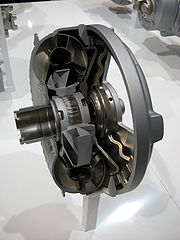
In a torque converter there are at least three rotating elements: the impeller, which is mechanically driven by the prime mover; the turbine, which drives the load
Structural load
Structural loads or actions are forces, deformations or accelerations applied to a structure or its components.Loads cause stresses, deformations and displacements in structures. Assessment of their effects is carried out by the methods of structural analysis...
; and the stator, which is interposed between the impeller and turbine so that it can alter oil flow returning from the turbine to the impeller. The classic torque converter design dictates that the stator be prevented from rotating under any condition, hence the term stator. In practice, however, the stator is mounted on an overrunning clutch, which prevents the stator from counter-rotating with respect to the prime mover but allows forward rotation.
Modifications to the basic three element design have been periodically incorporated, especially in applications where higher than normal torque multiplication is required. Most commonly, these have taken the form of multiple turbines and stators, each set being designed to produce differing amounts of torque multiplication. For example, the Buick
Buick
Buick is a premium brand of General Motors . Buick models are sold in the United States, Canada, Mexico, China, Taiwan, and Israel, with China being its largest market. Buick holds the distinction as the oldest active American make...
Dynaflow
Dynaflow
Dynaflow was the trademark name for a type of automatic transmission developed and built by General Motors' Buick Motor Division from the late 1940s to the mid 1963...
automatic transmission was a non-shifting design and, under normal conditions, relied solely upon the converter to multiply torque. The Dynaflow
Dynaflow
Dynaflow was the trademark name for a type of automatic transmission developed and built by General Motors' Buick Motor Division from the late 1940s to the mid 1963...
used a five element converter to produce the wide range of torque multiplication needed to propel a heavy vehicle.
Although not strictly a part of classic torque converter design, many automotive converters include a lock-up clutch to improve cruising power transmission efficiency and reduce heat. The application of the clutch locks the turbine to the impeller, causing all power transmission to be mechanical, thus eliminating losses associated with fluid drive.
Operational phases
A torque converter has three stages of operation:- Stall. The prime mover is applying power to the impeller but the turbine cannot rotate. For example, in an automobile, this stage of operation would occur when the driver has placed the transmissionTransmission (mechanics)A machine consists of a power source and a power transmission system, which provides controlled application of the power. Merriam-Webster defines transmission as: an assembly of parts including the speed-changing gears and the propeller shaft by which the power is transmitted from an engine to a...
in gear but is preventing the vehicle from moving by continuing to apply the brakeBrakeA brake is a mechanical device which inhibits motion. Its opposite component is a clutch. The rest of this article is dedicated to various types of vehicular brakes....
s. At stall, the torque converter can produce maximum torque multiplication if sufficient input power is applied (the resulting multiplication is called the stall ratio). The stall phase actually lasts for a brief period when the load (e.g., vehicle) initially starts to move, as there will be a very large difference between pump and turbine speed.
- Acceleration. The load is accelerating but there still is a relatively large difference between impeller and turbine speed. Under this condition, the converter will produce torque multiplication that is less than what could be achieved under stall conditions. The amount of multiplication will depend upon the actual difference between pump and turbine speed, as well as various other design factors.
- Coupling. The turbine has reached approximately 90 percent of the speed of the impeller. Torque multiplication has essentially ceased and the torque converter is behaving in a manner similar to a simple fluid coupling. In modern automotive applications, it is usually at this stage of operation where the lock-up clutch is applied, a procedure that tends to improve fuel efficiencyFuel efficiencyFuel efficiency is a form of thermal efficiency, meaning the efficiency of a process that converts chemical potential energy contained in a carrier fuel into kinetic energy or work. Overall fuel efficiency may vary per device, which in turn may vary per application, and this spectrum of variance is...
.
The key to the torque converter's ability to multiply torque lies in the stator. In the classic fluid coupling
Fluid coupling
A fluid coupling is a hydrodynamic device used to transmit rotating mechanical power. It has been used in automobile transmissions as an alternative to a mechanical clutch...
design, periods of high slippage cause the fluid flow returning from the turbine to the impellor to oppose the direction of impeller rotation, leading to a significant loss of efficiency and the generation of considerable waste heat. Under the same condition in a torque converter, the returning fluid will be redirected by the stator so that it aids the rotation of the impeller, instead of impeding it. The result is that much of the energy in the returning fluid is recovered and added to the energy being applied to the impeller by the prime mover. This action causes a substantial increase in the mass of fluid being directed to the turbine, producing an increase in output torque. Since the returning fluid is initially travelling in a direction opposite to impeller rotation, the stator will likewise attempt to counter-rotate as it forces the fluid to change direction, an effect that is prevented by the one-way stator clutch.
Unlike the radially straight blades used in a plain fluid coupling, a torque converter's turbine and stator use angled and curved blades. The blade shape of the stator is what alters the path of the fluid, forcing it to coincide with the impeller rotation. The matching curve of the turbine blades helps to correctly direct the returning fluid to the stator so the latter can do its job. The shape of the blades is important as minor variations can result in significant changes to the converter's performance.
During the stall and acceleration phases, in which torque multiplication occurs, the stator remains stationary due to the action of its one-way clutch. However, as the torque converter approaches the coupling phase, the energy and volume of the fluid returning from the turbine will gradually decrease, causing pressure on the stator to likewise decrease. Once in the coupling phase, the returning fluid will reverse direction and now rotate in the direction of the impellor and turbine, an effect which will attempt to forward-rotate the stator. At this point, the stator clutch will release and the impeller, turbine and stator will all (more or less) turn as a unit.
Unavoidably, some of the fluid's kinetic energy
Kinetic energy
The kinetic energy of an object is the energy which it possesses due to its motion.It is defined as the work needed to accelerate a body of a given mass from rest to its stated velocity. Having gained this energy during its acceleration, the body maintains this kinetic energy unless its speed changes...
will be lost due to friction and turbulence, causing the converter to generate waste heat (dissipated in many applications by water cooling). This effect, often referred to as pumping loss, will be most pronounced at or near stall conditions. In modern designs, the blade geometry minimizes oil velocity at low impeller speeds, which allows the turbine to be stalled for long periods with little danger of overheating.
Efficiency and torque multiplication
A torque converter cannot achieve 100 percent coupling efficiency. The classic three element torque converter has an efficiency curve that resembles ∩: zero efficiency at stall, generally increasing efficiency during the acceleration phase and low efficiency in the coupling phase. The loss of efficiency as the converter enters the coupling phase is a result of the turbulence and fluid flow interference generated by the stator, and as previously mentioned, is commonly overcome by mounting the stator on a one-way clutch.Even with the benefit of the one-way stator clutch, a converter cannot achieve the same level of efficiency in the coupling phase as an equivalently sized fluid coupling. Some loss is due to the presence of the stator (even though rotating as part of the assembly), as it always generates some power-absorbing turbulence. Most of the loss, however, is caused by the curved and angled turbine blades, which do not absorb kinetic energy from the fluid mass as well as radially straight blades. Since the turbine blade geometry is a crucial factor in the converter's ability to multiply torque, trade-offs between torque multiplication and coupling efficiency are inevitable. In automotive applications, where steady improvements in fuel economy have been mandated by market forces and government edict, the nearly universal use of a lock-up clutch has helped to eliminate the converter from the efficiency equation during cruising operation.
The maximum amount of torque multiplication produced by a converter is highly dependent on the size and geometry of the turbine and stator blades, and is generated only when the converter is at or near the stall phase of operation. Typical stall torque
Stall torque
Stall torque is the torque which is produced by a device when the output rotational speed is zero. It may also mean the torque load that causes the output rotational speed of a device to become zero - i.e...
multiplication ratios range from 1.8:1 to 2.5:1 for most automotive applications (although multi-element designs as used in the Buick
Buick
Buick is a premium brand of General Motors . Buick models are sold in the United States, Canada, Mexico, China, Taiwan, and Israel, with China being its largest market. Buick holds the distinction as the oldest active American make...
Dynaflow
Dynaflow
Dynaflow was the trademark name for a type of automatic transmission developed and built by General Motors' Buick Motor Division from the late 1940s to the mid 1963...
and Chevrolet
Chevrolet
Chevrolet , also known as Chevy , is a brand of vehicle produced by General Motors Company . Founded by Louis Chevrolet and ousted GM founder William C. Durant on November 3, 1911, General Motors acquired Chevrolet in 1918...
Turboglide
Turboglide
The Turboglide is a Chevrolet constant torque automatic transmission that made its debut as an optional transmission on Chevrolet V8 passenger cars for 1957. It consisted of a concurrently geared planetary gearbox with a 'switch pitch' dual pitch torque converter stator...
could produce more). Specialized converters designed for industrial, rail, or heavy marine power transmission systems are capable of as much as 5.0:1 multiplication. Generally speaking, there is a trade-off between maximum torque multiplication and efficiency—high stall ratio converters tend to be relatively inefficient below the coupling speed, whereas low stall ratio converters tend to provide less possible torque multiplication.
While torque multiplication increases the torque delivered to the turbine output shaft, it also increases the slippage within the converter, raising the temperature of the fluid and reducing overall efficiency. For this reason, the characteristics of the torque converter must be carefully matched to the torque curve of the power source and the intended application. Changing the blade geometry of the stator and/or turbine will change the torque-stall characteristics, as well as the overall efficiency of the unit. For example, drag racing
Drag racing
Drag racing is a competition in which specially prepared automobiles or motorcycles compete two at a time to be the first to cross a set finish line, from a standing start, in a straight line, over a measured distance, most commonly a ¼-mile straight track....
automatic transmissions often use converters modified to produce high stall speeds to improve off-the-line torque, and to get into the power band of the engine more quickly. Highway vehicles generally use lower stall torque converters to limit heat production, and provide a more firm feeling to the vehicle's characteristics.
A design feature once found in some General Motors
General Motors
General Motors Company , commonly known as GM, formerly incorporated as General Motors Corporation, is an American multinational automotive corporation headquartered in Detroit, Michigan and the world's second-largest automaker in 2010...
automatic transmissions was the variable-pitch stator, in which the blades' angle of attack
Angle of attack
Angle of attack is a term used in fluid dynamics to describe the angle between a reference line on a lifting body and the vector representing the relative motion between the lifting body and the fluid through which it is moving...
could be varied in response to changes in engine speed and load. The effect of this was to vary the amount of torque multiplication produced by the converter. At the normal angle of attack, the stator caused the converter to produce a moderate amount of multiplication but with a higher level of efficiency. If the driver abruptly opened the throttle, a valve would switch the stator pitch to a different angle of attack, increasing torque multiplication at the expense of efficiency.
Some torque converters use multiple stators and/or multiple turbines to provide a wider range of torque multiplication. Such multiple-element converters are more common in industrial environments than in automotive transmissions, but automotive applications such as Buick
Buick
Buick is a premium brand of General Motors . Buick models are sold in the United States, Canada, Mexico, China, Taiwan, and Israel, with China being its largest market. Buick holds the distinction as the oldest active American make...
's Triple Turbine Dynaflow
Dynaflow
Dynaflow was the trademark name for a type of automatic transmission developed and built by General Motors' Buick Motor Division from the late 1940s to the mid 1963...
and Chevrolet
Chevrolet
Chevrolet , also known as Chevy , is a brand of vehicle produced by General Motors Company . Founded by Louis Chevrolet and ousted GM founder William C. Durant on November 3, 1911, General Motors acquired Chevrolet in 1918...
's Turboglide
Turboglide
The Turboglide is a Chevrolet constant torque automatic transmission that made its debut as an optional transmission on Chevrolet V8 passenger cars for 1957. It consisted of a concurrently geared planetary gearbox with a 'switch pitch' dual pitch torque converter stator...
also existed. The Buick Dynaflow utilized the torque-multiplying characteristics of its planetary gearset in conjunction with the torque converter for low gear and bypassed the first turbine, using only the second turbine as vehicle speed increased. The unavoidable trade-off with this arrangement was low efficiency and eventually these transmissions were discontinued in favor of the more efficient three speed units with a conventional three element torque converter.
Lock-up torque converters
As described above, impelling losses within the torque converter reduce efficiency and generate waste heat. In modern automotive applications, this problem is commonly avoided by use of a lock-up clutch that physically links the impeller and turbine, effectively changing the converter into a purely mechanical coupling. The result is no slippage, and virtually no power loss.The first automotive application of the lock-up principle was Packard
Packard
Packard was an American luxury-type automobile marque built by the Packard Motor Car Company of Detroit, Michigan, and later by the Studebaker-Packard Corporation of South Bend, Indiana...
's Ultramatic
Ultramatic
For the Voigtländer SLR camera, see Voigtländer Ultramatic CSUltramatic was the trademarked name of the Packard Motor Car Company's automatic transmission introduced in 1949 and produced until 1956 at Packard's Detroit, Michigan factory....
transmission, introduced in 1949, which locked up the converter at cruising speeds, unlocking when the throttle
Throttle
A throttle is the mechanism by which the flow of a fluid is managed by constriction or obstruction. An engine's power can be increased or decreased by the restriction of inlet gases , but usually decreased. The term throttle has come to refer, informally and incorrectly, to any mechanism by which...
was floored for quick acceleration or as the vehicle slowed down. This feature was also present in some Borg-Warner transmissions produced during the 1950s. It fell out of favor in subsequent years due to its extra complexity and cost. In the late 1970s lock-up clutches started to reappear in response to demands for improved fuel economy, and are now nearly universal in automotive applications.
Capacity and failure modes
As with a basic fluid coupling the theoretical torque capacity of a converter is proportional to , where
  is the mass density of the fluid (kg/m³),
  is the impeller speed (rpm), and
  is the diameter(m). In practice, the maximum torque capacity is limited by the mechanical characteristics of the materials used in the converter's components, as well as the ability of the converter to dissipate heat (often through water cooling). As an aid to strength, reliability and economy of production, most automotive converter housings are of welded construction. Industrial units are usually assembled with bolted housings, a design feature that eases the process of inspection and repair, but adds to the cost of producing the converter.
In high performance, racing and heavy duty commercial converters, the pump and turbine may be further strengthened by a process called furnace brazing, in which molten brass is drawn into seams and joints to produce a stronger bond between the blades, hubs and annular ring(s). Because the furnace brazing process creates a small radius at the point where a blade meets with a hub or annular ring, a theoretical decrease in turbulence will occur, resulting in a corresponding increase in efficiency.
Overloading a converter can result in several failure modes, some of them potentially dangerous in nature:
- Overheating: Continuous high levels of slippage may overwhelm the converter's ability to dissipate heat, resulting in damage to the elastomerElastomerAn elastomer is a polymer with the property of viscoelasticity , generally having notably low Young's modulus and high yield strain compared with other materials. The term, which is derived from elastic polymer, is often used interchangeably with the term rubber, although the latter is preferred...
sealSeal (mechanical)A mechanical seal is a device which helps join systems or mechanisms together by preventing leakage , containing pressure, or excluding contamination...
s that retain fluid inside the converter. This will cause the unit to leak and eventually stop functioning due to lack of fluid. - Stator clutch seizure: The inner and outer elements of the one-way stator clutch become permanently locked together, thus preventing the stator from rotating during the coupling phase. Most often, seizure is precipitated by severe loading and subsequent distortion of the clutch components. Eventually, gallingGallingGalling usually refers to the adhesive wear and transfer of material between metallic surfaces in relative converging contact during sheet metal forming and other industrial operations....
of the mating parts occurs, which triggers seizure. A converter with a seized stator clutch will exhibit very poor efficiency during the coupling phase, and in a motor vehicle, fuel consumption will drastically increase. Converter overheating under such conditions will usually occur if continued operation is attempted. - Stator clutch breakage: A very abrupt application of power can cause shock loading of the stator clutch, resulting in breakage. If this occurs, the stator will freely counter-rotate in the direction opposite to that of the pump and almost no power transmission will take place. In an automobile, the effect is similar to a severe case of transmission slippage and the vehicle is all but incapable of moving under its own power.
- Blade deformation and fragmentation: If subjected to abrupt loading or excessive heating of the converter, pump and/or turbine blades may be deformed, separated from their hubs and/or annular rings, or may break up into fragments. At the least, such a failure will result in a significant loss of efficiency, producing symptoms similar (although less pronounced) to those accompanying stator clutch failure. In extreme cases, catastrophic destruction of the converter will occur.
- Ballooning: Prolonged operation under excessive loading, very abrupt application of load, or operating a torque converter at very high RPMRevolutions per minuteRevolutions per minute is a measure of the frequency of a rotation. It annotates the number of full rotations completed in one minute around a fixed axis...
may cause the shape of the converter's housing to be physically distorted due to internal pressure and/or the stress imposed by centrifugal force. Under extreme conditions, ballooning will cause the converter housing to rupture, resulting in the violent dispersal of hot oil and metal fragments over a wide area.
Current
- Allison TransmissionAllison TransmissionAllison Transmission is an American manufacturer of commercial duty automatic transmissions and hybrid propulsion systems. Allison products are specified by over 250 of the world’s leading vehicle manufacturers and are used in many market sectors including bus, refuse, fire, construction,...
, used in bus, refuse, fire, construction, distribution, military and specialty applications - BorgWarnerBorgWarnerBorgWarner Inc. is a United States-based worldwide automotive industry components and parts supplier. It is primarily known for its powertrain products, which include manual and automatic transmissions and transmission components, , turbochargers, engine valve timing system...
, used in automobileAutomobileAn automobile, autocar, motor car or car is a wheeled motor vehicle used for transporting passengers, which also carries its own engine or motor...
s - SubaruSubaru; is the automobile manufacturing division of Japanese transportation conglomerate Fuji Heavy Industries .Subaru is internationally known for their use of the boxer engine layout popularized in cars by the Volkswagen Beetle and Porsche 911, in most of their vehicles above 1500 cc as well as...
, used in automobiles - Twin DiscTwin DiscTwin Disc, Inc. designs, manufactures and distributes power transmission equipment for a wide range of applications, including marine, off-road vehicle and industrial. The company was founded in the 1920s to manufacture clutches for farm tractors...
, used in vehicle, marine and oilfield applications - Voith Turbo-Transmissions, used in many diesel locomotives and diesel multiple unitDiesel multiple unitA diesel multiple unit or DMU is a multiple unit train consisting of multiple carriages powered by one or more on-board diesel engines. They may also be referred to as a railcar or railmotor, depending on country.-Design:...
s - ZF FriedrichshafenZF FriedrichshafenZF Friedrichshafen AG, also known as ZF Group, and commonly abbreviated to ZF, is a German public company headquartered in Friedrichshafen, in the south-west German region of Baden-Württemberg....
, automobiles, popular in city busBusA bus is a road vehicle designed to carry passengers. Buses can have a capacity as high as 300 passengers. The most common type of bus is the single-decker bus, with larger loads carried by double-decker buses and articulated buses, and smaller loads carried by midibuses and minibuses; coaches are...
applications - JatcoJatcoJATCO is a subsidiary of Nissan which manufactures automatic transmissions for automobiles. Originally, Mazda was also a partner.-History:...
, used in automobiles - ValeoValeoValeo is a French automotive components manufacturer.-History:The Société Anonyme Française du Ferodo was founded in 1923 in Saint-Ouen, a suburb of Paris...
,produces Torque converter for Ford,GM - LuK USA LLC, produces Torque Converters for Ford, GM, Allison, and Hyundai
Past
- Lysholm-Smith, named after its inventor, Alf Lysholm, and used in some British Rail Derby LightweightBritish Rail Derby LightweightThe British Rail Derby Lightweight diesel multiple units, were the first such trains to be built en-masse for British Railways. The units were built at BR's Derby Works from 1954 to 1955. The units were built in various formations, including 12 power-twin 2-car units, 84 power-trailer 2-car units,...
diesel multiple units - Mekydro, used in British Rail Class 35British Rail Class 35The British Rail Class 35 is a class of mixed-traffic B-B diesel locomotive with hydraulic transmission. Because of their Mekydro-design hydraulic transmission units, the locomotives became known as the Hymeks....
Hymek locomotives. - VoithVoithThe Voith GmbH, which is headquartered in Germany, is a family-run corporation in the mechanical engineering sector with worldwide operations....
, used in British Rail Class 52British Rail Class 52British Rail assigned Class 52 to the class of 74 large Type 4 diesel-hydraulic locomotives built for the Western Region of British Railways between 1961 and 1964...
, and still used in German locomotives, - PackardPackardPackard was an American luxury-type automobile marque built by the Packard Motor Car Company of Detroit, Michigan, and later by the Studebaker-Packard Corporation of South Bend, Indiana...
, used in the UltramaticUltramaticFor the Voigtländer SLR camera, see Voigtländer Ultramatic CSUltramatic was the trademarked name of the Packard Motor Car Company's automatic transmission introduced in 1949 and produced until 1956 at Packard's Detroit, Michigan factory....
automobile transmission system - Rolls-Royce (Twin Disc), used in some British United Traction diesel multiple units
External links
- HowStuffWorks article on torque converters
- Subaru article on Subaru torque converters