
All Topics  
Disc brake

 
Disc Brake

   Email Print
   Bookmark   Link


Disc brake


The disc brake or disk brake is a device for slowing or stopping the rotation of a wheel
Wheel

A wheel is a circular device that is capable of rotating on its axis, facilitating movement or transportation whilst supporting a load , or performing labour in machines....
.


Discussion
Ask a question about 'Disc brake'
Start a new discussion about 'Disc brake'
Answer questions from other users
Full Discussion Forum


Recent Posts


Encyclopedia


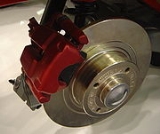
Disk Brake Dsc03682
Suspension
The disc brake or disk brake is a device for slowing or stopping the rotation of a wheel
Wheel

A wheel is a circular device that is capable of rotating on its axis, facilitating movement or transportation whilst supporting a load , or performing labour in machines....
. A brake
Brake

A brake is a device for applying a force against the friction of the road, slowing or stopping the motion of a machine or vehicle, or alternatively a device to restrain it from starting to move again....
 disc (or rotor in U.S. English
U.S. English

U.S. English, Inc. is an USA politics advocacy group founded in 1983 by Senator S. I. Hayakawa and Dr. John Tanton to advocate the adoption of the English language as the official language of the United States of America....
), usually made of cast iron
Cast iron

Cast iron usually refers to Gray iron, but also identifies a large group of ferrous alloys, which solidify with a eutectic. The color of a fractured surface can be used to identify an alloy....
 or ceramic
Ceramic

File:Bridge from dental porcelain.jpgFile:Qing vase p1070256.jpgA ceramic is an inorganic, nonmetal solid prepared by the action of heat and subsequent cooling....
 composites (including carbon
Carbon

Carbon is a chemical element with chemical symbol C and atomic number 6. As a member of group 14 on the periodic table, it is nonmetallic and tetravalence?making four electrons available to form covalent bond chemical bonds....
, kevlar
Kevlar

Kevlar is the registered trademark for a light, strong aramid synthetic fiber, related to other aramids such as Nomex and Technora.Developed at DuPont in 1965 by Stephanie Kwolek it was first commercially used in the early 1970s as a replacement for steel in racing tires....
 and silica), is connected to the wheel and/or the axle
Axle

An axle is a central shaft for a rotation wheel or gear. In some cases the axle may be fixed in position with a bearing or bushing sitting inside the hole in the wheel or gear to allow the wheel or gear to rotate around the axle....
. To stop the wheel, friction material in the form of brake pads (mounted on a device called a brake caliper) is forced mechanically, hydraulically
Hydraulics

Hydraulics is a topic of science and engineering dealing with the mechanical properties of liquids. Hydraulics is part of the more general discipline of fluid power....
, pneumatically
Pneumatics

Pneumatics is the use of pressurized gas to affect mechanical motion.Pneumatic power is used in industry, where factory machines are commonly plumbed for compressed air; other compressed inert gases can also be used....
 or electromagnet
Electromagnet

An electromagnet is a type of magnet in which the magnetic field is produced by the flow of electric Current . The magnetic field disappears when the current ceases....
ically against both sides of the disc. Friction
Friction

File:Friction alt.svgFriction is the force resisting the relative lateral motion of solid surfaces, fluid layers, or material elements in contact....
 causes the disc and attached wheel to slow or stop.

History

Disc-style brakes development and use began in England
England

native_name =|conventional_long_name = England|common_name = England|image_flag = Flag of England.svg|image_coat = England COA.svg|symbol_type = Royal Coat of Arms...
 in the 1890s; the first ever caliper type automobile disc brakes were patented by Frederick William Lanchester in his Birmingham
Birmingham

Birmingham is a city status in the United Kingdom and metropolitan borough in the West Midlands of England. Birmingham is the most populous of England's English Core Cities Group, and is the List of United Kingdom cities by population British city after London, with a population of 1,010,200 ....
 factory in 1902, though it took another half century for his innovation to be widely adopted.

Modern-style disc brakes first appeared on the low-volume Crosley Hotshot in 1949, although they had to be discontinued in 1950 due to design problems. Chrysler's Imperial
Chrysler Imperial

The Chrysler Imperial, introduced in 1926, was the company's top of the range vehicle for much of its history. Models were produced with the Chrysler name until 1954, and again from 1990 to 1993....
 also offered a type of disc brake from 1949 through 1953, though in this instance they were enclosed with dual internal-expanding, full-circle pressure plates. Reliable modern disc brakes were developed in the UK
United Kingdom

The United Kingdom of Great Britain and Northern Ireland, commonly known as the United Kingdom , the UK or Britain,is a sovereign state located off the northwestern coast of continental Europe....
 by Dunlop
Dunlop Rubber

Dunlop Rubber was a British company which manufactured tyres and other rubber products for most of the 20th century. It was taken over by BTR plc in 1985....
 and first appeared in 1953 on the Jaguar C-Type
Jaguar C-Type

The Jaguar C-Type is a racing car built by Jaguar Cars and sold from 1951 to 1953. Its aerodynamic body was designed by Malcolm Sayer, its lightweight, multi-tubular, triangulated frame designed by Bob Knight....
 racing car. The Citroën DS
Citroën DS

The Citro?n DS is an executive car that was produced by the France manufacturer Citro?n between 1955 and 1975. Citro?n sold nearly 1.5 million D-series during its 20 years of production....
 of 1955, with powered inboard front disc brakes, and the 1956 Triumph TR3
Triumph TR3

The Triumph TR3 was a car built between 1955 and 1959 by the Standard Motor Company in the United Kingdom, during which time 13,377 cars were produced, of which 1286 were sold within the UK while the rest were exported mainly to the United States....
 were the first Europe
Europe

Europe is, conventionally, one of the world's seven continents. Comprising the westernmost peninsula of Eurasia, Europe is generally divided from Asia to its east by the water divide of the Ural Mountains, the Ural , the Caspian Sea, and by the Caucasus Mountains to the southeast....
an production cars to feature modern disc brakes. The first production car to feature disc brakes at all 4 corners was the Austin-Healey 100S
Austin-Healey 100

The Austin-Healey 100 is a sports car built between 1951 and 1959 by the British Motor Corporation. It was developed by Donald Healey to be produced in-house by Healey's company on Austin Atlantic mechanicals....
 in 1954. The first British company to market a production saloon fitted with disc brakes to all four wheels was Jensen Motors Ltd with the introduction of a Deluxe version of the Jensen 541 with Dunlop disc brakes. The next American production cars to be fitted with disc brakes were the 1963 Studebaker Avanti
Studebaker Avanti

The Studebaker Avanti was a sports car coupe built by the Studebaker Corporation of South Bend, Indiana, United States between June 1962 and December 1963....
 (optional on other Studebaker models), standard equipment on the 1965 Rambler Marlin
Rambler Marlin

The Marlin can claim to be the first mid-size car fastback car made in the United States during the sixties. Built by American Motors Corporation from 1965 to 1967, it was a halo car for the company....
 (optional on other AMC models), and the 1965 Chevrolet Corvette
Chevrolet Corvette

The Chevrolet Corvette is a sports car that has been manufactured by General Motors since 1953. The car was originally designed by Harley Earl, and named by Myron Scott after the fast corvette....
 Stingray (C2).

These brakes offer better stopping performance than comparable drum brake
Drum brake

A drum brake is a brake in which the friction is caused by a set of Brake shoe or Brake pad that press against the Brake lining of a rotating drum....
s, including resistance to "brake fade
Brake fade

Vehicle Brake fade, or brake fade is the reduction in stopping power that can occur after repeated application of the brakes, especially in high load or high speed conditions....
" caused by the overheating of brake components, and are able to recover quickly from immersion (wet brakes are less effective). Unlike a drum brake, the disc brake has no self-servo effect and the braking force is always proportional to the pressure placed on the braking pedal or lever.

Many early implementations for automobiles located the brakes on the inboard
Inboard brake

An inboard braking system is an automobile technology wherein the brakes are mounted so as not to contribute to the vehicles unsprung weight. Inboard brakes are by definition always used on axles that have independent suspension....
 side of the driveshaft
Driveshaft

A drive shaft, driving shaft, propeller shaft, or Universal joint#History shaft is a mechanical component for transmitting torque and rotation, usually used to connect other components of a drive train that cannot be connected directly because of distance or the need to allow for relative movement between them....
, near the differential
Differential (mechanics)

A differential is a device, usually but not necessarily employing gears, capable of transmitting torque and rotation through three shafts, almost always used in one of two ways....
, but most brakes today are located inside the road wheels. (An inboard location reduces the unsprung weight
Unsprung weight

In a ground vehicle with a suspension , the unsprung weight is the mass of the suspension, wheels or Caterpillar tracks , and other components directly connected to them, rather than supported by the suspension....
 and eliminates a source of heat transfer to the tires, important in Formula One
Formula One

Formula One, abbreviated to F1, and currently officially referred as the FIA Formula One World Championship is the highest class of auto racing sanctioned by the F?d?ration Internationale de l'Automobile ....
 racing.)

Disc brakes were most popular on sports car
Sports car

A sports car is a term used to describe a class of automobile. The exact definition varies, but generally it is used to refer to a low to ground, light weight vehicle with a powerful engine....
s when they were first introduced, since these vehicles are more demanding about brake performance. Discs have now become the more common form in most passenger vehicles, although many (particularly light weight vehicles) use drum brakes on the rear wheels to keep costs and weight down as well as to simplify the provisions for a parking brake. As the front brakes perform most of the braking effort, this can be a reasonable compromise.

Discs


The design of the disc varies somewhat. Some are simply solid cast iron
Cast iron

Cast iron usually refers to Gray iron, but also identifies a large group of ferrous alloys, which solidify with a eutectic. The color of a fractured surface can be used to identify an alloy....
, but others are hollowed out with fins or vanes joining together the disc's two contact surfaces (usually included as part of a casting process). This "ventilated" disc design helps to dissipate the generated heat and is commonly used on the more-heavily-loaded front discs.

Many higher performance brakes have holes drilled through them. This is known as cross-drilling and was originally done in the 1960s on racing cars. Brake pads will outgas and under use may create boundary layer of gas between the pad and the disc hurting braking performance. Cross-drilling was created to provide the gas someplace to escape. Although modern brake pads seldom suffer from outgassing problems, water residue may build up after a vehicle passes through a puddle and impede braking performance. For this reason, and for heat dissipation purposes, cross drilling is still used on some braking components, but is not favored for racing or other hard use as the holes are a source of stress cracks under severe conditions.

Discs may also be slotted, where shallow channels are machined into the disc to aid in removing dust and gas. Slotting is the preferred method in most racing environments to remove gas, water, and de-glaze brake pads. Some discs are both drilled and slotted. Slotted discs are generally not used on standard vehicles because they quickly wear down brake pads; however, this removal of material is beneficial to race vehicles since it keeps the pads soft and avoids vitrification
Vitrification

Vitrification is a process of converting a material into a glass-like amorphous solid that is free from any crystalline structure, either by the quick removal or addition of heat, or by mixing with an additive....
 of their surfaces.

On the road, drilled or slotted discs still have a positive effect in wet conditions because the holes or slots prevent a film of water building up between the disc and the pads. Crossdrilled discs will eventually crack at the holes due to metal fatigue. Cross-drilled brakes that are manufactured poorly or subjected to high stresses will crack much sooner and more severely.

New technology now allows smaller brake systems to be fitted to bicycles, moped
Moped

Mopeds are a class of low-powered motorized vehicle, generally two or three wheeled. Moped classification is designed to allow the use of small motorized vehicles seen as not requiring the safety restrictions and license requirement that larger motorcycles are subject to....
s and now even mountain bike
Mountain bike

A mountain bike or mountain bicycle is a bicycle designed for off-road cycling, including jumps, and traversing of rocks and washouts, and steep declines,...
s. The market for mountain bike disc brakes is very large and has huge variety, ranging from simple, mechanical (cable) systems, to highly expensive and also powerful, 6-pot hydraulic disc systems, commonly used on downhill racing bikes. Improved technology has seen the creation of the first vented discs for use on mountain bikes. The vented discs are similar to that seen on cars and have been introduced to help prevent heat fade on fast alpine descents. The first use of disc brakes on mountain bikes utilized mechanical braking systems which did not offer solid braking power, which is why disc brakes were not popular among mountain bikers until hydraulic disc brakes were presented. Most mountain bike brake rotors are made from stainless steel and are very thin. Some use a two-piece floating rotor style, and some lightweight rotors are made from aluminum.

Disc brake discs are commonly manufactured out of a material called grey iron. The SAE
Society of Automotive Engineers

SAE International is a professional organization for mobility engineering professionals in the aerospace, automotive, and commercial vehicle industries....
 maintains a specification for the manufacture of grey iron for various applications. For normal car and light truck applications, the SAE specification is J431 G3000 (superseded to G10). This specification dictates the correct range of hardness, chemical composition, tensile strength, and other properties necessary for the intended use.

Historically, brake discs were manufactured throughout the world with a strong concentration in Europe, and America. Between 1989 and 2005, manufacturing of brake discs is migrating predominantly to China.

Racing

In racing and very high performance road cars, other disc materials have been employed. Reinforced carbon
Reinforced carbon-carbon

Carbon fibre-reinforced Carbon is a composite material consisting of carbon fiber reinforcement in a matrix of graphite. It was developed for the nose cones of intercontinental ballistic missiles, and is most widely known as the material for the nose cone and leading edges of the Space Shuttle....
 discs and pads inspired by aircraft braking systems were introduced in Formula One
Formula One

Formula One, abbreviated to F1, and currently officially referred as the FIA Formula One World Championship is the highest class of auto racing sanctioned by the F?d?ration Internationale de l'Automobile ....
 by Brabham in conjunction with Dunlop
Dunlop Rubber

Dunlop Rubber was a British company which manufactured tyres and other rubber products for most of the 20th century. It was taken over by BTR plc in 1985....
 in 1976. Carbon-Carbon braking is now used in most top-level motorsport worldwide, reducing unsprung weight
Unsprung weight

In a ground vehicle with a suspension , the unsprung weight is the mass of the suspension, wheels or Caterpillar tracks , and other components directly connected to them, rather than supported by the suspension....
, giving better frictional performance and improved structural properties at high temperatures, compared to cast iron. Carbon brakes have occasionally been applied to road cars, by the French Venturi sports car manufacturer in the mid 1990s for example, but need to reach a very high operating temperature before becoming truly effective and so are not well suited to road use.

Ceramic composites


Ceramic
Ceramic

File:Bridge from dental porcelain.jpgFile:Qing vase p1070256.jpgA ceramic is an inorganic, nonmetal solid prepared by the action of heat and subsequent cooling....
 discs are used occasionally in high-performance cars and heavy vehicles.

The first development of the modern ceramic brake was made by British Engineers working in the railway industry for TGV
TGV

The TGV is France's high-speed rail service. It was developed during the 1970s by GEC-Alsthom and SNCF, the French national rail transport operations, and is now operated primarily by SNCF....
 applications in 1988. The objective was to reduce weight, the number of brakes per axle, as well as provide stable friction from very high speeds and all temperatures. The result was a carbon fibre reinforced ceramic process which is now used in various forms for automotive, railway, and aircraft brake applications.

The requirement for a large section of ceramic composite material having very high heat tolerance and mechanical strength often relegates ceramic discs to exotic vehicles where the cost is not prohibitive to the application, and industrial use where the ceramic disc's light weight and low maintenance properties justify the cost relative to alternatives. Composite brakes can withstand temperatures that would make steel discs bendable.

Disc damage modes

Discs are usually damaged in one of four ways: warping, scarring, cracking, or excessive rusting. Service shops will sometimes respond to any disc problem by changing out the discs entirely, This is done mainly where the cost of a new disc may actually be lower than the cost of labor to resurface the original disc. Mechanically this is unnecessary if the discs have not yet reached manufacturers minimum thickness and it is unsafe to use them, or vane rusting is not severe (ventilated discs only). All leading vehicle manufacturers recommend brake disc skimming (US: rotor turning) as a solution for lateral run-out, vibration issues and brake noises. The milling process is performed in a brake lathe, which removes a very thin layer off the disc surface to clean off minor damage and restore uniform thickness. Milling the disc as necessary will maximise the mileage out of the current discs on the vehicle.

Warping

Warping is often caused by excessive heat. When the disc's friction area is at a substantially higher temperature than the inner portion (hat) the thermal expansion of the friction area is greater than the inner portion and warping occurs. This can be minimized by using "floating" rotors which decouple the friction area from the inner portion and allow thermal expansion to occur at different rates. Primary causes of overheating include undersized or overmachined brake discs, excessive braking (racing, descending hills/mountains), "riding" the brakes, or a "stuck" brake pad (pad touches disc at all times).

Measuring warping is accomplished using a dial indicator on a fixed rigid base, with the tip perpendicular to the brake rotor's face. It is typically measured about 1/2" (12 mm) from the outside diameter of the rotor. The rotor is spun. The difference between minimum and maximum value on the dial is called lateral runout. Typical hub/rotor assembly runout specifications for passenger vehicles are around 0.0020" or 50 micrometres. Runout can be caused either by deformation of the disc itself or by runout in the underlying wheel hub face or by contamination between the rotor surface and the underlying hub mounting surface. Determining the root cause of the indicator displacement (lateral runout) requires disassembly of the rotor from the hub. Rotor face runout due to hub face runout or contamination will typically have a period of 1 minimum and 1 maximum per revolution of the brake rotor.

Another cause of warping is when the disc is overheated and the vehicle is stopped. When keeping the brakes applied, the area where the pads contact the disc will cause uneven cooling and lead to warping.

Incorrect fitting also leads to many cases of warping; the disc's retaining bolts (or the wheel/lug nuts, if the disc is simply sandwiched in place by the wheel, as on many cars) must be tightened progressively and evenly. The use of air tools to fasten lug nuts is extremely bad practice, unless a torque tube is also used. The vehicle manual will indicate the proper pattern for tightening as well as a torque rating for the bolts. Lug nuts should never be tightened in a circle. Some vehicles are sensitive to the force the bolts apply and tightening should be done with a torque wrench
Torque wrench

A torque wrench is a tool used to precisely set the torque of a fastener such as a Nut or Screw#Bolt. It is usually in the form of a socket wrench with special internal mechanisms....
.

Several methods can be used to avoid overheating brake discs. Use of a lower gear when descending steep grades to obtain engine braking
Engine braking

Engine braking is the act of using the energy-requiring compression phase of a heat engine to dissipate energy and slow down a vehicle. Compression braking is a common legal term for the same mechanism....
 will reduce the brake loading. Also, operating the brakes intermittently - braking to slower speed for a brief time then coasting will allow the brake material to cool between applications. Riding the brakes lightly will generate a great amount of heat with little braking effect and should be avoided. High temperature conditions as found in automobile racing
Racing

A race is a competition of speed, against an objective criterion, usually a clock or to a specific point. The competitors in a race try to complete a given task in the shortest amount of time....
 can be dealt with by proper pad selection, but at the tradeoff of everyday driveability. Pads that can take high heat usually do best when hot and will have reduced braking force when cold. Also, high heat pads typically have more aggressive compounds and will wear discs down more quickly. Brake ducting that forces air directly onto the brake discs, common in motorsports, is highly effective at preventing brake overheating. This is also useful for cars that are driven both in motorsports and on the street, as it has no negative effect on driveability. A further extension of this method is to install a system which mists the discs with water. Jaguar has reported great reductions in disc temperatures with such a system.

Warping will often lead to a thickness variation of the disc. If it has runout, a thin spot will develop by the repetitive contact of the pad against the high spot as the disc turns. When the thin section of the disc passes under the pads, the pads move together and the brake pedal will drop slightly. When the thicker section of the disc passes between the pads, the pads will move apart and the brake pedal will raise slightly, this is pedal pulsation. The thickness variation can be felt by the driver when it is approximately 0.17 mm or greater (on automobile rotors).

Not all pedal pulsation is due to warped discs. Brake pad material operating outside of its designed temperature range can leave a thicker than normal deposit in one area of the disc surface, creating run-out due to a "sticky" or "hotspot" that will grab with every revolution of the disc. Grease or other foreign materials can create a slippery spot on the disc, also creating pulsation.

Scarring

Scarring (US: Scoring) can occur if brake pads are not changed promptly when they reach the end of their service life and are considered worn out. Once enough of the friction material has worn away, the pad's steel backing plate (for glued pads) or the pad retainer rivets (for riveted pads) will bear directly upon the rotor's wear surface, reducing braking power and making scratches on the disc. Generally a moderately scarred / scored rotor, which operated satisfactorily with existing brake pads, will be equally usable with new pads. If the scarring is deeper but not excessive, it can be repaired by machining off a layer of the disc's surface. This can only be done a limited number of times as the disc has a minimum rated safe thickness. The minimum thickness value is tyically cast into the disc rotor during manufacturing on the hub of the rotor or on the edge of the disc in the USA.

To prevent scarring, it is prudent to periodically inspect the brake pads for wear. A tire rotation is a logical time for inspection, since rotation must be performed regularly based on vehicle operation time and all wheels must be removed, allowing ready visual access to the brake pads. Some types of alloy wheels and brake arrangements will provide enough open space to view the pads without removing the wheel. When practical, pads that are near the wear-out point should be replaced immediately, as complete wear out leads to scarring damage and unsafe braking. Many disc brake pads will include some sort of soft steel spring or drag tab as part of the pad assembly, which is designed to start dragging on the disc when the pad is nearly worn out. The result is a moderately loud metallic squealing noise, alerting the vehicle user that service is required, and this will not normally scar the disc if the brakes are serviced promptly. A set of pads can be considered for replacement if the thickness of the pad material is the same or less than the thickness of the backing steel.

Cracking

Cracking is limited mostly to drilled discs, which may develop small cracks around edges of holes drilled near the edge of the disc due to the disc's uneven rate of expansion in severe duty environments. Manufacturers that use drilled discs as OEM
Original Equipment Manufacturer

OEM stands for "Original Equipment Manufacturer".An original equipment manufacturer, or OEM is typically a company that uses a component made by a second company in its own product, or sells the product of the second company under its own brand....
 typically do so for two reasons: appearance, if they determine that the average owner of the vehicle model will prefer the look while not overly stressing the hardware; or as a function of reducing the unsprung weight
Unsprung weight

In a ground vehicle with a suspension , the unsprung weight is the mass of the suspension, wheels or Caterpillar tracks , and other components directly connected to them, rather than supported by the suspension....
 of the brake assembly, with the engineering assumption that enough brake disc mass remains to absorb racing temperatures and stresses. A brake disc is a heat sink
Heat sink

A heat sink is an environment or object that absorbs and dissipates heat from another object using thermal contact . Heat sinks are used in a wide range of applications wherever efficient heat dissipation is required; major examples include refrigeration, heat engines, Thermal management of electronic devices and systems and lasers....
, so removing mass increases the heat stress it will have to contend with. Small hairline cracks may appear in any cross drilled metal disc as a normal wear mechanism, but in the severe case the disc will fail catastrophically. No repair is possible for the cracks, and if cracking becomes severe, the disc rotor must be replaced.

Rusting

The discs are commonly made from cast iron and a certain amount of surface rust
Rust

Rust is a general term for a series of iron oxides, usually red oxides, formed by the reaction of iron and oxygen in the presence of water or air moisture....
 is normal. The disc contact area for the brake pads will be kept clean by regular use, but a vehicle that is stored for an extended period can develop significant rust in the contact area that may reduce braking power for a time until the rusted layer is worn off again. Over time, vented brake rotors may develop severe rust corrosion inside the ventilation slots, compromising the strength of the structure and necessitating replacement.

Calipers

The brake caliper is the assembly which houses the brake pads and pistons. The pistons are usually made of aluminum or chrome-plated
Chrome plating

Chrome plating, often referred to simply as chrome, is a technique of electroplating a thin layer of chromium onto a metal object. The chromed layer can be decorative, provide corrosion resistance, ease cleaning procedures, or increase surface hardness....
 steel
Steel

Steel is an alloy consisting mostly of iron, with a carbon content between 0.2% and 2.14% by weight , depending on grade. Carbon is the most cost-effective alloying material for iron, but various other alloying elements are used such as manganese, chromium, vanadium, and tungsten....
. There are two types of calipers: floating or fixed. A fixed caliper does not move relative to the disc. It uses one or more pairs of opposing pistons to clamp from each side of the disc, and is more complex and expensive than a floating caliper. A floating caliper (also called a "sliding caliper") moves with respect to the disc, along a line parallel to the axis of rotation of the disc; a piston on one side of the disc pushes the inner brake pad until it makes contact with the braking surface, then pulls the caliper body with the outer brake pad so pressure is applied to both sides of the disc.

Floating caliper (single piston) designs are subject to sticking failure, which can occur due to dirt or corrosion entering at least one mounting mechanism and stopping its normal movement. This can cause the pad attached to the caliper to rub on the disc when the brake is not engaged, or cause it to engage at an angle. Sticking can occur due to infrequent vehicle use, failure of a seal or rubber protection boot allowing debris entry, dry-out of the grease in the mounting mechanism and subsequent moisture incursion leading to corrosion, or some combination of these factors. Consequences may include reduced fuel efficiency, excessive wear on the affected pad, and friction-induced heat warping of the disc.

Various types of brake calipers are also used on bicycle rim brakes
Bicycle brake systems

Bicycle brake systems are used to slow down,or brake a bicycle. There have been various types through history, and several are still in use today....
.

Pistons and cylinders

The most common caliper design uses a single hydraulically actuated piston within a cylinder, although high performance brakes use as many as twelve. Modern cars use different hydraulic circuits to actuate the brakes on each set of wheels as a safety measure
Car safety

Automobile safety is the avoidance of automobile accidents or the minimization of harmful effects of accidents, in particular as pertaining to human life and health....
. The hydraulic design also helps multiply braking force. The number of pistons in a caliper is often referred to as the number of 'pots', so if a vehicle has 'six pot' calipers it means that each caliper houses six pistons.

Brake failure can occur due to failure of the piston to retract - this is usually a consequence of not operating the vehicle during a time that it is stored outdoors in adverse conditions. On high mileage vehicles the piston seal
Seal (mechanical)

A mechanical seal is a device which helps join systems or mechanisms together by preventing leakage , containing pressure, or excluding contamination....
s may leak, which must be promptly corrected.

Brake pads

The brake pads are designed for high friction
Friction

File:Friction alt.svgFriction is the force resisting the relative lateral motion of solid surfaces, fluid layers, or material elements in contact....
 with brake pad material embedded in the disc in the process of bedding while wearing evenly. Although it is commonly thought that the pad material contacts the metal of the disc to stop the car, the pads work with a very thin layer of their own material and generate a semi-liquid friction boundary that creates the actual braking force. Of course, depending on the properties of the material, disc wear rates may vary. The properties that determine material wear involve trade-offs between performance and longevity.

The brake pads must usually be replaced regularly (depending on pad material), and most are equipped with a method of alerting the driver when this needs to take place. Some have a thin piece of soft metal that causes the brakes to squeal when the pads are too thin, while others have a soft metal tab embedded in the pad material that closes an electric circuit and lights a warning light when the brake pad gets thin. More expensive cars may use an electronic sensor
Sensor

A sensor is a device that measures a physical quantity and converts it into a signal which can be read by an observer or by an instrument. For example, a mercury thermometer converts the measured temperature into expansion and contraction of a liquid which can be read on a calibrated glass tube....
.

Although almost all road-going vehicles have only two brake pads per caliper, racing calipers utilize up to six pads, with varying frictional properties in a staggered pattern for optimum performance.

Early brake pads (and linings
Brake lining

Brake linings are the consumable surfaces in brake systems, especially drum brakes as those used in vehicles....
) contained asbestos
Asbestos

Asbestos is a naturally occurring silicate mineral with long, thin fibrous crystals. The word asbestos is derived from a Greek language adjective meaning inextinguishable....
. When working on an older car's brakes, care must be taken not to inhale any dust present on the caliper (or drum). Although newer pads can be made of exotic materials like ceramics, kevlar and other plastics, care to avoid inhalation of brake dust produced during operation should still be practiced no matter what materials are employed.

Brake squeal

Sometimes a loud noise or high pitch squeal occurs when the brakes are applied. Most brake squeal is produced by vibration (resonance instability) of the brake components, especially the pads and discs (known as “force-coupled excitation”.) This type of squeal should not negatively affect brake stopping performance. Simple techniques like adding chamfers to linings, greasing or gluing the contact between caliper and the pads (finger to backplate, piston to backplate), bonding insulators (damping material) to pad backplate, inclusion of a brake shim between the brake pad and back plate etc, may help to reduce squeal. Cold weather combined with high early morning humidity (dew) often makes brake-squeal worse, although the squeal stops when the lining reaches regular operating temperatures. However, some lining wear indicators are also designed to squeal when the lining is due for replacement. Overall brake squeal can be annoying to the vehicle passengers, passerby, pedestrians, etc especially as vehicles are designed to be more comfortable and quieter. Hence vehicle NVH (Noise, Vibration and Harshness) is one of the important priorities for today's vehicle manufacturers.

One solution is to put a small amount of copper grease
Grease (lubricant)

The term grease is used to describe a number of Quasi-solid lubricants possessing a higher initial viscosity than oil. Although the word grease is also used to describe Rendering fat of animals, in the context of lubricants, it typically applies to a material consisting of a calcium, sodium or lithium soap base emulsion with mineral oi...
 onto the back of the pads where they contact the brake caliper piston and on the pad shims, if present. While this will normally stop the squeal, getting grease on the pads or disks will affect braking performance.

Dust on the brakes may also cause squeal; there are many commercial brake cleaning products that can be used to remove dust and contaminants from the brakes.

Apart from noise generated from squeal, brakes may also develop a phenomenon called brake judder or shudder.

Brake squeal on some pads is caused by a layer put in by the manufacturer that makes them squeal when they need replacing.

Brake judder

Brake judder is usually perceived by the driver as minor to severe vibrations transferred through the chassis during braking.

The judder phenomenon can be classified into two distinct subgroups; they are Hot (Thermal) or Cold Judder.

Hot judder is usually produced as a result of longer more moderate braking from high speed where the vehicle does not come to a complete stop. It commonly occurs when a motorist decelerates from speeds of around 120 km/h to about 60 km/h, which results in severe vibrations being transmitted to the driver. These vibrations are the result of uneven thermal distributions believed to be the result of phenomena called Hot Spots. Hot Spots are classified as concentrated thermal regions that alternate between both sides of a disc that distort it in such a way that produces a sinusoidal waviness around its edges. Once the brake pads (friction material / brake lining) comes in contact with the sinusoidal surface during braking severe vibrations are induced as a result and can produce hazardous conditions for the person driving the vehicle.

Cold judder on the other hand is the result of uneven disc wear patterns or DTV. These variations in the disc surface are usually the result of extensive vehicle road usage. DTV is usually attributed to the following causes: waviness of rotor surface, misalignment of axis (Runout), elastic deflection, thermal distortion, wear and friction material transfers.

Brake dust

When braking force is applied, small amounts of material are gradually ground off the brake pads. This material is known as "brake dust" and a fair amount of it usually deposits itself on the braking system and the surrounding wheel. Brake dust can badly damage the finish of most wheels if not washed off. Different brake pad formulations create different amounts of dust, and some formulations are much more damaging than others. This applies to the use of metallic brake pads. Ceramic brake pads contain significantly fewer metal particles in them, and therefore produce less corrosion of surrounding metal parts.

Patents

.

See also

  • Brake lining
    Brake lining

    Brake linings are the consumable surfaces in brake systems, especially drum brakes as those used in vehicles....
  • Brake bleeding
    Brake bleeding

    Brake bleeding is the procedure performed on hydraulic brake systems whereby the brake lines are purged of any air bubbles. This is necessary because, while the brake fluid is an Physical compression liquid, air bubbles are Physical compression gas and their presence in the brake system greatly reduces the hydraulic pressure that can be de...
  • Brake fluid
    Brake fluid

    Brake fluid is a type of hydraulic fluid used in hydraulic brake applications in motorcycles, automobiles, light trucks, and some advanced bicycles....
  • Drum brake
    Drum brake

    A drum brake is a brake in which the friction is caused by a set of Brake shoe or Brake pad that press against the Brake lining of a rotating drum....
  • Hydraulic Disc Brakes
    Hydraulic disc brakes

    The word "Hydraulic" means that this system uses liquids in it . It is a system that uses pressure applied on one piston to exert pressure onto a larger piston clamping the disc brakes....


External links

  • Free video content from CDX eTextbook