


Manueline

Encyclopedia
Portugal
Portugal , officially the Portuguese Republic is a country situated in southwestern Europe on the Iberian Peninsula. Portugal is the westernmost country of Europe, and is bordered by the Atlantic Ocean to the West and South and by Spain to the North and East. The Atlantic archipelagos of the...
style of architectural ornamentation of the first decades of the 16th century, incorporating maritime elements and representations of the discoveries brought from the voyages of Vasco da Gama
Vasco da Gama
Vasco da Gama, 1st Count of Vidigueira was a Portuguese explorer, one of the most successful in the Age of Discovery and the commander of the first ships to sail directly from Europe to India...
and Pedro Álvares Cabral
Pedro Álvares Cabral
Pedro Álvares Cabral was a Portuguese noble, military commander, navigator and explorer regarded as the discoverer of Brazil. Cabral conducted the first substantial exploration of the northeast coast of South America and claimed it for Portugal. While details of Cabral's early life are sketchy, it...
. This innovative style synthesizes aspects of Late Gothic architecture
Gothic architecture
Gothic architecture is a style of architecture that flourished during the high and late medieval period. It evolved from Romanesque architecture and was succeeded by Renaissance architecture....
with influences of the Spanish
Spain
Spain , officially the Kingdom of Spain languages]] under the European Charter for Regional or Minority Languages. In each of these, Spain's official name is as follows:;;;;;;), is a country and member state of the European Union located in southwestern Europe on the Iberian Peninsula...
Plateresque
Plateresque
Plateresque, meaning "in the manner of a silversmith" , was an artistic movement, especially architectural, traditionally held to be exclusive to Spain and its territories, which appeared between the late Gothic and early Renaissance in the late 15th century, and spread over the next two centuries...
style, Italian
Italy
Italy , officially the Italian Republic languages]] under the European Charter for Regional or Minority Languages. In each of these, Italy's official name is as follows:;;;;;;;;), is a unitary parliamentary republic in South-Central Europe. To the north it borders France, Switzerland, Austria and...
urban architecture, and Flemish
Flanders
Flanders is the community of the Flemings but also one of the institutions in Belgium, and a geographical region located in parts of present-day Belgium, France and the Netherlands. "Flanders" can also refer to the northern part of Belgium that contains Brussels, Bruges, Ghent and Antwerp...
elements. It marks the transition from Late Gothic to Renaissance. The construction of churches and monasteries in Manueline was largely financed by proceeds of the lucrative spice trade with Africa and India.
The style was given its name, many years later, by Francisco Adolfo de Varnhagen
Francisco Adolfo de Varnhagen
Francisco Adolfo de Varnhagen, Viscount of Porto Seguro was a Brazilian military, diplomat and historian. He is the patron of the 39th chair of the Brazilian Academy of Letters.-Life:...
, Viscount of Porto Seguro, in his 1842 book, Noticia historica e descriptiva do Mosteiro de Belem, com um glossario de varios termos respectivos principalmente a architectura gothica, in his description of the Jerónimos Monastery
Jerónimos Monastery
The Hieronymites Monastery is located near the shore of the parish of Belém, in the municipality of Lisbon, Portugal...
. Varnhagen named the style after King Manuel I
Manuel I of Portugal
Manuel I , the Fortunate , 14th king of Portugal and the Algarves was the son of Infante Ferdinand, Duke of Viseu, , by his wife, Infanta Beatrice of Portugal...
, whose reign (1495–1521) coincided with its development. The style was much influenced by the astonishing successes of the voyages of discovery
Portugal in the Age of Discovery
During the history of Portugal between 1415 and 1578, Portugal discovered an eastern route to India that rounded the Cape of Good Hope, discovered Brazil, established trading routes throughout most of southern Asia, colonized selected areas of Africa, and sent the first direct European maritime...
of Portuguese navigators, from the coastal areas of Africa to the discovery of Brazil and the ocean routes to the Far East, drawing heavily on the style and decorations of East Indian temples.
Although the period of this style did not last long (from 1490 to 1520), it played an important part in the development of Portuguese art. The influence of the style outlived the king. Celebrating the newly maritime power, it manifested itself in architecture (churches, monasteries, palaces, castles) and extended into other arts such as sculpture, painting, works of art made of precious metals, faience
Faience
Faience or faïence is the conventional name in English for fine tin-glazed pottery on a delicate pale buff earthenware body, originally associated with Faenza in northern Italy. The invention of a white pottery glaze suitable for painted decoration, by the addition of an oxide of tin to the slip...
and furniture.
Characteristics

Mateus Fernandes
Mateus Fernandes , also called Mateus Fernandes the Elder, was a Portuguese architect. He was noted for his works in the Manueline style at the Monastery of Batalha, Portugal....
, Diogo de Arruda
Diogo de Arruda
Diogo de Arruda was a noted Portuguese architect active during the early years of the 16th century.Diogo de Arruda was the master builder of the Convento de Cristo in Tomar, Portugal between 1510 and 1513....
, Francisco de Arruda, João de Castilho, Diogo de Castilho, Diogo of Torralva, Jerome of Rouen; sculptor Diogo Pires
Diogo Pires
José Diego Pires is Brazilian football player, who plays for ŠK Slovan Bratislava.He has a gifted left foot, one of the main free kick takers.-External links:* at transfermarkt.de...
; and painters Vasco Fernandes
Vasco Fernandes
Vasco Fernandes , better known as Grão Vasco, was one of the main Portuguese Renaissance painters.Vasco Fernandes was probably born in Viseu, in Northern Portugal, where he began his career in the team of painters executing the main altarpiece of Viseu Cathedral . Between 1506 and 1511 he painted...
, Gaspar Vaz, Jorge Afonso
Jorge Afonso
Jorge Afonso was an important Portuguese Renaissance painter.Jorge Afonso was nominated royal painter in 1508 by King Manuel I and again in 1529 by John III. He was mainly based in Lisbon, with a workshop near the Church of São Domingos...
, Cristóvão de Figueiredo
Cristóvão de Figueiredo
Cristovão de Figueiredo was a Portuguese Renaissance painter.Like many other important painters of the time, Cristovão de Figueiredo was a pupil of Master Jorge Afonso, in Lisbon, in the early 16th century...
, Garcia Fernandes
Garcia Fernandes
Garcia Fernandes was a Portuguese Renaissance painter. Like many of painters of the time, Garcia Fernandes was a pupil in the Lisbon workshop of Jorge Afonso, who was the court painter of King Manuel I....
, Gregório Lopes
Gregório Lopes
Gregório Lopes was one of the most important Renaissance painters from Portugal.Gregório Lopes was educated in the workshop of Jorge Afonso, the court painter of King Manuel I. Later he himself became court painter for both Manuel I and for his successor, John III...
.
This decorative style is characterized by virtuoso complex ornamentation in portals, windows, columns and arcades. In its end period it tended to become excessively exuberant as in Tomar.
Several elements appear regularly in these intricately carved stoneworks:
- elements used on ships: the armillary sphere (a navigational instrument and the personal emblem of Manuel I and also symbol of the cosmosCosmosIn the general sense, a cosmos is an orderly or harmonious system. It originates from the Greek term κόσμος , meaning "order" or "ornament" and is antithetical to the concept of chaos. Today, the word is generally used as a synonym of the word Universe . The word cosmos originates from the same root...
), spheres, anchors, anchor chains, ropes and cables. - elements from the sea, such as shells, pearls and strings of seaweed.
- botanical motifs such as laurel branches, oak leaves, acorns, poppy capsules, corncobs, thistles.
- symbols of Christianity such as the cross of the Order of ChristOrder of Christ (Portugal)The Military Order of Christ previously the Royal Order of the Knights of Our Lord Jesus Christ was the heritage of the Knights Templar in Portugal, after the suppression of the Templars in 1312...
(former Templar knights), the military order that played a prominent role and helped finance the first voyages of discovery. The cross of this order decorated the sails of the Portuguese ships. - elements from newly discovered lands (such as the tracery in the Claustro Real in the Monastery of Batalha, suggesting Islamic filigreeFiligreeFiligree is a delicate kind of jewellery metalwork made with twisted threads usually of gold and silver or stitching of the same curving motifs. It often suggests lace, and in recent centuries remains popular in Indian and other Asian metalwork, and French from 1660 to the late 19th century...
work, influenced by buildings in India) - columns carved like twisted strands of rope
- semicircular arches (instead of Gothic pointed arches) of doors and windows, sometimes consisting of three or more convex curves
- multiple pillars
- eight-sided capitals
- lack of symmetry
- conical pinnaclePinnacleA pinnacle is an architectural ornament originally forming the cap or crown of a buttress or small turret, but afterwards used on parapets at the corners of towers and in many other situations. The pinnacle looks like a small spire...
s - bevelled crenellations
- ornate portals with niches or canopiesCanopy (building)A canopy is an overhead roof or else a structure over which a fabric or metal covering is attached, able to provide shade or shelter. A canopy can also be a tent, generally without a floor....
.
Examples
When King Manuel I died in 1521, he had funded 62 construction projects. However, much original Manueline architecture in Portugal was lost or damaged beyond restoration in the 1755 Lisbon earthquake1755 Lisbon earthquake
The 1755 Lisbon earthquake, also known as the Great Lisbon Earthquake, was a megathrust earthquake that took place on Saturday 1 November 1755, at around 9:40 in the morning. The earthquake was followed by fires and a tsunami, which almost totally destroyed Lisbon in the Kingdom of Portugal, and...
and subsequent tsunami
Tsunami
A tsunami is a series of water waves caused by the displacement of a large volume of a body of water, typically an ocean or a large lake...
. In Lisbon
Lisbon
Lisbon is the capital city and largest city of Portugal with a population of 545,245 within its administrative limits on a land area of . The urban area of Lisbon extends beyond the administrative city limits with a population of 3 million on an area of , making it the 9th most populous urban...
, the Ribeira Palace, residence of King Manuel I, and the Hospital Real de Todos os Santos
Hospital Real de Todos os Santos
The Hospital Real de Todos os Santos was a major hospital in Lisbon, Portugal. The hospital was built between 1492 and 1504 and was destroyed in the 1755 Lisbon earthquake, along with most of the city.-Foundation:...
(All-Saints Hospital) were destroyed, along with several churches. The city, however, still has outstanding examples of the style in the Jerónimos Monastery
Jerónimos Monastery
The Hieronymites Monastery is located near the shore of the parish of Belém, in the municipality of Lisbon, Portugal...
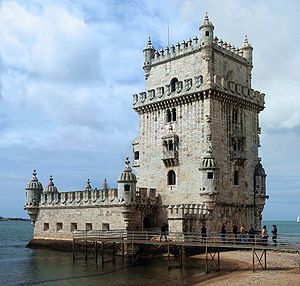
(mainly designed by Diogo Boitac and João de Castilho) and in the small fortress of the Belém Tower
Belém Tower
Belém Tower or the Tower of St Vincent is a fortified tower located in the civil parish of Santa Maria de Belém in the municipality of Lisbon, Portugal...
(designed by Francisco de Arruda). Both are located close to each other in the Belém neighbourhood. The portal of the Church of Nossa Senhora da Conceição Velha
Church of Nossa Senhora da Conceição Velha
The Igreja of Nossa Senhora da Conceição Velha is a church in the centre of Lisbon, in Portugal. It is notable as one of the last remnants of the Manueline style in the city....
, in downtown Lisbon, has also survived destruction.
Outside Lisbon, the church and chapter house of the Convent of the Order of Christ
Convent of the Order of Christ
The Convent of the Order of Christ is a religious building and Roman Catholic building in Tomar, Portugal, originally a Templar stronghold built in the 12th century...
at Tomar
Tomar
Tomar Municipality has a total area of 351.0 km² and a total population of 43,007 inhabitants.The municipality is composed of 16 parishes, and is located in Santarém District...
(designed by Diogo de Arruda
Diogo de Arruda
Diogo de Arruda was a noted Portuguese architect active during the early years of the 16th century.Diogo de Arruda was the master builder of the Convento de Cristo in Tomar, Portugal between 1510 and 1513....
) is a major Manueline monument. In particular, the large window of the chapter house, with its fantastic sculptured organic and twisted rope forms, is one of the most extraordinary achievements of the Manueline style.
Other major Manueline monuments include the arcade screens of the Royal Cloister (designed by Diogo Boitac) and the Unfinished Chapels (designed by Mateus Fernandes
Mateus Fernandes
Mateus Fernandes , also called Mateus Fernandes the Elder, was a Portuguese architect. He was noted for his works in the Manueline style at the Monastery of Batalha, Portugal....
) at the Monastery of Batalha and the Royal Palace of Sintra
Sintra
Sintra is a town within the municipality of Sintra in the Grande Lisboa subregion of Portugal. Owing to its 19th century Romantic architecture and landscapes, becoming a major tourist centre, visited by many day-trippers who travel from the urbanized suburbs and capital of Lisbon.In addition to...
.
Other remarkable Manueline buildings include the church of the Monastery of Jesus of Setúbal
Monastery of Jesus of Setúbal
The Monastery of Jesus is a historical religious building in Setúbal, Portugal. It is one of the first buildings in the Manueline style, the Portuguese version of late Gothic...
(one of the earliest Manueline churches) (also designed by Diogo Boitac), the Santa Cruz Monastery
Santa Cruz Monastery
The Santa Cruz Monastery, The Santa Cruz Monastery, The Santa Cruz Monastery, (English: Monastery of the Holy Cross, Portuguese: Mosteiro de Santa Cruz, best known as Igreja (Church) de Santa Cruz is a National Monument in Coimbra, Portugal. Because the first two kings of Portugal are buried in the...
in Coimbra
Coimbra
Coimbra is a city in the municipality of Coimbra in Portugal. Although it served as the nation's capital during the High Middle Ages, it is better-known for its university, the University of Coimbra, which is one of the oldest in Europe and the oldest academic institution in the...
, the main churches in Golegã, Vila do Conde, Moura, Caminha
Caminha
Caminha is a municipality in the north-west of Portugal, 21 km north from Viana do Castelo, located in the Viana do Castelo District.The municipality has a total area of 137.4 km² and 16,839 inhabitants ....
, Olivenza
Olivenza
Olivenza or Olivença is a town in the autonomous community of Extremadura, situated on a disputed section of the border between Portugal and Spain...
and portions of the cathedrals of Braga
Braga Cathedral
The Cathedral of Braga is one of the most important monuments in the city of Braga, in Northern Portugal. Due to its long history and artistic significance it is also one of the most important buildings in the country.-History:...
(main chapel), Viseu
Viseu
Viseu is both a city and a municipality in the Dão-Lafões Subregion of Centro Region, Portugal. The municipality, with an area of 507.1 km², has a population of 99,593 , and the city proper has 47,250...
(rib vaulting of the nave) and Guarda
Catedral da Guarda
The mediaeval Catedral da Guarda is a historical religious building in Guarda, in Northeastern Portugal. Its construction took from 1390 until the mid 16th century, combining Gothic and Manueline styles.-History:...
(main portal, pillars, vaulting).
Civil buildings in manueline style exist in
- ÉvoraÉvoraÉvora is a municipality in Portugal. It has total area of with a population of 55,619 inhabitants. It is the seat of the Évora District and capital of the Alentejo region. The municipality is composed of 19 civil parishes, and is located in Évora District....
, home to the Évora Royal Palace (1525, by Pedro de Trillo, Diogo de Arruda and Francisco de Arruda) and the Castle of Évoramonte (1531) - Viana do Castelo, GuimarãesGuimarãesGuimarães Municipality is located in northwestern Portugal in the province of Minho and in the Braga District. It contains the city of Guimarães.The present Mayor is António Magalhães Silva, elected by the Socialist Party.-Parishes:-Economy:...
and some other towns.
The style was extended to the decorative arts and spread throughout the Portuguese Empire
Portuguese Empire
The Portuguese Empire , also known as the Portuguese Overseas Empire or the Portuguese Colonial Empire , was the first global empire in history...
, to the islands of the Azores
Azores
The Archipelago of the Azores is composed of nine volcanic islands situated in the middle of the North Atlantic Ocean, and is located about west from Lisbon and about east from the east coast of North America. The islands, and their economic exclusion zone, form the Autonomous Region of the...
, Madeira
Madeira
Madeira is a Portuguese archipelago that lies between and , just under 400 km north of Tenerife, Canary Islands, in the north Atlantic Ocean and an outermost region of the European Union...
, enclaves in North Africa
North Africa
North Africa or Northern Africa is the northernmost region of the African continent, linked by the Sahara to Sub-Saharan Africa. Geopolitically, the United Nations definition of Northern Africa includes eight countries or territories; Algeria, Egypt, Libya, Morocco, South Sudan, Sudan, Tunisia, and...
, Brazil
Brazil
Brazil , officially the Federative Republic of Brazil , is the largest country in South America. It is the world's fifth largest country, both by geographical area and by population with over 192 million people...
, Goa
Goa
Goa , a former Portuguese colony, is India's smallest state by area and the fourth smallest by population. Located in South West India in the region known as the Konkan, it is bounded by the state of Maharashtra to the north, and by Karnataka to the east and south, while the Arabian Sea forms its...
in India
India
India , officially the Republic of India , is a country in South Asia. It is the seventh-largest country by geographical area, the second-most populous country with over 1.2 billion people, and the most populous democracy in the world...
and even Macau
Macau
Macau , also spelled Macao , is, along with Hong Kong, one of the two special administrative regions of the People's Republic of China...
, China. Its influence is apparent in Southern Spain, the Canary Islands, North Africa and the former Spanish colonies of Peru and Mexico.
See also
- Neo-ManuelineNeo-ManuelineNeo-Manueline was a revival architecture and decorative arts style developed in Portugal between the middle of the 19th century and the beginning of the 20th century...
- Gilded woodcarvingGilded woodcarvingGilded woodcarvingGilded woodcarving in Portugal is, along with the tile, one of its most original and rich artistic expressions. It is usually used in the internal decoration of churches and cathedrals, but also as part of the decoration of noble halls in palaces and large public buildings,...
- Manueline architects