
All Topics  
Theorbo


   Email Print
   Bookmark   Link


Theorbo


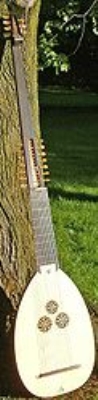
A theorbo (also tuorbe; , ) is a plucked string instrument. As a name, theorbo signifies a number of long-necked lute
Lute

Lute can refer generally to any plucked string instrument with a neck and a deep round back, or more specifically to an instrument from the family of European lutes....
s with second peg-boxes, such as the liuto attiorbato, the French théorbe des pièces, the English theorbo, the archlute
Archlute

The archlute is a European plucked string instrument developed around 1600 as a compromise between the very large theorbo, the size and re-entrant tuning of which made for difficulties in the performance of solo music, and the Renaissance tenor lute, which lacked the bass range of the theorbo....
, the German baroque lute
Lute

Lute can refer generally to any plucked string instrument with a neck and a deep round back, or more specifically to an instrument from the family of European lutes....
, the angélique
Angélique (instrument)

The ang?lique is a plucked string instrument of the lute family of the baroque era. It combines features of the lute, the harp and the theorbo....
 or angelica. The etymology of the name tiorba has not yet been explained.


Discussion
Ask a question about 'Theorbo'
Start a new discussion about 'Theorbo'
Answer questions from other users
Full Discussion Forum


Recent Posts


Encyclopedia


A theorbo (also tuorbe; , ) is a plucked string instrument. As a name, theorbo signifies a number of long-necked lute
Lute

Lute can refer generally to any plucked string instrument with a neck and a deep round back, or more specifically to an instrument from the family of European lutes....
s with second peg-boxes, such as the liuto attiorbato, the French théorbe des pièces, the English theorbo, the archlute
Archlute

The archlute is a European plucked string instrument developed around 1600 as a compromise between the very large theorbo, the size and re-entrant tuning of which made for difficulties in the performance of solo music, and the Renaissance tenor lute, which lacked the bass range of the theorbo....
, the German baroque lute
Lute

Lute can refer generally to any plucked string instrument with a neck and a deep round back, or more specifically to an instrument from the family of European lutes....
, the angélique
Angélique (instrument)

The ang?lique is a plucked string instrument of the lute family of the baroque era. It combines features of the lute, the harp and the theorbo....
 or angelica. The etymology of the name tiorba has not yet been explained. It is hypothesized that its origin might have been in the Slavic or Turkish "torba", meaning "bag" or "turban".

Theorboes were developed during the late sixteenth century, inspired by the demand for extended bass range for use in opera developed by the Florentine Camerata
Florentine Camerata

The Florentine Camerata was a group of Humanisms, musicians, poets and intellectuals in late Renaissance Florence who gathered under the patronage of Count Giovanni de' Bardi to discuss and guide trends in the arts, especially music and drama....
 and new musical works based on basso continuo, such as Giulio Caccini
Giulio Caccini

Giulio Caccini was an Italy composer, teacher, singer, instrumentalist and writer of the very late Renaissance music and early Baroque music eras....
's two collections, Le nuove musiche
Le nuove musiche

Le nuove musiche is a collection of monodies and songs for solo voice and basso continuo by the composer Giulio Caccini, published in Florence in July 1602....
 (1602 and 1614). Musicians adapted bass lutes (c.80+ cm string length) with a neck extension to accommodate open (i. e. unfretted) bass strings, called diapasons or bourdons. The instrument was called both chitarrone and tiorba. It is important to note that, although theorbo and chitarrone are virtually identical, they have different etymological origins, chitarrone being a descendant of chitarra italiana
Chitarra Italiana

Chitarra Italiana is a lute-shaped plucked instrument with 4 or 5 single strings, in a tuning similar to that of guitar. It was common in Italy during the Renaissance Era....
 (hence its name).

Similar adaptations to smaller lutes (c.55+ cm string length) produced the liuto attiorbato and the archlute
Archlute

The archlute is a European plucked string instrument developed around 1600 as a compromise between the very large theorbo, the size and re-entrant tuning of which made for difficulties in the performance of solo music, and the Renaissance tenor lute, which lacked the bass range of the theorbo....
, also similar-looking but differently tuned instruments.

The tuning of large theorboes is generally characterized by the octave displacement, or reëntrant tuning
Reentrant tuning

A reentrant tuning is a tuning of a stringed instrument where the strings are not ordered from the lowest pitch to the highest pitch .A break in an otherwise ascending order of string pitches is known as a reentry....
, of the uppermost of the two (sometimes one) uppermost string
Strings (music)

A string is the Vibrating string that is the source of vibration in string instruments, such as the guitar, harp, piano, and members of the violin family....
s, thus limiting the upper range of the instrument. The courses
Course (music)

A course is a pair or more of adjacent strings tuned to unison or an octave and usually played together as if a single string. It may also refer to a single string normally played on its own on an instrument with other multi-string courses, for example the bass string on a nine string baroque guitar....
, unlike those of a Renaissance lute
Lute

Lute can refer generally to any plucked string instrument with a neck and a deep round back, or more specifically to an instrument from the family of European lutes....
 or archlute
Archlute

The archlute is a European plucked string instrument developed around 1600 as a compromise between the very large theorbo, the size and re-entrant tuning of which made for difficulties in the performance of solo music, and the Renaissance tenor lute, which lacked the bass range of the theorbo....
, were often single, though double-stringing was used too. Typically, theorboes have 14 courses
Course (music)

A course is a pair or more of adjacent strings tuned to unison or an octave and usually played together as if a single string. It may also refer to a single string normally played on its own on an instrument with other multi-string courses, for example the bass string on a nine string baroque guitar....
, though a very few pieces from the Early Baroque period require a 19-course
Course (music)

A course is a pair or more of adjacent strings tuned to unison or an octave and usually played together as if a single string. It may also refer to a single string normally played on its own on an instrument with other multi-string courses, for example the bass string on a nine string baroque guitar....
 theorbo.

In the performance of basso continuo, theorboes were often paired with a small pipe organ
Pipe organ

The pipe organ is a keyboard musical instrument that produces sound by venting mechanically compressed air through resonant Organ pipe. Each pipe produces sound at one fixed pitch, so they are provided in sets or "ranks" with one pipe or more per note, each rank having a common timbre and loudness throughout....
. The most prominent players and composers of the chitarrone in Italy were Giovanni Girolamo Kapsberger and Alessandro Piccinini
Alessandro Piccinini

Alessandro Piccinini , was an Italy lutenist and composer.Piccinini was born in Bologna into a musical family: his father Leonardo Maria Piccinini taught lute playing to Alessandro as well as his brothers Girolamo and Filippo ....
. Little solo music for the theorbo survives from England, but William Lawes
William Lawes

William Lawes was an England composer and musician.He was born in Salisbury, Wiltshire and was baptised on 1 May 1602. He was the son of Thomas Lawes, a vicar choral at Salisbury Cathedral, and brother to Henry Lawes, a very successful composer in his own right....
 and others used it in their chamber music, and it also appeared in opera orchestras. In France, theorboes were appreciated and used in orchestral music just as well as in chamber music, until the second half of the 18th century (Nicolas Hotman
Nicolas Hotman

Nicolas Hotman was a baroque music composer, who spent most of his career in France, although he is believed to be from Germany, but was probably born in Brussels....
, Robert de Visée
Robert de Visée

Robert de Vis?e was a lutenist, baroque guitar, theorbo and viol at the court of Louis XIV, as well as a singer, and composer for lute, theorbo and guitar....
). Court orchestras at Vienna, Bayreuth and Berlin employed theorbo players still after 1750 (Ernst Gottlieb Baron
Ernst Gottlieb Baron

Ernst Gottlieb Baron was a Germany lutenist and composer.Baron was born in Breslau. He studied law in Leipzig, but later became successful as a performer on the lute....
, Francesco Conti).

Solo music for the theorbo is notated in tablature
Tablature

Tablature is a form of musical notation, which tells players where to place their fingers on a particular instrument rather than which pitches to play....
.

Theorbo tuning


This is theorbo tuning
Tuning

Tuning can refer to:*Musical tuning**Guitar tunings**Piano tuning*Radio tuning: see tuner*Tuning properties of neurons: see neuronal tuning...
 in A. Modern theorbo players usually play 14-course instruments, though (lowest course is G). A number of theorbo players will use an alternative tuning
Tuning

Tuning can refer to:*Musical tuning**Guitar tunings**Piano tuning*Radio tuning: see tuner*Tuning properties of neurons: see neuronal tuning...
 in G, a whole step lower, to facilitate playing in flat keys
Key signature

In musical notation, a key signature is a series of Sharp or Flat symbols placed on the staff , designating note s that are to be consistently played one semitone higher or lower than the equivalent natural sign notes unless otherwise altered with an Accidental ....
, which are unwieldy on instruments tuned in A, better suited for sharp
Sharp (music)

In music, sharp means higher in pitch. More specifically, in musical notation, sharp means "higher in pitch by a semitone ," and has an associated symbol , which is often confused with the number sign ....
 keys
Key signature

In musical notation, a key signature is a series of Sharp or Flat symbols placed on the staff , designating note s that are to be consistently played one semitone higher or lower than the equivalent natural sign notes unless otherwise altered with an Accidental ....
.

While usually players will have the top two courses
Course (music)

A course is a pair or more of adjacent strings tuned to unison or an octave and usually played together as if a single string. It may also refer to a single string normally played on its own on an instrument with other multi-string courses, for example the bass string on a nine string baroque guitar....
 down an octave
Octave

In music, an octave The octave is occasionally referred to as a diapason.The octave above an indicated note is sometimes abbreviated 8va, and the octave below 8vb....
 in reëntrant tuning
Reentrant tuning

A reentrant tuning is a tuning of a stringed instrument where the strings are not ordered from the lowest pitch to the highest pitch .A break in an otherwise ascending order of string pitches is known as a reentry....
, this does create problems for voice leading
Voice leading

In musical composition, voice leading is the term used to refer to a decision-making consideration when arranging voices , namely, how each voice should move in advancing from each chord to the next....
 and the playing of harmonies above the bass when accompanying and playing Basso Continuo. A solution is to have only the top course
Course (music)

A course is a pair or more of adjacent strings tuned to unison or an octave and usually played together as if a single string. It may also refer to a single string normally played on its own on an instrument with other multi-string courses, for example the bass string on a nine string baroque guitar....
 down an octave (English theorbo).

The diagram above shows the typical diatonic tuning of the bass strings, and these may be retuned to whichever key the player is working in. They not only come in extremely useful at cadences (for many lovers of Baroque Music
Baroque music

Baroque music describes a period or style of European classical music approximately extending from Dates of classical music eras. This era is said to begin in music after the Renaissance music and was followed by the Classical music era....
, the thump of low plucked strings is a most satisfying sound), but provide sympathetic resonance even when not played, enriching the general sound of the instrument.

Players

The important living theorbists include Lynda Sayce
Lynda Sayce

Lynda Sayce is a lutenist and theorbo player, living near Oxford, United Kingdom, known also as a scholar of musical history and a writer on the history of the lute and theorbo....
, Pascal Monteilhet, Edin Karamazov
Edin Karamazov

Edin Karamazov is a Bosnian musician-lutenist . He studied lute with Hopkinson Smith at the Schola Cantorum Basiliensis and worked with such ensembles as Hesperion, L'Arpeggiata, Hilliard Ensemble, Mala Punica, Orpheus Chamber Orchestra and singers Andreas Scholl, Maria-Cristina Kiehr, Arianna Savall, and Sting ....
, Eduardo Egüez
Eduardo Egüez

Eduardo Eg?ez is an lutenist, theorbist, and guitarist acclaimed for his interpretations of music by J.S.Bach.He first studied guitar with Miguel Angel Girollet and Eduardo Fern?ndez....
, Nigel North
Nigel North

Nigel North is an English lutenist and classical guitar....
, Eligio Luis Quinteiro , Hopkinson Smith
Hopkinson Smith

Hopkinson Smith is an United States of America lutenist.Born in New York, he graduated from Harvard with Honors in Music. He came to Europe in 1973 to study with Emilio Pujol, a great pedagogue in the highest Catalan people artistic tradition, and also Eugen Dombois, whose sense of organic unity between performer, instrument and historic...
, Paul O'Dette
Paul O'Dette

Paul R. O'Dette is an United States lutenist, conducting, and music researcher specializing in early music.O'Dette began playing classical guitar, and while in high school also played electric guitar in a rock band in Columbus, Ohio, where he grew up....
, Andreas Martin
Andreas Martin

Andreas Martin is a lutenist who was born in Frankfurt am Main in Germany.He studied guitar with Mario Sicca and Ruggero Chiesa , as well as Anglo?Saxon and Romance Languages and Philosophy at the University of Heidelberg....
, Rolf Lislevand, Christina Pluhar, Matthias Spaeter, Ugo Nastrucci
Ugo Nastrucci

Ugo Nastrucci is a composer, lutenist, theorbist and recording artist.He studied composition with Irlando Danieli and Giacomo Manzoni at the Conservatorio "G.Verdi" in Milan....
, Jakob Lindberg, Stephen Stubbs
Stephen Stubbs

Stephen Stubbs is a lutenist and director and has been a leading figure in the European early music scene for nearly thirty years.He was born in Seattle and studied harpsichord and composition at the University of Washington where, at the same time, he began to play the lute....
, and Diego Cantalupi among others.

Literature


  • Ekkehard Schulze-Kurz, Die Laute und ihre Stimmungen in der ersten Hälfte des 17. Jahrhundert, 1990, ISBN 3-927445-04-5, available at homepage


  • Robert Spencer, 'Chitarrone, Theorbo and Archlute', Early Music, Vol. 4 No. 4 (October 1976), 408-422, available at homepage.


  • Diego Cantalupi, "La tiorba ed il suo uso come strumento per il basso continuo", pre-press version of the dissertation discussed in 1996 at the Faculty of Musicology, University of Pavia. Freely downloadable at


See also


  • Torban
    Torban

    The torban or teorban is a Culture of Ukraine musical instrument that combines the features of the Baroque Lute with those of the psaltery. It was invented ca....
    , a Ukrainian relative of the theorbo


External links

  • by Robert Spencer: the definitive work on these terms


Video