


List of Emperors of the Qing Dynasty

Encyclopedia
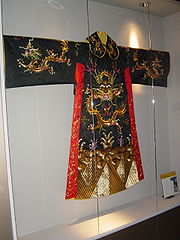
Qing Dynasty
The Qing Dynasty was the last dynasty of China, ruling from 1644 to 1912 with a brief, abortive restoration in 1917. It was preceded by the Ming Dynasty and followed by the Republic of China....
was founded as the "Later Jin Dynasty" in 1616 by Nurhaci
Nurhaci
Nurhaci was an important Jurchen chieftain who rose to prominence in the late sixteenth century in what is today Northeastern China...
, a Manchu of the Aisin-Gioro Clan, his son Hung Taiji changed its name to "Qing" in 1636. It lasted until 1912. In China proper
China proper
China proper or Eighteen Provinces was a term used by Western writers on the Qing Dynasty to express a distinction between the core and frontier regions of China. There is no fixed extent for China proper, as many administrative, cultural, and linguistic shifts have occurred in Chinese history...
, the Qing dynasty succeeded the Ming Dynasty
Ming Dynasty
The Ming Dynasty, also Empire of the Great Ming, was the ruling dynasty of China from 1368 to 1644, following the collapse of the Mongol-led Yuan Dynasty. The Ming, "one of the greatest eras of orderly government and social stability in human history", was the last dynasty in China ruled by ethnic...
in 1644, during the reign of the Dorgon
Dorgon
Dorgon , also known as Hošoi Mergen Cin Wang, the Prince Rui , was one of the most influential Manchu princes in the early Qing Dynasty. He laid the groundwork for the Manchu rule of China.-Early life:Dorgon was born in Yenden, Manchuria , China...
. Therefore politically Dorgon
Dorgon
Dorgon , also known as Hošoi Mergen Cin Wang, the Prince Rui , was one of the most influential Manchu princes in the early Qing Dynasty. He laid the groundwork for the Manchu rule of China.-Early life:Dorgon was born in Yenden, Manchuria , China...
, Emperor Chengzong of the Qing Dynasty, is the first Emperor of the Dynasty to be correctly titled the Emperor of China
Emperor of China
The Emperor of China refers to any sovereign of Imperial China reigning between the founding of Qin Dynasty of China, united by the King of Qin in 221 BCE, and the fall of Yuan Shikai's Empire of China in 1916. When referred to as the Son of Heaven , a title that predates the Qin unification, the...
. There were a total of 13 rulers from Nurhaci, of which 11 were rulers of China proper. The Qing Dynasty was toppled in the Xinhai Revolution
Xinhai Revolution
The Xinhai Revolution or Hsinhai Revolution, also known as Revolution of 1911 or the Chinese Revolution, was a revolution that overthrew China's last imperial dynasty, the Qing , and established the Republic of China...
of 1911, although the last Emperor
Puyi
Puyi , of the Manchu Aisin Gioro clan, was the last Emperor of China, and the twelfth and final ruler of the Qing Dynasty. He ruled as the Xuantong Emperor from 1908 until his abdication on 12 February 1912. From 1 to 12 July 1917 he was briefly restored to the throne as a nominal emperor by the...
did not officially abdicate to make way for the new Republic of China
Republic of China
The Republic of China , commonly known as Taiwan , is a unitary sovereign state located in East Asia. Originally based in mainland China, the Republic of China currently governs the island of Taiwan , which forms over 99% of its current territory, as well as Penghu, Kinmen, Matsu and other minor...
until early 1912 and kept his title until 1924.
List of emperors
| Given name1 | Posthumous name Posthumous name A posthumous name is an honorary name given to royalty, nobles, and sometimes others, in East Asia after the person's death, and is used almost exclusively instead of one's personal name or other official titles during his life... ² (short form) |
Temple name Temple name Temple names are commonly used when naming most Chinese, Korean , and Vietnamese royalty. They should not be confused with era names. Compared to posthumous names, the use of temple names is more exclusive... ² |
Reign name Chinese era name A Chinese era name is the regnal year, reign period, or regnal title used when traditionally numbering years in an emperor's reign and naming certain Chinese rulers . Some emperors have several era names, one after another, where each beginning of a new era resets the numbering of the year back... Chinese, Manchu |
Reign years | Name by which most commonly known |
|---|---|---|---|---|---|
| Nurhaci 努爾哈赤 pinyin Pinyin Pinyin is the official system to transcribe Chinese characters into the Roman alphabet in China, Malaysia, Singapore and Taiwan. It is also often used to teach Mandarin Chinese and spell Chinese names in foreign publications and used as an input method to enter Chinese characters into... : Nǔ'ěrhāchì |
Gāodì 高帝 |
Tàizǔ 太祖 |
Tiānmìng 天命 Abkai fulingga |
1616–1626³ | Nurhaci Nurhaci Nurhaci was an important Jurchen chieftain who rose to prominence in the late sixteenth century in what is today Northeastern China... |
| Hong Taiji4 皇太極 pinyin Pinyin Pinyin is the official system to transcribe Chinese characters into the Roman alphabet in China, Malaysia, Singapore and Taiwan. It is also often used to teach Mandarin Chinese and spell Chinese names in foreign publications and used as an input method to enter Chinese characters into... : Huángtàijí |
Wéndì 文帝 |
Tàizōng 太宗 |
Tiāncōng 天聰 Abkai sure 1627–1636; Chóngdé 崇德 Wesihun erdemungge 1636–1643 |
1626–1643 | Hong Taiji Hong Taiji Hong Taiji , also transliterated as Huang Taiji based on the Chinese language transcription of his name, was the first Emperor of the Qing Dynasty.Hong Taiji was the first Emperor of the Qing dynasty after acceding to the title in 1636... |
| Dorgon (Regent) 多尔衮 pinyin Pinyin Pinyin is the official system to transcribe Chinese characters into the Roman alphabet in China, Malaysia, Singapore and Taiwan. It is also often used to teach Mandarin Chinese and spell Chinese names in foreign publications and used as an input method to enter Chinese characters into... : Duōěrgǔn |
Yìdì 義帝 |
Chéngzōng 成宗 |
|
1643–1650 | Dorgon Dorgon Dorgon , also known as Hošoi Mergen Cin Wang, the Prince Rui , was one of the most influential Manchu princes in the early Qing Dynasty. He laid the groundwork for the Manchu rule of China.-Early life:Dorgon was born in Yenden, Manchuria , China... |
| Fúlín 福臨 |
Zhāngdì 章帝 |
Shìzǔ 世祖 |
Shùnzhì 順治 Ijishūn dasan |
1643–16615 | Shunzhi Emperor Shunzhi Emperor The Shunzhi Emperor was the third emperor of the Manchu-led Qing dynasty, and the first Qing emperor to rule over China, which he did from 1644 to 1661. "Shunzhi" was the name of his reign period... |
| Xuányè 玄燁 |
Réndì 仁帝 |
Shèngzǔ 聖祖 |
Kāngxī 康熙 Elhe taifin |
1661–1722 | Kangxi Emperor Kangxi Emperor The Kangxi Emperor ; Manchu: elhe taifin hūwangdi ; Mongolian: Энх-Амгалан хаан, 4 May 1654 –20 December 1722) was the fourth emperor of the Qing Dynasty, the first to be born on Chinese soil south of the Pass and the second Qing emperor to rule over China proper, from 1661 to 1722.Kangxi's... |
| Yìnzhēn 胤禛 |
Xiàndì 憲帝 |
Shìzōng 世宗 |
Yōngzhèng 雍正 Hūwaliyasun tob |
1722–1735 | Yongzheng Emperor Yongzheng Emperor The Yongzheng Emperor , born Yinzhen , was the fifth emperor of the Manchu Qing Dynasty and the third Qing emperor from 1722 to 1735. A hard-working ruler, Yongzheng's main goal was to create an effective government at minimal expense. Like his father, the Kangxi Emperor, Yongzheng used military... |
| Hónglì 弘曆 |
Chúndì 純帝 |
Gāozōng 高宗 |
Qiánlóng 乾隆 Abkai wehiyehe |
1735–1796 (died 1799)6 |
Qianlong Emperor Qianlong Emperor The Qianlong Emperor was the sixth emperor of the Manchu-led Qing Dynasty, and the fourth Qing emperor to rule over China proper. The fourth son of the Yongzheng Emperor, he reigned officially from 11 October 1735 to 8 February 1796... |
| Yóngyǎn 顒琰 |
Ruìdì 睿帝 |
Rénzōng 仁宗 |
Jiāqìng 嘉慶 Saicungga fengšen |
1796–1820 | Jiaqing Emperor Jiaqing Emperor The Jiaqing Emperor was the seventh emperor of the Manchu-led Qing dynasty, and the fifth Qing emperor to rule over China, from 1796 to 1820.... |
| Mínníng 旻寧 |
Chéngdì 成帝 |
Xuānzōng 宣宗 |
Dàoguāng 道光 Doro eldengge |
1820–1850 | Daoguang Emperor Daoguang Emperor The Daoguang Emperor was the eighth emperor of the Manchurian Qing dynasty and the sixth Qing emperor to rule over China, from 1820 to 1850.-Early years:... |
| Yìzhǔ 奕詝 |
Xiǎndì 顯帝 |
Wénzōng 文宗 |
Xiánfēng 咸豐 Gubci elgiyengge |
1850–1861 | Xianfeng Emperor Xianfeng Emperor The Xianfeng Emperor , born Aisin-Gioro I Ju, was the ninth Emperor of the Qing Dynasty, and the seventh Qing emperor to rule over China, from 1850 to 1861.-Family and his early years:... |
| Zǎichún 載淳 |
Yìdì 毅帝 |
Mùzōng 穆宗 |
Tóngzhì 同治 Yooningga dasan |
1861–18757 | Tongzhi Emperor Tongzhi Emperor The Tongzhi Emperor , born Aisin-Gioro Dzai Šun, was the tenth emperor of the Manchu-led Qing Dynasty, and the eighth Qing emperor to rule over China, from 1861 to 1875. His reign, which effectively lasted through his adolescence, was largely overshadowed by the rule of his mother, the Empress... |
| Zǎitián 載湉 |
Jǐngdì 景帝 |
Dézōng 德宗 |
Guāngxù 光緒 Badarangga doro |
1875–19087 | Guangxu Emperor Guangxu Emperor The Guangxu Emperor , born Zaitian of the Aisin-Gioro clan, was the eleventh emperor of the Manchurian Qing Dynasty, and the ninth Qing emperor to rule over China. His reign lasted from 1875 to 1908, but in practice he ruled, under Empress Dowager Cixi's influence, only from 1889 to 1898... |
| Pǔyí 溥儀 also known as Henry |
Xùndì 8 遜帝 |
None given 9 | Xuāntǒng 宣統 Gehungge yoso |
1908–191110 (died 1967) |
Xuantong Emperor |
| 1 The Qing imperial family name was Aisin Gioro Aisin Gioro Aisin Gioro was the family name of the Manchu emperors of the Qing Dynasty. The House of Aisin Gioro ruled China until the Xinhai Revolution of 1911, which established a republican government in its place. The word aisin means gold in the Manchu language, and "gioro" is the name of the place in... (愛新覺羅 aixin jueluo), but it was not common Manchu practice to include the family or clan name in an individual's personal name. |
|||||
| 2 As posthumous and temple names were often shared by emperors of different dynasties, they are usually preceded by the dynastic name, in this case, Qing, to avoid confusion. For example, the Qianlong emperor is frequently referred to as Qing Gaozong. | |||||
| 3 Nurhaci founded the Jin (金) or Later Jin (後金) dynasty in 1616, but it was his son Hong Taiji who changed the name of the dynasty to Qing in 1636. Nurhaci adopted the reign name Tianming but his Qing titles were all conferred posthumously. | |||||
| 4 Hong Taiji is referred to erroneously in some historical literature as Abahai (阿巴海). | |||||
| 5 The Shunzhi emperor was the first Qing emperor to rule over China proper following the occupation of Beijing in 1644. | |||||
| 6 The Qianlong emperor officially retired in 1796, taking the title Emperor Emeritus (太上皇帝). This was an act of filial piety to ensure that he would not reign longer than his illustrious grandfather, the Kangxi emperor. However, he remained the ultimate authority until his death in 1799, at which point his son, the Jiaqing emperor, began to exercise the power that had been his in name only from 1796. | |||||
| 7 The Empress Dowager Cixi Empress Dowager Cixi Empress Dowager Cixi1 , of the Manchu Yehenara clan, was a powerful and charismatic figure who became the de facto ruler of the Manchu Qing Dynasty in China for 47 years from 1861 to her death in 1908.... , concubine of the Xianfeng emperor, mother of the Tongzhi emperor, and adoptive mother of the Guangxu emperor, used her considerable skills of political manipulation to act as the power behind the throne or on the throne from 1861 until her death in 1908. She acted as a regent during the minorities of the two young emperors and confined the Guangxu emperor in the Summer Palace after he attempted to introduce reforms in 1898. The death of the Guangxu emperor was announced the day before her own. |
|||||
| 8 Xundi ("The Abdicated Emperor") is the posthumous name Posthumous name A posthumous name is an honorary name given to royalty, nobles, and sometimes others, in East Asia after the person's death, and is used almost exclusively instead of one's personal name or other official titles during his life... given by mainland China and Taiwan's history books to Pu-yi. |
|||||
| 9 In 2004 the descendants of the Qing imperial family have conferred a posthumous name Posthumous name A posthumous name is an honorary name given to royalty, nobles, and sometimes others, in East Asia after the person's death, and is used almost exclusively instead of one's personal name or other official titles during his life... and temple name Temple name Temple names are commonly used when naming most Chinese, Korean , and Vietnamese royalty. They should not be confused with era names. Compared to posthumous names, the use of temple names is more exclusive... upon the late Pu-yi. Posthumous name Posthumous name A posthumous name is an honorary name given to royalty, nobles, and sometimes others, in East Asia after the person's death, and is used almost exclusively instead of one's personal name or other official titles during his life... : Mindi (愍帝). Temple name Temple name Temple names are commonly used when naming most Chinese, Korean , and Vietnamese royalty. They should not be confused with era names. Compared to posthumous names, the use of temple names is more exclusive... : Gongzong (恭宗). It remains to be seen whether these names will be accepted by the Chinese public. |
|||||
| 10 The Qing dynasty was overthrown in 1911, and the last emperor, Pu-yi, abdicated officially on February 12, 1912. However, that same day the Republic of China granted the "Articles of Favourable Treatment of the Emperor of the Great Qing after his Abdication" (清帝退位 優待條件) which allowed Pu-yi to retain his imperial title and stated that he should be treated by the government of the Republic with the protocol attached to a foreign monarch. These articles were revised on November 5, 1924, after the coup by General Feng Yuxiang Feng Yuxiang Feng Yuxiang was a warlord and leader in Republican China. He was also known as the Christian General for his zeal to convert his troops and the Betrayal General for his penchant to break with the establishment. In 1911, he was an officer in the ranks of Yuan Shikai's Beiyang Army but joined... : the revised articles stated that Pu-yi was losing his imperial title and henceforth becoming a regular citizen of the Republic of China. Pu-yi was expelled from the Forbidden City Forbidden City The Forbidden City was the Chinese imperial palace from the Ming Dynasty to the end of the Qing Dynasty. It is located in the middle of Beijing, China, and now houses the Palace Museum... that same day. Thus, Pu-yi was ruling emperor until February 12, 1912 (and also briefly between July 1 and July 12, 1917), and non-ruling emperor between February 12, 1912 and November 5, 1924. Pu-yi also later became the puppet leader of Japanese-controlled Manchukuo Manchukuo Manchukuo or Manshū-koku was a puppet state in Manchuria and eastern Inner Mongolia, governed under a form of constitutional monarchy. The region was the historical homeland of the Manchus, who founded the Qing Empire in China... under the reign name Datong (大同) (1932–1934), then the puppet emperor of the same under the reign name Kangde (康德) (1934–1945). |
|||||
See also
- Qing Dynasty family tree
- Dynasties in Chinese historyDynasties in Chinese historyThe following is a chronology of the dynasties in Chinese history.Chinese history is not as neat as is often described and it was rare for one dynasty to change peacefully into the next. Dynasties were often established before the overthrow of an existing regime, or continued for a time after they...