

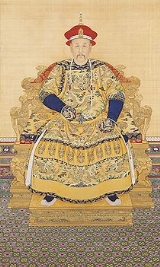
Yongzheng Emperor

Encyclopedia
The Yongzheng Emperor born Yinzhen ( ; Manchu language
: ; Möllendorff transliteration
: in jen), was the fifth emperor
of the Manchu
Qing Dynasty
and the third Qing emperor from 1722 to 1735. A hard-working ruler, Yongzheng's main goal was to create an effective government at minimal expense. Like his father, the Kangxi Emperor
, Yongzheng used military force to preserve the dynasty's position. Suspected by historians to have usurped the throne, his reign was known as despotic, efficient, and vigorous.
Although Yongzheng's reign was much shorter than the reigns of both his father (the Kangxi Emperor) and his son (the Qianlong Emperor
), his sudden death was probably brought about by a heavy workload. Yongzheng continued an era of peace and prosperity; he cracked down on corruption and waste, and reformed the financial administration.
during Kangxi's second battle against the Mongol khan Gordhun
. Yinzhen was made a beile
in 1689 and rose to the position of second-class prince in 1698.
In 1704, the Yangtze
and Yellow River
s saw unprecedented flooding. The economy and livelihood of people around these areas were severely damaged. Yongzheng was sent out as an envoy of the emperor with the 13th Imperial Prince Yinxiang
to deal with relief efforts in southern China. The imperial treasury, which had been drained due to unpaid loans by many officials and nobles, did not have sufficient funds to deal with the flooding; Yongzheng had the added responsibility of securing relief funds from the wealthy southern tycoons. These efforts ensured that funds were distributed properly and people would not starve. He was given the title of first-class prince, Prince Yong , in 1709.
, Yinzhen, Yinsi, and Yinti (the third, fourth, eighth and fourteenth Imperial Princes respectively). Of the princes Yinsi had the most support from the mandarins
, although often for self-serving reasons. Before this, Yinzhen had supported the crown prince. When the emperor died in December 1722 the field of contenders was reduced to three princes after Yinsi pledged his support to the 14th prince, Yinti (his brother).
At the time of the Kangxi Emperor's death Yinti, as border-pacification general-in-chief , was at war in the northwest. Some historians believe that this was to train the next emperor in military affairs; others maintain that it was to ensure a peaceful succession for Yinzhen. It was Yongzheng who nominated Yinti for the post—not Yinsi, with whom Yinti was closely affiliated. This post was seen as an indication of Kangxi's choice of successor, since the position of crown prince had been vacant for seven years.
The official record (which may have been modified by Yongzheng for political purposes) states that on 20 December 1722 the ailing Kangxi Emperor called seven of his sons and the general commandant of the Peking gendarmerie, Longkodo
, to his bedside; Longkodo read the will, and declared that Yinzhen succeed the emperor on the throne. Some evidence has suggested that Yinzhen contacted Longkodo months before the will was read in preparation for his succession by military means, although in their official capacities frequent encounters were expected. Legend has it that Yongzheng changed Kangxi's will by adding strokes and modifying characters. The best-known account says that Yongzheng changed "fourteen" ( → shísì) to "four" ( → yúsì); others say it was "fourteen" to "fourth" ( → dìsì). While widely accepted, there is little supporting evidence—especially considering that the character 于 was not widely used during the Qing Dynasty; on official documents, 於 (yú) is used. Secondly, Qing tradition insists that the will was done in both Manchu and Chinese; Manchu writing, however, is more intricate and (in this case) impossible to modify. Furthermore, princes in the Qing Dynasty are referred to as "the Emperor's son", in the order which they were born (for example, "the emperor's fourth son": ). Therefore, there is doubt that Yinzhen changed the will to ascend to the throne.
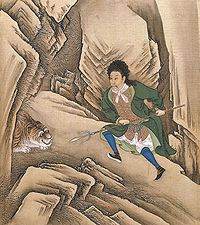 Yinzhen chose an era name
similar in sound to his given name; 1723 was to be the first year of the Yongzheng era. For his first official act as emperor Yongzheng released his long-time ally—the 13th prince Yinxiang
, who had been imprisoned by the Kangxi Emperor at the same time as the crown prince. Some sources indicate that Yinxiang, the most militant of the princes, then assembled a group of special Peking soldiers from the Fengtai command to seize immediate control of the Forbidden City
and surrounding areas to prevent usurpation by Yinsi's cronies. Yongzheng's personal account stated that he was emotionally unstable and deeply saddened over his father's death, and knew it would be a burden "much too heavy" for himself if he were to succeed the throne. In addition, after the will was read Yinzhen wrote that the officials (premier Zhang Tingyu, Longkedo and Yinzhi
) and Prince Cheng led the other princes in the ceremonial Three-Kneels and Nine-Salutes to the emperor. The following day Yongzheng issued an edict summoning Yinti back from Qinghai
, bestowing on their mother the title "Holy Mother Empress Dowager
" the day Yinti arrived at the funeral.
In the first major comprehensive biography of the Yongzheng Emperor by Feng Erkang, the author puts the Yongzheng succession in perspective. Feng writes that there were some suspicious signs from the lost wills and the dates released, but the majority of evidence points to Yinzhen succeeding the throne legitimately (although with political and military maneuvering deemed necessary by the situation). The eighth prince (Yinsi) had been bribing officials for support throughout his life, and his influence penetrated the Fengtai command. Furthermore, Feng suggests that "although we are not yet altogether certain on what happened with the succession, and which side is correct, it is reasonable to think that Yongzheng's political enemies manipulated all suspicion behind the will in an attempt to put a dark image on Yongzheng; Imperial Chinese tradition had led certain schools of thought in believing that Yongzheng's whole reign can be discredited simply because his succession of the throne did not come as a will of his father, the emperor and ultimate decision maker in China." He further suggests that Kangxi made a grave mistake by allowing his sons to become major political players (especially since the position of crown prince was empty) and a bloody battle of succession (including a possible usurpation) was the inevitable result of imperial Chinese institutions. Therefore, it would be an even-bigger mistake to judge a ruler solely on the way he came to power. Certainly, the Yongzheng Emperor ensured his successor would have a smooth transition when his turn came.
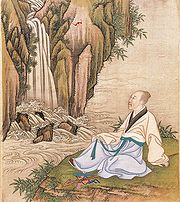 After ascending to the throne in December 1722, Yinzhen took the era name "Harmonious Justice" ( → yōngzhèng) in 1723 from his peerage title "harmonious" ( → yōng) and "just, correct, upright" ( → zhèng). It has been suggested that the second character of his era name was an attempt to cover up his illegal claim to the throne by calling himself "justified". Immediately after succeeding to the throne, Yongzheng chose his new governing council. It consisted of the eighth prince Yinsi, the 13th prince Yinxiang
, Zhang Tingyu
, Ma Qi, and Longkodo
. Yinsi was given the title of Prince Lian, and Yinxiang
was given the title of Prince Yi
; both held the highest positions in the land.
under the pretext of military service, but in reality fell within Yongzheng's trusted protégé Nian Gengyao
's territory. Yin'e, the tenth prince, was stripped of all his titles in May 1724 and sent north to the Shunyi area. The 14th Prince Yinti (Yongzheng's full-brother) was placed under house arrest at the Imperial Tombs under the pretext of guarding their parents' tombs. The first few years of Yongzheng's reign saw an increase in partisan politics. Yinsi wanted to use his position to manipulate Yongzheng into errors, while appearing supportive. Yinsi and Yintang (both supporters of Yinti for the throne) were stripped of their titles, languished in prison and died in 1727.
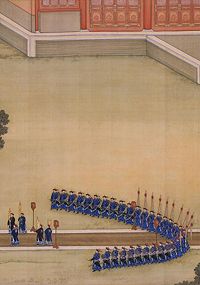 Nian Gengyao
was a supporter of Yongzheng long before he succeeded to the throne. In 1722, when he was recalling his brother Yinti from the northwest, Yongzheng appointed Nian general. The situation in Xinjiang at the time was still precarious, and a strong general was needed in the area. After several military conquests, however, Nian Gengyao's lust for power grew; he reportedly wanted to be equal to Yongzheng. Seeing the situation unfold, Yongzheng issued an imperial edict demoting Nian to general of the Hangzhou Command. Continuing to be unrepentant, Nian was given an ultimatum and committed suicide by poison in 1726. Longkodo
was commander of Peking's armies at the time of Yongzheng's succession. He fell in disgrace in 1728, and died under house arrest.
After becoming emperor, Yongzheng suppressed writings he deemed unfavorable to his regime, particularly those with an anti-Manchu bias.
Foremost among these were those of Zeng Jing, an unsuccessful degree candidate heavily influenced by 17th-century scholar Lü Liuliang
. Zeng had been so affected by what he read that he attempted to incite the governor-general of Shaanxi-Sichuan, Yue Zhongqi, to rebellion. The general promptly turned him in, and in 1730 the case reached Yongzheng Emperor. Highly concerned with the implications of the case, Yongzheng had Zeng Jing brought to Beijing for trial. The emperor's verdict seemed to demonstrate a Confucian sovereign's benevolence: He ascribed Zeng's actions to the gullibility and naïveté of a youth taken in by Lü's abusive and overdrawn rhetoric. In addition to this the emperor suggested that Lü's original attack on the Manchus was misplaced, since they had been transformed by their long-term exposure to the civilizing force of Confucianism.
Yongzheng is also known for establishing a strict autocracy rule during his reign. He detested corruption, and punished officials severely when they were found guilty of an offense. In 1729 he issued an edict prohibiting the smoking of madak
, a blend of tobacco and opium. During Yongzheng's reign the Manchu Empire became a great power and a peaceful land, and he enhanced the Kangqian Period of Harmony . In response to his father's tragedy, Yongzheng created a sophisticated procedure for choosing a successor. He was known for his trust in Mandarin officials. Li Wei
and Tian Wenjing governed China's southern areas, with the assistance of Ortai.
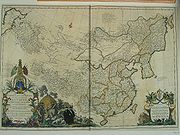 Like his father, Yongzheng used military force in order to preserve the dynasty's position in Outer Mongolia
. When Tibet was torn by civil war in 1727–1728, he intervened militarily. After withdrawing, he left a Qing citizen (the amban
) backed up with a military garrison to safeguard the dynasty's interests. For the Tibetan campaign Yongzheng sent an army of 230,000 (led by Nian Gengyao
) against the Dzungars, who had an army of 80,000. Due to geography, the Qing army (although superior in numbers) was unable to engage the more-mobile enemy at first. Eventually, however, they engaged the Dzungars and defeated them. This campaign cost the treasury at least 8,000,000 tael
s of silver. Later in Yongzheng's reign, he would send a small army of 10,000 to fight the Dzungars. However, that army was annihilated and the Qing had faced the danger of losing control of Mongolia. Fortunately, a Khalkha ally of the Qing Dynasty would later defeat the Dzungars.
Following the reforms of 1729, the treasury increased from the 1721 total of 32,622,421 taels to about 60,000,000 taels in 1730, surpassing the record set during Yongzheng's father's (the Kangxi Emperor's) regime; however, the pacification of the Qinghai area and the defense on the border areas were heavy burdens. For safeguarding the borders alone, 100,000 taels were needed each year. The total military budget was up to 10,000,000 taels a year. By the end of 1735 military spending depleted half the treasury, which totaled 33,950,000 taels. It was because of this burden that the Yongzheng Emperor considered making peace with the Dzungars.
, whose family was (reportedly) executed for literary crimes against the Manchu Regime. Another possible reason was that he had been a lover of Lü Siniang; Lü was the real mother of Qianlong, but Yongzheng refused to allow Lü to be the queen
. In reality, it is likely his death was the result of an overdose of the medication he was consuming which he believed would prolong his life. Yongzheng Emperor's family life seems to have been tragic undertone. Of the 14 children born to him and his Empress and consorts, only five are known to have survived to adulthood. To prevent the succession tragedy he had faced, he ordered his third son (Hongshi, an ally of Yinsi) to commit suicide. His son Hongli, Prince Bao, then became the fifth emperor of the Qing dynasty under the era name of Qianlong. The Yongzheng Emperor was interred in the Western Qing Tombs
, 120 kilometres (74.6 mi) southwest of Beijing
, in the Tailing mausoleum complex (known in Manchu
as the Elhe Munggan).
broadcast the historical drama Yongzheng Dynasty
, which focuses on his positive image and tough stance on corruption (a contemporary issue).
Manchu language
Manchu is a Tungusic endangered language spoken in Northeast China; it used to be the language of the Manchu, though now most Manchus speak Mandarin Chinese and there are fewer than 70 native speakers of Manchu out of a total of nearly 10 million ethnic Manchus...
: ; Möllendorff transliteration
Transliterations of Manchu
There are several systems for transliteration of the Manchu alphabet which is used for the Manchu and Sibe languages. These include the Möllendorff transliteration system invented by Paul Georg von Möllendorff, BabelPad transliteration, the transliteration of the New Manchu-Chinese Dictionary, and...
: in jen), was the fifth emperor
Emperor of China
The Emperor of China refers to any sovereign of Imperial China reigning between the founding of Qin Dynasty of China, united by the King of Qin in 221 BCE, and the fall of Yuan Shikai's Empire of China in 1916. When referred to as the Son of Heaven , a title that predates the Qin unification, the...
of the Manchu
Manchu
The Manchu people or Man are an ethnic minority of China who originated in Manchuria . During their rise in the 17th century, with the help of the Ming dynasty rebels , they came to power in China and founded the Qing Dynasty, which ruled China until the Xinhai Revolution of 1911, which...
Qing Dynasty
Qing Dynasty
The Qing Dynasty was the last dynasty of China, ruling from 1644 to 1912 with a brief, abortive restoration in 1917. It was preceded by the Ming Dynasty and followed by the Republic of China....
and the third Qing emperor from 1722 to 1735. A hard-working ruler, Yongzheng's main goal was to create an effective government at minimal expense. Like his father, the Kangxi Emperor
Kangxi Emperor
The Kangxi Emperor ; Manchu: elhe taifin hūwangdi ; Mongolian: Энх-Амгалан хаан, 4 May 1654 –20 December 1722) was the fourth emperor of the Qing Dynasty, the first to be born on Chinese soil south of the Pass and the second Qing emperor to rule over China proper, from 1661 to 1722.Kangxi's...
, Yongzheng used military force to preserve the dynasty's position. Suspected by historians to have usurped the throne, his reign was known as despotic, efficient, and vigorous.
Although Yongzheng's reign was much shorter than the reigns of both his father (the Kangxi Emperor) and his son (the Qianlong Emperor
Qianlong Emperor
The Qianlong Emperor was the sixth emperor of the Manchu-led Qing Dynasty, and the fourth Qing emperor to rule over China proper. The fourth son of the Yongzheng Emperor, he reigned officially from 11 October 1735 to 8 February 1796...
), his sudden death was probably brought about by a heavy workload. Yongzheng continued an era of peace and prosperity; he cracked down on corruption and waste, and reformed the financial administration.
Prince Yong
Yinzhen was the fourth son of Kangxi to survive into adulthood and the eldest son from Empress Xiaogongren, a lady of the Manchu Uya clan who was then known as De-fei. Kangxi knew it would be a mistake to raise his children inside the palace alone; therefore, exposed his sons (including Yinzhen) to the outside world and gave them a rigorous education. Yongzheng went with Kangxi on several inspection trips around the Beijing area, as well as one trip further south. He was honorary leader of the Plain Red BannerEight Banners
The Eight Banners were administrative divisions into which all Manchu families were placed. They provided the basic framework for the Manchu military organization...
during Kangxi's second battle against the Mongol khan Gordhun
Galdan
Choros Erdeniin Galdan was a Dzungar-Oirat Khan of the Dzungar Khanate. He was the fourth son of Erdeni Baatur Hongtaiji, founder of the Zunghar Khanate, thus Galdan is a descendant of Esen taishi...
. Yinzhen was made a beile
Qing Dynasty nobility
The Qing Dynasty of China developed a complicated peerage system for ranking nobility. All titles were to be inherited by a noble's eldest son, but always one grade lower. There were instances, however, where an emperor approved of a title being hereditary . This was regarded as an honour by the...
in 1689 and rose to the position of second-class prince in 1698.
In 1704, the Yangtze
Yangtze River
The Yangtze, Yangzi or Cháng Jiāng is the longest river in Asia, and the third-longest in the world. It flows for from the glaciers on the Tibetan Plateau in Qinghai eastward across southwest, central and eastern China before emptying into the East China Sea at Shanghai. It is also one of the...
and Yellow River
Yellow River
The Yellow River or Huang He, formerly known as the Hwang Ho, is the second-longest river in China and the sixth-longest in the world at the estimated length of . Originating in the Bayan Har Mountains in Qinghai Province in western China, it flows through nine provinces of China and empties into...
s saw unprecedented flooding. The economy and livelihood of people around these areas were severely damaged. Yongzheng was sent out as an envoy of the emperor with the 13th Imperial Prince Yinxiang
Yinxiang
Yinxiang may refer to"*Yinxiang, 1st Prince Yi , a noble of the Qing Dynasty*Yinxiang Motorcycle , mainland Chinese company based in Chongqing*Yinxiang , town in Shanghe County, Shandong, PRC...
to deal with relief efforts in southern China. The imperial treasury, which had been drained due to unpaid loans by many officials and nobles, did not have sufficient funds to deal with the flooding; Yongzheng had the added responsibility of securing relief funds from the wealthy southern tycoons. These efforts ensured that funds were distributed properly and people would not starve. He was given the title of first-class prince, Prince Yong , in 1709.
Disputed succession
In 1712 the Kangxi Emperor removed his second son, Yinreng, as successor to the throne and did not designate another. This led to further division in court, which was long split among supporters of YinzhiYinzhi
Aisin Gioro Yinzhi was the third son of the Kangxi Emperor of the Qing Dynasty. His mother, the Consort Rong , was of the Manchu Magiya clan . He was born on the twentieth day of the second lunar month in the twenty-sixth year of the Kangxi era...
, Yinzhen, Yinsi, and Yinti (the third, fourth, eighth and fourteenth Imperial Princes respectively). Of the princes Yinsi had the most support from the mandarins
Mandarin (bureaucrat)
A mandarin was a bureaucrat in imperial China, and also in the monarchist days of Vietnam where the system of Imperial examinations and scholar-bureaucrats was adopted under Chinese influence.-History and use of the term:...
, although often for self-serving reasons. Before this, Yinzhen had supported the crown prince. When the emperor died in December 1722 the field of contenders was reduced to three princes after Yinsi pledged his support to the 14th prince, Yinti (his brother).
At the time of the Kangxi Emperor's death Yinti, as border-pacification general-in-chief , was at war in the northwest. Some historians believe that this was to train the next emperor in military affairs; others maintain that it was to ensure a peaceful succession for Yinzhen. It was Yongzheng who nominated Yinti for the post—not Yinsi, with whom Yinti was closely affiliated. This post was seen as an indication of Kangxi's choice of successor, since the position of crown prince had been vacant for seven years.
The official record (which may have been modified by Yongzheng for political purposes) states that on 20 December 1722 the ailing Kangxi Emperor called seven of his sons and the general commandant of the Peking gendarmerie, Longkodo
Longkodo
Longkodo was an eminent Manchu-Chinese official at court from the Tunggiya Clan, belonging to the Bordered Yellow Banner, during the Qing Dynasty...
, to his bedside; Longkodo read the will, and declared that Yinzhen succeed the emperor on the throne. Some evidence has suggested that Yinzhen contacted Longkodo months before the will was read in preparation for his succession by military means, although in their official capacities frequent encounters were expected. Legend has it that Yongzheng changed Kangxi's will by adding strokes and modifying characters. The best-known account says that Yongzheng changed "fourteen" ( → shísì) to "four" ( → yúsì); others say it was "fourteen" to "fourth" ( → dìsì). While widely accepted, there is little supporting evidence—especially considering that the character 于 was not widely used during the Qing Dynasty; on official documents, 於 (yú) is used. Secondly, Qing tradition insists that the will was done in both Manchu and Chinese; Manchu writing, however, is more intricate and (in this case) impossible to modify. Furthermore, princes in the Qing Dynasty are referred to as "the Emperor's son", in the order which they were born (for example, "the emperor's fourth son": ). Therefore, there is doubt that Yinzhen changed the will to ascend to the throne.
Regnal name
A regnal name, or reign name, is a formal name used by some monarchs and popes during their reigns. Since medieval times, monarchs have frequently chosen to use a name different from their own personal name when they inherit a throne....
similar in sound to his given name; 1723 was to be the first year of the Yongzheng era. For his first official act as emperor Yongzheng released his long-time ally—the 13th prince Yinxiang
Yinxiang
Yinxiang may refer to"*Yinxiang, 1st Prince Yi , a noble of the Qing Dynasty*Yinxiang Motorcycle , mainland Chinese company based in Chongqing*Yinxiang , town in Shanghe County, Shandong, PRC...
, who had been imprisoned by the Kangxi Emperor at the same time as the crown prince. Some sources indicate that Yinxiang, the most militant of the princes, then assembled a group of special Peking soldiers from the Fengtai command to seize immediate control of the Forbidden City
Forbidden City
The Forbidden City was the Chinese imperial palace from the Ming Dynasty to the end of the Qing Dynasty. It is located in the middle of Beijing, China, and now houses the Palace Museum...
and surrounding areas to prevent usurpation by Yinsi's cronies. Yongzheng's personal account stated that he was emotionally unstable and deeply saddened over his father's death, and knew it would be a burden "much too heavy" for himself if he were to succeed the throne. In addition, after the will was read Yinzhen wrote that the officials (premier Zhang Tingyu, Longkedo and Yinzhi
Yinzhi
Aisin Gioro Yinzhi was the third son of the Kangxi Emperor of the Qing Dynasty. His mother, the Consort Rong , was of the Manchu Magiya clan . He was born on the twentieth day of the second lunar month in the twenty-sixth year of the Kangxi era...
) and Prince Cheng led the other princes in the ceremonial Three-Kneels and Nine-Salutes to the emperor. The following day Yongzheng issued an edict summoning Yinti back from Qinghai
Qinghai
Qinghai ; Oirat Mongolian: ; ; Salar:) is a province of the People's Republic of China, named after Qinghai Lake...
, bestowing on their mother the title "Holy Mother Empress Dowager
Empress Dowager
Empress Dowager was the title given to the mother of a Chinese, Korean, Japanese or Vietnamese emperor.The title was also given occasionally to another woman of the same generation, while a woman from the previous generation was sometimes given the title of Grand empress dowager. Numerous empress...
" the day Yinti arrived at the funeral.
In the first major comprehensive biography of the Yongzheng Emperor by Feng Erkang, the author puts the Yongzheng succession in perspective. Feng writes that there were some suspicious signs from the lost wills and the dates released, but the majority of evidence points to Yinzhen succeeding the throne legitimately (although with political and military maneuvering deemed necessary by the situation). The eighth prince (Yinsi) had been bribing officials for support throughout his life, and his influence penetrated the Fengtai command. Furthermore, Feng suggests that "although we are not yet altogether certain on what happened with the succession, and which side is correct, it is reasonable to think that Yongzheng's political enemies manipulated all suspicion behind the will in an attempt to put a dark image on Yongzheng; Imperial Chinese tradition had led certain schools of thought in believing that Yongzheng's whole reign can be discredited simply because his succession of the throne did not come as a will of his father, the emperor and ultimate decision maker in China." He further suggests that Kangxi made a grave mistake by allowing his sons to become major political players (especially since the position of crown prince was empty) and a bloody battle of succession (including a possible usurpation) was the inevitable result of imperial Chinese institutions. Therefore, it would be an even-bigger mistake to judge a ruler solely on the way he came to power. Certainly, the Yongzheng Emperor ensured his successor would have a smooth transition when his turn came.
Reign
Yinxiang
Yinxiang may refer to"*Yinxiang, 1st Prince Yi , a noble of the Qing Dynasty*Yinxiang Motorcycle , mainland Chinese company based in Chongqing*Yinxiang , town in Shanghe County, Shandong, PRC...
, Zhang Tingyu
Zhang Tingyu
Zhang Tingyu was a Han Chinese politician and historian during the Qing Dynasty.Zhang Tingyu was born in Tongcheng in Anhui province. In 1700, he was awarded the highest degree in the imperial examinations and shortly afterwards he was appointed to the Hanlin Academy...
, Ma Qi, and Longkodo
Longkodo
Longkodo was an eminent Manchu-Chinese official at court from the Tunggiya Clan, belonging to the Bordered Yellow Banner, during the Qing Dynasty...
. Yinsi was given the title of Prince Lian, and Yinxiang
Yinxiang
Yinxiang may refer to"*Yinxiang, 1st Prince Yi , a noble of the Qing Dynasty*Yinxiang Motorcycle , mainland Chinese company based in Chongqing*Yinxiang , town in Shanghe County, Shandong, PRC...
was given the title of Prince Yi
Prince Yi
Prince Yi of the Blood was the title of peerage first given to Yinxiang, the 13th son of the Kangxi Emperor of China, then subsequently inherited by his descendants. It was created by Yinxiang's brother the Yongzheng Emperor. After a power struggle won by Empress Dowager Cixi, Zaiyuan, Sixth...
; both held the highest positions in the land.
Battle with princes
The nature of his succession is deeply clouded, and Yongzheng saw challenges in all his surviving brothers. Yinzhi, the eldest, continued to live under house arrest; Yinreng, the former crown prince, died two years into his brother's reign (although they were both imprisoned not by Yongzheng, but by Kangxi). The biggest challenge was to separate Yinsi's party (consisting of Yinsi, the ninth and tenth princes and their minions), and isolate Yinti to reduce their power. Yinsi (who had nominally held the position of President of the Feudatory Affairs Office, the title "Prince Lian" and later the office of Prime Minister) was held under close watch by Yongzheng. Yintang was sent to QinghaiQinghai
Qinghai ; Oirat Mongolian: ; ; Salar:) is a province of the People's Republic of China, named after Qinghai Lake...
under the pretext of military service, but in reality fell within Yongzheng's trusted protégé Nian Gengyao
Nian Gengyao
Nian Gengyao Nian Gengyao Nian Gengyao (Manchu: niyan geng yoo)was a Chinese military commander of the Qing Dynasty. He was born a member of the Chinese Bordered Yellow Banner and had extensive military experience on the western frontier of the Qing empire...
's territory. Yin'e, the tenth prince, was stripped of all his titles in May 1724 and sent north to the Shunyi area. The 14th Prince Yinti (Yongzheng's full-brother) was placed under house arrest at the Imperial Tombs under the pretext of guarding their parents' tombs. The first few years of Yongzheng's reign saw an increase in partisan politics. Yinsi wanted to use his position to manipulate Yongzheng into errors, while appearing supportive. Yinsi and Yintang (both supporters of Yinti for the throne) were stripped of their titles, languished in prison and died in 1727.
Nian and Long
Nian Gengyao
Nian Gengyao Nian Gengyao Nian Gengyao (Manchu: niyan geng yoo)was a Chinese military commander of the Qing Dynasty. He was born a member of the Chinese Bordered Yellow Banner and had extensive military experience on the western frontier of the Qing empire...
was a supporter of Yongzheng long before he succeeded to the throne. In 1722, when he was recalling his brother Yinti from the northwest, Yongzheng appointed Nian general. The situation in Xinjiang at the time was still precarious, and a strong general was needed in the area. After several military conquests, however, Nian Gengyao's lust for power grew; he reportedly wanted to be equal to Yongzheng. Seeing the situation unfold, Yongzheng issued an imperial edict demoting Nian to general of the Hangzhou Command. Continuing to be unrepentant, Nian was given an ultimatum and committed suicide by poison in 1726. Longkodo
Longkodo
Longkodo was an eminent Manchu-Chinese official at court from the Tunggiya Clan, belonging to the Bordered Yellow Banner, during the Qing Dynasty...
was commander of Peking's armies at the time of Yongzheng's succession. He fell in disgrace in 1728, and died under house arrest.
After becoming emperor, Yongzheng suppressed writings he deemed unfavorable to his regime, particularly those with an anti-Manchu bias.
Foremost among these were those of Zeng Jing, an unsuccessful degree candidate heavily influenced by 17th-century scholar Lü Liuliang
Lü Liuliang
Lü Liuliang was a Han Chinese from Tongxiang in Zhejiang province. He was born under the Ming Dynasty but died under the Manchu-led Qing....
. Zeng had been so affected by what he read that he attempted to incite the governor-general of Shaanxi-Sichuan, Yue Zhongqi, to rebellion. The general promptly turned him in, and in 1730 the case reached Yongzheng Emperor. Highly concerned with the implications of the case, Yongzheng had Zeng Jing brought to Beijing for trial. The emperor's verdict seemed to demonstrate a Confucian sovereign's benevolence: He ascribed Zeng's actions to the gullibility and naïveté of a youth taken in by Lü's abusive and overdrawn rhetoric. In addition to this the emperor suggested that Lü's original attack on the Manchus was misplaced, since they had been transformed by their long-term exposure to the civilizing force of Confucianism.
Yongzheng is also known for establishing a strict autocracy rule during his reign. He detested corruption, and punished officials severely when they were found guilty of an offense. In 1729 he issued an edict prohibiting the smoking of madak
Madak
Madak was a blend of opium and tobacco used as a recreational drug in 17th and 18th century China. It emerged in southern coastal areas in the first half of the 17th century. In the last quarter of the 18th century madak was phased out by raw opium...
, a blend of tobacco and opium. During Yongzheng's reign the Manchu Empire became a great power and a peaceful land, and he enhanced the Kangqian Period of Harmony . In response to his father's tragedy, Yongzheng created a sophisticated procedure for choosing a successor. He was known for his trust in Mandarin officials. Li Wei
Li Wei (mandarin)
Li Wei was a famous mandarin during the reign of the Yongzheng Emperor of the Qing Dynasty, who was instrumental in carrying out Yongzheng's nationwide reforms in his role in various regional governing positions....
and Tian Wenjing governed China's southern areas, with the assistance of Ortai.
Expansion in the northwest
Outer Mongolia
Outer Mongolia was a territory of the Qing Dynasty = the Manchu Empire. Its area was roughly equivalent to that of the modern state of Mongolia, which is sometimes informally called "Outer Mongolia" today...
. When Tibet was torn by civil war in 1727–1728, he intervened militarily. After withdrawing, he left a Qing citizen (the amban
Amban
Amban is a Manchu word meaning "high official," which corresponds to a number of different official titles in the Qing imperial government...
) backed up with a military garrison to safeguard the dynasty's interests. For the Tibetan campaign Yongzheng sent an army of 230,000 (led by Nian Gengyao
Nian Gengyao
Nian Gengyao Nian Gengyao Nian Gengyao (Manchu: niyan geng yoo)was a Chinese military commander of the Qing Dynasty. He was born a member of the Chinese Bordered Yellow Banner and had extensive military experience on the western frontier of the Qing empire...
) against the Dzungars, who had an army of 80,000. Due to geography, the Qing army (although superior in numbers) was unable to engage the more-mobile enemy at first. Eventually, however, they engaged the Dzungars and defeated them. This campaign cost the treasury at least 8,000,000 tael
Tael
Tael can refer to any one of several weight measures of the Far East. Most commonly, it refers to the Chinese tael, a part of the Chinese system of weights and currency....
s of silver. Later in Yongzheng's reign, he would send a small army of 10,000 to fight the Dzungars. However, that army was annihilated and the Qing had faced the danger of losing control of Mongolia. Fortunately, a Khalkha ally of the Qing Dynasty would later defeat the Dzungars.
Following the reforms of 1729, the treasury increased from the 1721 total of 32,622,421 taels to about 60,000,000 taels in 1730, surpassing the record set during Yongzheng's father's (the Kangxi Emperor's) regime; however, the pacification of the Qinghai area and the defense on the border areas were heavy burdens. For safeguarding the borders alone, 100,000 taels were needed each year. The total military budget was up to 10,000,000 taels a year. By the end of 1735 military spending depleted half the treasury, which totaled 33,950,000 taels. It was because of this burden that the Yongzheng Emperor considered making peace with the Dzungars.
Death and succession
The Yongzheng Emperor ruled the Qing Empire for thirteen years before dying suddenly in 1735 at age 56. Legend holds that he was assassinated by Lü Siniang, daughter of Lü LiuliangLü Liuliang
Lü Liuliang was a Han Chinese from Tongxiang in Zhejiang province. He was born under the Ming Dynasty but died under the Manchu-led Qing....
, whose family was (reportedly) executed for literary crimes against the Manchu Regime. Another possible reason was that he had been a lover of Lü Siniang; Lü was the real mother of Qianlong, but Yongzheng refused to allow Lü to be the queen
Queen consort
A queen consort is the wife of a reigning king. A queen consort usually shares her husband's rank and holds the feminine equivalent of the king's monarchical titles. Historically, queens consort do not share the king regnant's political and military powers. Most queens in history were queens consort...
. In reality, it is likely his death was the result of an overdose of the medication he was consuming which he believed would prolong his life. Yongzheng Emperor's family life seems to have been tragic undertone. Of the 14 children born to him and his Empress and consorts, only five are known to have survived to adulthood. To prevent the succession tragedy he had faced, he ordered his third son (Hongshi, an ally of Yinsi) to commit suicide. His son Hongli, Prince Bao, then became the fifth emperor of the Qing dynasty under the era name of Qianlong. The Yongzheng Emperor was interred in the Western Qing Tombs
Western Qing Tombs
The Western Qing Tombs are located some southwest of Beijing in Hebei province near the town of Yixian. The Western Qing Tombs is a necropolis that incorporate four royal mausoleums where seventy-eight royal members in all are buried...
, 120 kilometres (74.6 mi) southwest of Beijing
Beijing
Beijing , also known as Peking , is the capital of the People's Republic of China and one of the most populous cities in the world, with a population of 19,612,368 as of 2010. The city is the country's political, cultural, and educational center, and home to the headquarters for most of China's...
, in the Tailing mausoleum complex (known in Manchu
Manchu language
Manchu is a Tungusic endangered language spoken in Northeast China; it used to be the language of the Manchu, though now most Manchus speak Mandarin Chinese and there are fewer than 70 native speakers of Manchu out of a total of nearly 10 million ethnic Manchus...
as the Elhe Munggan).
Family
- Father: The Kangxi EmperorKangxi EmperorThe Kangxi Emperor ; Manchu: elhe taifin hūwangdi ; Mongolian: Энх-Амгалан хаан, 4 May 1654 –20 December 1722) was the fourth emperor of the Qing Dynasty, the first to be born on Chinese soil south of the Pass and the second Qing emperor to rule over China proper, from 1661 to 1722.Kangxi's...
(of whom he was the fourth son) - Mother: Concubine from the Manchu Uya clan (1660–1723), who was made the Empress Dowager Renshou when her son became emperor. She is known posthumously as Empress Xiaogongren ' onMouseout='HidePop("64861")' href="/topics/Manchu_language">ManchuManchu languageManchu is a Tungusic endangered language spoken in Northeast China; it used to be the language of the Manchu, though now most Manchus speak Mandarin Chinese and there are fewer than 70 native speakers of Manchu out of a total of nearly 10 million ethnic Manchus...
: Hiyoošungga Gungnecuke Gosin Hūwanghu).
Consorts
- Empress Xiaojingxian (1681–1731) of the Ulanara clan (Chinese: 孝敬憲皇后; Manchu: Hiyoošungga Ginggun Temgetulehe Hūwanghu)
- Empress Xiaoshengxian (1693–1777) of the Niohuru clan (Chinese: 孝聖憲皇后; Manchu: Hiyoošungga Enduringge Temgetulehe Hūwanghu), mother of Hongli (Qianlong EmperorQianlong EmperorThe Qianlong Emperor was the sixth emperor of the Manchu-led Qing Dynasty, and the fourth Qing emperor to rule over China proper. The fourth son of the Yongzheng Emperor, he reigned officially from 11 October 1735 to 8 February 1796...
) - Imperial Noble Consort Dun Shu (?-1725), sister of Nian GengyaoNian GengyaoNian Gengyao Nian Gengyao Nian Gengyao (Manchu: niyan geng yoo)was a Chinese military commander of the Qing Dynasty. He was born a member of the Chinese Bordered Yellow Banner and had extensive military experience on the western frontier of the Qing empire...
; bore three sons and a daughter, none of whom survived - Imperial Noble Consort Chun Que (1689-1784) née Geng, mother of Hongzhou; daughter of Geng Degin
- Consort Ji (?-1737) née Li
- Consort Qian (1714-1767) née Liu; bore Yongzheng's youngest son, Prince Hongzhan. Daughter of Liu Man
- Consort Ning (?-1734), née Wu, was the daughter of Wu Zhuguo . Posthumously granted the title of Consort Ning in 1734
- Imperial Concubine Mau (?-1730), née Song, bore two daughters. Daughter of Ginzhu
- Worthy Lady Go (?-1786)
- Worthy Lady Li (?-1760), née Li
- Worthy Lady An (?-1750)
- Worthy Lady Hai (?-1761)
- Worthy Lady Zhang (?-1735)
Sons
- Honghui (1697-1704), posthumously granted title of Prince of the First Rank Duan by the Qianlong Emperor
- Hongpan (1697-1699)
- Hongyun (1700-1710)
- HongshiHongshiHongshi was a Manchu prince of the Aisin Gioro clan, and the third son of the Yongzheng Emperor of China's Qing Dynasty...
(1704-1726) - HongliQianlong EmperorThe Qianlong Emperor was the sixth emperor of the Manchu-led Qing Dynasty, and the fourth Qing emperor to rule over China proper. The fourth son of the Yongzheng Emperor, he reigned officially from 11 October 1735 to 8 February 1796...
(1711-1799): Qianlong emperor - Hongzhou (1712-1770), Prince of the First Rank He Gong
- Fu I (1720-1721)
- Fuhui (1721-1728), posthumously the title of Prince of the First Rank Huai
- Fupei (1723)
- Hongzhan (1733-1765): Prince of the Second Rank Guo Gong
Daughters
- Oldest daughter (1795)
- Princess of the Second Rank Huai Ke (1795-1717)
- Third daughter (1706)
- Fourth daughter (1715-1717)
- Foster daughter: Princess of the Second Rank Shu Shen (1708-1784)
- Foster daughter: Princess of the Second Rank He Hui (1714-1731)
- Foster daughter: Princess of the Second Rank Duan Rou (1714-1754)
Legacy
Although his name is little-known, Yongzheng was an inseparable part of the era known as the Kangqian Period of Harmony during which China saw continued development. In 1999 China's CCTV-1China Central Television
China Central Television or Chinese Central Television, commonly abbreviated as CCTV, is the major state television broadcaster in mainland China. CCTV has a network of 19 channels broadcasting different programmes and is accessible to more than one billion viewers...
broadcast the historical drama Yongzheng Dynasty
Yongzheng Dynasty
Yongzheng Dynasty is a Chinese television series based on the novel Yongzheng Huangdi by Eryue He. The series was followed by a 2001 prequel, Kangxi Dynasty, and a 2002 sequel, Qianlong Dynasty, both of which were also based on Eryue He's novels.-Plot:In 1722 during the Qing Dynasty, the Kangxi...
, which focuses on his positive image and tough stance on corruption (a contemporary issue).