


Leontyne Price

Encyclopedia
Mary Violet Leontyne Price (born February 10, 1927) is an American soprano
Soprano
A soprano is a voice type with a vocal range from approximately middle C to "high A" in choral music, or to "soprano C" or higher in operatic music. In four-part chorale style harmony, the soprano takes the highest part, which usually encompasses the melody...
. Born and raised in the Deep South
Deep South
The Deep South is a descriptive category of the cultural and geographic subregions in the American South. Historically, it is differentiated from the "Upper South" as being the states which were most dependent on plantation type agriculture during the pre-Civil War period...
, she rose to international acclaim in the 1950s and 1960s, and was one of the first African American
African American
African Americans are citizens or residents of the United States who have at least partial ancestry from any of the native populations of Sub-Saharan Africa and are the direct descendants of enslaved Africans within the boundaries of the present United States...
s to become a leading artist at the Metropolitan Opera
Metropolitan Opera
The Metropolitan Opera is an opera company, located in New York City. Originally founded in 1880, the company gave its first performance on October 22, 1883. The company is operated by the non-profit Metropolitan Opera Association, with Peter Gelb as general manager...
.
One critic characterized Price's voice as "vibrant", "soaring" and "a Price beyond pearls", as well as "genuinely buttery, carefully produced but firmly under control", with phrases that "took on a seductive sinuousness." Time
Time (magazine)
Time is an American news magazine. A European edition is published from London. Time Europe covers the Middle East, Africa and, since 2003, Latin America. An Asian edition is based in Hong Kong...
magazine called her voice "Rich, supple and shining, it was in its prime capable of effortlessly soaring from a smoky mezzo to the pure soprano gold of a perfectly spun high C."
A lirico spinto (Italian for "pushed lyric") soprano, she was considered especially well suited to the roles of Giuseppe Verdi
Giuseppe Verdi
Giuseppe Fortunino Francesco Verdi was an Italian Romantic composer, mainly of opera. He was one of the most influential composers of the 19th century...
and Giacomo Puccini
Giacomo Puccini
Giacomo Antonio Domenico Michele Secondo Maria Puccini was an Italian composer whose operas, including La bohème, Tosca, Madama Butterfly, and Turandot, are among the most frequently performed in the standard repertoire...
, as well as several in operas by Wolfgang Amadeus Mozart
Wolfgang Amadeus Mozart
Wolfgang Amadeus Mozart , baptismal name Johannes Chrysostomus Wolfgangus Theophilus Mozart , was a prolific and influential composer of the Classical era. He composed over 600 works, many acknowledged as pinnacles of symphonic, concertante, chamber, piano, operatic, and choral music...
. Her voice ranged from A-flat below middle C
Middle C
C or Do is the first note of the fixed-Do solfège scale. Its enharmonic is B.-Middle C:Middle C is designated C4 in scientific pitch notation because of the note's position as the fourth C key on a standard 88-key piano keyboard...
to the E above high C. (She said she reached F "in the shower.")
After her retirement from the opera stage in 1985, she continued to appear in recitals and orchestral concerts for another 12 years.
Among her many honors are the Presidential Medal of Freedom
Presidential Medal of Freedom
The Presidential Medal of Freedom is an award bestowed by the President of the United States and is—along with thecomparable Congressional Gold Medal bestowed by an act of U.S. Congress—the highest civilian award in the United States...
(1964), the Kennedy Center Honors
Kennedy Center Honors
The Kennedy Center Honors is an annual honor given to those in the performing arts for their lifetime of contributions to American culture. The Honors have been presented annually since 1978 in Washington, D.C., during gala weekend-long events which culminate in a performance for—and...
(1980), the National Medal of Arts
National Medal of Arts
The National Medal of Arts is an award and title created by the United States Congress in 1984, for the purpose of honoring artists and patrons of the arts. It is the highest honor conferred to an individual artist on behalf of the people. Honorees are selected by the National Endowment for the...
(1985), numerous honorary degrees, and nineteen Grammy Award
Grammy Award
A Grammy Award — or Grammy — is an accolade by the National Academy of Recording Arts and Sciences of the United States to recognize outstanding achievement in the music industry...
s, 13 for operatic or song recitals, five for full operas, and a special Lifetime Achievement Award
Grammy Lifetime Achievement Award
The Grammy Lifetime Achievement Award is awarded by the Recording Academy to "performers who, during their lifetimes, have made creative contributions of outstanding artistic significance to the field of recording."...
in 1989, more than any other classical singer. In October 2008, she was one of the recipients of the first Opera Honors given by the National Endowment for the Arts
National Endowment for the Arts
The National Endowment for the Arts is an independent agency of the United States federal government that offers support and funding for projects exhibiting artistic excellence. It was created by an act of the U.S. Congress in 1965 as an independent agency of the federal government. Its current...
.
Life and career
Leontyne Price was born in Laurel, MississippiLaurel, Mississippi
Laurel is a city located in Jones County in Mississippi, a state of the United States of America. As of the 2000 census, the city had a total population of 18,393 although a significant population increase has been reported following Hurricane Katrina. Located in southeast Mississippi, southeast of...
. Her father James worked in a lumber mill and her mother Katie was a midwife who sang in the church choir. They had waited 13 years for a child, and Leontyne became the focus of intense pride and love. Given a toy piano at age 3, she began piano lessons with a local teacher. When she was in kindergarten, her parents traded in the family phonograph as the down payment on an upright piano. At 14, she was taken on a school trip to hear Marian Anderson
Marian Anderson
Marian Anderson was an African-American contralto and one of the most celebrated singers of the twentieth century...
sing in Jackson
Jackson, Mississippi
Jackson is the capital and the most populous city of the US state of Mississippi. It is one of two county seats of Hinds County ,. The population of the city declined from 184,256 at the 2000 census to 173,514 at the 2010 census...
, an experience she later said was inspirational.
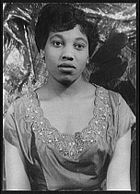
Aiming for a teaching career, Price enrolled in the music education program at the all-black Wilberforce College
Wilberforce University
Wilberforce University is a private, coed, liberal arts historically black university located in Wilberforce, Ohio. Affiliated with the African Methodist Episcopal Church, it was the first college to be owned and operated by African Americans...
in Wilberforce, Ohio
Wilberforce, Ohio
Wilberforce is a census-designated place in Greene County, Ohio, United States. The population was 1,579 at the 2000 census. The community was named for the English statesman William Wilberforce, who worked for abolition of slavery and achieved the end of the slave trade in the United Kingdom and...
. (This institution split in her junior year and she graduated from the publicly funded half, Central State College.) Her success in the glee club led to solo assignments, and she was encouraged to complete her studies in voice. She sang in the choir with another soon-to-be-famous singer, Betty Allen
Betty Allen
Betty Allen was a renowned American operatic mezzo-soprano who had an active international singing career during the 1950s through the 1970s...
. With the help of the Chisholms and the famous bass Paul Robeson
Paul Robeson
Paul Leroy Robeson was an American concert singer , recording artist, actor, athlete, scholar who was an advocate for the Civil Rights Movement in the first half of the twentieth century...
, who put on a benefit concert for her, she enrolled on a scholarship at the Juilliard School
Juilliard School
The Juilliard School, located at the Lincoln Center for the Performing Arts in New York City, United States, is a performing arts conservatory which was established in 1905...
in New York City, where she studied with Florence Page Kimball, who would remain her principal teacher and advisor throughout the 1960s.
Her first opera performance was as Mistress Ford in a 1952 student production of Verdi's Falstaff
Falstaff (opera)
Falstaff is an operatic commedia lirica in three acts by Giuseppe Verdi, adapted by Arrigo Boito from Shakespeare's plays The Merry Wives of Windsor and scenes from Henry IV. It was Verdi's last opera, written in the composer's ninth decade, and only the second of his 26 operas to be a comedy...
. Shortly thereafter, Virgil Thomson
Virgil Thomson
Virgil Thomson was an American composer and critic. He was instrumental in the development of the "American Sound" in classical music...
hired her for the revival of his all-black opera, Four Saints in Three Acts
Four Saints in Three Acts
Four Saints in Three Acts is an opera by American composer Virgil Thomson with a libretto by Gertrude Stein. Written in 1927-8, it contains about 20 saints, and is in at least four acts...
. After a two-week Broadway run, Saints went to Paris. Meanwhile, she had been cast as Bess in the Blevins Davis/Robert Breen revival of George Gershwin
George Gershwin
George Gershwin was an American composer and pianist. Gershwin's compositions spanned both popular and classical genres, and his most popular melodies are widely known...
's Porgy and Bess
Porgy and Bess
Porgy and Bess is an opera, first performed in 1935, with music by George Gershwin, libretto by DuBose Heyward, and lyrics by Ira Gershwin and DuBose Heyward. It was based on DuBose Heyward's novel Porgy and subsequent play of the same title, which he co-wrote with his wife Dorothy Heyward...
, and returned for the opening of the national tour at the Dallas State Fair, on June 9, 1952. The tour visited Chicago, Pittsburgh, and Washington, D.C, and then went on a tour of Europe, sponsored by the U.S. State Department.
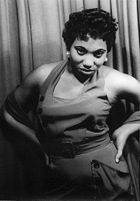
William Warfield
William Caesar Warfield , was an American concert bass-baritone singer and actor.-Early life and career:Warfield was born in West Helena, Arkansas and grew up in Rochester, New York, where his father was called to serve as pastor of Mt. Vernon Church. He gave his recital debut in New York's Town...
, who was singing Porgy in the Davis-Breen production, in a ceremony at the Abyssinian Baptist Church
Abyssinian Baptist Church
The Abyssinian Baptist Church is among the most famous of the many prominent and activist churches in the Harlem section of New York City.- History :...
in Harlem
Harlem
Harlem is a neighborhood in the New York City borough of Manhattan, which since the 1920s has been a major African-American residential, cultural and business center. Originally a Dutch village, formally organized in 1658, it is named after the city of Haarlem in the Netherlands...
, with many in the cast in attendance. In his memoir, My Music and My Life, Warfield describes how their careers forced them apart. They were legally separated in 1967, and divorced in 1973. They had no children.
At first, Price planned on a recital career, modeling herself after Anderson, tenor Roland Hayes
Roland Hayes
Roland Hayes was a lyric tenor and is considered the first African American male concert artist to receive wide international acclaim as well as at home...
, Warfield, and other great black concert singers. On occasional leaves from "Porgy," she sang new songs and song cycles by American composers, including Lou Harrison
Lou Harrison
Lou Silver Harrison was an American composer. He was a student of Henry Cowell, Arnold Schoenberg, and K. P. H. Notoprojo Lou Silver Harrison (May 14, 1917 – February 2, 2003) was an American composer. He was a student of Henry Cowell, Arnold Schoenberg, and K. P. H. Notoprojo Lou Silver Harrison...
, John La Montaine
John La Montaine
John La Montaine is an American composer, born in Oak Park, Illinois, who won the 1959 Pulitzer Prize for Music for his Piano Concerto no. 1, Op. 9, "In Time of War" , which was premiered by Jorge Bolet....
, and Samuel Barber
Samuel Barber
Samuel Osborne Barber II was an American composer of orchestral, opera, choral, and piano music. His Adagio for Strings is his most popular composition and widely considered a masterpiece of modern classical music...
.
However, her Bess proved she had the instincts and the voice for the operatic stage, and the Met
Metropolitan Opera
The Metropolitan Opera is an opera company, located in New York City. Originally founded in 1880, the company gave its first performance on October 22, 1883. The company is operated by the non-profit Metropolitan Opera Association, with Peter Gelb as general manager...
itself recognized this by inviting her to sing "Summertime" at a "Met Jamboree" fund-raiser on April 6, 1953 at the Ritz Theater on Broadway. Price was therefore the first African American to sing with the Met, if not at the Met. That distinction went to Marian Anderson, who, on January 7, 1955, sang Ulrica in Verdi's Un ballo in maschera
Un ballo in maschera
Un ballo in maschera , is an opera in three acts by Giuseppe Verdi with text by Antonio Somma. The libretto is loosely based on an 1833 play, Gustave III, by French playwright Eugène Scribe who wrote about the historical assassination of King Gustav III of Sweden...
.
Emergence
In November 1954, Price made her recital debut at New York's Town Hall with a program that featured the New York premiere of Samuel Barber's cycle, "Hermit Songs", with the composer at the piano. (They had performed the world premiere of the cycle the previous fall at the Library of Congress.) Then, opera opened its door to her through TV. In February 1955, she sang Puccini's "Tosca" for NBCNBC
The National Broadcasting Company is an American commercial broadcasting television network and former radio network headquartered in the GE Building in New York City's Rockefeller Center with additional major offices near Los Angeles and in Chicago...
-TV Opera, under music director Peter Herman Adler, and became the first black to appear in a leading role in televised opera. Several NBC affiliates (not all Southern) canceled the broadcast in protest.
That spring, Andre Mertens, Price's agent at Columbia Artists, arranged an audition for her at Carnegie Hall with the Austrian conductor Herbert von Karajan
Herbert von Karajan
Herbert von Karajan was an Austrian orchestra and opera conductor. To the wider world he was perhaps most famously associated with the Berlin Philharmonic, of which he was principal conductor for 35 years...
, then touring with the Berlin Philharmonic. Karajan declared her "an artist of the future" and invited her to sing Salome
Salome (opera)
Salome is an opera in one act by Richard Strauss to a German libretto by the composer, based on Hedwig Lachmann’s German translation of the French play Salomé by Oscar Wilde. Strauss dedicated the opera to his friend Sir Edgar Speyer....
under his baton at La Scala. (On the advice of Miss Kimball and Mertens, she declined.) In 1956 and 1957, Price made recital tours across the U.S. in the Community Concert series, and then toured India and Australia, sponsored by the U.S. State Department.
She took her first steps onto the grand operatic stage in San Francisco on September 20, 1957, singing Madame Lidoine in the U.S. premiere of Francis Poulenc
Francis Poulenc
Francis Jean Marcel Poulenc was a French composer and a member of the French group Les six. He composed solo piano music, chamber music, oratorio, choral music, opera, ballet music, and orchestral music...
's Dialogues des Carmélites. A few weeks later, Price sang her first Aida, stepping in for Italian soprano Antonietta Stella. The following May, she made her European debut at the Vienna Staatsoper on May 24, 1958, as Aida, under Karajan. There followed debuts at London's Royal Opera House
Royal Opera House
The Royal Opera House is an opera house and major performing arts venue in Covent Garden, central London. The large building is often referred to as simply "Covent Garden", after a previous use of the site of the opera house's original construction in 1732. It is the home of The Royal Opera, The...
, Covent Garden
Covent Garden
Covent Garden is a district in London on the eastern fringes of the West End, between St. Martin's Lane and Drury Lane. It is associated with the former fruit and vegetable market in the central square, now a popular shopping and tourist site, and the Royal Opera House, which is also known as...
(replacing Anita Cerquetti), and at the Arena di Verona, both in Aida. She returned to Vienna the following year to sing Aida and her first onstage Pamina in Die Zauberflöte, and in the summer of 1959, made her debut at the Salzburg Festival in the "Missa Solemnis," under Karajan.
Over the next decade, Karajan conducted Price in many of her greatest performances, in the opera house (Mozart's Don Giovanni
Don Giovanni
Don Giovanni is an opera in two acts with music by Wolfgang Amadeus Mozart and with an Italian libretto by Lorenzo Da Ponte. It was premiered by the Prague Italian opera at the Teatro di Praga on October 29, 1787...
, Verdi's Il trovatore
Il trovatore
Il trovatore is an opera in four acts by Giuseppe Verdi to an Italian libretto by Salvadore Cammarano, based on the play El Trovador by Antonio García Gutiérrez. Cammarano died in mid-1852 before completing the libretto...
and Puccini's Tosca), in the concert hall (Bach's B-minor Mass, Beethoven's Missa Solemnis
Missa Solemnis (Beethoven)
The Missa solemnis in D Major, Op. 123 was composed by Ludwig van Beethoven from 1819-1823. It was first performed on April 7, 1824 in St. Petersburg, under the auspices of Beethoven's patron Prince Nikolai Galitzin; an incomplete performance was given in Vienna on 7 May 1824, when the Kyrie,...
, Bruckner's Te Deum, and the Requiems of Verdi and Mozart), as well as in the recording studio (complete recordings of Tosca
Tosca
Tosca is an opera in three acts by Giacomo Puccini to an Italian libretto by Luigi Illica and Giuseppe Giacosa. It premiered at the Teatro Costanzi in Rome on 14 January 1900...
and Carmen
Carmen
Carmen is a French opéra comique by Georges Bizet. The libretto is by Henri Meilhac and Ludovic Halévy, based on the novella of the same title by Prosper Mérimée, first published in 1845, itself possibly influenced by the narrative poem The Gypsies by Alexander Pushkin...
, and a bestselling holiday music album A Christmas Offering--all of which are available on CD).
On May 21, 1960, she made her first appearance at the Teatro alla Scala, again as Aida. (She was not the first African American, however, to sing a leading role in Italy's leading opera house. Gloria Davy had sung Aida there in 1958, and Mattiwilda Dobbs
Mattiwilda Dobbs
Mattiwilda Dobbs is an African-American coloratura soprano and one of the first black singers to enjoy a major international career in opera...
had sung Elvira, the secondary lead soprano role in Rossini's L'italiana in Algeri
L'italiana in Algeri
L'italiana in Algeri is an operatic dramma giocoso in two acts by Gioachino Rossini to an Italian libretto by Angelo Anelli, based on his earlier text set by Luigi Mosca...
.)
Metropolitan Opera
The Metropolitan Opera invited Price to join the company in 1958, but she turned down the offer - apparently for a pair of performances as Aida - on the advice of friends, including Peter Herman AdlerPeter Herman Adler
Peter Herman Adler was an American conductor born in Austria–Hungary in Gablonz an der Neiße, which is now in the Czech Republic....
, director of NBC Opera. "Leontyne is to be a great artist," Adler said, according to William Warfield's autobiography. "When she makes her debut at the Met, she must do it as a lady, not a slave."
A year later, after hearing her in Il Trovatore at Verona, in a performance with tenor Franco Corelli
Franco Corelli
Franco Corelli was a famous Italian tenor who had a major international opera career between 1951 and 1976. Associated in particular with the spinto and dramatic tenor roles of the Italian repertory, he was celebrated universally for his powerhouse voice, electrifying top notes, clear timbre, a...
, Met General Manager Rudolf Bing offered her a season with multiple leading roles, and on January 27, 1961 she made a historic double-debut with Corelli in Trovatore. The ovation at the final curtain lasted at least 35 minutes, one of the longest in Met history. (Price claimed her friends had timed it at 42 minutes, and that was the figure used in much of her later publicity.) Price received the most attention in the reviews, prompting Corelli to tell Bing the next morning that he would never sing with her again. However, the vow was short-lived and Price and Corelli sang together often over the next ten years, at the Met, in Salzburg, and on records.
In his review, The New York Times
The New York Times
The New York Times is an American daily newspaper founded and continuously published in New York City since 1851. The New York Times has won 106 Pulitzer Prizes, the most of any news organization...
critic Harold Schonberg wrote that Price's "voice, warm and luscious, has enough volume to fill the house with ease, and she has a good technique to back up the voice itself. She even took the trills as written, and nothing in the part as Verdi wrote it gave her the least bit of trouble. She moves well and is a competent actress. But no soprano makes a career of acting. Voice is what counts, and voice is what Miss Price has."
In the next few weeks, Price gave her first Met performances as Aïda, Cio-Cio-San in Madama Butterfly
Madama Butterfly
Madama Butterfly is an opera in three acts by Giacomo Puccini, with an Italian libretto by Luigi Illica and Giuseppe Giacosa. Puccini based his opera in part on the short story "Madame Butterfly" by John Luther Long, which was dramatized by David Belasco...
, Donna Anna in Don Giovanni
Don Giovanni
Don Giovanni is an opera in two acts with music by Wolfgang Amadeus Mozart and with an Italian libretto by Lorenzo Da Ponte. It was premiered by the Prague Italian opera at the Teatro di Praga on October 29, 1787...
, and Liu in Turandot
Turandot
Turandot is an opera in three acts by Giacomo Puccini, set to a libretto in Italian by Giuseppe Adami and Renato Simoni.Though Puccini's first interest in the subject was based on his reading of Friedrich Schiller's adaptation of the play, his work is most nearly based on the earlier text Turandot...
. In the middle of this extraordinary run, equaled by only a few sopranos in the history of the Met, Time magazine put her on its cover. The next fall music critics named her "Musician of the Year" and she was put on the cover of "Musical America."
In September 1961, Price opened the Met season as Minnie in La fanciulla del West
La fanciulla del West
La fanciulla del West is an opera in three acts by Giacomo Puccini to an Italian libretto by Guelfo Civinini and Carlo Zangarini, based on the play The Girl of the Golden West by the American author David Belasco. Its highly-publicised premiere occurred in New York City in 1910...
. A musicians' strike had threatened to abort the season, but President Kennedy sent Secretary of Labor Arthur Goldberg
Arthur Goldberg
Arthur Joseph Goldberg was an American statesman and jurist who served as the U.S. Secretary of Labor, Supreme Court Justice and Ambassador to the United Nations.-Early life:...
to mediate a settlement. During the second "Fanciulla" performance, she had her first serious vocal crisis. In the middle of the second Act, Price grew hoarse and then lost her singing voice, and shouted her lines to the end of the scene. The standby, soprano Dorothy Kirsten
Dorothy Kirsten
Dorothy Kirsten was an American operatic soprano.-Biography:...
, was called to sing the third Act. The newspapers reported that Price had a virus. She returned after several weeks off, repeated the Fanciulla, and then, after a Butterfly in December, canceled other appearances and left for a three-month respite in Rome.
The official word was that she had never fully recovered from the earlier virus. However, Price later said she was suffering the pressure of overwork and her unwillinness to "say no." In April 1962, she returned to the Met for her first Met Tosca. That spring, she was featured on the Met's annual national tour, singing Tosca, "Butterfly," and two performances of Fanciulla, including one in Dallas that was the first performance by an African-American on the Met tour in the South.
Other African American singers had preceded her in leading roles at the Met.
However, Price was the first to build a career on both sides of the Atlantic, to return to the Met in multiple leading roles, and to earn the Met's top fee. In 1964, according to the Met archives, Leontyne Price was paid $2,750 per performance, on a par with Joan Sutherland
Joan Sutherland
Dame Joan Alston Sutherland, OM, AC, DBE was an Australian dramatic coloratura soprano noted for her contribution to the renaissance of the bel canto repertoire from the late 1950s through to the 1980s....
, Maria Callas
Maria Callas
Maria Callas was an American-born Greek soprano and one of the most renowned opera singers of the 20th century. She combined an impressive bel canto technique, a wide-ranging voice and great dramatic gifts...
and Renata Tebaldi
Renata Tebaldi
Renata Tebaldi was an Italian lirico-spinto soprano popular in the post-war period...
. At the time, Birgit Nilsson
Birgit Nilsson
right|thumb|Nilsson in 1948.Birgit Nilsson was a celebrated Swedish dramatic soprano who specialized in operatic and symphonic works...
, who was unique in singing Italian and Wagnerian roles, earned the Met's highest fee, $3,000 a performance.
Over the next five seasons, Price added seven more roles at the Met: (in chronological order) Elvira in Verdi's Ernani
Ernani
Ernani is an operatic dramma lirico in four acts by Giuseppe Verdi to an Italian libretto by Francesco Maria Piave, based on the play Hernani by Victor Hugo. The first production took place at La Fenice Theatre, Venice on 9 March 1844...
, Pamina in Mozart's Die Zauberflöte, Fiordiligi in Mozart's Così fan tutte
Così fan tutte
Così fan tutte, ossia La scuola degli amanti K. 588, is an opera buffa by Wolfgang Amadeus Mozart first performed in 1790. The libretto was written by Lorenzo Da Ponte....
, Tatyana in Tchaikovsky
Pyotr Ilyich Tchaikovsky
Pyotr Ilyich Tchaikovsky Pyotr Ilyich Tchaikovsky Pyotr Ilyich Tchaikovsky (Russian: Пётр Ильи́ч Чайко́вский ; often "Peter Ilich Tchaikovsky" in English. His names are also transliterated "Piotr" or "Petr"; "Ilitsch", "Il'ich" or "Illyich"; and "Tschaikowski", "Tschaikowsky", "Chajkovskij"...
's Eugene Onegin
Eugene Onegin (opera)
Eugene Onegin, Op. 24, is an opera in 3 acts , by Pyotr Ilyich Tchaikovsky. The libretto was written by Konstantin Shilovsky and the composer and his brother Modest, and is based on the novel in verse by Alexander Pushkin....
, Cleopatra in Barber's Antony and Cleopatra
Antony and Cleopatra (opera)
Antony and Cleopatra is an opera in three acts by American composer Samuel Barber. The libretto was prepared by Franco Zeffirelli based on the play Antony and Cleopatra by Shakespeare...
, Amelia in Un ballo in maschera
Un ballo in maschera
Un ballo in maschera , is an opera in three acts by Giuseppe Verdi with text by Antonio Somma. The libretto is loosely based on an 1833 play, Gustave III, by French playwright Eugène Scribe who wrote about the historical assassination of King Gustav III of Sweden...
, and Leonora in La forza del destino
La forza del destino
La forza del destino is an Italian opera by Giuseppe Verdi. The libretto was written by Francesco Maria Piave based on a Spanish drama, Don Álvaro o la fuerza del sino , by Ángel de Saavedra, Duke of Rivas, with a scene adapted from Friedrich Schiller's Wallensteins Lager. It was first performed...
. She was considered most suited to Verdi's "middle period" heroines, with their high, glowing lines and postures of noble grief and prayerful supplication. She also became the leading exponent of the plaintive soprano part in Verdi's Requiem.
Antony and Cleopatra
Another career milestone came on September 16, 1966, when Price sang Cleopatra in Antony and CleopatraAntony and Cleopatra (opera)
Antony and Cleopatra is an opera in three acts by American composer Samuel Barber. The libretto was prepared by Franco Zeffirelli based on the play Antony and Cleopatra by Shakespeare...
by American composer Samuel Barber
Samuel Barber
Samuel Osborne Barber II was an American composer of orchestral, opera, choral, and piano music. His Adagio for Strings is his most popular composition and widely considered a masterpiece of modern classical music...
, commissioned to open the Met's new house at Lincoln Center. Since their early collaborations, Price and Barber had remained close friends and colleagues, and the composer carefully tailored Cleopatra's music to Price's voice, with its sultry overtones and brilliant upper register.
The opera was widely considered a failure. Many blamed director Franco Zeffirelli
Franco Zeffirelli
Franco Zeffirelli KBE is an Italian director and producer of films and television. He is also a director and designer of operas and a former senator for the Italian center-right Forza Italia party....
for burying the music under heavy costumes and huge scenery. Others said Bing had underestimated the challenge of mounting an unprecedented five new productions that season, and relying heavily on new high-tech equipment. (An expensive new turntable broke down and during a dress rehearsal Price was trapped briefly inside a pyramid.) Still others complained that the problem was Barber's score, which drew on a difficult Shakespeare play and lacked satisfying set pieces. The opera was never revived at the Met. With the help of Gian Carlo Menotti
Gian Carlo Menotti
Gian Carlo Menotti was an Italian-American composer and librettist. Although he often referred to himself as an American composer, he kept his Italian citizenship. He wrote the classic Christmas opera, Amahl and the Night Visitors, among about two dozen other operas intended to appeal to popular...
, Barber later reworked the score for successful productions at the Juilliard School and the Spoleto Festival
Spoleto Festival USA
Spoleto Festival USA in Charleston, South Carolina, is one of the world's major performing arts festivals. It was founded in 1977 by Pulitzer Prize-winning composer Gian Carlo Menotti, who sought to establish a counterpart to the Festival dei Due Mondi in Spoleto, Italy...
in Charleston
Charleston, South Carolina
Charleston is the second largest city in the U.S. state of South Carolina. It was made the county seat of Charleston County in 1901 when Charleston County was founded. The city's original name was Charles Towne in 1670, and it moved to its present location from a location on the west bank of the...
. Barber also prepared a concert suite of Cleopatra's two arias, which Price premiered in Washington in 1968 and subsequently recorded.
Late opera career
In the late 1960s, Price cut back on opera in favor of recitals and concerts. She was tired, frustrated with the number (and quality) of the Met's new productions, and perhaps felt the need to rework her technique as her voice naturally aged. Amid scattered opera performances, she gave biennial recitals in all the major American cities and large university music series. She also appeared in recitals in Hamburg, Vienna, Paris, and the SalzburgSalzburg
-Population development:In 1935, the population significantly increased when Salzburg absorbed adjacent municipalities. After World War II, numerous refugees found a new home in the city. New residential space was created for American soldiers of the postwar Occupation, and could be used for...
Festival, where she became a favorite, appearing there in 1975, 1977, 1978, 1980, 1981, and 1984.
She undertook only three new operatic roles after 1970 and they brought her less acclaim than those of the previous decade: Giorgetta in Puccini's Il tabarro
Il tabarro
Il tabarro is an opera in one act by Giacomo Puccini to an Italian libretto by Giuseppe Adami, based on Didier Gold's play La houppelande. It is the first of the trio of operas known as Il trittico...
(in San Francisco), Puccini's Manon Lescaut
Manon Lescaut (Puccini)
Manon Lescaut is an opera in four acts by Giacomo Puccini. The story is based on the 1731 novel L’histoire du chevalier des Grieux et de Manon Lescaut by the Abbé Prévost....
, and Ariadne in Richard Strauss
Richard Strauss
Richard Georg Strauss was a leading German composer of the late Romantic and early modern eras. He is known for his operas, which include Der Rosenkavalier and Salome; his Lieder, especially his Four Last Songs; and his tone poems and orchestral works, such as Death and Transfiguration, Till...
' Ariadne auf Naxos
Ariadne auf Naxos
Ariadne auf Naxos is an opera by Richard Strauss with a German libretto by Hugo von Hofmannsthal. Bringing together slapstick comedy and consuming beautiful music, the opera's theme is the competition between high and low art for the public's attention.- First version :The opera was originally...
(both in San Francisco and New York). She was frequently called on as a soloist for state occasions. In January 1973, she sang "Precious Lord, Take My Hand" and "Onward, Christian Soldiers
Onward, Christian Soldiers
"Onward, Christian Soldiers" is a 19th century English hymn. The words were written by Sabine Baring-Gould in 1865, and the music was composed by Arthur Sullivan in 1871. Sullivan named the tune "St. Gertrude," after the wife of his friend Ernest Clay Ker Seymer, at whose country home he composed...
" at the state funeral
State funeral
A state funeral is a public funeral ceremony, observing the strict rules of protocol, held to honor heads of state or other important people of national significance. State funerals usually include much pomp and ceremony as well as religious overtones and distinctive elements of military tradition...
of President
President
A president is a leader of an organization, company, trade union, university, or country.Etymologically, a president is one who presides, who sits in leadership...
Lyndon Johnson, at whose inauguration she had sung in 1964. President Jimmy Carter
Jimmy Carter
James Earl "Jimmy" Carter, Jr. is an American politician who served as the 39th President of the United States and was the recipient of the 2002 Nobel Peace Prize, the only U.S. President to have received the Prize after leaving office...
invited her to sing a nationally televised recital at the White House
White House
The White House is the official residence and principal workplace of the president of the United States. Located at 1600 Pennsylvania Avenue NW in Washington, D.C., the house was designed by Irish-born James Hoban, and built between 1792 and 1800 of white-painted Aquia sandstone in the Neoclassical...
in 1978.
In October 1973, she returned to the Met to sing Butterfly for the first time in a decade, and received a half-hour ovation. In 1976, she sang Aida in a new Met production, with James McCracken as Radames and Marilyn Horne
Marilyn Horne
Marilyn Horne is an American mezzo-soprano opera singer. She specialized in roles requiring a large sound, beauty of tone, excellent breath support, and the ability to execute difficult coloratura passages....
as Amneris, directed by John Dexter
John Dexter
John Dexter was an English theatre, opera, and film director.- Theatre :Born in Derby, England, Dexter left school at the age of fourteen to serve in the British army during World War II. Following the war, he began working as a stage actor before turning to producing and directing shows for...
. The next year, she renewed her partnership with Karajan as soloist in Brahms Requiem with the Berlin Philharmonic at Carnegie Hall
Carnegie Hall
Carnegie Hall is a concert venue in Midtown Manhattan in New York City, United States, located at 881 Seventh Avenue, occupying the east stretch of Seventh Avenue between West 56th Street and West 57th Street, two blocks south of Central Park....
, and in Il trovatore
Il trovatore
Il trovatore is an opera in four acts by Giuseppe Verdi to an Italian libretto by Salvadore Cammarano, based on the play El Trovador by Antonio García Gutiérrez. Cammarano died in mid-1852 before completing the libretto...
in Salzburg and Vienna's Staatsoper. (She and Karajan were both returning after a 13-year hiatus, she having to refused to sing at the house after Karajan resigned as artistic director in 1964.)
In 1977, Price introduced her last new role, Strauss' Ariadne, in San Francisco, to an enthusiastic house and reviews. When she brought the role to the Met in 1979, she was suffering from a viral infection and had to cancel all but two of eight scheduled performances. Reviewing her first performance, the New York Times critic John Rockwell was not complimentary.
In fall 1981, she had a late triumph in San Francisco when she was asked to step in for soprano Margaret Price
Margaret Price
Dame Margaret Berenice Price, DBE was a Welsh soprano.-Early years:Price was born in Blackwood, Wales. Born with deformed legs, she was operated on at age four and suffered pain in her legs the rest of her life. She often looked after her younger brother John who was born with a mental handicap...
as Aida, a role she had not sung since 1976. San Francisco Chronicle columnist Herbert Caen reported that she had insisted on being paid $1 more than the tenor, Luciano Pavarotti. This would have made her, for the moment, the highest-paid opera singer in the world. The opera house denied this.
After revisiting in her most famous roles in San Francisco and at the Met, Price gave her operatic farewell at the Met on January 3, 1985, in a televised performance of Aida. Time Magazine described it as a "vocally stunning performance... that proved she can still capture her peak form." Donal Henahan
Donal Henahan
Donal Henahan is a retired American music critic and journalist who had lengthy associations with the Chicago Daily News and The New York Times...
wrote that the "57-year-old soprano took an act or two to warm to her work, but what she delivered in the Nile Scene turned out to be well worth the wait." In 2007, PBS viewers voted her singing of the aria, "O Patria Mia," as the #1 "Great Moment" in 30 years of "Live from the Met" telecasts. The performance ended with 25 minutes of applause.
In all, Price sang 201 performances with the Met, in 16 roles, in the house and on tour, including galas. (She was absent for three seasons—1970–71, 1977–78, and 1980-81—and sang only in galas in 1972-73, 1979–80, and 1982-83.)
Post-operatic career
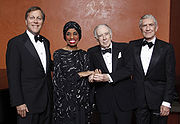
Ned Rorem
Ned Rorem is a Pulitzer prize-winning American composer and diarist. He is best known and most praised for his song settings.-Life:...
, and Lee Hoiby
Lee Hoiby
Lee Henry Hoiby was an American composer and classical pianist. Best known as a composer of operas and songs, he was a disciple of composer Gian Carlo Menotti. Like Menotti, his works championed lyricism during a time when such compositions were deemed old fashioned and irrelevant to modern society...
.
With time, Price's voice became darker and heavier, but her upper register held up well and the conviction and joy in her singing always spilled over the footlights. On November 19, 1997, she gave a recital at the University of North Carolina at Chapel Hill
University of North Carolina at Chapel Hill
The University of North Carolina at Chapel Hill is a public research university located in Chapel Hill, North Carolina, United States...
that turned out to be her last.
Price avoided the term African American, preferring to call herself an American, even a "chauvinistic American." She summed up her philosophy thus: "If you are going to think black, think positive about it. Don't think down on it, or think it is something in your way. And this way, when you really do want to stretch out, and express how beautiful black is, everybody will hear you."
Price gave several master classes at Juilliard and other schools. In 1997, at the suggestion of RCA-BMG, she wrote a children's book version of Aida
Aida (musical)
Aida is a musical with music by Elton John, lyrics by Tim Rice, and book by Linda Woolverton, Robert Falls, and David Henry Hwang, and produced by Walt Disney Theatrical....
, which became the basis for the hit Broadway musical by Elton John
Elton John
Sir Elton Hercules John, CBE, Hon DMus is an English rock singer-songwriter, composer, pianist and occasional actor...
and Tim Rice
Tim Rice
Sir Timothy Miles Bindon "Tim" Rice is an British lyricist and author.An Academy Award, Golden Globe Award, Tony Award and Grammy Award-winning lyricist, Rice is best known for his collaborations with Andrew Lloyd Webber, with whom he wrote Joseph and the Amazing Technicolor Dreamcoat, Jesus...
in 2000.
In October 2001, at age 74, Price was asked to come out of retirement to sing in a memorial concert at Carnegie Hall for the victims of the September 11 attacks. With James Levine at the piano, she sang a favorite spiritual, "This Little Light of Mine", followed by an unaccompanied "God Bless America", capping it with a bright, easy high B-flat. She lives in Greenwich Village
Greenwich Village
Greenwich Village, , , , .in New York often simply called "the Village", is a largely residential neighborhood on the west side of Lower Manhattan in New York City. A large majority of the district is home to upper middle class families...
in New York City.
Recordings
Leontyne Price's commercial recordings include three complete sets of Il trovatore, two of La forza del destino, two of Aida, two of Verdi's Requiem, two of Tosca, and one each of Ernani, Un ballo in maschera, Carmen, Madama Butterfly, Cosí fan tutte, Don Giovanni (as Donna Elvira), Il tabarro and (her final complete opera recording) Ariadne auf Naxos. She also recorded a disc of highlights from Porgy and Bess, singing the music of all three female leads. It was conducted by Skitch Henderson and featured William Warfield as Porgy.She recorded five Prima Donna albums of operatic arias of roles that she never performed on stage. She also recorded two albums of Richard Strauss arias, recitals of French and German art songs, two albums of Spirituals, and a crossover disc, Right as the Rain, with André Previn. Music by Samuel Barber that she recorded includes the "Hermit Songs", scenes from Antony and Cleopatra, and "Knoxville: Summer of 1915". These were reissued on CD as Leontyne Price Sings Barber. Her most popular operatic solo disc is her first, titled Leontyne Price, sometimes referred to as the "Blue Album." It has been released on CD, and lately on SACD. In 1996, on her 70th birthday, RCA-BMG issued a limited edition 11-CD boxed collection of her recordings, with an accompanying book, titled The Essential Leontyne Price.
Archival recordings of live performances have also been released. Deutsche Grammophon released CDs in the Salzburger Festspiel Dokeumenten series of her 1960 "Missa Solemnis," and a 1962 performance of Il trovatore, both conducted by Karajan. In 2002, RCA discovered a shelved tape pf her 1965 Carnegie Hall recital debut and released it in the "Rediscovered" series. In 2005, Bridge Records released her complete 1953 Library of Congress recital with Barber, including the "Hermit Songs," Henri Sauguet's "La Voyante", and songs by Poulenc. In August 2008, a tape of a Berplin erformance of the Breen-Davis "Porgy and Bess" in September 1952 was found in the Berlin radio archives and released on CD--the earliest recorded glimpse of Price's voice and style. In 2011, Sony Classics brought out CD sets of her first Met broadcast performances, Il trovatore (1961) and Tosca (1962).
Critical appreciation
In The Grand Tradition, a 1974 history of operatic recording, the British critic J.B. SteaneJ.B. Steane
John Barry Steane was an English music critic, musicologist, literary scholar and teacher, with a particular interest in singing and the human voice...
writes that "one might conclude from recordings that [Price] is the best interpreter of Verdi of the century." For the Russian soprano Galina Vishnevskaya
Galina Vishnevskaya
Galina Pavlovna Vishnevskaya is a Russian soprano opera singer and recitalist who was named a People's Artist of the USSR in 1966.-Biography:...
, a 1963 Price performance of Tosca at the Vienna State Opera "left me with the strongest impression I have ever gotten from opera." In his 1983 autobiography, Plácido Domingo
Plácido Domingo
Plácido Domingo KBE , born José Plácido Domingo Embil, is a Spanish tenor and conductor known for his versatile and strong voice, possessing a ringing and dramatic tone throughout its range...
writes, "The power and sensuousness of Leontyne's voice were phenomenal--the most beautiful Verdi soprano I have ever heard."
In an interview, Price once recalled that Maria Callas
Maria Callas
Maria Callas was an American-born Greek soprano and one of the most renowned opera singers of the 20th century. She combined an impressive bel canto technique, a wide-ranging voice and great dramatic gifts...
had told her, during a meeting with the older diva in Paris, "I hear a lot of love in your voice." The sopranos Renee Fleming
Renée Fleming
Renée Fleming is an American soprano specializing in opera and lieder. Fleming has a full lyric soprano voice.Fleming has performed coloratura, lyric, and lighter spinto soprano repertoires. She has sung roles in Italian, German, French, Czech, and Russian, aside from her native English. She also...
, Kiri Te Kanawa
Kiri Te Kanawa
Dame Kiri Jeanette Te Kanawa, ONZ, DBE, AC is a New Zealand / Māori soprano who has had a highly successful international opera career since 1968. Acclaimed as one of the most beloved sopranos in both the United States and Britain she possesses a warm full lyric soprano voice, singing a wide array...
, Jessye Norman
Jessye Norman
Jessye Norman is an American opera singer. Norman is a well-known contemporary opera singer and recitalist, and is one of the highest paid performers in classical music...
Leona Mitchell
Leona Mitchell
Leona Mitchell , is an African-American and Chickasaw operatic soprano and an Oklahoma Music Hall of Fame inductee....
, Barbara Bonney
Barbara Bonney
-Early life:Bonney was born in Montclair, New Jersey. As a child she studied piano and cello. When Bonney was 13 her family moved to Maine, where she became part of the Portland Youth Orchestra as a cellist...
, Sondra Radvanovsky
Sondra Radvanovsky
Sondra Radvanovsky is an American soprano. Sondra was born in Berwyn, Illinois, a suburb of Chicago, on April 11, 1969. She lived and attended high school in Richmond, Indiana, a small city which, despite its size, had its own opera company...
, the mezzo-soprano Denyce Graves
Denyce Graves
Denyce Graves is an American mezzo-soprano opera singer.-Early life:Graves was born on March 7, 1964, to Charles Graves and Dorothy Graves-Kenner. She is the middle of three children and was raised by her mother on Galveston Street, S.W., in the Bellevue section of Washington...
, bass-baritone Jose Van Dam
José van Dam
Joseph, Baron van Damme , known as José van Dam, is a Belgian bass-baritone.At the age of 17, he entered the Brussels Royal Conservatory and studied with Frederic Anspach. A year later, he graduated with diplomas and first prizes in voice and opera performance...
, and the countertenor David Daniels
David Daniels
-Youth:Daniels was born in Spartanburg, South Carolina, the son of two singing teachers. He began to sing as a boy soprano, moving to tenor as his voice matured. His father, Perry Daniels, was one of the pre-eminent members of the performing faculty during each summer at Brevard Music Center,...
, talk about Price as an early inspiration.
Miles Davis
Miles Davis
Miles Dewey Davis III was an American jazz musician, trumpeter, bandleader, and composer. Widely considered one of the most influential musicians of the 20th century, Miles Davis was, with his musical groups, at the forefront of several major developments in jazz music, including bebop, cool jazz,...
, in Miles The Autobiography, writes: "Man, I love her as an artist. I love the way she sings Tosca. I wore out her recording of that, wore out two sets. Now, I might not do Tosca, but I loved the way Leontyne did it. I used to wonder how she would have sounded if she had sung jazz. She should be an inspiration for every musician, black or white. I know she is to me."
She has also had her critics. In his book The American Opera Singer, Peter G. Davis wrote that Price had "a fabulous vocal gift that went largely unfulfilled," criticizing her reluctance to try new roles, her Tosca for its lack of a "working chest register", and her late Aidas for a "swooping" vocal line. Others criticized her lack of flexibility in florid music, and her occasional mannerisms, including scooping or swooping up to high notes, gospel-style. Karajan took her to task for these during rehearsals for the 1977 Il trovatore, as Price herself related in an interview in Diva, by Helena Matheopoulos. In later recordings and appearances, she sang with a cleaner line.
Her acting, too, drew different responses over a long career. As Bess, she was praised for her dramatic fire and sensuality, and tapes of the early NBC Opera appearances show her an appealing presence on camera. In her early Met years, she was often praised for her dramatic as well as vocal skill.
In March 2007, on BBC Music magazine's list of the "20 All-time Best Sopranos" based on a poll of 21 British music critics and BBC presenters, Leontyne Price was ranked fourth, after, in order, Maria Callas
Maria Callas
Maria Callas was an American-born Greek soprano and one of the most renowned opera singers of the 20th century. She combined an impressive bel canto technique, a wide-ranging voice and great dramatic gifts...
, Dame Joan Sutherland, and Victoria de los Ángeles
Victoria de los Ángeles
Victoria de los Ángeles was a Spanish Catalan operatic soprano and recitalist whose career began in the early 1940s and reached its height in the years from the mid-1950s to the mid-1960s. Her obituary in The Times noted that she must be counted “among the finest singers of the second half...
.
Books
- Sir Rudolf Bing, 5,000 Nights at the Opera: The Memoirs of Sir Rudolf Bing (Doubleday, 1972).
- Peter G. Davis, The American Opera Singer: The Lives and Adventures of America's Great Singers in Opera and Concert from 1825 to the Present (Anchor, 1999).
- Plácido Domingo, My First Forty Years (Alfred A. Knopf, 1983).
- Peter G. Davis, The American Opera Singer (Doubleday, 1997).
- Barbara B. Heyman, Samuel Barber, The Composer and His Music (Oxford University Press, 1992).
- Helena Matheopolous, Diva: Sopranos and Mezzo-sopranos Discuss Their Art (Northeastern University Press, 1992).
- Luciano Pavarotti with William Wright, Pavarotti, My Own Story (Doubleday, 1981), ISBN 978-0-3851-5340-9
- Stephen Rubin, The New Met (MacMillan, 1974).
- Winthrop Sargeant, Divas (Coward, McCann, Geohegan, 1973).
- J.B. Steane, The Grand Tradition: Seventy Years of Singing on Record (Timber Press, 1993).
- Robert Vaughan, Herbert von Karajan (W.W. Norton & Company, 1986).
- Galina Vishneyskaya, Galina, A Russian Story (Harvest/HBJ Book, 1985).
- William Warfield, with Alton Miller, William Warfield: My Music and My Life (Sagamore Publishing, 1991).
Articles
- "From Collard Greens to Caviar: Leontyne Price Reminisces", Opera News, July and August 1985.
- "Reunion: Justino Diaz", by Eric Myers, Opera News, March 2006, Vol. 70, No. 9
- "Time After Time", Stephen Blier reviews "The Essential Leontyne Price" CD collection, Opera News, October 1996
- "The Garbo of Opera", by David Perkins, News and Observer (Raleigh, North Carolina), October 5, 1986
- "Leontyne Price Ill, To Rest for Month", New York Times, December 23, 1961
- "Where Atlanta's 'Big Mules' Relax", Time, January 10, 1977 (on 1964 "Don Giovanni" controversy)