

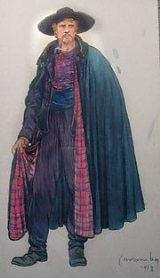
Il tabarro

Encyclopedia
Il tabarro is an opera
in one act by Giacomo Puccini
to an Italian
libretto
by Giuseppe Adami
, based on Didier Gold's play La houppelande. It is the first of the trio of operas known as Il trittico
. The first performance was given on December 14, 1918 at Metropolitan Opera
in New York City
.
.jpg)
It is close to sundown in Paris, and the stevedores work unloading Michele's barge. Giorgetta, Michele's wife, asks her husband if she can bring wine
to the workers. He agrees but does not join them because she refuses his kiss. The stevedores start dancing to the music of a nearby organ grinder and one of them steps on Giorgetta's foot. Luigi, a stevedore, dances with her, and it is evident that there is something between them. Upon hearing of Michele's return the stevedores' gathering breaks up.
Work is getting scarce and Giorgetta and Michele discuss which of the stevedores should be dismissed; she prefers that it be anyone other than Luigi despite this being Michele's first choice. Soon the conversation turns into a fight. La Frugola enters, looking for Talpa, one of the stevedores and her husband. She shows everyone the fruits of her scavenging in Paris and scolds the men for their drinking. Luigi laments his lot in life, and La Frugola sings of her wish to one day buy a house in the country that she and her husband can retire to. Giorgetta and Luigi sing a duet remembering the town they were both born in.
The stevedores depart except for Luigi who asks Michele to dismiss him and that he be allowed to disembark in Rouen
, but Michele convinces him against this notion. When alone, Giorgetta asks Luigi why he requested to be dismissed and they acknowledge their mutual love. They plan to meet later that evening upon the signal of a match being lit on-board. By now Luigi seems very determined to kill Michele and flee with Giorgetta.

Michele reminisces with Giorgetta of the days before their child died and how all three would fit under his cloak. He is distressed about the fact that he is twice her age; she comforts him but she will still not kiss him. Michele wonders if his wife is still faithful to him and ponders who might have changed her so much. He reviews for himself the list of all the men that have shared in their lives but dismisses all of them as improbable. Michele then lights his pipe and Luigi, seeing it from afar, thinks that it is Giorgetta's signal. He returns to the barge only to be confronted by Michele. In the ensuing fight Michele gets the upper hand and forces Luigi to confess his affair before killing him and hiding the body under his cloak. Giorgetta returns to the barge, feigning remorse, and Michele opens wide the cloak to reveal her dead lover.
Opera
Opera is an art form in which singers and musicians perform a dramatic work combining text and musical score, usually in a theatrical setting. Opera incorporates many of the elements of spoken theatre, such as acting, scenery, and costumes and sometimes includes dance...
in one act by Giacomo Puccini
Giacomo Puccini
Giacomo Antonio Domenico Michele Secondo Maria Puccini was an Italian composer whose operas, including La bohème, Tosca, Madama Butterfly, and Turandot, are among the most frequently performed in the standard repertoire...
to an Italian
Italian language
Italian is a Romance language spoken mainly in Europe: Italy, Switzerland, San Marino, Vatican City, by minorities in Malta, Monaco, Croatia, Slovenia, France, Libya, Eritrea, and Somalia, and by immigrant communities in the Americas and Australia...
libretto
Libretto
A libretto is the text used in an extended musical work such as an opera, operetta, masque, oratorio, cantata, or musical. The term "libretto" is also sometimes used to refer to the text of major liturgical works, such as mass, requiem, and sacred cantata, or even the story line of a...
by Giuseppe Adami
Giuseppe Adami
Giuseppe Adami was an Italian librettist, known for his collaboration with Puccini on La rondine , Il tabarro and Turandot ....
, based on Didier Gold's play La houppelande. It is the first of the trio of operas known as Il trittico
Il trittico
Il trittico is the title of a collection of three one-act operas, Il tabarro, Suor Angelica, and Gianni Schicchi, by Giacomo Puccini...
. The first performance was given on December 14, 1918 at Metropolitan Opera
Metropolitan Opera
The Metropolitan Opera is an opera company, located in New York City. Originally founded in 1880, the company gave its first performance on October 22, 1883. The company is operated by the non-profit Metropolitan Opera Association, with Peter Gelb as general manager...
in New York City
New York City
New York is the most populous city in the United States and the center of the New York Metropolitan Area, one of the most populous metropolitan areas in the world. New York exerts a significant impact upon global commerce, finance, media, art, fashion, research, technology, education, and...
.
Roles
| Role | Voice type | Premiere cast 14 December 1918 (Conductor: Roberto Moranzoni) |
|---|---|---|
| Michele, a barge-owner | baritone Baritone Baritone is a type of male singing voice that lies between the bass and tenor voices. It is the most common male voice. Originally from the Greek , meaning deep sounding, music for this voice is typically written in the range from the second F below middle C to the F above middle C Baritone (or... |
Luigi Montesanto |
| Giorgetta, Michele's wife | soprano Soprano A soprano is a voice type with a vocal range from approximately middle C to "high A" in choral music, or to "soprano C" or higher in operatic music. In four-part chorale style harmony, the soprano takes the highest part, which usually encompasses the melody... |
Claudia Muzio Claudia Muzio Claudia Muzio was an Italian operatic soprano, whose international career was among the most successful of the early 20th century.-Early years:... |
| Luigi, a stevedore Stevedore Stevedore, dockworker, docker, dock labourer, wharfie and longshoreman can have various waterfront-related meanings concerning loading and unloading ships, according to place and country.... |
tenor Tenor The tenor is a type of male singing voice and is the highest male voice within the modal register. The typical tenor voice lies between C3, the C one octave below middle C, to the A above middle C in choral music, and up to high C in solo work. The low extreme for tenors is roughly B2... |
Giulio Crimi Giulio Crimi Giulio Crimi was an Italian operatic tenor.Crimi was born in Paternò, Italy. He studied in Catania with Adernò and made his debut in Palermo, as Manrico in Il trovatore, in 1910, later appearing in Treviso as Hagenbach in La Wally... |
| 'Tinca' ('tench'), a stevedore | tenor | Angelo Badà Angelo Badà Angelo Badà was an Italian operatic tenor. He had a lengthy association with the Metropolitan Opera of New York City where he gave a total of 2,170 performance in 94 different operas in over 100 different roles from 1908 through 1938. Only two singers in the Met's history have made more... |
| 'Talpa' ('mole'), a stevedore | bass | Adamo Didur Adamo Didur Adamo Didur was a top-class Polish operatic bass vocalist. He sang extensively in opera in Europe and appeared at New York's Metropolitan Opera from 1908 to 1932.-Career:... |
| La Frugola ('the rummager'), Talpa's wife | mezzo-soprano Mezzo-soprano A mezzo-soprano is a type of classical female singing voice whose range lies between the soprano and the contralto singing voices, usually extending from the A below middle C to the A two octaves above... |
Alice Gentle Alice Gentle Alice Gentle was an American operatic mezzo-soprano. She began her career in 1908 as a member of the opera chorus in Oscar Hammerstein I's Manhattan Opera Company... |
| Stevedores, a ballad-seller, midinettes, an organ-grinder, two lovers | ||
Synopsis
- Place: A bargeBargeA barge is a flat-bottomed boat, built mainly for river and canal transport of heavy goods. Some barges are not self-propelled and need to be towed by tugboats or pushed by towboats...
on the SeineSeineThe Seine is a -long river and an important commercial waterway within the Paris Basin in the north of France. It rises at Saint-Seine near Dijon in northeastern France in the Langres plateau, flowing through Paris and into the English Channel at Le Havre . It is navigable by ocean-going vessels...
in ParisParisParis is the capital and largest city in France, situated on the river Seine, in northern France, at the heart of the Île-de-France region...
. - Time: 1910.
It is close to sundown in Paris, and the stevedores work unloading Michele's barge. Giorgetta, Michele's wife, asks her husband if she can bring wine
Wine
Wine is an alcoholic beverage, made of fermented fruit juice, usually from grapes. The natural chemical balance of grapes lets them ferment without the addition of sugars, acids, enzymes, or other nutrients. Grape wine is produced by fermenting crushed grapes using various types of yeast. Yeast...
to the workers. He agrees but does not join them because she refuses his kiss. The stevedores start dancing to the music of a nearby organ grinder and one of them steps on Giorgetta's foot. Luigi, a stevedore, dances with her, and it is evident that there is something between them. Upon hearing of Michele's return the stevedores' gathering breaks up.
Work is getting scarce and Giorgetta and Michele discuss which of the stevedores should be dismissed; she prefers that it be anyone other than Luigi despite this being Michele's first choice. Soon the conversation turns into a fight. La Frugola enters, looking for Talpa, one of the stevedores and her husband. She shows everyone the fruits of her scavenging in Paris and scolds the men for their drinking. Luigi laments his lot in life, and La Frugola sings of her wish to one day buy a house in the country that she and her husband can retire to. Giorgetta and Luigi sing a duet remembering the town they were both born in.
The stevedores depart except for Luigi who asks Michele to dismiss him and that he be allowed to disembark in Rouen
Rouen
Rouen , in northern France on the River Seine, is the capital of the Haute-Normandie region and the historic capital city of Normandy. Once one of the largest and most prosperous cities of medieval Europe , it was the seat of the Exchequer of Normandy in the Middle Ages...
, but Michele convinces him against this notion. When alone, Giorgetta asks Luigi why he requested to be dismissed and they acknowledge their mutual love. They plan to meet later that evening upon the signal of a match being lit on-board. By now Luigi seems very determined to kill Michele and flee with Giorgetta.
Michele reminisces with Giorgetta of the days before their child died and how all three would fit under his cloak. He is distressed about the fact that he is twice her age; she comforts him but she will still not kiss him. Michele wonders if his wife is still faithful to him and ponders who might have changed her so much. He reviews for himself the list of all the men that have shared in their lives but dismisses all of them as improbable. Michele then lights his pipe and Luigi, seeing it from afar, thinks that it is Giorgetta's signal. He returns to the barge only to be confronted by Michele. In the ensuing fight Michele gets the upper hand and forces Luigi to confess his affair before killing him and hiding the body under his cloak. Giorgetta returns to the barge, feigning remorse, and Michele opens wide the cloak to reveal her dead lover.
Arias
- "Hai ben ragione! meglio non pensare" — Luigi
- "Nulla! Silenzio!" — Michele
- "Scorri, fiume eterno" — Michele. This more contemplative aria for Michele was later replaced by Puccini with the vengeful "Nulla! Silenzio!". The Leinsdorf and Gardelli recordings both include it as an addendum.
Recordings
| Year | Cast (Michele, Giorgetta, Luigi) |
Conductor, Opera House and Orchestra |
Label |
|---|---|---|---|
| 1955 | Tito Gobbi Tito Gobbi Tito Gobbi was an Italian operatic baritone with an international reputation.-Biography:Tito Gobbi was born in Bassano del Grappa and studied law at the University of Padua before he trained as a singer. Giulio Crimi, a well-known Italian tenor of a previous generation, was Gobbi's teacher in Rome... , Margaret Mas, Giacinto Prandelli Giacinto Prandelli Giacinto Prandelli was an Italian operatic tenor, particularly associated with the Italian and French repertoires.-Life and career:Born in Lumezzane, Italy, Prandelli sang as a boy in a church choir... |
Vincenzo Bellezza, Chorus and Orchestra of the Rome Opera House |
Audio CD: EMI Classics EMI The EMI Group, also known as EMI Music or simply EMI, is a multinational music company headquartered in London, United Kingdom. It is the fourth-largest business group and family of record labels in the recording industry and one of the "big four" record companies. EMI Group also has a major... Cat: 5099921294921 |
| 1962 | Robert Merrill Robert Merrill Robert Merrill was an American operatic baritone.-Early life:Merrill was born Moishe Miller, later known as Morris Miller, in the Williamsburg section of Brooklyn, New York, to tailor Abraham Miller, originally Milstein, and his wife Lillian, née Balaban, immigrants from Warsaw, Poland.His mother... , Renata Tebaldi Renata Tebaldi Renata Tebaldi was an Italian lirico-spinto soprano popular in the post-war period... , Mario del Monaco Mario del Monaco Mario Del Monaco was an Italian tenor who is regarded by his admirers as being one of the greatest dramatic tenors of the 20th century.... |
Lamberto Gardelli Lamberto Gardelli Lamberto Gardelli was an Italian conductor, particularly associated with the Italian opera repertory, especially the works of Giuseppe Verdi.... , Orchestra e coro del Maggio Musicale Fiorentino Maggio Musicale Fiorentino Maggio Musicale Fiorentino is an annual opera festival which was founded in April 1933 by conductor Vittorio Gui with the aim of presenting contemporary and forgotten operas in visually dramatic productions. It was the first music festival in Italy. The first opera presented was Verdi's early... |
Audio CD: Decca Decca Records Decca Records began as a British record label established in 1929 by Edward Lewis. Its U.S. label was established in late 1934; however, owing to World War II, the link with the British company was broken for several decades.... Cat: 000289 475 7625 9 |
| 1971 | Sherrill Milnes Sherrill Milnes Sherrill Milnes is an American operatic baritone most famous for his Verdi roles. From 1965 until 1997 he was associated with the Metropolitan Opera.... , Leontyne Price Leontyne Price Mary Violet Leontyne Price is an American soprano. Born and raised in the Deep South, she rose to international acclaim in the 1950s and 1960s, and was one of the first African Americans to become a leading artist at the Metropolitan Opera.One critic characterized Price's voice as "vibrant",... , Plácido Domingo Plácido Domingo Plácido Domingo KBE , born José Plácido Domingo Embil, is a Spanish tenor and conductor known for his versatile and strong voice, possessing a ringing and dramatic tone throughout its range... |
Erich Leinsdorf Erich Leinsdorf Erich Leinsdorf was a naturalized American Austrian conductor. He performed and recorded with leading orchestras and opera companies throughout the United States and Europe, earning a reputation for exacting standards as well as an acerbic personality... , New Philharmonia Orchestra Philharmonia Orchestra The Philharmonia Orchestra is one of the leading orchestras in Great Britain, based in London. Since 1995, it has been based in the Royal Festival Hall. In Britain it is also the resident orchestra at De Montfort Hall, Leicester and the Corn Exchange, Bedford, as well as The Anvil, Basingstoke... |
Audio CD: RCA Victor |
| 1977 | Ingvar Wixell Ingvar Wixell Ingvar Wixell was a Swedish baritone who had an active international career in operas and concerts from 1955-2003. He mostly sang roles from the Italian repertory, and, according to The New York Times, "was best known for his steady-toned, riveting portrayals of the major baritone roles of... , Renata Scotto Renata Scotto Renata Scotto is an Italian soprano and opera director.Recognized for her sense of style, musicality and as a remarkable singer-actress, Scotto is considered one of the preeminent singers of her generation, specializing in the bel canto repertoire with excursions into the verismo and Verdi... , Plácido Domingo Plácido Domingo Plácido Domingo KBE , born José Plácido Domingo Embil, is a Spanish tenor and conductor known for his versatile and strong voice, possessing a ringing and dramatic tone throughout its range... |
Lorin Maazel Lorin Maazel Lorin Varencove Maazel is an American conductor, violinist and composer.- Early life :Maazel was born to Jewish-American parents in Neuilly-sur-Seine in France and brought up in the United States, primarily at his parents' home in Pittsburgh's Oakland neighborhood. His father, Lincoln Maazel , was... , New Philharmonia Orchestra Philharmonia Orchestra The Philharmonia Orchestra is one of the leading orchestras in Great Britain, based in London. Since 1995, it has been based in the Royal Festival Hall. In Britain it is also the resident orchestra at De Montfort Hall, Leicester and the Corn Exchange, Bedford, as well as The Anvil, Basingstoke... |
Audio CD: Sony Classical Sony Classical Records Sony Classical Records was started in 1927 as Columbia Masterworks Records, a subsidiary of the American Columbia Records. In 1948, it issued the first commercially successful long-playing 12" record... Cat: 88697527292 |
| 1994 | Juan Pons Juan Pons Joan Pons Álvarez , is a Spanish dramatic baritone, known internationally as Juan Pons.-Career:With his outstandingly successful international début in 1980 at the Teatro alla Scala of Milan with Falstaff, staged by Giorgio Strehler and conducted by Lorin Maazel, Juan Pons has revealed himself as... , Mirella Freni Mirella Freni Mirella Freni, birth name Mirella Fregni, is an Italian opera soprano whose repertoire includes Verdi, Puccini, Mozart and Tchaikovsky... , Giuseppe Giacomini |
Bruno Bartoletti, Orchestra e coro del Maggio Musicale Fiorentino Maggio Musicale Fiorentino Maggio Musicale Fiorentino is an annual opera festival which was founded in April 1933 by conductor Vittorio Gui with the aim of presenting contemporary and forgotten operas in visually dramatic productions. It was the first music festival in Italy. The first opera presented was Verdi's early... |
Audio CD: Decca Decca Records Decca Records began as a British record label established in 1929 by Edward Lewis. Its U.S. label was established in late 1934; however, owing to World War II, the link with the British company was broken for several decades.... Cat: 000289 478 0341 6 |
| 1994 | Juan Pons Juan Pons Joan Pons Álvarez , is a Spanish dramatic baritone, known internationally as Juan Pons.-Career:With his outstandingly successful international début in 1980 at the Teatro alla Scala of Milan with Falstaff, staged by Giorgio Strehler and conducted by Lorin Maazel, Juan Pons has revealed himself as... , Teresa Stratas Teresa Stratas Teresa Stratas, OC , is a retired Canadian operatic soprano. She is especially well-known for her award-winning recording of Alban Berg's Lulu.-Early life and career:... , Plácido Domingo Plácido Domingo Plácido Domingo KBE , born José Plácido Domingo Embil, is a Spanish tenor and conductor known for his versatile and strong voice, possessing a ringing and dramatic tone throughout its range... |
James Levine James Levine James Lawrence Levine is an American conductor and pianist. He is currently the music director of the Metropolitan Opera and former music director of the Boston Symphony Orchestra. Levine's first performance conducting the Metropolitan Opera was on June 5, 1971, and as of May 2011 he has... , Metropolitan Opera Metropolitan Opera The Metropolitan Opera is an opera company, located in New York City. Originally founded in 1880, the company gave its first performance on October 22, 1883. The company is operated by the non-profit Metropolitan Opera Association, with Peter Gelb as general manager... orchestra and chorus |
DVD Video: Deutsche Grammophon Deutsche Grammophon Deutsche Grammophon is a German classical record label which was the foundation of the future corporation to be known as PolyGram. It is now part of Universal Music Group since its acquisition and absorption of PolyGram in 1999, and it is also UMG's oldest active label... Cat: 000440 073 4024 0 |
| 1997 | Carlo Guelfi, Maria Guleghina Maria Guleghina Maria Agasovna Guleghina is a Ukrainian-Russian soprano opera singer, particularly associated with the Italian repertory.-Biography:Maria Guleghina was born in Odessa, Ukraine , to an Armenian father and a Ukrainian mother, where she studied voice at the Music Conservatory with Evgeny Nikolaevich... , Neil Shicoff Neil Shicoff Neil Shicoff is an American Jewish opera singer and cantor known for his lyric tenor singing and his dramatic, emotional acting.- Beginnings :... |
Antonio Pappano Antonio Pappano Antonio Pappano is a British conductor and pianist of Italian parentage.Pappano's family relocated to England from Castelfranco in Miscano near Benevento, Italy in 1958 and at the time of his birth his parents worked in the restaurant business, but Pasquale Pappano, his father, was by vocation a... , London Voices London Voices London Voices is a London-based choral ensemble led by Terry Edwards, who founded the ensemble in 1973... & London Symphony Orchestra London Symphony Orchestra The London Symphony Orchestra is a major orchestra of the United Kingdom, as well as one of the best-known orchestras in the world. Since 1982, the LSO has been based in London's Barbican Centre.-History:... |
Audio CD: EMI Classics EMI The EMI Group, also known as EMI Music or simply EMI, is a multinational music company headquartered in London, United Kingdom. It is the fourth-largest business group and family of record labels in the recording industry and one of the "big four" record companies. EMI Group also has a major... Cat: 0724355658722 |