

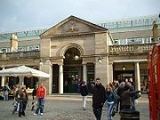
Covent Garden

Encyclopedia
Covent Garden is a district in London
on the eastern fringes of the West End
, between St. Martin's Lane
and Drury Lane
. It is associated with the former fruit and vegetable market in the central square, now a popular shopping and tourist site, and the Royal Opera House
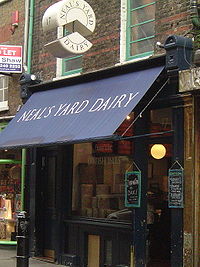
, which is also known as "Covent Garden". The district is divided by the main thoroughfare of Long Acre, north of which is given over to independent shops centred on Neal's Yard
and Seven Dials
, while the south contains the central square with its street performers and most of the elegant buildings, theatres and entertainment facilities, including the Theatre Royal, Drury Lane
, and the London Transport Museum.
Though mainly fields until the 16th century, the area was briefly settled when it became the heart of the Anglo-Saxon trading town of Lundenwic. After the town was abandoned, part of the area was walled off for use as arable land
and orchards by Westminster Abbey
, and was referred to as "the garden of the Abbey and Convent". The land, now called "the Covent Garden", was seized by Henry VIII
, and granted to the Earls of Bedford
in 1552. The 4th Earl
commissioned Inigo Jones
to build some fine houses to attract wealthy tenants. Jones designed the Italianate arcaded square along with the church of St Paul's
. The design of the square was new to London, and had a significant influence on modern town planning, acting as the prototype for the laying-out of new estates as London grew. A small open-air fruit and vegetable market had developed on the south side of the fashionable square by 1654. Gradually, both the market and the surrounding area fell into disrepute, as taverns, theatres, coffee-houses and brothels opened up; the gentry moved away, and rakes, wits and playwrights moved in. By the 18th century it had become a well-known red-light district
, attracting notable prostitutes. An Act of Parliament was drawn up to control the area, and Charles Fowler
's neo-classical building was erected in 1830 to cover and help organise the market. The area declined as a pleasure-ground as the market grew and further buildings were added: the Floral Hall, Charter Market, and in 1904 the Jubilee Market. By the end of the 1960s traffic congestion was causing problems, and in 1974 the market relocated to the New Covent Garden Market
about three miles (5 km) south-west at Nine Elms
. The central building re-opened as a shopping centre in 1980, and is now a tourist location containing cafes, pubs, small shops, and a craft market called the Apple Market, along with another market held in the Jubilee Hall.
Covent Garden, with the postcode WC2
, falls within the London boroughs of Westminster
and Camden
, and the parliamentary constituencies of Cities of London and Westminster
and Holborn and St Pancras. The area has been served by the Piccadilly line
at Covent Garden tube station
since 1907; the journey from Leicester Square, at 300 yards, is the shortest in London.
as part of a route to Silchester
, known as "Iter VII" on the Antonine Itinerary
. Excavations in 2006 at St Martin-in-the-Fields
revealed a Roman grave, suggesting the site had sacred significance. The area to the north of the Strand was long thought to have remained as unsettled fields until the 16th century, but theories by Alan Vince
and Martin Biddle
that there had been an Anglo-Saxon
settlement to the west of the old Roman town of Londinium
were borne out by excavations in 1985 and 2005. These revealed Covent Garden as the centre of a trading town called Lundenwic, developed around 600 AD, which stretched from Trafalgar Square
to Aldwych
. Alfred the Great
gradually shifted the settlement into the old Roman town of Londinium from around 886 AD onwards, leaving no mark of the old town, and the site returned to fields.
Around 1200 the first mention of an abbey garden appears in a document mentioning a walled garden owned by the Benedictine monks of the Abbey of St. Peter, Westminster. A later document, dated between 1250 and 1283, refers to "the garden of the Abbot and Convent of Westminster". By the 13th century this had become a 40 acres (16.2 ha) quadrangle of mixed orchard, meadow, pasture and arable land, lying between modern-day St. Martin's Lane and Drury Lane, and Floral Street and Maiden Lane. The use of the name "Covent"—an Anglo-French term for a religious community, equivalent to "monastery" or "convent"—appears in a document in 1515, when the Abbey, which had been letting out parcels of land along the north side of the Strand for inns and market gardens, granted a lease of the walled garden, referring to it as "a garden called Covent Garden". This is how it was recorded from then on.
in 1540, Henry VIII
took for himself the land belonging to Westminster Abbey, including the convent garden and seven acres to the north called Long Acre; and in 1552 his son, Edward VI
, granted it to John Russell, 1st Earl of Bedford
. The Russell family, who in 1694 were advanced in their peerage
from Earl to Duke of Bedford
, held the land from 1552 to 1918.
Russell had Bedford House and garden built on part of the land, with an entrance on the Strand, the large garden stretching back along the south side of the old walled-off convent garden. Apart from this, and allowing several poor-quality tenements
to be erected, the Russells did little with the land until the 4th Earl of Bedford, Francis Russell
, an active and ambitious businessman, commissioned Inigo Jones in 1630 to design and build a church and three terraces of fine houses around a large square or piazza. The commission had been prompted by Charles I
taking offence at the condition of the road and houses along Long Acre, which were the responsibility of Russell and Henry Carey, 2nd Earl of Monmouth
. Russell and Carey complained that under the 1625 Proclamation concerning Buildings, which restricted building in and around London, they could not build new houses; the King then granted Russell, for a fee of £2,000, a licence to build as many new houses on his land as he "shall thinke fitt and convenient". The church of St Paul's
was the first building, begun in July 1631 on the western side of the square. The last house was completed in 1637.
The houses initially attracted the wealthy, though when a market developed on the south side of the square around 1654, the aristocracy moved out and coffee houses, taverns, and prostitutes moved in. The Bedford Estate was expanded in 1669 to include Bloomsbury
, when Lord Russell
married Lady Rachel Vaughan
, one of the daughters of the 4th Earl of Southampton.
By the 18th century Covent Garden had become a well-known red-light district, attracting notable prostitutes such as Betty Careless
and Jane Douglas
. Descriptions of the prostitutes and where to find them were provided by Harris's List of Covent Garden Ladies
, the "essential guide and accessory for any serious gentleman of pleasure". In 1830 a market hall was built to provide a more permanent trading centre. In 1913, Herbrand Russell, 11th Duke of Bedford
agreed to sell the Covent Garden Estate for £2 million to the MP and land speculator Harry Mallaby-Deeley, who sold his option in 1918 to the Beecham family for £250,000.
of St Margaret
. During a reorganisation in 1542 it was transferred to St Martin in the Fields
, and then in 1645 a new parish was created, splitting governance of the estate between the parishes of St Paul Covent Garden
and St Martin, both still within the Liberty of Westminster
. St Paul Covent Garden was completely surrounded by the parish of St Martin in the Fields. It was grouped into the Strand District in 1855 when it came within the area of responsibility of the Metropolitan Board of Works
.
In 1889 the parish became part of the County of London
and in 1900 it became part of the Metropolitan Borough of Westminster
. It was abolished as a civil parish in 1922. Since 1965 Covent Garden falls within the London boroughs of Westminster
and Camden
, and is in the Parliamentary constituencies of Cities of London and Westminster
and Holborn and St Pancras.
from 1924 to 1928, after which time it was managed by a successor company called Covent Garden Properties Company Limited, owned by the Beechams and other private investors. This new company sold some properties at Covent Garden, while becoming active in property investment in other parts of London. In 1962 the bulk of the remaining properties in the Covent Garden area, including the market, were sold to the newly established government-owned Covent Garden Authority for £3,925,000.
By the end of the 1960s, traffic congestion had reached such a level that the use of the square as a modern wholesale distribution market was becoming unsustainable, and significant redevelopment was planned. Following a public outcry, buildings around the square were protected in 1973, preventing redevelopment. The following year the market moved to a new site in south-west London. The square languished until its central building re-opened as a shopping centre in 1980. An action plan was drawn up by Westminster Council in 2004 in consultation with residents and businesses to improve the area while retaining its historic character. The market buildings, along with several other properties in Covent Garden, were bought by a property company in 2006.
. Shelton Street, running parallel to the north of Long Acre, marks the boundary between Westminster Council and Camden London Borough Council
. Long Acre is the main thoroughfare, running north-east from St Martin's Lane to Drury Lane.
The area to the south of Long Acre contains the Royal Opera House, the market and central square, and most of the elegant buildings, theatres and entertainment facilities, including the Theatre Royal, Drury Lane, and the London Transport Museum; while the area to the north of Long Acre is largely given over to independent retail units centred on Neal Street, Neal's Yard and Seven Dials; though this area also contains residential buildings such as Odhams Walk, built in 1981 on the site of the Odhams print works, and is home to over 6,000 residents.
 The area's historic association with the retail and entertainment economy continues. In 1979, Covent Garden Market reopened as a retail centre; in 2010, the largest Apple Store in the world opened in The Piazza. The central hall has shops, cafes and bars alongside the Apple Market stalls selling antiques, jewellery, clothing and gifts; there are additional casual stalls in the Jubilee Hall Market on the south side of the square. Long Acre has a range of clothes shops and boutiques, and Neal Street is noted for its large number of shoe shops. London Transport Museum and the side entrance to the Royal Opera House box office and other facilities are also located on the square. During the late 1970s and 1980s the Rock Garden music venue was popular with up and coming punk rock and New Wave artists.
The market halls and several other buildings in Covent Garden were bought by CapCo in partnership with GE Real Estate in August 2006 for £421 million, on a 150-year head lease. The buildings are let to the Covent Garden Area Trust, who pay an annual peppercorn rent
of one red apple and a posy of flowers for each head lease, and the Trust protects the property from being redeveloped. In March 2007 CapCo also acquired the shops located under the Royal Opera House.
The complete Covent Garden Estate owned by CapCo consists of 550000 sq ft (51,096.7 m²), and has a market value of £650 million.
. During the first hundred years or so of its history, the theatre was primarily a playhouse, with the Letters Patent granted by Charles II giving Covent Garden and Theatre Royal, Drury Lane exclusive rights to present spoken drama in London. In 1734, the first ballet was presented; a year later Handel
's first season of operas began. Many of his operas and oratorio
s were specifically written for Covent Garden and had their premières here. It has been the home of The Royal Opera
since 1945, and the Royal Ballet
since 1946.
The current building is the third theatre on the site following destructive fires in 1808 and 1857. The façade, foyer and auditorium were designed by Edward Barry
, and date from 1858, but almost every other element of the present complex dates from an extensive £178 million reconstruction in the 1990s. The Royal Opera House seats 2,268 people and consists of four tiers of boxes and balconies and the amphitheatre gallery. The stage performance area is roughly 15 metres square. The main auditorium is a Grade 1 listed building. The inclusion of the adjacent old Floral Hall, previously a part of the old Covent Garden Market, created a new and extensive public gathering place. In 1779 the pavement outside the playhouse was the scene of the murder of Martha Ray
, mistress of the Earl of Sandwich
, by her admirer the Rev. James Hackman
.
with low railings. A casual market started on the south side, and by 1830 the present market hall was built. The space is popular with street performers, who audition with the site's owners for an allocated slot. The square was originally laid out in 1630 when the 4th Earl of Bedford, Francis Russell, commissioned Inigo Jones to design and build a church and three terraces of fine houses around the site of a former walled garden belonging to Westminster Abbey. Jones's design was informed by his knowledge of modern town planning in Europe, particularly Leghorn in Tuscany, Piazza San Marco
in Venice, Piazza Santissima Annunziata in Florence, and the Place des Vosges
in Paris. The centrepiece of the project was the large square, the concept of which was new to London, and this had a significant influence on modern town planning in the city, acting as the prototype for the laying-out of new estates as the metropolis grew. Isaac de Caus
, the French Huguenot architect, designed the individual houses under Jones's overall design.
The church of St Paul's
was the first building, and was begun in July 1631 on the western side of the square. The last house was completed in 1637. Seventeen of the houses had arcaded
portico
walks organised in groups of four and six either side of James Street on the north side, and three and four either side of Russell Street. These arcades, rather than the square itself, took the name Piazza; the group from James Street to Russell Street became known as the "Great Piazza" and that to the south of Russell Street as the "Little Piazza". None of Inigo Jones's houses remain, though part of the north group was reconstructed in 1877–79 as Bedford Chambers by William Cubitt
to a design by Henry Clutton
.
in 1670 for a fruit and vegetable market, permitting him and his heirs to hold a market every day except Sundays and Christmas Day. The original market, consisting of wooden stalls and sheds, became disorganised and disorderly, and the 6th Earl requested an Act of Parliament in 1813 to regulate it, then commissioned Charles Fowler
in 1830 to design and build the neo-classical market building that is the heart of Covent Garden today. Further buildings were added—the Floral hall, Charter Market, and in 1904 the Jubilee Market for foreign flowers was built by Cubitt and Howard.
By the end of the 1960s, traffic congestion was causing problems for the market, which required increasingly large lorries for deliveries and distribution. Redevelopment was considered, but protests from the Covent Garden Community Association in 1973 prompted the Home Secretary, Robert Carr
, to give dozens of buildings around the square listed-building status, preventing redevelopment. The following year the market relocated to its new site, New Covent Garden Market, about three miles (5 km) south-west at Nine Elms. The central building re-opened as a shopping centre in 1980, with cafes, pubs, small shops and a craft market called the Apple Market. Another market, the Jubilee Market, is held in the Jubilee Hall on the south side of the square. The market halls and several other buildings in Covent Garden have been owned by the property company Capital & Counties Properties
(CapCo) since 2006.
granted rights in London for the production of drama, and had a claim to be one of London's leading theatres. The first theatre, known as "Theatre Royal, Bridges Street", saw performances by Nell Gwyn
and Charles Hart
. After it was destroyed by fire in 1672, English dramatist and theatre manager Thomas Killigrew
engaged Christopher Wren
to build a larger theatre on the same spot, which opened in 1674. This building lasted nearly 120 years, under leadership including Colley Cibber
, David Garrick
, and Richard Brinsley Sheridan
. In 1791, under Sheridan's management, the building was demolished to make way for a larger theatre which opened in 1794; but that survived only 15 years, burning down in 1809. The building that stands today opened in 1812. It has been home to actors as diverse as Shakespearean actor Edmund Kean
, child actress Clara Fisher
, comedian Dan Leno
, the comedy troupe Monty Python
(who recorded a concert album there), and musical composer and performer Ivor Novello
. Since November 2008 the theatre has been owned by composer Andrew Lloyd Webber
and generally stages popular musical theatre. It is a Grade I listed building.
iron and glass building on the east side of the market square. It was designed as a dedicated flower market by William Rogers of William Cubitt and Company in 1871, and was first occupied by the museum in 1980. Previously the transport collection had been held at Syon Park and Clapham
. The first parts of the collection were brought together at the beginning of the 20th century by the London General Omnibus Company
(LGOC) when it began to preserve buses being retired from service. After the LGOC was taken over by the London Electric Railway (LER), the collection was expanded to include rail vehicles. It continued to expand after the LER became part of the London Passenger Transport Board
in the 1930s and as the organisation passed through various successor bodies up to TfL, London's transport authority since 2000. The Covent Garden building has on display many examples of buses, trams, trolleybus
es and rail vehicles from 19th and 20th centuries as well as artefacts and exhibits related to the operation and marketing of passenger services and the impact that the developing transport network has had on the city and its population.
; though it is believed that the columns are original—the rest is mostly Georgian or Victorian reconstruction.
in 1977, and the area remains focused on young people with its trendy mid-market retail outlets.
's diary in May 1662, when he recorded the first mention of a Punch and Judy
show in Britain. Impromptu performances of song and swimming were given by local celebrity William Cussans
in the eighteenth century. Covent Garden is licensed for street entertainment, and performers audition for timetabled slots in a number of venues around the market, including the North Hall, West Piazza, and South Hall Courtyard. The courtyard space is dedicated to classical music only. There are street performances at Covent Garden Market every day of the year, except Christmas Day. Shows run throughout the day and are about 30 minutes in length. In March 2008, the market owner, CapCo, proposed to reduce street performances to one 30-minute show each hour.
. The Harp in Chandos Place has received several awards, including London Pub of the Year in 2008 by the Society for the Preservation of Beers from the Wood
, and National Pub of the Year
by CAMRA in 2011. It was at one time owned by the Charrington Brewery, when it was known as The Welsh Harp; in 1995 the name was abbreviated to just The Harp, before Charrington sold it to Punch Taverns
in 1997. It has been owned by the landlady since 2010. The Lamb & Flag in Rose Street has a reputation as the oldest pub in the area, though records are not clear. The first mention of a pub on the site is 1772 (when it was called the Cooper's Arms – the name changing to Lamb & Flag in 1833); the 1958 brick exterior conceals what may be an early 18th century frame of a house replacing the original one built in 1638. The pub acquired a reputation for staging bare-knuckle prize fights during the early 19th century when it earned the nickname "Bucket of Blood". The alleyway beside the pub was the scene of an attack on John Dryden
in 1679 by thugs hired by John Wilmot, 2nd Earl of Rochester
, with whom he had a long-standing conflict. The Salisbury in St. Martin's Lane was built as part of a six-storey block around 1899 on the site of an earlier pub that had been known under several names, including the Coach & Horses and Ben Caunt's Head; it is both Grade II listed, and on CAMRA's National Inventory, due to the quality of the etched and polished glass and the carved woodwork, summed up as "good fin de siècle
ensemble".
's play, Pygmalion
, and the musical adaptation by Alan Jay Lerner
, My Fair Lady
, is a Covent Garden flower seller. Alfred Hitchcock
's 1972 film Frenzy
about a Covent Garden fruit vendor who becomes a serial sex killer, was set in the market where his father had been a wholesale greengrocer. The daily activity of the market was the topic of a 1957 Free Cinema
documentary by Lindsay Anderson
, Every Day Except Christmas
, which won the Grand Prix at the Venice Festival of Shorts and Documentaries.
at Covent Garden tube station
on the corner of Long Acre and James Street. The station was opened by Great Northern, Piccadilly and Brompton Railway
on 11 April 1907, four months after services on the rest of the line began operating on 15 December 1906. Platform access is only by lift or stairs; until improvements to the exit gates in 2007, due to high passenger numbers (16 million annually), London Underground had to advise travellers to get off at Leicester Square and walk the short distance (the tube journey at less than 300 yards is London's shortest) to avoid the congestion. Stations just outside the area include the Charing Cross tube station
and Charing Cross railway station
, Leicester Square tube station
, and Holborn tube station
. While there is only one bus route in Covent Garden itself—the RV1
, which uses Catherine Street as a terminus, just to the east of Covent Garden square—there are over 30 routes which pass close by, mostly on the Strand or the Kingsway
.
Community
London
London is the capital city of :England and the :United Kingdom, the largest metropolitan area in the United Kingdom, and the largest urban zone in the European Union by most measures. Located on the River Thames, London has been a major settlement for two millennia, its history going back to its...
on the eastern fringes of the West End
West End of London
The West End of London is an area of central London, containing many of the city's major tourist attractions, shops, businesses, government buildings, and entertainment . Use of the term began in the early 19th century to describe fashionable areas to the west of Charing Cross...
, between St. Martin's Lane
St. Martin's Lane
St. Martin's Lane is a street on the edge of Covent Garden in Central London, which runs from the church of St. Martin-in-the-Fields, after which it is named, near Trafalgar Square northwards to Long Acre.A narrow street with relatively little traffic, St...
and Drury Lane
Drury Lane
Drury Lane is a street on the eastern boundary of the Covent Garden area of London, running between Aldwych and High Holborn. The northern part is in the borough of Camden and the southern part in the City of Westminster....
. It is associated with the former fruit and vegetable market in the central square, now a popular shopping and tourist site, and the Royal Opera House
Royal Opera House
The Royal Opera House is an opera house and major performing arts venue in Covent Garden, central London. The large building is often referred to as simply "Covent Garden", after a previous use of the site of the opera house's original construction in 1732. It is the home of The Royal Opera, The...
, which is also known as "Covent Garden". The district is divided by the main thoroughfare of Long Acre, north of which is given over to independent shops centred on Neal's Yard
Neal's Yard
Neal's Yard is a small alley in Covent Garden between Shorts Gardens and Monmouth Street which opens into a courtyard. It is named after the 17th century developer, Thomas Neale. It now contains several health food cafes and new age retailers such as Neal's Yard Remedies, Neal's Yard Dairy, World...
and Seven Dials
Seven Dials
Seven Dials is a small but well-known road junction in the West End of London in Covent Garden where seven streets converge. At the centre of the roughly-circular space is a pillar bearing six sundials, a result of the pillar being commissioned before a late stage alteration of the plans from an...
, while the south contains the central square with its street performers and most of the elegant buildings, theatres and entertainment facilities, including the Theatre Royal, Drury Lane
Theatre Royal, Drury Lane
The Theatre Royal, Drury Lane is a West End theatre in Covent Garden, in the City of Westminster, a borough of London. The building faces Catherine Street and backs onto Drury Lane. The building standing today is the most recent in a line of four theatres at the same location dating back to 1663,...
, and the London Transport Museum.
Though mainly fields until the 16th century, the area was briefly settled when it became the heart of the Anglo-Saxon trading town of Lundenwic. After the town was abandoned, part of the area was walled off for use as arable land
Arable land
In geography and agriculture, arable land is land that can be used for growing crops. It includes all land under temporary crops , temporary meadows for mowing or pasture, land under market and kitchen gardens and land temporarily fallow...
and orchards by Westminster Abbey
Westminster Abbey
The Collegiate Church of St Peter at Westminster, popularly known as Westminster Abbey, is a large, mainly Gothic church, in the City of Westminster, London, United Kingdom, located just to the west of the Palace of Westminster. It is the traditional place of coronation and burial site for English,...
, and was referred to as "the garden of the Abbey and Convent". The land, now called "the Covent Garden", was seized by Henry VIII
Henry VIII of England
Henry VIII was King of England from 21 April 1509 until his death. He was Lord, and later King, of Ireland, as well as continuing the nominal claim by the English monarchs to the Kingdom of France...
, and granted to the Earls of Bedford
Earl of Bedford
Earl of Bedford is a title that has been created three times in the Peerage of England. The first creation came in 1138 in favour Hugh de Beaumont. He appears to have been degraded from the title three or four years after its creation. However, the existence of the title altogether has been...
in 1552. The 4th Earl
Francis Russell, 4th Earl of Bedford
Francis Russell, 4th Earl of Bedford PC was an English politician. About 1631 he built the square of Covent Garden, with the piazza and church of St. Paul's, employing Inigo Jones as his architect...
commissioned Inigo Jones
Inigo Jones
Inigo Jones is the first significant British architect of the modern period, and the first to bring Italianate Renaissance architecture to England...
to build some fine houses to attract wealthy tenants. Jones designed the Italianate arcaded square along with the church of St Paul's
St Paul's, Covent Garden
St Paul's Church, also commonly known as the Actors' Church, is a church designed by Inigo Jones as part of a commission by Francis Russell, 4th Earl of Bedford in 1631 to create "houses and buildings fitt for the habitacons of Gentlemen and men of ability" in Covent Garden, London, England.As well...
. The design of the square was new to London, and had a significant influence on modern town planning, acting as the prototype for the laying-out of new estates as London grew. A small open-air fruit and vegetable market had developed on the south side of the fashionable square by 1654. Gradually, both the market and the surrounding area fell into disrepute, as taverns, theatres, coffee-houses and brothels opened up; the gentry moved away, and rakes, wits and playwrights moved in. By the 18th century it had become a well-known red-light district
Red-light district
A red-light district is a part of an urban area where there is a concentration of prostitution and sex-oriented businesses, such as sex shops, strip clubs, adult theaters, etc...
, attracting notable prostitutes. An Act of Parliament was drawn up to control the area, and Charles Fowler
Charles Fowler
Charles Fowler , English architect, was born at Cullompton, Devon.After serving an apprenticeship of seven years with John Powning of Exeter, he went to London in 1814, and entered the office of David Laing, where he remained until he commenced practice for himself...
's neo-classical building was erected in 1830 to cover and help organise the market. The area declined as a pleasure-ground as the market grew and further buildings were added: the Floral Hall, Charter Market, and in 1904 the Jubilee Market. By the end of the 1960s traffic congestion was causing problems, and in 1974 the market relocated to the New Covent Garden Market
New Covent Garden Market
'New Covent Garden Market' is the largest wholesale fruit, vegetable and flower market in the UK. Located in Nine Elms between Vauxhall and Battersea, South West London, the Market covers a site of 57 acres and is home to approximately 200 fruit, vegetable and flower companies.The Market serves...
about three miles (5 km) south-west at Nine Elms
Nine Elms
Nine Elms is a suburb of London, situated in the far north-eastern corner of the London Borough of Wandsworth between Battersea and Vauxhall.It is primarily an industrial area, dominated by Battersea Power Station, Battersea Dogs and Cats Home, railway lines, a major Royal Mail sorting office and...
. The central building re-opened as a shopping centre in 1980, and is now a tourist location containing cafes, pubs, small shops, and a craft market called the Apple Market, along with another market held in the Jubilee Hall.
Covent Garden, with the postcode WC2
WC postcode area
The WC postcode area, also known as the London WC postcode area, is a group of postcode districts in central London, England. It includes parts of the London Borough of Camden, City of Westminster, London Borough of Islington and a very small part of the City of London. The area covered is of...
, falls within the London boroughs of Westminster
City of Westminster
The City of Westminster is a London borough occupying much of the central area of London, England, including most of the West End. It is located to the west of and adjoining the ancient City of London, directly to the east of the Royal Borough of Kensington and Chelsea, and its southern boundary...
and Camden
London Borough of Camden
In 1801, the civil parishes that form the modern borough were already developed and had a total population of 96,795. This continued to rise swiftly throughout the 19th century, as the district became built up; reaching 270,197 in the middle of the century...
, and the parliamentary constituencies of Cities of London and Westminster
Cities of London and Westminster (UK Parliament constituency)
Cities of London and Westminster is a borough constituency covering the area comprising the City of London and southern portion of the City of Westminster in Central London...
and Holborn and St Pancras. The area has been served by the Piccadilly line
Piccadilly Line
The Piccadilly line is a line of the London Underground, coloured dark blue on the Tube map. It is the fifth busiest line on the Underground network judged by the number of passengers transported per year. It is mainly a deep-level line, running from the north to the west of London via Zone 1, with...
at Covent Garden tube station
Covent Garden tube station
Covent Garden is a London Underground station in Covent Garden. It is on the Piccadilly Line between Leicester Square and Holborn. The station is a Grade II listed building, on the corner of Long Acre and James Street...
since 1907; the journey from Leicester Square, at 300 yards, is the shortest in London.
Early history
The route of the Strand on the southern boundary of what was to become Covent Garden was used during the Roman periodRoman Britain
Roman Britain was the part of the island of Great Britain controlled by the Roman Empire from AD 43 until ca. AD 410.The Romans referred to the imperial province as Britannia, which eventually comprised all of the island of Great Britain south of the fluid frontier with Caledonia...
as part of a route to Silchester
Silchester
Silchester is a village and civil parish about north of Basingstoke in Hampshire. It is adjacent to the county boundary with Berkshire and about south-west of Reading....
, known as "Iter VII" on the Antonine Itinerary
Antonine Itinerary
The Antonine Itinerary is a register of the stations and distances along the various roads of the Roman empire, containing directions how to get from one Roman settlement to another...
. Excavations in 2006 at St Martin-in-the-Fields
St Martin-in-the-Fields
St Martin-in-the-Fields is an Anglican church at the north-east corner of Trafalgar Square in the City of Westminster, London. Its patron is Saint Martin of Tours.-Roman era:Excavations at the site in 2006 led to the discovery of a grave dated about 410...
revealed a Roman grave, suggesting the site had sacred significance. The area to the north of the Strand was long thought to have remained as unsettled fields until the 16th century, but theories by Alan Vince
Alan Vince
Dr. Alan George Vince was a British archaeologist who transformed the study of Saxon, medieval and early modern ceramics through the application of petrological, geological and archaeological techniques...
and Martin Biddle
Martin Biddle
Martin Biddle is a British archaeologist. He was educated at Merchant Taylors' School. His work was important in the development of medieval and post-medieval archaeology in Great Britain.-Excavations:* Nonsuch Palace 1959-1960* Winchester 1961-1971...
that there had been an Anglo-Saxon
Anglo-Saxon
Anglo-Saxon may refer to:* Anglo-Saxons, a group that invaded Britain** Old English, their language** Anglo-Saxon England, their history, one of various ships* White Anglo-Saxon Protestant, an ethnicity* Anglo-Saxon economy, modern macroeconomic term...
settlement to the west of the old Roman town of Londinium
Londinium
The city of London was established by the Romans around AD 43. It served as a major imperial commercial centre until its abandonment during the 5th century.-Origins and language:...
were borne out by excavations in 1985 and 2005. These revealed Covent Garden as the centre of a trading town called Lundenwic, developed around 600 AD, which stretched from Trafalgar Square
Trafalgar Square
Trafalgar Square is a public space and tourist attraction in central London, England, United Kingdom. At its centre is Nelson's Column, which is guarded by four lion statues at its base. There are a number of statues and sculptures in the square, with one plinth displaying changing pieces of...
to Aldwych
Aldwych
Aldwych is a place and road in the City of Westminster in London, England.-Description:Aldwych, the road, is a crescent, connected to the Strand at both ends. At its centre, it meets the Kingsway...
. Alfred the Great
Alfred the Great
Alfred the Great was King of Wessex from 871 to 899.Alfred is noted for his defence of the Anglo-Saxon kingdoms of southern England against the Vikings, becoming the only English monarch still to be accorded the epithet "the Great". Alfred was the first King of the West Saxons to style himself...
gradually shifted the settlement into the old Roman town of Londinium from around 886 AD onwards, leaving no mark of the old town, and the site returned to fields.
Around 1200 the first mention of an abbey garden appears in a document mentioning a walled garden owned by the Benedictine monks of the Abbey of St. Peter, Westminster. A later document, dated between 1250 and 1283, refers to "the garden of the Abbot and Convent of Westminster". By the 13th century this had become a 40 acres (16.2 ha) quadrangle of mixed orchard, meadow, pasture and arable land, lying between modern-day St. Martin's Lane and Drury Lane, and Floral Street and Maiden Lane. The use of the name "Covent"—an Anglo-French term for a religious community, equivalent to "monastery" or "convent"—appears in a document in 1515, when the Abbey, which had been letting out parcels of land along the north side of the Strand for inns and market gardens, granted a lease of the walled garden, referring to it as "a garden called Covent Garden". This is how it was recorded from then on.
The Bedford Estate (1552–1918)
After the Dissolution of the MonasteriesDissolution of the Monasteries
The Dissolution of the Monasteries, sometimes referred to as the Suppression of the Monasteries, was the set of administrative and legal processes between 1536 and 1541 by which Henry VIII disbanded monasteries, priories, convents and friaries in England, Wales and Ireland; appropriated their...
in 1540, Henry VIII
Henry VIII of England
Henry VIII was King of England from 21 April 1509 until his death. He was Lord, and later King, of Ireland, as well as continuing the nominal claim by the English monarchs to the Kingdom of France...
took for himself the land belonging to Westminster Abbey, including the convent garden and seven acres to the north called Long Acre; and in 1552 his son, Edward VI
Edward VI of England
Edward VI was the King of England and Ireland from 28 January 1547 until his death. He was crowned on 20 February at the age of nine. The son of Henry VIII and Jane Seymour, Edward was the third monarch of the Tudor dynasty and England's first monarch who was raised as a Protestant...
, granted it to John Russell, 1st Earl of Bedford
John Russell, 1st Earl of Bedford
John Russell, 1st Earl of Bedford, KG, PC, JP was an English royal minister in the Tudor era. He served variously as Lord High Admiral and Lord Privy Seal....
. The Russell family, who in 1694 were advanced in their peerage
Peerage
The Peerage is a legal system of largely hereditary titles in the United Kingdom, which constitute the ranks of British nobility and is part of the British honours system...
from Earl to Duke of Bedford
Duke of Bedford
thumb|right|240px|William Russell, 1st Duke of BedfordDuke of Bedford is a title that has been created five times in the Peerage of England. The first creation came in 1414 in favour of Henry IV's third son, John, who later served as regent of France. He was made Earl of Kendal at the same time...
, held the land from 1552 to 1918.
Russell had Bedford House and garden built on part of the land, with an entrance on the Strand, the large garden stretching back along the south side of the old walled-off convent garden. Apart from this, and allowing several poor-quality tenements
Apartment
An apartment or flat is a self-contained housing unit that occupies only part of a building...
to be erected, the Russells did little with the land until the 4th Earl of Bedford, Francis Russell
Francis Russell, 4th Earl of Bedford
Francis Russell, 4th Earl of Bedford PC was an English politician. About 1631 he built the square of Covent Garden, with the piazza and church of St. Paul's, employing Inigo Jones as his architect...
, an active and ambitious businessman, commissioned Inigo Jones in 1630 to design and build a church and three terraces of fine houses around a large square or piazza. The commission had been prompted by Charles I
Charles I of England
Charles I was King of England, King of Scotland, and King of Ireland from 27 March 1625 until his execution in 1649. Charles engaged in a struggle for power with the Parliament of England, attempting to obtain royal revenue whilst Parliament sought to curb his Royal prerogative which Charles...
taking offence at the condition of the road and houses along Long Acre, which were the responsibility of Russell and Henry Carey, 2nd Earl of Monmouth
Henry Carey, 2nd Earl of Monmouth
Henry Carey, 2nd Earl of Monmouth was an English nobleman and translator born in Bolton, Lancashire, England to Robert Carey, 1st Earl of Monmouth and Elizabeth Trevannion. On 6 November 1652 Henry married Martha Cranfield daughter of Lionel Cranfield, 1st Earl of Middlesex and Elizabeth Shepard...
. Russell and Carey complained that under the 1625 Proclamation concerning Buildings, which restricted building in and around London, they could not build new houses; the King then granted Russell, for a fee of £2,000, a licence to build as many new houses on his land as he "shall thinke fitt and convenient". The church of St Paul's
St Paul's, Covent Garden
St Paul's Church, also commonly known as the Actors' Church, is a church designed by Inigo Jones as part of a commission by Francis Russell, 4th Earl of Bedford in 1631 to create "houses and buildings fitt for the habitacons of Gentlemen and men of ability" in Covent Garden, London, England.As well...
was the first building, begun in July 1631 on the western side of the square. The last house was completed in 1637.
The houses initially attracted the wealthy, though when a market developed on the south side of the square around 1654, the aristocracy moved out and coffee houses, taverns, and prostitutes moved in. The Bedford Estate was expanded in 1669 to include Bloomsbury
Bloomsbury
-Places:* Bloomsbury is an area in central London.* Bloomsbury , related local government unit* Bloomsbury, New Jersey, New Jersey, USA* Bloomsbury , listed on the NRHP in Maryland...
, when Lord Russell
William Russell, Lord Russell
William Russell, Lord Russell was an English politician. He was a leading member of the Country Party, forerunners of the Whigs, who opposed the succession of James II during the reign of Charles II, ultimately resulting in his execution for treason.-Early life and marriage:Russell was the third...
married Lady Rachel Vaughan
Rachel Wriothesley, Lady Russell
Rachel Wriothesley, Lady Russell was an English noblewoman, heiress, and author. Her second husband was William Russell, Lord Russell, who was implicated in the Rye House Plot and later executed...
, one of the daughters of the 4th Earl of Southampton.
By the 18th century Covent Garden had become a well-known red-light district, attracting notable prostitutes such as Betty Careless
Betty Careless
Betty Careless or Betsy Careless was a notorious prostitute and later bagnio-owner in 18th-century London. Probably born Elizabeth Carless , she adapted her name to better suit her profession...
and Jane Douglas
Jane Douglas
Jane Douglas commonly known as Mother Douglas, was a brothel-keeper in mid-18th century London. Known at the time as The Empress of the Bawds, her house in Covent Garden attracted customers from the higher echelons of society.-Early career:Mother Douglas was born around 1700 to a well-to-do...
. Descriptions of the prostitutes and where to find them were provided by Harris's List of Covent Garden Ladies
Harris's List of Covent Garden Ladies
Harris's List of Covent Garden Ladies, published from 1757 to 1795, was an annual directory of prostitutes then working in Georgian London. A small, attractive pocketbook, it was printed and published in Covent Garden, and sold for two shillings and sixpence...
, the "essential guide and accessory for any serious gentleman of pleasure". In 1830 a market hall was built to provide a more permanent trading centre. In 1913, Herbrand Russell, 11th Duke of Bedford
Herbrand Russell, 11th Duke of Bedford
Herbrand Arthur Russell, 11th Duke of Bedford KG KBE DL LLD FRS FSA was the son of Francis Russell, 9th Duke of Bedford.-Family:...
agreed to sell the Covent Garden Estate for £2 million to the MP and land speculator Harry Mallaby-Deeley, who sold his option in 1918 to the Beecham family for £250,000.
Governance
The Covent Garden estate was originally under the control of Westminster Abbey and lay in the parishCivil parish
In England, a civil parish is a territorial designation and, where they are found, the lowest tier of local government below districts and counties...
of St Margaret
Westminster St Margaret and St John
Westminster St Margaret and St John were two parishes, which shared a joint vestry, in the City and Liberty of Westminster and the metropolitan area of London, England....
. During a reorganisation in 1542 it was transferred to St Martin in the Fields
St Martin in the Fields (parish)
St Martin in the Fields was a civil parish in the metropolitan area of London, England. It took its name from the church of St Martin-in-the-Fields and was within the Liberty of Westminster. It included within its boundaries Buckingham Palace and St...
, and then in 1645 a new parish was created, splitting governance of the estate between the parishes of St Paul Covent Garden
St Paul Covent Garden
St Paul Covent Garden was a civil parish in the metropolitan area of London, England. It was created in 1645 from part of the ancient parish of St Martin in the Fields, and was within the Liberty of Westminster....
and St Martin, both still within the Liberty of Westminster
Liberty of Westminster
The City and Liberty of Westminster was an independent liberty, located to the west of the City of London in the county of Middlesex, England....
. St Paul Covent Garden was completely surrounded by the parish of St Martin in the Fields. It was grouped into the Strand District in 1855 when it came within the area of responsibility of the Metropolitan Board of Works
Metropolitan Board of Works
The Metropolitan Board of Works was the principal instrument of London-wide government from 1855 until the establishment of the London County Council in 1889. Its principal responsibility was to provide infrastructure to cope with London's rapid growth, which it successfully accomplished. The MBW...
.
In 1889 the parish became part of the County of London
County of London
The County of London was a county of England from 1889 to 1965, corresponding to the area known today as Inner London. It was created as part of the general introduction of elected county government in England, by way of the Local Government Act 1888. The Act created an administrative County of...
and in 1900 it became part of the Metropolitan Borough of Westminster
Metropolitan Borough of Westminster
The Metropolitan Borough of Westminster was a metropolitan borough in the County of London, England, from 1900 to 1965.-City Status:By royal charter dated 29 October 1900 the borough was granted the title City of Westminster. Westminster had originally been created a city and seat of the...
. It was abolished as a civil parish in 1922. Since 1965 Covent Garden falls within the London boroughs of Westminster
City of Westminster
The City of Westminster is a London borough occupying much of the central area of London, England, including most of the West End. It is located to the west of and adjoining the ancient City of London, directly to the east of the Royal Borough of Kensington and Chelsea, and its southern boundary...
and Camden
London Borough of Camden
In 1801, the civil parishes that form the modern borough were already developed and had a total population of 96,795. This continued to rise swiftly throughout the 19th century, as the district became built up; reaching 270,197 in the middle of the century...
, and is in the Parliamentary constituencies of Cities of London and Westminster
Cities of London and Westminster (UK Parliament constituency)
Cities of London and Westminster is a borough constituency covering the area comprising the City of London and southern portion of the City of Westminster in Central London...
and Holborn and St Pancras.
Modern changes
The Covent Garden Estate was part of Beecham Estates and Pills LimitedBeecham's Pills
Beecham's Pills were a laxative first marketed around 1842 in St Helens, Lancashire. They were invented by Thomas Beecham , grandfather of Thomas Beecham ....
from 1924 to 1928, after which time it was managed by a successor company called Covent Garden Properties Company Limited, owned by the Beechams and other private investors. This new company sold some properties at Covent Garden, while becoming active in property investment in other parts of London. In 1962 the bulk of the remaining properties in the Covent Garden area, including the market, were sold to the newly established government-owned Covent Garden Authority for £3,925,000.
By the end of the 1960s, traffic congestion had reached such a level that the use of the square as a modern wholesale distribution market was becoming unsustainable, and significant redevelopment was planned. Following a public outcry, buildings around the square were protected in 1973, preventing redevelopment. The following year the market moved to a new site in south-west London. The square languished until its central building re-opened as a shopping centre in 1980. An action plan was drawn up by Westminster Council in 2004 in consultation with residents and businesses to improve the area while retaining its historic character. The market buildings, along with several other properties in Covent Garden, were bought by a property company in 2006.
Geography
Historically, the Bedford Estate defined the boundary of Covent Garden, with Drury Lane to the east, the Strand to the south, St. Martin's Lane to the west, and Long Acre to the north. However, over time the area has expanded northwards past Long Acre to to High HolbornHigh Holborn
High Holborn is a road in Holborn in central London, England. It starts in the west near St Giles Circus, then goes east, past the Kingsway and Southampton Row, and continues east. The road becomes Holborn at the junction with Gray's Inn Road....
. Shelton Street, running parallel to the north of Long Acre, marks the boundary between Westminster Council and Camden London Borough Council
Camden London Borough Council
Camden London Borough Council is the local authority for the London Borough of Camden in Greater London, England. It is a London borough council, one of 32 in the United Kingdom capital of London...
. Long Acre is the main thoroughfare, running north-east from St Martin's Lane to Drury Lane.
The area to the south of Long Acre contains the Royal Opera House, the market and central square, and most of the elegant buildings, theatres and entertainment facilities, including the Theatre Royal, Drury Lane, and the London Transport Museum; while the area to the north of Long Acre is largely given over to independent retail units centred on Neal Street, Neal's Yard and Seven Dials; though this area also contains residential buildings such as Odhams Walk, built in 1981 on the site of the Odhams print works, and is home to over 6,000 residents.
Economy
The market halls and several other buildings in Covent Garden were bought by CapCo in partnership with GE Real Estate in August 2006 for £421 million, on a 150-year head lease. The buildings are let to the Covent Garden Area Trust, who pay an annual peppercorn rent
Peppercorn (legal)
A peppercorn in legal parlance is a metaphor for a very small payment, a nominal consideration, used to satisfy the requirements for the creation of a legal contract. "A peppercorn does not cease to be good consideration if it is established that the promisee does not like pepper and will throw...
of one red apple and a posy of flowers for each head lease, and the Trust protects the property from being redeveloped. In March 2007 CapCo also acquired the shops located under the Royal Opera House.
The complete Covent Garden Estate owned by CapCo consists of 550000 sq ft (51,096.7 m²), and has a market value of £650 million.
Royal Opera House
The Royal Opera House, often referred to as simply "Covent Garden", was constructed as the "Theatre Royal" in 1732 to a design by Edward ShepherdEdward Shepherd
Edward Shepherd was a prominent London-based English architect and developer in the Georgian period.- Architectural work :Shepherd worked on the following projects, among others:...
. During the first hundred years or so of its history, the theatre was primarily a playhouse, with the Letters Patent granted by Charles II giving Covent Garden and Theatre Royal, Drury Lane exclusive rights to present spoken drama in London. In 1734, the first ballet was presented; a year later Handel
HANDEL
HANDEL was the code-name for the UK's National Attack Warning System in the Cold War. It consisted of a small console consisting of two microphones, lights and gauges. The reason behind this was to provide a back-up if anything failed....
's first season of operas began. Many of his operas and oratorio
Oratorio
An oratorio is a large musical composition including an orchestra, a choir, and soloists. Like an opera, an oratorio includes the use of a choir, soloists, an ensemble, various distinguishable characters, and arias...
s were specifically written for Covent Garden and had their premières here. It has been the home of The Royal Opera
Royal Opera, London
The Royal Opera is an opera company based in central London, resident at the Royal Opera House, Covent Garden. Along with the English National Opera, it is one of the two principal opera companies in London. Founded in 1946 as the Covent Garden Opera Company, it was known by that title until 1968...
since 1945, and the Royal Ballet
Royal Ballet, London
The Royal Ballet is an internationally renowned classical ballet company, based at the Royal Opera House in Covent Garden, London, England. The largest of the four major ballet companies in Great Britain, the Royal Ballet was founded in 1931 by Dame Ninette de Valois, it became the resident ballet...
since 1946.
The current building is the third theatre on the site following destructive fires in 1808 and 1857. The façade, foyer and auditorium were designed by Edward Barry
Edward Middleton Barry
Edward Middleton Barry was an English architect of the 19th century.-Biography:Edward Barry was the third son of Sir Charles Barry, born in his father's house, 27 Foley Place, London. In infancy he was delicate, and was placed under the care of a confidential servant at Blackheath...
, and date from 1858, but almost every other element of the present complex dates from an extensive £178 million reconstruction in the 1990s. The Royal Opera House seats 2,268 people and consists of four tiers of boxes and balconies and the amphitheatre gallery. The stage performance area is roughly 15 metres square. The main auditorium is a Grade 1 listed building. The inclusion of the adjacent old Floral Hall, previously a part of the old Covent Garden Market, created a new and extensive public gathering place. In 1779 the pavement outside the playhouse was the scene of the murder of Martha Ray
Martha Ray
Martha Ray was a British singer of the Georgian era. Her father was a corsetmaker and her mother was a servant in a noble household. Good-looking, intelligent, and a talented singer, she came to the attention of many of her father's patrons. She is best known for her affair with John Montagu, 4th...
, mistress of the Earl of Sandwich
John Montagu, 4th Earl of Sandwich
John Montagu, 4th Earl of Sandwich, PC, FRS was a British statesman who succeeded his grandfather, Edward Montagu, 3rd Earl of Sandwich, as the Earl of Sandwich in 1729, at the age of ten...
, by her admirer the Rev. James Hackman
James Hackman
James Hackman , briefly Rector of Wiveton in Norfolk, was the murderer who killed Martha Ray, singer and mistress of John Montagu, 4th Earl of Sandwich.-Early life:...
.
Covent Garden square
The central square in Covent Garden is simply called "Covent Garden", often marketed as "Covent Garden Piazza" to distinguish it from the eponymous surrounding area. It was the first modern square in London, and was originally a flat, open space or piazzaPiazza
A piazza is a city square in Italy, Malta, along the Dalmatian coast and in surrounding regions. The term is roughly equivalent to the Spanish plaza...
with low railings. A casual market started on the south side, and by 1830 the present market hall was built. The space is popular with street performers, who audition with the site's owners for an allocated slot. The square was originally laid out in 1630 when the 4th Earl of Bedford, Francis Russell, commissioned Inigo Jones to design and build a church and three terraces of fine houses around the site of a former walled garden belonging to Westminster Abbey. Jones's design was informed by his knowledge of modern town planning in Europe, particularly Leghorn in Tuscany, Piazza San Marco
Piazza San Marco
Piazza San Marco , is the principal public square of Venice, Italy, where it is generally known just as "the Piazza". All other urban spaces in the city are called "campi"...
in Venice, Piazza Santissima Annunziata in Florence, and the Place des Vosges
Place des Vosges
The Place des Vosges is the oldest planned square in Paris.It is located in the Marais district, and it straddles the dividing-line between the 3rd and 4th arrondissements of Paris.- History :...
in Paris. The centrepiece of the project was the large square, the concept of which was new to London, and this had a significant influence on modern town planning in the city, acting as the prototype for the laying-out of new estates as the metropolis grew. Isaac de Caus
Isaac de Caus
Isaac de Caus was a French landscaper, and architect. He arrived in England in 1612 to carry on the work that his brother Salomon de Caus had left behind. He is noted for his work at Wilton House, and Lincoln's Inn....
, the French Huguenot architect, designed the individual houses under Jones's overall design.
The church of St Paul's
St Paul's, Covent Garden
St Paul's Church, also commonly known as the Actors' Church, is a church designed by Inigo Jones as part of a commission by Francis Russell, 4th Earl of Bedford in 1631 to create "houses and buildings fitt for the habitacons of Gentlemen and men of ability" in Covent Garden, London, England.As well...
was the first building, and was begun in July 1631 on the western side of the square. The last house was completed in 1637. Seventeen of the houses had arcaded
Arcade (architecture)
An arcade is a succession of arches, each counterthrusting the next, supported by columns or piers or a covered walk enclosed by a line of such arches on one or both sides. In warmer or wet climates, exterior arcades provide shelter for pedestrians....
portico
Portico
A portico is a porch leading to the entrance of a building, or extended as a colonnade, with a roof structure over a walkway, supported by columns or enclosed by walls...
walks organised in groups of four and six either side of James Street on the north side, and three and four either side of Russell Street. These arcades, rather than the square itself, took the name Piazza; the group from James Street to Russell Street became known as the "Great Piazza" and that to the south of Russell Street as the "Little Piazza". None of Inigo Jones's houses remain, though part of the north group was reconstructed in 1877–79 as Bedford Chambers by William Cubitt
William Cubitt
Sir William Cubitt was an eminent English civil engineer and millwright. Born in Norfolk, England, he was employed in many of the great engineering undertakings of his time. He invented a type of windmill sail and the prison treadwheel, and was employed as chief engineer, at Ransomes of Ipswich,...
to a design by Henry Clutton
Henry Clutton
Henry Clutton was an English architect and designer and a student of Edward Blore and also worked with William Burges.-Work:* Battle Abbey, Sussex* Cliveden, Buckinghamshire* Hoar Cross Hall, Staffordshire...
.
Covent Garden market
The first record of a "new market in Covent Garden" is in 1654 when market traders set up stalls against the garden wall of Bedford House. The Earl of Bedford acquired a private charter from Charles IICharles II of England
Charles II was monarch of the three kingdoms of England, Scotland, and Ireland.Charles II's father, King Charles I, was executed at Whitehall on 30 January 1649, at the climax of the English Civil War...
in 1670 for a fruit and vegetable market, permitting him and his heirs to hold a market every day except Sundays and Christmas Day. The original market, consisting of wooden stalls and sheds, became disorganised and disorderly, and the 6th Earl requested an Act of Parliament in 1813 to regulate it, then commissioned Charles Fowler
Charles Fowler
Charles Fowler , English architect, was born at Cullompton, Devon.After serving an apprenticeship of seven years with John Powning of Exeter, he went to London in 1814, and entered the office of David Laing, where he remained until he commenced practice for himself...
in 1830 to design and build the neo-classical market building that is the heart of Covent Garden today. Further buildings were added—the Floral hall, Charter Market, and in 1904 the Jubilee Market for foreign flowers was built by Cubitt and Howard.
By the end of the 1960s, traffic congestion was causing problems for the market, which required increasingly large lorries for deliveries and distribution. Redevelopment was considered, but protests from the Covent Garden Community Association in 1973 prompted the Home Secretary, Robert Carr
Robert Carr
Leonard Robert Carr, Baron Carr of Hadley, PC is a British Conservative politician.Robert Carr was educated at Gonville and Caius College, Cambridge where he read Natural Sciences, graduating in 1938....
, to give dozens of buildings around the square listed-building status, preventing redevelopment. The following year the market relocated to its new site, New Covent Garden Market, about three miles (5 km) south-west at Nine Elms. The central building re-opened as a shopping centre in 1980, with cafes, pubs, small shops and a craft market called the Apple Market. Another market, the Jubilee Market, is held in the Jubilee Hall on the south side of the square. The market halls and several other buildings in Covent Garden have been owned by the property company Capital & Counties Properties
Capital & Counties Properties
Capital & Counties Properties plc is a United Kingdom-based property investment and development company which is focused on sites in the West and West End of London...
(CapCo) since 2006.
Theatre Royal, Drury Lane
The current Theatre Royal on Drury Lane is the most recent of four incarnations, the first of which opened in 1663, making it the oldest continuously used theatre in London. For much of its first two centuries, it was, along with the Royal Opera House, a patent theatrePatent theatre
The patent theatres were the theatres that were licensed to perform "spoken drama" after the English Restoration of Charles II in 1660. Other theatres were prohibited from performing such "serious" drama, but were permitted to show comedy, pantomime or melodrama...
granted rights in London for the production of drama, and had a claim to be one of London's leading theatres. The first theatre, known as "Theatre Royal, Bridges Street", saw performances by Nell Gwyn
Nell Gwyn
Eleanor "Nell" Gwyn was a long-time mistress of King Charles II of England. Called "pretty, witty Nell" by Samuel Pepys, she has been regarded as a living embodiment of the spirit of Restoration England and has come to be considered a folk heroine, with a story echoing the rags-to-royalty tale of...
and Charles Hart
Charles Hart (17th-century actor)
Charles Hart was a prominent British Restoration actor.A Charles Hart was christened on 11 December 1625, in the parish of St. Giles Cripplegate, in London. It is not absolutely certain that this was the actor, though the name was not common at the time...
. After it was destroyed by fire in 1672, English dramatist and theatre manager Thomas Killigrew
Thomas Killigrew
Thomas Killigrew was an English dramatist and theatre manager. He was a witty, dissolute figure at the court of King Charles II of England.-Life and work:...
engaged Christopher Wren
Christopher Wren
Sir Christopher Wren FRS is one of the most highly acclaimed English architects in history.He used to be accorded responsibility for rebuilding 51 churches in the City of London after the Great Fire in 1666, including his masterpiece, St. Paul's Cathedral, on Ludgate Hill, completed in 1710...
to build a larger theatre on the same spot, which opened in 1674. This building lasted nearly 120 years, under leadership including Colley Cibber
Colley Cibber
Colley Cibber was an English actor-manager, playwright and Poet Laureate. His colourful memoir Apology for the Life of Colley Cibber describes his life in a personal, anecdotal and even rambling style...
, David Garrick
David Garrick
David Garrick was an English actor, playwright, theatre manager and producer who influenced nearly all aspects of theatrical practice throughout the 18th century and was a pupil and friend of Dr Samuel Johnson...
, and Richard Brinsley Sheridan
Richard Brinsley Sheridan
Richard Brinsley Butler Sheridan was an Irish-born playwright and poet and long-term owner of the London Theatre Royal, Drury Lane. For thirty-two years he was also a Whig Member of the British House of Commons for Stafford , Westminster and Ilchester...
. In 1791, under Sheridan's management, the building was demolished to make way for a larger theatre which opened in 1794; but that survived only 15 years, burning down in 1809. The building that stands today opened in 1812. It has been home to actors as diverse as Shakespearean actor Edmund Kean
Edmund Kean
Edmund Kean was an English actor, regarded in his time as the greatest ever.-Early life:Kean was born in London. His father was probably Edmund Kean, an architect’s clerk, and his mother was an actress, Anne Carey, daughter of the 18th century composer and playwright Henry Carey...
, child actress Clara Fisher
Clara Fisher
Clara Fisher was a British prodigy who, at age six, began performing on the London stage in 1817. Ten years later she made her New York debut in 1827. Her acting career lasted for 72 years and in her later life she was commonly called "the oldest living actress".-The British stage:Clara Fisher was...
, comedian Dan Leno
Dan Leno
Dan Leno , born George Wild Galvin, was an English comedian and actor, famous for appearing in music hall and dozens of comic plays, pantomimes, Victorian burlesques and musical comedies during the Victorian era...
, the comedy troupe Monty Python
Monty Python
Monty Python was a British surreal comedy group who created their influential Monty Python's Flying Circus, a British television comedy sketch show that first aired on the BBC on 5 October 1969. Forty-five episodes were made over four series...
(who recorded a concert album there), and musical composer and performer Ivor Novello
Ivor Novello
David Ivor Davies , better known as Ivor Novello, was a Welsh composer, singer and actor who became one of the most popular British entertainers of the first half of the 20th century. Born into a musical family, his first successes were as a songwriter...
. Since November 2008 the theatre has been owned by composer Andrew Lloyd Webber
Andrew Lloyd Webber
Andrew Lloyd Webber, Baron Lloyd-Webber is an English composer of musical theatre.Lloyd Webber has achieved great popular success in musical theatre. Several of his musicals have run for more than a decade both in the West End and on Broadway. He has composed 13 musicals, a song cycle, a set of...
and generally stages popular musical theatre. It is a Grade I listed building.
London Transport Museum
The London Transport Museum is in a VictorianVictorian architecture
The term Victorian architecture refers collectively to several architectural styles employed predominantly during the middle and late 19th century. The period that it indicates may slightly overlap the actual reign, 20 June 1837 – 22 January 1901, of Queen Victoria. This represents the British and...
iron and glass building on the east side of the market square. It was designed as a dedicated flower market by William Rogers of William Cubitt and Company in 1871, and was first occupied by the museum in 1980. Previously the transport collection had been held at Syon Park and Clapham
Clapham
Clapham is a district in south London, England, within the London Borough of Lambeth.Clapham covers the postcodes of SW4 and parts of SW9, SW8 and SW12. Clapham Common is shared with the London Borough of Wandsworth, although Lambeth has responsibility for running the common as a whole. According...
. The first parts of the collection were brought together at the beginning of the 20th century by the London General Omnibus Company
London General Omnibus Company
The London General Omnibus Company or LGOC, was the principal bus operator in London between 1855 and 1933. It was also, for a short period between 1909 and 1912, a motor bus manufacturer.- Overview :...
(LGOC) when it began to preserve buses being retired from service. After the LGOC was taken over by the London Electric Railway (LER), the collection was expanded to include rail vehicles. It continued to expand after the LER became part of the London Passenger Transport Board
London Passenger Transport Board
The London Passenger Transport Board was the organisation responsible for public transport in London, UK, and its environs from 1933 to 1948...
in the 1930s and as the organisation passed through various successor bodies up to TfL, London's transport authority since 2000. The Covent Garden building has on display many examples of buses, trams, trolleybus
Trolleybus
A trolleybus is an electric bus that draws its electricity from overhead wires using spring-loaded trolley poles. Two wires and poles are required to complete the electrical circuit...
es and rail vehicles from 19th and 20th centuries as well as artefacts and exhibits related to the operation and marketing of passenger services and the impact that the developing transport network has had on the city and its population.
St Paul's
St Paul's, commonly known as the Actors' Church, was designed by Inigo Jones as part of a commission by Francis Russell in 1631 to create "houses and buildings fitt for the habitacons of Gentlemen and men of ability". Work on the church began that year and was completed in 1633, at a cost of £4,000, with it becoming consecrated in 1638. In 1645 Covent Garden was made a separate parish and the church was dedicated to St Paul. It is uncertain how much of Jones's original building is left, as the church was damaged by fire in 1795 during restoration work by Thomas HardwickThomas Hardwick
Thomas Hardwick was a British architect and a founding member of the Architect's Club in 1791.-Early life and career :Hardwick was born in Brentford, the son of a master mason turned architect also named Thomas Hardwick Thomas Hardwick (1752–1829) was a British architect and a founding...
; though it is believed that the columns are original—the rest is mostly Georgian or Victorian reconstruction.
Culture
The Covent Garden area has long been associated with both entertainment and shopping, and this continues. Covent Garden has 13 theatres, and over 60 pubs and bars, with most south of Long Acre, around the main shopping area of the old market. The Seven Dials area in the north of Covent Garden was home to the punk rock club The RoxyThe Roxy
The Roxy was a fashionable nightclub on Neal Street in London's Covent Garden, known for hosting the flowering British punk music scene in its infancy.-Brief history:...
in 1977, and the area remains focused on young people with its trendy mid-market retail outlets.
Street performance
Street entertainment at Covent Garden was noted in Samuel PepysSamuel Pepys
Samuel Pepys FRS, MP, JP, was an English naval administrator and Member of Parliament who is now most famous for the diary he kept for a decade while still a relatively young man...
's diary in May 1662, when he recorded the first mention of a Punch and Judy
Punch and Judy
Punch and Judy is a traditional, popular puppet show featuring the characters of Mr. Punch and his wife, Judy. The performance consists of a sequence of short scenes, each depicting an interaction between two characters, most typically the anarchic Punch and one other character...
show in Britain. Impromptu performances of song and swimming were given by local celebrity William Cussans
William Cussans
William Cussans, or Curzons, a native of Barbadoes, who lived upon an income allowed him by his family, was a most eccentric fellow, perfectly good-tempered, and particularly well known in Covent-garden and its vicinity. William Cussans, or Curzons, a native of Barbadoes, who lived upon an income...
in the eighteenth century. Covent Garden is licensed for street entertainment, and performers audition for timetabled slots in a number of venues around the market, including the North Hall, West Piazza, and South Hall Courtyard. The courtyard space is dedicated to classical music only. There are street performances at Covent Garden Market every day of the year, except Christmas Day. Shows run throughout the day and are about 30 minutes in length. In March 2008, the market owner, CapCo, proposed to reduce street performances to one 30-minute show each hour.
Pubs and bars
The Covent Garden area has over 60 pubs and bars, with several of them listed buildings as well as being on CAMRA's National InventoryNational Inventory of Historic Pub Interiors
The National Inventory of Historic Pub Interiors is a register of public houses in the United Kingdom with interiors which have been noted as being of significant historic interest, having remained largely unchanged for at least 30 years, but usually since at least World War II...
. The Harp in Chandos Place has received several awards, including London Pub of the Year in 2008 by the Society for the Preservation of Beers from the Wood
Society for the Preservation of Beers from the Wood
The Society for the Preservation of Beers from the Wood , founded in 1963, is the oldest consumer-based group interested in stimulating the brewing of, increasing the awareness of, and encouraging the drinking of cask-conditioned real ale.- History :...
, and National Pub of the Year
National Pub of the Year
The National Pub of the Year is an annual competition held by CAMRA in February that finds the best pub in the UK. Established in 1988, the competition helps to highlight quality pubs around the UK that are worth seeking out and visiting. Each year, each local CAMRA branch nominates one pub in...
by CAMRA in 2011. It was at one time owned by the Charrington Brewery, when it was known as The Welsh Harp; in 1995 the name was abbreviated to just The Harp, before Charrington sold it to Punch Taverns
Punch Taverns
Punch Taverns plc is the largest pub and bar operator in the United Kingdom, with around 6,800 leased, tenanted and managed pubs. It is headquartered in the traditional brewing centre of Burton upon Trent in Staffordshire...
in 1997. It has been owned by the landlady since 2010. The Lamb & Flag in Rose Street has a reputation as the oldest pub in the area, though records are not clear. The first mention of a pub on the site is 1772 (when it was called the Cooper's Arms – the name changing to Lamb & Flag in 1833); the 1958 brick exterior conceals what may be an early 18th century frame of a house replacing the original one built in 1638. The pub acquired a reputation for staging bare-knuckle prize fights during the early 19th century when it earned the nickname "Bucket of Blood". The alleyway beside the pub was the scene of an attack on John Dryden
John Dryden
John Dryden was an influential English poet, literary critic, translator, and playwright who dominated the literary life of Restoration England to such a point that the period came to be known in literary circles as the Age of Dryden.Walter Scott called him "Glorious John." He was made Poet...
in 1679 by thugs hired by John Wilmot, 2nd Earl of Rochester
John Wilmot, 2nd Earl of Rochester
John Wilmot, 2nd Earl of Rochester , styled Viscount Wilmot between 1652 and 1658, was an English Libertine poet, a friend of King Charles II, and the writer of much satirical and bawdy poetry. He was the toast of the Restoration court and a patron of the arts...
, with whom he had a long-standing conflict. The Salisbury in St. Martin's Lane was built as part of a six-storey block around 1899 on the site of an earlier pub that had been known under several names, including the Coach & Horses and Ben Caunt's Head; it is both Grade II listed, and on CAMRA's National Inventory, due to the quality of the etched and polished glass and the carved woodwork, summed up as "good fin de siècle
Fin de siècle
Fin de siècle is French for "end of the century". The term sometimes encompasses both the closing and onset of an era, as it was felt to be a period of degeneration, but at the same time a period of hope for a new beginning...
ensemble".
Cultural connections
Covent Garden, and especially the market, have appeared in a number of works. Eliza Doolittle, the central character in George Bernard ShawGeorge Bernard Shaw
George Bernard Shaw was an Irish playwright and a co-founder of the London School of Economics. Although his first profitable writing was music and literary criticism, in which capacity he wrote many highly articulate pieces of journalism, his main talent was for drama, and he wrote more than 60...
's play, Pygmalion
Pygmalion (play)
Pygmalion: A Romance in Five Acts is a play by Irish playwright George Bernard Shaw. Professor of phonetics Henry Higgins makes a bet that he can train a bedraggled Cockney flower girl, Eliza Doolittle, to pass for a duchess at an ambassador's garden party by teaching her to assume a veneer of...
, and the musical adaptation by Alan Jay Lerner
Alan Jay Lerner
Alan Jay Lerner was an American lyricist and librettist. In collaboration with Frederick Loewe, he created some of the world's most popular and enduring works of musical theatre for both the stage and on film...
, My Fair Lady
My Fair Lady
My Fair Lady is a musical based upon George Bernard Shaw's Pygmalion and with book and lyrics by Alan Jay Lerner and music by Frederick Loewe...
, is a Covent Garden flower seller. Alfred Hitchcock
Alfred Hitchcock
Sir Alfred Joseph Hitchcock, KBE was a British film director and producer. He pioneered many techniques in the suspense and psychological thriller genres. After a successful career in British cinema in both silent films and early talkies, Hitchcock moved to Hollywood...
's 1972 film Frenzy
Frenzy
Frenzy is a 1972 British thriller film produced and directed by Alfred Hitchcock, and is the penultimate feature film of his extensive career. The film is based upon the novel Goodbye Piccadilly, Farewell Leicester Square by Arthur La Bern, and was adapted for the screen by Anthony Shaffer. La Bern...
about a Covent Garden fruit vendor who becomes a serial sex killer, was set in the market where his father had been a wholesale greengrocer. The daily activity of the market was the topic of a 1957 Free Cinema
Free Cinema
Free Cinema was a documentary film movement that emerged in England in the mid-1950s. The term referred to an absence of propagandised intent or deliberate box office appeal. Co-founded by Lindsay Anderson, though he later disdained the 'movement' tag, with Karel Reisz, Tony Richardson and Lorenza...
documentary by Lindsay Anderson
Lindsay Anderson
Lindsay Gordon Anderson was an Indian-born, British feature film, theatre and documentary director, film critic, and leading light of the Free Cinema movement and the British New Wave...
, Every Day Except Christmas
Every Day Except Christmas
Every Day Except Christmas is a 37-minute documentary film filmed in 1957 at the Covent Garden fruit, vegetable and flower market, then located in the Covent Garden area of East central London...
, which won the Grand Prix at the Venice Festival of Shorts and Documentaries.
Transport
Covent Garden is served by the Piccadilly linePiccadilly Line
The Piccadilly line is a line of the London Underground, coloured dark blue on the Tube map. It is the fifth busiest line on the Underground network judged by the number of passengers transported per year. It is mainly a deep-level line, running from the north to the west of London via Zone 1, with...
at Covent Garden tube station
Covent Garden tube station
Covent Garden is a London Underground station in Covent Garden. It is on the Piccadilly Line between Leicester Square and Holborn. The station is a Grade II listed building, on the corner of Long Acre and James Street...
on the corner of Long Acre and James Street. The station was opened by Great Northern, Piccadilly and Brompton Railway
Great Northern, Piccadilly and Brompton Railway
The Great Northern, Piccadilly and Brompton Railway , also known as the Piccadilly tube, was a railway company established in 1902 that constructed a deep-level underground "tube" railway in London. The GNP&BR was formed through a merger of two older companies, the Brompton and Piccadilly Circus...
on 11 April 1907, four months after services on the rest of the line began operating on 15 December 1906. Platform access is only by lift or stairs; until improvements to the exit gates in 2007, due to high passenger numbers (16 million annually), London Underground had to advise travellers to get off at Leicester Square and walk the short distance (the tube journey at less than 300 yards is London's shortest) to avoid the congestion. Stations just outside the area include the Charing Cross tube station
Charing Cross tube station
Charing Cross tube station is a London Underground station at Charing Cross in the City of Westminster with entrances located in Trafalgar Square and The Strand. The station is served by the Northern and Bakerloo lines and provides an interchange with the National Rail network at station...
and Charing Cross railway station
Charing Cross railway station
Charing Cross railway station, also known as London Charing Cross, is a central London railway terminus in the City of Westminster, England. It is one of 18 stations managed by Network Rail, and trains serving it are operated by Southeastern...
, Leicester Square tube station
Leicester Square tube station
Leicester Square is a station on the London Underground, located on Charing Cross Road, a short distance to the east of Leicester Square itself....
, and Holborn tube station
Holborn tube station
Holborn is a station of the London Underground in Holborn in London, located at the junction of High Holborn and Kingsway. Situated on the Piccadilly Line and on the Central Line , it is the only station common to the two lines, although the two lines cross each other three times elsewhere...
. While there is only one bus route in Covent Garden itself—the RV1
London Buses route RV1
London Buses route RV1 is a Transport for London contracted bus route in London, England. Prior to its launch, the service was promoted as Riverside Bus, and was intended to open up the south bank of riverside London, connecting visitor attractions such as the Tower of London, the Tate Modern, the...
, which uses Catherine Street as a terminus, just to the east of Covent Garden square—there are over 30 routes which pass close by, mostly on the Strand or the Kingsway
Kingsway (London)
Kingsway is a major road in central London in the United Kingdom, designated as part of the A4200. It runs from High Holborn, at its north end in the London Borough of Camden, and meets Aldwych in the south in the City of Westminster at Bush House. It was built in the 1900s...
.
External links
Local authoritiesCommunity