

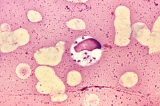
Leishmania

Encyclopedia
Leishmania is a genus
of Trypanosomatid protozoa
, and is the parasite responsible for the disease leishmaniasis
. It is spread through sandflies
of the genus Phlebotomus
in the Old World
, and of the genus Lutzomyia
in the New World
. Their primary hosts are vertebrate
s; Leishmania commonly infects hyrax
es, canids, rodent
s, and human
s. Leishmania currently affects 12 million people in 88 countries.
The parasite was named in 1903 after the Scottish
pathologist William Boog Leishman
.
about 15 million years ago, across the Bering Strait
land bridge. Another proposes a palearctic
origin. Such migrations would entail migration of vector and reservoir or successive adaptations along the way. A more recent migration is that of L. infantum from Mediterranean countries to Latin America
(there named L. chagasi), since European colonization of the New World
, where the parasites picked up its current New World vectors in their respective ecologies. This is the cause of the epidemics now evident. One recent New World epidemic concerns foxhounds in the USA.
which has an invagination, the flagellar pocket, at its base, a kinetoplast
which is found in the single mitochondrion
and a sub-pelicular array of microtubles which make up the main part of the cytoskeleton
.
, a signalling receptor involved in triggering an innate immune response
in mammals.
stage of the parasite. The glycan component is particularly variable and different lipophosphoglycan variants can be used as a molecular marker for different life cycle stages. Lectin
s, a group of plant
proteins which bind different glycans, are often used to detect these lipophosphoglycan variants. For example peanut agglutinin
binds a particular lipophosphoglycan found on the surface of the infective form of Leishmania major
.
, inhibiting the oxidative burst response, inducing an inflammation
response and preventing natural killer T cells recognising that the macrophage is infected with the Leishmania parasite.
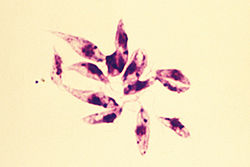
forms: promastigote (with an anterior flagellum
) in the insect host, and amastigote
(without flagella) in the vertebrate host. Infections are regarded as cutaneous, mucocutaneous, or visceral.
of intracellular
microorganisms is to avoid the immune system
and its memory function cleverly with phagocytosis of infected and apoptotic neutrophils by macrophages and employing the non-danger surface signals of apoptotic cells.
Transmitted by the sandfly
, the protozoan parasites
of the genus Leishmania major
may switch the strategy of the first immune defense from eating/inflammation/killing to eating/no inflammation/no killing of their host phagocyte
' and corrupt it for their own benefit. They use the willingly phagocytosing polymorphonuclear neutrophil granulocytes (PMN) rigorously as a tricky hideout, where they proliferate
unrecognized from the immune system and enter the long-lived macrophages to establish a “hidden” infection
.
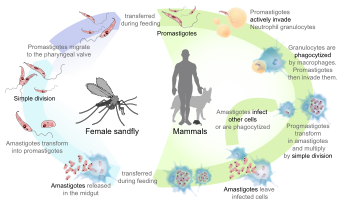 By a microbial infection PMN move out from the bloodstream and through the vessels’ endothelial layer, to the site of the infected tissue (dermal tissue after fly bite). They immediately start their business there as the first immune response and phagocytize the invader because of the foreign and activating surfaces. In that processes an inflammation
emerges. Activated PMN secrete chemokines, IL-8
particularly, to attract further granulocytes and stimulate them to phagocytosis. Furthermore Leishmania major increases the secretion of IL-8 by PMN. In the parasites case, that may not sound reasonable at first. We can observe this mechanism on other obligate intracellular parasites, too. For microbes like these, there are several ways to survive inside cells. Surprisingly, the co-injection of apoptotic and viable pathogens causes by far a more fulminate course of disease than injection of only viable parasites. Exposing on the surface of dead parasites the anti-inflammatory signal phosphatidylserine
, usually found on apoptotic cells, Leishmania major switches off the oxidative burst, so killing and degradation of the co-injected viable pathogen is not achieved.
In the case of Leishmania, progeny are not generated in PMN, but in this way they can survive and persist untangled in the primary site of infection. The promastigote forms also release LCF (Leishmania chemotactic factor) to actively recruit neutrophils, but not other leukocytes , for instance monocytes or NK cells. In addition to that, the production of interferon gamma (IFNγ)-inducible protein 10 (IP10) by PMN is blocked in attendance of Leishmania, what involves the shut down of inflammatory and protective immune response by NK and Th1 cell recruitment. The pathogens stay viable during phagocytosis since their primary hosts, the PMN, expose apoptotic cell associated molecular pattern (ACAMP) signaling “no pathogen.”
, whereupon they undergo spontaneous apoptosis. Microbial pathogens have been reported to influence cellular apoptosis by different strategies. Obviously because of the inhibition of caspase
3-activation Leishmania major can induce the delay of neutrophils apoptosis and extend their lifespan for at least 2–3 days. The fact of extended lifespan is very beneficial for the development of infection because the final host cells for these parasites are macrophages, which normally migrate to the sites of infection within 2 or 3 days. The pathogens are not dronish; instead they take over the command at the primary site of infection. They induce the production by PMN of the chemokines MIP-1α and MIP-1β (macrophage inflammatory protein
) to recruit macrophages.
which is transferred to the outer leaflet of the plasma membrane during apoptosis. By reason of delayed apoptosis the parasites that persist in PMN are taken up into macrophages, employing an absolutely physiological and non-phlogistic process.
The strategy of this "silent phagocytosis" has following advantage for the parasite:
compounds such as sodium stibogluconate
and meglumine antimoniate
are the traditional treatments for leishmaniasis.
Resistance to the antimonials is prevalent in some parts of the world, and the most common alternative is amphotericin B
(see leishmaniasis
for other treatment options). Paromomycin
is an inexpensive alternative with fewer side effects than amphotericin that The Institute for OneWorld Health has funded for production as an orphan drug
for use in treatment of leishmaniasis, starting in India.
fusing with a lysosome
, releasing acid hydrolase
s which degrade DNA
, RNA
, proteins and carbohydrates.
 The genomes of three Leishmania species (L. major, L. infantum and L. braziliensis) have been sequenced, revealing more than 8300 protein-coding and 900 RNA
genes. Almost 40% of protein-coding genes fall into 662 families containing between two and 500 members. Most of the smaller gene families are tandem arrays of one to three genes, while the larger gene families are often dispersed in tandem arrays at different loci
throughout the genome
. Each of the 35 or 36 chromosome
s are organized into a small number of gene clusters of tens-to-hundreds of genes on the same DNA strand. These clusters can be organized in head-to-head (divergent) or tail-to-tail (convergent) fashion, with the latter often separated by tRNA, rRNA and/or snRNA genes. Transcription of protein-coding genes initiates bi-directionally in the divergent strand-switch regions between gene clusters and extends polycistron
ically through each gene cluster before terminating in the strand-switch region separating convergent clusters. Leishmania telomere
s are usually relatively small, consisting of a few different types of repeat sequence. Evidence can be found for recombination between several different groups of telomeres. The L. major and L. infantum genomes contain only ~50 copies of inactive degenerated Ingi/L1Tc-related elements (DIREs), while L. braziliensis also contains several telomere-associated transposable elements (TATEs) and spliced leader-associated (SLACs) retroelements. The Leishmania genomes share a conserved core proteome of ~6200 genes with the related trypanosomatids Trypanosoma brucei and Trypanosoma cruzi , but there are ~1000 Leishmania-specific genes (LSGs), which are mostly randomly distributed throughout the genome. There are relatively few (~200) species-specific differences in gene content between the three sequenced Leishmania genomes, but ~8% of the genes appear to be evolving at different rates between the three species, indicative of different selective pressures that could be related to disease pathology. About 65% of protein-coding genes currently lack functional assignment.
) covers diseases caused by pathogens transmitted by ectoparasites such as ticks, fleas, sand flies or mosquitoes.
Other microorganism-based diseases caused by ectoparasites include Bartonella
, Borrelia
, Babesia
, Dirofilaria
, Ehrlichia
, and Anaplasma
.
Genus
In biology, a genus is a low-level taxonomic rank used in the biological classification of living and fossil organisms, which is an example of definition by genus and differentia...
of Trypanosomatid protozoa
Protozoa
Protozoa are a diverse group of single-cells eukaryotic organisms, many of which are motile. Throughout history, protozoa have been defined as single-cell protists with animal-like behavior, e.g., movement...
, and is the parasite responsible for the disease leishmaniasis
Leishmaniasis
Leishmaniasis is a disease caused by protozoan parasites that belong to the genus Leishmania and is transmitted by the bite of certain species of sand fly...
. It is spread through sandflies
Phlebotominae
Members of the subfamily Phlebotominae are known outside of the United States by the name sand fly. This subfamily includes numerous genera of blood-feeding flies, including the primary vectors of leishmaniasis, bartonellosis and pappataci fever...
of the genus Phlebotomus
Phlebotomus
Phlebotomus is a genus of "sand fly" in the Dipteran family Psychodidae. In the past, they have sometimes been considered to belong in a separate family, Phlebotomidae, but this alternative classification has not gained wide acceptance.-Epidemiology:...
in the Old World
Old World
The Old World consists of those parts of the world known to classical antiquity and the European Middle Ages. It is used in the context of, and contrast with, the "New World" ....
, and of the genus Lutzomyia
Lutzomyia
Lutzomyia is a genus of "sand flies" in the Psychodidae subfamily Phlebotominae and in the order Diptera. In the New World, Lutzomyia sand flies are responsible for the transmission of leishmaniasis, an important parasitic disease and Carrion's disease. Leishmaniasis is generally transmitted in...
in the New World
New World
The New World is one of the names used for the Western Hemisphere, specifically America and sometimes Oceania . The term originated in the late 15th century, when America had been recently discovered by European explorers, expanding the geographical horizon of the people of the European middle...
. Their primary hosts are vertebrate
Vertebrate
Vertebrates are animals that are members of the subphylum Vertebrata . Vertebrates are the largest group of chordates, with currently about 58,000 species described. Vertebrates include the jawless fishes, bony fishes, sharks and rays, amphibians, reptiles, mammals, and birds...
s; Leishmania commonly infects hyrax
Hyrax
A hyrax is any of four species of fairly small, thickset, herbivorous mammals in the order Hyracoidea. The rock hyrax Procavia capensis, the yellow-spotted rock hyrax Heterohyrax brucei, the western tree hyrax Dendrohyrax dorsalis, and the southern tree hyrax, Dendrohyrax arboreus live in Africa...
es, canids, rodent
Rodent
Rodentia is an order of mammals also known as rodents, characterised by two continuously growing incisors in the upper and lower jaws which must be kept short by gnawing....
s, and human
Human
Humans are the only living species in the Homo genus...
s. Leishmania currently affects 12 million people in 88 countries.
The parasite was named in 1903 after the Scottish
Scotland
Scotland is a country that is part of the United Kingdom. Occupying the northern third of the island of Great Britain, it shares a border with England to the south and is bounded by the North Sea to the east, the Atlantic Ocean to the north and west, and the North Channel and Irish Sea to the...
pathologist William Boog Leishman
William Boog Leishman
Lieutenant-General Sir William Boog Leishman FRS was a Scottish pathologist and British Army medical officer. He was Director-General of Army Medical Services from 1923 to 1926....
.
Origin
The origins of Leishmania are unclear. One possible theory proposes an African origin, with migration to the Americas. Another migration from the Americas to the Old WorldOld World
The Old World consists of those parts of the world known to classical antiquity and the European Middle Ages. It is used in the context of, and contrast with, the "New World" ....
about 15 million years ago, across the Bering Strait
Bering Strait
The Bering Strait , known to natives as Imakpik, is a sea strait between Cape Dezhnev, Chukotka Autonomous Okrug, Russia, the easternmost point of the Asian continent and Cape Prince of Wales, Alaska, USA, the westernmost point of the North American continent, with latitude of about 65°40'N,...
land bridge. Another proposes a palearctic
Palearctic
The Palearctic or Palaearctic is one of the eight ecozones dividing the Earth's surface.Physically, the Palearctic is the largest ecozone...
origin. Such migrations would entail migration of vector and reservoir or successive adaptations along the way. A more recent migration is that of L. infantum from Mediterranean countries to Latin America
Latin America
Latin America is a region of the Americas where Romance languages – particularly Spanish and Portuguese, and variably French – are primarily spoken. Latin America has an area of approximately 21,069,500 km² , almost 3.9% of the Earth's surface or 14.1% of its land surface area...
(there named L. chagasi), since European colonization of the New World
New World
The New World is one of the names used for the Western Hemisphere, specifically America and sometimes Oceania . The term originated in the late 15th century, when America had been recently discovered by European explorers, expanding the geographical horizon of the people of the European middle...
, where the parasites picked up its current New World vectors in their respective ecologies. This is the cause of the epidemics now evident. One recent New World epidemic concerns foxhounds in the USA.
Biochemistry and cell biology
The biochemistry and cell biology of Leishmania is similar to that of other kinetoplastids. They share the same main morphological features; a single flagellumFlagellum
A flagellum is a tail-like projection that protrudes from the cell body of certain prokaryotic and eukaryotic cells, and plays the dual role of locomotion and sense organ, being sensitive to chemicals and temperatures outside the cell. There are some notable differences between prokaryotic and...
which has an invagination, the flagellar pocket, at its base, a kinetoplast
Kinetoplast
A kinetoplast is a disk-shaped mass of circular DNA inside a large mitochondrion that contains many copies of the mitochondrial genome. Kinetoplasts are only found in protozoa of the class Kinetoplastida...
which is found in the single mitochondrion
Mitochondrion
In cell biology, a mitochondrion is a membrane-enclosed organelle found in most eukaryotic cells. These organelles range from 0.5 to 1.0 micrometers in diameter...
and a sub-pelicular array of microtubles which make up the main part of the cytoskeleton
Cytoskeleton
The cytoskeleton is a cellular "scaffolding" or "skeleton" contained within a cell's cytoplasm and is made out of protein. The cytoskeleton is present in all cells; it was once thought to be unique to eukaryotes, but recent research has identified the prokaryotic cytoskeleton...
.
Lipophosphoglycan coat
Leishmania possess a lipophosphoglycan coat over the outside of the Leishmania cell. Lipophosphoglycan is a trigger for Toll-like receptor 2TLR 2
Toll-like receptor 2 also known as TLR-2 is a protein that in humans is encoded by the TLR2 gene. TLR2 has also been designated as CD282 . TLR-2 plays a role in the immune system...
, a signalling receptor involved in triggering an innate immune response
Innate immune system
The innate immune system, also known as non-specific immune system and secondary line of defence, comprises the cells and mechanisms that defend the host from infection by other organisms in a non-specific manner...
in mammals.
Structure
The precise structure of lipophosphoglycan varies depending on the species and life cycleBiological life cycle
A life cycle is a period involving all different generations of a species succeeding each other through means of reproduction, whether through asexual reproduction or sexual reproduction...
stage of the parasite. The glycan component is particularly variable and different lipophosphoglycan variants can be used as a molecular marker for different life cycle stages. Lectin
Lectin
Lectins are sugar-binding proteins that are highly specific for their sugar moieties. They play a role in biological recognition phenomena involving cells and proteins. For example, some viruses use lectins to attach themselves to the cells of the host organism during infection...
s, a group of plant
Plant
Plants are living organisms belonging to the kingdom Plantae. Precise definitions of the kingdom vary, but as the term is used here, plants include familiar organisms such as trees, flowers, herbs, bushes, grasses, vines, ferns, mosses, and green algae. The group is also called green plants or...
proteins which bind different glycans, are often used to detect these lipophosphoglycan variants. For example peanut agglutinin
Peanut agglutinin
Peanut agglutinin is plant lectin protein derived from the fruits of Arachis hypogaea. Peanut agglutinin may also be referred to as Arachis hypogaea lectin. Lectins recognise and bind particular sugar sequences in carbohydrates; peanut agglutinin binds the carbohydrate sequence Gal-β-GalNAc...
binds a particular lipophosphoglycan found on the surface of the infective form of Leishmania major
Leishmania major
Leishmania major is a species of Leishmania.It is associated with zoonotic cutaneous leishmaniasis.The genome has been sequenced....
.
Function
Lipophosphoglycan is used by the parasite to promote its survival in the host and the mechanisms by which the parasite does this center around modulating the immune response of the host. This is vital as the Leishania parasites live within macrophages and need to prevent the macrophage from killing them. Lipophosphoglycan has a role in resisting the complement systemComplement system
The complement system helps or “complements” the ability of antibodies and phagocytic cells to clear pathogens from an organism. It is part of the immune system called the innate immune system that is not adaptable and does not change over the course of an individual's lifetime...
, inhibiting the oxidative burst response, inducing an inflammation
Inflammation
Inflammation is part of the complex biological response of vascular tissues to harmful stimuli, such as pathogens, damaged cells, or irritants. Inflammation is a protective attempt by the organism to remove the injurious stimuli and to initiate the healing process...
response and preventing natural killer T cells recognising that the macrophage is infected with the Leishmania parasite.
Pathophysiology
Leishmania cells have two morphologicalMorphology (biology)
In biology, morphology is a branch of bioscience dealing with the study of the form and structure of organisms and their specific structural features....
forms: promastigote (with an anterior flagellum
Flagellum
A flagellum is a tail-like projection that protrudes from the cell body of certain prokaryotic and eukaryotic cells, and plays the dual role of locomotion and sense organ, being sensitive to chemicals and temperatures outside the cell. There are some notable differences between prokaryotic and...
) in the insect host, and amastigote
Amastigote
An amastigote is a cell that does not have a visible external flagella or cilia. The term is used mainly to describe a certain phase in the life-cycle of trypanosome protozoans. It is also called the leishmanial stage, since in Leishmania it is the form the parasite takes in the vertebrate host,...
(without flagella) in the vertebrate host. Infections are regarded as cutaneous, mucocutaneous, or visceral.
| Type | Pathogen | Location |
|---|---|---|
| Cutaneous leishmaniasis Cutaneous leishmaniasis Cutaneous leishmaniasis is the most common form of leishmaniasis. It is a skin infection caused by a single-celled parasite that is transmitted by sandfly bites... (localized and diffuse) infections appear as obvious skin reactions. |
The most common is the Oriental Sore (caused by Old World species L. major Leishmania major Leishmania major is a species of Leishmania.It is associated with zoonotic cutaneous leishmaniasis.The genome has been sequenced.... , L. tropica Leishmania tropica Leishmania tropica is a species of flagellate parasites that infects humans and rodents. It can cause a disease called oriental sore which is a form of cutaneous leishmaniasis.Leishmania tropica is a single-celled trypanosome parasite responsible for causing cutaneous Leishmaniasis.[1]... , and L. aethiopica Leishmania aethiopica Leishmania is a Leishmania species.It is associated with leishmaniasis.... ). In the New World, the most common culprits is L. mexicana Leishmania mexicana Leishmania mexicana is a Leishmania species.It is associated with leishmaniasis.Leishmania mexicana is an obligate intracellular protozoan parasite that causes a less dangerous form of leishmeniasis. Given its name, this parasitic form occurs in South and Central America. Infection of L... . |
Cutaneous infections are most common in Afghanistan Afghanistan Afghanistan , officially the Islamic Republic of Afghanistan, is a landlocked country located in the centre of Asia, forming South Asia, Central Asia and the Middle East. With a population of about 29 million, it has an area of , making it the 42nd most populous and 41st largest nation in the world... , Brazil Brazil Brazil , officially the Federative Republic of Brazil , is the largest country in South America. It is the world's fifth largest country, both by geographical area and by population with over 192 million people... , Iran Iran Iran , officially the Islamic Republic of Iran , is a country in Southern and Western Asia. The name "Iran" has been in use natively since the Sassanian era and came into use internationally in 1935, before which the country was known to the Western world as Persia... , Peru Peru Peru , officially the Republic of Peru , is a country in western South America. It is bordered on the north by Ecuador and Colombia, on the east by Brazil, on the southeast by Bolivia, on the south by Chile, and on the west by the Pacific Ocean.... , Saudi Arabia Saudi Arabia The Kingdom of Saudi Arabia , commonly known in British English as Saudi Arabia and in Arabic as as-Sa‘ūdiyyah , is the largest state in Western Asia by land area, constituting the bulk of the Arabian Peninsula, and the second-largest in the Arab World... and Syria Syria Syria , officially the Syrian Arab Republic , is a country in Western Asia, bordering Lebanon and the Mediterranean Sea to the West, Turkey to the north, Iraq to the east, Jordan to the south, and Israel to the southwest.... . |
| Mucocutaneous leishmaniasis Mucocutaneous leishmaniasis Mucocutaneous leishmaniasis is a cutaneous condition which occurs at the site of a fly bite, and is characterized by an ulceration of the skin.... (Espundia or Uta) infections will start off as a reaction at the bite, and can go via metastasis Metastasis Metastasis, or metastatic disease , is the spread of a disease from one organ or part to another non-adjacent organ or part. It was previously thought that only malignant tumor cells and infections have the capacity to metastasize; however, this is being reconsidered due to new research... into the mucous membrane and become fatal. |
L. braziliensis Leishmania braziliensis Leishmania braziliensis is a Leishmania species.It is associated with leishmaniasis.-Signs and Symptoms:Within a few months of infection, an ulcer forms. After healing there is an asymptomatic phase for three to twenty years... |
Mucocutaneous infections are most common in Bolivia Bolivia Bolivia officially known as Plurinational State of Bolivia , is a landlocked country in central South America. It is the poorest country in South America... , Brazil Brazil Brazil , officially the Federative Republic of Brazil , is the largest country in South America. It is the world's fifth largest country, both by geographical area and by population with over 192 million people... and Peru Peru Peru , officially the Republic of Peru , is a country in western South America. It is bordered on the north by Ecuador and Colombia, on the east by Brazil, on the southeast by Bolivia, on the south by Chile, and on the west by the Pacific Ocean.... . Mucocutaneous infections are also found in Karamay Karamay Karamay, Qaramay or Kelamayi is a prefecture-level city in the north of the Xinjiang Uygur Autonomous Region, in northwestern China... , China Xinjiang Uygur Autonomous Region. |
| Visceral leishmaniasis Visceral leishmaniasis Visceral leishmaniasis , also known as kala-azar, black fever, and Dumdum fever, is the most severe form of leishmaniasis. Leishmaniasis is a disease caused by protozoan parasites of the Leishmania genus. This disease is the second-largest parasitic killer in the world , responsible for an... infections are often recognized by fever, swelling of the liver and spleen, and anemia Anemia Anemia is a decrease in number of red blood cells or less than the normal quantity of hemoglobin in the blood. However, it can include decreased oxygen-binding ability of each hemoglobin molecule due to deformity or lack in numerical development as in some other types of hemoglobin... . They are known by many local names, of which the most common is probably Kala azar, |
Caused exclusively by species of the L. donovani complex (L. donovani Leishmania donovani Leishmania donovani is a species of Leishmania. It is an important cause of visceral leishmaniasis. The reference genome of L. donovani extracted in the south eastern Nepal was published in 2011... , L. infantum Leishmania infantum Leishmania infantum is the causative agent of infantile visceral leishmaniasis in the Mediterranean region of the Old World and in Latin America, where it has been called Leishmania chagasi. It is also an unusual cause of cutaneous leishmaniasis. Wild canids and domestic dogs are the natural... syn. L. chagasi). |
Found in tropical and subtropical areas of all continents except Australia Australia Australia , officially the Commonwealth of Australia, is a country in the Southern Hemisphere comprising the mainland of the Australian continent, the island of Tasmania, and numerous smaller islands in the Indian and Pacific Oceans. It is the world's sixth-largest country by total area... , visceral infections are most common in Bangladesh Bangladesh Bangladesh , officially the People's Republic of Bangladesh is a sovereign state located in South Asia. It is bordered by India on all sides except for a small border with Burma to the far southeast and by the Bay of Bengal to the south... , Brazil Brazil Brazil , officially the Federative Republic of Brazil , is the largest country in South America. It is the world's fifth largest country, both by geographical area and by population with over 192 million people... , India India India , officially the Republic of India , is a country in South Asia. It is the seventh-largest country by geographical area, the second-most populous country with over 1.2 billion people, and the most populous democracy in the world... , Nepal Nepal Nepal , officially the Federal Democratic Republic of Nepal, is a landlocked sovereign state located in South Asia. It is located in the Himalayas and bordered to the north by the People's Republic of China, and to the south, east, and west by the Republic of India... and Sudan Sudan Sudan , officially the Republic of the Sudan , is a country in North Africa, sometimes considered part of the Middle East politically. It is bordered by Egypt to the north, the Red Sea to the northeast, Eritrea and Ethiopia to the east, South Sudan to the south, the Central African Republic to the... . Visceral leishmaniasis also found in part of China, such as Sichuan Province, Gansu Province and Xinjiang Uygur Autonomous Region. |
Neutrophil granulocytes - the Trojan horses for Leishmania parasites
The strategy of the "Trojan horse" as a mechanism of pathogenicityPathogenicity
Pathogenicity is the ability of a pathogen to produce an infectious disease in an organism.It is often used interchangeably with the term "virulence", although virulence is used more specifically to describe the relative degree of damage done by a pathogen, or the degree of pathogenicity caused by...
of intracellular
Intracellular
Not to be confused with intercellular, meaning "between cells".In cell biology, molecular biology and related fields, the word intracellular means "inside the cell".It is used in contrast to extracellular...
microorganisms is to avoid the immune system
Immune system
An immune system is a system of biological structures and processes within an organism that protects against disease by identifying and killing pathogens and tumor cells. It detects a wide variety of agents, from viruses to parasitic worms, and needs to distinguish them from the organism's own...
and its memory function cleverly with phagocytosis of infected and apoptotic neutrophils by macrophages and employing the non-danger surface signals of apoptotic cells.
Transmitted by the sandfly
Sandfly
thumb|Sandfly biting a human's little fingerthumb|Sandfly biteSandfly is a colloquial name for any species or genus of flying, biting, blood-sucking Dipteran encountered in sandy areas...
, the protozoan parasites
Parasitism
Parasitism is a type of symbiotic relationship between organisms of different species where one organism, the parasite, benefits at the expense of the other, the host. Traditionally parasite referred to organisms with lifestages that needed more than one host . These are now called macroparasites...
of the genus Leishmania major
Leishmania major
Leishmania major is a species of Leishmania.It is associated with zoonotic cutaneous leishmaniasis.The genome has been sequenced....
may switch the strategy of the first immune defense from eating/inflammation/killing to eating/no inflammation/no killing of their host phagocyte
Phagocyte
Phagocytes are the white blood cells that protect the body by ingesting harmful foreign particles, bacteria, and dead or dying cells. Their name comes from the Greek phagein, "to eat" or "devour", and "-cyte", the suffix in biology denoting "cell", from the Greek kutos, "hollow vessel". They are...
' and corrupt it for their own benefit. They use the willingly phagocytosing polymorphonuclear neutrophil granulocytes (PMN) rigorously as a tricky hideout, where they proliferate
Cell growth
The term cell growth is used in the contexts of cell development and cell division . When used in the context of cell division, it refers to growth of cell populations, where one cell grows and divides to produce two "daughter cells"...
unrecognized from the immune system and enter the long-lived macrophages to establish a “hidden” infection
Infection
An infection is the colonization of a host organism by parasite species. Infecting parasites seek to use the host's resources to reproduce, often resulting in disease...
.
Uptake and survival
Inflammation
Inflammation is part of the complex biological response of vascular tissues to harmful stimuli, such as pathogens, damaged cells, or irritants. Inflammation is a protective attempt by the organism to remove the injurious stimuli and to initiate the healing process...
emerges. Activated PMN secrete chemokines, IL-8
Interleukin 8
Interleukin-8 is a chemokine produced by macrophages and other cell types such as epithelial cells. It is also synthesized by endothelial cells, which store IL-8 in their storage vesicles, the Weibel-Palade bodies...
particularly, to attract further granulocytes and stimulate them to phagocytosis. Furthermore Leishmania major increases the secretion of IL-8 by PMN. In the parasites case, that may not sound reasonable at first. We can observe this mechanism on other obligate intracellular parasites, too. For microbes like these, there are several ways to survive inside cells. Surprisingly, the co-injection of apoptotic and viable pathogens causes by far a more fulminate course of disease than injection of only viable parasites. Exposing on the surface of dead parasites the anti-inflammatory signal phosphatidylserine
Phosphatidylserine
Phosphatidylserine is a phospholipid component, usually kept on the inner-leaflet of cell membranes by an enzyme called flippase...
, usually found on apoptotic cells, Leishmania major switches off the oxidative burst, so killing and degradation of the co-injected viable pathogen is not achieved.
In the case of Leishmania, progeny are not generated in PMN, but in this way they can survive and persist untangled in the primary site of infection. The promastigote forms also release LCF (Leishmania chemotactic factor) to actively recruit neutrophils, but not other leukocytes , for instance monocytes or NK cells. In addition to that, the production of interferon gamma (IFNγ)-inducible protein 10 (IP10) by PMN is blocked in attendance of Leishmania, what involves the shut down of inflammatory and protective immune response by NK and Th1 cell recruitment. The pathogens stay viable during phagocytosis since their primary hosts, the PMN, expose apoptotic cell associated molecular pattern (ACAMP) signaling “no pathogen.”
Persistency and attraction
The lifespan of neutrophil granulocytes is quite short. They circulate in bloodstream for about 6 or 10 hours after leaving bone marrowBone marrow
Bone marrow is the flexible tissue found in the interior of bones. In humans, bone marrow in large bones produces new blood cells. On average, bone marrow constitutes 4% of the total body mass of humans; in adults weighing 65 kg , bone marrow accounts for approximately 2.6 kg...
, whereupon they undergo spontaneous apoptosis. Microbial pathogens have been reported to influence cellular apoptosis by different strategies. Obviously because of the inhibition of caspase
Caspase
Caspases, or cysteine-aspartic proteases or cysteine-dependent aspartate-directed proteases are a family of cysteine proteases that play essential roles in apoptosis , necrosis, and inflammation....
3-activation Leishmania major can induce the delay of neutrophils apoptosis and extend their lifespan for at least 2–3 days. The fact of extended lifespan is very beneficial for the development of infection because the final host cells for these parasites are macrophages, which normally migrate to the sites of infection within 2 or 3 days. The pathogens are not dronish; instead they take over the command at the primary site of infection. They induce the production by PMN of the chemokines MIP-1α and MIP-1β (macrophage inflammatory protein
Macrophage Inflammatory Protein
Macrophage Inflammatory Proteins belong to the family of chemotactic cytokines known as chemokines. Macrophage inflammatory protein-1 , MIP-1 and MIP-1 are chemokines crucial for immune responses towards infection and inflammation. In humans, there are two major forms, MIP-1α and MIP-1β that are...
) to recruit macrophages.
Silent phagocytosis
To save the integrity of the surrounding tissue from the toxic cell components and proteolytic enzymes contained in neutrophils, the apoptotic PMN are silently cleared by macrophages. Dying PMN expose the "eat me"-signal phosphatidylserinePhosphatidylserine
Phosphatidylserine is a phospholipid component, usually kept on the inner-leaflet of cell membranes by an enzyme called flippase...
which is transferred to the outer leaflet of the plasma membrane during apoptosis. By reason of delayed apoptosis the parasites that persist in PMN are taken up into macrophages, employing an absolutely physiological and non-phlogistic process.
The strategy of this "silent phagocytosis" has following advantage for the parasite:
- Taking up apoptotic cells silences macrophage killing activity leading to a survival of the pathogens.
- Pathogens inside of PMN have no direct contact to the macrophage surface receptors, because they can not see the parasite inside the apoptotic cell. So the activation of the phagocyte for immune activation does not occur.
Treatment
Pentavalent antimonialPentavalent antimonial
Pentavalent antimonials are a group of compounds used for the treatment of leishmaniasis. They are also called pentavalent antimony compounds.-Types:...
compounds such as sodium stibogluconate
Sodium stibogluconate
Sodium stibogluconate is a medicine used to treat leishmaniasis and is only available for administration by injection. It belongs to the class of medicines known as the pentavalent antimonials. Sodium stibogluconate is sold in the United Kingdom as Pentostam...
and meglumine antimoniate
Meglumine antimoniate
Meglumine antimoniate is a medicine used for treating leishmaniasis. It is manufactured by Aventis and sold as Glucantime in France, and Glucantim in Italy. It belongs to a group of compounds known as the pentavalent antimonials. It is administered by intramuscular injection....
are the traditional treatments for leishmaniasis.
Resistance to the antimonials is prevalent in some parts of the world, and the most common alternative is amphotericin B
Amphotericin B
Amphotericin B is a polyene antifungal drug, often used intravenously for systemic fungal infections...
(see leishmaniasis
Leishmaniasis
Leishmaniasis is a disease caused by protozoan parasites that belong to the genus Leishmania and is transmitted by the bite of certain species of sand fly...
for other treatment options). Paromomycin
Paromomycin sulfate
Paromomycin is an aminoglycoside antibiotic, first isolated from Streptomyces krestomuceticus in the 1950s. It is also called monomycin and aminosidine;-Uses:...
is an inexpensive alternative with fewer side effects than amphotericin that The Institute for OneWorld Health has funded for production as an orphan drug
Orphan drug
An orphan drug is a pharmaceutical agent that has been developed specifically to treat a rare medical condition, the condition itself being referred to as an orphan disease...
for use in treatment of leishmaniasis, starting in India.
Molecular biology
An important aspect of the Leishmania protozoan is its glycoconjugate layer of lipophosphoglycan (LPG). This is held together with a phosphoinositide membrane anchor, and has a tripartite structure consisting of a lipid domain, a neutral hexasaccharide, and a phosphorylated galactose-mannose, with a termination in a neutral cap. Not only do these parasites develop post-phlebotomus digestion but, it is thought to be essential to oxidative bursts, thus allowing passage for infection. Characteristics of intracellular digestion include an endosomeEndosome
In biology, an endosome is a membrane-bound compartment inside eukaryotic cells. It is a compartment of the endocytic membrane transport pathway from the plasma membrane to the lysosome. Molecules internalized from the plasma membrane can follow this pathway all the way to lysosomes for...
fusing with a lysosome
Lysosome
thumb|350px|Schematic of typical animal cell, showing subcellular components. [[Organelle]]s: [[nucleoli]] [[cell nucleus|nucleus]] [[ribosomes]] [[vesicle |vesicle]] rough [[endoplasmic reticulum]]...
, releasing acid hydrolase
Hydrolase
In biochemistry, a hydrolase is an enzyme that catalyzes the hydrolysis of a chemical bond. For example, an enzyme that catalyzed the following reaction is a hydrolase:-Nomenclature:...
s which degrade DNA
DNA
Deoxyribonucleic acid is a nucleic acid that contains the genetic instructions used in the development and functioning of all known living organisms . The DNA segments that carry this genetic information are called genes, but other DNA sequences have structural purposes, or are involved in...
, RNA
RNA
Ribonucleic acid , or RNA, is one of the three major macromolecules that are essential for all known forms of life....
, proteins and carbohydrates.
Genomics
RNA
Ribonucleic acid , or RNA, is one of the three major macromolecules that are essential for all known forms of life....
genes. Almost 40% of protein-coding genes fall into 662 families containing between two and 500 members. Most of the smaller gene families are tandem arrays of one to three genes, while the larger gene families are often dispersed in tandem arrays at different loci
Locus (genetics)
In the fields of genetics and genetic computation, a locus is the specific location of a gene or DNA sequence on a chromosome. A variant of the DNA sequence at a given locus is called an allele. The ordered list of loci known for a particular genome is called a genetic map...
throughout the genome
Genome
In modern molecular biology and genetics, the genome is the entirety of an organism's hereditary information. It is encoded either in DNA or, for many types of virus, in RNA. The genome includes both the genes and the non-coding sequences of the DNA/RNA....
. Each of the 35 or 36 chromosome
Chromosome
A chromosome is an organized structure of DNA and protein found in cells. It is a single piece of coiled DNA containing many genes, regulatory elements and other nucleotide sequences. Chromosomes also contain DNA-bound proteins, which serve to package the DNA and control its functions.Chromosomes...
s are organized into a small number of gene clusters of tens-to-hundreds of genes on the same DNA strand. These clusters can be organized in head-to-head (divergent) or tail-to-tail (convergent) fashion, with the latter often separated by tRNA, rRNA and/or snRNA genes. Transcription of protein-coding genes initiates bi-directionally in the divergent strand-switch regions between gene clusters and extends polycistron
Cistron
A cistron is a gene. The term cistron is used to emphasize that genes exhibit a specific behavior in a cis-trans test; distinct positions within a genome are cistronic when mutations at the loci exhibit the same simple Mendelian inheritance as would mutations at a single locus.For example,...
ically through each gene cluster before terminating in the strand-switch region separating convergent clusters. Leishmania telomere
Telomere
A telomere is a region of repetitive DNA sequences at the end of a chromosome, which protects the end of the chromosome from deterioration or from fusion with neighboring chromosomes. Its name is derived from the Greek nouns telos "end" and merοs "part"...
s are usually relatively small, consisting of a few different types of repeat sequence. Evidence can be found for recombination between several different groups of telomeres. The L. major and L. infantum genomes contain only ~50 copies of inactive degenerated Ingi/L1Tc-related elements (DIREs), while L. braziliensis also contains several telomere-associated transposable elements (TATEs) and spliced leader-associated (SLACs) retroelements. The Leishmania genomes share a conserved core proteome of ~6200 genes with the related trypanosomatids Trypanosoma brucei and Trypanosoma cruzi , but there are ~1000 Leishmania-specific genes (LSGs), which are mostly randomly distributed throughout the genome. There are relatively few (~200) species-specific differences in gene content between the three sequenced Leishmania genomes, but ~8% of the genes appear to be evolving at different rates between the three species, indicative of different selective pressures that could be related to disease pathology. About 65% of protein-coding genes currently lack functional assignment.
Leishmania as component of CVBD
Canine Vector-borne Diseases (CVBDCVBD
CVBD - Canine Vector-Borne Diseases - is a veterinarian term for diseases transferred to dogs by various parasitic vectors. This includes diseases caused by pathogens transmitted by ectoparasites such as ticks, fleas, sand flies, or mosquitoes, as well as those transmitted by endoparasites such as...
) covers diseases caused by pathogens transmitted by ectoparasites such as ticks, fleas, sand flies or mosquitoes.
Other microorganism-based diseases caused by ectoparasites include Bartonella
Bartonella
Bartonella is a genus of Gram-negative bacteria. Facultative intracellular parasites, Bartonella species can infect healthy people but are considered especially important as opportunistic pathogens. Bartonella are transmitted by insect vectors such as ticks, fleas, sand flies and mosquitoes...
, Borrelia
Borrelia
Borrelia is a genus of bacteria of the spirochete phylum. It causes borreliosis, a zoonotic, vector-borne disease transmitted primarily by ticks and some by lice, depending on the species...
, Babesia
Babesia
Babesia is a protozoan parasite of the blood that causes a hemolytic disease known as Babesiosis. There are over 100 species of Babesia identified; however only a handful have been documented as pathogenic in humans....
, Dirofilaria
Dirofilaria
Dirofilaria is a genus of roundworm . These worms cause Dirofilariasis in humans defined as infection by filarial nematodes of the genus Dirofilaria....
, Ehrlichia
Ehrlichia
Ehrlichia is a genus of rickettsiales bacteria. They are transmitted by ticks. Several species can cause infection in humans. The genus is named after German microbiologist Paul Ehrlich...
, and Anaplasma
Anaplasma
Anaplasma is a genus of rickettsiales bacteria.Anaplasmas reside in host red blood cells and lead to the disease anaplasmosis. The disease most commonly occurs in tropical areas of the world....
.
Literature
- Zandbergen et al. "Leishmania disease development depends on the presence of apoptotic promastigotes in the virulent inoculum", PNAS, Sept. 2006 (PDF)
External links
- The International Leishmania Network (ILN) has basic information on the disease and links to many aspects of the disease and its vector.
- A discussion list (Leish-L) is also available with over 600 subscribers to the list, ranging from molecular biologists to public health workers, from many countries both inside and outside endemic regions. Comments and questions are welcomed.
- KBD: Kinetoplastid Biology and Disease, is a website devoted to leishmaniasis, sleeping sickness and Chagas diseaseChagas diseaseChagas disease is a tropical parasitic disease caused by the flagellate protozoan Trypanosoma cruzi. T. cruzi is commonly transmitted to humans and other mammals by an insect vector, the blood-sucking insects of the subfamily Triatominae most commonly species belonging to the Triatoma, Rhodnius,...
(American trypanosomiasis). It contains free access to full text peer-reviewed articles on these subjects. The site contains many articles relating to the unique kinetoplastid organelle and genetic material therein. - Sexual reproduction in leishmania parasites, short review of a "science"-paper
- World Community Grid: Drug Search for Leishmaniasis