


Peter von Hagenbach

Encyclopedia

He was born into an Alsatian
Alsace
Alsace is the fifth-smallest of the 27 regions of France in land area , and the smallest in metropolitan France. It is also the seventh-most densely populated region in France and third most densely populated region in metropolitan France, with ca. 220 inhabitants per km²...
-Burgundian
Bourgogne
Burgundy is one of the 27 regions of France.The name comes from the Burgundians, an ancient Germanic people who settled in the area in early Middle-age. The region of Burgundy is both larger than the old Duchy of Burgundy and smaller than the area ruled by the Dukes of Burgundy, from the modern...
family, originally from Hagenbach
Hagenbach, Haut-Rhin
Hagenbach is a commune in the Haut-Rhin department in Alsace in north-eastern France.-References:*...
and owned a castle there.
He was instated as Landvogt by Archduke Sigmund of Habsburg to rule the land he had leased from Duke Charles the Bold of Burgundy. There he coined the term Landsknecht
Landsknecht
Landsknechte were European, predominantly German mercenary pikemen and supporting foot soldiers from the late 15th to the late 16th century, and achieved the reputation for being the universal mercenary of Early modern Europe.-Etymology:The term is from German, Land "land, country" + Knecht...
—from German
German language
German is a West Germanic language, related to and classified alongside English and Dutch. With an estimated 90 – 98 million native speakers, German is one of the world's major languages and is the most widely-spoken first language in the European Union....
, Land ("land, country") + Knecht ("servant"). It was originally intended to indicate soldiers of the lowlands
Swabia
Swabia is a cultural, historic and linguistic region in southwestern Germany.-Geography:Like many cultural regions of Europe, Swabia's borders are not clearly defined...
of the Holy Roman Empire
Holy Roman Empire
The Holy Roman Empire was a realm that existed from 962 to 1806 in Central Europe.It was ruled by the Holy Roman Emperor. Its character changed during the Middle Ages and the Early Modern period, when the power of the emperor gradually weakened in favour of the princes...
as opposed to the Swiss mercenaries
Swiss mercenaries
Swiss mercenaries were notable for their service in foreign armies, especially the armies of the Kings of France, throughout the Early Modern period of European history, from the Later Middle Ages into the Age of the European Enlightenment...
. As early as 1500 the misleading spelling of Lanzknecht became common because of the association with Lanze ("lance
Lance
A Lance is a pole weapon or spear designed to be used by a mounted warrior. The lance is longer, stout and heavier than an infantry spear, and unsuited for throwing, or for rapid thrusting. Lances did not have tips designed to intentionally break off or bend, unlike many throwing weapons of the...
").
Following a rebellion
Burgundian Wars
The Burgundian Wars were a conflict between the Dukes of Burgundy and the Kings of France, later involving the Old Swiss Confederacy, which would play a decisive role. Open war broke out in 1474, and in the following years the Duke of Burgundy, Charles the Bold, was defeated three times on the...
by towns of the Upper Rhine
Upper Rhine
The Upper Rhine is the section of the Rhine in the Upper Rhine Plain between Basel, Switzerland and Bingen, Germany. The river is marked by Rhine-kilometers 170 to 529 ....
against his tyranny, Hagenbach was put on trial for the atrocities committed during the occupation of Breisach
Breisach
Breisach is a town with approximately 16,500 inhabitants, situated along the Rhine in the Rhine Valley, in the district Breisgau-Hochschwarzwald, Baden-Württemberg, Germany, about halfway between Freiburg and Colmar — 20 kilometres away from each — and about 60 kilometres north of Basel near the...
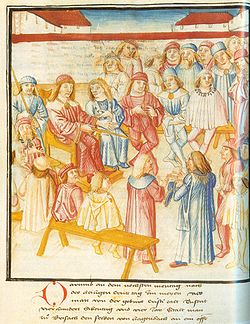
, found guilty of war crimes and beheaded at Breisach am Rhein. His trial by an ad hoc
Ad hoc
Ad hoc is a Latin phrase meaning "for this". It generally signifies a solution designed for a specific problem or task, non-generalizable, and not intended to be able to be adapted to other purposes. Compare A priori....
tribunal of the Holy Roman Empire
Holy Roman Empire
The Holy Roman Empire was a realm that existed from 962 to 1806 in Central Europe.It was ruled by the Holy Roman Emperor. Its character changed during the Middle Ages and the Early Modern period, when the power of the emperor gradually weakened in favour of the princes...
in 1474, was the first “international” recognition of commanders’ obligations to act lawfully. He was convicted of crimes "he as a knight was deemed to have a duty to prevent." He defended himself by arguing that he was only following orders
Superior Orders
Superior orders is a plea in a court of law that a soldier not be held guilty for actions which were ordered by a superior office...
, from the Duke of Burgundy
Duke of Burgundy
Duke of Burgundy was a title borne by the rulers of the Duchy of Burgundy, a small portion of traditional lands of Burgundians west of river Saône which in 843 was allotted to Charles the Bald's kingdom of West Franks...
to whom the Holy Roman Empire had given Breisach. Despite the fact there was no explicit use of a doctrine of command responsibility
Command responsibility
Command responsibility, sometimes referred to as the Yamashita standard or the Medina standard, and also known as superior responsibility, is the doctrine of hierarchical accountability in cases of war crimes....
it is seen as the first trial based on that principle.